Wednesday, August 21, 2013

Thel


Thel
Rosenwald LC


Thel
Rosenwald LC


Thel 1
Rosenwald LC


Thel 2
Rosenwald LC


Thel 3
Rosenwald LC


Wednesday, July 3, 2013

MHH 2


Plate 2 of MHH
LC  Rare books Rosenwald


As a new heaven is begun, and it is now thirty-

three years since its advent: 

the Eternal Hell revives. 

And lo! Swedenborg is the Angel sitting at the 

tomb; his writings are the linen clothes folded up. 

Now is the dominion of Edom, & the return of 

Adam into Paradise; see Isaiah XXXIV & XXXV 
Chap:

Without Contraries is no progression. Attraction 

and Repulsion, 

Reason and Energy, Love and Hate, are 

necessary to Human existence.

From these contraries spring 
what the religious call Good & Evil. 

Good is the passive that obeys Reason. 
Evil is the active springing from Energy.  Good is Heaven. Evil is Hell.

Why did Blake cite Isaiah 33 and 34 in this plate? Try Isaiah and Blake.

June Singer, a jungian authority wrote The Unholy Bible, 
Blake, Jung and the Collective Uncounscious; the title is a 
reflection of Blake's statement at the end of MHH:

"I have also The Bible of Hell, which the world shall have 
whether they will or no." 

Jung was a student of Blake and some say that the four zoas is reflected in Jung's four functions.

Sunday, June 30, 2013

mhh 1

Library of Congress
Rosenwald Collection


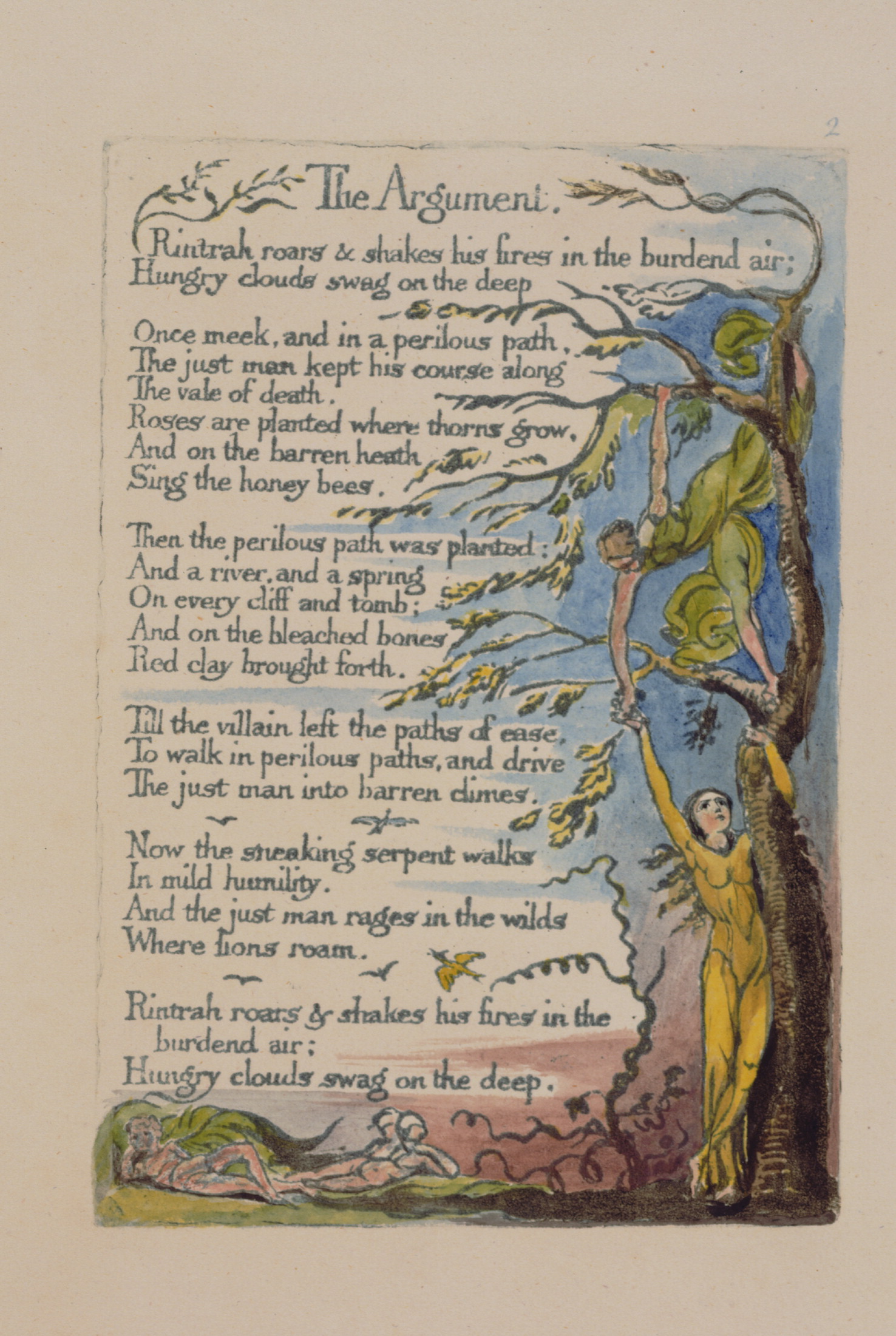
In Copy G the coloring is quite different than in this one. 
(Also in Copy I.)

Look at the omnipresent tree in the right border of the 
image. Two people (girls?) are climbing it. The upper one 
holds with her left hand to a limb of the tree and reaches 
down to the outstretched arm of the other one, standing on 
the ground and holding on with her other arm wrapped 
around the trunk of the tree.

In front of the upper girl's leg is an undetermined coiled up 
shape with the same color as the girls. (What might that 
be?)  Might it be the serpent; the poisoned apple, the tree 
of the knowledge of good and evil?

On the bottom border two naked figures are stretched out,  
joined at the bottom of their feet. The one on the left rests 
our head on her hand while the other one.

between the last three verses flying birds of various sizes 
and colors fill the empty space.
***************************************************************************
Rintrah roars & shakes his fires in the burdend air; 
Hungry clouds swag on the deep
Once meek, and in a perilous path,
The just man kept his course along
The vale of death.
Roses are planted where thorns grow.
And on the barren heath
Sing the honey bees.
Then the perilous path was planted:
And a river, and a spring
On every cliff and tomb;
And on the bleached bones
Red clay brought forth.
Till the villain left the paths of ease,
To walk in perilous paths, and drive
The just man into barren climes.
Now the sneaking serpent walks
In mild humility.
And the just man rages in the wilds
Where lions roam.

Rintrah roars & shakes his fires in the burdend air;
Hungry clouds swag on the deep.

Some interpretations:

    Rintrah = Elijah, the angry prophet.  His roaring certainly seems energetic enough.

    "left the paths of ease, / To walk in perilous paths" = Christianity was perverted from its original power to become an institutional religion.


The just man is laughed to scorn (Job 12:4).
Perilous Path occurs three times in the text.  It obviously had a special meaning to Blake.

Friday, June 28, 2013

Little Black Boy

In Blake's day slavery was legal (I don't think it was as crude and 
vicious as it was in some Southern plantations, but the negro was 
generally considered inferior in polite society).  Actually Slavery 
was abolished in 1833, five years after Blake died.

From Wiki Commons


My mother bore me in the southern wild,
And I am black, but O! my soul is white;
White as an angel is the English child: 
But I am black as if bereav'd of light.

My mother taught me underneath a tree 
And sitting down before the heat of day,
She took me on her lap and kissed me,
And pointing to the east began to say. 

Look on the rising sun: there God does live 
And gives his light, and gives his heat away. 
And flowers and trees and beasts and men receive
Comfort in morning joy in the noonday.

And we are put on earth a little space,
That we may learn to bear the beams of love, 
And these black bodies and this sun-burnt face
Is but a cloud, and like a shady grove.

For when our souls have learn'd the heat to bear 
The cloud will vanish we shall hear his voice. 
Saying: come out from the grove my love & care,
And round my golden tent like lambs rejoice.

Thus did my mother say and kissed me, 
And thus I say to little English boy. 
When I from black and he from white cloud free,
And round the tent of God like lambs we joy: 

Ill shade him from the heat till he can bear,   
To lean in joy upon our fathers knee. 
And then I'll stand and stroke his silver hair,
And be like him and he will then love me.

Note the love the boy's mother feels in her response to his situation
and how she encourages his faith in a loving God. The shady
grove describes his circumstance, but God will melt the cloud

("Melt the clouds of sin and sadness and drive the dark of doubt
away.
Giver of immortal gladness, fill us with the light of day!")

There is much more to be said about this beautiful poem, enough
for many posts.


Thursday, June 27, 2013

Marriage of Heaven and Hell


From Wikipedia:

The work was composed between 1790 and 1793, in the 

period of radical foment and political conflict immediately 
after the French Revolution.

 The title is an ironic reference to Emanuel Swedenborg's
 theological work Heaven and Hell, published in Latin 33 
years earlier. Blake directly cited Swedenborg and criticized 
him in several places in the Marriage, as well as throughout 
his poetry.

(See Plates 3, 19, 21, and 22 of MHH as well as well as 
 Blake's annotations of three of Swedenborg's works; 
 Erdman 601-11))


Title page of
Marriage of Heaven and Hell
from LocGov Rosenwal


The title page is colored with a lot of detail:

On the borders you see several trees, merging at the top of the 
image.
At the upper part of the picture, between the Marriage, drawn and 
Heaven, typed. you see a couple on the left and another one on the 
right.  The one on the left is strolling; on the right one is kneeling 
and the other reclining.

Below 'Heaven', clustered around the drawn 'of' are a series of 
'flying' figures, solitary ones at the upper left, but showing couples 
as you move over to the right part.
Below HELL is construed to be a single couple in a romantic 
embrace, the left one perhaps a naked girl and on the left what 
might be a clothed young man. Erdman in Alluminated Blake 
refers to this couple as an angel and a devil (much of the text in 
MHH involves a dialogue between an angel and a devil).

This figure may be thought to symbolize the Marriage of Heaven and Hell.

At this level the trees might be thought of as flaming, followed by 
a patch of blue and then darker branches leading to a black 
background. The flames seem to be consuming the trees, 
suggesting "the alchemical tradition  where truncated trees signify 
death, as an instrument of transformation, preparing the way for 
new life"

The concept of death and resulting life is very central in Blake's 
thought and values.  All of the elements of the picture described above are significant details of Blake's myth and values.


types


If you've read The Great Code, you should have some idea of the concept type/antitype.  Here's a sample:

One simple one is Moses as the type and Jesus the antitype.


Otherwise

Type
Number 21:6-9:
"[6] And the LORD sent fiery serpents among the people, and they bit the people; and much people of Israel died.
[7] Therefore the people came to Moses, and said, We have sinned, for we have spoken against the LORD, and against thee; pray unto the LORD, that he take away the serpents from us. And Moses prayed for the people.
[8] And the LORD said unto Moses, Make thee a fiery serpent, and set it upon a pole: and it shall come to pass, that every one that is bitten, when he looketh upon it, shall live.
[9] And Moses made a serpent of brass, and put it upon a pole, and it came to pass, that if a serpent had bitten any man, when he beheld the serpent of brass, he lived."


Antitype
John 3:
[9] Nicodemus answered and said unto him, How can these things be?
[10] Jesus answered and said unto him, Art thou a master of Israel, and knowest not these things?
[11] Verily, verily, I say unto thee, We speak that we do know, and testify that we have seen; and ye receive not our witness.
[12] If I have told you earthly things, and ye believe not, how shall ye believe, if I tell you of heavenly things?
[13] And no man hath ascended up to heaven, but he that came down from heaven, even the Son of man which is in heaven.
[14And as Moses lifted up the serpent in the wilderness, even so must the Son of man be lifted up:
[15] That whosoever believeth in him should not perish, but have eternal life.
[16] For God so loved the world, that he gave his only begotten Son, that whosoever believeth in him should not perish, but have everlasting life.

From Milton, Plate 21:
"Then the Divine Family said. Six Thousand Years are now
Accomplish'd in this World of Sorrow; Miltons Angel knew The Universal Dictate; and you also feel this Dictate.And now you know this World of Sorrow, and feel Pity. Obey The Dictate! Watch over this World, and with your brooding wings,Renew it to Eternal Life: Lo! I am with you alway"

From the Book of Urizen (Erdman 79):
"5. All day the worm lay on her bosom
All night within her womb                                        
The worm lay till it grew to a serpent
With dolorous hissings & poisons
Round Enitharmons loins folding,

6. Coild within Enitharmons womb
The serpent grew casting its scales,                             
With sharp pangs the hissings began
To change to a grating cry,
Many sorrows and dismal throes,
Many forms of fish, bird & beast,
Brought forth an Infant form                                     
Where was a worm before.

7. The Eternals their tent finished
Alarm'd with these gloomy visions
When Enitharmon groaning
Produc'd a man Child to the light.
8. A shriek ran through Eternity                    


Vison of the Last Judgmemt
Enlarge however you want to
At Erdman 556 we read a part of Visions of the Last Judgment:
"Satan is seen falling headlong wound round by the tail of the
serpent whose bulk naild to the Cross roud which he wreathes is
falling into the Abyss Sin is also representd as a female bound
in one of the Serpents folds surrounded by her fiends Death is
Chaind to the Cross & Time falls together with death dragged down

Look also at this.


Friday, May 24, 2013

Job 7


The left image is the engraving.

.                                                The right image is the picture.

Job 2:
[7] So went Satan forth from the presence of the LORD, and smote 
Job with sore boils from the sole of his foot unto his crown.

[8] And he took him a potsherd to scrape himself withal; and he sat 

down among the ashes.

The sun is going down, which in Blake's terminology means we are 

leaving Eternity to sojourn in this dark dirty world.

Job lies there covered with boils while his wife bows at his feet and 

give him this awful advice in verses 9 and 10:
Dost thou still retain thine integrity? curse God, and die.

[10] But he said unto her, Thou speakest as one of the foolish 

women speaketh. What? shall we receive good at the hand of God, 
and shall we not receive evil? In all this did not Job sin with his 
lips.


What did Blake think of this passage?:

"The disease of Shame covers me from bead to feet: I have no hope

Every boil upon my body is a separate & deadly Sin.
Doubt first assaild me, then Shame took possession of me         
Shame divides Families. Shame hath divided Albion in sunder!
First fled my Sons, & then my Daughters, then my Wild Animations
My Cattle next, last ev'n the Dog of my Gate. the Forests fled
The Corn-fields, & the breathing Gardens outside separated
The Sea; the Stars: the Sun: the Moon: drivn forth by my disease 
All is Eternal Death unless you can weave a chaste
Body over an unchaste Mind! Vala! O that thou wert pure!"
(Jerusalem Plate 21-2; Erdman 166)
The disease he speaks of (boils?) is the false religion that 

Job has been afflicted with, a legalism instead of love and 
forgiveness. (He's actually not talking about Job; he's talking 
about himself, about you and me!)

Blake's Job realizes his self-righteousness, perhaps the only 
unforgiveable sin.
(cf Golgonooza 130-31)

And from Edward Edinger (28-31):

The broken pitcher in the bottom border of the engraving 
suggests that the ego as a container may break if more is 
poured into it than it can stand.

Cf a broken shepherd's crook at the bottom left suggests that 
Jehovah is not a very good shepherd- a facet of 
disillusionment with the conventional church.

Quoting Zechariah 6-10:
New Living Translation (NLT)
Likewise, I will no longer have pity on the people of the 
land,” says the Lord. “I will let them fall into each other’s 
hands and into the hands of their king. They will turn the land 
into a wilderness, and I will not rescue them.”

So I cared for the flock intended for slaughter—the flock 
that was oppressed. Then I took two shepherd’s staffs and 
named one Favor and the other Union. 

I got rid of their three evil shepherds in a single month.
But I became impatient with these sheep, and they hated me, 
too. 

So I told them, “I won’t be your shepherd any longer. If you 
die, you die. If you are killed, you are killed. And let those 
who remain devour each other!”

10 Then I took my staff called Favor and cut it in two, showing 
that I had revoked the covenant I had made with all the 
nations.


Thursday, May 9, 2013

Doubt


In a recent post Ellie gave a detailed description of what Blake meant by Doubt.

This post points to some of the sources.  As everyone knows Blake was more (very much more) indebted to the Bible than to any other documents. Here are some passages of scripture showing the particular places where the biblical meaning of the word, doubt, remarkable resembles the way Blake used it:

(These quotes came from the excellent King James Bible published by the University of Michigan.)

Dan.5

  1. [12] Forasmuch as an excellent spirit, and knowledge, and understanding, interpreting of dreams, and shewing of hard sentences, and dissolving of doubts, were found in the same Daniel, whom the king named Belteshazzar: now let Daniel be called, and he will shew the interpretation.
  2. [16] And I have heard of thee, that thou canst make interpretations, and dissolve doubts: now if thou canst read the writing, and make known to me the interpretation thereof, thou shalt be clothed with scarlet, and have a chain of gold about thy neck, and shalt be the third ruler in the kingdom.

Matt.14

  1. [31] And immediately Jesus stretched forth his hand, and caught him, and said unto him, O thou of little faith, wherefore didst thou doubt?

Matt.21

  1. [21] Jesus answered and said unto them, Verily I say unto you, If ye have faith, and doubt not, ye shall not only do this which is done to the fig tree, but also if ye shall say unto this mountain, Be thou removed, and be thou cast into the sea; it shall be done.

Matt.28

  1. [17] And when they saw him, they worshipped him: but some doubted.

Mark.11

  1. [23] For verily I say unto you, That whosoever shall say unto this mountain, Be thou removed, and be thou cast into the sea; and shall not doubt in his heart, but shall believe that those things which he saith shall come to pass; he shall have whatsoever he saith.

Luke.12

  1. [29] And seek not ye what ye shall eat, or what ye shall drink, neither be ye of doubtful mind.

Acts.5

  1. [24] Now when the high priest and the captain of the temple and the chief priests heard these things, they doubted of them whereunto this would grow.

Acts.10

  1. [17] Now while Peter doubted in himself what this vision which he had seen should mean, behold, the men which were sent from Cornelius had made inquiry for Simon's house, and stood before the gate,
  2. [20] Arise therefore, and get thee down, and go with them, doubting nothing: for I have sent them.

Acts.11

  1. [12] And the spirit bade me go with them, nothing doubting. Moreover these six brethren accompanied me, and we entered into the man's house:

Rom.14

  1. [1] Him that is weak in the faith receive ye, but not to doubtful disputations.
  2. [23] And he that doubteth is damned if he eat, because he eateth not of faith: for whatsoever is not of faith is sin.

1Tim.2

  1. [8] I will therefore that men pray every where, lifting up holy hands, without wrath and doubting.

Thursday, May 2, 2013

The Angel of the Divine Presence

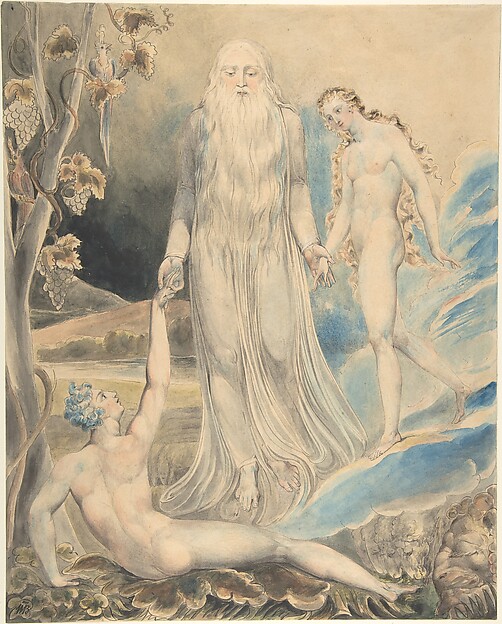
In 1802 Blake painted this beautiful picture in watercolor; it may have been one among
the series that he did for Thomas Butts.


From the Metropolitan Museum of 'Art

It refers of course to the second chapter of Genesis, especially to verses 20-24:
[20]And Adam gave names to all cattle, and to the fowl of the air, and to every beast of the field; but for Adam there was was not found an help meet for him.

[21] And the LORD God caused a deep sleep to fall upon Adam and he slept: and he took one of his ribs, and closed up the flesh instead thereof;

[22] And of the rib, which the LORD God had taken from man, made he a woman, and brought her unto the man.

[23] And Adam said, This is now bone of my bones, and flesh of my flesh: she shall be called Woman, because she was taken out of Man.

[24] Therefore shall a man leave his father and his mother, and shall cleave unto his wife: and they shall be one flesh.

In Exodus 14:19
 And the angel of God, which went before the camp of Israel, removed and went behind them;
and the pillar of the cloud went from before their face, and stood behind them:

Isaiah 63 King James Version (KJV):
63 Who is this that cometh from Edom, with dyed garments from Bozrah? this that is glorious in his apparel, travelling in the greatness of his strength? I that speak in righteousness, mighty to save.

2 Wherefore art thou red in thine apparel, and thy garments like him that treadeth in the winefat?

3 I have trodden the winepress alone; and of the people there was none with me: for I will tread them in mine anger, and trample them in my fury; and their blood shall be sprinkled upon my garments, and I will stain all my raiment.

4 For the day of vengeance is in mine heart, and the year of my redeemed is come.

5 And I looked, and there was none to help; and I wondered that there was none to uphold: therefore mine own arm brought salvation unto me; and my fury, it upheld me.

6 And I will tread down the people in mine anger, and make them drunk in my fury, and I will bring down their strength to the earth.

7 I will mention the lovingkindnesses of the Lord, and the praises of the Lord, according to all that theLord hath bestowed on us, and the great goodness toward the house of Israel, which he hath bestowed on them according to his mercies, and according to the multitude of his lovingkindnesses.

8 For he said, Surely they are my people, children that will not lie: so he was their Saviour.

9 In all their affliction he was afflicted, and the angel of his presence saved them:

Exodus 14:
[19] And the angel of God, which went before the camp of Israel, removed and went behind them; and the pillar of the cloud went from before their face, and stood behind them:
[20] And it came between the camp of the Egyptians and the camp of Israel; and it was a cloud and darkness to them, but it gave light by night to these: so that the one came not near the other all the night.


The 'Presence of God' and similar expressions appear often in Psalms:

The earth shook, the heavens also dropped at the presence of God: even Sinai itself was moved at the presence of God, the God of Israel.
Psalms 68:8 |

Tremble, thou earth, at the presence of the Lord, at the presence of the God of Jacob;
Psalm 113:7
The same shall drink of the wine of the wrath of God, which is poured out without mixture into the cup of his indignation; and he shall be tormented with fire and brimstone in the presence of the holy angels, and in the presence of the Lamb:

Look now at some passages in Blake's poetry:
In Plate 32 of Milton we read:

And Milton oft sat up on the Couch of Death & oft conversed In vision & dream beatific with the Seven Angels of the Presence I have turned my back upon these Heavens builded on cruelty My Spectre still wandering thro' them follows my Emanation He hunts her footsteps thro' the snow & the wintry hail & rain The idiot Reasoner laughs at the Man of Imagination And from laughter proceeds to murder by undervaluing calumny Then Hillel who is Lucifer replied over the Couch of Death And thus the Seven Angels instructed him & thus they converse. We are not Individuals but States: Combinations of Individuals We were Angels of the Divine Presence: & were Druids in Annandale Compelld to combine into Form by Satan, the Spectre of Albion, Who made himself a God &, destroyed the Human Form Divine. But the Divine Humanity & Mercy gave us a Human [Hebrew text] Form as multitudes Because we were combind in Freedom & holy Vox Populi Brotherhood

In A Vision of the Last Judgment (Erdman 559)
The Aged Figure with Wings having a writing tablet & taking
account of the numbers who arise is That Angel of the Divine
Presence mentiond in Exodus XIVc 19v & in other Places this Angel
is frequently calld by the Name of Jehovah Elohim The I am of the
Oaks of Albion 


Wednesday, May 1, 2013

Cupid and Psyche


Cupid and Psyche

       Blake had read Taylors' translation of Apuleius' Marriage of Cupid and Psyche.
 In her discussion of Blake's use of Cupid and Psyche Raine refers us to a passage in
Night ii of The Four Zoas:
    And I commanded the Great deep to hide her in his hand 
    Till she became a little weeping Infant a span long I carried her in my bosom as a man carries a lamb I loved her I gave her all my soul & my delight I hid her in soft gardens & in secret bowers of Summer Weaving mazes of delight along the sunny Paradise Inextricable labyrinths, She bore me sons & daughters And they have taken her away & hid her from my sight. (K 317)
       This is a "paradise of shadows" (Raine 24). Blake described here the coming of an eternal soul into generation, which in Blake's myth is always a misfortune. (However in this (long!) poem Blake provided a creative rational for 'generation' (the descent of the soul).
       In this passage Luvah has (more or less) created Vala, and then (for an unknown reason here) found himself shut off from her and she from him.

       Cupid provides a magnificent house for Psyche, and Luvah does the same thing for Vala, just as Solomon had done (your house is traditionally a symbol of your body). Cupid, Luvah, Solomon build houses for Psyche, Vala, and the Shulamite respectively. They made a house for them, just as God makes a house for us all.

Psyche's House
From Apuleius

    And when she had refreshed her selfe sufficiently with sleepe, she rose with a more quiet and pacified minde, and fortuned to espy a pleasant wood invironed with great and mighty trees. Shee espied likewise a running river as cleare as crystall : in the midst of the wood well nigh at the fall of the river was a princely Edifice, wrought and builded not by the art or hand of man, but by the mighty power of God : and you would judge at the first entry therin, that it were some pleasant and worthy mansion for the powers of heaven. For the embowings above were of Citron and Ivory, propped and undermined with pillars of gold, the walls covered and seeled with silver, divers sorts of beasts were graven and carved, that seemed to encounter with such as entered in. All things were so curiously and finely wrought, that it seemed either to be the worke of some Demy god, or of God himselfe. The pavement was all of pretious stones, divided and cut one from another, whereon was carved divers kindes of pictures, in such sort that blessed and thrice blessed were they that might goe upon such a pavement : Every part and angle of the house was so well adorned, that by reason of the pretious stones and inestimable treasure there, it glittered and shone in such sort, that the chambers, porches, and doores gave light as it had beene the Sunne.
       Words of Vala:

    My Luvah here hath placd me in a Sweet & pleasant Land
    And given me fruits & pleasant waters & warm hills & cool valleys
    Here will I build myself a house & here Ill call on his name
    Here Ill return when I am weary & take my pleasant rest
    So spoke the Sinless Soul and laid her head on the downy fleece
    Of a curld Ram who stretchd himself in sleep beside his mistress
    And soft sleep fell upon her eyelids in the silent noon of day 
    Then Luvah passed by & saw the sinless Soul
    And said Let a pleasant house arise to be the dwelling place
    Of this immortal Spirit growing in lower Paradise
    He spoke & pillars were builded & walls as white as ivory
    The grass she slept upon was pavd with pavement as of pearl. Beneath her rose a downy bed & a cieling coverd all

    (Night 9 of 4Z 128:20-33; quoted by Raine on page 26)

       The pleasant house has the symbolic meaning of the Beloved's (that's us!) body. In the Song of Solomon we have this duet:
    Solomon: If she is a wall, we will build towers of silver on her. If she is a door, we will enclose her with panels of cedar.
    Shulamite: I am a wall, and my breasts are like towers. Thus I have become in his eyes like one bringing contentment. Song of Solomon 8:9-10
       Each of these three ladies (Psyche, Vala, and the Shulamite) mourns the absence of her husband. Each lady's husband acts as a surrogate for God. Descending into mortal life is a downer that stays with us until the mortal end.

       With a rhapsodic verse from Solomon re his "beloved" in Blake and Tradition (but not Blake and Antiquity) Raine makes for us an extremely significant revelation:
    6:4 Thou art beautiful, O my love, as Tirzah, comely as Jerusalem,
       As you read 4Z it becomes more and more apparent that Tirzah is the type of Vala fallen. Jerusalem represent's Vala redeemed.
(4Z is a notebook; Jerusalem is a magnificent (and very long!) poem.)

Wednesday, April 17, 2013

Images of Truth Plus


The word 'image' can easily be used as a symbol with complex meaning. When Blake spoke 
of 'image of Truth' it was with the realization the Truth produces many images. Each image 
is partial and inadequate for encompassing Truth, but as images they are valuable 
illuminations of facets of Truth. Blake used the term 'imagination' more the the term 'image.' 
But imagination was to Blake the ability to manipulate images in order that Truth be 
revealed.


Blake's production of images in poetry and painting is only the tip of the iceberg. Blake saw 
the things he read, including the Bible, as containing images of underlying truth which could 
not be communicated literally. He related to the natural world as a source of images which 
explained eternal truth. His awareness of the language of images provided the connections 
through which he could draw together the pieces of Eternity scattered in time. Images to 
Blake were not simple reflections as we may see in our mirrors, but the way in which Eternity 
becomes manifest in time.


Marriage of Heaven & Hell, Plate 8, (E 37)
"Every thing possible to be believ'd is an
image of truth."   

All Religions Are One, Plate 3, (E 1)
"No man can think write or speak from his heart,
but he must intend truth."

Songs of Innocence & of Experience, Song 54, (E 31)
"The Voice of the Ancient Bard.
Youth of delight come hither:
And see the opening morn,
Image of truth new born.
Doubt is fled & clouds of reason.
Dark disputes & artful teazing.
Folly is an endless maze,
Tangled roots perplex her ways,

How many have fallen there!
They stumble all night over bones of the dead,
(A young Blake was not concerned with Ezekiel 37 at this point.)
And feel they know not what but care
And wish to lead others, when they should be led."
Marriage of Heaven & Hell, Plate 10, E 38
"Truth can never be told so as to be understood, and not be believ'd."
Jerusalem, Plate 55, (E 205)
"He who would do good to another, must do it in Minute Particulars
General Good is the plea of the scoundrel hypocrite & flatterer:
For Art & Science cannot exist but in minutely organized Particulars
And not in generalizing Demonstrations of the Rational Power.
The Infinite alone resides in Definite & Determinate Identity
Establishment of
Truth depends on destruction of Falshood continually"  
Vision of Last Judgment, (E 562)
"All Life consists of these Two Throwing off Error
continually & recieving
Truth or Wise Men into our
Company Continually

(In his fundamental theology Blake disallowed  ‘good and evil’ and
replaced it with ‘truth and error’; Ellie amply documented that with extracts
from ‘Vision of the Last Judgment’.
...
What are all the Gifts of the
Spirit but Mental Gifts whenever any Individual Rejects Error &
Embraces
Truth a Last Judgment passes upon that Individual"
Vision of Last Judgment, (E 563)
"These represent those who tho willing were
too weak to Reject Error without the Assistance & Countenance of
those Already in the
Truth for a Man Can only Reject Error by the
Advice of a Friend or by the Immediate Inspiration of God it is
for this Reason among many others that I have put the Lords
Supper on the Left hand of the [Picture] Throne for it appears so
at the Last Judgment for a Protection"
Vision of Last Judgment, (E 565)
"Error is
Created Truth is Eternal Error or Creation will be Burned Up &
then & not till then
Truth or Eternity will appear It is Burnt up
the Moment Men cease to behold it I assert for My self that I do
not behold the Outward Creation & that to me it is hindrance &
not Action it is as the Dirt upon my feet No part of Me."

Blake radically refuted the conventional understanding that sinners will
be tormented forever with ‘everlasting burnings’.


And the Lord passed by before him, and proclaimed, The Lord, The Lord God, merciful and 
gracious, longsuffering, and abundant in goodness and truth,

He is the Rock, his work is perfect: for all his ways are judgment: a God of truth and without 
iniquity, just and right is he.

Now therefore fear the Lord, and serve him in sincerity and in truth: and put away the gods which 
your fathers served on the other side of the flood, and in Egypt; and serve ye the Lord.

And Solomon said, Thou hast shewed unto thy servant David my father great mercy, according as he 
walked before thee in truth, and in righteousness, and in uprightness of heart with thee; and thou 
hast kept for him this great kindness, that thou hast given him a son to sit on his throne, as it is this 
day.

Lead me in thy truth, and teach me: for thou art the God of my salvation; on thee do I wait all the 
day.

For thy mercy is great unto the heavens, and thy truth unto the clouds.

The Lord is nigh unto all them that call upon him, to all that call upon him in truth.
O Lord, thou art my God; I will exalt thee, I will praise thy name; for thou hast done wonderful 
things; thy counsels of old are faithfulness and truth.

Now I Nebuchadnezzar praise and extol and honour the King of heaven, all whose works are truth
and his ways judgment: and those that walk in pride he is able to abase.

The law of truth was in his mouth, and iniquity was not found in his lips: he walked with me in 
peace and equity, and did turn many away from iniquity.

And when they were come, they say unto him, Master, we know that thou art true, and carest for no 
man: for thou regardest not the person of men, but teachest the way of God in truth: Is it lawful to 
give tribute to Caesar, or not?

For the law was given by Moses, but grace and truth came by Jesus Christ.

Jesus saith unto him, I am the way, the truth, and the life: no man cometh unto the Father, but by 
me.

It was among these and the other 224 places in the Bible that Blake learned the most about Truth.