Thursday, May 9, 2013

Doubt


In a recent post Ellie gave a detailed description of what Blake meant by Doubt.

This post points to some of the sources.  As everyone knows Blake was more (very much more) indebted to the Bible than to any other documents. Here are some passages of scripture showing the particular places where the biblical meaning of the word, doubt, remarkable resembles the way Blake used it:

(These quotes came from the excellent King James Bible published by the University of Michigan.)

Dan.5

  1. [12] Forasmuch as an excellent spirit, and knowledge, and understanding, interpreting of dreams, and shewing of hard sentences, and dissolving of doubts, were found in the same Daniel, whom the king named Belteshazzar: now let Daniel be called, and he will shew the interpretation.
  2. [16] And I have heard of thee, that thou canst make interpretations, and dissolve doubts: now if thou canst read the writing, and make known to me the interpretation thereof, thou shalt be clothed with scarlet, and have a chain of gold about thy neck, and shalt be the third ruler in the kingdom.

Matt.14

  1. [31] And immediately Jesus stretched forth his hand, and caught him, and said unto him, O thou of little faith, wherefore didst thou doubt?

Matt.21

  1. [21] Jesus answered and said unto them, Verily I say unto you, If ye have faith, and doubt not, ye shall not only do this which is done to the fig tree, but also if ye shall say unto this mountain, Be thou removed, and be thou cast into the sea; it shall be done.

Matt.28

  1. [17] And when they saw him, they worshipped him: but some doubted.

Mark.11

  1. [23] For verily I say unto you, That whosoever shall say unto this mountain, Be thou removed, and be thou cast into the sea; and shall not doubt in his heart, but shall believe that those things which he saith shall come to pass; he shall have whatsoever he saith.

Luke.12

  1. [29] And seek not ye what ye shall eat, or what ye shall drink, neither be ye of doubtful mind.

Acts.5

  1. [24] Now when the high priest and the captain of the temple and the chief priests heard these things, they doubted of them whereunto this would grow.

Acts.10

  1. [17] Now while Peter doubted in himself what this vision which he had seen should mean, behold, the men which were sent from Cornelius had made inquiry for Simon's house, and stood before the gate,
  2. [20] Arise therefore, and get thee down, and go with them, doubting nothing: for I have sent them.

Acts.11

  1. [12] And the spirit bade me go with them, nothing doubting. Moreover these six brethren accompanied me, and we entered into the man's house:

Rom.14

  1. [1] Him that is weak in the faith receive ye, but not to doubtful disputations.
  2. [23] And he that doubteth is damned if he eat, because he eateth not of faith: for whatsoever is not of faith is sin.

1Tim.2

  1. [8] I will therefore that men pray every where, lifting up holy hands, without wrath and doubting.

Thursday, May 2, 2013

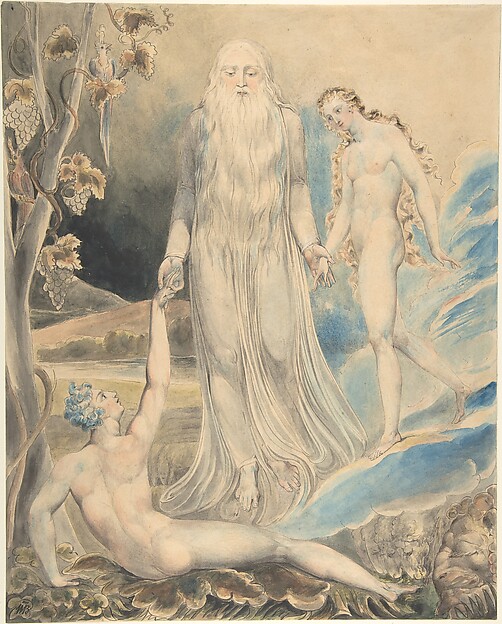
The Angel of the Divine Presence

In 1802 Blake painted this beautiful picture in watercolor; it may have been one among
the series that he did for Thomas Butts.


From the Metropolitan Museum of 'Art

It refers of course to the second chapter of Genesis, especially to verses 20-24:
[20]And Adam gave names to all cattle, and to the fowl of the air, and to every beast of the field; but for Adam there was was not found an help meet for him.

[21] And the LORD God caused a deep sleep to fall upon Adam and he slept: and he took one of his ribs, and closed up the flesh instead thereof;

[22] And of the rib, which the LORD God had taken from man, made he a woman, and brought her unto the man.

[23] And Adam said, This is now bone of my bones, and flesh of my flesh: she shall be called Woman, because she was taken out of Man.

[24] Therefore shall a man leave his father and his mother, and shall cleave unto his wife: and they shall be one flesh.

In Exodus 14:19
 And the angel of God, which went before the camp of Israel, removed and went behind them;
and the pillar of the cloud went from before their face, and stood behind them:

Isaiah 63 King James Version (KJV):
63 Who is this that cometh from Edom, with dyed garments from Bozrah? this that is glorious in his apparel, travelling in the greatness of his strength? I that speak in righteousness, mighty to save.

2 Wherefore art thou red in thine apparel, and thy garments like him that treadeth in the winefat?

3 I have trodden the winepress alone; and of the people there was none with me: for I will tread them in mine anger, and trample them in my fury; and their blood shall be sprinkled upon my garments, and I will stain all my raiment.

4 For the day of vengeance is in mine heart, and the year of my redeemed is come.

5 And I looked, and there was none to help; and I wondered that there was none to uphold: therefore mine own arm brought salvation unto me; and my fury, it upheld me.

6 And I will tread down the people in mine anger, and make them drunk in my fury, and I will bring down their strength to the earth.

7 I will mention the lovingkindnesses of the Lord, and the praises of the Lord, according to all that theLord hath bestowed on us, and the great goodness toward the house of Israel, which he hath bestowed on them according to his mercies, and according to the multitude of his lovingkindnesses.

8 For he said, Surely they are my people, children that will not lie: so he was their Saviour.

9 In all their affliction he was afflicted, and the angel of his presence saved them:

Exodus 14:
[19] And the angel of God, which went before the camp of Israel, removed and went behind them; and the pillar of the cloud went from before their face, and stood behind them:
[20] And it came between the camp of the Egyptians and the camp of Israel; and it was a cloud and darkness to them, but it gave light by night to these: so that the one came not near the other all the night.


The 'Presence of God' and similar expressions appear often in Psalms:

The earth shook, the heavens also dropped at the presence of God: even Sinai itself was moved at the presence of God, the God of Israel.
Psalms 68:8 |

Tremble, thou earth, at the presence of the Lord, at the presence of the God of Jacob;
Psalm 113:7
The same shall drink of the wine of the wrath of God, which is poured out without mixture into the cup of his indignation; and he shall be tormented with fire and brimstone in the presence of the holy angels, and in the presence of the Lamb:

Look now at some passages in Blake's poetry:
In Plate 32 of Milton we read:

And Milton oft sat up on the Couch of Death & oft conversed In vision & dream beatific with the Seven Angels of the Presence I have turned my back upon these Heavens builded on cruelty My Spectre still wandering thro' them follows my Emanation He hunts her footsteps thro' the snow & the wintry hail & rain The idiot Reasoner laughs at the Man of Imagination And from laughter proceeds to murder by undervaluing calumny Then Hillel who is Lucifer replied over the Couch of Death And thus the Seven Angels instructed him & thus they converse. We are not Individuals but States: Combinations of Individuals We were Angels of the Divine Presence: & were Druids in Annandale Compelld to combine into Form by Satan, the Spectre of Albion, Who made himself a God &, destroyed the Human Form Divine. But the Divine Humanity & Mercy gave us a Human [Hebrew text] Form as multitudes Because we were combind in Freedom & holy Vox Populi Brotherhood

In A Vision of the Last Judgment (Erdman 559)
The Aged Figure with Wings having a writing tablet & taking
account of the numbers who arise is That Angel of the Divine
Presence mentiond in Exodus XIVc 19v & in other Places this Angel
is frequently calld by the Name of Jehovah Elohim The I am of the
Oaks of Albion 


Wednesday, May 1, 2013

Cupid and Psyche


Cupid and Psyche

       Blake had read Taylors' translation of Apuleius' Marriage of Cupid and Psyche.
 In her discussion of Blake's use of Cupid and Psyche Raine refers us to a passage in
Night ii of The Four Zoas:
    And I commanded the Great deep to hide her in his hand 
    Till she became a little weeping Infant a span long I carried her in my bosom as a man carries a lamb I loved her I gave her all my soul & my delight I hid her in soft gardens & in secret bowers of Summer Weaving mazes of delight along the sunny Paradise Inextricable labyrinths, She bore me sons & daughters And they have taken her away & hid her from my sight. (K 317)
       This is a "paradise of shadows" (Raine 24). Blake described here the coming of an eternal soul into generation, which in Blake's myth is always a misfortune. (However in this (long!) poem Blake provided a creative rational for 'generation' (the descent of the soul).
       In this passage Luvah has (more or less) created Vala, and then (for an unknown reason here) found himself shut off from her and she from him.

       Cupid provides a magnificent house for Psyche, and Luvah does the same thing for Vala, just as Solomon had done (your house is traditionally a symbol of your body). Cupid, Luvah, Solomon build houses for Psyche, Vala, and the Shulamite respectively. They made a house for them, just as God makes a house for us all.

Psyche's House
From Apuleius

    And when she had refreshed her selfe sufficiently with sleepe, she rose with a more quiet and pacified minde, and fortuned to espy a pleasant wood invironed with great and mighty trees. Shee espied likewise a running river as cleare as crystall : in the midst of the wood well nigh at the fall of the river was a princely Edifice, wrought and builded not by the art or hand of man, but by the mighty power of God : and you would judge at the first entry therin, that it were some pleasant and worthy mansion for the powers of heaven. For the embowings above were of Citron and Ivory, propped and undermined with pillars of gold, the walls covered and seeled with silver, divers sorts of beasts were graven and carved, that seemed to encounter with such as entered in. All things were so curiously and finely wrought, that it seemed either to be the worke of some Demy god, or of God himselfe. The pavement was all of pretious stones, divided and cut one from another, whereon was carved divers kindes of pictures, in such sort that blessed and thrice blessed were they that might goe upon such a pavement : Every part and angle of the house was so well adorned, that by reason of the pretious stones and inestimable treasure there, it glittered and shone in such sort, that the chambers, porches, and doores gave light as it had beene the Sunne.
       Words of Vala:

    My Luvah here hath placd me in a Sweet & pleasant Land
    And given me fruits & pleasant waters & warm hills & cool valleys
    Here will I build myself a house & here Ill call on his name
    Here Ill return when I am weary & take my pleasant rest
    So spoke the Sinless Soul and laid her head on the downy fleece
    Of a curld Ram who stretchd himself in sleep beside his mistress
    And soft sleep fell upon her eyelids in the silent noon of day 
    Then Luvah passed by & saw the sinless Soul
    And said Let a pleasant house arise to be the dwelling place
    Of this immortal Spirit growing in lower Paradise
    He spoke & pillars were builded & walls as white as ivory
    The grass she slept upon was pavd with pavement as of pearl. Beneath her rose a downy bed & a cieling coverd all

    (Night 9 of 4Z 128:20-33; quoted by Raine on page 26)

       The pleasant house has the symbolic meaning of the Beloved's (that's us!) body. In the Song of Solomon we have this duet:
    Solomon: If she is a wall, we will build towers of silver on her. If she is a door, we will enclose her with panels of cedar.
    Shulamite: I am a wall, and my breasts are like towers. Thus I have become in his eyes like one bringing contentment. Song of Solomon 8:9-10
       Each of these three ladies (Psyche, Vala, and the Shulamite) mourns the absence of her husband. Each lady's husband acts as a surrogate for God. Descending into mortal life is a downer that stays with us until the mortal end.

       With a rhapsodic verse from Solomon re his "beloved" in Blake and Tradition (but not Blake and Antiquity) Raine makes for us an extremely significant revelation:
    6:4 Thou art beautiful, O my love, as Tirzah, comely as Jerusalem,
       As you read 4Z it becomes more and more apparent that Tirzah is the type of Vala fallen. Jerusalem represent's Vala redeemed.
(4Z is a notebook; Jerusalem is a magnificent (and very long!) poem.)

Wednesday, April 17, 2013

Images of Truth Plus


The word 'image' can easily be used as a symbol with complex meaning. When Blake spoke 
of 'image of Truth' it was with the realization the Truth produces many images. Each image 
is partial and inadequate for encompassing Truth, but as images they are valuable 
illuminations of facets of Truth. Blake used the term 'imagination' more the the term 'image.' 
But imagination was to Blake the ability to manipulate images in order that Truth be 
revealed.


Blake's production of images in poetry and painting is only the tip of the iceberg. Blake saw 
the things he read, including the Bible, as containing images of underlying truth which could 
not be communicated literally. He related to the natural world as a source of images which 
explained eternal truth. His awareness of the language of images provided the connections 
through which he could draw together the pieces of Eternity scattered in time. Images to 
Blake were not simple reflections as we may see in our mirrors, but the way in which Eternity 
becomes manifest in time.


Marriage of Heaven & Hell, Plate 8, (E 37)
"Every thing possible to be believ'd is an
image of truth."   

All Religions Are One, Plate 3, (E 1)
"No man can think write or speak from his heart,
but he must intend truth."

Songs of Innocence & of Experience, Song 54, (E 31)
"The Voice of the Ancient Bard.
Youth of delight come hither:
And see the opening morn,
Image of truth new born.
Doubt is fled & clouds of reason.
Dark disputes & artful teazing.
Folly is an endless maze,
Tangled roots perplex her ways,

How many have fallen there!
They stumble all night over bones of the dead,
(A young Blake was not concerned with Ezekiel 37 at this point.)
And feel they know not what but care
And wish to lead others, when they should be led."
Marriage of Heaven & Hell, Plate 10, E 38
"Truth can never be told so as to be understood, and not be believ'd."
Jerusalem, Plate 55, (E 205)
"He who would do good to another, must do it in Minute Particulars
General Good is the plea of the scoundrel hypocrite & flatterer:
For Art & Science cannot exist but in minutely organized Particulars
And not in generalizing Demonstrations of the Rational Power.
The Infinite alone resides in Definite & Determinate Identity
Establishment of
Truth depends on destruction of Falshood continually"  
Vision of Last Judgment, (E 562)
"All Life consists of these Two Throwing off Error
continually & recieving
Truth or Wise Men into our
Company Continually

(In his fundamental theology Blake disallowed  ‘good and evil’ and
replaced it with ‘truth and error’; Ellie amply documented that with extracts
from ‘Vision of the Last Judgment’.
...
What are all the Gifts of the
Spirit but Mental Gifts whenever any Individual Rejects Error &
Embraces
Truth a Last Judgment passes upon that Individual"
Vision of Last Judgment, (E 563)
"These represent those who tho willing were
too weak to Reject Error without the Assistance & Countenance of
those Already in the
Truth for a Man Can only Reject Error by the
Advice of a Friend or by the Immediate Inspiration of God it is
for this Reason among many others that I have put the Lords
Supper on the Left hand of the [Picture] Throne for it appears so
at the Last Judgment for a Protection"
Vision of Last Judgment, (E 565)
"Error is
Created Truth is Eternal Error or Creation will be Burned Up &
then & not till then
Truth or Eternity will appear It is Burnt up
the Moment Men cease to behold it I assert for My self that I do
not behold the Outward Creation & that to me it is hindrance &
not Action it is as the Dirt upon my feet No part of Me."

Blake radically refuted the conventional understanding that sinners will
be tormented forever with ‘everlasting burnings’.


And the Lord passed by before him, and proclaimed, The Lord, The Lord God, merciful and 
gracious, longsuffering, and abundant in goodness and truth,

He is the Rock, his work is perfect: for all his ways are judgment: a God of truth and without 
iniquity, just and right is he.

Now therefore fear the Lord, and serve him in sincerity and in truth: and put away the gods which 
your fathers served on the other side of the flood, and in Egypt; and serve ye the Lord.

And Solomon said, Thou hast shewed unto thy servant David my father great mercy, according as he 
walked before thee in truth, and in righteousness, and in uprightness of heart with thee; and thou 
hast kept for him this great kindness, that thou hast given him a son to sit on his throne, as it is this 
day.

Lead me in thy truth, and teach me: for thou art the God of my salvation; on thee do I wait all the 
day.

For thy mercy is great unto the heavens, and thy truth unto the clouds.

The Lord is nigh unto all them that call upon him, to all that call upon him in truth.
O Lord, thou art my God; I will exalt thee, I will praise thy name; for thou hast done wonderful 
things; thy counsels of old are faithfulness and truth.

Now I Nebuchadnezzar praise and extol and honour the King of heaven, all whose works are truth
and his ways judgment: and those that walk in pride he is able to abase.

The law of truth was in his mouth, and iniquity was not found in his lips: he walked with me in 
peace and equity, and did turn many away from iniquity.

And when they were come, they say unto him, Master, we know that thou art true, and carest for no 
man: for thou regardest not the person of men, but teachest the way of God in truth: Is it lawful to 
give tribute to Caesar, or not?

For the law was given by Moses, but grace and truth came by Jesus Christ.

Jesus saith unto him, I am the way, the truth, and the life: no man cometh unto the Father, but by 
me.

It was among these and the other 224 places in the Bible that Blake learned the most about Truth.

Saturday, April 13, 2013

Fourfold I


Albion is the giant figure who represents Man. Blake’s myth consists of the life, death, and resurrection of Albion. The ‘heavenly Albion’ is One, the condition for which Jesus prayed in the Gospel of John 17:21.

However  Albion fell, like Adam did in the Garden.  He fell; we fell, everyone of us. Blake’s myth goes into great detail about how we fell. Albion fell essentially into four parts:

His head, heart, loins and body separated, became selfish and strove for dominion.
Blake called them Urizen, Luvah, Urthona (heavenly) or Los (carnally), and Tharmas.

The Eternal Man was a fourfold Unity; when Albion fell, it was into the four parts.
Blake called the four parts, the four zoas.  His first very long poem had that name (although originally called ‘Vala’).


Each of the four zoas had an Emanation

Ahania was the emanation of Urizen
Vala was the emanation of Luvah
Enitharmon was the emanation of Los
Enion was the emanation of Tharmas


Prime biblical sources for the Four Zoas is found at Ezekiel 1 and Revelation 4 and 7.
Ezekiel 1:4-10:
4] And I looked, and, behold, a whirlwind came out of the north, a great cloud, and a fire infolding itself, and a brightness was about it, and out of the midst thereof as the colour of amber, out of the midst of the fire.
[5] Also out of the midst thereof came the likeness of four living creatures. And this was their appearance; they had the likeness of a man.
[6] And every one had four faces, and every one had four wings.
[7] And their feet were straight feet; and the sole of their feet was like the sole of a calf's foot: and they sparkled like the colour of burnished brass.
[8] And they had the hands of a man under their wings on their four sides; and they four had their faces and their wings.
[9] Their wings were joined one to another; they turned not when they went; they went every one straight forward.
[10] As for the likeness of their faces, they four had the face of a man, and the face of a lion, on the right side: and they four had the face of an ox on the left side; they four also had the face of an eagle.

Revelation 4:6-7
[6] And before the throne there was a sea of glass like unto crystal: and in the midst of the throne, and round about the throne, were four beasts full of eyes before and behind.
[7] And the first beast was like a lion, and the second beast like a calf, and the third beast had a face as a man, and the fourth beast was like a flying eagle.
[8] And the four beasts had each of them six wings about him; and they were full of eyes within: and they rest not day and night, saying, Holy, holy, holy, Lord God Almighty, which was, and is, and is to come.
[9] And when those beasts give glory and honour and thanks to him that sat on the throne, who liveth for ever and ever,


From Blake:

Letter 23, to Thomas Butts, (E 722)
"Now I a fourfold vision see
And a fourfold vision is given to me
Tis fourfold in my supreme delight
And three fold in soft Beulahs night
And twofold Always. May God us keep
From Single vision & Newtons sleep"

At the end of Jerusalem, the song:

Bring me my Bow of burning gold;
Bring me my Arrows of desire:
Bring me my Spear: O clouds unfold!
Bring me my Chariot of fire

From Jerusalem, Plate 98, (E 257)
"A Sun of blood red wrath surrounding heaven on all sides around
Glorious incompreh[en]sible by Mortal Man & each Chariot was Sexual Threefold
And every Man stood Fourfold, each Four Faces had. One to the West
One toward the East One to the South One to the North. the Horses Fourfold
And the dim Chaos brightend beneath, above, around! Eyed as the Peacock
According to the Human Nerves of Sensation, the Four Rivers of the Water of Life"


Sunday, April 7, 2013

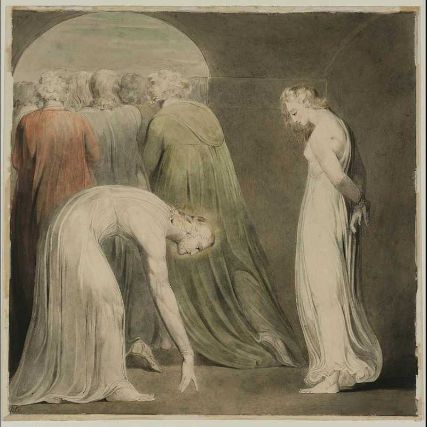
The Adulterous Woman

For many years adultery has been considered adequate grounds for divorce in civil courts.  Jesus had 
something creative to say about that in this passage from the Gospel of John:


8:3 And the scribes and Pharisees brought unto him a woman taken in adultery; and when they 
had set her in the midst,
8:4 They say unto him, Master, this woman was taken in adultery, in the very act.
8:5 Now Moses in the law commanded us, that such should be stoned: but what sayest thou?
8:6 This they said, tempting him, that they might have to accuse him. But Jesus stooped down, and 
with his finger wrote on the ground, as though he heard them not.
8:7 So when they continued asking him, he lifted up himself, and said unto them, He that is 
without sin among you, let him first cast a stone at her.
8:8 And again he stooped down, and wrote on the ground.
8:9 And they which heard it, being convicted by their own conscience, went out one by one, 
beginning at the eldest, even unto the last: and Jesus was left alone, and the woman standing in the 
midst.
8:10 When Jesus had lifted up himself, and saw none but the woman, he said unto her, Woman, 
where are those thine accusers? hath no man condemned thee? 
8:11 She said, No man, Lord. And Jesus said unto her, Neither do I condemn thee: go, and sin no 
more.
The Adulterous Woman

From the Museum of Fine Arts in Boston


“Was Jesus Chaste or did he
Give any Lessons of Chastity
The morning blushd fiery red
Mary was found in Adulterous bed
Earth groand beneath & Heaven above   
Trembled at discovery of Love
Jesus was sitting in Moses Chair
They brought the trembling Woman There
Moses commands she be stoned to Death
What was the sound of Jesus breath                              t
He laid his hand on Moses Law
The Ancient Heavens in Silent Awe
Writ with Curses from Pole to Pole
All away began to roll
The Earth trembling & Naked lay    
In secret bed of Mortal Clay
On Sinai felt the hand Divine
Putting back the bloody shrine
And she heard the breath of God
As she heard by Edens flood     
Good & Evil are no more                                         t
Sinais trumpets cease to roar
Cease finger of God to Write
The Heavens are not clean in thy Sight
Thou art Good & thou Alone     
Nor may the sinner cast one stone
To be Good only is to be
A Devil or else a Pharisee”  


Once again from The Everlasting Gospel (Erdman 521):


In plain English this is a little lesson that all of us have sinned and should not condemn others.


Here's a passage from Plate 61 of Jerusalem; (Erdman 211-12):
"Behold: in the Visions of Elohim Jehovah, behold Joseph & Mary   
And be comforted O Jerusalem in the Visions of Jehovah Elohim
She looked & saw Joseph the Carpenter in Nazareth & Mary
His espoused Wife. And Mary said, If thou put me away from thee
Dost thou not murder me? Joseph spoke in anger & fury. Should I  
Marry a Harlot & an Adulteress? Mary answerd, Art thou more pure
Than thy Maker who forgiveth Sins & calls again Her that is Lost
Tho She hates. he calls her again in love. I love my dear Joseph
But he driveth me away from his presence. yet I hear the voice of
     God
In the voice of my Husband. tho he is angry for a moment, he will
     not      
Utterly cast me away. if I were pure, never could I taste the
     sweets
Of the Forgive[ne]ss of Sins! if I were holy! I never could
     behold the tears
Of love! of him who loves me in the midst of his anger in furnace
     of fire.

Ah my Mary: said Joseph: weeping over & embracing her closely in
His arms: Doth he forgive Jerusalem & not exact Purity from her
     who is
Polluted. I heard his voice in my sleep O his Angel in my dream:
Saying, Doth Jehovah Forgive a Debt only on condition that it 
     shall
Be Payed? Doth he Forgive Pollution only on conditions of Purity
That Debt is not Forgiven! That Pollution is not Forgiven
Such is the Forgiveness of the Gods, the Moral Virtues of the    
Heathen, whose tender Mercies are Cruelty. But Jehovahs Salvation
Is without Money & without Price, in the Continual Forgiveness of
     Sins
In the Perpetual Mutual Sacrifice in Great Eternity! for behold!
There is none that liveth & Sinneth not! And this is the Covenant
Of Jehovah: If you Forgive one-another, so shall Jehovah Forgive
     You:    
That He Himself may Dwell among You. Fear not then to take
To thee Mary thy Wife, for she is with Child by the Holy Ghost

Then Mary burst forth into a Song! she flowed like a River of
Many Streams in the arms of Joseph & gave forth her tears of joy
Like many waters, and Emanating into gardens & palaces upon
Euphrates & to forests & floods & animals wild & tame from
Gihon to Hiddekel, & to corn fields & villages & inhabitants
Upon Pison & Arnon & Jordan. And I heard the voice among
The Reapers Saying, Am I Jerusalem the lost Adulteress? or am I
Babylon come up to Jerusalem? And another voice answerd Saying   

Does the voice of my Lord call me again? am I pure thro his Mercy
And Pity. Am I become lovely as a Virgin in his sight who am
Indeed a Harlot drunken with the Sacrifice of Idols does he
Call her pure as he did in the days of her Infancy when She
Was cast out to the loathing of her person. The Chaldean took
Me from my Cradle. The Amalekite stole me away upon his Camels
Before I had ever beheld with love the Face of Jehovah; or known
That there was a God of Mercy: O Mercy O Divine Humanity!
O Forgiveness & Pity & Compassion! If I were Pure I should never
Have known Thee; If I were Unpolluted I should never have        
Glorified thy Holiness, or rejoiced in thy great Salvation.

Mary leaned her side against Jerusalem, Jerusalem recieved
The Infant into her hands in the Visions of Jehovah."