Showing posts with label Symbols. Show all posts

Thursday, February 10, 2011

BLAKE & HIS READER

Blake's Sublime Allegory, Essays on The Four Zoas, Milton, & Jerusalem, Edited by Stuart Curran & Joseph Anthony Wittreich, Jr. is an excellent book to add to your library or download to your computer. Of interest is Roger R. Easson's essay, Blake and His Reader in Jerusalem.

In attempting to assist Blake students in making sense out of Jerusalem, Roger Easson says that "Jerusalem may be read as a poem about the experience of reading Jerusalem; it is a poem which enjoins the reader to participate in the creative process." Easson uses Blake's metaphor of the Golden String to demonstrate that the reader is expected to break down his dependence of reasoning and analysis in trying to work his way through the labyrinth or Jerusalem.

"...recalling the string metaphor in the Theseus myth, where Ariadne shows Theseus how to escape from the labyrinth after he has killed the Minotaur - he is to wind up the ball of string he unwound as he entered. Traditionally, the guide gives the ball of string to the adventurer as he enters the confusion of the labyrinth. Here however, Blake hands the reader the end of the string, which is unwound, indicating that the reader is in the depths of the labyrinth already. In this case, though, to follow the mythic parallel to its conclusion, before the reader can wind up the ball of string, he must conquer his spiritual Minotaur, the selfhood. At that point, winding the string may, in fact lead 'in Heavens gate,/Built in Jerusalem's wall'; for he will then be traveling in the 'Spirit of Jesus' which is 'continual forgiveness of Sin.' If however the reader does not subdue the selfhood, then the essential task enjoined by the metaphor - the destruction of the Minotaur - is unfulfilled and the reader succumbs to the selfhood, leaving Jerusalem a literary puzzle without solution.
As we have noted before, Jerusalem mirrors the state of the reader; and if the reader is still dominated by the spectral reason when he attempts to thread his way through the verbal maze, then he will be led deeper and deeper into the enigma, into the darkness of Blake's allegoric night." ( page 314).

AMERICA, Plate 11

Easson's view is that Blake's aim is to transform the accusing, rational reader to the forgiving, faithful reader by altering his perception.

On our blog we have often returned to the metaphors of Golden String from the 77th plate of
Jerusalem. Read more.

Heaven's Gate in Jerusalem's Wall
Ariadne's Thread
Return to the Fount of Life
Door to Heaven
Following the String
The Gate in the Arlington Tempera

Monday, January 31, 2011

BLAKE & STARS

To begin figuring out Blake's use of the symbol 'stars' let's start with some of his geography.

Milton, Plate 13, (E 156)
"Around Golgonooza lies the land of death eternal; a Land
Of pain and misery and despair and ever brooding melancholy:
In all the Twenty-seven Heavens, numberd from Adam to Luther;
From the blue Mundane Shell, reaching to the Vegetative Earth.

The Vegetative Universe, opens like a flower from the Earths center:
In which is Eternity. It expands in Stars to the Mundane Shell
And there it meets Eternity again, both within and without,
And the abstract Voids between the Stars are the Satanic Wheels."

Damon (A Blake Dictionary) says of the stars in Blake: "They are the visible machinery of the astronomical universe," and "Albion's limbs once contained all the starry heavens."


Percival (William Blake's Circle of Destiny) explains :
"As Albion falls he carries his celestial light with him in ever diminishing strength and splendor. The heavenly light with which his world is illuminated at all times, therefore an indication of his spiritual condition. The eternal world of Eden and Beulah is lighted by the sun and moon in their diurnal courses. When that world fails and the Mundane Shell is created as a barrier against utter dissolution, light is provided by the stars which in their multiplicity represent the break-up of the eternal sun and in their unified westward movement represent the effort to maintain some vestige of eternal values. When the starry Mundane Shell crashes into the darkness of the abyss, the Planets, moving irregularly eastward, make their appearance. To counteract their maleficent influence Los creates a temporal sun and a temporal moon, feeble but indispensable replicas of their eternal counterparts.
The first diminution of light is indicated, as we have just said, by the star world. This world was created to keep the body of man from falling into the abyss, when both sun and moon had failed. When knowledge ceased to be intuitive and love ceased to be spontaneous, when in astrological imagery, the eternal order was threatened by the departure of Urizen, the sun, into the north (the realm sacred Urthona), and of Luvah, the moon, into the south (The realm sacred to Urizen), the diminished reason became Albion's guiding light. Out of fear it built the world of law that Albion might descend into chaos. The ordered round of constellations is Blake's beautiful and appropriate symbol for the order imposed by law upon a world from which unity has fled." (page 148)

Marriage of Heaven and Hell
, Plate 26, (E 44)
16. Falling, rushing, ruining! buried in the ruins, on Urthona's
dens.
17. All night beneath the ruins, then their sullen flames faded
emerge round the gloomy king,
18. With thunder and fire: leading his starry hosts thro' the
waste wilderness he promulgates his ten commands,
glancing his beamy eyelids over the deep in dark dismay,

America, Plate 8, (E 54)
The terror answerd: I am Orc, wreath'd round the accursed tree:
The times are ended; shadows pass the morning gins to break;
The fiery joy, that Urizen perverted to ten commands,
What night he led the starry hosts thro' the wide wilderness:

Milton, Plate 4, (E 98)
Every Mans Wisdom is peculiar to his own Individ[u]ality
O Satan my youngest born, art thou not Prince of the Starry Hosts
And of the Wheels of Heaven, to turn the Mills day & night?

Song of Los, Plate 5, (E 68)
Thus the terrible race of Los & Enitharmon gave
Laws & Religions to the sons of Har binding them more
And more to Earth: closing and restraining:
Till a Philosophy of Five Senses was complete
Urizen wept & gave it into the hands of Newton & Locke

Percival calls the stars the 'remnant of light left to the falling Albion'. From this remnant of light is built the Mundane Shell which embodies the law in 'beneficence and majesty'. So the trail left by the fall becomes the chain which restricts the fall. The voids between the stars are the 'doubt and negation of the spectrous mind'.
Percival calls to our minds that the appearance of the stars in the 12th of the Illustrations to the Book of Job 'marks Job's emergence out of the darkness of Ulro.

Saturday, January 29, 2011

MILTON & BLAKE

In 1816 Thomas Butts is thought to have requested of Blake a series of illustrations for two poems by Milton: L'Allegro and Il Penseroso, which contrast the personality types or attitudes of one who is lively and gay with one who is meditative and pensive. So here was another opportunity for Blake to apply his imagination to subjects which he found endlessly fascinating - the life and work of his mentor Milton, and exploration and resolution of contrary positions.

Constellations - Cancer (The Crab), Gemini (The Twins), Orion, Taurus (The Bull), Aries (The Ram)

The final illustration of the series shows Milton in His Old Age since Blake inserted Milton into his own poem as a character. Blake made inscriptions to accompany each section of the poem that he was illustrating. You may read these in The Complete Poetry and Prose of William Blake edited by David V. Erdman beginning on page 682. To locate this click on Blake's content on the sidebar of this blog, page down to close to bottom, click on 'Inscriptions and Notes On or For Pictures', page down to E682 in the margin, read 'Blake's manuscript notes accompanying his watercolors.'

The poem IL Penseroso ends with these lines:
167 "And may at last my weary age
168 Find out the peaceful hermitage,
169 The hairy gown and mossy cell,
170 Where I may sit and rightly spell
171 Of every star that Heav'n doth shew,
172 And every herb that sips the dew;
173 Till old experience do attain
174 To something like prophetic strain.
175 These pleasures, Melancholy, give,
176 And I with thee will choose to live."

Bette Charlène Werner in Blake's vision of the poetry of Milton: illustrations to six poems, wrote a chapter on Blake's Illustrations to these two poems. Here is some of what she says:
"The L'Allegro and Il Penseroso illustrations show the earthly life of Milton, a life Blake envisioned as leaving the poet unhappy though in heaven, his emanation (or his poetry) still unredeemed. Milton's life in Blake's eyes is a 'bright pilgrimage,' but an uncompleted journey. Its destination unachieved, the pilgrimage will not be taken up again until the future time when Blake himself, united in prophetic brotherhood with Milton and inspired by the fiery spirit of imagination, Los, straps on his golden sandal to walk froward through eternity. The Milton of L'Allegro and Il Penseroso illustrations has not yet progressed beyond the moony rest of the threefold Beulah into Eden. Blake emphasizes Milton's sleeping humanity in the series, while calling upon him to become 'the Awakener.' (page 146)
...
"In Blake's imagery he is a figure of humanity enclosed in the life of the five senses; his optic nerve, a hardened bone or black pebble on the beach, still opens within like a diamond that holds in it's hallowed center the heavens of bright eternity.
Blake closes his story of Milton's earthly life with a night scene instead of a dawn. The stars in Blake's imagery, as forms of fallen light, are frequently associated with constriction and confinement as they follow the strict order of mathematically defined pathways through the skies. Still, Blake like Milton, also thought of them as forming a golden chain "To bind the Body of Man to heaven from falling into the Abyss."
...
"Even as the stars in general are ambivalent images for Blake, the ones pictured here are particularly so. The constellation of Cancer, Gemini, Taurus, and Aries can be seen together in the sky of either winter or spring. There are suggestions of both in the picture, in which the winter mood of old age and night is brightened by the flower forms of spring. There is an auspicious note in the part of Orion's myth that tells of the cure of his blindness when he waded far into the sea until he finally reached the land where the sun rises." (page 164)

Four Zoas, Page 34, (E 321)
"For the Divine Lamb Even Jesus who is the Divine Vision
Permitted all lest Man should fall into Eternal Death
For when Luvah sunk down himself put on the robes of blood
Lest the state calld Luvah should cease. & the Divine Vision
Walked in robes of blood till he who slept should awake
Thus were the stars of heaven created like a golden chain
To bind the Body of Man to heaven from falling into the Abyss"

Sunday, January 23, 2011

BLAKE'S RAINBOW

Blake uses the rainbow more as a visual image than a verbal image. Jerusalem appears here as a butterfly within the arc of a rainbow in the image at the bottom of Plate 14 of Jerusalem which shows Albion in his death-sleep. The heavenly bodies are portrayed as images in the plate, reminders of the universe measured in eons not minutes.

Jerusalem, Plate 13&14, (E 158)
"And all that has existed in the space of six thousand years:
Permanent, & not lost not lost nor vanishd, & every little act,
Word, work, & wish, that has existed, all remaining still
In those Churches ever consuming & ever building by the Spectres
Of all the inhabitants of Earth wailing to be Created:
Shadowy to those who dwell not in them, meer possibilities:
But to those who enter into them they seem the only substances
For every thing exists & not one sigh nor smile nor tear,

PLATE 14
One hair nor particle of dust, not one can pass away.

He views the Cherub at the Tree of Life, also the Serpent,
Orc the first born coild in the south: the Dragon Urizen:
Tharmas the Vegetated Tongue even the Devouring Tongue:
A threefold region, a false brain: a false heart:
And false bowels: altogether composing the False Tongue,
Beneath Beulah: as a watry flame revolving every way
And as dark roots and stems: a Forest of affliction, growing
In seas of sorrow. Los also views the Four Females:
Ahania, and Enion, and Vala, and Enitharmon lovely.
And from them all the lovely beaming Daughters of Albion,
Ahania & Enion & Vala, are three evanescent shades:
Enitharmon is a vegetated mortal Wife of Los:
His Emanation, yet his Wife till the sleep of death is past.

Such are the Buildings of Los! & such are the Woofs of
Enitharmon!"

The permanence and the multiplicity of the created world are described in the text. Blake has used words and images to remind us that there is an eternal world which underlies the vicissitudes of the temporal world. Because the image of the rainbow (which appeared after the Flood of Noah), is seen on this plate, Blake is going beyond the idea of an account of the physical body or the world of matter. The use of the rainbow makes the plate a token of a benevolent God's infinite care. We must remember that Blake uses water as a symbol for the material. To say that the world will not be destroyed by flood is to say the materiality shall not overcome spirituality.

When we seek out the biblical references for the rainbow we find this passage in Genesis 9:

[11] And I will establish my covenant with you; neither shall
all flesh be cut off any more by the waters of a flood; neither shall
there any more be a flood to destroy the earth.
[12] And God said, This is the token of the covenant which I make between me and you and every living creature that is with you, for perpetual generations:
[13] I do set my bow in the cloud, and it shall be for a token of a covenant between me and the earth.
[14] And it shall come to pass, when I bring a cloud over the earth, that the bow shall be seen in the cloud:
[15] And I will remember my covenant, which is between me and you and every living creature of all flesh; and the waters shall no more become a flood to destroy all flesh.
[16] And the bow shall be in the cloud; and I will look upon it, that I may remember the everlasting covenant between God and every living creature of all flesh that is upon the earth.
[17] And God said unto Noah, This is the token of the covenant, which I have established between me and all flesh that is upon the earth.

Genesis states that God covenants not to repeat the destruction of the earth and all living things by flood. The covenant is among God, man and the living creatures of the earth. The rainbow is a token of the covenant which is everlasting.

In Blake's 28 illustrations to Pilgrim's progress the rainbow colors appear frequently as reminders of the rainbow as a token. The rainbow image itself is prominent in three plates: the first, the last, and Plate 17 - CHRISTIAN AT THE ARBOR. In Plate One the arc of the rainbow previews the pilgrim's journey as a reminder of God's providence as man travels through life. Christian at the Arbor shows the linkage between God and man, a reference to the incarnation through which physicality and spirituality become one. The rainbow above the arbor symbolizes that linkage. In the final picture, in which the fourfold ascension is portrayed, the pilgrims and angels are embedded in the rainbow becoming themselves tokens of the process of reaching the visionary goal.
Plate I, THE DREAMER DREAMS A DREAM

Wednesday, January 5, 2011

BLAKE & 'DEAD MAN'

In 1995 Jim Jarmusch directed a movie, Dead Man, which follows the character named William Blake through harrowing experiences. Although the character has no knowledge of William Blake's poetry he is befriended by a Native American under the influence of Blake. To a person familiar with Blake's writing, the movie is presenting Blake's thought in a contemporary media. To one unfamiliar with Blake the film may be either a slow moving Western exhibiting sex and violence, or an opportunity to become acquainted with quotes from Blake. If a person can view the movie psychologically as a myth of psychic and spiritual development, he may experience some of what one experiences in reading Blake's poetry.

The website 366 Weird Movies comments on the movie Dead Man:
"On it’s release, Dead Man received mostly negative reviews. It was criticized as too slow and too pretentious, appearing to be thoughtful but actually delivering no ideas worth mentioning. Time has been kind to the movie, however, which has emerged as Jarmusch’s best work to date. In Dead Man, a measured journey into an odd, somber, dark and funny wilderness of the spirit, Jarmusch created a myth with staying power. Filled with poetic images like Johnny Depp reclining with a slaughtered fawn, Dead Man has proven a mysterious power to linger in the memory. It may never yield up its meaning, but that doesn’t make it empty."

It would be impossible to explain the movie Dead Man in the same way that it is impossible to explain Jerusalem. But there are a few things it might be beneficial to say about it. It is not just a movie which takes the name William Blake and attaches it to a character in a Western. It is a movie which attempts to emulate Blake's enigmatic methods of communication and present Blakean images and ideas in an alternate media. If one is prepared to discern repeated references to the processes enacted in Blake's poetry as well as to listen for quotes from Blake's work, the movie will become more than a series of killings.

The theme of annihilation is prominent in Jerusalem and Milton as the means of eliminating error and fostering forgiveness. The furnaces of Los through which characters must pass on the way to redemption play a large part in the activity which reverses the fall. Annihilation through killing is repeated throughout Dead Man. If the killing is meant to portray the murder of men, the movie is only about senseless violence. If error or wrong ideas are being destroyed to promote the journey of William Blake through the underworld, it makes more sense. Milton O. Percival, in Circle of Destiny says "In the destruction of these forms by the restless energy of time lies man's hope of release from error. 'All that can be annihilated must be annihilated.' [Milton, E 142] The eternal will live on. For that reason error must be provided with a mortal body capable of destruction by the energy of time."

The title of the movie, Dead Man, suggests that the protagonist, William Blake (played by Johnny Depp), is dead from the beginning. At least the suggestion is that he died immediately (early in the movie) when he was shot in Thel's room. The action takes on different meaning if William Blake is not a living man trying to escape from multiple pursuers. As a myth we see the journey of a man attempting to reach his home in a world beyond the trials and errors of ordinary life.

This is Blake's advice on viewing symbolic images like those that are abundant in the movie.

Vision of the Last Judgment , (E 560):
"If the Spectator could Enter into these Images in his
Imagination approaching them on the Fiery Chariot of his
Contemplative Thought, if he could Enter into Noahs Rainbow or into his bosom or could make a Friend & Companion of one of these Images of wonder which always intreats him to leave mortal things as he must know then would he arise from his Grave then would he meet the Lord in the Air & then he would be happy"

The following passage helps us understand how Blake viewed existence in this world compared to existence in the permanent world.

Jerusalem , Plate 13, (E 157)
"Los walks round the walls night and day.

He views the City of Golgonooza, & its smaller Cities:
The Looms & Mills & Prisons & Work-houses of Og & Anak:
The Amalekite: the Canaanite: the Moabite: the Egyptian:
And all that has existed in the space of six thousand years:
Permanent, & not lost not lost nor vanishd, & every little act,
Word, work, & wish, that has existed, all remaining still
In those Churches ever consuming & ever building by the Spectres
Of all the inhabitants of Earth wailing to be Created:
Shadowy to those who dwell not in them, meer possibilities:
But to those who enter into them they seem the only substances
For every thing exists & not one sigh nor smile nor tear,
PLATE 14
One hair nor particle of dust, not one can pass away."

This next section in Blake may be correlated with the 'men' who pursue William Blake in the movie. They 'die' because they are negations which must be compelled into non-entity.

Jerusalem, Plate 17, (E 162)
"Negations are not Contraries: Contraries mutually Exist:
But Negations Exist Not: Exceptions & Objections & Unbeliefs
Exist not: nor shall they ever be Organized for ever & ever:
If thou separate from me, thou art a Negation: a meer
Reasoning & Derogation from Me, an Objecting & cruel Spite
And Malice & Envy: but my Emanation, Alas! will become
My Contrary: O thou Negation, I will continually compell
Thee to be invisible to any but whom I please, & when
And where & how I please, and never! never! shalt thou be Organized
But as a distorted & reversed Reflexion in the Darkness
And in the Non Entity: nor shall that which is above
Ever descend into thee: but thou shalt be a Non Entity for ever
And if any enter into thee, thou shalt be an Unquenchable Fire
And he shall be a never dying Worm, mutually tormented by
Those that thou tormentest, a Hell & Despair for ever & ever."

A future post will bring up the quotes from Blake which are included in the movie.

Thursday, December 30, 2010

FREY ON SYMBOLS


Frye's thoughts and writings on Blake and Milton were assembled in a volume published by the University of Toronto Press and appropriately named Northrop Frye on Milton and Blake:
"
This volume brings together all of Frye's writings on Milton and Blake from 1947 to 1987 - published and unpublished essays, reviews, commentaries, and public lectures - with the exception of Fearful Symmetry...His engagement with Blake, meanwhile, was a personal, intellectual, and spiritual quest, leading him to became the world authority on Blake in the mid-twentieth century."

Here Northrop Frey provides some of his insight into Blake's symbolic meaning of male and female (
p 351):

"The traditional Christian symbolism, God the Creator is symbolically male, and all human souls, whether of men or of women, are creatures, and therefore symbolically female. In Blake, the real man is creating man; hence all human beings, men or women, are symbolically male. The symbolic female in Blake is what we call nature, and has four relations to humanity, depending on the quality of the vision. In the world of death, or Satan, which Blake calls Ulro, the human body is completely absorbed in the body of nature - a "dark Hermaphrodite," as Blake says in The Gates of Paradise (E 268). In the ordinary world of experience, which Blake calls Generation, the relation of humanity to nature is that of subject and object. In the usually frustrated and suppressed world of sexual desire, which Blake calls Beulah, the relation is that of lover and beloved, and in the purely imaginative or creative state, called Eden, the relation is of creator to creature. In the first two worlds, nature is a remote and tantalizing "female will"; in the last two she is an "emanation." Human women are associated with this female nature only when in their behavior they dramatize its characteristics. The relations between man and nature in the individual and historical cycle are different, and are summarized in the The Mental Traveller, a poem as closely related to the cyclical symbolism of twentieth-century poetry as Keats's La Belle Dame Sans Merci is to pre-Raphaelite poetry.
The Mental Traveller
traces the life of a "Boy" from infancy through manhood to death and rebirth. The boy represents humanity, and consequently the cycle he goes through can be read either individually and psychologically, or socially and historically. The latter reading is easier, and closer to the centre of gravity Blake is talking about. The poem traces a cycle, but the cycle differs from that of the single vision in that the emphasis is thrown on rebirth and return instead of on death. A female principle, nature, cycles in contrary motion against the Boy, growing young as he grown old and vice versa."

Thursday, October 28, 2010

Blake's Symbolic Thought and Language

The Perennial Philosophy was about as good a description of Blake's thought as we can find. Not trained and conditioned to the Enlightenment philosophy of radical materialism, he used for it his favorite metaphor, Bacon, Newton, and Locke.

Blake was steeped with the wisdom of the ages; that was in poor repute to cultured people of his day. At its apogee the radical materialists became logical positivists; they considered statements of anything not measureable in height or weight to be meaningless; they frowned on emotion and considered it enthusiasm (a pejorative).

The cultured people of that day tended to be primarily deistical and purely materialistic: God created the world and wound it up like a clock and thereafter had no interest in what went on in this planet.

Blake had his problems with God, but he knew that the word indicated something other than that; he despised the Deists. In Plate 52 at the beginning of his Chapter Three of Jerusalem (To the Deists) he told them what's what. Read it, and get a fuller grasp of Blake's faith.

The traditional symbols make up the stuff of poetry; 18th century English poetry by and large can be seen as peurile. Blake initiated the Romantic movement in poetry leading to the Romantic poets and artists; they were rich in the symbolism of tradition.

You may trace the deterioration of 18th Century English poetic thought through Shakespeare, Spencer, and Milton to William Hayley. At that low ebb Blake and the other Romantics intervened to bring about another renaissance.

Society was utterly commercial, especially in things like marriage (the first 50 pages of Dickens' Our Mutual Friend show to what lengths they went even in his day.)

Blake revolted emphatically against materialistic attitudes to the disgust of the materialists who made up his age. So he spent his creative life in obscurity, his brilliance largely unrecognized. (There are others like that, the general consequence of caring more for art than money.)

He was excluded because his thought forms were too radical; his language lacked the comfortable familiarity of the conventional majority. More than that he was too deep: completely beyond comprehension to the positivists, and just too dense for everyone. They called him mad!

Until today! Blake is coming alive in the 21st Century.

Friday, October 15, 2010

BLAKE & DYLAN II

Book of Urizen, Plate 22, (E 82)
"The tormented element stretch'd
From the sorrows of Urizen's soul."


When Larry was writing his Blake Book, (Ram Horn'd with Gold) in the seventies and eighties the influence of Bob Dylan was everywhere including under our roof. He wrote a chapter on Blake and Dylan for his book but it was not included in the online version. Since I posted on the influence of Blake's poetry on Dylan's song EVERY GRAIN ON SAND, I'd like to pass along some of what Larry said in the missing chapter:


"In style Dylan closely approaches Blake as a symbolist. Fiercely eclectic like the English poet, he drew with utmost freedom upon his entire experience for the imagery of his lyrics. This means that the listener unversed in Dylan's experience will have the same sort of problems with his lyrics as so many have had with '4Z's' or 'Jerusalem'. Much of it comes through as sheer gibberish to all except the few some where in the vicinity of Dylan's mind. It helps to know the sixties Greenwich Village scene, country music, blues and rock as well as Verlaine, Rimbaud and Baudelaire, plus a few other esoteric sources.

"It also helps to know the Bible. Nowhere are Blake and Dylan more alike than in their dependence upon Biblical symbolism. Dylan is fully capable of throwing a wicked curve, when for example, one of his songs embedded in the western ethos where clean hands evoke the gambling man, and suddenly he switches to the imagery of Psalm 24: "His clothes are dirty but his hands are clean". [Example from Michael Gray's book.]

"Whether he knew of Blake's letter to Trusler or not, Dylan certainly put into practice the advice of the "Wisest of the Ancients [who] consider'd what was not too Explicit as the fittest for instruction, because it rouzes the faculties to act". For the intellectually curious the lure of the two men is identical: to find the kernel of meaning in the peculiar wrapping."

It is fascinating to compare the lives of these two poets whose struggles to express their enormous gifts, and to master the psychological conflicts of warring aspects of their minds were played out so publicly in their poetry. As Larry says:
"We should realize that this ['The Wicked Messenger'] like most of Dylan's songs is essentially autobiographical. He shared Blake's perspective on the oneness of the human race. He knew that his (and our) experiences are universal. The song ends appropriately with this message to the messenger: 'If you cannot bring good news, then don't bring any.'" Our two messengers brought their good news even though they often dipped into the deepest and darkest reaches of the psyche to bring it into the light.

Lyrics to Wicked Messenger

Tuesday, August 17, 2010

TRANSFORM THINKING

Philosophers give a lot of thought and study to the question of external existence and and the access we have to it. We tend to think of the images we have in our minds as having external referents, and we take sense data as being the evidence of that. But we 'know' that sense data is highly processed by the mind before it enters our consciousness. The mind has created a symbol which we can read as an object.

So we postulate one of the first levels of 'symbol'; the processed data as opposed to the raw data with which we were originally bombarded. If the external world is the source of raw data, the question becomes what is the organization inherent in the external world or is there any. Does the organization (form) have an independent existence or was it created by us, through us, for us? We tend to think of the latest concept of perceiving as being the true representation of the outer world. But we can recognize that any representation is a symbol and not the object symbolized.

The contrast between Jesus and the Christ demonstrates some of how symbols work. We take Jesus as less a symbol than Christ, because a historical person named Jesus had accounts written of his activities in the world we recognize as our exterior world. Christ is altogether symbol because it is an idea, a force, a constellation of characteristics, an archetype, a non-sensory entity.

We can clarify our thinking by understanding our symbols: where we are coming from, how many layers of processing they have been through, what purpose they are serving, what meaning they convey to others and how they may be expressed in less symbolic language. But this is understanding symbols from the outside. Many think that Blake lived in a symbolic world to which few have access. Those learning a new language using words, undergo a transition to mastering the new language without translating from the original language. Those learning to process information in the symbolic language must learn to think in the language of symbols before they have a mastery of it. We translate ideas to and from symbols as an exterior exercise, Blake understood them through the very structure and organization of his mind.
Many students of Blake tell us the same thing in different ways: the crux of reading Blake is in a transformation of one's thinking - not what you think but how you think. As I have said before Blake doesn't want us to go out the same door we came in.

Jerusalem, Plate 100
Urizen, Los and Enitharmon

Pierre Berger,
William Blake: poet and mystic, (Page 107) gives us an idea of how Blake developed the characters, Urizen and Los, as a symbols carried by a particular personalities.
"By the same process, the Eternal Man has become a definite personality. The birth of Urizen is not merely a mystical representation of the world's creation : it symbolizes also the creation of man as a distinct being. Like Urizen, the Spirit of Man broke away from that of the Eternals, and found itself closed up in Time and Space. But, in this second interpretation, Los is no longer only symbolical of Time : he is also the Prophet of Eternity, the prophetic Spirit in humanity, sent by the Eternals to watch over man, even while he separates him from them. And as he fulfills this task, he cannot help retaining a remembrance of the Eternals, and a clear consciousness of their existence. His mission of separation reminds him perpetually of his former union with them. Consequently, he keeps alive in man's spirit the recollection of his first state, and a vague longing to return to it. He is the spirit of the Seers, the spirit that will later on inspire the poets and the artists, and speak by the mouth of the prophets. By him comes all that constitutes the Ideal, all that reaches us from the unseen world. He is at the root of all the arts and of all true religion ; for religion and art are nought but visions of Eternity. He it was who spoke through Milton. He it is who will enter into Blake, and dictate his words."

Blake built his symbols by reaching into archetypal experience and incorporating mythopoeic images into poetic form.

Sunday, August 15, 2010

BLAKE & ALCHEMY

The symbolism of alchemy runs through Blake's writings and will be apparent to those who seek it out. The basic symbolism of alchemy is of transformation. Although the original object was to produce gold from base metals, the discipline was later spiritualized to that of becoming transformed oneself by the processes which were developed in the laboratory for transmuting elements.

Click on this picture from MHH Plate 14 to enlarge an image of transformation by fire.

There is a chapter on Alchemical Symbolism in Milton O Percival's book, William Blake's Circle of Destiny. William Blake's acquaintance with alchemy was primarily through Paracelsus and Boehme whom he acknowledges as influential in his thinking. Among the prominent patterns of thought in alchemy which are noticed in Blake are:
>The four elements - air, water, fire and earth,
>The original state is unified,
>The centrality of reunifying male and female,
>Fire as the liberating and regenerating agent,
>That all things are alive and sentient,
>Achieving life through death,
>Transformation of body into soul.

In my post on Angel & Devil, in the passage I quoted, the Angel at the point of transformation undergoes mutations of color which are the primary indication that the crisis has been reached. Color changes were outward manifestations that hidden change were taking place in the alchemical processes.
MHH plate 22
"The Angel hearing this became almost blue but mastering
himself he grew yellow, & at last white pink & smiling, and then
replied,"

Los' work at his furnaces is the work of the alchemist. Here is a quote from page 212 of Circle of Destiny:
"Los handles the purification of the contraries in the furnaces in accordance with alchemical tradition. As in alchemy the imperfect triple body (salt, sulphur, and mercury) has to be broken, and the masculine sulphur and the feminine mercury freed for purification in the fire, that they may be united in the one only essence, so must sinful man, his doubting head and cruel heart selfishly combined into a mortal body, be subjected to trial by fire, that his divided selves may be reunited in the one man Christ. But, though man himself is metaphorically the sum of all that is in the furnaces, the forms (or bodies) which Los continually breaks down should be thought of as forms of government, of religion, of what you will - forms constructed by a crafty head or a cruel heart. The intellectual life (the theory, the dogma) of these forms must be broken down in order that the chastened emotions may be set free for a new fixation under the guidance of a liberated intelligence. In alchemical parlance, two must be drawn out of the three and separately purged before the transforming union can take place."

Blake writes of a world in need of renewal and regeneration. He uses the symbols of alchemy in presenting his complex myth of breaking down the destructive systems and opening the way to transformation to the new age.

Jerusalem, Plate 78, (E 233)
"Los with his mace of iron
Walks round: loud his threats, loud his blows fall
On the rocky Spectres, as the Potter breaks the potsherds;
Dashing in pieces Self-righteousnesses: driving them from Albions
Cliffs: dividing them into Male & Female forms in his Furnaces
And on his Anvils: lest they destroy the Feminine Affections
They are broken. Loud howl the Spectres in his iron Furnace

While Los laments at his dire labours, viewing Jerusalem,
Sitting before his Furnaces clothed in sackcloth of hair;"

Sunday, August 8, 2010

Man and State

Look first at what Blake meant by state: at Milton plate 32.

For Blake everything was a man (Look at Letter 16; verse 26-32); Things are material objects, but in Heaven, where Blake generally lived when he created, matter is absent; "everything is a man".

In his ordinary experience as well as his heavenly ones Blake customarily referred to objects as people, much like Jesus referred to the demons in Matthew...

Look at Letter 23 verse 24ff:
"With my inward Eye 'tis an old Man grey
With my outward a Thistle across my way";
Blake proceeds to have a conversation with the thistle, or if you prefer, the 'old Man grey'.

Recall that in the Book of Thel Thel converses with the clod of clay, the lilly, the worm, the cloud; these were all men in Blake's imaginative world.

Some apparent men we immediately see are not:
Satan is a state; the Spectre is a state; however at times they are treated as men:
"Truly My Satan thou art but a Dunce."

Are the four zoas men or states? In Eternity Albion is a Unity; fallen into the Sea of Time and Space he is divided into four elements, treated like people in Blake's myth. But we can call them states:

So we might speak of a man dominated by Urizen, or Luvah, or Los. Tharmas presents more of a problem. Carrying this idea a bit further we might say that a man may have much of Urizen and a little of Luvah, etc.

In this way Blake's four zoas (and Jung's four functions) may provide a valuable instrument for understanding ourselves as well as our friends and other associates.

Blake went through life talking to non-human entities and describing them in human terms; he had a great disinterest in things as such; he always personalized; in that way he included everything in Eternity. "Not one Milton 22; line 19-26.
In this of course he was not alone. Jesus said something about the stones crying out and talked with devils (Matt 8:31-32) and was himself described as the cornerstone.

You, too may pick up this habit.

Tuesday, July 13, 2010

CARPENTER SHOP

The New Art Gallery Walsall, West Midlands of England
The Garman Ryan Collection

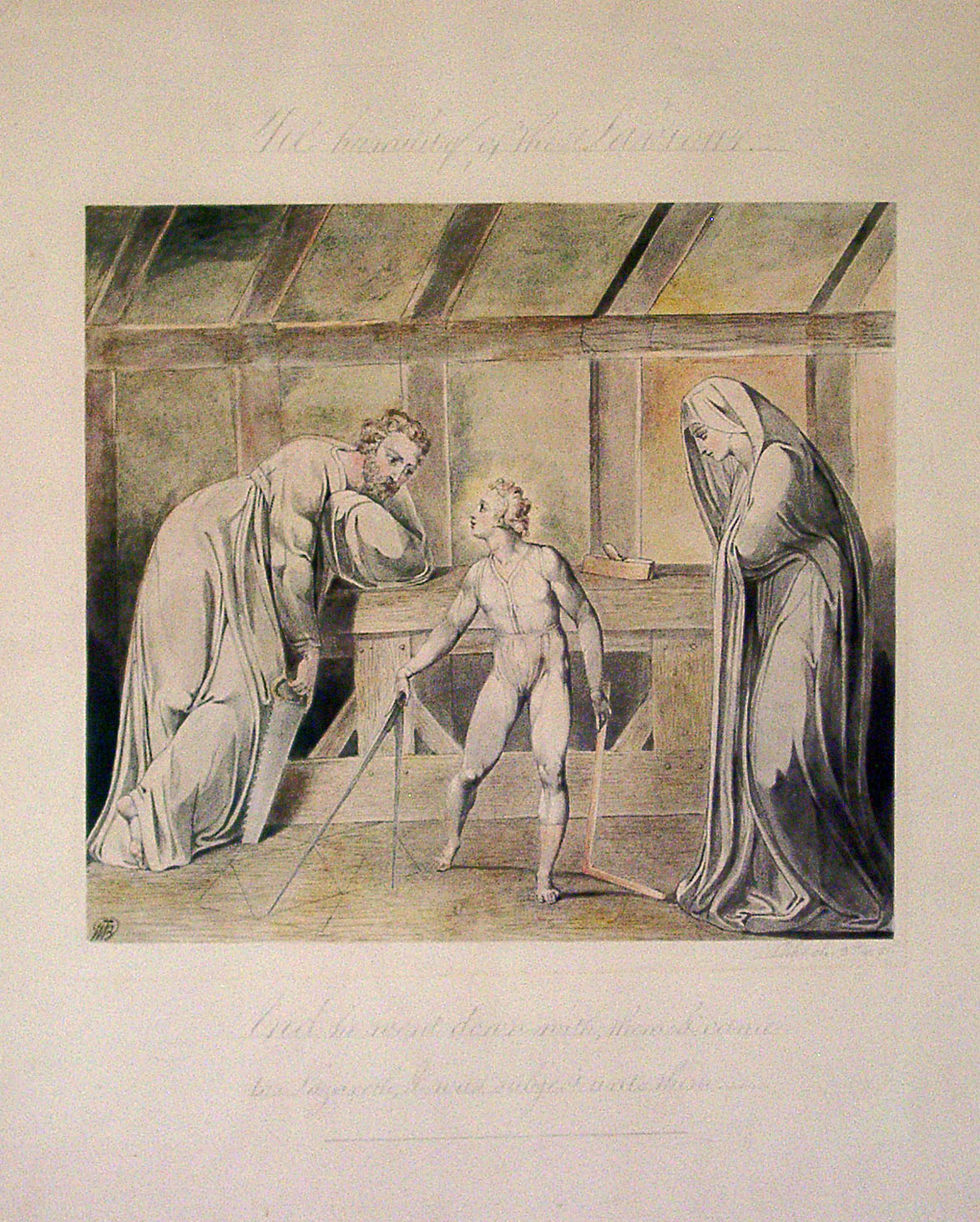
Christ in the Carpenter's Shop
"This illustration is one of the Bible series commissioned by Blake's patron Thomas Butts. Eight others from the series are in the Tate Gallery. Christ is pictured as a youth, demonstrating his knowledge of carpentry with the geometric drawing on the floor. The artist's love for symbolism is evident here - Christ's compass indicating rational knowledge and reason, and Christ himself a symbol of imagination and creativity. In actual fact, in the original biblical text the scene refers to (Luke 2:51), nowhere is a carpenter's shop referred to. Blake has interpreted the meaning to relate to Christ's family trade." From the Walsall website.

Legend above picture - The Humility of the Savior
Below picture - "And he went down with them and came to Nazareth, and was subject unto them." [Luke 2:51]

As usual Blake is doing more in this picture than represent an actual scene from the life of Jesus. The figures we take to be Mary and Joseph seem to be shown symbolically. Christ looks away from Mary as if saying 'what have I to do with thee' (the question asked in To Tirzah), although she focuses her complete loving attention on him. The clothing Mary wears is the thick draped fabric seen in classical painting. So Mary as the material side is covered in dark thick garments (robes.)

The youth focuses his attention on Joseph as an image of the Father, perhaps even with the appearance of Los (the Eternal Prophet.) Joseph shows his left heel, a favorite position of Blake; according to Erdman the heel, synonymous with the word tarsus, suggests the conversion of Paul (of Tarsus).

The boy Jesus engrossed in conversation with the man, is a reminder of the encounter Jesus had had earlier in Luke's gospel with the teachers in the temple as he was engaged in discussions which lasted three days.

The youth holds the two symbols associated with Masonic organization. The compass toward Joseph, the square toward Mary. So the representation is of the male and female, the sky and earth, the spirit and matter, the eternal and the transient. The figure inscribed on the floor (squares and triangles), reminds me that Jesus traced figures in the dust when the woman was taken in adultery, which lead to her forgiveness.

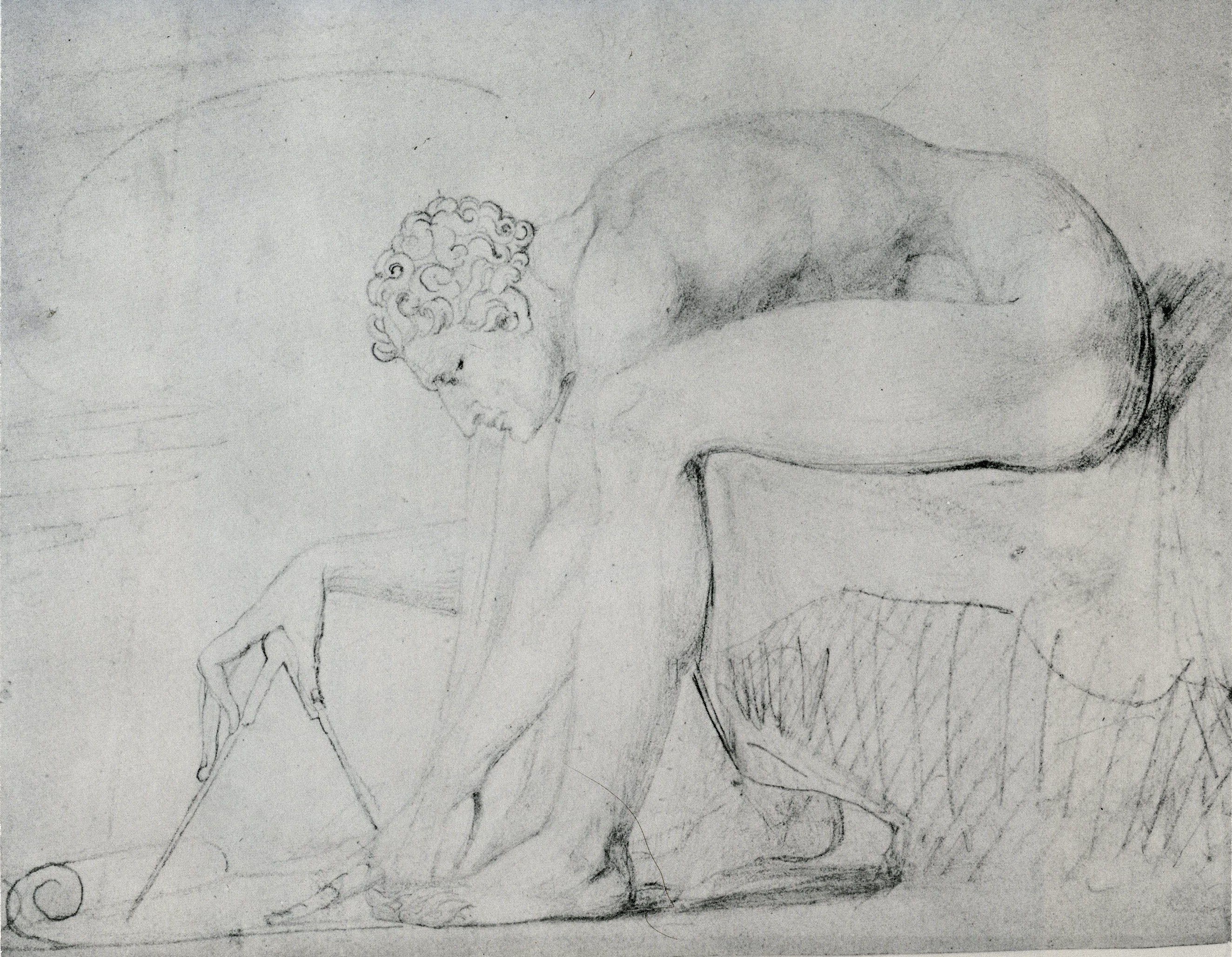
On a more prosaic note, I see Jesus portrayed as a carpenter, an artisan with the tools he used in his work. I don't doubt that Blake had the same tools in his art and printing shop and used them daily. Newton (ever the mathematician) in Blake's portrayal, too, is shown holding the compass and inscribing a figure on paper as Blake himself did, and as was done in the carpenter's shop. The image from the frontispiece of Europe often called the Ancient of Days, shows either the creator God or Urizen, inscribing the world of matter with the compass. The picture I get is that Jesus, Newton, Blake, the Creator and Urizen shared the same instrument as well as some of the same activity. That activity was giving body to ideas.


Thursday, July 1, 2010

LEVELS of EXISTENCE

I am indebted to Milton O Percival's William Blake's Circle of Destiny for the understanding I have of this subject. Quotations are from his book. This book is rarely for sale at a modest price but is available in many libraries. To find a library near you from which it is available try worldcat.com. If your local library doesn't have the book, you can ask them to obtain it on interlibrary loan.

Blake sees the status of man in terms of levels of existence. At each level man is capable of living according to certain principles which represent his level of consciousness. In ascending order the worlds through man may progress are Ulro, Generation, Beulah and Eden. Each level is characterized by the ability of man to perceive at that level, and the structure which results from that level of perception.

ULRO

So we have in Ulro the ability to perceive at only the level of single or literal vision. Meaning beyond the superficial material level escapes single vision. Looking for information about the relationship between William and Catherine Blake in the prophetic books is confining oneself to Ulro thought, since it is looking for outward sensory data about outward sensory events. The most striking facet of perception in Ulro is the inability to see spiritual significance in anything that comes to us. Perception is turned outward only; the inner world is thought to be non-existent. Seeing only an outward existence creates the world of matter, rigid and passive.

Page 87: "This void in the empty East is Ulro, the Hell of Blake's myth. In this void the selfish emotions are activated by rational doubts and fears. ..Everything in this world is 'without internal light.' The souls which inhabit it have 'neither lineament nor form.'"

Ulro is the bottom of man's fall from eternity. If the fall had continued man would have fallen into the abyss of non-entity. The limits of Adam and Satan were set to prevent that from happening. When the limits were defined, man could start the rebuilding and return.

GENERATION

The agent for the the process of rising or returning is Los who gives form or concrete expression to the abstractions of Urizen in Ulro. In this way error is revealed for what it is and can be repudiated. This is our world where ideas and emotions are expressed in behaviors and personalities.

This is man's condition in the generative world: he is confined to the world of time and space, he is vegetated in a body whose limitations he cannot escape, he is receiving his information from shrunken senses. But there is more going on in generation; it is the world of transition from the outward and corporeal to the inward and spiritual. Los in the role of the holy Spirit is the agent of transformation.

Los's job is breaking down and building up. Breaking down by revealing error for what it is. Building up by creating Golgonooza in which man may exercise imagination. Spiritual vision becomes possible through the development of symbolic thinking. The object seen outwardly and corporeally becomes capable of carrying meaning which is inward and spiritual. 'The world of generation might indeed be thought of as a training school in vision.' (Page 272)

Page 273: "When the struggle is over, and the world and all that is therein can be seen, calm and assuredly, as the manifestation of spirit - then the soul has arrived at threefold vision and soft Beulah's light."

'To Be Continued' in my next post.

Friday, June 11, 2010

POET & MYSTIC


William Blake: poet and mystic

By Pierre Berger, Daniel Henry Conner

Page 221
"Blake's symbolic language is perhaps even more largely responsible than his want of logic for the obscurity of his writings. His use of this symbolic language was a natural result of his views upon the nature of the world and upon art. To him, the spiritual world revealed itself not in abstract terms, but in concrete symbols, which were the visible things of this world. He saw the supernatural, instead of imagining it. The living spirit was symbolised and made visible to men by lifeless matter. The created world was an expression of the Divine Humanity in all its forms.
"But the artist's creation should be an analogous kind or expression. His abstract ideas ought only to be represented by words which designate concrete things. A thought can only be expressed by a symbol. The artist must therefore create a symbol for every thought, and must speak always in metaphors. He will learn to live in the symbolic world created by his own mind, as we live in this vast, composite symbol which is the universe. And just as we see concrete objects without thinking of the metaphysical ideas they represent, so Blake, having created his symbols, proceeds to use them as living personages without regarding the idea that underlay them and had brought them into existence. He comes to feel, think and speak in symbols. Urizen and Los cease to be allegorical figures, and become actual persons, like Hamlet or Polonius, like Milton or Blake himself. This process takes place in the mind of every poet, but Blake carried it further than others."


So Berger's idea is that Blake lived in the symbolic world which he created and that we understand Blake by learning to live in his symbolic world.

Leaving the Cosmic Egg

Wednesday, May 26, 2010

LIVING SYMBOLS

Songs of Innocence (E 16)
Infant Joy

"Sweet Joy Befall Thee"

Besides his well know (to Blake students), A Blake Dictionary, S. Foster Damon wrote William Blake: His Philosophy and Symbols which also has much to teach about Blake's poetry and how it can be understood. This quote about various levels of meaning which the symbol can represent is found on page 65.

"Practically the whole existence of poetry consists of imposing of human values on natural objects...
Symbolism is the recognition and fixation of these values. It is the highest form of that process usually performed by the weaker metaphor and the still weaker simile. The simile states a resemblance, the metaphor states an identity, and the symbol assumes the identity without direct statement. In the first case love would be likened to a rose; in the second case, Love would be called a rose; in the third, the Rose would appear unexplained. There is a still higher rung in this Jacob's Ladder: the rung popularly known as Prophecy. Here the Rose would indicate some particular act in the past, present, or future. A specific temporal significance is thus imposed upon the Symbol, which hitherto dealt with Eternities...
Let us return , then, to the symbol. Blake, of course, knew perfectly well what he was doing. He deliberately interpreted objects to show their relation to, and their expression of, mankind. Everything he saw revealed to him its inner essence, which was in turn the revelation of a truth. Only through this method could Truth be approached. Isis cannot be seen unveiled, for the mortal eye itself is her vesture. The great secrets cannot be told; the very syllables are their mask....
And thus we learn a strange fact: that the clearer, the more precise, Blake's writings become, the more obscure they seem. The trouble is not with Blake, it lies in our own inability to understand. The fires of Hell still seem like torment and insanity to us, the Angles. Therefore Blake cried so fiercely: 'Go! put off Holiness, and put on Intellect!' "

It is not difficult to find passages in Blake to illustrate the use of the symbol to reveal multiple layers of psychological, poetic and spiritual meanings. How does this speak to you?

Four Zoas, Night VIII, Page 113-114, (E 384) [Enion speaking:]
"Listen: I will tell you what is done in the caverns of the grave
the lamb of God has rent the veil of mystery
When the mortal disappears in improved knowledge cast away
The former things so shall the Mortal gently fade away
And so become invisible to those who still remain
Listen I will tell thee what is done in the caverns of the grave

The Lamb of God has rent the Veil of Mystery soon to return
In Clouds & Fires around the rock & the Mysterious tree
As the seed waits Eagerly watching for its flower & fruit
Anxious its little soul looks out into the clear expanse
To see if hungry winds are abroad with their invisible army
So Man looks out in tree & herb & fish & bird & beast
Collecting up the scatterd portions of his immortal body
Into the Elemental forms of every thing that grows
He tries the sullen north wind riding on its angry furrows
The sultry south when the sun rises & the angry east
When the sun sets when the clods harden & the cattle stand
Drooping & the birds hide in their silent nests. he stores his
thoughts
As in a store house in his memory he regulates the forms
Of all beneath & all above & in the gentle West
Reposes where the Suns heat dwells he rises to the Sun
And to the Planets of the Night & to the stars that gild
The Zodiac & the stars that sullen stand to north & south
He touches the remotest pole & in the Center weeps
That Man should Labour & sorrow & learn & forget & return
To the dark valley whence he came to begin his labours anew
In pain he sighs in pain he labours in his universe
Screaming in birds over the deep & howling in the Wolf
Over the slain & moaning in the cattle & in the winds
And weeping over Orc & Urizen in clouds & flaming fires
And in the cries of birth & in the groans of death his voice
Is heard throughout the Universe whereever a grass grows
Or a leaf buds The Eternal Man is seen is heard is felt
And all his Sorrows till he reassumes his ancient bliss"

This is symbolic language at its finest; not allegory, simile or metaphor but living symbols which may enter the Soul of Man: an opportunity to collect the 'scattered portions of [our] immortal bodies.'

Tuesday, May 18, 2010

READING SYMBOLS

In 1904 two scholars at the Victoria and Albert Museum published the text for Blake's Jerusalem together with their introduction. Eric Maclagen and Archibald Russell had a gift for a profound understanding of Blake symbolic system. They were able to see in the poem at the beginning of the second chapter of Jerusalem a precis of the entire contents of of the book Jerusalem . I hope you will find this section as enlightening in developing an ability to read Blake with understanding as I do.

Jerusalem, Plate 27, (E 171)

"The fields from Islington to Marybone,
To Primrose Hill and Saint Johns Wood:
Were builded over with pillars of gold,
And there Jerusalems pillars stood.

Her Little-ones ran on the fields
The Lamb of God among them seen
And fair Jerusalem his Bride:
Among the little meadows green.

Pancrass & Kentish-town repose
Among her golden pillars high:
Among her golden arches which
Shine upon the starry sky.

The Jews-harp-house & the Green Man;
The Ponds where Boys to bathe delight:
The fields of Cows by Willans farm:
Shine in Jerusalems pleasant sight.

She walks upon our meadows green:
The Lamb of God walks by her side:
And every English Child is seen,
Children of Jesus & his Bride,

Forgiving trespasses and sins
Lest Babylon with cruel Og,
With Moral & Self-righteous Law
Should Crucify in Satans Synagogue!

What are those golden Builders doing
Near mournful ever-weeping Paddington
Standing above that mighty Ruin
Where Satan the first victory won.

Where Albion slept beneath the Fatal Tree
And the Druids golden Knife,
Rioted in human gore,
In Offerings of Human Life

They groan'd aloud on London Stone
They groand aloud on Tyburns Brook
Albion gave his deadly groan,
And all the Atlantic Mountains shook

Albions Spectre from his Loins
Tore forth in all the pomp of War!
Satan his name: in flames of fire
He stretch'd his Druid Pillars far.

Jerusalem fell from Lambeth's Vale,
Down thro Poplar & Old Bow;
Thro Malden & acros the Sea,
In War & howling death & woe.

The Rhine was red with human blood:
The Danube rolld a purple tide:
On the Euphrates Satan stood:
And over Asia stretch'd his pride.

He witherd up sweet Zions Hill,
From every Nation of the Earth:
He witherd up Jerusalems Gates,
And in a dark Land gave her birth.

He witherd up the Human Form,
By laws of sacrifice for sin:
Till it became a Mortal Worm:
But O! translucent all within.

The Divine Vision still was seen
Still was the Human Form, Divine
Weeping in weak & mortal clay
O Jesus still the Form was thine.

And thine the Human Face & thine
The Human Hands & Feet & Breath
Entering thro' the Gates of Birth
And passing thro' the Gates of Death

And O thou Lamb of God, whom I
Slew in my dark self-righteous pride:
Art thou return'd to Albions Land!
And is Jerusalem thy Bride?

Come to my arms & never more
Depart; but dwell for ever here:
Create my Spirit to thy Love:
Subdue my Spectre to thy Fear,

Spectre of Albion! warlike Fiend!
In clouds of blood & ruin roll'd:
I here reclaim thee as my own
My Selfhood! Satan! armd in gold.

Is this thy soft Family-Love
Thy cruel Patriarchal pride
Planting thy Family alone
Destroying all the World beside.

A mans worst enemies are those
Of his own house & family;
And he who makes his law a curse,
By his own law shall surely die.

In my Exchanges every Land
Shall walk, & mine in every Land,
Mutual shall build Jerusalem:
Both heart in heart & hand in hand."

Jesus reaching down

This is the section from the introduction to Jerusalem By William Blake, Eric Robert Dalrymple Maclagan, Archibald George Blomefield Russell:


"In this unfallen state the " fields " in the north, from east to west, the regions, that is, of instinctive life both on the side of emotion and on that of sensual perception, were the supports of the holy Imagination, through the pillars of intellect (gold being the metal of Urizen). The Imagination was the Bride of the Lamb of God, happy in many lovely and innocent ways, and every idea of man was the " child of Jesus and his Bride " in the religion of forgiveness, refusing to impute sin. But the peace is broken: the intellectual powers are busied with the western region of bodily things (and in particular the sense of the Tongue, through which came the first sin): and man falls into the sleep that we call the life of the body, shadowed by the tree of mystery, and passing from inspired religion to that false faith which demands bodily instead of mental sacrifice. He enters into mortal sorrow, and his hard rational power, called by Blake "Satan," separates itself from his loins (the place of judgment), and furiously enforces its legal morality. By this separation the imagination also is forced to depart, and passing eastward through mere emotionalism it is lost in grief. Further and further the reason asserts its dominion over the emotional life, and the happinesses of man (rivers) become stained with sensuality: in every phase of mental life the place of the imagination is restricted, and the power itself is forced into the dark land of corporeal life. By such a system of religion man is convinced of his own mortality, equaling himself with the worms: but nothing can wholly obscure the glory of the divine within him, even in the weakness and transience of the life between birth and death. This state is common to all mankind; and the poet identifies himself with the man whose fall he has narrated, and calls on the Lamb of God, the Divine Image whom he crucified, but who still makes his perpetual appeal to the heart of man: he implores him to mould the spiritual and to repress the merely rational life with the love and fear of God. For the reason is to be mastered, not to be abandoned; in all its selfish cruelty and pride of intellectual war it is still a true part of man, even when it tries to claim that its own children (the logical ideas) have alone the right to exist, though such a system is bound at last to be its own destruction. The true life knows no compulsion, but consists in mutual acceptance and forgiveness: for so can man be joined with man to build up Christianity, the religion of the Imagination."
______________
The poem leads us through sights and locations familiar to Blake, changes which he has observed, and the possibilities for further changes in a positive direction. Recognizing this as being written in symbolic language, the authors restate it in prosaic language. The restatement functions as a summation of the book Jerusalem itself. The poem makes more sense to our ordinary way of thinking when its symbols are revealed. Through the paraphrase of the poem we can see that it represents an outline of the whole book.

Saturday, April 10, 2010

SYMBOLIC THINKING

William Blake: poet and mystic
By Pierre Berger, Daniel Henry Conner

The authors of this book demonstrate a profound
understanding of the way Blake thought and wrote.

Rarely do we get such a clear description of Blake's
use of symbols to present a world beyond sensation.

This book, published in 1914, can be read online as
a Google Book.

"When the smoke of the incense rises from the altar,
symbolizing the prayers of the congregation, the
priest ...admits the existence of the incense. But
Blake would say: "There is no incense: I see only a
ladder by which angels are carrying our prayers up
to God's throne." And he would see only pity for the
unbeliever who could not see it also. These familiar
symbols will help us to understand Blake's conception
of the visible world. We have only to apply the same
procedure to every case. The world of matter has no
existence of its own: it is only a symbol of the invisible
universe, something shown to us in order that, through
it, we may gain knowledge of what we cannot see.
The earth, the sky, the sun, are all symbols, each at
once a portion and a visible representation, as
delusive as a mirage, of some eternal spirit. Trees,
animals, nay more, even men, are only symbols.
History is a symbol: revolutions are symbols of some
great change actually taking place in the invisible
world. The American Revolution, for instance, merely
symbolized the revolt of the angels of liberty against
the powers of tyranny in the eternal universe.
America itself is only symbol, standing for the part of
the human spirit not yet subjugated and bound down
by tyrannical laws. Blake is a symbol, a mere
transitory form of the prophetic spirit: his wife is a
symbol for the internal joy felt by that spirit, and for
its softer emotions. And so we pass through this little
life of ours, unknowing, unsuspecting that we are but
reflection, metaphors in action, symbols and
representations of eternal beings, who dwell outside
of time and space, and whose life is the only real
existence.
...
It was always from this other point of view that
Blake regarded the world of nature and matter.
Consequently, everything in the visible universe
was an expression of some profounder invisible
existence; and, as a further consequence, no
earthly thing could ever be insignificant."

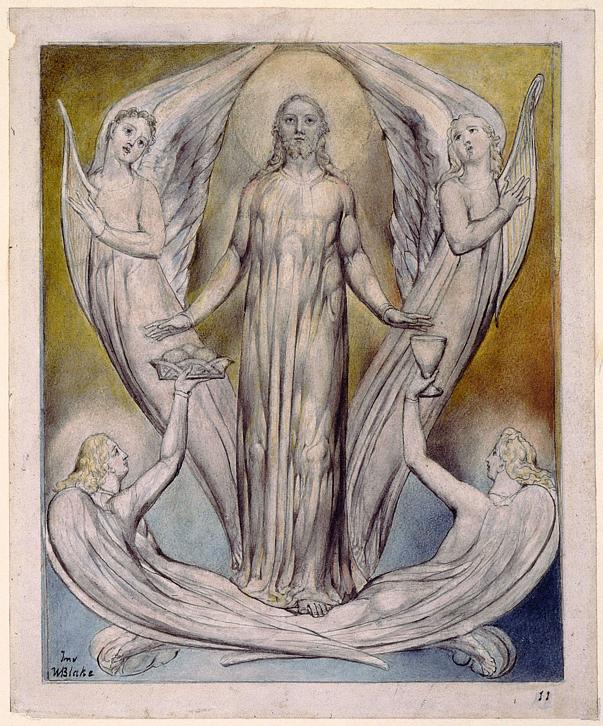
'As our dear Redeemer said, this the Wine & this the Bread'

Saturday, January 16, 2010

Some Significant Symbols

Much of this is taken from Digby's 'Symbol and Image in William Blake':

ALBION (Glad Day) was Blake's name for Everyman, Adam Kadman, Cosmic Man, the Eternal Great Humanity Divine (See Milton, plates 2 and 30) or in Quakereze 'that of God in Everyone'. Albion asleep is an apt commentary on Blake's age-- and ours.

"Every human life is part of Albion and can realize more or less the Cosmic Man's total nature... Albion suffers and triumphs in each individual, as is described in ...Jerusalem
..
The Dance of Eternal Death" Digby p.12.

ETERNAL DEATH: Blake used this phrase 78 times; it's mortal life;I translate it to 'this vale of tears', the Sea of Time and Space from which we may emerge at the end; "whenever any Individual Rejects Error & Embraces Truth a Last Judgment passes upon that Individual.." [[A Vision of the Last Judgment] PAGE 85] (Erdman 562)

From Milton: In Heaven, having heard the Bard's Song,
"Milton said, I go to Eternal Death! The Nations still
Follow after the detestable Gods of Priam; in pomp
Of warlike selfhood, contradicting and blaspheming.
When will the Resurrection come; to deliver the sleeping body.."

JERUSALEM: This image cannot be defined; we can only begin a journey of 1000 miles. The Concordance has 288 occurences and Damon has 7 pages trying to describe it. Blake used it as the title for his largest poem; 'Jerusalem' the (smaller) poem, appears in the Preface to Milton (and in many hymnbooks): "till we have built Jerusalem in Englands green and pleasant land."

Jerusalem is the bride of Christ (the conventional church considers itself to be the bride of Christ, but to Blake the bride of Christ was the human race). Jerusalem was Albion's wife-- until he went to sleep; at that point he turned to Vala.

VALA is fallen Jerusalem. A picture is worth a thousand words, and the relationship betwem Vala and Jerusalem can be best understood in this plate (click on the pic for an enlargement). Jerusalem stands out in light with (supposedly) her three daughter, while Vala, in a dark vale, attempts to entice Jerusalem into her darkness. The two battle through The Four Zoas and Jerusalem (the large poem). In your life you can see the 'good girl' and 'bad girl' fighting for supremacy. A woman may become a thief, and/or she may give birth to a spiritual genius. Such is life.

Blake did not believe in 'good and bad'; he believed in Truth and Error. At the Last Judgment Error is burned up and we live (eternally) in Truth.