Thursday, January 6, 2011

Blake's Hell

The meaning of Hell to ordinary people with a religious faith is a place of unending torture and misery at death for those who have not deserved a better fate. This idea has been deeply ingrained in the public consciousness, and it has been expressed by millions of religious practitioners.

William Blake's idea of Hell was very different. In The Marriage of Heaven and Hell he parodied Conventional Christians' ideas of Heaven and Hell, of angels and devils. The Elect (angels) are the CC people, especially the priests. The Reprobates (devils) are those who deny the conventional priests; they have the Energy of Imagination. Blake kept these categories through the course of his poetry;

Eventually it became evident that Jesus was one of the Reprobates; look at Milton Plate 13[14]:


"Around the Lamb, a Female Tabernacle woven in Cathedrons Looms
He died as a Reprobate. he was Punish'd as a Transgressor!

Glory! Glory! Glory! to the Holy Lamb of God

I touch the heavens as an instrument to glorify the Lord!" (Erdman 107)

MHH ends with these magical words:
"For every thing that lives is Holy."

That is one of Blake's statements of Universalism (The original American Universalists believed that everyone in the world was and will remain a child of God.)

Blake's MHH was likely a response to Swedenborg's Heaven and Hell, published in 1758, the year Blake was born. Blake, in his early days, was influenced by Swedenborg, but by his late twenties he had become disenchanted with S's thought.

Quoting Wikipedia Swedenborg's Heaven and hell
"is a detailed description of the afterlife where people go after the death of the physical body. It deals with God, heaven, hell, angels, spirits, and devils, which the author claimed to have witnessed first hand."

Blake dealt with all these subjects in his MHH, but his perspective on them was far different from those of the earlier writer.

*****************************************

We may read Blake's definition of Hell in Erdman 590 (one of Blake's Annotations of Lavater):
"
to hell till he behaves better. mark that I do not believe there is such a thing litterally. but hell is the being shut up in the possession of corporeal desires which shortly weary the man for all life is holy."


Wednesday, January 5, 2011

BLAKE & 'DEAD MAN'

In 1995 Jim Jarmusch directed a movie, Dead Man, which follows the character named William Blake through harrowing experiences. Although the character has no knowledge of William Blake's poetry he is befriended by a Native American under the influence of Blake. To a person familiar with Blake's writing, the movie is presenting Blake's thought in a contemporary media. To one unfamiliar with Blake the film may be either a slow moving Western exhibiting sex and violence, or an opportunity to become acquainted with quotes from Blake. If a person can view the movie psychologically as a myth of psychic and spiritual development, he may experience some of what one experiences in reading Blake's poetry.

The website 366 Weird Movies comments on the movie Dead Man:
"On it’s release, Dead Man received mostly negative reviews. It was criticized as too slow and too pretentious, appearing to be thoughtful but actually delivering no ideas worth mentioning. Time has been kind to the movie, however, which has emerged as Jarmusch’s best work to date. In Dead Man, a measured journey into an odd, somber, dark and funny wilderness of the spirit, Jarmusch created a myth with staying power. Filled with poetic images like Johnny Depp reclining with a slaughtered fawn, Dead Man has proven a mysterious power to linger in the memory. It may never yield up its meaning, but that doesn’t make it empty."

It would be impossible to explain the movie Dead Man in the same way that it is impossible to explain Jerusalem. But there are a few things it might be beneficial to say about it. It is not just a movie which takes the name William Blake and attaches it to a character in a Western. It is a movie which attempts to emulate Blake's enigmatic methods of communication and present Blakean images and ideas in an alternate media. If one is prepared to discern repeated references to the processes enacted in Blake's poetry as well as to listen for quotes from Blake's work, the movie will become more than a series of killings.

The theme of annihilation is prominent in Jerusalem and Milton as the means of eliminating error and fostering forgiveness. The furnaces of Los through which characters must pass on the way to redemption play a large part in the activity which reverses the fall. Annihilation through killing is repeated throughout Dead Man. If the killing is meant to portray the murder of men, the movie is only about senseless violence. If error or wrong ideas are being destroyed to promote the journey of William Blake through the underworld, it makes more sense. Milton O. Percival, in Circle of Destiny says "In the destruction of these forms by the restless energy of time lies man's hope of release from error. 'All that can be annihilated must be annihilated.' [Milton, E 142] The eternal will live on. For that reason error must be provided with a mortal body capable of destruction by the energy of time."

The title of the movie, Dead Man, suggests that the protagonist, William Blake (played by Johnny Depp), is dead from the beginning. At least the suggestion is that he died immediately (early in the movie) when he was shot in Thel's room. The action takes on different meaning if William Blake is not a living man trying to escape from multiple pursuers. As a myth we see the journey of a man attempting to reach his home in a world beyond the trials and errors of ordinary life.

This is Blake's advice on viewing symbolic images like those that are abundant in the movie.

Vision of the Last Judgment , (E 560):
"If the Spectator could Enter into these Images in his
Imagination approaching them on the Fiery Chariot of his
Contemplative Thought, if he could Enter into Noahs Rainbow or into his bosom or could make a Friend & Companion of one of these Images of wonder which always intreats him to leave mortal things as he must know then would he arise from his Grave then would he meet the Lord in the Air & then he would be happy"

The following passage helps us understand how Blake viewed existence in this world compared to existence in the permanent world.

Jerusalem , Plate 13, (E 157)
"Los walks round the walls night and day.

He views the City of Golgonooza, & its smaller Cities:
The Looms & Mills & Prisons & Work-houses of Og & Anak:
The Amalekite: the Canaanite: the Moabite: the Egyptian:
And all that has existed in the space of six thousand years:
Permanent, & not lost not lost nor vanishd, & every little act,
Word, work, & wish, that has existed, all remaining still
In those Churches ever consuming & ever building by the Spectres
Of all the inhabitants of Earth wailing to be Created:
Shadowy to those who dwell not in them, meer possibilities:
But to those who enter into them they seem the only substances
For every thing exists & not one sigh nor smile nor tear,
PLATE 14
One hair nor particle of dust, not one can pass away."

This next section in Blake may be correlated with the 'men' who pursue William Blake in the movie. They 'die' because they are negations which must be compelled into non-entity.

Jerusalem, Plate 17, (E 162)
"Negations are not Contraries: Contraries mutually Exist:
But Negations Exist Not: Exceptions & Objections & Unbeliefs
Exist not: nor shall they ever be Organized for ever & ever:
If thou separate from me, thou art a Negation: a meer
Reasoning & Derogation from Me, an Objecting & cruel Spite
And Malice & Envy: but my Emanation, Alas! will become
My Contrary: O thou Negation, I will continually compell
Thee to be invisible to any but whom I please, & when
And where & how I please, and never! never! shalt thou be Organized
But as a distorted & reversed Reflexion in the Darkness
And in the Non Entity: nor shall that which is above
Ever descend into thee: but thou shalt be a Non Entity for ever
And if any enter into thee, thou shalt be an Unquenchable Fire
And he shall be a never dying Worm, mutually tormented by
Those that thou tormentest, a Hell & Despair for ever & ever."

A future post will bring up the quotes from Blake which are included in the movie.

Tuesday, January 4, 2011

Indentation

This sectin is indented in Blake's Sex II; I don't know just why or how:

    Remove away that black'ning church:
    Remove away that marriage hearse:
    Remove away that ..... blood:
    You'll quite remove the ancient curse.
    (An Ancient Proverb; in Songs and Ballards; Erdman p. 475)

Blake's Sex II

A review of Blake's early life suggests the most normal and ordinary psychosexual development, to which the biographers testify. Through his refusal of formal education (See CHAPTER ONE ) Blake appears to have escaped many of the common pathologies of sex that afflicted his age as ours. In fact he systematically held some of them up to ridicule.

Blake never tired of painting the human form, and he usually refused to hide it with clothes. His primary models appear to have been his wife and himself. We read that a friend once found them naked in the garden of their home. In all probability they were planning poses and postures for his illustrations of Paradise Lost.

In his early twenties Blake formed an emotional attachment to a young woman named Polly Wood. Unfortunately Polly had other interests, and when he showed jealousy, she asked him if he were a fool. The experience seems to have cured him of jealousy; in fact the foolishness of jealousy became a life long motif; his false God received the name (among others) of Father of Jealousy.

On the rebound he met a beautiful girl named Catherine Boucher, a gardener's daughter. He told Catherine his mournful story, and when she pitied him, he promptly transfered his affection to her. A year later they were married, a relationship that according to all the evidence seems to have been made in heaven.

Illiterate at her marriage, Catherine Blake must have been a gifted and rare person; she had a great deal to do with Blake's enormous creativity. Her high and continuous level of affirmation released Blake from the drain of domestic preoccupations. She affirmed and encouraged his gift of vision even when it meant long hours of wakefulness while he communed with heaven. She provided the appreciative audience that the world in general denied Blake and made him a happy creative artist in the same way that J.S.Bach was happy.

One important influence on Blake's ideology of sex came from certain left wing religious dissenters. The ranters and other antinomians deeply affected Blake's world of thought. They considered marriage a part of the law which they wanted to abolish. They claimed the right, living above the law, to cohabitate with whomever, whenever and wherever they felt led. We find evidence of similar excesses among fringe groups both in the New Testament and in the 20th Century:

    Remove away that black'ning church:
    Remove away that marriage hearse:
    Remove away that ..... blood:
    You'll quite remove the ancient curse.
    (An Ancient Proverb; in Songs and Ballards; Erdman p. 475)

Blake found these ideas attractive as a young man, but no one believes that he carried them very far in practice. Libertines and hedonists have at times made Blake their hero, but they simply don't know their man. All the evidence suggests that Blake lived as a faithful and loving husband for some forty five years--and a happy one as well (This is spite of a recent fanciful 'biography' of Catherine Blake).

Monday, January 3, 2011

EDEN & GENERATION

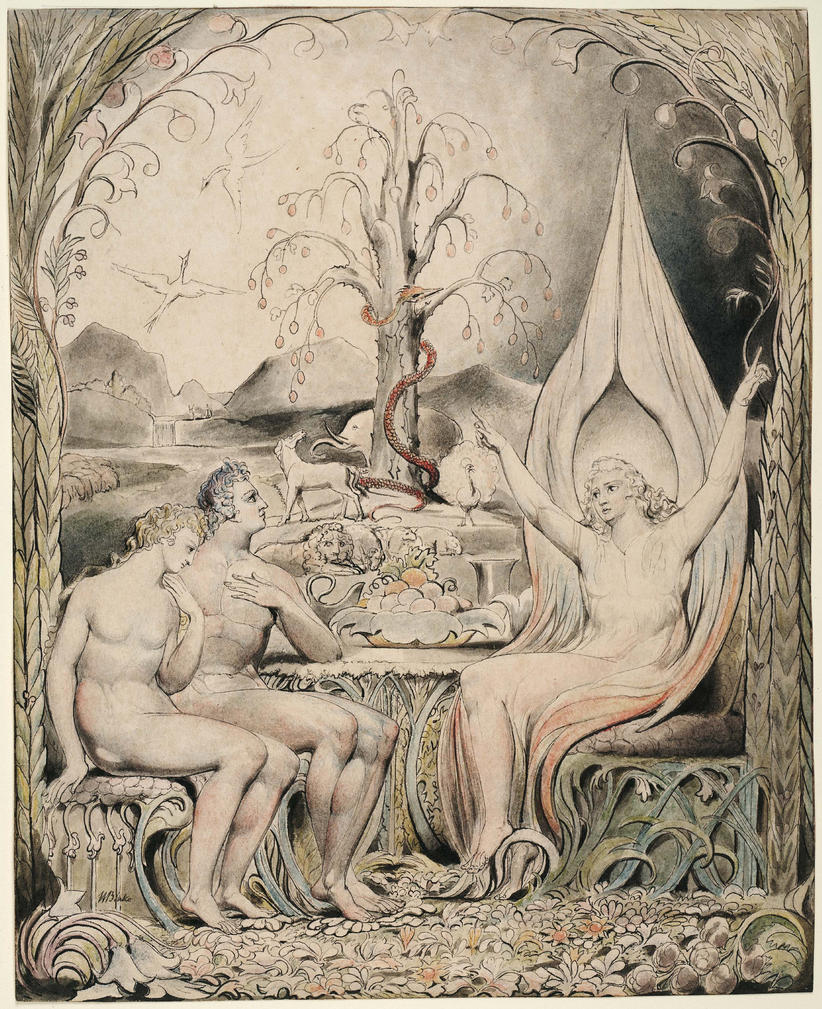
Saturated as was Blake's mind with the thought of Milton, his writings and paintings are permeated with Milton's ideas. Blake painted three sets of illustrations to Milton's Paradise Lost - one each for his supporters Butts, Thomas and Linnell. In Book 5 the Archangel Raphael is sent by God to warn Adam and Eve of the threat that Satan poses. Book 7 of Paradise Lost recounts the Biblical story of creation as told to Adam by Raphael. The Genesis account is embellished with the fall of Lucifer which is not included in the Bible. In Book 8 Adam narrates to Raphael the aspects of creation which took place after his own creation.

Book 5 - Raphael warns Adam and
Eve about Satan


This illustration for Book 5 represents the warning. The idyllic world as pictured has not been disturbed, but symbols of division (or contraries) are manifest: the lion and the lamb, the horse and the peacock. The tree bears its tempting fruit and the Serpent has made his appearance.

The scene is set for the fall which leads to Blake's world of Generation: Los' world, our world.


The world in which we live is meant to be the path through experience by which fallen man can return to consciousness of the Eternal. Blake's world of Generation affords fallen man the opportunity to realize the incarnation and return to Eden as a new being. The path through generation is not easy but this is where man finds himself. The outcome should be regeneration. Blake's progression is from innocence through experience to Eternity. He offers many levels, many gates and many paths. Only the destination is single - the return to Eternity. This can be reached any time (because it is not in time) by its realization - which he calls the Last Judgment:

Vision of the Last Judgment, (E 562)
"Thus My Picture is a
History of Art & Science [& /its/] Which is Humanity itself. What are all the Gifts of the
Spirit but Mental Gifts whenever any Individual Rejects Error &
Embraces Truth a Last Judgment passes upon that Individual"

Many people understand the Biblical Garden of Eden as an idealized material world with a creator God who is outside of creation; with man being given 'dominion' over the animals; and with man walking with an external God in the cool of the evening. Blake's Eden was the state of mind in which the vision of God was not obscured. William Blake's personal goal was to spend as much time in Eden as possible. To transcend to fourfold vision - the ability to perceive the Infinite - was his supreme delight. But to him Eden meant more than vision it also meant creative energy, forgiveness, brotherhood and the oneness of wholeness. Eden to Blake was an internal not an external experience.

MILTON: BOOK THE SECOND, PLATE 30 [33], (E 129)
"Beulah is evermore Created around Eternity; appearing
To the Inhabitants of Eden, around them on all sides.
But Beulah to its Inhabitants appears within each district
As the beloved infant in his mothers bosom round incircled
With arms of love & pity & sweet compassion. But to
The Sons of Eden the moony habitations of Beulah,
Are from Great Eternity a mild & pleasant Rest."

Jerusalem, Plate 12, (E 156)
"fourfold,
The great City of Golgonooza: fourfold toward the north
And toward the south fourfold, & fourfold toward the east & west
Each within other toward the four points: that toward
Eden, and that toward the World of Generation,
And that toward Beulah, and that toward Ulro:
Ulro is the space of the terrible starry wheels of Albions sons:
But that toward Eden is walled up, till time of renovation:
Yet it is perfect in its building, ornaments & perfection.

Jerusalem, PLATE 34 [38],(E 179)
"Turning from Universal Love petrific as he [Albion] went,
His cold against the warmth of Eden rag'd with loud
Thunders of deadly war (the fever of the human soul)
Fires and clouds of rolling smoke! but mild the Saviour follow'd
him,"

Sunday, January 2, 2011

Blake's Sex I

Following his Fundamental Presuppositions Blake, like virtually every mystic and esoteric perceived sex as the primary created duality. Paracelsus may have best described his point.

(The following from Franz Hartman, quoted by Percival on page 91.)
"Woman as such represents the will (including love and desire), and man as such represents intellect (including the imagination). Woman represents substance; man represents spirit. Man imagines; woman executes. Man creates images; woman renders them substantial.
The divine man (the angel) is male and female in one; such Adam was before the woman became separated from him."

(Blake disagreed emphatically with the biblical creation story, Blake considered the separation of the original Adam into male and female as more of a Fall than a Creation. Of course you and I and Blake as well are faced with the Reality of our circumstances.) At any rate after the Fall:

"Man was like the Sun; woman as such resembles the Moon, receiving her light from the Sun, and man without woman (in him) is a consuming fire in want of fuel."

This means that Blake (and Paracelsus) in their use of sex have a primarily metaphysical rather than a physical connotation. Nevertheless Blake began working with a sexual hangup of some sort, which he seems to have satisfactorily worked through with some 40 years of happy marriage.


In the Christian faith marriage is a sacrament, and for many of us the primary sacrament. However living the sacrament was no more common in Blake's day than in ours. 18th and 19th century England seemed largely to view marriage more as a commercial transaction.

Such a view led Blake to condemn the marriage hearse. He also condemned jealousy.

***********************

Many people have deeply misunderstood Blake's doctrine of sex. It has complex roots and abounds in paradoxes that defy casual acquaintance. But like most things the subject yields to close and careful study. If we can separate the conflicting strands of thought and resolve the paradoxes, we may achieve a better understanding of Blake, the man and the thinker, than is enjoyed by most even among his interpreters.

Saturday, January 1, 2011

ILLUSTRATING THE BIBLE

The Blake Archive has recently announced the addition of a series of Blake's paintings produced for Thomas Butts and identified as Paintings Illustrating the Bible. The index lists the nineteen subjects for the Old and New Testaments.

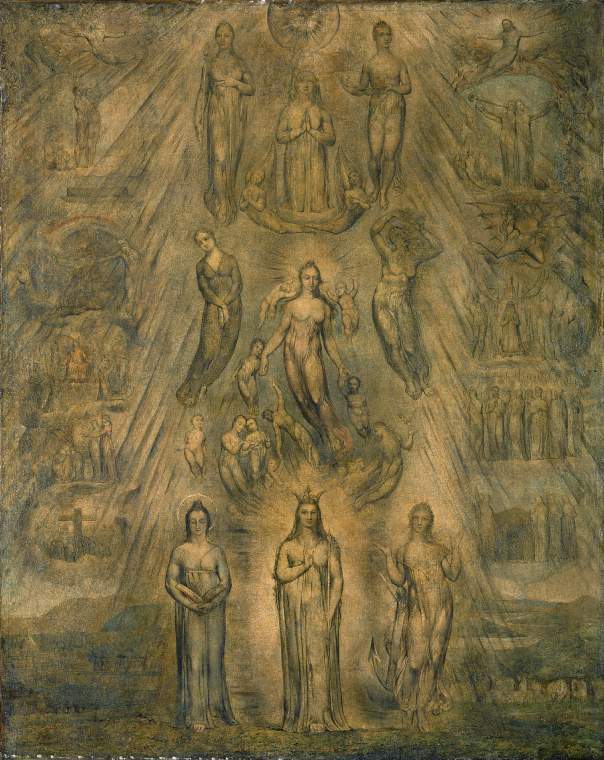
Although I cannot post images from the Blake Archive, I can post this image of The Circumcision from the site named William Blake: The Complete Works which does not restrict the use of the images (which are obviously beyond the period for which copyright protection applies.) .
The final picture of the group in the Archive is particularly appealing : "Christ The Mediator": Christ Pleading Before the Father for St. Mary Magdalene. In this picture Blake portrays the theme of forgiveness. Christ acting as the advocate for the sinner intervenes with Jehovah on the part of Magdalene who was said to have been a harlot.

Mark 16
[9] Now when Jesus was risen early the first day of the week, he appeared first to Mary Magdalene, out of whom he had cast seven devils.

On this the eighth day after the celebration of the birth of Jesus (the first day of the new year), the day on which circumcision is performed according to the Law of Moses, it is appropriate to observe Christ intervening in the exercise of the Law before the Father on the part of the woman who both was forgiven and discovered the empty grave.