The Perennial Philosophy was about as good a description of Blake's thought as we can find. Not trained and conditioned to the Enlightenment philosophy of radical materialism, he used for it his favorite metaphor, Bacon, Newton, and Locke.
Blake was steeped with the wisdom of the ages; that was in poor repute to cultured people of his day. At its apogee the radical materialists became logical positivists; they considered statements of anything not measureable in height or weight to be meaningless; they frowned on emotion and considered it enthusiasm (a pejorative).
The cultured people of that day tended to be primarily deistical and purely materialistic: God created the world and wound it up like a clock and thereafter had no interest in what went on in this planet.
Blake had his problems with God, but he knew that the word indicated something other than that; he despised the Deists. In Plate 52 at the beginning of his Chapter Three of Jerusalem (To the Deists) he told them what's what. Read it, and get a fuller grasp of Blake's faith.
The traditional symbols make up the stuff of poetry; 18th century English poetry by and large can be seen as peurile. Blake initiated the Romantic movement in poetry leading to the Romantic poets and artists; they were rich in the symbolism of tradition.
You may trace the deterioration of 18th Century English poetic thought through Shakespeare, Spencer, and Milton to William Hayley. At that low ebb Blake and the other Romantics intervened to bring about another renaissance.
Society was utterly commercial, especially in things like marriage (the first 50 pages of Dickens' Our Mutual Friend show to what lengths they went even in his day.)
Blake revolted emphatically against materialistic attitudes to the disgust of the materialists who made up his age. So he spent his creative life in obscurity, his brilliance largely unrecognized. (There are others like that, the general consequence of caring more for art than money.)
He was excluded because his thought forms were too radical; his language lacked the comfortable familiarity of the conventional majority. More than that he was too deep: completely beyond comprehension to the positivists, and just too dense for everyone. They called him mad!
Until today! Blake is coming alive in the 21st Century.
Showing posts with label Poetic language. Show all posts
Showing posts with label Poetic language. Show all posts
Thursday, October 28, 2010

Saturday, October 23, 2010
BLAKE'S SUBLIME

The word sublime, has many meanings both specialized and generalized. Blake uses the term in a variety of ways and enhances the meaning by the usage he puts it to. Here are a few of the definitions:
>to cause to pass directly from the solid to the vapor state
>to elevate or exalt especially in dignity or honor
>to convert into something of higher worth
>tending to inspire awe or terror.
A related word with a related meaning is subliminal: taking place below the threshold of sensory perception or outside the range of conscious awareness.
Roger R. Easson in his chapter of Blake's Sublime Allegory explains sublime in the context of its chemical or alchemical meaning:
"Blake defines sublime allegory, in the famous Butts letter of 6 July 1803, as 'Allegory addressed to the Intellectual powers, while it is altogether hidden from the Corporeal understanding...' (Letters, p. 69 [27]). Discussing the same idea of poetry, Blake puts it more chemically: 'What is it sets Homer, Virgil & Milton in so high a rank of art? Why is the Bible more entertaining than any other book? Is it not because they are addressed to the Imagination, which is Spiritual Sensation, & but mediately to the Understanding or reason?...Consider what Lord Bacon says: 'Sense sends over to Imagination before Reason have Judged, & Reason send over to Imagination before the Decree can be acted'' (Letters, p. 30 [5]). In chemistry the verb 'sublime' means that a substance may pass from solid to gas without passing into the intermediate liquid state. So too is Blake using the word. Sublime allegory is poetry that speaks to the intellectual powers without penetrating the intermediate stage of the corporeal understanding. It is poetry that is, quite literally, beyond reason. Consequently, it is best suited for dethroning reason within the reader who does not understand that the dominance of reason in his own mind prevents his entering the life of eternity."
Letter 27, [To Thomas Butts] (E 729)
Felpham July 6. 1803
"...Thus I hope that all our three years trouble Ends in
Good Luck at last & shall be forgot by my affections & only
rememberd by my Understanding to be a Memento in time to come &
to speak to future generations by a Sublime Allegory which is now
perfectly completed into a Grand Poem[.] I may praise it since I
dare not pretend to be any other than the Secretary the Authors
are in Eternity I consider it as the Grandest Poem that This
World Contains. Allegory addressd to the Intellectual powers
while it is altogether hidden from the Corporeal Understanding is
My Definition of the Most Sublime Poetry."
More quotes of Blake's use of Sublime:
MHH, Plate 7, (E 35)
"The most sublime act is to set another before you."
MHH, Plate 10, (E 37)
"The head Sublime, the heart Pathos, the genitals Beauty, the
hands & feet Proportion."
Descriptive Catalogue, Page 42, (E 543)
"The Strong man represents the human sublime. The Beautiful
man represents the human pathetic, which was in the wars of Eden
divided into male and female. The Ugly man represents the human
reason."
Four Zoas, Page 5, (E 302)
"Tharmas groand among his Clouds
Weeping, then bending from his Clouds he stoopd his innocent head
And stretching out his holy hand in the vast Deep sublime
Turnd round the circle of Destiny with tears & bitter sighs"
Four Zoas, PAGE 98 [90], (E 370)
"Then I can sigh forth on the winds of Golgonooza piteous forms
That vanish again into my bosom but if thou my Los
Wilt in sweet moderated fury. fabricate forms sublime
Such as the piteous spectres may assimilate themselves into
They shall be ransoms for our Souls that we may live
So Enitharmon spoke & Los his hands divine inspired began
To modulate his fires studious the loud roaring flames"
Descriptive Catalogue, Page 2, (E 531)
"The Greek Muses are daughters of Mnemosyne, or Memory, and not of
Inspiration or Imagination, therefore not authors of such sublime
conceptions."
Jerusalem, Plate 1,(E 144)
"There is a Void, outside of Existence, which if enterd into
Englobes itself & becomes a Womb, such was Albions Couch
A pleasant Shadow of Repose calld Albions lovely Land
His Sublime & Pathos become Two Rocks fixd in the Earth
His Reason his Spectrous Power, covers them above
Jerusalem his Emanation is a Stone laying beneath"
Jerusalem, Plate 34, (E 180)
"I see thee awful Parent Land in light, behold I see!
Verulam! Canterbury! venerable parent of men,
Generous immortal Guardian golden clad! for Cities
Are Men, fathers of multitudes, and Rivers & Mount[a]ins
Are also Men; every thing is Human, mighty! sublime!
In every bosom a Universe expands, as wings
Let down at will around, and call'd the Universal Tent."
To locate all 58 mentions of sublime, go to the blog sidebar, page down to LINKS TO ONLINE BLAKE, click on Concordance to Complete Works.
These are characteristics which you may note as being associated with sublime in Blake:
TRANSFORMATIVE,
BELOW LEVEL OF THE CONSCIOUS,
ASSOCIATED WITH HUMAN IMAGINATION,
PARTAKING OF IDENTITY,
ELEVATED OR AWE-INSPIRING
Tuesday, October 5, 2010
EARLY INTERPRETERS
Alexander Gilchrist wrote the first book on William Blake and his work, Life and Works of William Blake. After Gilchrist's book was published in 1863, interest in Blake began to develop. Algernon Charles Swinburne wrote in 1868, William Blake: A Critical Essay.
Swinburne, poet that he was, wrote his book length essay on William Blake in poetic language evoking emotions and calling on the intuition to assimilate the images presented. Here is his account of the beginning of Gates of Paradise (Page 19-23):
"In the first plate of the 'Gates of Paradise,' the woman finds the child under a tree, sprung of the earth like a mandrake, which he who plucks up and hears groan must go mad or die; grown under the tree of physical life, which is rooted in death, and the leaf of it is poisonous, and it bears as fruit the wisdom of the serpent, moral reason or rational truth, which invents the names of virtue and vice, and divides moral life into good and evil. Out of earth is rent violently forth the child of dust and clay, naked, wide-eyed, shrieking ; the woman bends down to gather him as a flower, half blind with fierce surprise and eagerness, half smiling with foolish love and pitiful pleasure ; with one hand she holds other children, small and new-blown also as flowers, huddled in the lap of her garment; with the other she plucks him up by the hair, regardless of his deadly shriek and convulsed arms, heedless that this uprooting of the mandrake is the seal of her own death also.
"Then follow symbols of the four created elements from which the corporeal man is made; the water, blind and mutable as doting age, emblem of ignorant doubt and moral jealousy ; the heavy melancholy earth, grievous to life, oppressive of the spirit, type of all sorrows and tyrannies that are brought forth upon it, saddest of all the elements, tightest as a curb and painfullest as a load upon the soul: then the air wherein man is naked, the fire wherein man is blind; ashamed and afraid of his own nature and its nakedness, surrounded with similitudes of severance and strife:...
"In these first six plates is the kernel of the book ; round these the subsecpient symbols revolve, and toward these converge. The seventh we may assume to be an emblem of desire as it is upon earth, blind and wild, glad and sad, destroying the pleasures it catches hold of, losing those it lets go. One Love, a moth-like spirit, lies crushed at the feet of the boy who pursues another, flinging his cap towards it as though to trap a butterfly; startled with the laugh of triumphant capture even at his lips, as the wingless flying thing eludes him and soars beyond the enclosure of summer leaves and stems toward upper air and cloud."
 Blake expresses some of above sentiments about fleeting joys in this poem from his notebook (E 470) except those who release joys in this poem experience a higher level of existence:
Eternity
"He who binds to himself a joy
Does the winged life destroy
But he who kisses the joy as it flies
Lives in eternity's sun rise"
Swinburne wrote 5 years after the Gilchrist biography was published, 41 years after Blake's death, and he wrote with the enthusiasm of a convert.
You can read Gilchrist's biography and Swinburne essays as Google books on your computer. Gilchrist's book is also available as a text document.
Here is Joseph Viscomi comments on the Gilchrist Life.
To learn more about Gilchrist and his book read on Wiki:
Alexander Gilchrist
Gilchrist's book
Volume II Blake's writings
Versions of Gilchrist's Book
Swinburne, poet that he was, wrote his book length essay on William Blake in poetic language evoking emotions and calling on the intuition to assimilate the images presented. Here is his account of the beginning of Gates of Paradise (Page 19-23):
"In the first plate of the 'Gates of Paradise,' the woman finds the child under a tree, sprung of the earth like a mandrake, which he who plucks up and hears groan must go mad or die; grown under the tree of physical life, which is rooted in death, and the leaf of it is poisonous, and it bears as fruit the wisdom of the serpent, moral reason or rational truth, which invents the names of virtue and vice, and divides moral life into good and evil. Out of earth is rent violently forth the child of dust and clay, naked, wide-eyed, shrieking ; the woman bends down to gather him as a flower, half blind with fierce surprise and eagerness, half smiling with foolish love and pitiful pleasure ; with one hand she holds other children, small and new-blown also as flowers, huddled in the lap of her garment; with the other she plucks him up by the hair, regardless of his deadly shriek and convulsed arms, heedless that this uprooting of the mandrake is the seal of her own death also.

"Then follow symbols of the four created elements from which the corporeal man is made; the water, blind and mutable as doting age, emblem of ignorant doubt and moral jealousy ; the heavy melancholy earth, grievous to life, oppressive of the spirit, type of all sorrows and tyrannies that are brought forth upon it, saddest of all the elements, tightest as a curb and painfullest as a load upon the soul: then the air wherein man is naked, the fire wherein man is blind; ashamed and afraid of his own nature and its nakedness, surrounded with similitudes of severance and strife:...
"In these first six plates is the kernel of the book ; round these the subsecpient symbols revolve, and toward these converge. The seventh we may assume to be an emblem of desire as it is upon earth, blind and wild, glad and sad, destroying the pleasures it catches hold of, losing those it lets go. One Love, a moth-like spirit, lies crushed at the feet of the boy who pursues another, flinging his cap towards it as though to trap a butterfly; startled with the laugh of triumphant capture even at his lips, as the wingless flying thing eludes him and soars beyond the enclosure of summer leaves and stems toward upper air and cloud."
 Blake expresses some of above sentiments about fleeting joys in this poem from his notebook (E 470) except those who release joys in this poem experience a higher level of existence:
Eternity
"He who binds to himself a joy
Does the winged life destroy
But he who kisses the joy as it flies
Lives in eternity's sun rise"
Swinburne wrote 5 years after the Gilchrist biography was published, 41 years after Blake's death, and he wrote with the enthusiasm of a convert.
You can read Gilchrist's biography and Swinburne essays as Google books on your computer. Gilchrist's book is also available as a text document.
Here is Joseph Viscomi comments on the Gilchrist Life.
To learn more about Gilchrist and his book read on Wiki:
Alexander Gilchrist
Gilchrist's book
Volume II Blake's writings
Versions of Gilchrist's Book
Thursday, September 30, 2010
MAN IS A WORM
Some have suggested that Blake meant butterfly by fly, and caterpillar by worm.
SONGS OF EXPERIENCE, 40, THE FLY,(E 23)
Little Fly
Thy summers play,
My thoughtless hand
Has brush'd away.
Am not I
A fly like thee?
Or art not thou
A man like me?
For I dance
And drink & sing:
Till some blind hand
Shall brush my wing.
If thought is life
And strength & breath:
And the want
Of thought is death;
Then am I
A happy fly,
If I live,
Or if I die.
Man who knows himself to be a mind and spirit frequently seeks an explanation for his being a material being in a world of matter.
Here are some explanations which have been devised:
*It pleased God to have some companions.
*Man is being punished for some disobedience.
*Life is meant to be a learning experience.
*The material world spontaneously produced life including mind.
*We are placed here to figure out why we were placed here.
*We are paced here to love God and serve him forever.
*Matter is a manifestation and expression of Spirit.
Blake of course had his explanation which he expressed in poetic language. At the Golden Feast these words were spoken:
Four Zoas, Page 133, (E 401)
"This is the Generative world they rememberd the Days of old
And One of the Eternals spoke All was silent at the feast
Man is a Worm wearied with joy he seeks the caves of sleep
Among the Flowers of Beulah in his Selfish cold repose
Forsaking Brotherhood & Universal love in selfish clay
Folding the pure wings of his mind seeking the places dark
Abstracted from the roots of Science then inclosd around
In walls of Gold we cast him like a Seed into the Earth
Till times & spaces have passd over him duly every morn
We visit him covering with a Veil the immortal seed
With windows from the inclement sky we cover him & with walls
And hearths protect the Selfish terror till divided all
In families we see our shadows born. & thence we know | Ephesians
That Man subsists by Brotherhood & Universal Love | iii c.
We fall on one anothers necks more closely we embrace | 10 v
Not for ourselves but for the Eternal family we live
Man liveth not by Self alone but in his brothers face
Each shall behold the Eternal Father & love & joy abound
So spoke the Eternal at the Feast they embracd the New born Man
Calling him Brother image of the Eternal Father."
The Bible verse referenced in the passage in the Four Zoas:
Ephesians 3
[10] To the intent that now unto the principalities and powers in heavenly places might be known by the church the manifold wisdom of God,
The above verse in context:
[9] And to make all men see what is the fellowship of the mystery, which from the beginning of the world hath been hid in God, who created all things by Jesus Christ:
[10] To the intent that now unto the principalities and powers in heavenly places might be known by the church the manifold wisdom of God,
[11] According to the eternal purpose which he purposed in Christ Jesus our Lord:
I think that you can say unequivocally that Blake does not think that life in the physical world is a punishment. Blake affirms that God in his love presents man with life as a mercy, grace and gift. Time and matter are gifts too, to incubate the seed which is to grow into a replica and brother of the Eternal Father.
SONGS OF EXPERIENCE, 40, THE FLY,(E 23)
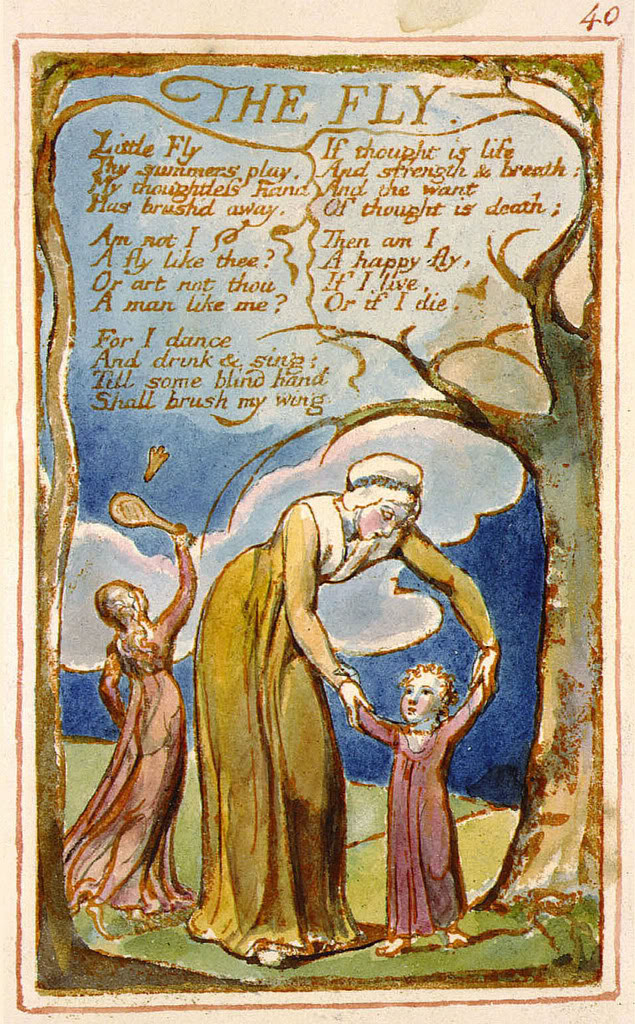
Little Fly
Thy summers play,
My thoughtless hand
Has brush'd away.
Am not I
A fly like thee?
Or art not thou
A man like me?
For I dance
And drink & sing:
Till some blind hand
Shall brush my wing.
If thought is life
And strength & breath:
And the want
Of thought is death;
Then am I
A happy fly,
If I live,
Or if I die.
Man who knows himself to be a mind and spirit frequently seeks an explanation for his being a material being in a world of matter.
Here are some explanations which have been devised:
*It pleased God to have some companions.
*Man is being punished for some disobedience.
*Life is meant to be a learning experience.
*The material world spontaneously produced life including mind.
*We are placed here to figure out why we were placed here.
*We are paced here to love God and serve him forever.
*Matter is a manifestation and expression of Spirit.
Blake of course had his explanation which he expressed in poetic language. At the Golden Feast these words were spoken:
Four Zoas, Page 133, (E 401)
"This is the Generative world they rememberd the Days of old
And One of the Eternals spoke All was silent at the feast
Man is a Worm wearied with joy he seeks the caves of sleep
Among the Flowers of Beulah in his Selfish cold repose
Forsaking Brotherhood & Universal love in selfish clay
Folding the pure wings of his mind seeking the places dark
Abstracted from the roots of Science then inclosd around
In walls of Gold we cast him like a Seed into the Earth
Till times & spaces have passd over him duly every morn
We visit him covering with a Veil the immortal seed
With windows from the inclement sky we cover him & with walls
And hearths protect the Selfish terror till divided all
In families we see our shadows born. & thence we know | Ephesians
That Man subsists by Brotherhood & Universal Love | iii c.
We fall on one anothers necks more closely we embrace | 10 v
Not for ourselves but for the Eternal family we live
Man liveth not by Self alone but in his brothers face
Each shall behold the Eternal Father & love & joy abound
So spoke the Eternal at the Feast they embracd the New born Man
Calling him Brother image of the Eternal Father."
The Bible verse referenced in the passage in the Four Zoas:
Ephesians 3
[10] To the intent that now unto the principalities and powers in heavenly places might be known by the church the manifold wisdom of God,
The above verse in context:
[9] And to make all men see what is the fellowship of the mystery, which from the beginning of the world hath been hid in God, who created all things by Jesus Christ:
[10] To the intent that now unto the principalities and powers in heavenly places might be known by the church the manifold wisdom of God,
[11] According to the eternal purpose which he purposed in Christ Jesus our Lord:
I think that you can say unequivocally that Blake does not think that life in the physical world is a punishment. Blake affirms that God in his love presents man with life as a mercy, grace and gift. Time and matter are gifts too, to incubate the seed which is to grow into a replica and brother of the Eternal Father.
Wednesday, May 26, 2010
LIVING SYMBOLS
 Songs of Innocence (E 16)
Infant Joy
"Sweet Joy Befall Thee"
Besides his well know (to Blake students), A Blake Dictionary, S. Foster Damon wrote William Blake: His Philosophy and Symbols which also has much to teach about Blake's poetry and how it can be understood. This quote about various levels of meaning which the symbol can represent is found on page 65.
"Practically the whole existence of poetry consists of imposing of human values on natural objects...
Symbolism is the recognition and fixation of these values. It is the highest form of that process usually performed by the weaker metaphor and the still weaker simile. The simile states a resemblance, the metaphor states an identity, and the symbol assumes the identity without direct statement. In the first case love would be likened to a rose; in the second case, Love would be called a rose; in the third, the Rose would appear unexplained. There is a still higher rung in this Jacob's Ladder: the rung popularly known as Prophecy. Here the Rose would indicate some particular act in the past, present, or future. A specific temporal significance is thus imposed upon the Symbol, which hitherto dealt with Eternities...
Let us return , then, to the symbol. Blake, of course, knew perfectly well what he was doing. He deliberately interpreted objects to show their relation to, and their expression of, mankind. Everything he saw revealed to him its inner essence, which was in turn the revelation of a truth. Only through this method could Truth be approached. Isis cannot be seen unveiled, for the mortal eye itself is her vesture. The great secrets cannot be told; the very syllables are their mask....
And thus we learn a strange fact: that the clearer, the more precise, Blake's writings become, the more obscure they seem. The trouble is not with Blake, it lies in our own inability to understand. The fires of Hell still seem like torment and insanity to us, the Angles. Therefore Blake cried so fiercely: 'Go! put off Holiness, and put on Intellect!' "
It is not difficult to find passages in Blake to illustrate the use of the symbol to reveal multiple layers of psychological, poetic and spiritual meanings. How does this speak to you?
Four Zoas, Night VIII, Page 113-114, (E 384) [Enion speaking:]
"Listen: I will tell you what is done in the caverns of the grave
the lamb of God has rent the veil of mystery
When the mortal disappears in improved knowledge cast away
The former things so shall the Mortal gently fade away
And so become invisible to those who still remain
Listen I will tell thee what is done in the caverns of the grave
The Lamb of God has rent the Veil of Mystery soon to return
In Clouds & Fires around the rock & the Mysterious tree
As the seed waits Eagerly watching for its flower & fruit
Anxious its little soul looks out into the clear expanse
To see if hungry winds are abroad with their invisible army
So Man looks out in tree & herb & fish & bird & beast
Collecting up the scatterd portions of his immortal body
Into the Elemental forms of every thing that grows
He tries the sullen north wind riding on its angry furrows
The sultry south when the sun rises & the angry east
When the sun sets when the clods harden & the cattle stand
Drooping & the birds hide in their silent nests. he stores his
thoughts
As in a store house in his memory he regulates the forms
Of all beneath & all above & in the gentle West
Reposes where the Suns heat dwells he rises to the Sun
And to the Planets of the Night & to the stars that gild
The Zodiac & the stars that sullen stand to north & south
He touches the remotest pole & in the Center weeps
That Man should Labour & sorrow & learn & forget & return
To the dark valley whence he came to begin his labours anew
In pain he sighs in pain he labours in his universe
Screaming in birds over the deep & howling in the Wolf
Over the slain & moaning in the cattle & in the winds
And weeping over Orc & Urizen in clouds & flaming fires
And in the cries of birth & in the groans of death his voice
Is heard throughout the Universe whereever a grass grows
Or a leaf buds The Eternal Man is seen is heard is felt
And all his Sorrows till he reassumes his ancient bliss"
This is symbolic language at its finest; not allegory, simile or metaphor but living symbols which may enter the Soul of Man: an opportunity to collect the 'scattered portions of [our] immortal bodies.'
Subscribe to:
Posts (Atom)