Showing posts with label Imagination. Show all posts

Tuesday, January 25, 2011

BLAKE & EZEKIEL

The book of Ezekiel in the Old Testament begins with Ezekiel's vision which inludes the Four Living Creatures which Blake used as inspiration for the Four Zoas.

Ezekiel, Chapter 1:
1 "In the thirtieth year, in the fourth month, on the fifth day of the month, as I was among the exiles by the river Chebar, the heavens were opened, and I saw visions of God.
2 On the fifth day of the month (it was the fifth year of the exile of King Jehoi'achin),
3 the word of the LORD came to Ezekiel the priest, the son of Buzi, in the land of the Chalde'ans by the river Chebar; and the hand of the LORD was upon him there.
4 As I looked, behold, a stormy wind came out of the north, and a great cloud, with brightness round about it, and fire flashing forth continually, and in the midst of the fire, as it were gleaming bronze.
5 And from the midst of it came the likeness of four living creatures. And this was their appearance: they had the form of men,
6 but each had four faces, and each of them had four wings.
7 Their legs were straight, and the soles of their feet were like the sole of a calf's foot; and they sparkled like burnished bronze.
8 Under their wings on their four sides they had human hands. And the four had their faces and their wings thus:
9 their wings touched one another; they went every one straight forward, without turning as they went.
10 As for the likeness of their faces, each had the face of a man in front; the four had the face of a lion on the right side, the four had the face of an ox on the left side, and the four had the face of an eagle at the back.
11 Such were their faces. And their wings were spread out above; each creature had two wings, each of which touched the wing of another, while two covered their bodies.
12 And each went straight forward; wherever the spirit would go, they went, without turning as they went.
13 In the midst of the living creatures there was something that looked like burning coals of fire, like torches moving to and fro among the living creatures; and the fire was bright, and out of the fire went forth lightning.
14 And the living creatures darted to and fro, like a flash of lightning.
15 Now as I looked at the living creatures, I saw a wheel upon the earth beside the living creatures, one for each of the four of them.
16 As for the appearance of the wheels and their construction: their appearance was like the gleaming of a chrysolite; and the four had the same likeness, their construction being as it were a wheel within a wheel.
17 When they went, they went in any of their four directions without turning as they went.
18 The four wheels had rims and they had spokes; and their rims were full of eyes round about.
19 And when the living creatures went, the wheels went beside them; and when the living creatures rose from the earth, the wheels rose.
20 Wherever the spirit would go, they went, and the wheels rose along with them; for the spirit of the living creatures was in the wheels.
21 When those went, these went; and when those stood, these stood; and when those rose from the earth, the wheels rose along with them; for the spirit of the living creatures was in the wheels.
22 Over the heads of the living creatures there was the likeness of a firmament, shining like crystal, spread out above their heads.
23 And under the firmament their wings were stretched out straight, one toward another; and each creature had two wings covering its body.
24 And when they went, I heard the sound of their wings like the sound of many waters, like the thunder of the Almighty, a sound of tumult like the sound of a host; when they stood still, they let down their wings.
25 And there came a voice from above the firmament over their heads; when they stood still, they let down their wings.
26 And above the firmament over their heads there was the likeness of a throne, in appearance like sapphire; and seated above the likeness of a throne was a likeness as it were of a human form.
27 And upward from what had the appearance of his loins I saw as it were gleaming bronze, like the appearance of fire enclosed round about; and downward from what had the appearance of his loins I saw as it were the appearance of fire, and there was brightness round about him.
28 Like the appearance of the bow that is in the cloud on the day of rain, so was the appearance of the brightness round about. Such was the appearance of the likeness of the glory of the LORD. And when I saw it, I fell upon my face, and I heard the voice of one speaking."

Here is Blake's image of Ezekiel's vision in the Book of Ezekiel in the Old Testament from the Museum of Fine Arts Boston.
Notice the four faced living creature, the starry wheels with eyes, the six wings, the four additional faces, the throne on which sits the likeness of God, and between the feet of the creature the tiny man who is Ezekiel observing the vision. Not apparent in this image is the light of the rainbow around the image of God displaying his glory. The image in the Blake Archive better displays the light.

This vision described in the words of the Bible and later illustrated by Blake, has prepared Ezekiel to hear the voice. In Marriage of Heaven and Hell Ezekiel converses with Blake:

Marriage of Heaven and Hell, Plate 12, (E 38)
"The Prophets Isaiah and Ezekiel dined with me, and I asked
them how they dared so roundly to assert. that God spake to them;
and whether they did not think at the time, that they would be
misunderstood, & so be the cause of imposition.
...
Then Ezekiel said. The philosophy of the east taught the first
principles of human perception some nations held one
principle for the origin & some another, we of Israel taught
that the Poetic Genius (as you now call it) was the first
principle and all the others merely derivative, which was the
cause of our despising the Priests & Philosophers of other
countries, and prophecying that all Gods [PL 13] would at last be
proved. to originate in ours & to be the tributaries of the
Poetic Genius,"

Blake was convinced that it is the Poetic Genius, the Human Imagination, the voice of the poet and prophet, that was the voice which spoke to Ezekiel, and through Ezekiel, and which continues to speak to those who have 'ears to hear'.

All Religions Are One, (E 1)
PRINCIPLE. 5. The Religions of all Nations are derived from
each Nations different reception of the Poetic Genius which is
every where call'd the Spirit of Prophecy.
PRINCIPLE 6 The Jewish & Christian Testaments are An original
derivation from the Poetic Genius. this is necessary from the
confined nature of bodily sensation

Thursday, January 13, 2011

BUNYAN'S DARK FIGURES

We were fortunate to purchase (for less the $20) a copy of Gerda S. Norvig's book Dark Figures in the Desired Country in which she presents her study of Blake's illustrations of Pilgrim's Progress.

It is refreshing to read Blake criticism from a scholar who thinks with a psychological perspective. Norvig is a qualified clinical psychologist as well a professor of English literature. Her book was assembled over a period of twenty years during which she was refining her understanding of Blake and of the human psyche. She sees Blake's development as being a process in which he gained the self-understanding which allowed him to understand the process through which Bunyan produced Pilgrim's Progress.

Norvig says "When in the following chapters I explore Blake's psychologizing of Bunyan's myth, I draw often, as mentioned in the preface, on the vocabulary of Jungian and post-Jungian theory to articulate some of Blake's most characteristic moves. What led me to choose the Jungian perspectives of analytical and archetypal psychology for this task is that the central vision of these approaches so clearly echoes the conception of the imagination dominating Blake's every word and every stroke of graphic expression...
for both Blake and the Jungians, "imagination is not a state" (M 32, E132/K522), nor is it just one of the many faculties of the mind; rather, it is the root capacity conditioning all mental functioning. [Page 17]..

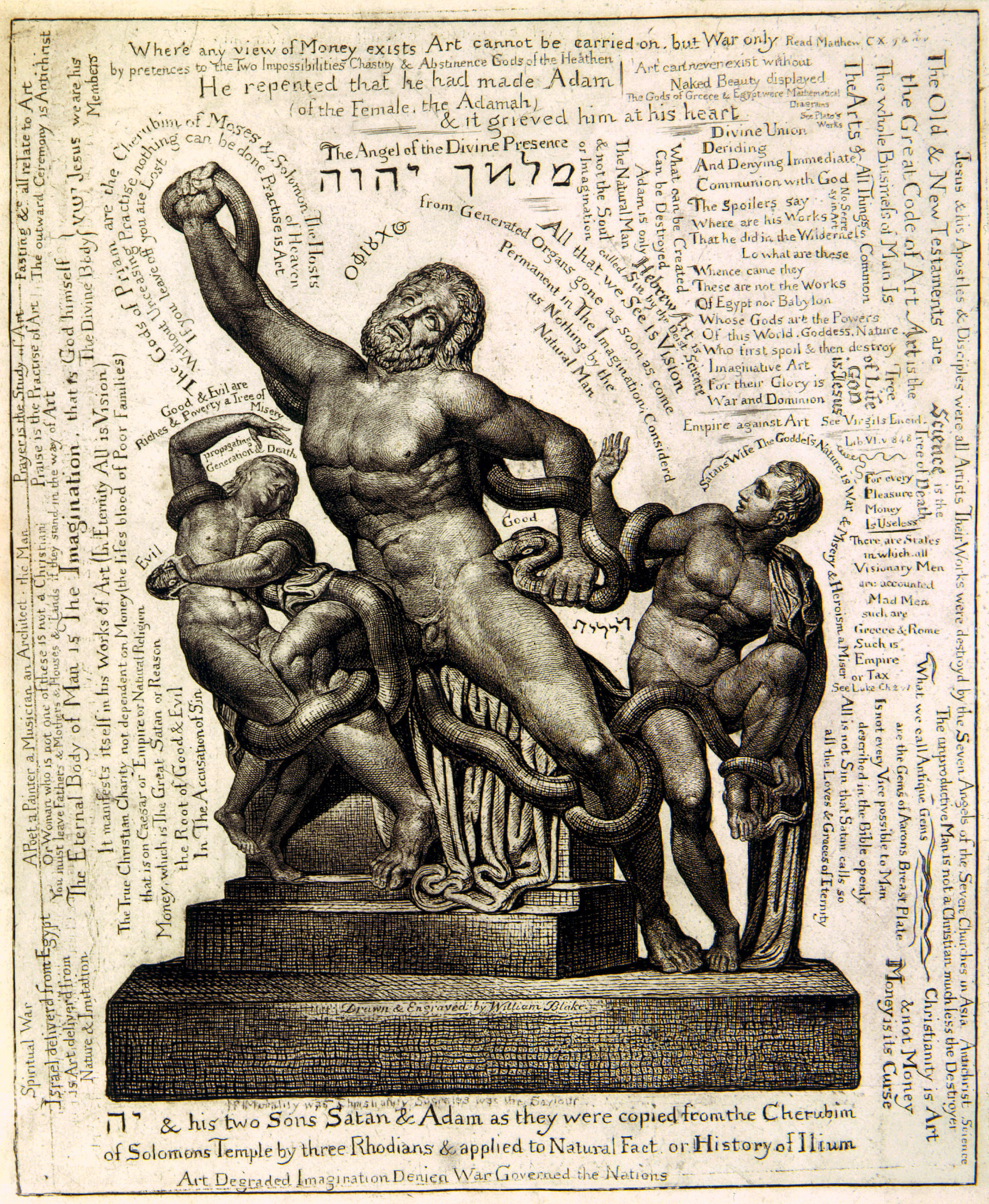
"For him, too, the archetypal structures, functions, fictions and images of the human imagination have both primacy over and ontological independence from the psychodynamics of any individuals case history. Thus his statement that "The Eternal Body of Man is the IMAGINATION that is God himself The Divine Body...JESUS we are his Members" (Laocoon, E273/K776) creates a picture of the psyche as larger than the body and life of the the individual subjects who articulate it." [Page 18]

Bringing these strategies to bear in discerning the meaning which Blake perceives in Bunyan's allegory and presents through images of archetypal experiences, Norvig reveals Bunyan and Blake delving into the collective psyche.


Blake's Laocoon
Text on Laocoon

Wednesday, December 8, 2010

EVIDENT TO THE CHILD

___________________________Image from Songs of Innocence,
___________________________Little Black Boy

Blake with his unusually high intelligence can be assumed to have to have learned to read very early in his life. Very likely the Bible was among his preferred reading material. He seems to have been attracted to the Old Testament prophets such as Isaiah, Ezekiel, Jeremiah, Amos whose influence is seen in his poetry.
It is interesting to think of Blake as a young child reading the Bible without instruction or supervision, as interacting in his own unique, superintelligent way. He got into some scholarship later and also absorbed the general understanding from his culture. Nevertheless his interaction and interpretation continued to be direct and unusual.

Annotations to Berkeley, (E 664)
"Jesus supposes every Thing to be Evident to the Child & to
the Poor & Unlearned Such is the Gospel
The Whole Bible is filld with Imaginations & Visions from
End to End & not with Moral virtues that is the baseness of Plato
& the Greeks & all Warriors The Moral Virtues are continual
Accusers of Sin & promote Eternal Wars & Domineering over others"

Annotations to Berkeley, (E 664)
"Man is All Imagination God is Man & exists in us & we in him"

Jonathan Roberts and Christopher Rowland contributed a chapter to the Blackwell Companion to the Bible in English Literature in which they present their views on Blake's use of the Bible (Page 376):
"This emphasis on the importance of individuals (and their social contexts) in interpreting the Bible means that Blake is particularly concerned with replacing a literalist hermeneutic with one that considers the Bible to be a stimulus to the imagination. This means above all engaging readers in the interpretation of the text, rather than demanding they accept it as in object above and beyond them. To this end Blake provides a consistent polemic against the preoccupation with the literal sense of the text, and against a reverence for the text that comes at the expense of what an imaginative and life-affirming encounter with the Bible might offer. These two tasks required a thoroughgoing assault on the ways in which the Bible had been constructed and reduced to a focus on the sacrificial death of Jesus and a religion of moral virtue. Blake would have no truck, for example, with the view that humans are inherently sinful: that God must be appeased by a sacrifice (of Christ); and that God - having made that sacrifice - then expects humanity to behave morally in order to stay in relationship with him (i.e. by keeping his commandments). Such an outlook, Blake thought, led to a denial of aspects of the human person and the subjection of some human beings to others."

Blake seemed to continue to read the Bible as he had as a child - with an open mind. He didn't look back to what the words had meant when they were written exclusively, but to what they meant in the immediate present to his own imaginative ability. His conversations with Ezekiel and Isaiah may have begun long before he wrote The Marriage of Heaven and Hell and continued long after.

Wednesday, October 27, 2010

TRUST II


MARY AT HER DISTAFF WATCHED OVER BY TWO ANGELS
from Milton's Paradise Regained

What may one trust (see post TRUST):

In contrast to things which Blake thought that we could not trust, there were things in which he placed implicit trust. These were the manifestations of the Spirit which increased in his consciousness as he traveled his journey.
_________________________________________________
The Eternal Realities

Jerusalem, Plate 34 [38], (E 180)
"We live as One Man; for contracting our infinite senses
We behold multitude; or expanding: we behold as one,
As One Man all the Universal Family; and that One Man
We call Jesus the Christ: and he in us, and we in him,
Live in perfect harmony in Eden the land of life,
"

Jerusalem, Plate 71, (E 225)
"For all are Men in Eternity. Rivers Mountains Cities Villages,
All are Human & when you enter into their Bosoms you walk
In Heavens & Earths; as in your own Bosom you bear your Heaven
And Earth, & all you behold, tho it appears Without it is Within
In your Imagination of which this World of Mortality is but a
Shadow."

___________________________________________
The Imagination

Milton, Plate 32 [35], (E 132)
"Judge then of thy Own Self: thy Eternal Lineaments explore
What is Eternal & what Changeable? & what Annihilable!
The Imagination is not a State: it is the Human Existence itself
Affection or Love becomes a State, when divided from Imagination
The Memory is a State always, & the Reason is a State
Created to be Annihilated & a new Ratio Created "

Jerusalem, Plate 77, (E 231)
"I know of no other
Christianity and of no other Gospel than the liberty both of body
& mind to exercise the Divine Arts of Imagination.
Imagination the real & eternal World of which this Vegetable
Universe is but a faint shadow & in which we shall live in our
Eternal or Imaginative Bodies, when these Vegetable Mortal Bodies
are no more."

_________________________________________________
The Identity in oneself and in others


Vision of the Last Judgment, Page 80, (E 556)
"These States Exist now Man Passes on but States remain for Ever he passes thro them like a traveller who may as well suppose that the places he has passed thro exist no more as a Man may suppose that the States he has passd thro exist no more Every Thing is Eternal In Eternity one Thing never Changes into another Thing Each Identity is Eternal"

Jerusalem, Plate 38 [43], (E 185)
"Swelld & bloated General Forms, repugnant to the Divine-
Humanity, who is the Only General and Universal Form
To which all Lineaments tend & seek with love & sympathy
All broad & general principles belong to benevolence
Who protects minute particulars, every one in their own identity."

Jerusalem, Plate 55, (E 205)
"The Infinite alone resides in Definite & Determinate Identity
Establishment of Truth depends on destruction of Falshood
continually"
________________________________________________
Our own ability to discern God's presence within Humanity

Milton, Plate 30 [33], (E 129)
"Lo the Eternal Great Humanity
To whom be Glory & Dominion Evermore Amen
Walks among all his awful Family seen in every face
As the breath of the Almighty. such are the words of man to man
In the great Wars of Eternity, in fury of Poetic Inspiration,
To build the Universe stupendous: Mental forms Creating "

Milton, Plate 20 [22], (E 114)
"It has a heart like thee; a brain open to heaven & hell,
Wthinside wondrous & expansive; its gates are not clos'd,
I hope thine are not: hence it clothes itself in rich array;
Hence thou art cloth'd with human beauty O thou mortal man.
Seek not thy heavenly father then beyond the skies:"

If we reject or destroy the verities on which we have relied without a means of replacing them, we are left with a void to fill. If we do not have Truth to fill the emptiness, fear and falsehood will invade the empty space. Blake offered alternatives to those who came to reject their reliance on sense data, rationalization, following authority and accepting systems of deception.

Reliance on sense data is to be replaced with awareness of the Eternal Realities.
Reliance on the reasoning mind is to be replaced by the ability to use the Imagination.
Reliance on established authority is to be replaced by the ability to discern God's presence in humanity
The reliance on systems created by others is to be replaced by the ability to recognize the Identity in oneself and others.

In vision Blake was able to see the new world which could replace this fallen existence:

Vision of the Last Judgment, (E 555)
"There Exist in that Eternal
World the Permanent Realities of Every Thing which we
see are reflected in this Vegetable Glass of Nature All
Things are comprehended in their Eternal Forms in the
Divine body of the Saviour the True Vine of Eternity
The Human Imagination who appeard to Me as Coming to
Judgment. among his Saints & throwing off the Temporal
that the Eternal might be Establishd."

Saturday, October 23, 2010

BLAKE'S SUBLIME


The word sublime, has many meanings both specialized and generalized. Blake uses the term in a variety of ways and enhances the meaning by the usage he puts it to. Here are a few of the definitions:
>to cause to pass directly from the solid to the vapor state
>to elevate or exalt especially in dignity or honor
>to convert into something of higher worth
>tending to inspire awe or terror.

A related word with a related meaning is subliminal: taking place below the threshold of sensory perception or outside the range of conscious awareness.

Roger R. Easson in his chapter of Blake's Sublime Allegory explains sublime in the context of its chemical or alchemical meaning:
"Blake defines sublime allegory, in the famous Butts letter of 6 July 1803, as 'Allegory addressed to the Intellectual powers, while it is altogether hidden from the Corporeal understanding...' (Letters, p. 69 [27]). Discussing the same idea of poetry, Blake puts it more chemically: 'What is it sets Homer, Virgil & Milton in so high a rank of art? Why is the Bible more entertaining than any other book? Is it not because they are addressed to the Imagination, which is Spiritual Sensation, & but mediately to the Understanding or reason?...Consider what Lord Bacon says: 'Sense sends over to Imagination before Reason have Judged, & Reason send over to Imagination before the Decree can be acted'' (Letters, p. 30 [5]). In chemistry the verb 'sublime' means that a substance may pass from solid to gas without passing into the intermediate liquid state. So too is Blake using the word. Sublime allegory is poetry that speaks to the intellectual powers without penetrating the intermediate stage of the corporeal understanding. It is poetry that is, quite literally, beyond reason. Consequently, it is best suited for dethroning reason within the reader who does not understand that the dominance of reason in his own mind prevents his entering the life of eternity."

Letter 27, [To Thomas Butts] (E 729)
Felpham July 6. 1803
"...Thus I hope that all our three years trouble Ends in
Good Luck at last & shall be forgot by my affections & only
rememberd by my Understanding to be a Memento in time to come &
to speak to future generations by a Sublime Allegory which is now
perfectly completed into a Grand Poem[.] I may praise it since I
dare not pretend to be any other than the Secretary the Authors
are in Eternity I consider it as the Grandest Poem that This
World Contains. Allegory addressd to the Intellectual powers
while it is altogether hidden from the Corporeal Understanding is
My Definition of the Most Sublime Poetry."

More quotes of Blake's use of Sublime:

MHH, Plate 7, (E 35)
"The most sublime act is to set another before you."

MHH, Plate 10, (E 37)
"The head Sublime, the heart Pathos, the genitals Beauty, the
hands & feet Proportion."

Descriptive Catalogue, Page 42, (E 543)
"The Strong man represents the human sublime. The Beautiful
man represents the human pathetic, which was in the wars of Eden
divided into male and female. The Ugly man represents the human
reason."

Four Zoas, Page 5, (E 302)
"Tharmas groand among his Clouds
Weeping, then bending from his Clouds he stoopd his innocent head
And stretching out his holy hand in the vast Deep sublime
Turnd round the circle of Destiny with tears & bitter sighs"

Four Zoas, PAGE 98 [90], (E 370)
"Then I can sigh forth on the winds of Golgonooza piteous forms
That vanish again into my bosom but if thou my Los
Wilt in sweet moderated fury. fabricate forms sublime
Such as the piteous spectres may assimilate themselves into
They shall be ransoms for our Souls that we may live

So Enitharmon spoke & Los his hands divine inspired began
To modulate his fires studious the loud roaring flames"

Descriptive Catalogue, Page 2, (E 531)
"The Greek Muses are daughters of Mnemosyne, or Memory, and not of
Inspiration or Imagination, therefore not authors of such sublime
conceptions."

Jerusalem, Plate 1,(E 144)
"There is a Void, outside of Existence, which if enterd into
Englobes itself & becomes a Womb, such was Albions Couch
A pleasant Shadow of Repose calld Albions lovely Land

His Sublime & Pathos become Two Rocks fixd in the Earth
His Reason his Spectrous Power, covers them above

Jerusalem his Emanation is a Stone laying beneath"

Jerusalem, Plate 34, (E 180)
"I see thee awful Parent Land in light, behold I see!
Verulam! Canterbury! venerable parent of men,
Generous immortal Guardian golden clad! for Cities
Are Men, fathers of multitudes, and Rivers & Mount[a]ins
Are also Men; every thing is Human, mighty! sublime!
In every bosom a Universe expands, as wings
Let down at will around, and call'd the Universal Tent."

To locate all 58 mentions of sublime, go to the blog sidebar, page down to LINKS TO ONLINE BLAKE, click on Concordance to Complete Works.

These are characteristics which you may note as being associated with sublime in Blake:
TRANSFORMATIVE,
BELOW LEVEL OF THE CONSCIOUS,
ASSOCIATED WITH HUMAN IMAGINATION,
PARTAKING OF IDENTITY,
ELEVATED OR AWE-INSPIRING

Thursday, October 21, 2010

TERROR & WOE

Four Zoas, Night VII, Page 84, (E 359)

"This thou well rememberest listen I will tell
What thou forgettest. They in us & we in them alternate Livd
Drinking the joys of Universal Manhood. One dread morn
Listen O vision of Delight One dread morn of goary blood
The manhood was divided for the gentle passions making way
Thro the infinite labyrinths of the heart & thro the nostrils issuing
In odorous stupefaction stood before the Eyes of Man
A female bright. I stood beside my anvil dark a mass
Of iron glowd bright prepard for spades & plowshares. sudden down
I sunk with cries of blood issuing downward in the veins
Which now my rivers were become rolling in tubelike forms
Shut up within themselves descending down I sunk along,
The goary tide even to the place of seed & there dividing
I was divided in darkness & oblivion thou an infant woe
And I an infant terror in the womb of Enion
My masculine spirit scorning the frail body issud forth
From Enions brain In this deformed form leaving thee there
Till times passd over thee but still my spirit returning hoverd
And formd a Male to be a counterpart to thee O Love
Darkend & Lost In due time issuing forth from Enions womb
Thou & that demon Los wert born Ah jealousy & woe
Ah poor divided dark Urthona now a Spectre wandering
The deeps of Los the Slave of that Creation I created
I labour night & day for Los but listen thou my vision
I view futurity in thee I will bring down soft Vala
To the embraces of this terror & I will destroy
That body I created then shall we unite again in bliss"

From the Seventh Night of the Four Zoas we have one of several accounts of the origin of Los, Enitharmon and the Spectre of Urthona. The eternal Zoa Urthona, first has his manhood divided from the gentle passions resulting in the externalization of the female. Urthona begins to manifest internal changes as he continues his work at his furnaces. The masculine spirit issues from Enion's brain. Times passed until Enitharmon issued from Enion's womb. The division into the 'infant terror', Los and the 'infant woe', Enitharmon leaves Urthona as a Spectre.

Illustrations to Gray's Poems, Page 78


Looking at this situation from the perspective of Los as the Imagination, the division has left the imagination without its inspiration which should be supplied by the Emanation and the instrumentality which could be supplied by the Spectre.


Frye, on page 294 of Fearful Symmetry, explains some of the consequences of the division and separation of the unified Zoa Urthona:
"In creation, therefore, the Spectre of Urthona is the inventive faculty, and invention is the art of finding things in nature: it does not create so much as supply the instruments for creating. The Spectre of Urthona, properly controlled, is the obedient demon who brings his master the fire and metals and other physical needs of culture, and brings the artist his technical skill...But once separated from creative and imaginative ends, the instrumental becomes an end in itself, its criteria of use and value are made absolute principles, its media, such as money, become more important than the things they circulate, and vast complications of tools and machines are produced out of sheer automatic compulsion to produce them."

Only the reunion of the disparate functions - the terror and the woe - can restore the bliss of integration.

Monday, October 4, 2010

INTRODUCTION TO OUR BLOG

This is a repost of an earlier post intended to help Blake students get started:

An anonymous reader has asked that we provide more information in our posts. So I will try to explain what we are attempting to do in our Blake blog.


First we want to focus our attention on William Blake and his writing.

We are not experts but students of Blake. We follow our own interests. We are interested in sharing what we have learned of Blake and would would like to tailor our posts to the interests of the reader. We hope readers will let us know what interests them about Blake.

There have been posts which attempt to introduce the reader to studying Blake especially using the resources on the internet. The links to the text of Blake's poetry and prose, and to his graphic works are provided. A link to Larry's online book which includes a primer is also a useful tool. (These files can be electronically searched for specific topics.) Within the posts we often provide links to external files which expand the study to wider sources.

None of Blake's work is simple to understand. Beginners can start with Songs of Innocence and Experience. Marriage of Heaven and Hell grabs the attention of many with its irony. The major prophecies can be approached a little at a time rather than entire. If you are visually oriented, the visual images can be used as an avenue to draw you into reading the poetry.

Blake's body of work is large and complex. On our blog we have not attempted a systematic study. We are giving clues to solving the mystery. Analysts of Blake's work often tell us that Blake expected the reader to go beyond what was stated in the text, to perceive the underlying meaning. We hope our readers will sift through the blog posts looking for cracks or doors or highways through which they may enter Blake's mind and heart and imagination.

Reading Blake may expand your mind, nourish your spirit, or enrich your imagination; don't expect it to put money in your pocket, expand your social circle or impress your professors.

Here are some earlier posts which may help the neophyte.

Bible
Perception
Vision
Emphasis
Help
Fourfold
Idealism
Reader
Plates
4Z's


I can't end without a quote from Blake as well as the picture.
Liberty or Stems of Vegetation

Jerusalem, Plate 60, (E 209)

"within the Furnaces the Divine Vision appeard

On Albions hills: often walking from the Furnaces in clouds
And flames among the Druid Temples & the Starry Wheels
Gatherd Jerusalems Children in his arms & bore them like
A Shepherd in the night of Albion which overspread all the Earth

I gave thee liberty and life O lovely Jerusalem
And thou hast bound me down upon the Stems of Vegetation"

Saturday, October 2, 2010

PRINTMAKER

Blake's London
- follow the sites in London where Blake lived, was educated and worked.

In addition to home-schooling from his Moravian mother and his hosier father, Blake's formal schooling came from Henry Par's drawing school.
For his parents to provide this opportunity to him, he must shown a talent for art and a strong interest in it early in life. There is no way to know how much skill in art he had picked up before he was sent to drawing school at age 10, or how rigorous his training was at Par's. When he was apprenticed at age 14 to the engraver James Basire, he began a thorough education in a demanding discipline. Basire's apprenticeship made him into an accomplished engraver with the wide range of technical and artistic skills necessary for a mastery of the trade.

With his apprenticeship complete, Blake knew that he had acquired a skill with which he could with diligence earn a living. But Blake's desire was to be an artist not an artisan. He never let his engraving skills lie fallow, but his work as an artist was his passion. He could use his engraving skills for illustrating other people's books or producing advertisements and leaflets, or producing pictures for a catalog. He preferred to put his engraving to the service of his own art and poetry.

We see from the first books that he produced (1788), All Religions Are One, and There Is No Natural Religion, that he was willing to start small and simple as if he were beginning an exploration. These tiny books had images less that 2x3 inches in size. With combined text and images in
black and white, they would lead to further experiments with size, color, media, and techniques. Sometimes his poetry took center stage and left the images as the supporting cast. In other cases the image provided the essence of what he wanted to communicate.

He experimented with a technique of adding colored pigments directly to his engraved plates before they were printed. This produced images in which the color rather than the line was of the greatest import in the work. Images from this short lived period are among my favorites. However Blake did not stick with this technique, probably because the defining line which was all important to him was less evident in this style of printing. Blake valued originality, the unique expression. His artwork evolved throughout his lifetime to give continuing fresh expression to his imagination.

_____Book of Los, image 1________________America, image 8


Blake repeatedly stated his loyalty to the use of outline in his works of art:

Jerusalem, Plate 74, (E 229)
"I tell how Albions Sons by Harmonies of Concords & Discords
Opposed to Melody, and by Lights & Shades, opposed to Outline
And by Abstraction opposed to the Visions of Imagination"

Descriptive Catalog (E 549)
[BLAKE'S EXHIBITION AND CATALOGUE OF 1809]
"If losing and obliterating the outline constitutes a
Picture, Mr. B. will never be so foolish as to do one. Such
art of losing the outlines is the art of Venice and Flanders; it
loses all character, and leaves what some people call,
expression: but this is a false notion of expression; expression
cannot exist without character as its stamina; and neither
character nor expression can exist without firm and determinate
outline."

Annotations to Reynolds, (E 651)
[Reynolds - Page 75] "A firm and determined outline is one of the
characteristics of the great style in painting; and . . . he who
possesses the knowledge of the exact form which every part of
nature ought to have, will be fond of expressing that knowledge
with correctness and precision in all his works."
[Blake's comment] "A Noble Sentence
Here is a Sentence Which overthrows all his Book"

Saturday, September 4, 2010

FLAXMAN, GRAY & BLAKE


Item 89, "To him the mighty mother did unveil her awful face", Thomas Gray


"Around the Springs of Gray my wild root weaves
Traveller repose & Dream among my leaves,"

--WILL. BLAKE


John Flaxman was a friend of Blake from his student days, a fellow artist and associated with the Swedenborg Church in which Blake briefly participated. There was sometimes tension in the relationship between the fiery Blake and the restrained Flaxman but their relationship was sustained. Blake appreciated the help his friend gave him emotionally and professionally.

This section from a letter Blake wrote to Flaxman in 1800 shows that Blake understood the debt he owed to Flaxman who became quite successful and influential in his time.

Letters, Mr Flaxman, Buckingham Street, Fitzroy Square (E 707)
"To My Dearest Friend John Flaxman
these lines

I bless thee O Father of Heaven & Earth that ever I saw Flaxmans face
Angels stand round my Spirit in Heaven. the blessed of Heaven are my friends upon Earth
When Flaxman was taken to Italy. Fuseli was giv'n to me for a season
And now Flaxman hath given me Hayley his friend to be mine such my lot upon Earth
Now my lot in the Heavens is this; Milton lovd me in childhood & shewd me his face
Ezra came with Isaiah the Prophet, but Shakespeare in riper years gave me his hand
Paracelsus & Behmen appeard to me. terrors appeard in the Heavens above
And in Hell beneath & a mighty & awful change threatend the Earth
The American War began All its dark horrors passed before my face
Across the Atlantic to France. Then the French Revolution commencd in thick clouds
And My Angels have told me. that seeing such visions I could not subsist on the Earth
But by my conjunction with Flaxman who knows to forgive Nervous Fear
I remain for Ever Yours
WILLIAM BLAKE"

Owing to the close social connection between the Blakes and the Flaxmans, we have one of Blake's unique productions. To please his wife Ann, John Flaxman commissioned William Blake to produce a set of watercolor illustrations of the poems of Thomas Gray which were favorites of Ann. For the sum of 10 guineas Blake produced 116 watercolors and this poem of his own which he attached to the end.

[With Blake's Illustrations to Gray's Poems]
Pickering Manuscript (E 482)
"To Mrs Ann Flaxman
A little flower grew in a lonely Vale
Its form was lovely but its colors pale
One standing in the Porches of the Sun
When his Meridian Glories were begun
Leaped from the steps of fire & on the grass
Alighted where this little flower was
With hands divine he moved the gentle sod
And took the Flower up in its native Clod
Then planting it upon a Mountains brow
'Tis your own fault if you don't flourish now
- William Blake"

The watercolors which were bound into a book remained in the Flaxman family and in private hands until in1966 they were purchased by Paul Melon (for the Yale Center for British Art) and a expensive facsimile book was issued. You can now purchase a copy of the Dover reprint of Blake's Watercolours for the Poems of Thomas Gray for $24.95 or for less if you wait for a sale. All 116 color illustrations are included in a
9 1/8 x 11 5/8 inch format.

Monday, August 23, 2010

MUSIC, ART & POETRY

For Blake, the gifts of the imagination are music as well as art and poetry. Through these avenues man maintains contact with Eternity. Man's inner life needs to be fed by activities which draw him away from consciousness of the material world into spiritual consciousness.

Blake portrayed these gifts of the imagination in the only lithograph he is known to have made. The technique of lithography was originated in the early nineteenth century. Somehow Blake gained the knowledge and opportunity to experiment with this new technique. He chose for his subject the various skills of imaginative expression, surrounding a central figure who holds in his hand a book bearing the word Enoch in Hebrew. Inscribed on
a plaque being read by two figures on the upper right is a verse (in Hebrew) from the book of Genesis (2:24): "Enoch walked with God; and he was not, for God took him".

The central figure resembles the Job, Urizen, or Jehovah from other images, but he has the face of a visionary, holds no tablets of law, and in his lap is a book whose inscription is the name of a patriarch who was uniquely close to God. The grape vines surrounding the figures remind us of the wine of transformation. The artist, the poet and the musician on the earthly plane focus their attention on creating. Between the portrayals of working artists and the references to the Bible, Blake primary source of inspiration, we have as complete a picture of the life of Blake's imagination as we will find.

Plate four of the Illustration to the Book of Job, 'Satan Before the Throne of God' , provides an interesting comparison to this picture.

Here is some of what Blake said in his poetry to supplement what he said in graphic art:

Milton, Plate 27 [29],(E 125)
"But in Eternity the Four Arts: Poetry, Painting, Music,
And Architecture which is Science: are the Four Faces of Man.
Not so in Time & Space: there Three are shut out, and only
Science remains thro Mercy: & by means of Science, the Three
Become apparent in time & space, in the Three Professions
Poetry in Religion: Music, Law: Painting, in Physic & Surgery:
That Man may live upon Earth till the time of his awaking,
And from these Three, Science derives every Occupation of Men."

Jerusalem, Plate 3, (E 146)
"Every word and every letter is studied and put into its fit
place: the terrific numbers are reserved for the terrific
parts--the mild & gentle, for the mild & gentle parts, and the
prosaic, for inferior parts: all are necessary to each other.
Poetry Fetter'd, Fetters the Human Race! Nations are Destroy'd,
or Flourish, in proportion as Their Poetry Painting and Music,
are Destroy'd or Flourish! The Primeval State of Man, was Wisdom,
Art, and Science."

The Laocoon (E 273)
"Practise is Art If you leave off you are Lost

A Poet a Painter a Musician an Architect: the Man
Or Woman who is not one of these is not a Christian
You must leave Fathers & Mothers & Houses & Lands
if they stand in the way of ART

The unproductive Man is not a Christian much less the Destroyer"

EUROPE a PROPHECY, Plate 3,(E 60)
"Five windows light the cavern'd Man; thro' one he breathes the
air;
Thro' one, hears music of the spheres; thro' one, the eternal
vine
Flourishes, that he may recieve the grapes; thro' one can look.
And see small portions of the eternal world that ever groweth;
Thro' one, himself pass out what time he please, but he will not;
For stolen joys are sweet, & bread eaten in secret pleasant."

Saturday, August 14, 2010

The Happy Child

Before the loss of innocence the average child has an inner vision absent to most adults; it's generally stripped away by the age of six. Under the influence of early public education a socialization or social conditioning process takes place, and conventional thought forms take the place of the child's inner thoughts.

Most Blake students remember the vision of the angry God that Blake found in his window at the age of four. You can be sure that such a fancy is likely to be trained out of a small child-- in most cases but not in Blake's. We know very little about his parents other than a generally dissenting faith (Swedenborgians, Moravians, etc.).

But they must have had liberal ideas about child rearing because a few years later when he reported seeing a tree filled with angels, his mother talked his father out of a disciplinary response. Another liberal idea was their permission for him to leave school after the first day (when the schoolmaster flogged a boy).

All this leads to the conclusion that Blake never lost the faculty of inner vision, which has been conditioned out of most of us. With no hindrance to his childhood visions and freedom from organized schooling Blake became an autodidact; in all likelihood regarding pre-Enlightenment thought he became the most learned man of his generation.

Jesus is reported to have said, "Whosoever shall not receive the kingdom of God as a little child, he shall not enter therein" in Mark 10:15. That's often thought to mean that the child trusts his father, but might it not also mean he has a child's imagination?

One might say Blake remained like a child his entire life. The four year old who had seen the angry God in his window, who a bit later had seen the tree full of angels continued to see those sorts of things as the years went by.

In the course of time the 'angry God' became Nobodaddy and a large variety of other 'god-like' figures. And the 'tree full of angels'? who knows.

How could that be? Unlike you and me Blake (after the first day) never went to school, the place where most of the 'child' has been drilled out of us. For Blake? no! "I must Create a System or be enslav'd by another Mans". He didn't heed what the priests told him about God; he already knew the God within (the Quaker Way). He spent twenty years wrestling with the God he knew.

In Songs of Innocence he gave delightful portraits of the child within himself, and in Songs of Experience he showed us what this cruel vale in tears where we live had done to those lovely children. Look at Version 1 and Version 2 of Holy Thursday and at Version 1 and 2 of the Chimney Sweeper.

The Little Black Boy showed a child put upon by a cruel society, but not embittered thereby. Blake's poetry is often bitter, ironic, satiric, condemnatory! "Blake's poetry has the unpleasantness of great poetry" (T.S.Eliot). So much like Isaiah and Jeremiah: pages and pages of bitter excoriation.

But in the midst of the cries, just like Isaiah, you suddenly find passages of ethereal beauty and joy. Like a child: either delighted or miserable!

Finally the child is creative! I haven't found any poet who matches Blake's creativity; his System is like discovering another planet.


Thursday, July 15, 2010

GIVE BODY to IDEAS

I ended my last post by saying: "The picture I get is that Jesus, Newton, Blake, the Creator and Urizen shared the same instrument as well as some of the same activity. That activity was giving body to ideas."

Here is the passage from Northrup Frye' s Fearful Symmetry (Page 267) about giving body to ideas.

"The artist does not use natural images to clothe his ideas so much as to give body to them. An abstract idea is a spectre, a collapsing skeleton; a concrete image has flesh and blood. Hence the rather violent image of woven bodies which Blake employs in this context: from the skeleton's point of view it is rather difficult to say whether the flesh is body or clothing.
In making the familiar intelligible, in imposing a permanent vision on the flux of time, the artist creates a body out of nature which has a mental form. He thereby teaches us to see, in the small part of mystery which he has made coherent, the image, that is, the form of reality, of a universal coherence; he suggests, in other words, that if his natural body is a mental form, then the entire body of nature, from atoms to stars, may also be form of the human mind, if the imagination could get hold of it. Our fallen senses hollow out a tiny grotto in a boundless stretch of mystery, and this grotto is our home. But the center of the real universe is wherever we happen to be, and its circumference the limit of the radius of our experience. In the perspective of the awakened mind, the radius of of our experience is the universe, and art reveals to the senses of distant contact, eyesight and hearing, a universal home or Paradise which is ready for us to inhabit."

Jerusalem, Plate 92, (E 252)
"Los answerd swift as the shuttle of gold. Sexes must vanish & cease
To be, when Albion arises from his dread repose O lovely Enitharmon:
When all their Crimes, their Punishments their Accusations of Sin:
All their Jealousies Revenges. Murders. hidings of Cruelty in Deceit
Appear only in the Outward Spheres of Visionary Space and Time.
In the shadows of Possibility by Mutual Forgiveness forevermore
And in the Vision & in the Prophecy, that we may Foresee & Avoid
The terrors of Creation & Redemption & Judgment. Beholding them
Displayd in the Emanative Visions of Canaan in Jerusalem & in Shiloh
And in the Shadows of Remembrance, & in the Chaos of the Spectre
Amalek, Edom, Egypt, Moab, Ammon, Ashur, Philistea, around
Jerusalem"


This is the world turned upside down.
What we have called reality is seen
to be illusion; what we have called
illusion is seen to be reality. The
powers which have controlled us
have become powerless. Albion
arises and a new day dawns.


Thursday, July 8, 2010

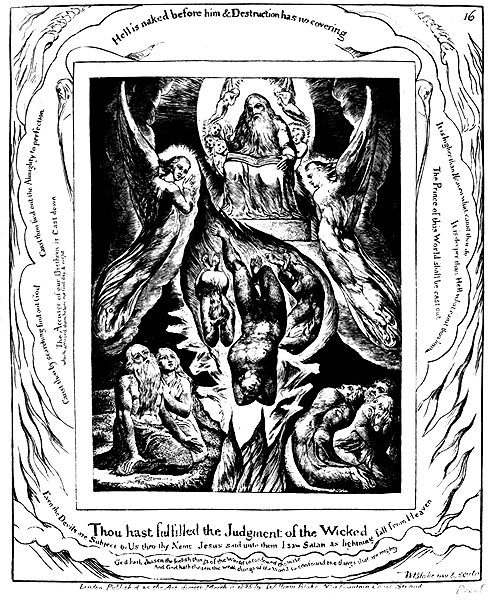
Job Picture 16

Picture 16 is not about Job per-se, but celebrates a statement made by Jesus in Luke 10:18, "I saw Satan fall like lightning from heaven" (incidentally leading to Paradise Lost in a nutshell). In the legends he continued with a proliferation of Bible verses, some in Job and then moving on to the New Testament.

"Hell is naked before him and Destruction has no covering" (Job 26:6). It has the usual three layered Universe and on the left border Blake wrote, "Canst thou by searching find out God -- canst thou find out the Almighty to perfection" (Job 11:7) and below that "the Accuser of our Brethen is Cast down".

And on the right border: "It is higher than Heaven what canst thou do" "it is deeper than Hell what canst thou know" (Job 11:8) "the Prince of this world shall be cast out" (John 12:31)

Below the picture he wrote:
"Thou hast fulfilled the Judgment of the Wicked" (Job 36:17) and "even the Devils are Subject to Us through thy Name" (Luke 10:17) and I saw Satan" etc.

Then "God hath chosen the foolish things of the World to confound the wise and God hath chosen the weak things of the World to confound the things that are mighty"
(I Corinthians 1:27)


Blow this picture up with ctrl + several times and look carefully at the figure of God--with several babies? (cherubs?) around him. (You may find a child about to be born to your favorite mother.) Now compare this picture with Picture 2. The difference indicates a change in Job's evaluation of God (reflecting a more personal change in Blake's attitude toward the O.T. God.)

Let your imagination run wild (Like Blake's?) and you may see the new children God had prepared for Job.

Wednesday, July 7, 2010

REASON & EMOTION


Erdman, in The Illuminated Blake
says: "Phaeton-like, down hurdle a naked man and sword and a horse with saddle cloth and broken chariot wheel...The man's spread hands are braced to hit the ground, but it is already in flames. Reason must have forgotten to let the horse do the pulling; a sword is not a bridle. But Energy must have restraint. Between them they have let the sun fall, connoting universal ruin."


The Marriage of Heaven and Hell was written in 1791 when Blake was a young man; he might be called an angry young man.

Marriage of Heaven and Hell, Plate 5, (E 34)
"Those who restrain desire, do so because theirs
is weak enough to be restrained; and the restrainer or
reason usurps its place & governs the unwilling.
And being restraind it by degrees becomes passive
till it is only the shadow of desire.
The history of this is written in Paradise Lost. & the
Governor or Reason is call'd Messiah.
And the original Archangel or possessor of the com-
mand of the heavenly host, is calld the Devil or Satan
and his children are call'd Sin & Death
But in the Book of Job Miltons Messiah is call'd
Satan. For this history has been adopted by both parties
It indeed appear'd to Reason as if Desire was
cast out. but the Devils account is, that the Messiah
fell. & formed a heaven of what he stole from the Abyss
This is shewn in the Gospel, where he prays to the
Father to send the comforter or Desire that Reason
may have Ideas to build on, the Jehovah of the Bible
being no other than he, who dwells in flaming fire.
Know that after Christs death, he became Jehovah.
But in Milton; the Father is Destiny, the Son, a
Ratio of the five senses. & the Holy-ghost, Vacuum!
Note. The reason Milton wrote in fetters when
he wrote of Angels & God, and at liberty when of
Devils & Hell, is because he was a true Poet and
of the Devils party without knowing it"

Blake was continually striving to free his imagination from constraints. The internal constraints of which he was most aware (excluding the selfhood) were misguided reason and emotion. In Plate 5 of Marriage of Heaven and Hell he expresses the concern that reason will succeed in restraining the emotions to the point that the imagination is bound. Emotion or desire is the source of energy which is required for the creative process.

As a poet, Blake identifies with Milton whose Paradise Lost was of consuming interest to Blake. In this Plate Blake deals with the poet's work (his own and Milton's), Biblical characters who becomes fictional characters for both the poets, and the abstract ideas of reason and emotion.

Blake became so interested in correcting the misconceptions of his friend (his spiritual, intellectual but not corporeal friend), that he addressed the issue in his poem Milton. Since Milton died 83 years before Blake was born, this was a friendship on the level of Eternity; time was not of the essence.

The crux of Milton's error in Blake's system is stated concisely as:
"But in Milton; the Father is Destiny, the Son, a Ratio of the
five senses. & the Holy-ghost, Vacuum!"

In Blake the Father is the Divine Humanity, in whose Image man is created; the Son is the Divine Vision, God in Man, the Incarnation; and the Holy Spirit is the Divine Body, the Human Imagination, the activity of expressing the Divine.

Or in other terms for Blake:
Father = Urizen = reason
Son = Luvah = emotions
Holy Spirit = Los = intuition or imagination
Unified man = Tharmas = body

Saturday, July 3, 2010

LEVELS of EXISTENCE II

Continuation of July 1 post.

BEULAH

Through Los generation supplies belief in the Eternal values using reason and the senses, (although confined in the illusion of time and space). Beulah supplies knowledge of the Eternal through the imagination which can transcend material limits. Beulah like generation is a world of the sexes, but in Beulah the male and female are married, each plays a role and accepts the designed functions. Beulah is a place of rest and repose where the contraries are equally true. The active nature of the male is in abeyance and the female is obedient. The delicate balance of Beulah however is maintained through illusion which is not to be taken for reality. Reality is unified as in Eden; Beulah maintains the illusion of duality.

Page 86: "...so long as love remains self-sacrificing, man retains his faith in a spiritual reality beyond the world of appearance. When, however, love fails, faith is lost and the finite mind seeks for reality within the finite form."Percival

Man is not meant to remain in Beulah for it is a place of retreat and renewal. Upward to Eden or downward to Generation are the options offered. A desire to remain in Beulah destroys the beautiful balance and sends man backward. Beulah shares with Eden evanescence, fluidity the ability to escape time and space. Love and forgiveness are the methods of maintaining Beulah as the environs of Eden.

EDEN

William Blake's personal goal was to spend as much time in Eden as possible. To transcend to fourfold vision, the ability to perceive the infinite, was his supreme delight. But Eden meant more than vision it also means creative energy, forgiveness, brotherhood and the oneness of wholeness. Beulah is the condition of rest and repose for a purpose - that of returning to the energetic activity of Eden.

Page 50: "In Eden 'there is no restraint from the greatest of all restraints on imaginative living - the selfhood. The self knows it, too, but fixes and makes manifest the energy which flows into it from God.'"

In this life the intensity and clarity of Eden is more than the soul can long endure. Thus the visionary world is fled for the worlds of appearance which have already been described.

Three Levels of Existence are pictured in Plate 9 of Jerusalem:
Pastoral world - Beulah
Dualistic world -Generation
Disintegrated World - Ulro.

A Descriptive Catalogue (E 541)
"The Prophets describe what they saw in Vision as real and existing men whom they saw with their imaginative and immortal organs; the Apostles the same; the clearer the organ the more distinct the object. A Spirit and a Vision are not, as the modern philosophy supposes, a cloudy vapour or a nothing: they are organized and minutely articulated beyond all that the mortal and perishing nature can produce. He who does not imagine in stronger and better lineaments, and in stronger and better light than his perishing mortal eye can see does not imagine at all. The painter of this work asserts that all his imaginations appear to him infinitely more perfect and more minutely organized than any thing seen by his mortal eye"

Thursday, June 17, 2010

SPIRITUAL SENSATION

'If the doors of perception were cleansed everything would appear to man as it is: infinite.' Among the doors of perception are the senses and cleaning them means learning to use them to see not only the finite but the infinite - the finite world is the world of matter the infinite is Eternity. Limiting ourselves to a perception of only the natural world forces to 'believe a lie'.

A dear friend, who spent a lot of time working with underprivileged girls once told us of a revealing dream. She found herself on a stage in a theater and discovered that she was not earthbound but could fly. To the rear of the stage was a scrim and she learned the she could pass through the scrim at will and experience the delights on the other side. She wanted to share the experience with her young friends who were on the stage with her, but found that although they could with effort become airborne, the scrim was a barrier through which they could not pass.

The experience of becoming able to see the Eternal in every event in our lives is analogous to becoming able to pass through the scrim. It is a skill to be recognized, sought, learned and practiced. It is also a gift which can't be mastered by the will. God seeks to give this gift to all who open themselves in receptiveness.


Blake has said the 'Imagination' is 'Spiritual Sensation': a sense like seeing or hearing, formed instead to perceive the non-material. The exercise of the Imagination is the 'perception of the infinite.' If we 'use our imagination' as a tool for our natural sensation directing it toward enhancing material experience, this is not the Imagination of which Blake spoke. 'Seek first the Kingdom of God' as Jesus says. Look for the Eternal Truth revealed within the external world and become a 'Man of Imagination.'

______________________________ The Genius of Shakespeare
MHH, Plate 14, (E 39)
"If the doors of perception were cleansed every thing would
appear to man as it is: infinite."

Auguries of Innocence, (E 492)

"We are led to Believe a Lie
When we see not Thro the Eye"

MHH, Plate 13, (E 39)
"I then asked Ezekiel. why he eat dung, & lay so long on his
right & left side? he answerd. the desire of raising other men
into a perception of the infinite"

Letter to Truxler, (E 702)
"But to the Eyes of the Man of Imagination Nature is Imagination itself. As a man is So he Sees. As the Eye is formed such are its Powers You certainly Mistake when you say that the Visions of Fancy are not be found in This World. To Me This World is all One continued Vision of Fancy or Imagination & I feel Flatterd when I am told So. What is it sets Homer Virgil & Milton in so high a rank of Art. Why is the Bible more Entertaining & Instructive than any other book. Is it not because they are addressed to the Imagination which is Spiritual Sensation & but mediately to the Understanding or Reason Such is True Painting and such alone valued by the Greeks & the best modern Artists."

Matthew 6:33
"But seek ye first the kingdom of God, and his righteousness; and all these things shall be added unto you."

Tuesday, June 15, 2010

NOTHING LOST

Northrup Frye has a good bit to say that adds to the picture of Golgoonoza which we have been developing. Here is a paragraph which clarifies the purpose and the eventual outcome for Blake's City of Imagination. Notice that he emphasizes that Golgonooza as it becomes the New Jerusalem, 'the total form of all culture and civilization', will make permanent (but not static) all the imaginative work which has been contributed to its building. It reminds me of a phrase which I picked up somewhere along the way: nothing lost, nothing wasted.

This is from page 91 of Fearful Symmetry:

"Inspiration is the artist's empirical proof of the divinity of his imagination; and all inspiration is divine in origin whether used, perverted, hidden or frittered away in reverie. All imaginative and creative arts, being eternal, go to build up a permanent structure, which Blake called Golgonooza, above time, and, when this structure is finished, nature, its scaffolding, will be knocked away and man will live in it. Golgonooza will be the city of God, the New Jerusalem which is the total form of all culture and civilization. Nothing that the heroes, martyrs, prophets and poets of the past have done for it has been wasted; no anonymous and unrecognized contribution to it has been overlooked. In it is conserved all the good man has done, and in it is completed all he hoped and intended to do. And the artist who uses the same energy and genius that Homer and Isaiah had will find that he not only lives in the same palace of art as Homer and Isaiah, but lives at the same time."
Perhaps Blake is even more inclusive in the passage about Los' work.

Jerusalem, Plate 13,(E 157)
"Golgonooza: Los walks round the walls night and day.

He views the City of Golgonooza, & its smaller Cities:
The Looms & Mills & Prisons & Work-houses of Og & Anak:
The Amalekite: the Canaanite: the Moabite: the Egyptian:
And all that has existed in the space of six thousand years:
Permanent, & not lost not lost nor vanishd, & every little act,
Word, work, & wish, that has existed, all remaining still
In those Churches ever consuming & ever building by the Spectres
Of all the inhabitants of Earth wailing to be Created:
Shadowy to those who dwell not in them, meer possibilities:
But to those who enter into them they seem the only substances
For every thing exists & not one sigh nor smile nor tear,

PLATE 14
One hair nor particle of dust, not one can pass away."
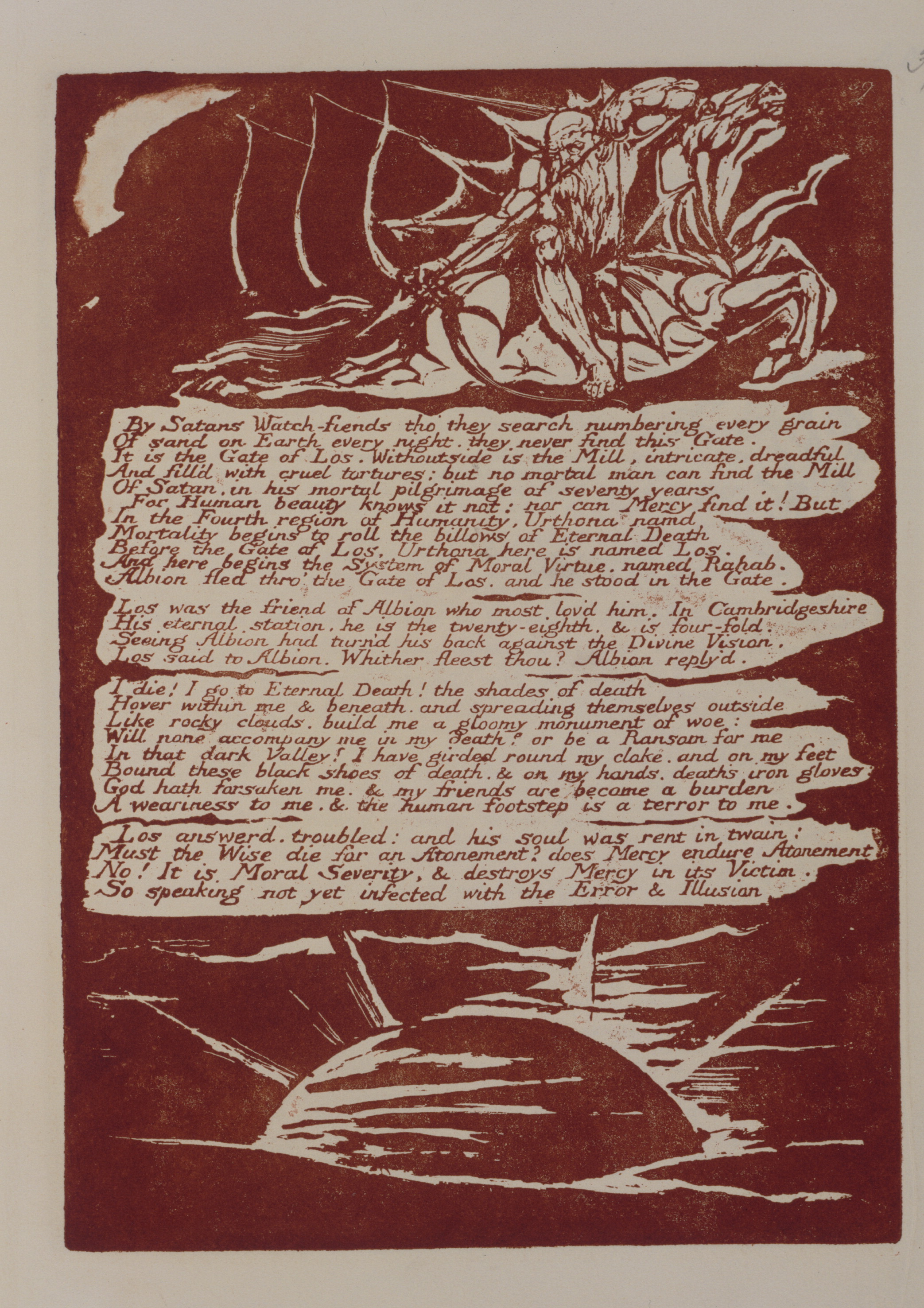
Satan's Watch-fiends Never Find the Gate of Los
JERUSALEM
"this gate cannot be found

PLATE 35 [39] (E 181)
By Satans Watch-fiends
tho' they search numbering
every grain
Of sand on Earth every night,
they never find this Gate.
It is the Gate of Los.
Withoutside is the Mill,
intricate, dreadful
And fill'd with cruel tortures;
but no mortal man can find
the Mill
Of Satan, in his mortal
pilgrimage of seventy years"

Sunday, June 13, 2010

IMAGE


SONGS OF INNOCENCE
, Number 16, (E 11)
A CRADLE SONG

"Sweet dreams form a shade,
O'er my lovely infants head.
Sweet dreams of pleasant streams,
By happy silent moony beams.

Sweet sleep with soft down,
Weave thy brows an infant crown.
Sweet sleep Angel mild,
Hover o'er my happy child.

Sweet smiles in the night,
Hover over my delight.
Sweet smiles Mothers smiles
All the livelong night beguiles.

Sweet moans, dovelike sighs,
Chase not slumber from thy eyes.
Sweet moans, sweeter smiles,
All the dovelike moans beguiles.

Sleep sleep happy child.
All creation slept and smil'd.
Sleep sleep, happy sleep,
While o'er thee thy mother weep.

Sweet babe in thy face,
Holy image I can trace.
Sweet babe once like thee,
Thy maker lay and wept for me

SONGS 17
Wept for me for thee for all,
When he was an infant small.
Thou his image ever see,
Heavenly face that smiles on thee.

Smiles on thee on me on all,
Who became an infant small,
Infant smiles are his own smiles.
Heaven & earth to peace beguiles."
Blake has a way of setting the stage for the development of his future complex system in his early works. Looking at A Cradle Song from the perspective of Jerusalem we see both the intimation of his process of speaking through images and the particular images which came to speak volumes in his mature works. The word 'image' appears twice in this double poem.

First the mother is able to see the creator in the countenance of he child:

"Sweet babe in thy face,
Holy image I can trace."

Later she prays that the child himself may ever see the image of the creator:

"Thou his image ever see,
Heavenly face that smiles on thee."

So the child is in the image of God, and the God whom the child may see is an image also. Blake consistently presents the world of matter as the reflection of another world, the Eternal, more real than this one but which we see through images not through our senses. Throughout his art and poetry Blake is presenting us with images of the Eternal for us to integrate into our mental processing.

Among the words in this poem which will frequently appear as images as we continue to read Blake are dream, shade, infant, moon, sleep, weave, Angel, child, night, delight, mother, weep, babe, face, maker, holy, see, heaven, earth, peace. As images the words point to configurations of associated ideas drawn from our own experience and from the experience of those who influence us. Blake builds his image vocabulary in this poem and in whatever he writes or pictures. We are assisted in building our vocabularies of images through Blake's vast assimilation of ideas from past thinkers and through his gift for seeing through images to the Eternal realities beyond.