Showing posts with label Frye. Show all posts

Thursday, December 30, 2010

FREY ON SYMBOLS


Frye's thoughts and writings on Blake and Milton were assembled in a volume published by the University of Toronto Press and appropriately named Northrop Frye on Milton and Blake:
"
This volume brings together all of Frye's writings on Milton and Blake from 1947 to 1987 - published and unpublished essays, reviews, commentaries, and public lectures - with the exception of Fearful Symmetry...His engagement with Blake, meanwhile, was a personal, intellectual, and spiritual quest, leading him to became the world authority on Blake in the mid-twentieth century."

Here Northrop Frey provides some of his insight into Blake's symbolic meaning of male and female (
p 351):

"The traditional Christian symbolism, God the Creator is symbolically male, and all human souls, whether of men or of women, are creatures, and therefore symbolically female. In Blake, the real man is creating man; hence all human beings, men or women, are symbolically male. The symbolic female in Blake is what we call nature, and has four relations to humanity, depending on the quality of the vision. In the world of death, or Satan, which Blake calls Ulro, the human body is completely absorbed in the body of nature - a "dark Hermaphrodite," as Blake says in The Gates of Paradise (E 268). In the ordinary world of experience, which Blake calls Generation, the relation of humanity to nature is that of subject and object. In the usually frustrated and suppressed world of sexual desire, which Blake calls Beulah, the relation is that of lover and beloved, and in the purely imaginative or creative state, called Eden, the relation is of creator to creature. In the first two worlds, nature is a remote and tantalizing "female will"; in the last two she is an "emanation." Human women are associated with this female nature only when in their behavior they dramatize its characteristics. The relations between man and nature in the individual and historical cycle are different, and are summarized in the The Mental Traveller, a poem as closely related to the cyclical symbolism of twentieth-century poetry as Keats's La Belle Dame Sans Merci is to pre-Raphaelite poetry.
The Mental Traveller
traces the life of a "Boy" from infancy through manhood to death and rebirth. The boy represents humanity, and consequently the cycle he goes through can be read either individually and psychologically, or socially and historically. The latter reading is easier, and closer to the centre of gravity Blake is talking about. The poem traces a cycle, but the cycle differs from that of the single vision in that the emphasis is thrown on rebirth and return instead of on death. A female principle, nature, cycles in contrary motion against the Boy, growing young as he grown old and vice versa."

Friday, December 24, 2010

BLAKEAN CHRISTMAS CARD

This is Our Blakean Christmas Card.
The picture was inspired by one of Blake's images in the Small Book of Designs which is in the collection of the British Museum.

Read about Tharmas and this image in this post on our blog.

Northrop Frye has this to say about Tharmas on page 354 of Northrop Frey on Milton and Blake:
"The passage from death to rebirth is represented in Blake's symbolism by Tharmas, the power of renewing life. The ability of the individual to renew his life in resurrection is a break with the cycle, but in ordinary life such a renewal takes place only in the group or species, and within the cycle. Tharmas is symbolized by the sea, the end and beginning of life."


Picture after Blake’s Small Book of Designs in British Museum

William Blake: Vision of the Last Judgment
"There Exist in that Eternal
World the Permanent Realities of Every Thing which we
see are reflected in this Vegetable Glass of Nature All
Things are comprehended in their Eternal Forms in the
Divine body of the Saviour the True Vine of Eternity
The Human Imagination who appeard to Me as Coming to
Judgment. among his Saints & throwing off the Temporal
that the Eternal might be Establishd."

Luke 2:28-32
Then took he him up in his arms, and blessed God, and said, Lord,
now lettest thou thy servant depart in peace, according to thy word:
For mine eyes have seen thy salvation,
Which thou hast prepared before the face of all people;
A light to lighten the Gentiles, and the glory of thy people Israel.

Thursday, December 16, 2010

CRYSTAL CABINET II

First post on The Crystal Cabinet.

Blake's Water-Colours for the Poems of Thomas Gray, Page 44
'With me the Muse shall sit, and think,'


The Pickering Manuscript, The Crystal Cabinet, (E 488)
"The Maiden caught me in the Wild
Where I was dancing merrily
She put me into her Cabinet
And Lockd me up with a golden Key

This Cabinet is formd of Gold
And Pearl & Crystal shining bright
And within it opens into a World
And a little lovely Moony Night

Another England there I saw
Another London with its Tower
Another Thames & other Hills
And another pleasant Surrey Bower

Another Maiden like herself
Translucent lovely shining clear
Threefold each in the other closd
O what a pleasant trembling fear

O what a smile a threefold Smile
Filld me that like a flame I burnd
I bent to Kiss the lovely Maid
And found a Threefold Kiss returnd

I strove to sieze the inmost Form
With ardor fierce & hands of flame
But burst the Crystal Cabinet
And like a Weeping Babe became

A weeping Babe upon the wild
And Weeping Woman pale reclind
And in the outward air again
I filld with woes the passing Wind"

Blake's poem The Crystal Cabinet is more complex than it may appear on the surface. It is filled with symbols which appear repeatedly in Blake's writing. He seems to have locked up the meaning of the poem in the same way that the maiden locked up the narrator. We are looking for the golden Key which may either let us in or let us out.

This post will give insights from three prominent Blake scholars. Later we will connect the poem to writings from C.S. Lewis and will look at the poem psychologically.

Thoughts on The Crystal Cabinet from Damon, Bloom and Frye:

S. Foster Damon, A Blake Dictionary, page 95:

"The Crystal Cabinet symbolizes the delusions of love. It may be the record of some casual affair in Surrey which ended unhappily."

Harold Bloom, The Visionary Company: A Reading of English Romantic Poetry, page 57:

"But the 'inmost Form' cannot be seized in Beulah; as Thel lamented, there is no unwavering or ultimate form there.The youth has attempted finality in the sexual, which cannot sustain it. As the Cabinet's precarious reality bursts, the youth and former maiden are thrown 'upon the wild' of Ulro; they are no longer 'in the wild' of untried Innocence or lost Experience. The youth is reduced to the schizoid second infancy or idiocy of Ulro, and the Maiden who initiated the act seem to regret the experience that made her a woman:
"A weeping Babe upon the wild,
And Weeping Woman pale reclin'd,
And in the outward air again
I fill'd with woes the passing Wind"
...
The image of sensual fulfillment, so eloquent in D. H. Lawrence, is inadequate and finally dangerous to Blake. Finality is not in the onefold Self of Ulro, the twofold subject-object world of Generation, or the threefold world of lovers and their love of Beulah. The inmost form is reserved for art, and achieved art for Blake is a harmony of the fourfold man, in whom the living creatures of imagination, wisdom, love and power have found again their human form."

Northrop Frye, Fearful Symmetry, page 234:

"If dwelt in too long, Beulah will soon turn into Ulro. For Ulro is to our world what Beulah is to Eden, and as in Beulah we have not yet got clear of our world, there is an affinity between Beulah and Ulro which in the crisis of vision becomes identity. This highly technical but crucial point in Blake's argument will meet us again. It is illustrated in 'The Crystal Cabinet,' in the Pickering MS, where the poet enters, perhaps through sexual intercourse, a 'crystal' world of a 'little Moony Night,' is kissed by a 'threefold' maiden, tries out of this complicated embrace to achieve something that is not transient but infinite, and collapses at once back into Generation to begin all over again. The triple mirror is Beulah, but the maiden is Rahab, the apocalyptic Whore who at this point is the world order of nature, including the Enitharmon of the sky and the Vala of the earth."

Northrop Frye, Angela Esterhammer, Northrop Frye on Milton and Blake, p 353:

"But in this world all creative achievements are inherited by someone else and are lost to their creator. This failure to take possession of one's deepest experience is the theme of 'The Crystal Cabinet' (by comparing the imagery of this latter poem with 'Jerusalem', plate 70, we discover that the Female Babe's name, in this context, is Rahab)."

Jerusalem, Plate 70, (E 224)
"when the lips
Recieve a kiss from Gods or Men, a threefold kiss returns
From the pressd loveliness: so her whole immortal form three-fold
Three-fold embrace returns: consuming lives of Gods & Men
In fires of beauty melting them as gold & silver in the furnace
Her Brain enlabyrinths the whole heaven of her bosom & loins
To put in act what her Heart wills; O who can withstand her power
Her name is Vala in Eternity: in Time her name is Rahab"

Considering various commentaries enables us to look more deeply into the poem, to fit it into the context of Blake's larger design, and to ferret out associations in our own experience which relate to its ideas.

Monday, November 8, 2010

MYSTICAL MARRIAGE

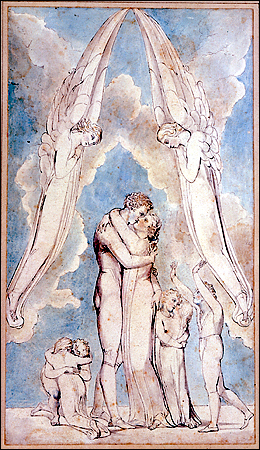
From Robert Blair's The Grave
The Meeting of the Family in Heaven


Both Blake and Jung involved themselves in the study of alchemy as a source of symbols for the regeneration of the primordial wholeness of the psyche. The union, reunion, or marriage of the contraries represented by male and female appears in the work of Jung and Blake as it does in alchemy, as the means to resolve the divisions in the psyche.


Here are two passages concerning Jung's use of the symbol of marriage:

From Man and His Symbols, Edited by Carl Jung
"Man's knowledge (logos) encounters women's relatedness (Eros) and their union is represented as that symbolic ritual of a sacred marriage..." Page 126

From Cambridge Companion to Jung, (Page 96, chapter by David L. Hart)
"That the work of wholeness is involved in alchemical symbolism is shown by the constant conjunction of opposites in its imagery: the marriage of sun and moon, of fire and water, of king and queen. This last conjunction forms the basis of Jung's study of the inner processes of the transference, that mysterious and unique relationship that undergirds the work of individuation as it proceeds in analysis. The transference, for Jung, is not a one-sided affair, nor is it merely the projection of parental images from the client onto the analyst. It is not even all that combined with the analyst's projections onto the client. It is, rather, a truly symbolic event in which both persons are changed, and inner 'marriage' leading, as one would expect, to a new, third being, comprising both individuals and yet transcending them."

Blake's use of the symbol of marriage is treated here in Northrup Frye's Fearful Symmetry:
"In eternity all the homes of the soul, the body, the palace, the city and the garden are one; and the eternal community of men is also the real presence of a divine body, whose blood is the new wine created from the water of nature." (Page 351)
"This enlightenment destroys the 'female will' for Milton and enables him to attain his emanation Ololon. We have spoken before of the ambiguity of the word 'consummation' in referring to the two chief aspects of the Last Judgment, the burning world and the sacred marriage. In Milton, too, the sacred marriage follows the vision of the absorption of nature into a fiery city." (Page 354)
"In the second part of Milton, Ololon appears in the world as a twelve-year-old girl, a child with a child's untouchable beauty, not yet a bride of a sacred marriage but a breastless 'little sister' like the one in the Song of Songs. She is respectfully referred to as the 'Virgin Ololon' for several pages; but as the physical world burns up before Milton's eyes, all images of a separated female will cease to mean anything, her virginity splits away from her and runs shrieking into chaos, as the bride Ololon, purified of the stain of virginity, stands before the poet in his final consummation." (Page 355)

Milton, Plate 40 [46], (E143)
"Then trembled the Virgin Ololon & replyd in clouds of despair

Is this our Femin[in]e Portion the Six-fold Miltonic Female
Terribly this Portion trembles before thee O awful Man
Altho' our Human Power can sustain the severe contentions
Of Friendship, our Sexual cannot: but flies into the Ulro.
Hence arose all our terrors in Eternity! & now remembrance
Returns upon us! are we Contraries O Milton, Thou & I
O Immortal! how were we led to War the Wars of Death
Is this the Void Outside of Existence, which if enterd into
Plate 42 [49]
Becomes a Womb? & is this the Death Couch of Albion
Thou goest to Eternal Death & all must go with thee

So saying, the Virgin divided Six-fold & with a shriek
Dolorous that ran thro all Creation a Double Six-fold Wonder!
Away from Ololon she divided & fled into the depths
Of Miltons Shadow as a Dove upon the stormy Sea.

Then as a Moony Ark Ololon descended to Felphams Vale
In clouds of blood, in streams of gore, with dreadful thunderings
Into the Fires of Intellect that rejoic'd in Felphams Vale
Around the Starry Eight: with one accord the Starry Eight became
One Man Jesus the Saviour. wonderful! round his limbs
The Clouds of Ololon folded as a Garment dipped in blood
Written within & without in woven letters: & the Writing
Is the Divine Revelation in the Litteral expression:
A Garment of War, I heard it namd the Woof of Six Thousand Years

And I beheld the Twenty-four Cities of Albion
Arise upon their Thrones to Judge the Nations of the Earth
And the Immortal Four in whom the Twenty-four appear Four-fold
Arose around Albions body: Jesus wept & walked forth
From Felphams Vale clothed in Clouds of blood, to enter into
Albions Bosom, the bosom of death & the Four surrounded him
In the Column of Fire in Felphams Vale; then to their mouths the Four
Applied their Four Trumpets & them sounded to the Four winds

Terror struck in the Vale I stood at that immortal sound
My bones trembled. I fell outstretchd upon the path
A moment, & my Soul returnd into its mortal state
To Resurrection & Judgment in the Vegetable Body
And my sweet Shadow of Delight stood trembling by my side

Immediately the Lark mounted with a loud trill from Felphams Vale
And the Wild Thyme from Wimbletons green & impurpled Hills
And Los & Enitharmon rose over the Hills of Surrey
Their clouds roll over London with a south wind, soft Oothoon
Pants in the Vales of Lambeth weeping oer her Human Harvest
Los listens to the Cry of the Poor Man: his Cloud
Over London in volume terrific, low bended in anger.

Rintrah & Palamabron view the Human Harvest beneath
Their Wine-presses & Barns stand open; the Ovens are prepar'd
The Waggons ready: terrific Lions & Tygers sport & play
All Animals upon the Earth, are prepard in all their strength
Plate 43 [50]
To go forth to the Great Harvest & Vintage of the Nations"


S. Foster Damon clarifies it all in A Blake Dictionary, Page 308:
"But then the sixfold Emanation divides from Ololon and like the repentant wife seeks refuge in Milton's bosom. Then 'as a Moony Ark Ololon descended ... into the Fires of Intellect': love and wisdom are combined. The Starry Eight become Jesus; Ololon's clouds are his wedding garment; and Jesus becomes one with mankind. The mystical union has been achieved, and Blake falls fainting on his garden path." (Milton, Plate 42)

Thursday, October 21, 2010

TERROR & WOE

Four Zoas, Night VII, Page 84, (E 359)

"This thou well rememberest listen I will tell
What thou forgettest. They in us & we in them alternate Livd
Drinking the joys of Universal Manhood. One dread morn
Listen O vision of Delight One dread morn of goary blood
The manhood was divided for the gentle passions making way
Thro the infinite labyrinths of the heart & thro the nostrils issuing
In odorous stupefaction stood before the Eyes of Man
A female bright. I stood beside my anvil dark a mass
Of iron glowd bright prepard for spades & plowshares. sudden down
I sunk with cries of blood issuing downward in the veins
Which now my rivers were become rolling in tubelike forms
Shut up within themselves descending down I sunk along,
The goary tide even to the place of seed & there dividing
I was divided in darkness & oblivion thou an infant woe
And I an infant terror in the womb of Enion
My masculine spirit scorning the frail body issud forth
From Enions brain In this deformed form leaving thee there
Till times passd over thee but still my spirit returning hoverd
And formd a Male to be a counterpart to thee O Love
Darkend & Lost In due time issuing forth from Enions womb
Thou & that demon Los wert born Ah jealousy & woe
Ah poor divided dark Urthona now a Spectre wandering
The deeps of Los the Slave of that Creation I created
I labour night & day for Los but listen thou my vision
I view futurity in thee I will bring down soft Vala
To the embraces of this terror & I will destroy
That body I created then shall we unite again in bliss"

From the Seventh Night of the Four Zoas we have one of several accounts of the origin of Los, Enitharmon and the Spectre of Urthona. The eternal Zoa Urthona, first has his manhood divided from the gentle passions resulting in the externalization of the female. Urthona begins to manifest internal changes as he continues his work at his furnaces. The masculine spirit issues from Enion's brain. Times passed until Enitharmon issued from Enion's womb. The division into the 'infant terror', Los and the 'infant woe', Enitharmon leaves Urthona as a Spectre.

Illustrations to Gray's Poems, Page 78


Looking at this situation from the perspective of Los as the Imagination, the division has left the imagination without its inspiration which should be supplied by the Emanation and the instrumentality which could be supplied by the Spectre.


Frye, on page 294 of Fearful Symmetry, explains some of the consequences of the division and separation of the unified Zoa Urthona:
"In creation, therefore, the Spectre of Urthona is the inventive faculty, and invention is the art of finding things in nature: it does not create so much as supply the instruments for creating. The Spectre of Urthona, properly controlled, is the obedient demon who brings his master the fire and metals and other physical needs of culture, and brings the artist his technical skill...But once separated from creative and imaginative ends, the instrumental becomes an end in itself, its criteria of use and value are made absolute principles, its media, such as money, become more important than the things they circulate, and vast complications of tools and machines are produced out of sheer automatic compulsion to produce them."

Only the reunion of the disparate functions - the terror and the woe - can restore the bliss of integration.

Friday, August 27, 2010

BLAKE, FRYE & BIBLE

Urizen's Bible was not Blake's Bible

We have often spoken of the distinctive way in which Blake read, studied and interpreted the Bible. Northrup Frey who was an ordained minister of the United Church of Canada before he was a literary critic, shows in this passage from Fearful Symmetry (page 370) how he and Blake were able to read the Bible according to the light which was given to them:

"The career of Jesus is visualized in the gospels as a recreation or epitome of the story of Israel. He comes of the seed of "David" that is, he is the new Orc or Luvah. A "father" who did not begat him, named Joseph, leads him to "Egypt," Herod's slaughter of the innocents being in counterpoint to the earlier Passover story. Returning from Egypt,he grows up and is baptized in the Jordon, corresponding to the crossing of the Red Sea; then he wanders forty days in the wilderness as the Israelites wandered forty years, resisting all the temptations the Israelites fell prey to, including at least one not presented as such in the earlier vision, the miraculous provision of bread. He emerges from the wilderness, gathers twelve followers, appears on a mountain with Moses and Elijah, enters and clenses the Temple, and is finally lifted up like the brazen serpent in the harlot Jerusalem he came to redeem. In the mean time he raised up a new civilization through the power of the unlearned and oppressed people who were most receptive to his teaching.The new historical cycle is symbolized in Blake by Lazarus of Bethany and the Lazarus of the parable, and who is, like Samson, a vision of Orc suggesting the larger contours of Albion, whose resurrection may not be far off. Thus the "life" of Jesus presented in the Gospels is really a visionary drama based on the earlier vision of Jehovah, worked out not, in terms of historical accuracy or evidence but purely as a clarification of the prophetic visions of the Messiah."


Milton, PLATE 24 [26], (E 120)
"When Jesus raisd Lazarus from the Grave I stood & saw
Lazarus who is the Vehicular Body of Albion the Redeemd
Arise into the Covering Cherub who is the Spectre of Albion
By martyrdoms to suffer: to watch over the Sleeping Body.
Upon his Rock beneath his Tomb. I saw the Covering Cherub
Divide Four-fold into Four Churches when Lazarus arose
Paul, Constantine, Charlemaine, Luther;"

Here is an earlier post on Albion and Lazarus.

Blake created his own 'visionary dramas' to present his prophetic visions of the Messiah which he was convinced could reveal the contours of a New Age.

Monday, August 2, 2010

Blake and Religion

Northrup Frye, an ordained Canadian minister, as a young man wrote a thesis entitled Fearful Symmetry, which became the magisterial exposure of Blake's thought to the academic world. His primary calling became English Literary Criticism, and he won signal distinction in that field (especially a book called The Anatomy of Criticism).

Later in life Frye said that if he had it to do over he would not write a sophisticated academic work about Blake, but something more like Percival's introductory survey. He called his last (monumental!) two volume work The Great Code of Art or The Bible as Literature. That's an invaluable work for learning Blake.

In Britain's early 19th Century the Enlightenment had a marked effect on religious thought; Deism was ascendant, the idea that God created the world and wound it up like a clock and thereafter retired from any interest in it. We are to God what ants are to us.

As you can imagine Bible soaked and God intoxicated Blake despised Deism. But he equally despised what he took to be the opposite, which he called (among other things) Druidism, the most primitive form of religion, including human sacrifice.

Druidism fit Blake's concept of established religion, whose leaders enthusiastically supported the king's wars; in the same way the religious leaders today have emphatically supported the government's wars. (The government, established religion and the military industrial complex were like three peas in a pod in Blake's day.)

Here's one of Blake's reactions to that sad reality:

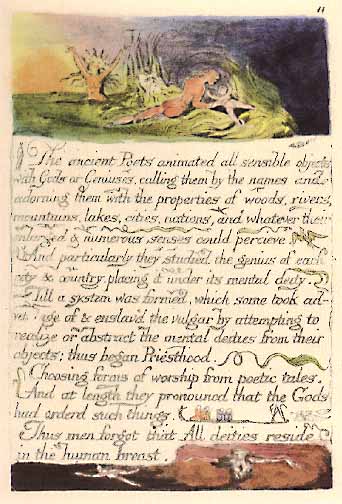
(Plate 11) (of the Marriage of Heaven and Hell)
"The ancient Poets animated all sensible objects with Gods or Geniuses, calling them by the names and adorning them with the properties of woods, rivers, mountains, lakes, cities, nations, and whatever their enlarged & numerous senses could percieve.

And particularly they studied the genius of each city & country, placing it under its mental deity.

Till a system was formed, which some took advantage of & enslav'd the vulgar by attempting to realize or abstract the mental deities from their objects; thus began Priesthood.

Choosing forms of worship from poetic tales.
And at length they pronounc'd that the Gods had order'd such things.
Thus men forgot that All deities reside in the human breast."
According to Blake God is within-- you and me, everyone. In this he closely resembled the Quakers who fundamentally speak of that of God in you/me/everyone. The God within is creative, a Creator of Art. This depends upon imagination, intuition, the expression of spiritual/eternal ideas in tangible things-- like words (the Bible), music, and representations of the human form in its various states.

Here's an example in the Laocoon (E274) of how Blake expressed this idea:
"Prayer is the Study of Art
Praise is the Practise of Art
Fasting &c. all relate to Art
The outward Ceremony is Antichrist
Without Unceasing Practise nothing can be done

Practise is Art If you leave off you are Lost

A Poet a Painter a Musician an Architect: the Man
Or Woman who is not one of these is not a
Christian"

Thursday, July 15, 2010

GIVE BODY to IDEAS

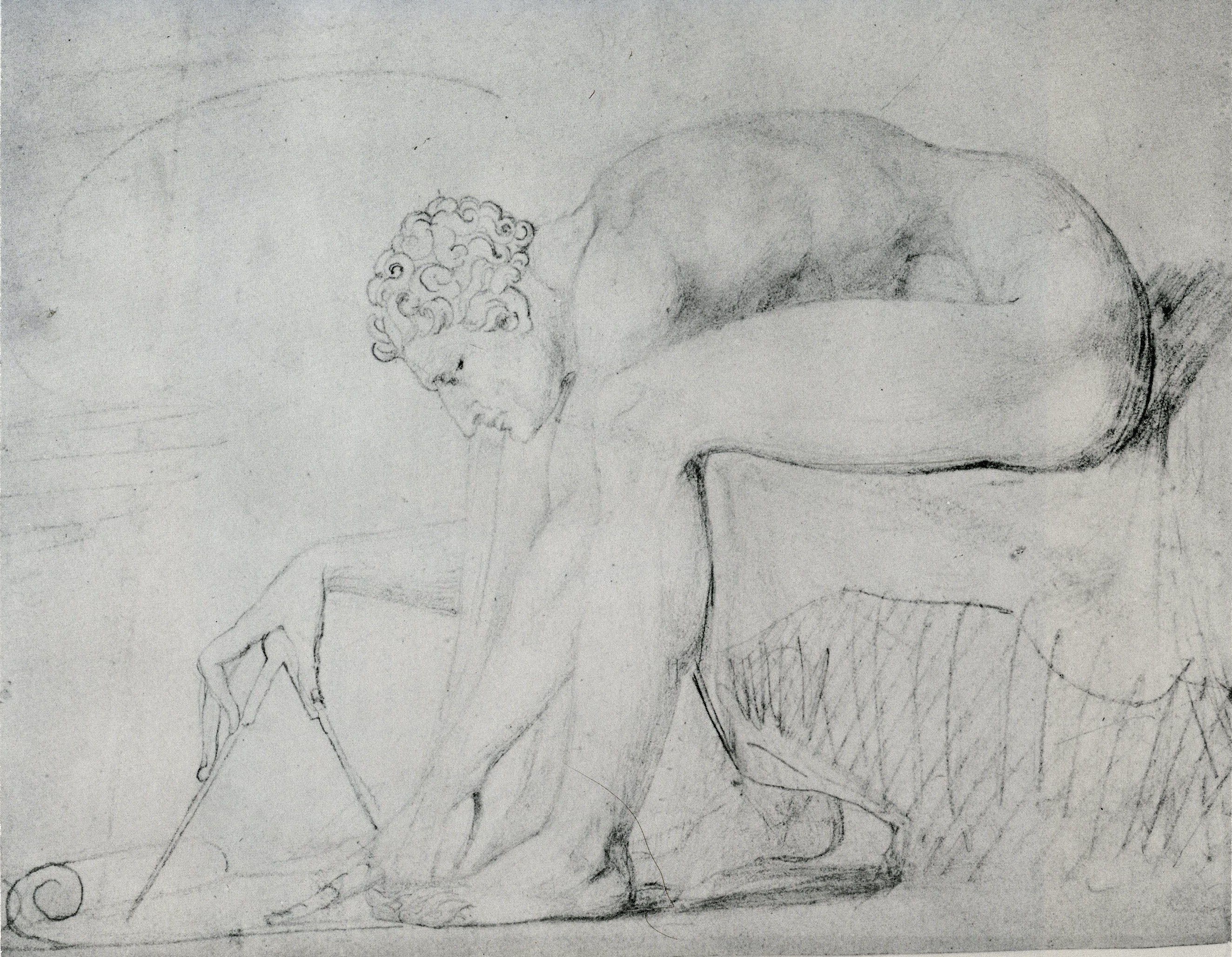
I ended my last post by saying: "The picture I get is that Jesus, Newton, Blake, the Creator and Urizen shared the same instrument as well as some of the same activity. That activity was giving body to ideas."

Here is the passage from Northrup Frye' s Fearful Symmetry (Page 267) about giving body to ideas.

"The artist does not use natural images to clothe his ideas so much as to give body to them. An abstract idea is a spectre, a collapsing skeleton; a concrete image has flesh and blood. Hence the rather violent image of woven bodies which Blake employs in this context: from the skeleton's point of view it is rather difficult to say whether the flesh is body or clothing.
In making the familiar intelligible, in imposing a permanent vision on the flux of time, the artist creates a body out of nature which has a mental form. He thereby teaches us to see, in the small part of mystery which he has made coherent, the image, that is, the form of reality, of a universal coherence; he suggests, in other words, that if his natural body is a mental form, then the entire body of nature, from atoms to stars, may also be form of the human mind, if the imagination could get hold of it. Our fallen senses hollow out a tiny grotto in a boundless stretch of mystery, and this grotto is our home. But the center of the real universe is wherever we happen to be, and its circumference the limit of the radius of our experience. In the perspective of the awakened mind, the radius of of our experience is the universe, and art reveals to the senses of distant contact, eyesight and hearing, a universal home or Paradise which is ready for us to inhabit."

Jerusalem, Plate 92, (E 252)
"Los answerd swift as the shuttle of gold. Sexes must vanish & cease
To be, when Albion arises from his dread repose O lovely Enitharmon:
When all their Crimes, their Punishments their Accusations of Sin:
All their Jealousies Revenges. Murders. hidings of Cruelty in Deceit
Appear only in the Outward Spheres of Visionary Space and Time.
In the shadows of Possibility by Mutual Forgiveness forevermore
And in the Vision & in the Prophecy, that we may Foresee & Avoid
The terrors of Creation & Redemption & Judgment. Beholding them
Displayd in the Emanative Visions of Canaan in Jerusalem & in Shiloh
And in the Shadows of Remembrance, & in the Chaos of the Spectre
Amalek, Edom, Egypt, Moab, Ammon, Ashur, Philistea, around
Jerusalem"


This is the world turned upside down.
What we have called reality is seen
to be illusion; what we have called
illusion is seen to be reality. The
powers which have controlled us
have become powerless. Albion
arises and a new day dawns.


Tuesday, June 15, 2010

NOTHING LOST

Northrup Frye has a good bit to say that adds to the picture of Golgoonoza which we have been developing. Here is a paragraph which clarifies the purpose and the eventual outcome for Blake's City of Imagination. Notice that he emphasizes that Golgonooza as it becomes the New Jerusalem, 'the total form of all culture and civilization', will make permanent (but not static) all the imaginative work which has been contributed to its building. It reminds me of a phrase which I picked up somewhere along the way: nothing lost, nothing wasted.

This is from page 91 of Fearful Symmetry:

"Inspiration is the artist's empirical proof of the divinity of his imagination; and all inspiration is divine in origin whether used, perverted, hidden or frittered away in reverie. All imaginative and creative arts, being eternal, go to build up a permanent structure, which Blake called Golgonooza, above time, and, when this structure is finished, nature, its scaffolding, will be knocked away and man will live in it. Golgonooza will be the city of God, the New Jerusalem which is the total form of all culture and civilization. Nothing that the heroes, martyrs, prophets and poets of the past have done for it has been wasted; no anonymous and unrecognized contribution to it has been overlooked. In it is conserved all the good man has done, and in it is completed all he hoped and intended to do. And the artist who uses the same energy and genius that Homer and Isaiah had will find that he not only lives in the same palace of art as Homer and Isaiah, but lives at the same time."
Perhaps Blake is even more inclusive in the passage about Los' work.

Jerusalem, Plate 13,(E 157)
"Golgonooza: Los walks round the walls night and day.

He views the City of Golgonooza, & its smaller Cities:
The Looms & Mills & Prisons & Work-houses of Og & Anak:
The Amalekite: the Canaanite: the Moabite: the Egyptian:
And all that has existed in the space of six thousand years:
Permanent, & not lost not lost nor vanishd, & every little act,
Word, work, & wish, that has existed, all remaining still
In those Churches ever consuming & ever building by the Spectres
Of all the inhabitants of Earth wailing to be Created:
Shadowy to those who dwell not in them, meer possibilities:
But to those who enter into them they seem the only substances
For every thing exists & not one sigh nor smile nor tear,

PLATE 14
One hair nor particle of dust, not one can pass away."
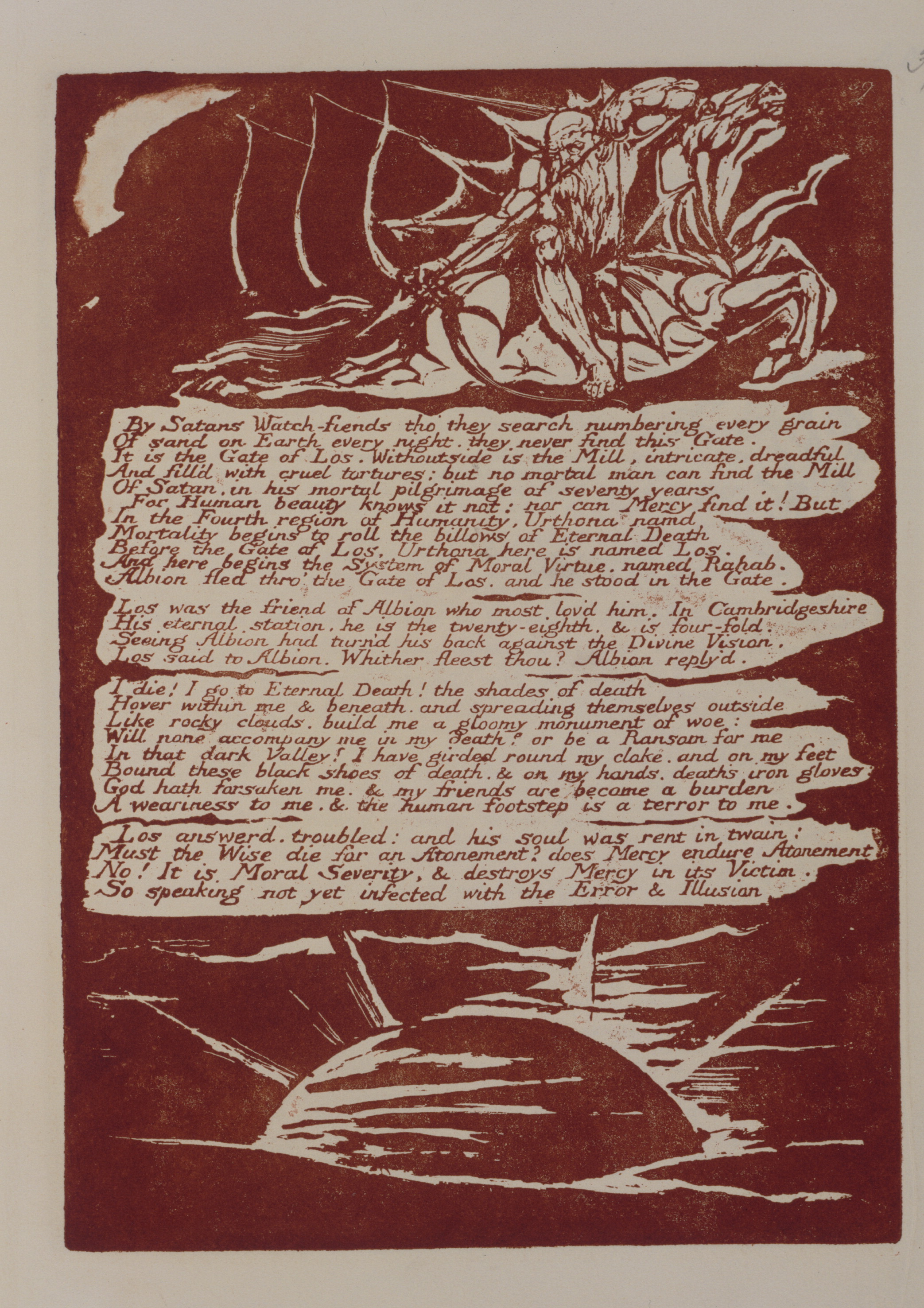
Satan's Watch-fiends Never Find the Gate of Los
JERUSALEM
"this gate cannot be found

PLATE 35 [39] (E 181)
By Satans Watch-fiends
tho' they search numbering
every grain
Of sand on Earth every night,
they never find this Gate.
It is the Gate of Los.
Withoutside is the Mill,
intricate, dreadful
And fill'd with cruel tortures;
but no mortal man can find
the Mill
Of Satan, in his mortal
pilgrimage of seventy years"

Monday, June 7, 2010

VISION of GOD

We are fortunate to have Northrup Frye's Fearful Symmetry as a Google book even though we are not able to read all the pages there. Click here to go to Chapter 5 of Fearful Symmetry.

In the first paragraph of Chapter 5, Frey delineates the relationship between the individual mind and mind of God. He refers to fallen man as the ego which perceives the general. As a part of the Universal Creator, man perceives or creates as a mental form. It is in the mind of the totality of creative power that we are able to perceive the particular. If we see through that seed of truth planted within us, we perceive this world as a 'single creature' fallen and redeemed. Frey states, 'This is the vision of God (subjective genitive: the vision which God in us has).'

This is the fourfold vision of which Blake speaks in a Letter to Thomas Butts, (E 722):
"Now I a fourfold vision see
And a fourfold vision is given to me
Tis fourfold in my supreme delight
And three fold in soft Beulahs night
And twofold Always. May God us keep
From Single vision & Newtons sleep"

Blake's idea that we must see not with but through the eye, is true at the level of vision as well; we are not to see the vision, or with the vision but through the vision to the transcendent reality which provides the vision and the means of apprehending it.

Auguries of Innocence, (E 520)
"This Lifes dim Windows of the Soul
Distorts the Heavens from Pole to Pole
And leads you to Believe a Lie
When you see with not thro the Eye
That was born in a night to perish in a night
When the Soul slept in the beams of Light."


Christ in circle

Tuesday, June 1, 2010

FEARFUL SYMMETRY

It is not easy to understand Blake's attitude toward Good & Evil. Northrup Frye, a renowned student of Blake has given some explanations in Fearful Symmetry. Let's go to him and to Mr. Blake himself for some help.


Northrup Frey, Fearful Symmetry, Page 197

"Moral good and moral evil do not represent any genuine opposition. The one wages wars and executes criminals; the other murders. The one exploits labor; the other robs. The one exploits marriage on the destruction of virginity; the other rapes. But they have a common enemy, the power of genius and prophecy. In terms of moral good it is not the murderer or the robber but the prophet who is really evil. Barabbas can be safely released, for it is impossible that his robberies can destroy the social structure of Pilate and Caiphas; but there is deadly danger in Jesus and John the Baptist, who must be got rid of at all costs."


Northrup Frey, Fearful Symmetry, Page 56

"Hence evil is a negative: all evil consists either in self-restraint or restraint of others. There can be no such thing, strictly speaking, as an evil act; all acts are good, and evil comes when activity is perverted into the frustration of activity, in oneself or others...

This death-impulse, this perverted wish to cut down and restrict the scope of life, is the touchstone not only of all the obvious vices, but of many acts often not classified as such, like teasing, instilling fear or discouragement, or exaction unthinking obedience."


William Blake, Annotations to Lavater (E 601)

"But as I understand Vice it is a Negative...Accident is the omission of act in self & the hindering of act in another, This is Vice but all Act [<from Individual propensity>] is Virtue. To hinder another is not an act it is the contrary it is a restraint on action both in ourselves & in the person hinderd. for he who hinders another omits his own duty. at the time

Murder is Hindering Another

Theft is Hindering Another

Backbiting. Undermining C[i]rcumventing & whatever is Negative is Vice."


Northrup Frey, Fearful Symmetry, Page 58

"But self-development leads us into a higher state of integration with a larger imaginative unit which is ultimately God. Hence the paradox that one gains his life by losing it, which Jesus taught. The selfish or egocentric are incapable of developing themselves; that comes from expansion outward not withdrawal inward. Hence there are two selves in man absolutely opposed to one another, the better self that grows and lives and the worse self that rots and withers, the good and evil angel:"


William Blake, Annotation to Lavater (E 594)

"Man is a twofold being. one part capable of evil & the other

capable of good that which is capable of good is not also

capable of evil. but that which is capable of evil is also

capable of good. this aphorism seems to consider man as

simple & yet capable of evil. now both evil & good cannot

exist in a simple being. for thus 2 contraries would. spring

from one essence which is impossible. but if man is

considerd as only evil. & god only good. how then is

regeneration effected which turns the evil to good. by

casting out the evil. by the good.

See Matthew XII. Ch. 26. 27. 28. 29 vs"

["If it is Satan who is expelling Satan, then he is divided against himself - so how do you suppose that his kingdom can continue? And if I expel devils because I am an ally of Beelzebub, what alliance do your sons make when they do the same thing? They can settle that question for you! But if I am expelling devils by the Spirit of God, then the kingdom of God has swept over you unawares! How do you suppose anyone could get into a strong man's house and steal his property unless he first tied up the strong man? But if he did that, he could ransack his whole house."]


Northrup Frey, Fearful Symmetry, Page 58

"Man has within him the principle of life and the principle of death: one is the imagination, the other the natural man.

...

The only possible cure for the original sin of this Selfhood of the natural man is vision, the revelation that this world is fallen and therefore not ultimate."


I think this leads us right back to the first quote; which says in essence that the enemy of the moral system is the prophet who can destroy the status quo.


Los and his Spectre

Jerusalem, Plate 6

Thursday, September 21, 2006

Blake and the Bible

(Look also at Blake's Bible.)

If you think the Bible is inerrant, and that every word has one and only one meaning, then you don't need to read this any further.

Blake had an unparalleled freedom with the Bible. Northrup Frye referred to him as a Bible soaked protestant. He was Bible soaked, but the meanings he found in most of the Bible were distinctive and often unique: "Both read the Bible day and night,But thou read’st black where I read white."

Blake's 'white' reading will excite you and/or repel you. Or perhaps you will add your Blake to the canon; that happens.

1. The idea of Nobodaddy implies an explicit and emphatic rejection of the "sub-Christian" elements of the O.T.

Blake spent half his life figuring out who/what Christ was, after which he measured the quality and value of everything in the Bible in accordance with Christ's identity.

He rejected the thump on the head for the "healing balm".

2. He put the same value on his own visions (and vision) as he did the Bible. In visions he conversed with Isaiah and Ezekiel (see the second Memorable Fancy). My wife's favorite Blake quoted Ezekiel's conversation with Blake thusly: when Blake asked him why he behaved so erratically re living in his underwear and spending 3 months on his left side, etc., Ezekiel responded "'the desire of raising other men into a perception of the infinite". That has in fact became our calling in life.

To use slightly more orthodox terminology we could say the desire to get people thinking about Heaven (in it's larger meaning). That's a good subject for another post.

When our youngest was married (an outdoor Catholic marriage, I had a chance to read some scripture. I finished with the quotation from "Saint William Blake":
"Throughout Eternity I forgive you, you forgive me;
as the dear Redeemer said, this the wine and this the bread."

Blake was very free with his use of the Bible, as I, too strive to be, God willing.

There's much further information on this subject at Chapter Six of my Blake website.