Showing posts with label Los. Show all posts

Friday, February 4, 2011

ENITHARMON WEAVES

In prosaic terms the work of Los (time) and Enitharman (space) is preparing Souls for regeneration.

Milton,PLATE 29 [31],(E 128)
"On Albions Rock Los stands creating the glorious Sun each morning
And when unwearied in the evening he creates the Moon
Death to delude, who all in terror at their splendor leaves
His prey while Los appoints, & Rintrah & Palamabron guide
The Souls clear from the Rock of Death, that Death himself may wake
In his appointed season when the ends of heaven meet.

Then Los conducts the Spirits to be Vegetated, into
Great Golgonooza, free from the four iron pillars of Satans Throne
(Temperance, Prudence, justice, Fortitude, the four pillars of tyranny)
That Satans Watch-Fiends touch them not before they Vegetate.

But Enitharmon and her Daughters take the pleasant charge.
To give them to their lovely heavens till the Great Judgment Day
Such is their lovely charge."

Four Zoas, Night the Eighth, Page 100, (E 372):
"Then Enitharmon erected Looms in Lubans Gate
And calld the Looms Cathedron in these Looms She wove the Spectres
Bodies of Vegetation Singing lulling Cadences to drive away
Despair from the poor wandering spectres
"

The weaving activity which is a recurring theme in Blake is complicated by the possibilities of providing either a positive or negative body. Enitharmon assumes the job of weaving bodies for the spectres of the dead in order to provide them with a means of regeneration through generation. She gives them bodies in mercy shaped by the virtues of love, hope, forgiveness, understanding and faith. Rahab is simultaneously counteracting Enitharmon's work by changing love to hate, hope to despair, forgiveness to retribution, understanding to jealousy, and faith to doubt.

Jerusalem, Plate 21, (E 166)
[Los speaking]
"Shame divides Families. Shame hath divided Albion in sunder!
First fled my Sons, & then my Daughters, then my Wild Animations
My Cattle next, last ev'n the Dog of my Gate. the Forests fled
The Corn-fields, & the breathing Gardens outside separated
The Sea; the Stars: the Sun: the Moon: drivn forth by my disease
All is Eternal Death unless you can weave a chaste
Body over an unchaste Mind! Vala! O that thou wert pure!
That the deep wound of Sin might be clos'd up with the Needle,
And with the Loom: to cover Gwendolen & Ragan with costly Robes
Of Natural Virtue, for their Spiritual forms without a Veil
Wither in Luvahs Sepulcher."

Comparing these passages we may get an inkling of the difficulty of journeying through the world of generation: the world of a spirit enclosed in a body. The pull of the world of matter is toward self preservation, selfishness, the selfhood. The material surface fails to recognize the spiritual substance. The Vala who looks after her own interests is the unchaste Mind which cannot be expressed in a chaste - unselfish body. Enitharmon is attempting to weave the spiritual body over a mind which has not yet grown spiritual. Los in his furnaces is preparing the mind through enduring the affliction of experience through which error can be extinguished allowing the perception of the infinite, Jesus.

The work of Los and Enitharmon is finished when Christ consciousness has replaced ego consciousness.

Percival (William Blake's Circle of Destiny):
"Though the burden of regeneration is placed upon Los and Enitharmon, the pivotal figure of the scheme is Christ. He is the only God, the divine humanity, the existence itself. When man lives by Urizen's 'beast-formed science' he is in nonexistence. The change from nonexistence to existence - the change from Satan to Christ - is accomplished when Enitharmon out of pity weaves the generative body of Christianity for the Spectre. In doing so both she and Los comprehend that the peace of mankind is to be achieved by their own extinction. The prophetic race which preached the wrath of God will come to an end. The Christ, as seen in their self-sacrificial pity, has been achieved. Nonexistence has been exchanged for existence. The sexual world has become the generative world, and so a mortal world which passes out of existence that man may become immortal. Clothed in the habiliments of the Elect, the Redeemed, and the Reprobate, the newly 'created' cross the Arnon and pass our of Moab into Cannan, out of the kingdom of Satan int the kingdom of Christ. Albion begins to awaken upon his couch." (page 231)


JERUSALEM PLATE 100


The summation of the whole process is presented in this passage:

Four Zoas, PAGE 113 (FIRST PORTION),(E 376)
In Golgonooza Los's anvils stand & his Furnaces rage
Ten thousand demons labour at the forges Creating Continually
The times & spaces of Mortal Life the Sun the Moon the Stars
In periods of Pulsative furor beating into wedges & bars
Then drawing into wires the terrific Passions & Affections
Of Spectrous dead. Thence to the Looms of Cathedron conveyd
The Daughters of Enitharmon weave the ovarium & the integument
In soft silk drawn from their own bowels in lascivious delight
With songs of sweetest cadence to the turning spindle & reel
Lulling the weeping spectres of the dead. Clothing their limbs
With gifts & gold of Eden. Astonishd stupefied with delight
The terrors put on their sweet clothing on the banks of Arnon
Whence they plunge into the river of space for a period till
The dread Sleep of Ulro is past. But Satan Og & Sihon
Build Mills of resistless wheels to unwind the soft threads & reveal
Naked of their clothing the poor spectres before the accusing heavens
While Rahab & Tirzah far different mantles prepare webs of torture
...
They unweave the soft threads then they weave them anew in the forms
Of dark death & despair & none from Eternity to Eternity could Escape
But thou O Universal Humanity who is One Man blessed for Ever
Recievest the Integuments woven Rahab beholds the Lamb of God
She smites with her knife of flint She destroys her own work
Times upon times thinking to destroy the Lamb blessed for Ever
He puts off the clothing of blood he redeems the spectres from their bonds
He awakes the sleepers in Ulro the Daughters of Beulah praise him
They anoint his feet with ointment they wipe them with the hair
of their head
"

Thursday, February 3, 2011

Blake's Joy

Count it all joy when ye fall into divers temptations; Knowing this, that the trying of your faith worketh patience. But let patience have her perfect work, that ye may be perfect and entire, wanting nothing. (James 1:2-4)

Th
e epigram says it all!

This little poem sets the natural scene:
"Man was made for Joy & Woe;
And when this we rightly know
Thro' the World we safely go.
Joy & Woe are woven fine,
A Clothing for the Soul divine;"
(From Auguries of Innocence; Erdman page 491)

We might wonder what meanings joy and woe had for Blake in the spiritual development of his life.

Blake must have been a joyous child to see a tree full of angels, but like all children he also knew woe at an early age; that is symbolized by the angry God at the window who left him screaming (I wonder how many of the small children of fundamentalist Christians have a similar experience.)

The angry God became Blake's chief source of woe and set him to writing feverishly over the years. It led to the system he created, the Myth, begun with a Fall. It led to a systematic study of human psychology with the division of the psyche into four fractions, namely Urizen, Luvah, Los, and Tharmas or in modern day parlance Thinking, Feeling, Intuition or Imagination, and Sensation.

Blake's Thinking became a bane to him; he identified Urizen with the Angry God, the Lawgiver, the Schoolmaster. He wrote thousands of words and produced a multitude of images dealing with Urizen.

He is first mentioned in 1793 in Visions of the Daughters of Albion: "O Urizen! Creator of men! mistaken Demon of heaven: Thy joys are tears! thy labour vain, to form men to thine image."(Erdman 48)

Also in 1793 Blake mentioned Urizen three times in America. (Erdman 54ff) Here's one of them:
"The fiery joy, that Urizen perverted to ten commands"; here he has identified Urizen with the God who directed Moses in the Exodus, but this Exodus was not to liberty, but from Eternity to a rule bound life .

In 1794 Blake began to describe Urizen's career with the Book of Urizen. The story is amplified in great detail. In The Four Zoas. (Put urizen in the concordance if you want to know where it occurs.)

Blake hated the dominance of Urizen over his mind, but in the course of time he dealt creatively with Urizen. After many, many scenes showing Urizen making things worse and beginning to fear for Futurity he encountered and was confronted by Los. The contest was arduous-- between imagination and what had become fear. The enmity went on and on until finally Los subdued Urizen.

Then strangely enough Los found that he no longer hated Urizen; in fact he had come to love him. (He forgave one who had sinned against him!) Urizen was in his power. With the shivering Urizen subdued by Los, Blake laid to rest the Angry God.

For Blake the thump on the head was replaced by the healing balm of the Jesus he had come to love and worship. Facing God he said:
"Throughout Eternity I forgive you; you forgive me." ([Notebook], "MySpectre"54; E477)
A powerful general statement about the consequences of grace. You is everyone of course, but Blake particularly addressed God in this statement. (We may not know it, but a host of us need to forgive God for the things that have appeared to us to be unjust.) Making that decision is infinitely liberating to the human soul.

For Blake having made it led to an immediate release of the visionary power he had lost twenty years before; like C.S.Lewis he was Surprised by Joy. He began to write and draw with power and vigor. In fact he became an evangelist. Unlike Francis of Assisi he used words by choice; words were his forte.

Milton, Jerusalem, Job (Illustrations): three of many ways of telling the old, old story.

Sunday, December 12, 2010

SAVING ALBION


In your journey have you ever turned away from the Divine Vision? Or have you known others who have become lost in a wilderness of pain and despair? Do you know of anyone who has refused the assistance of friends and family who attempted to show one the error of one's ways? Blake shows Albion in the circumstances of such a person - disintegrating in a morass of bad decisions, insisting on continuing along the road to destruction.

Albion's life is in a shambles when Los as the agent of the Divine Family continues his mission of saving Albion. Here he gives Albion a reminder of Albion's home in Eden.

Jerusalem, PLATE 34 [38], (E 179)
"So Los spoke: But when he saw blue death in Albions feet,
Again he join'd the Divine Body, following merciful;
While Albion fled more indignant! revengeful covering

His face and bosom with petrific hardness, and his hands
And feet, lest any should enter his bosom & embrace
His hidden heart; his Emanation wept & trembled within him:
Uttering not his jealousy, but hiding it as with
Iron and steel, dark and opake, with clouds & tempests brooding:
His strong limbs shudderd upon his mountains high and dark.

Turning from Universal Love petrific as he [Albion] went,
His cold against the warmth of Eden rag'd with loud
Thunders of deadly war (the fever of the human soul)
Fires and clouds of rolling smoke! but mild the Saviour follow'd him,

Displaying the Eternal Vision! the Divine Similitude!
In loves and tears of brothers, sisters, sons, fathers, and friends
Which if Man ceases to behold, he ceases to exist:

Saying. Albion! Our wars are wars of life, & wounds of love,
With intellectual spears, & long winged arrows of thought:
Mutual in one anothers love and wrath all renewing
We live as One Man; for contracting our infinite senses
We behold multitude; or expanding: we behold as one,
As One Man all the Universal Family; and that One Man
We call Jesus the Christ: and he in us, and we in him,
Live in perfect harmony in Eden the land of life,
Giving, recieving, and forgiving each others trespasses.
He is the Good shepherd, he is the Lord and master:
He is the Shepherd of Albion, he is all in all,
In Eden: in the garden of God: and in heavenly Jerusalem.
If we have offended, forgive us, take not vengeance against us.

Thus speaking; the Divine Family follow Albion:
I see them in the Vision of God upon my pleasant valleys."

Albion's plight is obvious as are attempts to save him. Here he is given a reminder that whatever heights one may have reached, the Selfhood must be annihilated if the process of healing is to continue. The incarnation which was first manifest through the life, death, and resurrection of Jesus is presented to Albion for his salvation. He again refuses.

PLATE 40 [45], (E 187)
"Bath, healing City! whose wisdom in midst of Poetic
Fervor: mild spoke thro' the Western Porch, in soft gentle tears

O Albion mildest Son of Eden! clos'd is thy Western Gate
Brothers of Eternity! this Man whose great example
We all admir'd & lov'd, whose all benevolent countenance, seen
In Eden, in lovely Jerusalem, drew even from envy
The, tear: and the confession of honesty, open & undisguis'd
From mistrust and suspition. The Man is himself become
A piteous example of oblivion. To teach the Sons
Of Eden, that however great and glorious; however loving
And merciful the Individuality; however high
Our palaces and cities, and however fruitful are our fields
In Selfhood, we are nothing: but fade away in mornings breath,
Our mildness is nothing: the greatest mildness we can use
Is incapable and nothing! none but the Lamb of God call heal
This dread disease: none but Jesus! O Lord descend and save!
Albions Western Gate is clos'd: his death is coming apace!
Jesus alone can save him; for alas we none can know
How soon his lot may be our own. When Africa in sleep
Rose in the night of Beulah, and bound down the Sun & Moon
His friends cut his strong chains, & overwhelm'd his dark
Machines in fury & destruction, and the Man reviving repented
He wept before his wrathful brethren, thankful & considerate
For their well timed wrath. But Albions sleep is not
Like Africa's: and his machines are woven with his life
Nothing but mercy can save him! nothing but mercy interposing
Lest he should slay Jerusalem in his fearful jealousy
O God descend! gather our brethren, deliver Jerusalem
But that we may omit no office of the friendly spirit
Oxford take thou these leaves of the Tree of Life: with eloquence
That thy immortal tongue inspires; present them to Albion:
Perhaps he may recieve them, offerd from thy loved hands.

So spoke, unheard by Albion. the merciful Son of Heaven
To those whose Western Gates were open, as they stood weeping
Around Albion: but Albion heard him not; obdurate! hard!
He frown'd on all his Friends, counting them enemies in his
sorrow

And the Seventeen conjoining with Bath, the Seventh:
In whom the other Ten shone manifest, a Divine Vision!
Assimilated and embrac'd Eternal Death for Albions sake."

We can see ourselves in Albion and Albion in ourselves. His experiences are our experiences.

Sunday, November 28, 2010

LOS'S PLEA

Near the beginning of Jerusalem Albion became enthralled with Vala who was fallen and material. Albion fell further and further from his true nature as the embodiment of humanity into his Selfhood.

When Albion was overcome by guilt and projected his self-hatred outward, manifestations appeared which threatened his continued existence. Los assumed the role of Albion's true self, his integrated self or identity and began the work of restoring Albion's psyche. Los knew the cost which would be assessed to him. He also knew that only through the appearance of the Lamb of God within Albion, could he be regenerated.

So Los makes this plea:

Jerusalem, Plate 82, (E 241)
"Los saw & was comforted at his Furnaces uttering thus his voice.

I know I am Urthona keeper of the Gates of Heaven,
And that I can at will expatiate in the Gardens of bliss;
But pangs of love draw me down to my loins which are
Become a fountain of veiny pipes: O Albion! my brother!

PLATE 83
Corruptibility appears upon thy limbs, and never more
Can I arise and leave thy side, but labour here incessant
Till thy awaking! yet alas I shall forget Eternity!
Against the Patriarchal pomp and cruelty, labouring incessant
I shall become an Infant horror. Enion! Tharmas! friends
Absorb me not in such dire grief: O Albion, my brother!
Jerusalem hungers in the desart! affection to her children!
The scorn'd and contemnd youthful girl, where shall she fly?
Sussex shuts up her Villages. Hants, Devon & Wilts
Surrounded with masses of stone in orderd forms, determine then
A form for Vala and a form for Luvah, here on the Thames
Where the Victim nightly howls beneath the Druids knife:
A Form of Vegetation, nail them down on the stems of Mystery:
O when shall the Saxon return with the English his redeemed
brother!
O when shall the Lamb of God descend among the Reprobate!"

Jerusalem Plate 19 (color copy is in Blake Archive)

Los knew that becoming the intimate friend and caregiver for Albion he would have to leave the clean, secure protected envelope of his home and be among the dirty, diseased and degenerate. Albion sleeps on his couch upon the rock while Los struggles through the ugly stages of development which precede awakening.


The seamy side of life where one may be rejected, taken advantage of, deceived and plotted against is not pleasant to endure. Those who assume the burden of bearing such alienation for the sake of others are close to the Lord.

At the end of Jerusalem when Albion is repentant, it is Jesus who stands with forgiveness and healing beside Albion, but Los is present too, totally involved in the conversation between God and Man.

Jerusalem, Plate 96, (E 255)
"Then Jesus appeared standing by Albion as the Good Shepherd
By the lost Sheep that he hath found & Albion knew that it
Was the Lord the Universal Humanity, & Albion saw his Form
A Man. & they conversed as Man with Man, in Ages of Eternity
And the Divine Appearance was the likeness & similitude of Los"
====================================================
"Blake considers the poet to be a crucial agent in the union of humankind with Christ. Indeed, the poet is the prophet who can foresee the apocalypse and salvation and who acts as a guide to lead the universal human to the Divine Vision."

Quote from ENOTES: Jerusalem: The emanation of the Giant Albion, William Blake - Introduction

Thursday, November 18, 2010

MID LIFE CRISIS

The parallels are so apparent in the thinking of Jung and Blake that we must recognize that they were under many of the same influences. I have been looking for ways in which Jung's insights are apparent in Blake's writing and have found what I was looking for. Each of the men had immersed himself in the perennial philosophy. Each was introverted and intuitive. Each had experienced a mid-life crisis which involved new self-awareness and new prioritization. The internal and external experiences of the two men led them to understand their own mental landscape and to extrapolate it to humanity. Coming from different perspectives and using different disciplines, they were each led to awareness of congruent interpretations of the nature of man and God.

I have found it a worthwhile enterprise is to read Blake looking for Jungian ideas, and to read Jung looking for Blakean ideas. The minds of two giants give insight into the messages of the other.

David L. Hart writing in The Cambridge Compannion to Jung, edited by Polly Young-Eisendrathand Terence Dawson gives an overview of the process of psychological development as seen by Jung on page 100:

"In a general way the whole development of an individual's life is seen by Jung as a gradual emergence out of the ego's control and into the realm of the Self - out of merely personal values and into those of more impersonal and collective meaning. The first half of life normally devoted to establishing a secure place in the world; education, profession, family, a personal identity. But at mid-life that crisis threatens whose ubiquity and importance Jung helped to clarify in the public mind. It is at bottom a spiritual crisis, the challenge to seek and discover the meaning of life. To meet this challenge, none of the tools of the first half of life are adequate. It is not a question of further conquests or acquisitions; it is more a question of exploration of the soul, for its own sake, letting go of the familiar demands of the ego to be fed and gratified. Therefore it is often felt as a loss, and is often powerfully resisted; and yet the psyche, with its own powerful demand to be realized, will persist in confronting consciousness with new and unheard-of views of life's meanings and possibilities. It is here that Jung sees the real work of individuation beginning, for from this point on, everything depends on the broadening of consciousness. Without a real sense that this change carries the true meaning of one's life, and a willingness to take on the inner voyage of discovery, one can fall into despair and a repetitive existence, which in effect only marks time until the end. The challenge of the second half of life is to prepare for death in a questioning, seeking, and conscious way accepting both the pain of disillusionment and the wonder of growth into ever new views of spiritual and psychological reality."


The following passage can be seen as describing Los's mid-life crisis. It focuses on Los' recognition of the contribution he made to his alienation from Enitharmon, the benefits he becomes aware of in cooperation, and the positive outcome that results from working together. Blake uses this incident as a turning point in his myth leading to the climactic restructuring of regeneration.


Four Zoas
, Page 98 [90], (E 369)
"O Enitharmon
Couldst thou but cease from terror & trembling & affright
When I appear before thee in forgiveness of ancient injuries
Why shouldst thou remember & be afraid. I surely have died in pain
Often enough to convince thy jealousy & fear & terror
Come hither be patient let us converse together because
I also tremble at myself & at all my former life

...
Enitharmon spread her beaming locks upon the wind & said
O Lovely terrible Los wonder of Eternity O Los my defence & guide
Thy works are all my joy. & in thy fires my soul delights
If mild they burn in just proportion & in secret night
And silence build their day in shadow of soft clouds & dews
Then I can sigh forth on the winds of Golgonooza piteous forms
That vanish again into my bosom but if thou my Los
Wilt in sweet moderated fury. fabricate forms sublime
Such as the piteous spectres may assimilate themselves into
They shall be ransoms for our Souls that we may live...
But Los loved them & refusd to Sacrifice their infant limbs
And Enitharmons smiles & tears prevaild over self protection
They rather chose to meet Eternal death than to destroy
The offspring of their Care & Pity Urthonas spectre was comforted
But Tharmas most rejoicd in hope of Enions return
For he beheld new Female forms born forth upon the air
Who wove soft silken veils of covering in sweet rapturd trance
Mortal & not as Enitharmon without a covering veil

First his immortal spirit drew Urizen[s] Shadow away
From out the ranks of war separating him in sunder
Leaving his Spectrous form which could not be drawn away
Then he divided Thiriel the Eldest of Urizens sons
Urizen became Rintrah Thiriel became Palamabron
Thus dividing the powers of Every Warrior
Startled was Los he found his Enemy Urizen now
In his hands. he wonderd that he felt love & not hate
His whole soul loved him he beheld him an infant
Lovely breathd from Enitharmon he trembled within himself

End of The Seventh Night "

Thursday, October 21, 2010

TERROR & WOE

Four Zoas, Night VII, Page 84, (E 359)

"This thou well rememberest listen I will tell
What thou forgettest. They in us & we in them alternate Livd
Drinking the joys of Universal Manhood. One dread morn
Listen O vision of Delight One dread morn of goary blood
The manhood was divided for the gentle passions making way
Thro the infinite labyrinths of the heart & thro the nostrils issuing
In odorous stupefaction stood before the Eyes of Man
A female bright. I stood beside my anvil dark a mass
Of iron glowd bright prepard for spades & plowshares. sudden down
I sunk with cries of blood issuing downward in the veins
Which now my rivers were become rolling in tubelike forms
Shut up within themselves descending down I sunk along,
The goary tide even to the place of seed & there dividing
I was divided in darkness & oblivion thou an infant woe
And I an infant terror in the womb of Enion
My masculine spirit scorning the frail body issud forth
From Enions brain In this deformed form leaving thee there
Till times passd over thee but still my spirit returning hoverd
And formd a Male to be a counterpart to thee O Love
Darkend & Lost In due time issuing forth from Enions womb
Thou & that demon Los wert born Ah jealousy & woe
Ah poor divided dark Urthona now a Spectre wandering
The deeps of Los the Slave of that Creation I created
I labour night & day for Los but listen thou my vision
I view futurity in thee I will bring down soft Vala
To the embraces of this terror & I will destroy
That body I created then shall we unite again in bliss"

From the Seventh Night of the Four Zoas we have one of several accounts of the origin of Los, Enitharmon and the Spectre of Urthona. The eternal Zoa Urthona, first has his manhood divided from the gentle passions resulting in the externalization of the female. Urthona begins to manifest internal changes as he continues his work at his furnaces. The masculine spirit issues from Enion's brain. Times passed until Enitharmon issued from Enion's womb. The division into the 'infant terror', Los and the 'infant woe', Enitharmon leaves Urthona as a Spectre.

Illustrations to Gray's Poems, Page 78


Looking at this situation from the perspective of Los as the Imagination, the division has left the imagination without its inspiration which should be supplied by the Emanation and the instrumentality which could be supplied by the Spectre.


Frye, on page 294 of Fearful Symmetry, explains some of the consequences of the division and separation of the unified Zoa Urthona:
"In creation, therefore, the Spectre of Urthona is the inventive faculty, and invention is the art of finding things in nature: it does not create so much as supply the instruments for creating. The Spectre of Urthona, properly controlled, is the obedient demon who brings his master the fire and metals and other physical needs of culture, and brings the artist his technical skill...But once separated from creative and imaginative ends, the instrumental becomes an end in itself, its criteria of use and value are made absolute principles, its media, such as money, become more important than the things they circulate, and vast complications of tools and machines are produced out of sheer automatic compulsion to produce them."

Only the reunion of the disparate functions - the terror and the woe - can restore the bliss of integration.

Thursday, August 5, 2010

LOS the WATCHMAN

The frontispiece of Blake's Jerusalem pictures a man clothed as a night watchman entering a dark doorway. He carries the watchman's light to illuminate the 'perilous path' whose entry he steps into wearing his sandals (which he strapped on in the poem Milton). The figure is Los beginning his journey through the underworld which Persephone entered before him. Blake describes it as 'the passage through Eternal Death! and of the awaking to Eternal Life.' (Jerusalem, Plate 4, E 146)
...................................................................................Click on Picture......

Among the many roles that Los is assigned is that of watchman for which he was first chosen in the Book of Urizen. When the Eternals see the vast world of Urizen appear, Los is called upon to confine Urizen's world.

Urizen, Plate 5,(E 73)
"8. And Los round the dark globe of Urizen,
Kept watch for Eternals to confine,
The obscure separation alone;
For Eternity stood wide apart,"

In Milton Los is singled out to be the watchman and to keep the peace until Milton's redemptive act is completed. The full weight falls on Los and his sons because the other Zoas have left their stations.

Milton, Plate 23 [25], (E 119)
"We were plac'd here by the Universal Brotherhood & Mercy
With powers fitted to circumscribe this dark Satanic death
And that the Seven Eyes of God may have space for Redemption.
But how this is as yet we know not, and we cannot know;
Till Albion is arisen; then patient wait a little while,
Six Thousand years are passd away the end approaches fast;
This mighty one is come from Eden, he is of the Elect,
Who died from Earth & he is returnd before the Judgment. This thing
Was never known that one of the holy dead should willing return
Then patient wait a little while till the Last Vintage is over:"

Milton, Plate 24 (E 119)
"Because of Satan: & the Seven Eyes of God continually
Guard round them, but I the Fourth Zoa am also set
The Watchman of Eternity, the Three are not! & I am preserved
Still my four mighty ones are left to me in Golgonooza
Still Rintrah fierce, and Palamabron mild & piteous
Theotormon filld with care, Bromion loving Science
You O my Sons still guard round Los."

In
Jerusalem, the role of watchman again falls to Los as he watches at his furnaces until Albion awakes.

Jerusalem, Plate 83, (E 242)
"It must lie in confusion till Albions time of awaking.
Place the Tribes of Llewellyn in America for a hiding place!
Till sweet Jerusalem emanates again into Eternity
The night falls thick: I go upon my watch: be attentive:
The Sons of Albion go forth; I follow from my Furnaces:
That they return no more: that a place be prepard on Euphrates
Listen to your Watchmans voice: sleep not before the Furnaces
Eternal Death stands at the door. O God pity our labours.

So Los spoke. to the Daughters of Beulah while his Emanation
Like a faint rainbow waved before him in the awful gloom
Of London City on the Thames from Surrey Hills to Highgate
...
While Los arose upon his Watch, and down from Golgonooza
Putting on his golden sandals to walk from mountain to mountain,
He takes his way, girding himself with gold & in his hand
Holding his iron mace: The Spectre remains attentive
Alternate they watch in night: alternate labour in day
Before the Furnaces labouring, while Los all night watches
The stars rising & setting, & the meteors & terrors of night!"

We can go back to the book America to get an intimation of the rejoicing which will take place when the watchman's duty is over.

America, PLATE 6, (E 52)
"The morning comes, the night decays, the watchmen leave their stations;
The grave is burst, the spices shed, the linen wrapped up;
The bones of death, the cov'ring clay, the sinews shrunk & dry'd.
Reviving shake, inspiring move, breathing! awakening!
Spring like redeemed captives when their bonds & bars are burst;"

Monday, July 5, 2010

DIVINE HAND

God's Providence

At critical junctures in Blake's poetry the Divine Hand intervenes to change the direction of the developing myth. The interventions usually involve the limits - contraction and opacity, Adam and Satan.

Adam, man who is formed to live as a physical body in a physical world with spiritual consciousness, is the limit of contraction. The Eternal Man, Albion may fall and divide but within him is planted a seed which connects him to the Eternal world. Humanity is not to become animal or vegetable but he is limited to remaining human. This is the condition which is preserved in the state called generation which will be put off in regeneration, or mortality which will be put off in immortality.

Jerusalem, Plate 31 [35], (E 177)
Satan the limit of opacity has lost his ability to perceive the spiritual world but he has not lost his reasoning power. He is unable to accept the Divine Vision, Jesus, the Imagination, but he attempts use reason to build a world based on moral law to replace the Divine Vision he has lost. The state of Satan, selfhood, which tries to impose the temporal on the eternal, the finite on the infinite, will be recognized as error when it appears as it is.

The limits were set by the Divine Hand that the fall may be reversed and fallen man may be regenerated. The Divine Hand is a name for God's providence, for his protective guidance in providing that man may return to the Eternal source. The Divine Hand seems to be the transcendent God who acts from outside of the individual to provide a framework through which the Divine Vision (the incarnate Jesus) may act through the Divine Body (the Imagination).

The Divine Hand finds the two limits and names them:
Milton, Plate 13[14], (E 107)
"The Divine hand found the Two Limits: first of Opacity, then of
Contraction
Opacity was named Satan, Contraction was named Adam."

The Divine Hand provides the sleep of Albion:
Jerusalem, Plate 15, (E 159)
"But first Albion must sleep, divided from the Nations

I see Albion sitting upon his Rock in the first Winter
And thence I see the Chaos of Satan & the World of Adam
When the Divine Hand went forth on Albion in the mid Winter
And at the place of Death when Albion sat in Eternal Death"

The Limits are found within each man:
Jerusalem, Plate 31, (E 177)
"Then the Divine hand found the Two Limits, Satan and Adam,
In Albions bosom: for in every Human bosom those Limits stand."

The Divine Hand strengthens Los as he awaits the fury of the dead:
Jerusalem, Plate 42, (E 189)
"Los stood before his Furnaces awaiting the fury of the Dead:
And the Divine hand was upon him, strengthening him mightily."

The Divine Hand assists Los and Enitharmon as they escape:
Jerusalem, PLATE 44 [30], (E 193)
"And the Divine hand was upon them bearing them thro darkness
Back safe to their Humanity as doves to their windows:"

The Divine Hand provides that vengeance not be taken against sinners:
Jerusalem, Plate 45, (E 194)
"I could not dare to take vengeance; for all things are so
constructed
And builded by the Divine hand, that the sinner shall always
escape,"

The Divine Hand who set the limits of Satan and Adam, sets the limit to Eternal Death and touches Los' furnaces. Los knows that his furnaces are not punishment for sin:
Four Zoas, Page 56, (E 338)
"And first he found the Limit of Opacity & namd it Satan
In Albions bosom for in every human bosom these limits stand
And next he found the Limit of Contraction & namd it Adam
While yet those beings were not born nor knew of good or Evil

Then wondrously the Starry Wheels felt the divine hand. Limit
Was put to Eternal Death Los felt the Limit & saw
The Finger of God touch the Seventh furnace in terror
And Los beheld the hand of God over his furnaces
Beneath the Deeps in dismal Darkness beneath immensity
And he who takes vengeance alone is the criminal of Providence;"

The work of the Divine Hand may be unseen but discerned through hope:
Four Zoas, Page 9,(E 305)
"They saw not yet the Hand Divine for it was not yet reveald
But they went on in Silent Hope & Feminine repose"

Saturday, July 3, 2010

LEVELS of EXISTENCE II

Continuation of July 1 post.

BEULAH

Through Los generation supplies belief in the Eternal values using reason and the senses, (although confined in the illusion of time and space). Beulah supplies knowledge of the Eternal through the imagination which can transcend material limits. Beulah like generation is a world of the sexes, but in Beulah the male and female are married, each plays a role and accepts the designed functions. Beulah is a place of rest and repose where the contraries are equally true. The active nature of the male is in abeyance and the female is obedient. The delicate balance of Beulah however is maintained through illusion which is not to be taken for reality. Reality is unified as in Eden; Beulah maintains the illusion of duality.

Page 86: "...so long as love remains self-sacrificing, man retains his faith in a spiritual reality beyond the world of appearance. When, however, love fails, faith is lost and the finite mind seeks for reality within the finite form."Percival

Man is not meant to remain in Beulah for it is a place of retreat and renewal. Upward to Eden or downward to Generation are the options offered. A desire to remain in Beulah destroys the beautiful balance and sends man backward. Beulah shares with Eden evanescence, fluidity the ability to escape time and space. Love and forgiveness are the methods of maintaining Beulah as the environs of Eden.

EDEN

William Blake's personal goal was to spend as much time in Eden as possible. To transcend to fourfold vision, the ability to perceive the infinite, was his supreme delight. But Eden meant more than vision it also means creative energy, forgiveness, brotherhood and the oneness of wholeness. Beulah is the condition of rest and repose for a purpose - that of returning to the energetic activity of Eden.

Page 50: "In Eden 'there is no restraint from the greatest of all restraints on imaginative living - the selfhood. The self knows it, too, but fixes and makes manifest the energy which flows into it from God.'"

In this life the intensity and clarity of Eden is more than the soul can long endure. Thus the visionary world is fled for the worlds of appearance which have already been described.

Three Levels of Existence are pictured in Plate 9 of Jerusalem:
Pastoral world - Beulah
Dualistic world -Generation
Disintegrated World - Ulro.

A Descriptive Catalogue (E 541)
"The Prophets describe what they saw in Vision as real and existing men whom they saw with their imaginative and immortal organs; the Apostles the same; the clearer the organ the more distinct the object. A Spirit and a Vision are not, as the modern philosophy supposes, a cloudy vapour or a nothing: they are organized and minutely articulated beyond all that the mortal and perishing nature can produce. He who does not imagine in stronger and better lineaments, and in stronger and better light than his perishing mortal eye can see does not imagine at all. The painter of this work asserts that all his imaginations appear to him infinitely more perfect and more minutely organized than any thing seen by his mortal eye"

Thursday, July 1, 2010

LEVELS of EXISTENCE

I am indebted to Milton O Percival's William Blake's Circle of Destiny for the understanding I have of this subject. Quotations are from his book. This book is rarely for sale at a modest price but is available in many libraries. To find a library near you from which it is available try worldcat.com. If your local library doesn't have the book, you can ask them to obtain it on interlibrary loan.

Blake sees the status of man in terms of levels of existence. At each level man is capable of living according to certain principles which represent his level of consciousness. In ascending order the worlds through man may progress are Ulro, Generation, Beulah and Eden. Each level is characterized by the ability of man to perceive at that level, and the structure which results from that level of perception.

ULRO

So we have in Ulro the ability to perceive at only the level of single or literal vision. Meaning beyond the superficial material level escapes single vision. Looking for information about the relationship between William and Catherine Blake in the prophetic books is confining oneself to Ulro thought, since it is looking for outward sensory data about outward sensory events. The most striking facet of perception in Ulro is the inability to see spiritual significance in anything that comes to us. Perception is turned outward only; the inner world is thought to be non-existent. Seeing only an outward existence creates the world of matter, rigid and passive.

Page 87: "This void in the empty East is Ulro, the Hell of Blake's myth. In this void the selfish emotions are activated by rational doubts and fears. ..Everything in this world is 'without internal light.' The souls which inhabit it have 'neither lineament nor form.'"

Ulro is the bottom of man's fall from eternity. If the fall had continued man would have fallen into the abyss of non-entity. The limits of Adam and Satan were set to prevent that from happening. When the limits were defined, man could start the rebuilding and return.

GENERATION

The agent for the the process of rising or returning is Los who gives form or concrete expression to the abstractions of Urizen in Ulro. In this way error is revealed for what it is and can be repudiated. This is our world where ideas and emotions are expressed in behaviors and personalities.

This is man's condition in the generative world: he is confined to the world of time and space, he is vegetated in a body whose limitations he cannot escape, he is receiving his information from shrunken senses. But there is more going on in generation; it is the world of transition from the outward and corporeal to the inward and spiritual. Los in the role of the holy Spirit is the agent of transformation.

Los's job is breaking down and building up. Breaking down by revealing error for what it is. Building up by creating Golgonooza in which man may exercise imagination. Spiritual vision becomes possible through the development of symbolic thinking. The object seen outwardly and corporeally becomes capable of carrying meaning which is inward and spiritual. 'The world of generation might indeed be thought of as a training school in vision.' (Page 272)

Page 273: "When the struggle is over, and the world and all that is therein can be seen, calm and assuredly, as the manifestation of spirit - then the soul has arrived at threefold vision and soft Beulah's light."

'To Be Continued' in my next post.

Tuesday, June 15, 2010

NOTHING LOST

Northrup Frye has a good bit to say that adds to the picture of Golgoonoza which we have been developing. Here is a paragraph which clarifies the purpose and the eventual outcome for Blake's City of Imagination. Notice that he emphasizes that Golgonooza as it becomes the New Jerusalem, 'the total form of all culture and civilization', will make permanent (but not static) all the imaginative work which has been contributed to its building. It reminds me of a phrase which I picked up somewhere along the way: nothing lost, nothing wasted.

This is from page 91 of Fearful Symmetry:

"Inspiration is the artist's empirical proof of the divinity of his imagination; and all inspiration is divine in origin whether used, perverted, hidden or frittered away in reverie. All imaginative and creative arts, being eternal, go to build up a permanent structure, which Blake called Golgonooza, above time, and, when this structure is finished, nature, its scaffolding, will be knocked away and man will live in it. Golgonooza will be the city of God, the New Jerusalem which is the total form of all culture and civilization. Nothing that the heroes, martyrs, prophets and poets of the past have done for it has been wasted; no anonymous and unrecognized contribution to it has been overlooked. In it is conserved all the good man has done, and in it is completed all he hoped and intended to do. And the artist who uses the same energy and genius that Homer and Isaiah had will find that he not only lives in the same palace of art as Homer and Isaiah, but lives at the same time."
Perhaps Blake is even more inclusive in the passage about Los' work.

Jerusalem, Plate 13,(E 157)
"Golgonooza: Los walks round the walls night and day.

He views the City of Golgonooza, & its smaller Cities:
The Looms & Mills & Prisons & Work-houses of Og & Anak:
The Amalekite: the Canaanite: the Moabite: the Egyptian:
And all that has existed in the space of six thousand years:
Permanent, & not lost not lost nor vanishd, & every little act,
Word, work, & wish, that has existed, all remaining still
In those Churches ever consuming & ever building by the Spectres
Of all the inhabitants of Earth wailing to be Created:
Shadowy to those who dwell not in them, meer possibilities:
But to those who enter into them they seem the only substances
For every thing exists & not one sigh nor smile nor tear,

PLATE 14
One hair nor particle of dust, not one can pass away."
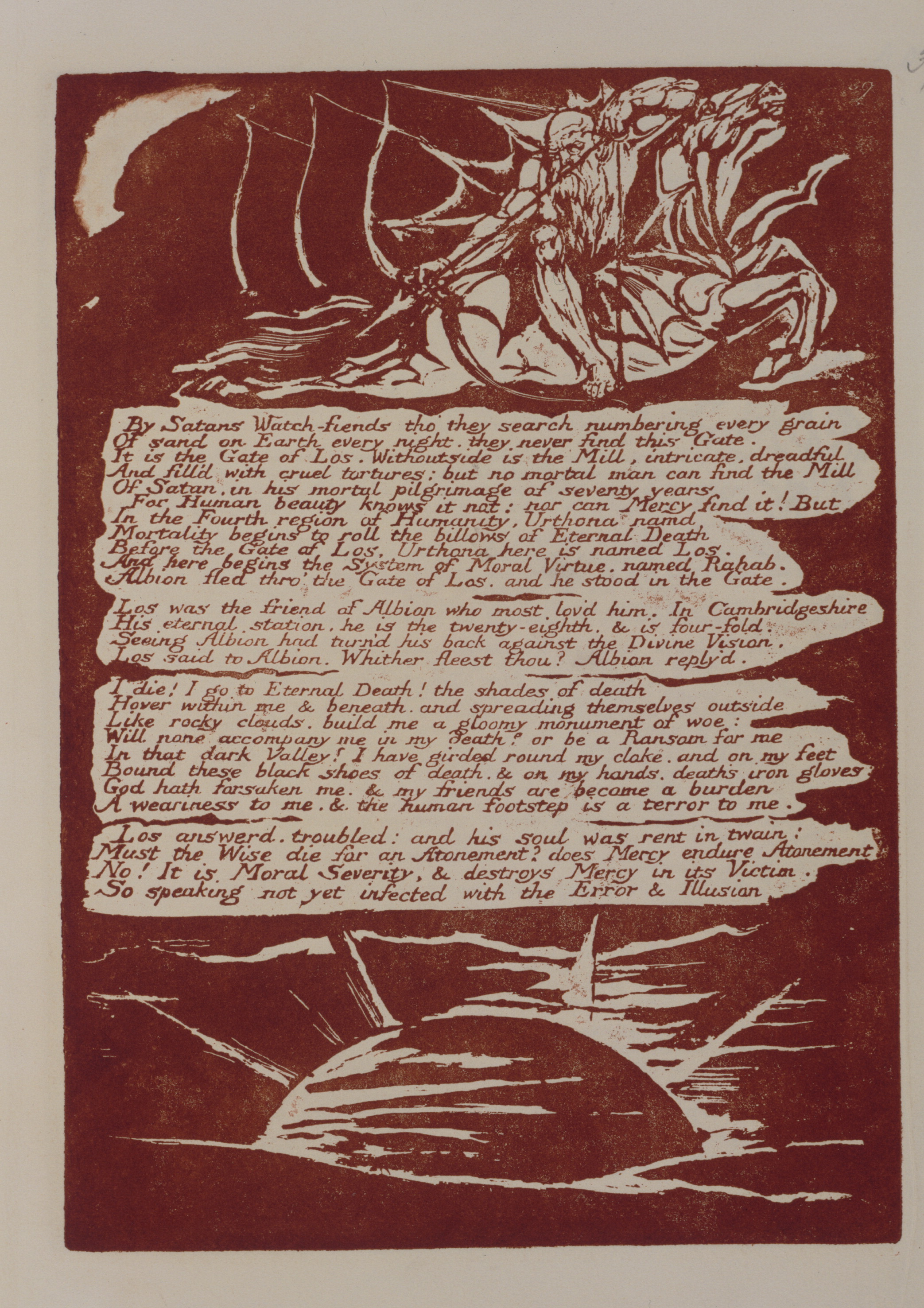
Satan's Watch-fiends Never Find the Gate of Los
JERUSALEM
"this gate cannot be found

PLATE 35 [39] (E 181)
By Satans Watch-fiends
tho' they search numbering
every grain
Of sand on Earth every night,
they never find this Gate.
It is the Gate of Los.
Withoutside is the Mill,
intricate, dreadful
And fill'd with cruel tortures;
but no mortal man can find
the Mill
Of Satan, in his mortal
pilgrimage of seventy years"

Wednesday, June 9, 2010

WITNESS to TRUTH

Stuart Curran in his chapter in Sublime Allegory (page 341) says, "Except for the apocalyptic concluding plates there are few distinct events in Jerusalem, which is why the reader feels himself caught in a labyrinth, fated to return again and again to the same land marks without discovering an egress." It is not about truth and falsehood, good and evil, consistency and confusion. Curren states that, "Los's striving is for comprehension, and progression in Blake's epic derives from the slowly maturing consolidation of error by which Los defines the logic of man's fallen state. What Los consolidates, significantly enough, is archetypes, and the underlying structure of Jerusalem is a single archetypal pattern successively repeated until Los can fathom the symbolic meaning of its 'Universal Attributes' (90:32) and use it to transfigure the fallen into the regenerated. The mind expands within like a spiral that at last encompasses the universe."

Jerusalem, Chapter 1, Plate 5, (E 148)
"For the Male is a Furnace of beryll: the Female is a golden Loom

Los cries: No Individual ought to appropriate to Himself
Or to his Emanation, any of the Universal Characteristics
Of David or of Eve, of the Woman, or of the Lord.
Of Reuben or of Benjamin, of Joseph or Judah or Levi
Those who dare appropriate to themselves Universal Attributes
Are the Blasphemous Selfhoods & must be broken asunder
A Vegetated Christ & a Virgin Eve, are the Hermaphroditic
Blasphemy, by his Maternal Birth he is that Evil-One
And his Maternal Humanity must be put off Eternally
Lest the Sexual Generation swallow up Regeneration
Come Lord Jesus take on thee the Satanic Body of Holiness

So Los cried in the Valleys of Middlesex in the Spirit of
Prophecy
While in Selfhood Hand & Hyle & Bowen & Skofeld appropriate
The Divine Names: seeking to Vegetate the Divine Vision
In a corporeal & ever dying Vegetation & Corruption
Mingling with Luvah in One. they become One Great Satan

Loud scream the Daughters of Albion beneath the Tongs & Hammer
Dolorous are their lamentations in the burning Forge
They drink Reuben & Benjamin as the iron drinks the fire
They are red hot with cruelty: raving along the Banks of Thames
And on Tyburns Brook among the howling Victims in loveliness
While Hand & Hyle condense the Little-ones & erect them into
A mighty Temple even to the stars: but they Vegetate
Beneath Los's Hammer, that Life may not be blotted out.

For Los said: When the Individual appropriates Universality
He divides into Male & Female: & when the Male & Female,
Appropriate Individuality, they become an Eternal Death.
Hermaphroditic worshippers of a God of cruelty & law!
Your Slaves & Captives; you compell to worship a God of Mercy.
These are the Demonstrations of Los, & the blows of my mighty
Hammer"

Blake's goal was to transform the world and he relentlessly pursued that goal. He knew that he could not impose his vision on the world or reach enough ears with his message to convince mankind of his truth. He knew that man will transform his world through transforming himself. So Blake left his testimony of what went on is his own soul as he was transformed through the Imagination within him.

Blake invites us to enter the struggle he underwent knowing that each individual will undergo his own struggle not a repeat of that of Blake. That is why Blake left no recipe or set of instruction for developing spiritually. What ever speaks to your inner being from Blake's accounts is what Blake has to provide for your development. What can any of us do but be a witness to the truth that became manifest through our experience? Blake was gifted in seeing into his own depths, and in communicating in images. His message has been broadcast, we have receivers to acquire the signal and put it to use.

Looking Down or Looking Up

Saturday, June 5, 2010

FURNACES of LOS

The furnaces of Los seem to represent the difficulties of gaining experience as psychological processes are undergone to transform divided minds into unified minds. Entering the furnaces is not done willingly because it is expected to be painful.
One of the processes of creating Blake's engravings is metaphoric of the smelting process in the furnace. On the copper plates Blake drew his text and images with a varnish which was resistant to acid. The prepared plates were dipped in acid to remove the uncoated surfaces which would not be holding ink. The furnaces are the acid bath which remove from the psyche the accumulated prejudices, misapprehensions, unfounded fears, unresolved projections, and other unfinished business that can be dissolved to reveal the outlines of identity. Los undertakes the operation of the furnaces as Blake undertakes the production of his engraving, to provide a process of construction through destruction.

In reading from Plate 9 of Jerusalem, (E 152)I was struck by these words:
"I lifted them into my Furnaces; to form the spiritual sword.
That lays open the hidden heart:"

A passage from the book of Hebrews seems to echo the import of these phrases:

Phillips NT, Hebrews 4:12
"For the Word that God speaks is alive and active; it cuts more keenly than any two-edged sword: it strikes through to the place where soul and spirit meet, to the innermost intimacies of a man's being: it exposes the very thoughts and motives of a man's heart. No creature has any cover from the sight of God; everything lies naked and exposed before the eyes of him with whom we have to do."

Blake of course is not explicit in referring to Hebrews or in identifying the purpose of the furnaces with the activities of the Holy Spirit. But reading in Hebrews of the sword which strikes to the inmost heart, I associate the passage with Blake's words. It becomes clear that the process in the furnaces may be for the purpose of stripping one naked as one is in the sight of God who sees everything as it is. Then we will see as we are seen. (I Corinthians 13:12)

Friday, May 28, 2010

FIERY ORC

None of Blake's characters is more complex or contradictory than is Orc. You may remember him as the first son of Los and Enitharmon who so aroused his father's jealousy that he was taken to a mountainside and chained to a rock. Los as prophecy was jealous of Orc as revolution. However Rintrah (just wrath), Palamabron (pity), Theomorton (frustrate desire), and Bromion (logic) are also identified as Los's first four sons which Damon explains as representing an analysis of Orc. (A Blake Dictionary, Page 309)

Orc's body became so enrooted to the rock that when his parents later tried to release him, they were unable to do so. As this passage notes he was the embodiment of the 'fires of Eternal Youth'.

Milton, Plate 29 [31], (E 127)
"But Rintrah & Palamabron govern over Day & Night
In Allamanda & Entuthon Benython where Souls wail:
Where Orc incessant howls burning in fires of Eternal Youth,
Within the vegetated mortal Nerves; for every Man born is joined
Within into One mighty Polypus, and this Polypus is Orc."


In this picture Orc is both the chained youth in the cruciform position and the figure enclosed underground in a fetal position. Orc has taken on his function as revolution which must be controlled. The potential for revolution which has erupted in the colonies and threatened Europe was expresed by Orc in the book America. Revolution which had been attractive to Blake in theory became repulsive to him when he saw it in actual practice in France.


America, PLATE 8, (E 54)
"The terror answerd: I am Orc, wreath'd round the accursed tree:
The times are ended; shadows pass the morning gins to break;
The fiery joy, that Urizen perverted to ten commands,
What night he led the starry hosts thro' the wide wilderness:
That stony law I stamp to dust: and scatter religion abroad
To the four winds as a torn book, & none shall gather the leaves;
But they shall rot on desart sands, & consume in bottomless
deeps;
To make the desarts blossom, & the deeps shrink to their
fountains,
And to renew the fiery joy, and burst the stony roof.
That pale religious letchery, seeking Virginity,
May find it in a harlot, and in coarse-clad honesty
The undefil'd tho' ravish'd in her cradle night and morn:
For every thing that lives is holy, life delights in life;
Because the soul of sweet delight can never be defil'd.
Fires inwrap the earthly globe, yet man is not consumd;
Amidst the lustful fires he walks: his feet become like brass,
His knees and thighs like silver, & his breast and head like
gold.
And Satan is the Spectre of Orc & Orc is the generate Luvah"

As the generate form of Luvah (emotion) which came into being as a result of the fall, Orc came under the dominion of Urizen the great lawgiver. As the dragon form, 'red Orc' is supressed energy seeking release. Suffering under the restraints of Urizen's system Orc explodes into revolution.

Milton Percival in William Blake's Circle of Destiny gives us this insight: "But, though the rational mind fears the fiery form of Orc, the imaginative mind knows that it is not evil, but rather an indictment of evil, a revelation of the mistaken character of the authority which has brought it into being. Orc is the personification of a deathless phenomenon, the spirit of revolution that arises when energy is repressed."

Urizen diverts Orc's energy into false religion, the Tree of Mystery, whereon Orc becomes the serpent and subsequently enters the state of Satan.

Four Zoas, Night viii, (E 380)
"The State namd Satan never can be redeemd in all Eternity
But when Luvah in Orc became a Serpent he des[c]ended into
That State calld Satan"

In the apocalypse Orc reverts to his eternal form Luvah and joins Jesus in ushering in the new age.


As always we can see the psyche of Blake being dealt with in his characters. Forces within seek expression in Blake's life; prophecy or imagination cannot let revolution take over dominance. The energy or revolution is a valuable asset but unfortunately cannot be released at will. Reason the conventional, conservative force may be able to control revolution, but to do so revolution's energy must be diverted in another direction since it can't be eliminated. This may lead to deeper degrees of error, since error given the freedom to act, will go to the extreme. Revolution is not permanent; it either subsides or or leads to a breaking up of the cycle and the initiation of a new paradigm.


Posted By ellie to William Blake: Religion and Psychology at 5/28/2010 06:41:00 AM

Friday, May 21, 2010

Gates of Paradise Picture 14


The couplets of this picture and the last one go so closely together that I've posted them here:

"13. But when once I did descry
The Immortal Man that cannot die,

14. Thro' evening shades I haste away
To close the labours of my day."


You have met Christ; you are saved; but there is still much to do. What is the chief labor of our day? to annihilate the Selhood? yes, that goes on ceaselessly; at least it has for me. The groves, the shadows, the "mind forg'd manacles" have to be cleared away one by one. Paul said "work out your own salvation with fear and trembling, for it is God which worketh in you both to will and to do of his good pleasure" (Philippians 2:12-13). All this is "the labors of my day".
(And what God is this that Paul speaks of? Why the God within of course, that of God in you. That was Blake's God.)

That's the work of Los, the Imagination, the 'Zoa' with whom Blake was most closely identified. Like Jeremiah he was called to build up and tear down. How many things did Edison have to try before he got the incandescent light? He learned to work continually and snatch a moment of sleep while one of his experiments was cooking. Such was Los; such was Blake.

Digby page 48: The Traveler "hastens to conclude the labors of his day; that is, the concerns that were so important for him...now appear to him as delusions to which he had been quite wrongly subservient. He has a new sense of direction and a new sense of his rightful task as a man."

If we look at Homer's myth, we see that it took many years for Odysseus to return from the escapades of the Trojan adventures. But finally having experienced about everything that could happen to a man, he escaped from the sea of time and space (with the help of the sea goddess, Eno), and was directed upward into the Eternal realm.

Saturday, March 27, 2010

CONTRARIES

THE MARRIAGE of HEAVEN and HELL, Plate 3, (E 34):

"Without Contraries is no progression. Attraction and
Repulsion, Reason and Energy, Love and Hate, are necessary to Human existence."

In the passage below we see the contraries at work personified in Los and Albion. What I see here is Los being forced into contrary positions by Albion's behavior. 'Albion sat...Brooding on evil'.

Albion was trapped in a self destructive mental state from which he could not extricate himself. Albion accuses Los and makes demands. Los' opposition begins the breaking down of the intractable disease with with Albion was afflicted. Albion begins to reflect on the consequences of his misguided decisions.

Milton, PLATE 42 (E 189)
"Thus Albion sat, studious of others in his pale disease:
Brooding on evil: but when Los opend the Furnaces before him:
He saw that the accursed things were his own affections,
And his own beloveds: then he turn'd sick! his soul died within
him
Also Los sick & terrified beheld the Furnaces of Death
And must have died, but the Divine Saviour descended
Among the infant loves & affections, and the Divine Vision wept
Like evening dew on every herb upon the breathing ground

Albion spoke in his dismal dreams: O thou deceitful friend
Worshipping mercy & beholding thy friend in such affliction:
Los! thou now discoverest thy turpitude to the heavens.
I demand righteousness & justice. O thou ingratitude!
Give me my Emanations back[,] food for my dying soul!
My daughters are harlots! my sons are accursed before me.
Enitharmon is my daughter: accursed with a fathers curse!
O! I have utterly been wasted! I have given my daughters to
devils

So spoke Albion in gloomy majesty, and deepest night
Of Ulro rolld round his skirts from Dover to Cornwall."

Albion is his self righteous desire to be the object of mercy forces Los to direct his mercy to those whom Albion may harm, rejecting Albions pleas. Albion by not showing mercy, forces cruelty on Los. Albion demanded righteousness and justice for himself with no thought for the harm that his failures were causing others. Albion could not be healed of his sickness by being affirmed in the symptoms he was displaying. (Think of the alcoholic and the enabler.) Los provided the contraries so that progress might take place.

"Los answerd. Righteousness & justice I give thee in return
For thy righteousness! but I add mercy also, and bind
Thee from destroying these little ones: am I to be only
Merciful to thee and cruel to all that thou hatest[?]
Thou wast the Image of God surrounded by the Four Zoa's
Three thou hast slain! I am the Fourth: thou canst not destroy
me.
Thou art in Error; trouble me not with thy righteousness.
I have innocence to defend and ignorance to instruct:
I have no time for seeming; and little arts of compliment,
In morality and virtue: in self-glorying and pride."

In this little tableau contrariness was the result as well as the cause of progress. Error has not been removed but progress is being made in recognizing and defining it. The process must continue because 'One Error not remov'd, will destroy a human Soul."

'Why should Punishment Weave the Veil with Iron Wheels of War
When Forgiveness might it Weave with Wings of Cherubim' Jerusalem, Plate 22

Saturday, February 6, 2010

VENGEANCE

Jesus taught forgiveness not vengeance. Blake rejected the God of vengeance of the Old Testament for the God of forgiveness of the New Testament.

Matthew 5:43-45 - "You have heard that it used to be said, 'You shall love your neighbour', and 'hate your enemy', but I tell you, Love your enemies, and pray for those who persecute you, so that you may be sons of your Heavenly Father. For he makes the sun rise upon evil men as well as good, and he sends his rain upon honest and dishonest men alike."

Matthew 7:1-5
Judge not, that ye be not judged.
For with what judgment ye judge, ye shall be judged: and with what measure ye mete, it shall be measured unto you.
And why beholdest thou the mote that is in thy brother's eye, but considerest not the beam that is in thine own eye?
Or how wilt thou say to thy brother, Let me cast out the mote out of thine eye; and lo, the beam is in thine own eye?
Thou hypocrite, cast out first the beam out of thine own eye; and then shalt thou see clearly to cast out the mote out of thy brother's eye.

In Jerusalem, Blake explains his attitude toward taking retribution for offense. He realizes that executing vengeful punishment does greater harm to the person who has been offended than it does to the offender. Doing harm - hindering your brother - does harm within yourself and hinders your spiritual development. The person who harms others, harms himself. Forgiving your brother opens your heart to receiving God's love and mending divisions in the unity of the whole body.

Jerusalem, Plate 25, (E 169)
"But Vengeance is the destroyer of Grace & Repentance in the bosom
Of the Injurer: in which the Divine Lamb is cruelly slain:
Descend O Lamb of God & take away the imputation of Sin
By the Creation of States & the deliverance of Individuals
Evermore Amen"

Jerusalem, Plate 47, (E 193)
"What shall I [Los] do! what could I do, if I could find these Criminals
I could not dare to take vengeance; for all things are so constructed
And builded by the Divine hand, that the sinner shall always escape,
And he who takes vengeance alone is the criminal of Providence;
If I should dare to lay my finger on a grain of sand
In way of vengeance; I punish the already punishd: O whom
Should I pity if I pity not the sinner who is gone astray!
O Albion, if thou takest vengeance; if thou revengest thy wrongs
Thou art for ever lost! What can I do to hinder the Sons
Of Albion from taking vengeance? or how shall I them perswade.
PLATE 48
These were his [Albion's] last words, and the merciful Saviour in his arms
Reciev'd him, in the arms of tender mercy and repos'd
The pale limbs of his Eternal Individuality
Upon the Rock of Ages."
Vala, Hyle, and SkofieldBlake created an image on Plate 51, which illustrates the harm which comes to the individual when he does harm to others. The three in the illustration are Vala, Hyle and Skofield; three whom Blake might consider his worst enemies. Vala is materiality, fallen Nature, the obscuring and distorting principle which hides Eternity and restrictes his imagination. Pictured as dark and frozen she bears no resemblance to the rich and glorious unfallen Nature. Hyle is Blake's representation of Hayley who wanted to prevent Blake from following his Imagination in exercising his artistic and poetic talents; pretending to be a friend he wanted to direct Blake's work to popular media. Hyle is pictured as if he were enclosed in a cube, his 'doors of perception' to this world as well as the other, are closed and locked. Skofield who brought Blake to law by false accusation, is pictured in the chains with which he hoped to manacle Blake. He is burning with the fire of wrath rather then sitting in darkness as is Vala.

But I think Blake presented these three, not as the vengeful but as 'the sinners' who 'always escape' although they have 'gone astray.'

Sunday, January 24, 2010

BLAKE'S HERO

Albion Rose - Blakes's inscription: 'Albion rose from where he labourd at the Mill with Slaves / Giving himself for the Nations he danc'd the dance of Eternal Death'.

"...myth is the secret opening through which the inexhaustible energies of the cosmos pour into human cultural manifestations." Joseph Campbell

It is interesting to observe the parallels visible between the mythological tradition and Blake's created myth. Here we have Joseph Campbell showing how the same concepts of fall and return which we encounter in Blake's poetry pervade the hero story.

From Joseph Campbell's, The Hero with a Thousand Faces, Page 259:

"'For,' as Jesus states it, 'behold, the Kingdom of God is within you.' Indeed, the lapse of superconsciousness into the state of unconsciousness is precisely the meaning of the Biblical image of the Fall. The constriction of consciousness, to which we owe the fact that we see not the source of the universal power but only the phenomenal forms reflected from that power, turns superconsciousness into unconsciousness and, at the same time creates the world. Redemption consists in the return to superconsciousness and therewith the dissolution of the world. This is the great image and theme of the cosmogonic cycle, the mythical image of the world's coming into manifestation and subsequent return into the nonmanifest condition. Equally, the birth, life, and death of the individual may be regarded as a descent into unconsciousness and return. The hero is the one who, while still alive, knows and represents the claim of the superconsciouness which throughout creation is more or less unconscious. The adventure of the hero represents the moment in his life when he achieved illumination - the nuclear moment when, while still alive, he found and opened the road to the light beyond the dark walls of our living death."...
"In any case, they are telling metaphors of the destiny of man, man's hope, man's faith, and man's dark mystery."

These are the processes of the human mind or of life as we experience it: analysis and synthesis (Chemistry), differentiation and integration (Mathematics), destruction and construction (Architecture), death and birth (Biology).

As Blake describes the breaking apart and bringing together and we join in the experience, hopefully we can focus as much on the synthesis as on the analysis.

Here Blake portrays Los as the Hero:
Jerusalem, Plate 38, (E 184)

"Then Los grew furious raging: Why stand we here trembling around
Calling on God for help; and not ourselves in whom God dwells
Stretching a hand to save the falling Man: are we not Four
Beholding Albion upon the Precipice ready to fall into Non-Entity:
Seeing these Heavens & Hells conglobing in the Void."


Friday, January 22, 2010

BLAKE & ECOLOGY

The principles of ecology which are most meaningful to me concern the awareness of everything being a part of one system with each part contributing to the functioning of the whole. Equally important is the idea of succession by which the conditions for new developments are always being created, often at the expense of the existence of current entities.

These two principles are apparent to me in the writings of William Blake. He looks at realities as two-fold, three-fold or four-fold, but always as parts of the whole. Albion is the whole of Humanity; Eternity is the wholeness unlimited by time and space; the body of his work reveals the wholeness of his mythopaeic system. He demonstrates the interconnectedness of the portions of the whole by showing how activities in one sphere have consequences in all others. The concepts of forgiveness, recognizing error, cyclical processes, responding to catastrophic events, creating conditions for new processes to become apparent, brotherhood: are all manifestations of an interconnected system.

The apocalyptic thrust of Blake's work speaks to the ecological principal of succession. Blake's state of generation is for the purpose not of sustaining itself but providing the condition in which the Savior may appear. Eternity is to be the final status as well as the initial, but it will be the Eternity of Experience not of Innocence, arrived at only through creation, fall, regeneration and apocalypse .


Milton, Plate 6, (E 100)
"But now the Starry Heavens are fled from the mighty limbs
of Albion

Loud sounds the Hammer of Los, loud turn the Wheels of Enitharmon
Her Looms vibrate with soft affections, weaving the Web of Life
Out from the ashes of the Dead; Los lifts his iron Ladles
With molten ore: he heaves the iron cliffs in his rattling chains
From Hyde Park to the Alms-houses of Mile-end & old Bow
Here the Three Classes of Mortal Men take their fixd destinations
And hence they overspread the Nations of the whole Earth & hence
The Web of Life is woven: & the tender sinews of life created
And the Three Classes of Men regulated by Los's hammer."

Monday, January 11, 2010

Blake a Gnostic?

Blake was not a Gnostic!  But he freely used gnostic ideas 
like he freely used biblical ideas, platonic and neo-platonic 
ideas and many other ideologies.  Here's an extract from a 
google book (click on the image to blow it up):


But there is certainly a relationship. Blake's myth involved
four levels: Eternity, Beulah, Ulro, generation/regeneration.

"In the Gnostic view, Hylics, also called Somatics (from Gk το σώμα, soma the body or of the body), were the lowest order of the three types of human. The other two were the Psychics and the Pneumatics (from Gk το πνεύμα, spirit, breath). So humanity comprised matter-bound beings, matter-dwelling spirits and the matter-free or immaterial, souls." in the Free Dictionary.

"When the Morning Stars Sang Together" Illustrations to the Book of Job (Butts Set) Click on picture for details.

The somatic (or hylic) level corresponds roughly to Paul's
appellation
or his 'slackers': "their god is their stomach"
(Philippians 3:19).
For Blake they dwell in Ulro.

The psychic dwell in matter, but that's not the only thing on their
minds. For Blake they are the created, the redeemed, those
struggling for a spiritual dimension under the care of Los.
They may eventually rise to Beulah.

The Pneumatic is matter free. We're told that in the gospel of
Judas
Jesus was pneumatic and his disciples were somatic.
Jesus, the
Universal Man, came down from Eternity for our
sakes. Blake calls his
universal man Albion. He came down to
Beulah, passed through the
two lower types, and finally at the
end of Jerusalem became
synonymous with Jesus.

Blake perceived that as the eventual fate of all of us.

So did Blake get his levels of humanity from this gnostic
system?
Who can tell? He may have developed his system
from any number of
sources. He was a voracious reader. A
good way to learn about Blake's sources is by reading the
Perennial Philosphy, which contains thousands of sources of
divine meaning throughout Western civilization.