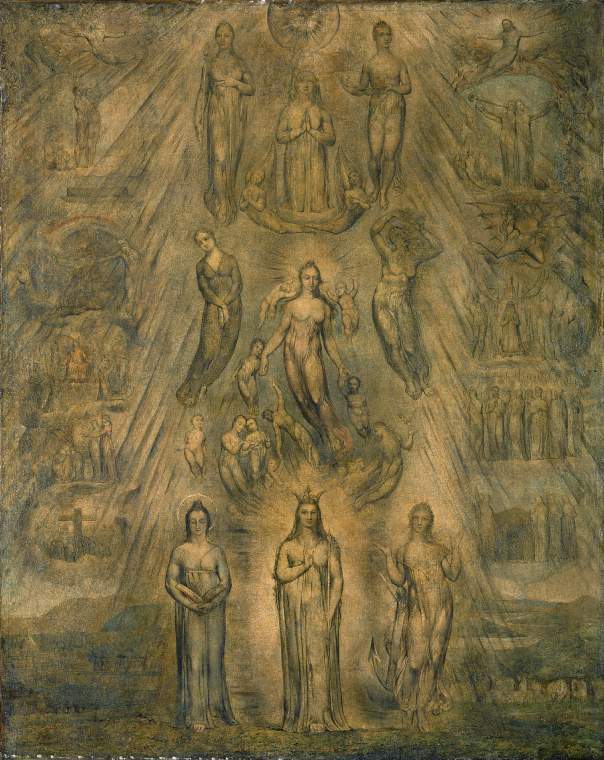
Showing posts with label Bible. Show all posts

Tuesday, February 8, 2011

DEAR MOTHER

Songs of Experience, Song 45, (E 26)
The Little Vagabond

"Dear Mother, dear Mother, the Church is cold,
But the Ale-house is healthy & pleasant & warm;
Besides I can tell where I am use'd well,
Such usage in heaven will never do well.

But if at the Church they would give us some Ale.
And a pleasant fire, our souls to regale;
We'd sing and we'd pray, all the live-long day;
Nor ever once wish from the Church to stray,

Then the Parson might preach & drink & sing.
And we'd be as happy as birds in the spring:
And modest dame Lurch, who is always at Church,
Would not have bandy children nor fasting nor birch.

And God like a father rejoicing to see,
His children as pleasant and happy as he:
Would have no more quarrel with the Devil or the Barrel
But kiss him & give him both drink and apparel."

The gentle father welcomes the penitent son in the picture for The Little Vagabond but the poem is not about Luke's story (verses 11-32) of the prodigal being welcomed home by a forgiving father. It is about the need for forgiveness, and becoming aware of the need to be forgiven on the part of the church. If a penitent is to be received into the arms of the father, it is the church.

"Dear Mother, dear Mother, the Church is cold," addresses the poem to the mother church herself, the church of the world. Blake was not known to be a church attender; his membership was in the Church Eternal, the Body of Christ which is the Church Universal.


He found fault with a worldly church which was cold, judgmental, exclusive and cruel. The name of the poem which is not overtly about a vagabond, calls our attention to the outsider, the lost and needy whom the church in Blake's day (as in our own day) neglected and rejected.

The Gentle Father's desire is to take into his arms not only the vagabonds and outcasts, but a church who is becoming a true expression of Christ's Body.

Thursday, January 27, 2011

RAINBOW of REVELATIONS

The three principle Biblical passages which make use of the image of the rainbow are the passage in Genesis (Noah), the section of Ezekiel in my last post, and the 10th chapter of Revelations:

Rev.10
[1] And I saw another mighty angel come down from heaven, clothed with a cloud: and a rainbow was upon his head, and his face was as it were the sun, and his feet as pillars of fire:
[2] And he had in his hand a little book open: and he set his right foot upon the sea, and his left foot on the earth,
[3] And cried with a loud voice, as when a lion roareth: and when he had cried, seven thunders uttered their voices.
[4] And when the seven thunders had uttered their voices, I was about to write: and I heard a voice from heaven saying unto me, Seal up those things which the seven thunders uttered, and write them not.
[5] And the angel which I saw stand upon the sea and upon the earth lifted up his hand to heaven,
[6] And sware by him that liveth for ever and ever, who created heaven, and the things that therein are, and the earth, and the things that therein are, and the sea, and the things which are therein, that there should be time no longer:
[7] But in the days of the voice of the seventh angel, when he shall begin to sound, the mystery of God should be finished, as he hath declared to his servants the prophets.
[8] And the voice which I heard from heaven spake unto me again, and said, Go and take the little book which is open in the hand of the angel which standeth upon the sea and upon the earth.
[9] And I went unto the angel, and said unto him, Give me the little book. And he said unto me, Take it, and eat it up; and it shall make thy belly bitter, but it shall be in thy mouth sweet as honey.
[10] And I took the little book out of the angel's hand, and ate it up; and it was in my mouth sweet as honey: and as soon as I had eaten it, my belly was bitter.
[11] And he said unto me, Thou must prophesy again before many peoples, and nations, and tongues, and kings.

The passage in Revelation like the passage in Ezekiel ends a vision with a voice calling to prophesy. Blake has once again chosen to illustrate the passage literally. We see with our eyes what John of Patmos saw as vision: the angel, the cloud the rainbow colors, the radiance of the face, the right foot and left foot on sea and earth, the little book in the left hand, the seven thunders as horsemen in the dark cloud and feet as pillars of fire. John himself is seen between the feet of the angel recording as directed.

The rainbow is one of many clues that this event of transition, the Revelation of the Apocalypse, is to link God and man. As a covenant was announced with the first rainbow appearance to Noah, a new dispensation is announced in Revelation. A new spiritual Jerusalem will replace the former Jerusalem whose temple had been intended to link God and man.

Blake's Vision of the Last Judgment provides us with images in words and pictures of the new dispensation which emanates from the Last Judgment. Blake includes these images of the new Jerusalem which is to replace the mortal with the immortal.

Vision of the Last Judgment,(E 561)
"The Cloud that opens rolling apart before the throne &
before the New Heaven & the New Earth is Composed of Various
Groupes of Figures particularly the Four Living Creatures
mentiond in Revelations as Surrounding the Throne these I suppose
to have the chief agency in removing the
old heavens & the old Earth
to make way for the New Heaven & the
New Earth to descend from the throne of God & of the Lamb."

Vision of the Last Judgment, (E 562)
"Jesus is surrounded by Beams of Glory in which are
seen all around him Infants emanating from him these represent
the Eternal Births of Intellect from the divine Humanity A
Rainbow surrounds the throne & the Glory in which youthful
Nuptials recieve the infants in their hands"

Perhaps the rainbow should always be seen as an invitation and a promise such as Blake issues here:

Vision of the Last Judgment, (E 560)
"If the Spectator could Enter into these Images in his
Imagination approaching them on the Fiery Chariot of his
Contemplative Thought if he could Enter into Noahs Rainbow or
into his bosom or could make a Friend & Companion of one of these
Images of wonder which always intreats him to leave mortal things
as he must know then would he arise from his Grave then would he
meet the Lord in the Air & then he would be happy"

Sunday, January 23, 2011

BLAKE'S RAINBOW

Blake uses the rainbow more as a visual image than a verbal image. Jerusalem appears here as a butterfly within the arc of a rainbow in the image at the bottom of Plate 14 of Jerusalem which shows Albion in his death-sleep. The heavenly bodies are portrayed as images in the plate, reminders of the universe measured in eons not minutes.

Jerusalem, Plate 13&14, (E 158)
"And all that has existed in the space of six thousand years:
Permanent, & not lost not lost nor vanishd, & every little act,
Word, work, & wish, that has existed, all remaining still
In those Churches ever consuming & ever building by the Spectres
Of all the inhabitants of Earth wailing to be Created:
Shadowy to those who dwell not in them, meer possibilities:
But to those who enter into them they seem the only substances
For every thing exists & not one sigh nor smile nor tear,

PLATE 14
One hair nor particle of dust, not one can pass away.

He views the Cherub at the Tree of Life, also the Serpent,
Orc the first born coild in the south: the Dragon Urizen:
Tharmas the Vegetated Tongue even the Devouring Tongue:
A threefold region, a false brain: a false heart:
And false bowels: altogether composing the False Tongue,
Beneath Beulah: as a watry flame revolving every way
And as dark roots and stems: a Forest of affliction, growing
In seas of sorrow. Los also views the Four Females:
Ahania, and Enion, and Vala, and Enitharmon lovely.
And from them all the lovely beaming Daughters of Albion,
Ahania & Enion & Vala, are three evanescent shades:
Enitharmon is a vegetated mortal Wife of Los:
His Emanation, yet his Wife till the sleep of death is past.

Such are the Buildings of Los! & such are the Woofs of
Enitharmon!"

The permanence and the multiplicity of the created world are described in the text. Blake has used words and images to remind us that there is an eternal world which underlies the vicissitudes of the temporal world. Because the image of the rainbow (which appeared after the Flood of Noah), is seen on this plate, Blake is going beyond the idea of an account of the physical body or the world of matter. The use of the rainbow makes the plate a token of a benevolent God's infinite care. We must remember that Blake uses water as a symbol for the material. To say that the world will not be destroyed by flood is to say the materiality shall not overcome spirituality.

When we seek out the biblical references for the rainbow we find this passage in Genesis 9:

[11] And I will establish my covenant with you; neither shall
all flesh be cut off any more by the waters of a flood; neither shall
there any more be a flood to destroy the earth.
[12] And God said, This is the token of the covenant which I make between me and you and every living creature that is with you, for perpetual generations:
[13] I do set my bow in the cloud, and it shall be for a token of a covenant between me and the earth.
[14] And it shall come to pass, when I bring a cloud over the earth, that the bow shall be seen in the cloud:
[15] And I will remember my covenant, which is between me and you and every living creature of all flesh; and the waters shall no more become a flood to destroy all flesh.
[16] And the bow shall be in the cloud; and I will look upon it, that I may remember the everlasting covenant between God and every living creature of all flesh that is upon the earth.
[17] And God said unto Noah, This is the token of the covenant, which I have established between me and all flesh that is upon the earth.

Genesis states that God covenants not to repeat the destruction of the earth and all living things by flood. The covenant is among God, man and the living creatures of the earth. The rainbow is a token of the covenant which is everlasting.

In Blake's 28 illustrations to Pilgrim's progress the rainbow colors appear frequently as reminders of the rainbow as a token. The rainbow image itself is prominent in three plates: the first, the last, and Plate 17 - CHRISTIAN AT THE ARBOR. In Plate One the arc of the rainbow previews the pilgrim's journey as a reminder of God's providence as man travels through life. Christian at the Arbor shows the linkage between God and man, a reference to the incarnation through which physicality and spirituality become one. The rainbow above the arbor symbolizes that linkage. In the final picture, in which the fourfold ascension is portrayed, the pilgrims and angels are embedded in the rainbow becoming themselves tokens of the process of reaching the visionary goal.
Plate I, THE DREAMER DREAMS A DREAM

Sunday, January 9, 2011

BLAKE READS THE BIBLE

Bishop Richard Watson’s An Apology for the Bible was published in 1796 and annotated by Blake in 1798.

When Blake annoted Watson's Apology for the Bible he expressd his unorthodox, inclusive views. He argued that man should realize he has direct access to God through the faculty of the imagination. He urged his reader to look within for the work of God in his own life and to be receptive to God's gifts.

Annotation to an Apology for the Bible (Bishop Watson)
E 615
"That the Jews assumed a right to the benefits
of God. will be a lasting witness against them. & the same will
it be [of] against Christians"

E 615
"The Bible or Word of God, Exclusive of Conscience
or the Word of God Universal, is that Abomination which like the
Jewish ceremonies is for ever removed & henceforth every man may
converse with God & be a King & Priest in his own house"

E 615
"It is strange that God should speak to man formerly & not
now. because it is not true"

E 615
"The Bible tells me that the plan of Providence was Subverted
at the Fall of Adam & that it was not restored till [we
in] Christ [?made ?restoration]"

E 616
"He who writes things for true which none could write. but
the actor. such are most of the acts of Moses. must either be the
actor or a fable writer or a liar. If Moses did not write the
history of his acts, it takes away the authority altogether it
ceases to be history & becomes a Poem of probable impossibilities
fabricated for pleasure as moderns say but I say by Inspiration."

E 617
"look over the events of your own life & if you do not find that
you have both done such miracles & lived by such you do not see
as I do True I cannot do a miracle thro experiment & to
domineer over & prove to others my superior power as neither
could Christ But I can & do work such as both astonish &
comfort me & mine"

E 617
"a Prophet is a Seer not an Arbitrary Dictator.
It is mans fault if God is not able to do him good. for he gives
to the just & to the unjust but the unjust reject his gift"

E 617
"for the facts are such as none but the actor
could tell, if it is True Moses & none but he could write it
unless we allow it to be Poetry & that poetry inspired"

Blake's heart was touched by man's failure to open the doors of perception. It grieved him that man had built walls to separate himself from the Divine. He showed us that the manacles we endure are forged in our own minds.


Book of Urizen, Plate 27, (E 83)
"5. And their children wept, & built
Tombs in the desolate places,
And form'd laws of prudence, and call'd them
The eternal laws of God"


Image from
Book of Urizen, Plate 26
____________________________________________________
Learn more about Blake's annotation in this review of
Blake's Margins: An Interpretive Study of the Annotations, by Hazard Adam (Reviewed by Morton D. Paley on 2010-05-22).

Saturday, January 1, 2011

ILLUSTRATING THE BIBLE

The Blake Archive has recently announced the addition of a series of Blake's paintings produced for Thomas Butts and identified as Paintings Illustrating the Bible. The index lists the nineteen subjects for the Old and New Testaments.

Although I cannot post images from the Blake Archive, I can post this image of The Circumcision from the site named William Blake: The Complete Works which does not restrict the use of the images (which are obviously beyond the period for which copyright protection applies.) .
The final picture of the group in the Archive is particularly appealing : "Christ The Mediator": Christ Pleading Before the Father for St. Mary Magdalene. In this picture Blake portrays the theme of forgiveness. Christ acting as the advocate for the sinner intervenes with Jehovah on the part of Magdalene who was said to have been a harlot.

Mark 16
[9] Now when Jesus was risen early the first day of the week, he appeared first to Mary Magdalene, out of whom he had cast seven devils.

On this the eighth day after the celebration of the birth of Jesus (the first day of the new year), the day on which circumcision is performed according to the Law of Moses, it is appropriate to observe Christ intervening in the exercise of the Law before the Father on the part of the woman who both was forgiven and discovered the empty grave.

Tuesday, December 14, 2010

NATIVITY V

Nativity I, II, III and IV

Last December I posted four time on the nativity using Blake's illustrations to Milton's On the Morning of Christ's Nativity. The fifth illustration of the series "The Flight of Molock" faithfully presents these lines from Milton's ode:

XXIII
And sullen Moloch fled,
Hath left in shadows dread
His burning Idol all of blackest hue;
In vain with Cymbals' ring
They call the grisly king,
In dismal dance about the furnace blue,Moloch, the second of Blake's Seven Eyes of God, called the executioner, required child sacrifice. Blake presents the theme of sacrificing children by showing the infant Jesus emerging from a 'fiery furnace.' Daniel tells of three men who emerged from such a furnace unscathed having met in the furnace a fourth who appeared as the 'Son of God.'

On plate 31 (E 177) of Jerusalem Blake tells us that:

"And the appearance of a Man was seen in the Furnaces;
Saving those who have sinned from the punishment of the Law,
(In pity of the punisher whose state is eternal death,)
And keeping them from Sin by the mild counsels of his love."

Two women (cf.1st Kings 3:16ff) are touching the child emerging from the furnace. One appears to be Jerusalem, the other Vala or Rahab. Both turn away from the child as they reach out to touch him. In The Mental Traveller we read of a babe whom none could touch:

The Mental Traveller, (E 484)
"Till from the fire on the hearth
A little Female Babe does spring

And she is all of solid fire
And gems & gold that none his hand
Dares stretch to touch her Baby form
Or wrap her in his swaddling-band"

Blake and Milton have supplemented the picture of the child who was laid in the manger as provided by Luke.

Friday, December 10, 2010

SIN & FORGIVENESS


Listen to Blake and the Bible commenting on Jesus, Sin, Error, Forgiveness, Satan and Judgment. These quotes from the two sources allow us to compare New Testament concepts and how similar ideas appear in Blake's :


CHRIST AS THE REDEEMER OF MAN

1)Jesus not the accuser (Satan) is our judge.


1John.2
[1] My little children, these things write I unto you, that ye sin not. And if any man sin, we have an advocate with the Father, Jesus Christ the righteous:

Vision of the Last Judgment, (E 565)
"Forgiveness of Sin is only at the Judgment Seat of Jesus the
Saviour where the Accuser is cast out. not because he Sins but
because he torments the Just & makes them do what he condemns as
Sin & what he knows is opposite to their own Identity"

2) The accuser has no power over us.

Rev.12
[10] And I heard a loud voice saying in heaven, Now is come salvation, and strength, and the kingdom of our God, and the power of his Christ: for the accuser of our brethren is cast down, which accused them before our God day and night.

Vision of the Last Judgment,(E 564)
"Christ comes
as he came at first to deliver those who were bound under the
Knave not to deliver the Knave He Comes to Deliver Man the
[Forgiven] not Satan the Accuser we do not
find any where that Satan is Accused of Sin he is only accused of
Unbelief & thereby drawing Man into Sin that he may accuse him.
Such is the Last Judgment a Deliverance from Satans Accusation
Satan thinks that Sin is displeasing to God he ought to know that
Nothing is displeasing to God but Unbelief & Eating of the Tree
of Knowledge of Good & Evil"

3) The light of Truth leads us to the new creation.

Acts.26
[18] To open their eyes, and to turn them from darkness to light, and from the power of Satan unto God, that they may receive forgiveness of sins, and inheritance among them which are sanctified by faith that is in me. [PAUL]

Vision of the Last Judgment, (E 565)
"I will not Flatter them Error is
Created Truth is Eternal [,] Error or Creation will be Burned Up &
then & not till then Truth or Eternity will appear It is Burnt up
the Moment Men cease to behold it I assert for My self that I do
not behold the Outward Creation & that to me it is hindrance &
not Action it is as the Dirt upon my feet No part of Me."

4) Forgiveness of sins is God's will.

Matt.9
[2] And, behold, they brought to him a man sick of the palsy, lying on a bed: and Jesus seeing their faith said unto the sick of the palsy; Son, be of good cheer; thy sins be forgiven thee.
[5] For whether is easier, to say, Thy sins be forgiven thee; or to say, Arise, and walk?
[6] But that ye may know that the Son of man hath power on earth to forgive sins, (then saith he to the sick of the palsy,) Arise, take up thy bed, and go unto thine house.

Jerusalem,
Plate 20, (E 165)

"Jerusalem answer'd with soft tears over the valleys.

O Vala what is Sin? that thou shudderest and weepest
At sight of thy once lov'd Jerusalem! What is Sin but a little
Error & fault that is soon forgiven; but mercy is not a Sin
Nor pity nor love nor kind forgiveness! O! if I have Sinned
Forgive & pity me! O! unfold thy Veil in mercy & love!
Slay not my little ones, beloved Virgin daughter of Babylon
Slay not my infant loves & graces, beautiful daughter of Moab"

5) The religion of Jesus practices mercy not vengeance.

Matt.23
[23] Woe unto you, scribes and Pharisees, hypocrites! for ye pay tithe of mint and anise and cummin, and have omitted the weightier matters of the law, judgment, mercy, and faith: these ought ye to have done, and not to leave the other undone.

Jerusalem, Plate 52, (E 201)
"Man must & will have Some Religion; if he has not the Religion
of Jesus, he will have the Religion of Satan, & will erect the
Synagogue of Satan. calling the Prince of this World, God; and
destroying all who do not worship Satan under the Name of God.
Will any one say: Where are those who worship Satan under the
Name of God! Where are they? Listen! Every Religion that Preaches
Vengeance for Sins the Religion of the Enemy & Avenger; and not
the Forgiver of Sin, and their God is Satan, Named by the Divine
Name Your Religion O Deists: Deism, is the Worship of the God
of this World by the means of what you call Natural Religion and
Natural Philosophy, and of Natural Morality or
Self-Righteousness, the Selfish Virtues of the Natural Heart.
This was the Religion of the Pharisees who murderd Jesus. Deism
is the same & ends in the same."

6) Practicing Forgiveness builds the Kingdom of God

Matthew 18
[21] Then came Peter to him, and said, Lord, how oft shall my brother sin against me, and I forgive him? till seven times?
[22] Jesus saith unto him, I say not unto thee, Until seven times: but, Until seventy times seven.

Jerusalem, Plate 77, (E 232)
"And remember: He who despises & mocks a Mental Gift in another;
calling it pride & selfishness & sin; mocks Jesus the giver of
every Mental Gift, which always appear to the ignorance-loving
Hypocrite, as Sins. but that which is a Sin in the sight of cruel
Man, is not so in the sight of our kind God.
Let every Christian as much as in him lies engage himself
openly & publicly before all the World in some Mental pursuit for
the Building up of Jerusalem "

The influence that the Bible had on shaping the mind of Blake led him to become a religious poet. He used the Christian metaphors in unique ways but always with the goal of opening the minds of men to the 'perception of the Infinite'.

Wednesday, December 8, 2010

EVIDENT TO THE CHILD

___________________________Image from Songs of Innocence,
___________________________Little Black Boy

Blake with his unusually high intelligence can be assumed to have to have learned to read very early in his life. Very likely the Bible was among his preferred reading material. He seems to have been attracted to the Old Testament prophets such as Isaiah, Ezekiel, Jeremiah, Amos whose influence is seen in his poetry.
It is interesting to think of Blake as a young child reading the Bible without instruction or supervision, as interacting in his own unique, superintelligent way. He got into some scholarship later and also absorbed the general understanding from his culture. Nevertheless his interaction and interpretation continued to be direct and unusual.

Annotations to Berkeley, (E 664)
"Jesus supposes every Thing to be Evident to the Child & to
the Poor & Unlearned Such is the Gospel
The Whole Bible is filld with Imaginations & Visions from
End to End & not with Moral virtues that is the baseness of Plato
& the Greeks & all Warriors The Moral Virtues are continual
Accusers of Sin & promote Eternal Wars & Domineering over others"

Annotations to Berkeley, (E 664)
"Man is All Imagination God is Man & exists in us & we in him"

Jonathan Roberts and Christopher Rowland contributed a chapter to the Blackwell Companion to the Bible in English Literature in which they present their views on Blake's use of the Bible (Page 376):
"This emphasis on the importance of individuals (and their social contexts) in interpreting the Bible means that Blake is particularly concerned with replacing a literalist hermeneutic with one that considers the Bible to be a stimulus to the imagination. This means above all engaging readers in the interpretation of the text, rather than demanding they accept it as in object above and beyond them. To this end Blake provides a consistent polemic against the preoccupation with the literal sense of the text, and against a reverence for the text that comes at the expense of what an imaginative and life-affirming encounter with the Bible might offer. These two tasks required a thoroughgoing assault on the ways in which the Bible had been constructed and reduced to a focus on the sacrificial death of Jesus and a religion of moral virtue. Blake would have no truck, for example, with the view that humans are inherently sinful: that God must be appeased by a sacrifice (of Christ); and that God - having made that sacrifice - then expects humanity to behave morally in order to stay in relationship with him (i.e. by keeping his commandments). Such an outlook, Blake thought, led to a denial of aspects of the human person and the subjection of some human beings to others."

Blake seemed to continue to read the Bible as he had as a child - with an open mind. He didn't look back to what the words had meant when they were written exclusively, but to what they meant in the immediate present to his own imaginative ability. His conversations with Ezekiel and Isaiah may have begun long before he wrote The Marriage of Heaven and Hell and continued long after.

Thursday, December 2, 2010

BLAKE & WORD OF GOD

Jonathan Roberts and Christopher Rowland contributed a chapter to the Blackwell Companion to the Bible in English Literature in which they present their views on Blake's use of the Bible. On page 375-76 they write:

"Blake was influenced by a view of the Bible which has a long history in Christianity and may have been a part of the radical religious underground of which he was an inheritor. In this view the Word of God is not a book but a person: Christ ( see John 1:14. "And the Word was made flesh and dwelt among us" and Hebrews 1:1-2. God...Hath in these last days spoken unto us by his Son"). In short, the Bible bears witness to the Word of God (that is Christ), but is not in itself the Word of God. Blake manifests this view when he writes:

'The Bible or Word of God, [when read] exclusive of conscience or the Word of God Universal, is that Abomination which like the Jewish ceremonies is for ever removed & henceforth every man may converse with God & be a King & Priest in his own house.' (Erdman, 1990, p.614) [Annotations to Bishop Watson]

"Here Blake exalts 'the Word of God Universal' (Christ, or conscience) over the 'Peculiar Word of God' (the Bible as the exclusive mode of divine communication). This distinction between the two 'Words' (Christ and the Bible) means that an individual inspired by the former (through conscience, the Divine Spirit within) may contest and criticize the latter."
End of Quote

Rowland and Roberts are right that this view has a long history and is apparent in Blake's writing. This view of placing the Living Word (acting through the Holy Spirit) above the Written Word (recorded in books) opens up the possibility of continuing revelation which Blake wholeheartedly affirmed. Placing complete and final trust in the recorded Word limits further revelation of Divine Truth. This obstacle to the possibility of the evolution of spiritual consciousness through the work of Imagination is removed through placing trust in the Living word of Christ. Rowland and Roberts were conveying their view that Blake most trusted the word that came to him in thought, and Vision and the expressions of the Imagination.

Friday, November 5, 2010

How Blake Read the Gospel

All his life Blake read the Bible, loved it, and engaged in dialogue with its immortal authors. Virtually every line of his poetry and every picture he painted had direct reference to some biblical idea that Blake had meditated upon.

In vivid contrast many of the orthodox don't read the Bible at all; they just wave it! Little wonder they dislike Blake. His early ironic description of his work as the Bible of Hell certainly helped to confirm their prejudice.

_____________________________________________

"Thou read'st black where I read white."
( Everlasting Gospel.

There are essentially two ways to read the Bible; Blake referred to them as black and white. What did he mean? We might look at Urizen's Book of Brass as the black book. It's a book of rules, a book of law. It tells people what to do, and more poignantly, what not to do.

Even today ordinary people see the Bible in this way, which helps to explain why hardly anyone reads it today. The few who do read it dutifully and dully. Such a reading constrains consciousness; it makes the reader obedient and unimaginative. The faithful few who feel that they should read their Bible often approach it in a child like way bordering on the childish. Reading the black book inhibits the imagination, deadens the mind and prevents spiritual development. At its worst it has led to many instances of religious persecution and mass murder.

But Blake read it white. The white book is not a book of rules, but a book of visions, a book of wonders. It provokes thought, causes the imagination to soar. Blake must have learned to read at about the age of four, when he had his first vision-- the frightful face at the window. Perhaps we've all been frightened by the Bible in one way or another; most people have had a sufficiently negative experience to leave it strictly alone. But little William overcame his fright and kept reading, and the next vision we hear of was more positive--a tree full of angels.

All the evidence suggests that for the next sixty five years Blake's Bible reading and his visions went hand in hand; his art is the record of it all. Whoever becomes really interested in Blake's visions will find himself reading the Bible because that's where most of them begin. In spite of this his secular critics have looked all over the world for his sources.

One of the greatest things that Blake has to offer the reader is that he makes you see and read the Bible in a new and better way. Not for nothing did the youthful circle of admirers of Blake's last years refer to him as the Interpreter.

The black book has most often been read as law, as history, in a restricted, literal interpretation. If the priest can get people to see it this way, and only this way, then he has secure control over his flock of sheep. In contrast Blake suggests that it's symbolic. Although written in categories of time and space, the temporal dimension is only instrumental; it points to the Beyond, the Eternal, the Real.

Too often people reading 'black' concern themselves with foolish questions such as "Did it really happen? Was Jonah really swallowed by the whale, or rather by the big fish?" But in Blake's vision that isn't the important thing. The important thing is "What does it mean?" The reader of the black book gets himself tied up in knots about the veracity or historicity of Jonah and his aquatic friend.

Blake shows you the Jonah in your psyche and helps you get some grasp of what the turbulent sea means to you personally. It's experiential, exciting! it puts you in touch with reality!, which is not material at all but spiritual. Literal or symbolic is black or white, and probably the two minds will never meet. At this point I simply urge you to join Blake and read white:

    "Why is the Bible more Entertaining & Instructive than any other book? Is it not because [it is] addressed to the Imagination which is Spiritual Sensation, and but mediately to the Understanding or Reason?"
    (Letter To Trusler; Erdman 702-3)

    All of the above is taken from Chapter Six of the Blake Primer.

Saturday, October 30, 2010

Blake's Everlasting Gospel

Here's what he thought of the Establishment Gospel:

Using the Blake Concordance I found only two occurrences of the word, idol; it led me to two plates (
60 and 61) in Jerusalem. Together they represent a central tenet of Blake's gospel; it concerns forgiveness:
Jerusalem, Plate 60:

"The clouds of Albions Druid Temples rage in the eastern heaven
While Los sat terrified beholding Albions Spectre who is Luvah
Spreading in bloody veins in torments over Europe & Asia;
Not yet formed but a wretched torment unformed & abyssal
In flaming fire; within the Furnaces the Divine Vision appeard

On Albions hills: often walking from the Furnaces in clouds
And flames among the Druid Temples & the Starry Wheels
Gatherd Jerusalems Children in his arms & bore them like
A Shepherd in the night of Albion which overspread all the Earth

I gave thee liberty and life O lovely Jerusalem
And thou hast bound me down upon the Stems of Vegetation
I gave thee Sheep-walks upon the Spanish Mountains Jerusalem
I gave thee Priams City and the Isles of Grecia lovely!
I gave thee Hand & Scofield & the Counties of Albion:
They spread forth like a lovely root into the Garden of God:
They were as Adam before me: united into One Man,
They stood in innocence & their skiey tent reachd over Asia
To Nimrods Tower to Ham & Canaan walking with Mizraim
Upon the Egyptian Nile, with solemn songs to Grecia
And sweet Hesperia even to Great Chaldea & Tesshina
Following thee as a Shepherd by the Four Rivers of Eden
Why wilt thou rend thyself apart, Jerusalem?
And build this Babylon & sacrifice in secret Groves,
Among the Gods of Asia: among the fountains of pitch & nitre
Therefore thy Mountains are become barren Jerusalem!
Thy Valleys, Plains of burning sand. thy Rivers: waters of death
Thy Villages die of the Famine and thy Cities
Beg bread from house to house, lovely Jerusalem
Why wilt thou deface thy beauty & the beauty of thy little-ones
To please thy Idols, in the pretended chastities of Uncircumcision[?]
Thy Sons are lovelier than Egypt or Assyria; wherefore
Dost thou blacken their beauty by a Secluded place of rest.
And a peculiar Tabernacle, to cut the integuments of beauty
Into veils of tears and sorrows O lovely Jerusalem!
They have perswaded thee to this, therefore their end shall come
And I will lead thee thro the Wilderness in shadow of my cloud
And in my love I will lead thee, lovely Shadow of Sleeping
Albion.

This is the Song of the Lamb, sung by Slaves in evening time.

But Jerusalem faintly saw him, closd in the Dungeons of Babylon
Her Form was held by Beulahs Daughters. but all within unseen
She sat at the Mills, her hair unbound her feet naked
Cut with the flints: her tears run down, her reason grows like
The Wheel of Hand. incessant turning day & night without rest
Insane she raves upon the winds hoarse, inarticulate:
All night Vala hears. she triumphs in pride of holiness
To see Jerusalem deface her lineaments with bitter blows
Of despair. while the Satanic Holiness triumphd in Vala
In a Religion of Chastity & Uncircumcised Selfishness
Both of the Head & Heart & Loins, closd up in Moral Pride.

But the Divine Lamb stood beside Jerusalem. oft she saw
The lineaments Divine & oft the Voice heard, & oft she said:
O Lord & Saviour, have the Gods of the Heathen pierced thee?
Or hast thou been pierced in the House of thy Friends?
Art thou alive! & livest thou for-evermore? or art thou
Not: but a delusive shadow, a thought that liveth not.
Babel mocks saying, there is no God nor Son of God
That thou O Human Imagination, O Divine Body art all
A delusion. but I know thee O Lord when thou arisest upon
My weary eyes even in this dungeon & this iron mill.
The Stars of Albion cruel rise; thou bindest to sweet influences:
For thou also sufferest with me altho I behold thee not;
And altho I sin & blaspheme thy holy name, thou pitiest me;
Because thou knowest I am deluded by the turning mills.
And by these visions of pity & love because of Albions death.

Thus spake Jerusalem, & thus the Divine Voice replied.
Mild Shade of Man, pitiest thou these Visions of terror & woe!
Give forth thy pity & love. fear not! lo I am with thee always.
Only believe in me that I have power to raise from death
Thy Brother who Sleepeth in Albion: fear not trembling Shade"

Jerusalem, Plate 61:
"Behold : in the Visions of Elohim
Jehovah, behold Joseph & Mary
And be comforted O Jerusalem
in the Visions of Jehovah Elohim
She looked & saw Joseph the Carpenter in Nazareth & Mary
His espoused Wife. And Mary said,
if thou put me away from thee
Dost thou not murder me?
Joseph spoke in anger & fury.
Should I Marry a Harlot or an Adulteress?
Mary answerd, Art thou more pure
Than thy Maker who forgiveth Sins & calls again Her that is Lost
Tho She hates. he calls her again in love. I love my dear Joseph
But he driveth me away from his presence. yet I hear the voice of God
In the voice of my Husband. tho he is angry for a moment,
he will not Utterly cast me away.
if I were pure, never could I taste the sweets
Of the Forgive[ne]ss of Sins! if I were holy! I never could behold the tears Of love!
of him who loves me in the midst of his anger in furnace of fire.
Ah my Mary: said Joseph: weeping over & embracing her closely in His arms:
Doth he forgive Jerusalem & not exact Purity from her who is
Polluted. I heard his voice in my sleep O his Angel in my dream:
Saying, Doth Jehovah Forgive a Debt only on condition that it shall Be Payed?
Doth he Forgive Pollution only on conditions of Purity
That Debt is not Forgiven! That Pollution is not Forgiven
Such is the Forgiveness of the Gods, the Moral Virtues of the
Heathen, whose tender Mercies are Cruelty. But Jehovahs
Salvation Is without Money & without Price,
the Continual Forgiveness of Sins
In the Perpetual Mutual Sacrifice in Great Eternity! for behold!
There is none that liveth & Sinneth not! And this is the Covenant
Of Jehovah: If you Forgive one-another, so shall Jehovah Forgive You:
That He Himself may Dwell among You.
Fear not then to take To thee Mary thy Wife,
or she is with Child by the Holy Ghost

Then Mary burst forth into a Song! she flowed like a River of
Many Streams in the arms of Joseph & gave forth her tears of joy
Like many waters, and Emanating into gardens & palaces upon
Euphrates & to forests & floods & animals wild & tame from
Gihon to Hiddekel, & to corn fields & villages & inhabitants
Upon Pison & Arnon & Jordan."

Here's what he thought of the establishment gospel:
"Priests in black gowns were walking their rounds,
And binding with briers my joys and desires" (from The Garden
of Love); Erdman 26)


And how like the famous Spectre:

"Seven of my sweet loves thy knife
Has bereaved of their life
Their marble tombs I built with tears
And with cold & shuddering fears

Seven more loves weep night & day
Round the tombs where my loves layt
And seven more loves attend each night
Around my couch with torches bright"

Blake worked with the Everlasting Gospel (Erdman 518-24) for years trying to explain how his gospel differed from the Establishment one; what came forth is (certainly not lucid), ambiguous, tortured English; the Spirit simply doesn't lend itself to our words. Here are the last few lines:
"The Vision of Christ that thou dost see
Is my Visions Greatest Enemy
Thine has a great hook nose like thine
Mine has a snub nose like to mine
Thine is the Friend of All Mankind
Mine speaks in parables to the Blind
Thine loves the same world that mine hates
Thy Heaven doors are my Hell Gates
Socrates taught what Melitus Loathd as a Nations bitterest Curse
And Caiphas was in his own Mind
A benefactor of Manking
Both read the Bible day & night

But thou readst black where I read white"

Reading it 'white' is what all true Blakeans strive to do.

Sunday, October 17, 2010

HARVEST & VINTAGE

Revelations 14
[15] And another angel came out of the temple, crying with a loud voice to him that sat on the cloud, Thrust in thy sickle, and reap: for the time is come for thee to reap; for the harvest of the earth is ripe.
[16] And he that sat on the cloud thrust in his sickle on the earth; and the earth was reaped.
[17] And another angel came out of the temple which is in heaven, he also having a sharp sickle.
[18] And another angel came out from the altar, which had power over fire; and cried with a loud cry to him that had the sharp sickle, saying, Thrust in thy sharp sickle, and gather the clusters of the vine of the earth; for her grapes are fully ripe.
[19] And the angel thrust in his sickle into the earth, and gathered the vine of the earth, and cast it into the great winepress of the wrath of God.
[20] And the winepress was trodden without the city, and blood came out of the winepress, even unto the horse bridles, by the space of a thousand and six hundred furlongs.

S. Foster Damon, William Blake: Philosophy and Symbols, in commenting on the final scenes in the Four Zoas, says (Page 164):

AND GOD BLESSED THE SEVENTH
DAY AND SANCTIFIED IT
"In six days heaven and earth had been created, according to Genesis, and on the seventh day the Lord rested. In six days, therefore, that work is to be reversed, before the Sabbath of the Millennium can arise. These six days are spent in a final Harvest and Vintage of the world, to make the Bread and Wine of Eternity. Urizen threshes the corn which Urthona bakes into the Bread of Philosophy, while Luvah presses the grapes into the Wine of Ecstacy; and all the chaff and refuse is cast into Non-Entity. This lovely festival in the spiritual world is the reality of what on earth seems to be the final catastrophes of the Apocalypse. During this time Orc burns himself out: Ahania and Enion rise to their former Glory; Luvah and Vala regain their original State of Innocence; while Los takes on his original form, Urthona. The terrific vision ends in a splendid peace:

[Four Zoas, PAGE 139, Night the Ninth, (E 406)]:
"How is it we have walkd thro fires & yet are not consumd
How is it that all things are changd even as in ancient times

The Sun arises from his dewy bed & the fresh airs
Play in his smiling beams giving the seeds of life to grow
And the fresh Earth beams forth ten thousand thousand springs of
life
Urthona is arisen in his strength no longer now
Divided from Enitharmon no longer the Spectre Los
Where is the Spectre of Prophecy where the delusive Phantom
Departed & Urthona rises from the ruinous walls
In all his ancient strength to form the golden armour of science
For intellectual War The war of swords departed now
The dark Religions are departed & sweet Science reigns

End of The Dream"

The image of the harvest and vintage appears in Milton as well:

Milton, PLATE 25 [27] (E 121)
"The Wine-press on the Rhine groans loud, but all its central beams
Act more terrific in the central Cities of the Nations
Where Human Thought is crushd beneath the iron hand of Power.
There Los puts all into the Press, the Opressor & the Opressed
Together, ripe for the Harvest & Vintage & ready for the Loom.

They sang at the Vintage. This is the Last Vintage! & Seed
Shall no more be sown upon Earth, till all the Vintage is over
And all gatherd in, till the Plow has passd over the Nations
And the Harrow & heavy thundering Roller upon the mountains

And loud the Souls howl round the Porches of Golgonooza

Crying O God deliver us to the Heavens or to the Earths,
That we may preach righteousness & punish the sinner with death
But Los refused, till all the Vintage of Earth was gatherd in.

And Los stood & cried to the Labourers of the Vintage in voice of
awe.

Fellow Labourers! The Great Vintage & Harvest is now upon Earth
The whole extent of the Globe is explored: Every scatterd Atom
Of Human Intellect now is flocking to the sound of the Trumpet
All the Wisdom which was hidden in caves & dens, from ancient
Time; is now sought out from Animal & Vegetable & Mineral

The Awakener is come. outstretchd over Europe! the Vision of God
is fulfilled
The Ancient Man upon the Rock of Albion Awakes,
He listens to the sounds of War astonishd & ashamed;"

Milton, PLATE 27 [29] (E 124)
"This Wine-press is call'd War on Earth, it is the Printing-Press
Of Los; and here he lays his words in order above the mortal
brain
As cogs are formd in a wheel to turn the cogs of the adverse
wheel.

Milton, PLATE 43 [50], (E 144)
"To go forth to the Great Harvest & Vintage of the Nations

Finis"

As Damon says, Blake wrote on multiple levels simultaneously. On the historical level the harvest and vintage appeared as the battles and wars which were taking place in his own times - the Napoleonic Wars ("Wine-press on the Rhine groans loud".) In Blake's personal experience the activities of his publishing work were his participation in the 'Great Harvest & Vintage' ("the Printing-Press Of Los; and here he lays his words in order above the mortal brain"). At the spiritual level they were the rewinding of the 'golden string' which had begun to be unwound with the material creation which Blake pictured in the Book of Urizen ("Every scatterd Atom Of Human Intellect now is flocking to the sound of the Trumpet").

Genesis 1
[5] And God called the light Day, and the darkness he called Night. And the evening and the morning were the first day.
[8] And God called the firmament Heaven. And the evening and the morning were the second day.
[12] And the earth brought forth grass, and herb yielding seed after his kind, and the tree yielding fruit, whose seed was in itself, after his kind: and God saw that it was good.
[13] And the evening and the morning were the third day.
[17] And God set them in the firmament of the heaven to give light upon the earth,
[18] And to rule over the day and over the night, and to divide the light from the darkness: and God saw that it was good.
[19] And the evening and the morning were the fourth day.
[22] And God blessed them, saying, Be fruitful, and multiply, and fill the waters in the seas, and let fowl multiply in the earth.
[23] And the evening and the morning were the fifth day.
[27] So God created man in his own image, in the image of God created he him; male and female created he them
[31] And God saw every thing that he had made, and, behold, it was very good. And the evening and the morning were the sixth day.

Friday, October 15, 2010

BLAKE & DYLAN II

Book of Urizen, Plate 22, (E 82)
"The tormented element stretch'd
From the sorrows of Urizen's soul."


When Larry was writing his Blake Book, (Ram Horn'd with Gold) in the seventies and eighties the influence of Bob Dylan was everywhere including under our roof. He wrote a chapter on Blake and Dylan for his book but it was not included in the online version. Since I posted on the influence of Blake's poetry on Dylan's song EVERY GRAIN ON SAND, I'd like to pass along some of what Larry said in the missing chapter:


"In style Dylan closely approaches Blake as a symbolist. Fiercely eclectic like the English poet, he drew with utmost freedom upon his entire experience for the imagery of his lyrics. This means that the listener unversed in Dylan's experience will have the same sort of problems with his lyrics as so many have had with '4Z's' or 'Jerusalem'. Much of it comes through as sheer gibberish to all except the few some where in the vicinity of Dylan's mind. It helps to know the sixties Greenwich Village scene, country music, blues and rock as well as Verlaine, Rimbaud and Baudelaire, plus a few other esoteric sources.

"It also helps to know the Bible. Nowhere are Blake and Dylan more alike than in their dependence upon Biblical symbolism. Dylan is fully capable of throwing a wicked curve, when for example, one of his songs embedded in the western ethos where clean hands evoke the gambling man, and suddenly he switches to the imagery of Psalm 24: "His clothes are dirty but his hands are clean". [Example from Michael Gray's book.]

"Whether he knew of Blake's letter to Trusler or not, Dylan certainly put into practice the advice of the "Wisest of the Ancients [who] consider'd what was not too Explicit as the fittest for instruction, because it rouzes the faculties to act". For the intellectually curious the lure of the two men is identical: to find the kernel of meaning in the peculiar wrapping."

It is fascinating to compare the lives of these two poets whose struggles to express their enormous gifts, and to master the psychological conflicts of warring aspects of their minds were played out so publicly in their poetry. As Larry says:
"We should realize that this ['The Wicked Messenger'] like most of Dylan's songs is essentially autobiographical. He shared Blake's perspective on the oneness of the human race. He knew that his (and our) experiences are universal. The song ends appropriately with this message to the messenger: 'If you cannot bring good news, then don't bring any.'" Our two messengers brought their good news even though they often dipped into the deepest and darkest reaches of the psyche to bring it into the light.

Lyrics to Wicked Messenger

Thursday, September 2, 2010

THE VEIL OF VALA

The Biblical accounts tell us that the veil of the Jewish Temple in Jerusalem was rent in two from top to bottom when Jesus died on the cross. The temple veil was the curtain that separated from the outer parts, the most holy part of the temple where God was present and into which only the high priest was allowed to go only once a year. The tearing was symbolic of removal of the barrier existing between man and God.

In the book of Hebrews we read:
"Therefore, my friends, since we have confidence to enter the sanctuary by the blood of Jesus, by the new and living way that he opened for us through the curtain (that is, through his flesh), and since we have a great priest over the house of God, let us approach with a true heart in full assurance of faith, with our hearts sprinkled clean from an evil conscience and our bodies washed with pure water" (NRSV).

The body, the flesh, of Jesus through the crucifixion and resurrection became the opening in the veil through which man was given direct access to God which he had been denied by the veil of the temple before it was rent.

Blake created his character Vala conscious of the complex symbols associated with the veil in Christianity. Vala in Blake's mythology carries many symbolic meanings including the Goddess Nature, symbol of a cruel unregenerate life. Another of Vala's names is Mystery which Percival says: "pretends to love, but practices hate. It pretends to forgiveness but practices envy, revenge and cruelty." Vala is further changed into Deism or Natural Religion which constructs a distant God who creates but does not interfere with the world he creates. Reason not revelation constitutes the deistic religion. Vala represents the concealment of the true relationship of God and man.

Blake believed that the removal of the obstruction between God and man accomplished by Christ had been reversed in the centuries following the establishment of the church. He used Vala and her veil to convey some of that meaning. For Blake there was no veil concealing God from his sight. Jesus the Imagination was the God in whom he 'lives and moves and has his being.' (Acts 17:28)

Jerusalem, Plate 23, (E 168)
My soul is melted away, inwoven within the Veil
Hast thou again knitted the Veil of Vala, which I for thee
Pitying rent in ancient times. I see it whole and more
Perfect, and shining with beauty!

Jerusalem Plate 60, (E 211)
"Babel mocks saying, there is no God nor Son of God
That thou O Human Imagination, O Divine Body art all
A delusion. but I know thee O Lord when thou arisest upon
My weary eyes even in this dungeon & this iron mill."

Jerusalem, Plate 4, (E 146)
"I am not a God afar off, I am a brother and friend;
Within your bosoms I reside, and you reside in me:
Lo! we are One; forgiving all Evil; Not seeking recompense!
Ye are my members O ye sleepers of Beulah, land of shades!"

The Laocoon (E 273)
"Adam is only The Natural Man & not the Soul or Imagination
The Eternal Body of Man is The IMAGINATION.
God himself |
that is |[Yeshua] JESUS We are his Members
The Divine Body|
It manifests itself in his Works of Art (In Eternity All is Vision)
All that we See is VISION from Generated Organs gone as soon as come
Permanent in The Imagination; considered as Nothing by the NATURAL MAN"