Showing posts with label Thomas Butts. Show all posts

Saturday, January 29, 2011

MILTON & BLAKE

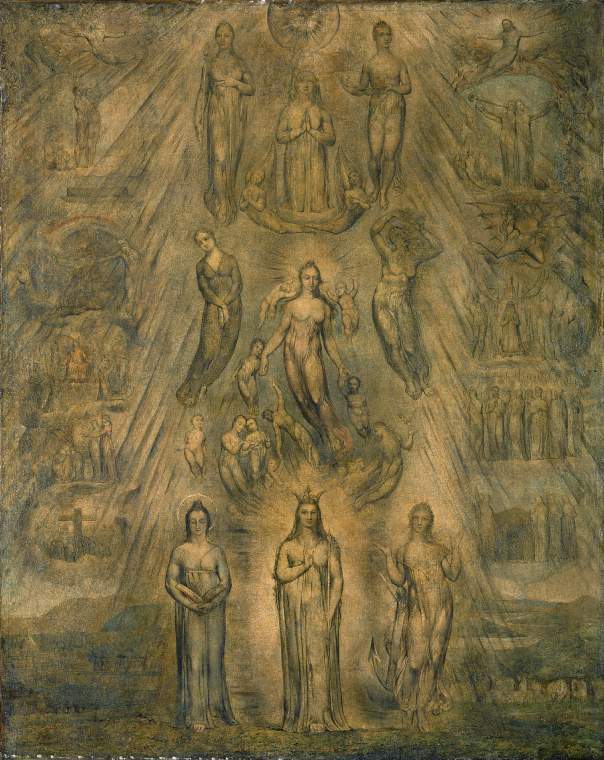
In 1816 Thomas Butts is thought to have requested of Blake a series of illustrations for two poems by Milton: L'Allegro and Il Penseroso, which contrast the personality types or attitudes of one who is lively and gay with one who is meditative and pensive. So here was another opportunity for Blake to apply his imagination to subjects which he found endlessly fascinating - the life and work of his mentor Milton, and exploration and resolution of contrary positions.

Constellations - Cancer (The Crab), Gemini (The Twins), Orion, Taurus (The Bull), Aries (The Ram)

The final illustration of the series shows Milton in His Old Age since Blake inserted Milton into his own poem as a character. Blake made inscriptions to accompany each section of the poem that he was illustrating. You may read these in The Complete Poetry and Prose of William Blake edited by David V. Erdman beginning on page 682. To locate this click on Blake's content on the sidebar of this blog, page down to close to bottom, click on 'Inscriptions and Notes On or For Pictures', page down to E682 in the margin, read 'Blake's manuscript notes accompanying his watercolors.'

The poem IL Penseroso ends with these lines:
167 "And may at last my weary age
168 Find out the peaceful hermitage,
169 The hairy gown and mossy cell,
170 Where I may sit and rightly spell
171 Of every star that Heav'n doth shew,
172 And every herb that sips the dew;
173 Till old experience do attain
174 To something like prophetic strain.
175 These pleasures, Melancholy, give,
176 And I with thee will choose to live."

Bette Charlène Werner in Blake's vision of the poetry of Milton: illustrations to six poems, wrote a chapter on Blake's Illustrations to these two poems. Here is some of what she says:
"The L'Allegro and Il Penseroso illustrations show the earthly life of Milton, a life Blake envisioned as leaving the poet unhappy though in heaven, his emanation (or his poetry) still unredeemed. Milton's life in Blake's eyes is a 'bright pilgrimage,' but an uncompleted journey. Its destination unachieved, the pilgrimage will not be taken up again until the future time when Blake himself, united in prophetic brotherhood with Milton and inspired by the fiery spirit of imagination, Los, straps on his golden sandal to walk froward through eternity. The Milton of L'Allegro and Il Penseroso illustrations has not yet progressed beyond the moony rest of the threefold Beulah into Eden. Blake emphasizes Milton's sleeping humanity in the series, while calling upon him to become 'the Awakener.' (page 146)
...
"In Blake's imagery he is a figure of humanity enclosed in the life of the five senses; his optic nerve, a hardened bone or black pebble on the beach, still opens within like a diamond that holds in it's hallowed center the heavens of bright eternity.
Blake closes his story of Milton's earthly life with a night scene instead of a dawn. The stars in Blake's imagery, as forms of fallen light, are frequently associated with constriction and confinement as they follow the strict order of mathematically defined pathways through the skies. Still, Blake like Milton, also thought of them as forming a golden chain "To bind the Body of Man to heaven from falling into the Abyss."
...
"Even as the stars in general are ambivalent images for Blake, the ones pictured here are particularly so. The constellation of Cancer, Gemini, Taurus, and Aries can be seen together in the sky of either winter or spring. There are suggestions of both in the picture, in which the winter mood of old age and night is brightened by the flower forms of spring. There is an auspicious note in the part of Orion's myth that tells of the cure of his blindness when he waded far into the sea until he finally reached the land where the sun rises." (page 164)

Four Zoas, Page 34, (E 321)
"For the Divine Lamb Even Jesus who is the Divine Vision
Permitted all lest Man should fall into Eternal Death
For when Luvah sunk down himself put on the robes of blood
Lest the state calld Luvah should cease. & the Divine Vision
Walked in robes of blood till he who slept should awake
Thus were the stars of heaven created like a golden chain
To bind the Body of Man to heaven from falling into the Abyss"

Saturday, January 1, 2011

ILLUSTRATING THE BIBLE

The Blake Archive has recently announced the addition of a series of Blake's paintings produced for Thomas Butts and identified as Paintings Illustrating the Bible. The index lists the nineteen subjects for the Old and New Testaments.

Although I cannot post images from the Blake Archive, I can post this image of The Circumcision from the site named William Blake: The Complete Works which does not restrict the use of the images (which are obviously beyond the period for which copyright protection applies.) .
The final picture of the group in the Archive is particularly appealing : "Christ The Mediator": Christ Pleading Before the Father for St. Mary Magdalene. In this picture Blake portrays the theme of forgiveness. Christ acting as the advocate for the sinner intervenes with Jehovah on the part of Magdalene who was said to have been a harlot.

Mark 16
[9] Now when Jesus was risen early the first day of the week, he appeared first to Mary Magdalene, out of whom he had cast seven devils.

On this the eighth day after the celebration of the birth of Jesus (the first day of the new year), the day on which circumcision is performed according to the Law of Moses, it is appropriate to observe Christ intervening in the exercise of the Law before the Father on the part of the woman who both was forgiven and discovered the empty grave.

Monday, December 6, 2010

CRYSTAL CABINET

Blake's illustration to Milton's Comus commissioned by Thomas Butts dated 1815


Thomas Butts was a principal patron of William Blake during the leanest of times in his life. It is hard to conceive of how Blake could have continued his imaginative work without the financial support which sales to Butts provided. Mary Butts, the great-granddaughter of Thomas Butts had the childhood experience of growing up under the influence of William Blake whose pictures adorned the walls of a room in her home. In her autobiography The Crystal Cabinet: My Childhood at Salterns, she applies the metaphor of Blake's poem to understanding her adolescent years. Her book was first published in 1937, shortly before her death, over objections from her fractious family. It was reissued in 1988 including material which had formerly been deleted.

Joel Hawkes of the University of Bristol wrote an article on Mary Butts's book which he called Inside The Crystal Cabinet: Truth, Lies and Vision in Mary Butts’s Autobiography of Place. On page 3 of the article we read:
"The title The Crystal Cabinet is borrowed from William Blake’s poem of the same name. In understanding Butts’s interpretation of Blake’s poem, and of Blake’s art more generally, one begins to see how Butts searches for truth and for vision through the creation of place within her writing. Salterns, as a place, is a means to this vision. Butts had grown up at Salterns – a large 21 acre estate near Poole – surrounded by Blake’s work. Butts’s great grandfather, Thomas Butts, was patron to William Blake, and in Mary’s childhood, in a room known as the ‘Blake room’, there hung a large number of Blake’s paintings, now found at the Tate Britain (Butts 1988, p.13). The house was also reportedly filled with other works of art, particularly those of the Pre-Raphaelites – the Rossettis were friends of her father’s (p.142). Butts, with good reason, writes that her early life was ‘saturated’ with art (1988, p.31)."

Hawkes' article on page 5 comments on the poem which Butts used to create a framework for her autobiography:

"Blake’s ‘The Crystal Cabinet’ explores the movement from Beulah to Generation. In the poem, a young man is taken away from the ‘Wild’, where he tells us he was ‘dancing merrily’ – a place of innocence. He is caught by a maiden, taken into the cabinet, and locked up with a ‘golden Key’ (1972, p.429, ll. 1-4). In the cabinet he sees another England, another London and Thames (ll. 9-12). They are like the one he knows, but different. A sexual and imaginative development takes place with the maiden, and during his experience the youth strives to ‘seize the inmost form’ of this event (l. 21). Doing so, he bursts the cabinet, becoming a ‘Weeping Babe’ – born into our world of experience (l. 24). The youth of the poem is moving from one realm to another through sexual and imaginative experience. It is a passage, indeed a rite of passage, from innocence to experience – one that unites the two opposites. It may seem like a fall in the tradition of Adam and Eve, but for Blake one must move from the innocence of the earthly paradise of Beulah into Generation, in order to progress spiritually. To not allow oneself this sexual and imaginative route, leads one only to Ulro, where Thel in Blake’s Book of Thel falls. With no imaginative and sexual experience one becomes half dead, a ghost in ‘a schizoid second infancy or idiocy’ (Bloom 1971, p.57)."

Blake's Crystal Cabinet is open to interpretation, at which many have tried their hand. We will have a further look at in later posts.

Tuesday, September 28, 2010

MARTHA & MARY

The biblical story of Mary and Martha presents two sisters who view life differently. Martha is the efficient housekeeper whose goal is to provide material comforts for her family and guests. When Jesus visits her and her sister Mary and her brother Lazarus, Martha has many duties in the kitchen and in serving her honored friend. Her sister Mary wishes only to enjoy Jesus' presence. Mary express the spiritual nature which can focus all its attention on things of the spirit neglecting outer interests and circumstances. Jesus accepted each sister for what she was and what she offered him. Martha could not recognize Mary's gifts; she wanted her sister to serve in the same way she herself did.

Luke 10
[38] Now it came to pass, as they went, that he entered into a certain village: and a certain woman named Martha received him into her house.
[39] And she had a sister called Mary, which also sat at Jesus' feet, and heard his word.
[40] But Martha was cumbered about much serving, and came to him, and said, Lord, dost thou not care that my sister hath left me to serve alone? bid her therefore that she help me.
[41] And Jesus answered and said unto her, Martha, Martha, thou art careful and troubled about many things:
[42] But one thing is needful: and Mary hath chosen that good part, which shall not be taken away from her.

Martha's complaint to Jesus that she was left alone to serve provoked Jesus' reply that, "Mary hath chosen that good part, which shall not be taken away from her." Jesus like Blake valued the spiritual nature which often went unexpressed while the material world absorbed the total attention.
Mary sits at Jesus' feet and meditates on his words while Martha holds a serving tray and questions Jesus' reaction to Mary's behavior. Blake, himself, was inclined to neglect worldly things when he heard the voice of prophetic imagination. I have no evidence that Jesus neglected worldly things but his mother and brothers may have thought he neglected family duties. (Mark 3: 31-34)

People who embark on the journey of psychological development often find themselves in a similar situation. Friends or family may resent the time and effort that is spent by an individual in looking inward to discern the dimensions and dynamics of the psyche.

When Blake was living at Felpham he was especially aware of the conflict between fulfilling the outer requirements of pleasing others and earning a living, and the inner requirement of living under the direction of his 'Messengers from Heaven'. It was impossible for Blake to reject the demands of the spirit in favor of 'Natural Fears or Natural Desires'. He resolved his conflict by determining to 'go on again with my Task Fearless' and forgo worldly wealth and success.

Letters, 24, Mr Butts, (E 424)
"I find on all hands great objections to my doing any thing but the meer
drudgery of business & intimations that if I do not confine
myself to this I shall not live. this has always pursud me. You
will understand by this the source of all my uneasiness This from
Johnson & Fuseli brought me down here & this from Mr H will
bring me back again for that I cannot live without doing my duty
to lay up treasures in heaven is Certain & Determined & to this I
have long made up my mind & why this should be made an objection
to Me while Drunkenness Lewdness Gluttony & even Idleness itself
does not hurt other men let Satan himself Explain--The Thing I
have most at Heart! more than life or all that seems to make life
comfortable without. Is the Interest of True Religion & Science
& whenever any thing appears to affect that Interest. (Especially
if I myself omit any duty to my [self] as a
Soldier of Christ) It gives me the greatest of torments, I am not
ashamed afraid or averse to tell You what Ought to be Told. That
I am under the direction of Messengers from Heaven Daily &
Nightly but the nature of such things is not as some suppose.
without trouble or care. Temptations are on the right hand &
left behind the sea of time & space roars & follows swiftly he
who keeps not right onward is lost & if our footsteps slide in
clay how can we do otherwise than fear & tremble. but I should
not have troubled You with this account of my spiritual state
unless it had been necessary in explaining the actual cause of my
uneasiness into which you are so kind as to Enquire for I never
obtrude such things on others unless questiond & then I never
disguise the truth--But if we fear to do the dictates of our
Angels & tremble at the Tasks set before us. if we refuse to do
Spiritual Acts. because of Natural Fears or Natural Desires! Who
can describe the dismal torments of such a state!--I too well
remember the Threats I heard!--If you who are organized by Divine
Providence for Spiritual communion. Refuse & bury your Talent in
the Earth even tho you should want Natural Bread. Sorrow &
Desperation pursues you thro life!"

In the wilderness Jesus too was tempted by Satan with success and power in the world and choose the course of following spiritual direction.

Wednesday, September 15, 2010

A Golden String

Perfect Peace

"Thou wilt keep him in perfect Peace, whose mind is stayed on thee" (Isaiah 26:3)
How do you "stay your mind" on God? That's a hard matter; I try and try and sometimes succeed for a moment, but then 'things' intrude; I leave the air (spirit) and return to the sea (matter). It seems impossible although some Quakers I know seem to have done it to a considerable degree. One wonders.

What about Blake; he was Bible soaked; did he focus on -- 'Nobodaddy'? My gosh, no! the Eternal, Heaven! (Mrs. Blake said he spent too much time like that.) William Blake was one of a small handful of human beings who had ready access to "thee".

By 'thee' Isaiah obviously meant the Hebrew God. But is that what God meant??? (One of the attributes of poetry is that the writer frequently doesn't understand the meaning of his words, and rarely or never the full meaning. Something may mean a particular thing to the poet and something entirely different years or centuries later.


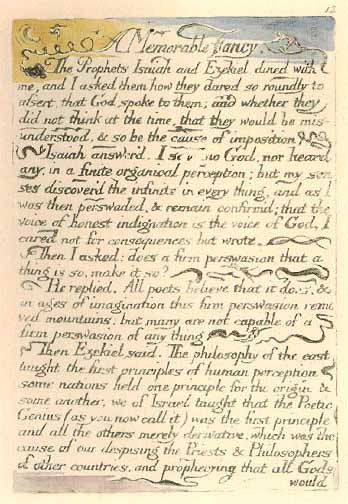
Isaiah meant Jehovah, but Christians mean Jesus. Our poet, Blake, knew Isaiah all too well; in fact he had dinner with him once (MHH plate 12); but he also knew that Jehovah was not worth 'staying his mind' on. He spent many years trying to dispose of that mental construct; at times it was Nobodaddy; then it became Urizen ("Schoolmaster of souls great
opposer of change" {
The Four Zoas [Nt 9], 120.21; E389}). He had many other ways to describing his enemy.

Actually he thought about Jehovah for many years, denounced him, defied him, particularly Jehovah in the shape of King George; that led to a meeting with a judge that might well have ended in the gallows (near the end of his three years at Felpham).


As a young man Blake had ready access to 'thee' (thee being the Eternal and Heaven). But as a married man the world took him in thrall and shut out his access to his 'thee' (the Eternal)--for twenty years. Then, like Jesus, 'he overcame the world'. He told about that in Letter 51 to Hayley:
"I was a slave bound in a mill among beasts and
devils; these beasts and these devils are now,
together with myself, become children of light and
liberty, and my feet and my wife's feet are free from
fetters. O lovely Felpham, parent of Immortal
Friendship, to thee I am eternally indebted for my
three years' rest from perturbation and the strength
I now enjoy. Suddenly, on the day after visiting the
Truchsessian Gallery of pictures, I was again
enlightened with the light I enjoyed in my youth, and
which has for exactly twenty years been closed from
me as by a door and by window-shutters."
Heaven came back; he was a new man; now he stayed his mind, not on Isaiah's 'thee', but on Jesus. Blake's 'Jesus' was no thing; he was the door to Heaven.

"I give you the end of a Golden String
Only wind it into a ball;
It will let you in at heaven's gate
Built in Jerusalem's wall."

Thursday, August 12, 2010

Two Kinds of Seeing

The prophet Ezekiel reported (in 4:4-8) that God told him to lay on his right side for three months, then on his left side for three months, as a warning to the Hebrews. In a vision Blake asked him why he did it and got this reply: "the desire of raising other men into a perception of the infinite" (Blake reported this to us in MHH Plate 13 (line 21ff).

"The desire of raising other men into a perception of the infinite": by and large that was Blake's main purpose in his creative endeavors.

There are many kinds of seeing and many levels of consciousness, but, resorting to the natural proclivity for the dialectic, we might say there are two:

1. The sense-based, natural, materialistic time and space consciousness, with no spiritual awareness. Blake called this Ulro; Jesus called it Hell.

2. Vision, coming forth from the inner man, the Light, the Now. It's a different kind of consciousness, a perception of the infinite (Blake called it Eden; Jesus called it the Kingdom of Heaven or the Kingdom of God).

Jesus showed us with his life how to live eternally; and he told us we could do it. Blake did it, periodically at least, and like Jesus he wanted us to share that heavenly gift.

He called it Vision; that's what he lived for; those eternal moments when he perceived the infinite were all that mattered. If you can't do it continuously, then you can talk about it, write about it, draw it, paint it. He did (and you can) show us how to see.

(This material was largely taken from the Blake Primer, near the beginning.)

Re double vision: "This is a cogent description of what he calls double vision, an attribute of schizophrenics as well as artists; they see what's not there to the sense based person." (Double vision appears to be closely related to intuition.)

Look also at twofold.

Write me if you need further information, or just comment and ask a question.

Monday, May 31, 2010

Severe Contentions of Friendship

From Milton (Plate 41 [48],  
"These are the destroyers of Jerusalem, these
are the murderers
Of Jesus, who deny the Faith & mock at Eternal Life:
Who pretend to Poetry that they may destroy Imagination;
By imitation of Natures Images drawn from Remembrance
These are the Sexual Garments, the Abomination of
Desolation
Hiding the Human lineaments as with an Ark & Curtains
Which Jesus rent: & now shall wholly purge away with Fire
Till Generation is swallowd up in Regeneration.
"Then trembled the Virgin Ololon & replyd in clouds of
despair
Is this our Femin[in]e Portion the Six-fold Miltonic Female
Terribly this Portion trembles before thee O awful Man
Altho' our Human Power can sustain the severe contentions
Of Friendship, our Sexual cannot: but flies into the Ulro."

(Erdman 142-3)
And from Jerusalem, Plate 91:
"I never made friends but by spiritual gifts;
By severe contentions of friendship & the burning fire of
thought.
He who would see the Divinity must see him in his Children
One first, in friendship & love; then a Divine Family, &
in the midst
Jesus will appear;" (Erdman 251)
Alfred Ames, son of a Congregational minister in Kansas, found a better faith (for himself) in a college in Illinois when he became a Quaker. He was a man of principle and a flaming liberal, one of his principles being an abhorrence of violence; in the early forties he was spared 'conscientious objection' by a medical diagnosis of flat feet.

During the war his Quaker Meeting was dominated by a man with contrary principles: his son was a Lt. Col. in the Marine Corps. This dominating 'Quaker' tired of Alfred's youthful fulminations against violence, asked Alfred to cease, and failing that, not to come to the Meeting. But this did not deter Alfred from faithful attendance. At that point the older Friend told the younger one that if he continued he would dissolve the meeting and reassemble in some location unknown to Alfred; however that ploy didn't work.

Alfred was well on his way to becoming a professional controversialist (he called himself that in later years). In due course he got his PhD in English Lit and began to teach. However somehow he found his way onto the editorial staff of the Chicago Tribune, and eventually in charge of the editorial page, something that mystified anyone who came to know him. He served there for 30 years, much to the consternation of his many liberal friends.

Although apparently not well acquainted with Blake, Ames was a true Blakean in this sense: he enjoyed the severe contentions of friendship; as a consequence his friends among the Friends were rare, but hearty.
--------------------------------------------------------
Like Alfred Ames, Blake's friendships were few, but hearty. He also counted two kinds of friendship: corporeal and spiritual: corporeal friends want you to do well in their thought-world, their tribe. Blake had a fair number of (what we call 'fair-weather') friends who wanted him to go along with the Arts estalishment.
Chief of these was a affluent poetaster named William Hayley: "With genuine good intentions Hayley tried to cure Blake of his unprofitable and unseemly enthusiasms and secured him commissions for safely genteel projects - painting ladies' fans, for example" (from http://www.answers.com/topic/william-blake). Blake might have said, I can deal with my enemies, but God protect me from my friends; or better he might have quoted scripture as usual; as Jesus said, "And a man's foes shall be they of his own household". Hayley was supporting Blake, but Blake gave up that relationship, and began to write the sublime poetry of his later years.

Spiritual friends were another matter for Blake; he had several, but Captain Butts was the most outstanding. To him we owe the Illustrations to the Book of Job, celebrated by Christians and psychologists alike. A spiritual friend values you for who you are, recognizes your gifts and became an enabler. When the role is called up yonder, they are the ones we find closest to us.