Showing posts with label Blake's Milton. Show all posts

Wednesday, February 2, 2011

BLAKE & PLATO

Commentary on Blake's six illustrations to Milton's Il Penseroso is found in Bette Charlene Werner's book Blake's vision of the poetry of Milton: illustrations to six poems. Blake 'invented', (he signed images WBlake inv), the third illustration The Spirit of Plato as a means of presenting a number of Plato's ideas as Milton contemplated them.

Il Penseroso

"Or let my lamp, at midnight hour,
Be seen in some high lonely tower,
Where I may oft outwatch the Bear,
With thrice great Hermes, or unsphere
The spirit of Plato, to unfold
What worlds or what vast regions hold
The immortal mind that hath forsook
Her mansion in this fleshly nook;
And of those demons that are found
In fire, air, flood, or underground,"
(lines 85-95)
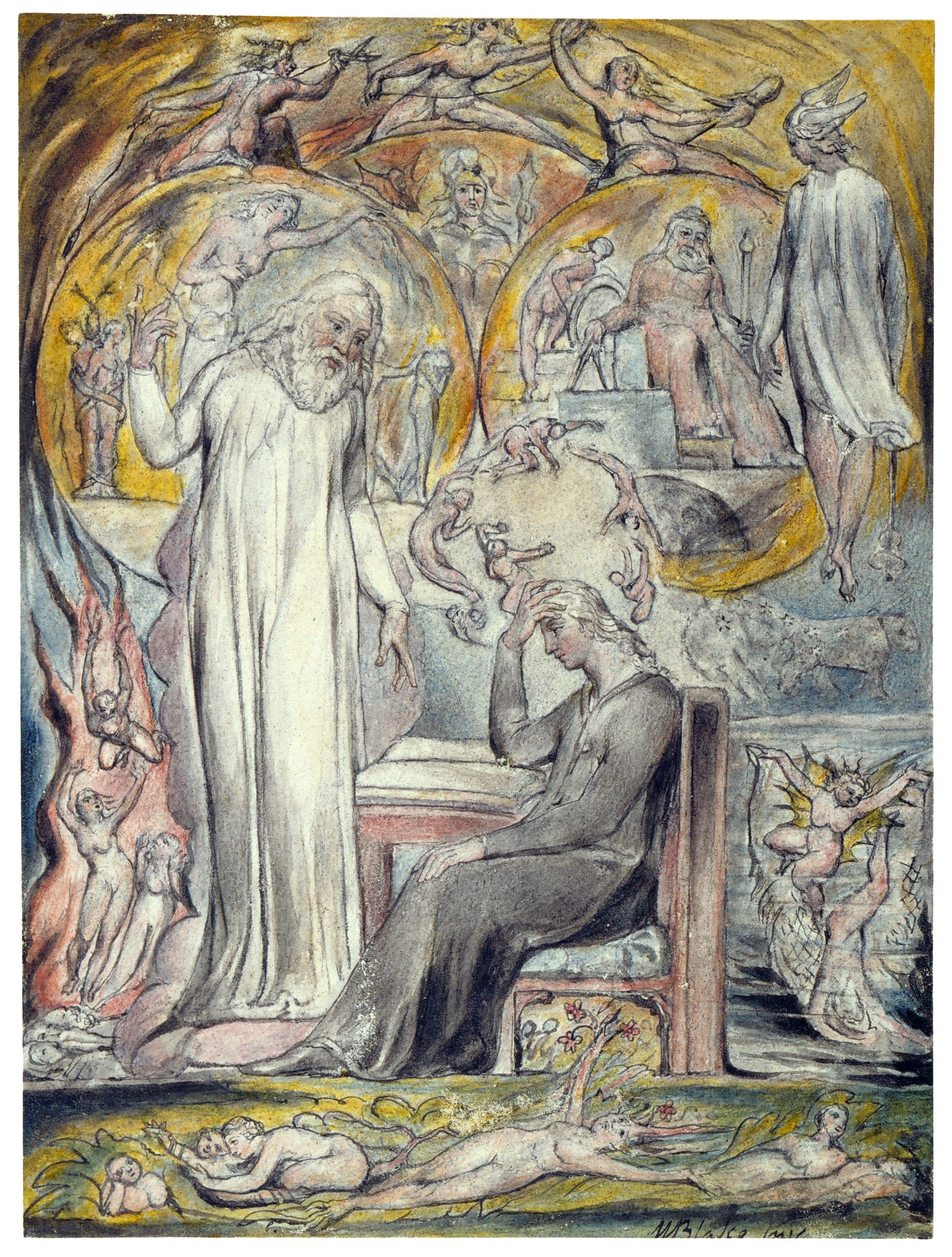
In the picture we see how Plato divided the soul between the three worlds of Venus, Jupiter, Mars - senses, reason and energy. The Great Bear is the constellation around which the constellations revolve; it never sets - symbolizing an ever circling round.

Blake added a few lines of descriptive material to each of his illustrations to Il Penseroso.
Blake's description: "The Spirit of Plato unfolds his Worlds to Milton in Contemplation. The three destinies sit on the Circles of Plato's Heavens weaving their Thread of Mortal Life; these Heavens are Venus Jupiter and Mars. Hermes flies before as attending on the Heaven of Jupiter, the Great Bear is seen in the Sky beneath Hermes & The Spirits of Fire, Air, Water & Earth Surround Milton's Chair."

In this the third illustration to Il Penseroso illustrating lines 85-95 of Milton's poem, Blake goes to pains to include the import of the lines of the poem but adds details to indicate the ideas of Plato to which he objected.

Damon enumerates the points at which Plato's thought differed from Blake's:
"Thus it is that although Plato banished poets from his Republic, made God a geometrician, preached morality, was a fatalist when he accepted the Three Fates, debased love to homosexuality, admitted war to his ideal state, and considered Art an imitation of Nature (hence second rate), Blake was indebted to him." Blake knew that there was much to be admired in Plato's thought although he said that "What Jesus came to remove was the Heathen or Platonic Philosophy, which blinds the eye to Imagination, The real Man." (E 664 ). Blake portrays the Greek learned and wise among the saved in the Last Judgment.

The prominence in the illustration of Hermes perhaps in his role of as the guide for souls in the underworld, may be Blake's assertion that both Plato and Milton are still in need of guidance in matters of the soul. None of the Platonic images contemplated by Milton seems to show the positive outcome for Man's plight for which Blake is working.

Blake's ambivalence to Plato and Greek thought can be seen in these 2 short passages:

Songs and Ballads,(E 479)
Twas the Greeks love of war
Turnd Love into a Boy
And Woman into a Statue of Stone
And away fled every joy

Letter to Trusler, (E 702)
"The wisest of the Ancients considerd what is not
too Explicit as the fittest for Instruction because it rouzes the
faculties to act. I name Moses Solomon Esop Homer Plato"

Saturday, January 29, 2011

MILTON & BLAKE

In 1816 Thomas Butts is thought to have requested of Blake a series of illustrations for two poems by Milton: L'Allegro and Il Penseroso, which contrast the personality types or attitudes of one who is lively and gay with one who is meditative and pensive. So here was another opportunity for Blake to apply his imagination to subjects which he found endlessly fascinating - the life and work of his mentor Milton, and exploration and resolution of contrary positions.

Constellations - Cancer (The Crab), Gemini (The Twins), Orion, Taurus (The Bull), Aries (The Ram)

The final illustration of the series shows Milton in His Old Age since Blake inserted Milton into his own poem as a character. Blake made inscriptions to accompany each section of the poem that he was illustrating. You may read these in The Complete Poetry and Prose of William Blake edited by David V. Erdman beginning on page 682. To locate this click on Blake's content on the sidebar of this blog, page down to close to bottom, click on 'Inscriptions and Notes On or For Pictures', page down to E682 in the margin, read 'Blake's manuscript notes accompanying his watercolors.'

The poem IL Penseroso ends with these lines:
167 "And may at last my weary age
168 Find out the peaceful hermitage,
169 The hairy gown and mossy cell,
170 Where I may sit and rightly spell
171 Of every star that Heav'n doth shew,
172 And every herb that sips the dew;
173 Till old experience do attain
174 To something like prophetic strain.
175 These pleasures, Melancholy, give,
176 And I with thee will choose to live."

Bette Charlène Werner in Blake's vision of the poetry of Milton: illustrations to six poems, wrote a chapter on Blake's Illustrations to these two poems. Here is some of what she says:
"The L'Allegro and Il Penseroso illustrations show the earthly life of Milton, a life Blake envisioned as leaving the poet unhappy though in heaven, his emanation (or his poetry) still unredeemed. Milton's life in Blake's eyes is a 'bright pilgrimage,' but an uncompleted journey. Its destination unachieved, the pilgrimage will not be taken up again until the future time when Blake himself, united in prophetic brotherhood with Milton and inspired by the fiery spirit of imagination, Los, straps on his golden sandal to walk froward through eternity. The Milton of L'Allegro and Il Penseroso illustrations has not yet progressed beyond the moony rest of the threefold Beulah into Eden. Blake emphasizes Milton's sleeping humanity in the series, while calling upon him to become 'the Awakener.' (page 146)
...
"In Blake's imagery he is a figure of humanity enclosed in the life of the five senses; his optic nerve, a hardened bone or black pebble on the beach, still opens within like a diamond that holds in it's hallowed center the heavens of bright eternity.
Blake closes his story of Milton's earthly life with a night scene instead of a dawn. The stars in Blake's imagery, as forms of fallen light, are frequently associated with constriction and confinement as they follow the strict order of mathematically defined pathways through the skies. Still, Blake like Milton, also thought of them as forming a golden chain "To bind the Body of Man to heaven from falling into the Abyss."
...
"Even as the stars in general are ambivalent images for Blake, the ones pictured here are particularly so. The constellation of Cancer, Gemini, Taurus, and Aries can be seen together in the sky of either winter or spring. There are suggestions of both in the picture, in which the winter mood of old age and night is brightened by the flower forms of spring. There is an auspicious note in the part of Orion's myth that tells of the cure of his blindness when he waded far into the sea until he finally reached the land where the sun rises." (page 164)

Four Zoas, Page 34, (E 321)
"For the Divine Lamb Even Jesus who is the Divine Vision
Permitted all lest Man should fall into Eternal Death
For when Luvah sunk down himself put on the robes of blood
Lest the state calld Luvah should cease. & the Divine Vision
Walked in robes of blood till he who slept should awake
Thus were the stars of heaven created like a golden chain
To bind the Body of Man to heaven from falling into the Abyss"

Monday, January 3, 2011

EDEN & GENERATION

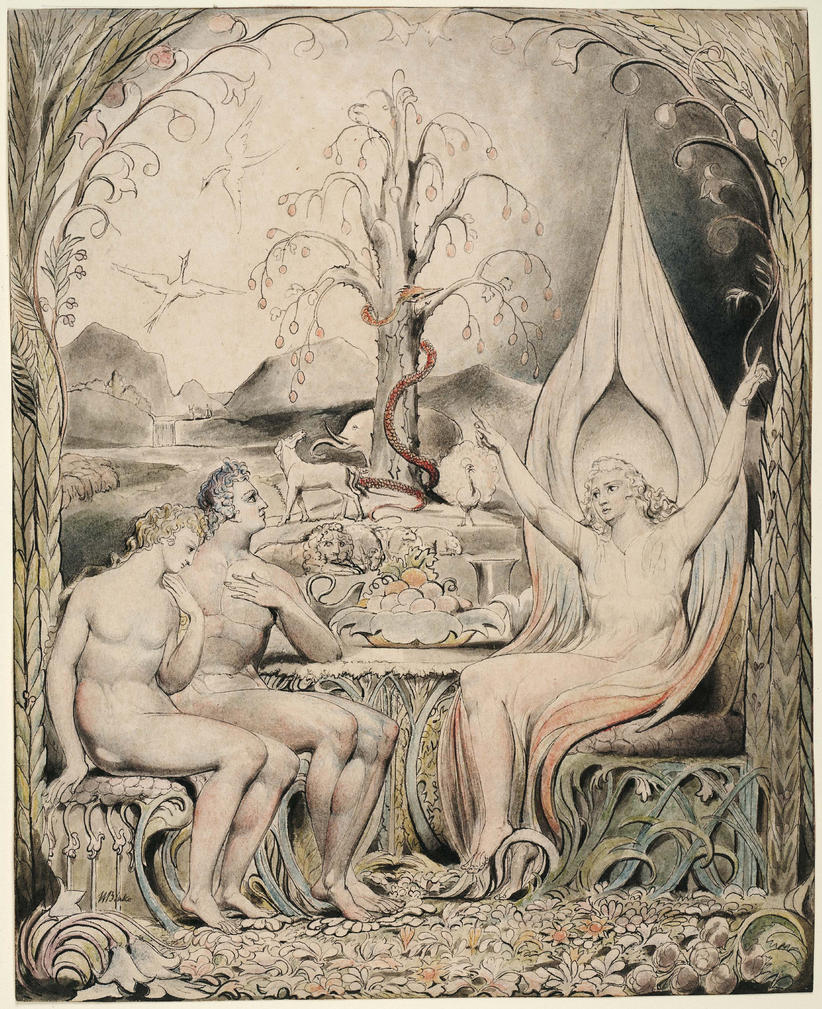
Saturated as was Blake's mind with the thought of Milton, his writings and paintings are permeated with Milton's ideas. Blake painted three sets of illustrations to Milton's Paradise Lost - one each for his supporters Butts, Thomas and Linnell. In Book 5 the Archangel Raphael is sent by God to warn Adam and Eve of the threat that Satan poses. Book 7 of Paradise Lost recounts the Biblical story of creation as told to Adam by Raphael. The Genesis account is embellished with the fall of Lucifer which is not included in the Bible. In Book 8 Adam narrates to Raphael the aspects of creation which took place after his own creation.

Book 5 - Raphael warns Adam and
Eve about Satan


This illustration for Book 5 represents the warning. The idyllic world as pictured has not been disturbed, but symbols of division (or contraries) are manifest: the lion and the lamb, the horse and the peacock. The tree bears its tempting fruit and the Serpent has made his appearance.

The scene is set for the fall which leads to Blake's world of Generation: Los' world, our world.


The world in which we live is meant to be the path through experience by which fallen man can return to consciousness of the Eternal. Blake's world of Generation affords fallen man the opportunity to realize the incarnation and return to Eden as a new being. The path through generation is not easy but this is where man finds himself. The outcome should be regeneration. Blake's progression is from innocence through experience to Eternity. He offers many levels, many gates and many paths. Only the destination is single - the return to Eternity. This can be reached any time (because it is not in time) by its realization - which he calls the Last Judgment:

Vision of the Last Judgment, (E 562)
"Thus My Picture is a
History of Art & Science [& /its/] Which is Humanity itself. What are all the Gifts of the
Spirit but Mental Gifts whenever any Individual Rejects Error &
Embraces Truth a Last Judgment passes upon that Individual"

Many people understand the Biblical Garden of Eden as an idealized material world with a creator God who is outside of creation; with man being given 'dominion' over the animals; and with man walking with an external God in the cool of the evening. Blake's Eden was the state of mind in which the vision of God was not obscured. William Blake's personal goal was to spend as much time in Eden as possible. To transcend to fourfold vision - the ability to perceive the Infinite - was his supreme delight. But to him Eden meant more than vision it also meant creative energy, forgiveness, brotherhood and the oneness of wholeness. Eden to Blake was an internal not an external experience.

MILTON: BOOK THE SECOND, PLATE 30 [33], (E 129)
"Beulah is evermore Created around Eternity; appearing
To the Inhabitants of Eden, around them on all sides.
But Beulah to its Inhabitants appears within each district
As the beloved infant in his mothers bosom round incircled
With arms of love & pity & sweet compassion. But to
The Sons of Eden the moony habitations of Beulah,
Are from Great Eternity a mild & pleasant Rest."

Jerusalem, Plate 12, (E 156)
"fourfold,
The great City of Golgonooza: fourfold toward the north
And toward the south fourfold, & fourfold toward the east & west
Each within other toward the four points: that toward
Eden, and that toward the World of Generation,
And that toward Beulah, and that toward Ulro:
Ulro is the space of the terrible starry wheels of Albions sons:
But that toward Eden is walled up, till time of renovation:
Yet it is perfect in its building, ornaments & perfection.

Jerusalem, PLATE 34 [38],(E 179)
"Turning from Universal Love petrific as he [Albion] went,
His cold against the warmth of Eden rag'd with loud
Thunders of deadly war (the fever of the human soul)
Fires and clouds of rolling smoke! but mild the Saviour follow'd
him,"

Monday, November 22, 2010

FRAGMENTS


Blake's ability to handle multiple aspects of reality at multiple levels of existence leaves most of us mystified. In this little passage we have the Eternals who, though multiple, speak with one voice; we have four forms of Milton in different locations and performing different acts; we have Urizen being molded from the clay by Milton; we have Blake negotiating with God as did Moses when he got his assignment; we have the Seven Angels of the Presence and all they imply; and we have Orc in chains.


Blake's mind operates in this fragmented, multiple way but so does every mind and every complex system. To provide order - to make connections - is the task of finding the meaning in the chaos. Meaninglessness is an affliction of the mind which has not reached the level where there is a cohesive wholeness which can assemble the pieces into a picture. Collect the pieces, look at them in the light of your own experience, follow the threads to their origins, associate the pieces which fit together: gradually out of the indistinct haze clear 'lineaments' may come into focus.

Milton, Plate 20 [22],(E 114)
"So spoke they as in one voice! Silent Milton stood before
The darkend Urizen; as the sculptor silent stands before
His forming image; he walks round it patient labouring.
Thus Milton stood forming bright Urizen, while his Mortal part
Sat frozen in the rock of Horeb:
and his Redeemed portion,
Thus form'd the Clay of Urizen
; but within that portion
His real Human walkd above in power and majesty

Tho darkend; and the Seven Angels of the Presence attended him.
O how can I with my gross tongue that cleaveth to the dust,
Tell of the Four-fold Man, in starry numbers fitly orderd
Or how can I with my cold hand of clay! But thou O Lord
Do with me as thou wilt! for I am nothing, and vanity.
If thou chuse to elect a worm, it shall remove the mountains.
For that portion namd the Elect: the Spectrous body of Milton:
Redounding from my left foot into Los's Mundane space,
Brooded over his Body in Horeb against the Resurrection
Preparing it for the Great Consummation; red the Cherub on Sinai
Glow'd; but in terrors folded round his clouds of blood.
...
At last when desperation almost tore his heart in twain
He recollected an old Prophecy in Eden recorded,
And often sung to the loud harp at the immortal feasts
That Milton of the Land of Albion should up ascend
Forwards from Ulro from the Vale of Felpham; and set free
Orc from his Chain of Jealousy, he started at the thought"

To add another wrinkle to this complex scenario Erdman brings our attention to Felpham's Vale and Blake's subsequent return to London. In commenting on Plate 20 [22] of Milton, Erdman states in The Illuminated Blake (Page 238):
"The cheering thought is that Milton, whose descent to Felpham's vale is rehearsed from many angles in this poem, will then ascend 'up' and 'Forwards' (59-60). (The personal parallel is Blake's retreat from Lambeth to Felpham - a journey for which he borrows the sandals of Los in Lambeth [24: 9-11] - seen as preparation for his return to mental war in London. The two moves are the pulsations between which the whole poem lives.)"

Sunday, October 31, 2010

MILTON'S TRACK

Picture from the Rosenwald Collection of the Library of Congress


On Plate 36 of Milton, Blake presents a diagram of Milton's descent into the world from Eternity. So we are able to see the globes of the four universes as they are positioned and overlap, the location of the earth and of Los' mundane egg. We see Adam at the center of the earth and Satan within the sphere of Urizen. We see the fiery chaos within the egg and flames outside of the Four Universes. Milton's track leads him past Satan to Adam.

In The Illuminated Blake (Page 252), Erdman describes the picture:
"Milton's track enters the universes at the intersection of the
eastern globe of Luvah and the southern globe of Urizen and carries
him into the Egg, close to the center of Satan's realm of fire and into
the earth circle - the drawing of this circle is obscured by paint in D
- that fits the smaller end of the egg, with its center marked "Adam." Note that the earth, often overlooked in discussions of this diagram, is wholly within the realm of Urthona (Los), wholly outside of the realm of Urizen, and only fractionally within those of Tharmas and Luvah. (But though Urthona is earth-owner, his realm is not confined to earth. In [copy] D where the spheres are differentiated, his contains most of the blue sky.)"

In the Blake Archive you can compare four versions of this plate.

Here are some of the word pictures from Blake describing the world and Milton's descent into it:
Milton, PLATE 19 [21], (E 112)
"All fell towards the Center in dire ruin, sinking down.
And in the South remains a burning fire; in the East a void.
In the West, a world of raging waters; in the North a solid,
Unfathomable! without end. But in the midst of these,
Is built eternally the Universe of Los and Enitharmon:
Towards which Milton went
, but Urizen oppos'd his path."

Milton, PLATE 34 [38], (E134)
"Around this Polypus Los continual builds the Mundane Shell
Four Universes round the Universe of Los remain Chaotic
Four intersecting Globes, & the Egg form'd World of Los
In midst; stretching from Zenith to Nadir, in midst of Chaos.
One of these Ruind Universes is to the North named Urthona
One to the South this was the glorious World of Urizen
One to the East, of Luvah: One to the West; of Tharmas.
But when Luvah assumed the World of Urizen in the South
All fell towards the Center sinking downward in dire Ruin

Here in these Chaoses the Sons of Ololon took their abode
In Chasms of the Mundane Shell which open on all sides round
Southward & by the East within the Breach of Miltons descent
To watch the time, pitying & gentle to awaken Urizen
They stood in a dark land of death of fiery corroding waters
Where lie in evil death the Four Immortals pale and cold
And the Eternal Man even Albion upon the Rock of Ages[.]
Seeing Miltons Shadow, some Daughters of Beulah trembling
Returnd, but Ololon remaind before the Gates of the Dead"

Milton, Plate 21 [23], (E 116)
"But saw them not, for the blue Mundane Shell inclosd them in.
And they lamented that they had in wrath & fury & fire
Driven Milton into the Ulro; for now they knew too late
That it was Milton the Awakener: they had not heard the Bard,
Whose song calld Milton to the attempt; and Los heard these
laments.
He heard them call in prayer all the Divine Family;
And he beheld the Cloud of Milton stretching over Europe.

But all the Family Divine collected as Four Suns
In the Four Points of heaven East, West & North & South
Enlarging and enlarging till their Disks approachd each other
;
And when they touch'd closed together Southward in One Sun
Over Ololon: and as One Man, who weeps over his brother,
In a dark tomb, so all the Family Divine. wept over Ololon.

Saying, Milton goes to Eternal Death! so saying, they groan'd in
spirit
And were troubled! and again the Divine Family groaned in spirit!

And Ololon said, Let us descend also, and let us give
Ourselves to death in Ulro among the Transgressors."

Milton, PLATE 21 [23] (E 115)
"also all men on Earth,
And all in Heaven, saw in the nether regions of the Imagination
In Ulro beneath Beulah, the vast breach of Miltons descent."

Search around and find these quotes in Blake's Milton.

If you are curious about the text on the plate with the diagram, find it here.

Wednesday, October 13, 2010

BLAKE & DYLAN

An illustration extracted from page 61 of
William Blake, painter and poet
by Richard Garnett

A plaintive song of Bob Dylan's which was evidently written under the influence of William Blake is titled EVERY GRAIN OF SAND. It was written during what is know as Dylan's Christian period. I see in the song echoes of "Auguries of Innocence" and what may be called the "Jerusalem Hymn" from the beginning of Blake's Milton. Dylan writes of the faith and fears experienced as one travels on the spiritual journey in a world of danger and temptation. Blake's images provide an affirmative note of comfort.


Milton,
Plate 1, (E 95)
"And did those feet in ancient time,
Walk upon Englands mountains green:
And was the holy Lamb of God,
On Englands pleasant pastures seen!

And did the Countenance Divine,
Shine forth upon our clouded hills?
And was Jerusalem builded here,
Among these dark Satanic Mills?

Bring me my Bow of burning gold:
Bring me my Arrows of desire:
Bring me my Spear: O clouds unfold!
Bring me my Chariot of fire!

I will not cease from Mental Fight,
Nor shall my Sword sleep in my hand:
Till we have built Jerusalem,
In Englands green & pleasant Land."

[Pickering Manuscript], Blake's Notebook, (E 490)
AUGURIES OF INNOCENCE
"To see a World in a Grain of Sand
And a Heaven in a Wild Flower
Hold Infinity in the palm of your hand
And Eternity in an hour
A Robin Red breast in a Cage
Puts all Heaven in a Rage
A Dove house filld with doves & Pigeons
Shudders Hell thro all its regions
A dog starvd at his Masters Gate
Predicts the ruin of the State"

This poem continues for 132 lines. The final lines were used prominently in the movie "Dead Man".

EVERY GRAIN OF SAND
by Bob Dylan
In the time of my confession, in the hour of my deepest need
When the pool of tears beneath my feet flood every newborn seed
There’s a dyin’ voice within me reaching out somewhere
Toiling in the danger and in the morals of despair

Don’t have the inclination to look back on any mistake
Like Cain, I now behold this chain of events that I must break
In the fury of the moment I can see the Master’s hand
In every leaf that trembles, in every grain of sand

Oh, the flowers of indulgence and the weeds of yesteryear
Like criminals, they have choked the breath of conscience and good cheer
The sun beat down upon the steps of time to light the way
To ease the pain of idleness and the memory of decay

I gaze into the doorway of temptation’s angry flame
And every time I pass that way I always hear my name
Then onward in my journey I come to understand
That every hair is numbered like every grain of sand

I have gone from rags to riches in the sorrow of the night
In the violence of a summer’s dream, in the chill of a wintry light
In the bitter dance of loneliness fading into space
In the broken mirror of innocence on each forgotten face

I hear the ancient footsteps like the motion of the sea
Sometimes I turn, there’s someone there, other times it’s only me
I am hanging in the balance of the reality of man
Like every sparrow falling, like every grain of sand

Copyright © 1981 by Special Rider Music

Emmy Lou Harris singing EVERY GRAIN OF SAND

Tuesday, August 31, 2010

SPIRITUAL FORCES

I've been thinking of energy as unseen forces. We see the results, but the activity is produced by invisible forces. There was a Foucault Pendulum in the Smithsonian which demonstrated unseen forces - the initial push which started the motion, the momentum which kept it going, the gravity which changed the direction of the swing, and (most mystifying) the rotation of the earth which controlled the path in a 24 hour period. These were the most obvious forces moving the pendulum. How many more could a specialist innumerate?

Like Blake, I see natural phenomena as reflections of the world of spirit and ideas. Knowing that the effects we see are from unseen (and unknown) forces in the world of nature, works as a reminder of spiritual forces which are stronger, more pervasive, more varied and more important than electricity, gravity, chemical energy and such.

Blake's poem The Mental Traveller seems to be talking about these spiritual forces. Blake wanted to help us understand how they develop and mature and interact. He wanted us to see how the growth or decline of one precipitates a reaction in another. He wrote 26 verses because he wanted to show us more than a simple pattern which could be delineated in a few lines. In future posts, there will be more about The Mental Traveller.

In Milton Blake speaks of the power which is working behind the scene of the Natural world.

Milton,
PLATE 26 [28], (E 123)
"For the various Classes of Men are all markd out determinate
In Bowlahoola; & as the Spectres choose their affinities
So they are born on Earth, & every Class is determinate
But not by Natural but by Spiritual power alone, Because
The Natural power continually seeks & tends to Destruction
Ending in Death: which would of itself be Eternal Death
And all are Class'd by Spiritual, & not by Natural power.

And every Natural Effect has a Spiritual Cause, and Not
A Natural: for a Natural Cause only seems, it is a Delusion
Of Ulro: & a ratio of the perishing Vegetable Memory."

Thursday, July 22, 2010

A Turning Point

The Moment of Grace

Life is made up of turning points, but if you're fortunate, then somewhere along life's crooked path you may take a most significant turning point to the right:

"When he came to himself"(verse 17): the fundamental biblical archetype), and there have been other similar ones since Jesus spoke those words.

In our poet's life that Moment has for me an endless fascination. He might have been a famous man, teacher to the Royal Family, world wide artist; he might have dedicated his life to the Main Chance, but he found a better way. The critical Moment (the darkness before the dawn) came when Hayley had given William and Catherine, a comfortable cottage, a comfortable care free life as a miniaturist, but "he came to himself". He returned to London, penniless, but free. Thereafter the main chance ceased to be a temptation. Blake celebrated that decisive Moment in letter 16 to his true (spiritual) friend, Captain Butts (the First Vision of Light):"...O thou Ram hornd with gold
Who awakest from sleep").

He also mentioned it in another letter, this one Letter 51, to William Hayley....

"I have entirely reduced that spectrous Fiend to his station, whose annoyance has been the ruin of my labours for the last passed twenty years of my life. He is the enemy of conjugal love and is the Jupiter of the Greeks, an iron-hearted tyrant, the ruiner of ancient Greece.......I was again enlightened with the light I enjoyed in my youth, and which has for exactly twenty years been closed from me as by a door and by window-shutters.

The prints of that Moment fill the pages of his poetry:

In the 9th Night of The Four Zoas (in Erdman 395-6) you may read of the regeneration and awakening of Vala, the sinless soul" the incorrigible female (this passage owes a lot to the Greek myth, Cupid and Psyche).

After the Moment of Grace annihilation of the Selfhood became a primary theme for Blake. In Milton he put these words in the mouth of the hero returned from Heaven, addressed to Ololon, his emanation:

"But turning toward Ololon in terrible majesty Milton
Replied. Obey thou the Words of the Inspired Man
All that can be annihilated must be annihilated
That the Children of Jerusalem may be saved from slavery
There is a Negation, & there is a Contrary
The Negation must be destroyd to redeem the Contraries
The Negation is the Spectre; the Reasoning Power in Man
This is a false Body: an Incrustation over my Immortal
Spirit; a Selfhood, which must be put off & annihilated alway
To cleanse the Face of my Spirit by Self-examination.

[Milton PLATE 41 [48]:
To bathe in the Waters of Life; to wash off the Not Human
I come in Self-annihilation & the grandeur of Inspiration
To cast off Rational Demonstration by Faith in the Saviour
To cast off the rotten rags of Memory by Inspiration
To cast off Bacon, Locke & Newton from Albions covering
To take off his filthy garments, & clothe him with Imagination
To cast aside from Poetry, all that is not Inspiration"
(Erdman 142)

Milton is a difficult poem, but Blake must have written it shortly after his Moment of Grace.

Blake celebrated the (miraculous?) turning point in Odysseus (my, your, Albion's, Everyman's) with his famous Arlington Tempera, called the Circle of Destiny.

In Blake's poetry, above all autobiographical, he marked the moment of truth for Los and all the rest of his characters who made up various elements of his psyche, of mine, yours, Albion's.

Monday, July 19, 2010

OLOLON

In Plate 31 of Milton, a contrast is seen between the way things appear in the fallen world and in the unfallen world. The first paragraph quoted below concerns Satan and Rahab, Generation, Kingdoms of the Earth, War and Strife. All of the Living creatures of the Four Element are wailing in bitter lament. They weep because "they see the Lord coming in the Clouds of Ololon with Power & Great Glory!"

Beulah is said to weep also, but the lamentation of Beulah is seen as a vision the greatest beauty, joy and hope. The eyes of vision see the loveliest things of the natural world as expressing the culmination which will result from Ololon's sacrificial descent following Milton in his return to the world of matter.

The world of suffering, war, and strife should welcome the prospect of the Lord's arrival, for it will initiate the world of love, and peace and brotherhood. But it is not so. First an open mind, a receptive heart, a gentle hand, and an intuitive soul must grow in man. The vision cannot appear until we have prepared ourselves for it.

Milton, Plate 31 [34], (E 130)
"And all the Living Creatures of the Four Elements, wail'd
With bitter wailing: these in the aggregate are named Satan
And Rahab: they know not of Regeneration, but only of Generation
The Fairies, Nymphs, Gnomes & Genii of the Four Elements
Unforgiving & unalterable: these cannot be Regenerated
But must be Created, for they know only of Generation
These are the Gods of the Kingdoms of the Earth: in contrarious
And cruel opposition: Element against Element, opposed in War
Not Mental, as the Wars of Eternity, but a Corporeal Strife
In Los's Halls continual labouring in the Furnaces of Golgonooza
Orc howls on the Atlantic: Enitharmon trembles: All Beulah weeps

Thou hearest the Nightingale begin the Song of Spring;
The Lark sitting upon his earthy bed: just as the morn
Appears; listens silent; then springing from the waving
Corn-field! loud
He leads the Choir of Day! trill, trill, trill, trill,
Mounting upon the wings of light into the Great Expanse:
Reecchoing against the lovely blue & shining heavenly Shell:
His little throat labours with inspiration; every feather
On throat & breast & wings vibrates with the effluence Divine
All Nature listens silent to him & the awful Sun
Stands still upon the Mountain looking on this little Bird

With eyes of soft humility, & wonder love & awe.
Then loud from their green covert all the Birds begin their Song
The Thrush, the Linnet & the Goldfinch, Robin & the Wren
Awake the Sun from his sweet reverie upon the Mountain:
The Nightingale again assays his song, & thro the day,
And thro the night warbles luxuriant; every Bird of Song
Attending his loud harmony with admiration & love.
This is a Vision of the lamentation of Beulah over Ololon!

Thou percievest the Flowers put forth their precious Odours!
And none can tell how from so small a center comes such sweets
Forgetting that within that Center Eternity expands
Its ever during doors, that Og & Anak fiercely guard[.]
First eer the morning breaks joy opens in the flowery bosoms
Joy even to tears, which the Sun rising dries; first the Wild Thyme
And Meadow-sweet downy & soft waving among the reeds.
Light springing on the air lead the sweet Dance: they wake
The Honeysuckle sleeping on the Oak: the flaunting beauty
Revels along upon the wind; the White-thorn lovely May
Opens her many lovely eyes: listening the Rose still sleeps
None dare to wake her. soon she bursts her crimson curtaind bed
And comes forth in the majesty of beauty; every Flower:
The Pink, the Jessamine, the Wall-flower, the Carnation
The Jonquil, the mild Lilly opes her heavens! every Tree,
And Flower & Herb soon fill the air with an innumerable Dance
Yet all in order sweet & lovely, Men are sick with Love!
Such is a Vision of the lamentation of Beulah over Ololon"

Advice from the apostle Paul:
Philippians
4:6-7 - Don't worry over anything whatever; tell God every detail of your needs in earnest and thankful prayer, and the peace of God which transcends human understanding, will keep constant guard over your hearts and minds as they rest in Christ Jesus.
4:8-9 - Here is a last piece of advice. If you believe in goodness and if you value the approval of God, fix your minds on the things which are holy and right and pure and beautiful and good. Model your conduct on what you have learned from me, on what I have told you and shown you, and you will find the God of peace will be with you.

J. B. Phillips translation of the New Testament

Sunday, May 23, 2010

Gates of Paradise Picture 15

15 The Door of Death I open found
And the Worm Weaving in the Ground


Why must this gloomy picture succeed the last one?


As Blake wrote in Jerusalem, Plate 3:

"Reader! [lover] of books! [lover] of heaven,And of that God from whom [all books are given,]
Who in mysterious Sinais awful cave
To Man the wond'rous art of writing gave,
Again he speaks in thunder and in fire!
Thunder of Thought, & flames of fierce desire:
Even from the depths of Hell his voice I hear,
Within the unfathomd caverns of my Ear.
Therefore I print; nor vain my types shall be:
Heaven, Earth & Hell, henceforth shall live in
harmony"

In Eternity the contraries unite; Digby p. 49 suggests that these two pictures (14 and 15), so different in aspect, are the two contraries married in Eternity. In 1st Peter 3:18-19 we're told that "Christ also once suffered for sins, the just for the unjust, that he might bring us to God...by which also he went and preached unto the spirits in prison."

Jung spoke of the
Mysterium Coniunctionis ("mysterious conjunction"): the final alchemical synthesis (for Jung, of ego and unconscious, matter and spirit, male and female) that brings forth the Philosopher's Stone (the Self). Its highest aspect, as for alchemist Gerard Dorn, was the unus mundus, a unification of the Stone with body, soul, and spirit" (the marriage if you will).

Digby shows us how Blake expressed this union of opposites in his poem, Milton: John Milton is in Heaven, but he has left "unresolved problems exemplified in three quarrelsome wives and daughters" (page 49), (his Selfhood was not entirely annihilated).
"He took off the robe of the promise and the girdle of
the oath of God
,
and Milton said, I go to Eternal Death! The Nations still
Follow after the detestable Gods of Priam; in pomp
Of warlike selfhood, contradicting and blaspheming.
When will the Resurrection come; to deliver the sleeping body From corruptibility: O when Lord Jesus wilt thou come? Tarry no longer; for my soul lies at the gates of death.
I will arise and look forth for the morning of the grave.
I will go down to the sepulcher to see if morning breaks!
I will go down to self annihilation and eternal death,
Lest the Last Judgment come & find me unannihilate
And I be siez'd & giv'n into the hands of my own

Selfhood" (Milton, plate 15, Erdman p. 108)


Long, long ago Isaiah was written (or edited); looking at the book as a whole you may perceive something like these two pictures in Gates of Paradise. Isaiah is written with a rapid alternation between wrath (judgment) and grace (The Promise).
So we find Isaiah, Blake, "Milton", Jung, alchemy: all
agree in the Eternal union of the temporal opposites. Our
Poet tried to express this fundamental truth of life("joy and
woe are woven fin
e....the babe is more than swadling bands".
When you've met the immortal man, you're armed with light,
like the man in picture 14, to deal with the cross we all bear.
You've experienced the Marriage.

Thursday, February 18, 2010

The Rock

The Blake concordance shows 324 occurences of the word rock .

The Dome of the Rock is sacred to Judaism, Christianity, and Islam. We can be sure that Blake was fully cognizant of these, and it seems likely in this common awareness he used the terms: Rock of Eternity ( the Rock of eternity), Rock of Ages, Rock of Albion, and many other significant Rocks..

Rock of Eternity:
FZ5-59.9-12; E340:
He [Albion] wept & he divided & he laid his gloomy head
Down on the Rock of Eternity on darkness of the deep
Torn by black storms & ceaseless torrents of consuming fire
Within his breast his fiery sons chaind down & filld with cursings

Rock of Ages:
M15.36-40; E109;
First Milton saw Albion upon the Rock of Ages,
Deadly pale outstretchd and snowy cold, storm coverd;
A Giant form of perfect beauty outstretchd on the rock
In solemn death: the Sea of Time & Space thunderd aloud
Against the rock, which was inwrapped with the weeds of death

Also FZ1-18.11-15 E310:
Now Man was come to the Palm tree & to the Oak of Weeping
Which stand upon the Edge of Beulah he [Albion] sunk down
From the Supporting arms of the Eternal Saviour; who disposd
The pale limbs of his Eternal Individuality
Upon The Rock of Ages. Watching over him with Love & Care"

Rock of Albion:
FZ2-24.5-8; E314|:
Luvah & Vala trembling & shrinking, beheld the great Work master [Urizen]
And heard his Word! Divide ye bands influence by influence
Build we a Bower for heavens darling in the grizly deep
Build we the Mundane Shell around the Rock of Albion

Albion Cold Lays on His Rock

The Rock, above the Sea of Time and Space, lies on the verge of Beulah, where Albion, forgiven and saved, awaits the Resurrection.

Saturday, January 16, 2010

Some Significant Symbols

Much of this is taken from Digby's 'Symbol and Image in William Blake':

ALBION (Glad Day) was Blake's name for Everyman, Adam Kadman, Cosmic Man, the Eternal Great Humanity Divine (See Milton, plates 2 and 30) or in Quakereze 'that of God in Everyone'. Albion asleep is an apt commentary on Blake's age-- and ours.

"Every human life is part of Albion and can realize more or less the Cosmic Man's total nature... Albion suffers and triumphs in each individual, as is described in ...Jerusalem
..
The Dance of Eternal Death" Digby p.12.

ETERNAL DEATH: Blake used this phrase 78 times; it's mortal life;I translate it to 'this vale of tears', the Sea of Time and Space from which we may emerge at the end; "whenever any Individual Rejects Error & Embraces Truth a Last Judgment passes upon that Individual.." [[A Vision of the Last Judgment] PAGE 85] (Erdman 562)

From Milton: In Heaven, having heard the Bard's Song,
"Milton said, I go to Eternal Death! The Nations still
Follow after the detestable Gods of Priam; in pomp
Of warlike selfhood, contradicting and blaspheming.
When will the Resurrection come; to deliver the sleeping body.."

JERUSALEM: This image cannot be defined; we can only begin a journey of 1000 miles. The Concordance has 288 occurences and Damon has 7 pages trying to describe it. Blake used it as the title for his largest poem; 'Jerusalem' the (smaller) poem, appears in the Preface to Milton (and in many hymnbooks): "till we have built Jerusalem in Englands green and pleasant land."

Jerusalem is the bride of Christ (the conventional church considers itself to be the bride of Christ, but to Blake the bride of Christ was the human race). Jerusalem was Albion's wife-- until he went to sleep; at that point he turned to Vala.

VALA is fallen Jerusalem. A picture is worth a thousand words, and the relationship betwem Vala and Jerusalem can be best understood in this plate (click on the pic for an enlargement). Jerusalem stands out in light with (supposedly) her three daughter, while Vala, in a dark vale, attempts to entice Jerusalem into her darkness. The two battle through The Four Zoas and Jerusalem (the large poem). In your life you can see the 'good girl' and 'bad girl' fighting for supremacy. A woman may become a thief, and/or she may give birth to a spiritual genius. Such is life.

Blake did not believe in 'good and bad'; he believed in Truth and Error. At the Last Judgment Error is burned up and we live (eternally) in Truth.

Wednesday, December 9, 2009

Jerusalem

The Bible story reports that Joseph of Arimathea lent his tomb for the burial of the crucified Jesus.

Legend suggests that Joseph of Arimathea, was the Lord's uncle (maternal no doubt), that he owned tin mines in Cornwall (England), and that Jesus may have accompanied him in a trip to Britain as a youngster. From that the legend grew.

Blake of course was familiar with both stories (the biblical one and the legendary one), and they led to the famous poem and hymn called Jerusalem that appears in the Preface of Milton. Here are the tune and words:

And did those feet in ancient time,
Walk upon Englands mountains green:
And was the holy Lamb of God,
On Englands pleasant pastures seen!

And did the Countenance Divine,
Shine forth upon our clouded hills?
And was Jerusalem builded here,
Among these dark Satanic Mills?
Bring me my Bow of burning gold:

Bring me my Arrows of desire:
Bring me my Spear: O clouds unfold!
Bring me my Chariot of fire!
I will not cease from Mental Fight,
Nor shall my sword sleep in my hand:
Till we have built Jerusalem,
In Englands green & pleasant Land.

(Would to God that all the Lords people were Prophets.) Numbers XI. ch 29 v.
This hymn became immensely popular and bid fair
to replace God Save the King (at least in some circles.)

Thursday, November 19, 2009

ANNIHILATION

When Blake talks about annihilation he is talking about annihilation of the Selfhood. It is an internal activity. It is not accomplished by force or violence but by forgiveness and receiving the Selfhood as a brother. As Blake portrays it, annihilation is not a single event but a way of life. Since the Selfhood continually asserts itself, the process of forgiveness must continually be active.

Blake sees the processes which takes place in the individual as also taking place in the One Man, Albion, who is the body of which we all are part. As the Book of Milton reaches its climax, Milton annihilates his Selfhood as seen in Plate 45. The struggle has been completed, but not in victory of one over the other. The Selfhood has lost its power but is embraced tenderly.

Milton, Plate 39 [44] (E141)

"He [Albion] strove to rise to walk into the Deep. but strength failing
Forbad & down with dreadful groans he sunk upon his Couch
In moony Beulah. Los his strong Guard walks round beneath the Moon

Urizen faints in terror striving among the Brooks of Arnon
With Miltons Spirit: as the Plowman or Artificer or Shepherd
While in the labours of his Calling sends his Thought abroad
To labour in the ocean or in the starry heaven. So Milton
Labourd in Chasms of the Mundane Shell, tho here before
My Cottage midst the Starry Seven, where the Virgin Ololon
Stood trembling in the Porch: loud Satan thunderd on the stormy Sea
Circling Albions Cliffs in which the Four-fold World resides
Tho seen in fallacy outside: a fallacy of Satans Churches
PLATE 40 [46]
Before Ololon Milton stood & percievd the Eternal Form
Of that mild Vision; wondrous were their acts by me unknown
Except remotely; and I heard Ololon say to Milton

I see thee strive upon the Brooks of Arnon. there a dread
And awful Man I see, oercoverd with the mantle of years.
I behold Los & Urizen. I behold Orc & Tharmas;
The Four Zoa's of Albion & thy Spirit with them striving
In Self annihilation giving thy life to thy enemies"

Milton, Plate 45, Blake's Image


Blake left it indefinite exactly who is being portrayed in this picture. Since this whole book is about Milton, the standing man with his feet near the water of the brook is said to be Milton; but it could be Los or Jesus or Blake himself, whose tale is told through Milton. The leaning figure could be identified as Ololon, Milton's emanation; or Urizen; or Satan; or the text suggests Albion as the Fourfold Man. The process portrayed is annihilation, forgiveness, being joined to the Selfhood through recognition or self awareness. Perhaps it is best thought of as breaking out of the limiting walls of the self into the unlimited existence in Eternity through imagination. The forgiveness is mutual, the annihilation is mutual, the release is mutual, the regeneration too is mutual.

Milton, Plate 38[43] (E138)
"In the Eastern porch of Satans Universe Milton stood & said

Satan! my Spectre! I know my power thee to annihilate
And be a greater in thy place, & be thy Tabernacle
A covering for thee to do thy will, till one greater comes
And smites me as I smote thee & becomes my covering.
Such are the Laws of thy false Heavns! but Laws of Eternity
Are not such: know thou: I come to Self Annihilation
Such are the Laws of Eternity that each shall mutually
Annihilate himself for others good, as I for thee"

Thursday, October 29, 2009

After the Bard's Song

The Bard's Song led to a loud murmuring in the
Heavens of Albion, and "the loud voic'd Bard
terrify'd took refuge in Miltons bosom;" then
Milton "took off the robe of the promise, & ungirded himself from the oath of God

And Milton said, I go to Eternal Death! The Nations still
Follow after the detestable Gods of Priam; in pomp
Of warlike selfhood, contradicting and blaspheming.
When will the Resurrection come; to deliver the sleeping body
From corruptibility: O when Lord Jesus wilt thou come?
Tarry no longer; for my soul lies at the gates of death.
I will arise and look forth for the morning of the grave.
I will go down to the sepulcher to see if morning breaks!
I will go down to self annihilation and eternal death,
Lest the Last Judgment come & find me unannihilate."
And I be siez'd & giv'n into the hands of my own Selfhood
The Lamb of God is seen thro' mists & shadows, hov'ring
Over the sepulchers in clouds of Jehovah & winds of Elohim
A disk of blood, distant; & heav'ns & earth's roll dark between
What do I here before the Judgment? without my Emanation?
With the daughters of memory, & not with the daughters of
inspiration[?]
I in my Selfhood am that Satan: I am that Evil One!
He is my Spectre! in my obedience to loose him from my Hells
To claim the Hells, my Furnaces, I go to Eternal Death."
(Milton, plate 14)

The way Blake saw him.

This of course is a climactic moment in the poem.
An unheard of thing! One leaves Heaven to return
to 'this vale of tears'. Well, not quite
unprecedented; Milton simply followed the path of
Jesus. In that way Blake gave Milton (the man)
the highest approval possible.

Blake's myth was to a large degree patterned after
Paradise Lost. His difference with Milton
resembled one of those "severe contentions of
Friendship." Milton had spoken; Blake replied
in MHH; now he replies again! That's
the shape of the poem as far as Blake himself was concerned.

Thereafter Milton allied himself with Los, giving, with Blake a triumvirate against which none could stand.

Milton is an essay describing the triumph of Jesus
over all the forces of the world.

It is difficult to immediately grasp, but yields
immense returns to anyone determined enough to
come to an understanding of it.