Showing posts with label Paul. Show all posts

Friday, November 26, 2010

JESUS & MORAL VIRTUE

Blake did not think that Jesus was sent to uphold the law or teach moral virtue. In The Marriage of Heaven and Hell Blake presents Jesus as a law breaker justifying his later statement that the Lamb of God was numbered among the transgressors. (Isaiah 53)

MHH, Plate 21, (E 43)
"if Jesus Christ is the
greatest man, you ought to love him in the greatest degree; now
hear how he has given his sanction to the law of ten
commandments: did he not mock at the sabbath, and so mock the
sabbaths God? murder those who were murderd because of him? turn
away the law from the woman taken in adultery? steal the labor of
others to support him? bear false witness when he omitted making
a defence before Pilate? covet when he pray'd for his disciples,
and when he bid them shake off the dust of their feet against
such as refused to lodge them? I tell you, no virtue can exist
without breaking these ten commandments: Jesus was all virtue,
and acted from impulse: not from rules."

The moral principle which Blake subscribed to was Forgiveness which replaced the whole of system of law, accusation, judgment and punishment. Blake along with the apostle Paul was convinced that encountering the law created a consciousness of sin, which resulted in a bondage to the 'law of sin and death'. Paul stated in the 8th chapter of Romans that 'the law of the Spirit of life in Christ Jesus has set [us] free from the law of sin and death'. Blake agreed that the hold of the law on the minds of men would be broken by the continual practice of forgiveness exemplified by Jesus. Vengeance, which resulted from enforcement of the law, had no place in Blake's religion or morality.

Everlasting Gospel, (E 876)
"It was when Jesus said to Me
Thy Sins are all forgiven thee
The Christian trumpets loud proclaim
Thro all the World in Jesus name
Mutual forgiveness of each Vice
And oped the Gates of Paradise
The Moral Virtues in Great fear
Formed the Cross & Nails & Spear
And the Accuser standing by
Cried out Crucify Crucify
Our Moral Virtues neer can be
Nor Warlike pomp & Majesty
For Moral Virtues all begin
In the Accusations of Sin"

Image from Milton's Paradise Regained

Thursday, October 14, 2010

Blake's Death


For Blake the word, death, had many meanings:

1. Physical death:
Quoting Damon p. 99: 
"Death of the physical body is the shedding of the shell (garment, robe) which the soul, or spiritual body has grown for protection in this world.  It's the return of the soul to Eternity.  It is an episode of life, a state through which one passes, awakening to Eternal life (J 4:1-2)".

Blake indicated the nature of physical death, particularly of his brother, Robert's death in a letter (9) to Hayley he wrote:

      "Thirteen years ago. I lost a  brother & with his spirit  I  converse daily & hourly in the  spirit. & See him in my
remembrance in the regions of my  imagination.
I hear his advice & even now write from his  Dictate--"

2. For Blake Eternal Death, itself seemed to have many meanings:
Among other things it seems to concern Ulro and the Spectre. Looking at The Four Zoas we read:
"There is from Great Eternity a mild & pleasant rest
Namd Beulah a Soft Moony Universe feminine lovely
Pure mild & Gentle given in Mercy to those who sleep
Eternally. Created by the Lamb of God around
On all sides within & without the Universal Man
The Daughters of Beulah follow sleepers in all their Dreams
Creating Spaces lest they fall into Eternal Death

The Circle of Destiny complete they gave to it a Space
And namd the Space Ulro & brooded over it in care & love
They said The Spectre is in every man insane & most
Deformd Thro the three heavens descending in fury & fire
We meet it with our Songs & loving blandishments & give
To it a form of vegetation But this Spectre of Tharmas
Is Eternal Death
What shall we do O God pity & help"
(The Four Zoas [Nt 1], 5.42; E303)  
Elsewhere in  Milton 4.15; Erdman 98 he reported this
conversation between Los and Satan:

"Satan was going to reply, but Los roll'd his loud thunders.
Anger me not! thou canst not drive the Harrow in pitys paths.
Thy Work is Eternal Death, with Mills & Ovens & Cauldrons.
Trouble me no more. thou canst not have Eternal Life
So Los spoke! Satan trembling obeyd weeping along the way.
Mark well my words, they are of your eternal Salvation"
Satan and the Spectre of course are synonymous. 
"And Milton said, I go to Eternal Death!" 
If you get the picture Milton, in Heaven, choses the path the 
Savior trod; he incarnated; he came down from Heaven into
Earth and for a similar purpose.  But here the meaning of
Eternal seems very clearly mortal life.
There are many other instances of the words in Milton.

Turning to Jerusalem Blake makes it pretty clear in Plate 4:
"Of the Sleep of Ulro! and of the passage through
Eternal Death! and of the awaking to Eternal Life."
It would be very worthwhile to read this plate carefully.
The last occurrence of Eternal Death in Jerusalem occurs in 
Plate 98 lines 21-24:
"Driving outward the Body of Death in an Eternal Death &
Resurrection
Awaking it to Life among the Flowers of Beulah rejoicing in Unity
In the Four Senses in the Outline the Circumference & Form, for
ever
In Forgiveness of Sins which is Self Annihilation." (E257)

(I wonder if he was thinking of Romans 7 when he spoke of the 
Body of Death.  The forgiveness of sins is Self Annihilation, the
end of mortal life.)                                                 
                                               

Thursday, October 7, 2010

GOD IN US

Jeremiah 23
[23] Am I a God at hand, saith the LORD, and not a God afar off?
[24]Can any hide himself in secret places that I shall not see him? saith the LORD. Do not I fill heaven and earth? saith the LORD.

From the beginning to the end of his work Blake attempted to communicate his image of God. Primarily Blake's experience was of what theologians call the immanent God, a God who is accessible and ever-present. When we gather together a number of Blake's references to God it is obvious that Blake's God was the incarnate God present within the whole of creation and particularly within humanity.

THERE IS NO NATURAL RELIGION (E 2)
"VII The desire of Man being Infinite the possession is Infinite
& himself Infinite
Conclusion, If it were not for the Poetic or Prophetic
character. the Philosophic & Experimental would soon be at the
ratio of all things & stand still, unable to do other than repeat
the same dull round over again
Application. He who sees the Infinite in all things sees
God. He who sees the Ratio only sees himself only.

Therefore God becomes as we are, that we may be as he is"

Songs of Innocence and Experience, (E 9)
Little Black Boy
"Look on the rising sun: there God does live
And gives his light, and gives his heat away.
And flowers and trees and beasts and men recieve
Comfort in morning joy in the noon day.

And we are put on earth a little space,
That we may learn to bear the beams of love,
And these black bodies and this sun-burnt face
Is but a cloud, and like a shady grove."

_______________________________
Milton Plate 45, Forgiveness
Songs of Innocence, (E 12)
The Divine Image.


"To Mercy Pity Peace and Love,
All pray in their distress:
And to these virtues of delight

Return their thankfulness.

For Mercy Pity Peace and Love,
Is God our father dear:
And Mercy Pity Peace and Love,
Is Man his child and care.

For Mercy has a human heart
Pity, a human face:
And Love, the human form divine,
And Peace, the human dress.

Then every man of every clime,
That prays in his distress,
Prays to the human form divine
Love Mercy Pity Peace.

And all must love the human form,
In heathen, turk or jew.
Where Mercy, Love & Pity dwell,
There God is dwelling too"

Milton, PLATE 32 [35],(E 131)
"But the Divine Humanity & Mercy gave us a Human [Hebrew text -multitudes]
Form as multitudes
Because we were combind in Freedom & holy Vox Populi [voice of the people]
Brotherhood"

Milton, Plate 32 [35], (E 131)
"For God himself enters Death's Door always with those that enter
And lays down in the Grave with them, in Visions of Eternity
Till they awake & see Jesus & the Linen Clothes lying
That the Females had Woven for them, & the Gates of their Fathers
House"

Jerusalem, Plate 4, (E 146)
"I am not a God afar off, I am a brother and friend;
Within your bosoms I reside, and you reside in me:
Lo! we are One; forgiving all Evil; Not seeking recompense!"

Jerusalem, Plate 5, (E 147)
"Trembling I sit day and night, my friends are astonish'd at me.
Yet they forgive my wanderings, I rest not from my great task!
To open the Eternal Worlds, to open the immortal Eyes
Of Man inwards into the Worlds of Thought: into Eternity
Ever expanding in the Bosom of God. the Human Imagination
O Saviour pour upon me thy Spirit of meekness & love:
Annihilate the Selfhood in me, be thou all my life!
Guide thou my hand which trembles exceedingly upon the rock of
ages,

While I write of the building of Golgonooza
Ye are my members O ye sleepers of Beulah, land of shades!"

Jerusalem
, Plate 38 [43], (E 184)
"O God of Albion descend! deliver Jerusalem from the Oaken Groves!

Then Los grew furious raging: Why stand we here trembling around
Calling on God for help; and not ourselves in whom God dwells
Stretching a hand to save the falling Man: are we not Four
Beholding Albion upon the Precipice ready to fall into
Non-Entity:"

Jerusalem, Plate 45 [31],(E 195)
"So spoke Los, travelling thro darkness & horrid solitude:
And he beheld Jerusalem in Westminster & Marybone,
Among the ruins of the Temple: and Vala who is her Shadow,
Jerusalems Shadow bent northward over the Island white.
At length he sat on London Stone, & heard Jerusalems voice.

Albion I cannot be thy Wife. thine own Minute Particulars,
Belong to God alone. and all thy little ones are holy
They are of Faith & not of Demonstration: wherefore is Vala
Clothd in black mourning upon my rivers currents, Vala awake!
I hear thy shuttles sing in the sky, and round my limbs
I feel the iron threads of love & jealousy & despair."

Satiric Verses, (E 516)
"To God

If you have formd a Circle to go into
Go into it yourself & see how you would do"

Annotations to Lavater (E 599)
"God is in the lowest effects as well as in the highest
causes for he is become a worm that he may nourish the weak
For let it be rememberd that creation is. God descending
according to the weakness of man for our Lord is the word of God
& every thing on earth is the word of God & in its essence is God"

As well as expressing the sentiments of the prophet Jeremiah, Blake was reflecting the message of the New Testament as stated by Paul in Colossians 1:

[26] Even the mystery which hath been hid from ages and from generations, but now is made manifest to his saints:
[27] To whom God would make known what is the riches of the glory of this mystery among the Gentiles; which is Christ in you, the hope of glory:

Thursday, August 19, 2010

GOD IN ALL

A close friend of William Blake and an associate of his in publishing through the radical publisher Joseph Johnson, Henry Fuselli was instrumental in the publication of Aphorisms on Man. Johann Caspar Lavater, Fusilli's friend, with whom he had been a theology student in Zurich, wrote the manuscript and Fuselli translated it into English and facilitated its publication in London. Blake engraved five illustrations for the work based on preliminary drawings by Fuselli.

Blake's annotation to his copy of Aphorisms on Man are included in his complete works, and are the chief reason Lavater's book is read today. The comment I focus on is an unequivocal statement of Blake's belief about the relationship of man to God which he wrote in annotating Lavater's book. That Blake felt that God related intimately with man as a companion and brother is made clear in this passage. Blake supports his belief by quoting John 6:56, "He that eateth my flesh, and drinketh my blood, dwelleth in me, and I in him." Blake replaces the phrase "eateth my flesh and drinketh my blood" with "dwelleth in love."

Blake continues by saying that it is this relationship with God that removes the need and ability of a man to judge another except in love.

The God Blake affirms bridges divisions because he who is the cause of all, humbles himself in order to nourish the weak. Blake then defines creation in terms of God descending to become the word which is in everything and which makes everything into God in it's essence.

Annotations to Lavater, (E 599)

"It is the God in all that is our companion & friend, for our God himself says, you are my brother my sister & my mother; & St John. Whoso dwelleth in love dwelleth in God & God in him. & such an one cannot judge of any but in love. & his feelings will be attractions or repulses
God is in the lowest effects as well as in the highest causes for he is become a worm that he may nourish the weak
For let it be rememberd that creation is. God descending according to the weakness of man for our Lord is the word of God & every thing on earth is the word of God & in its essence is God"

Blake's statement bears a close resemblance to Paul's statement in Philippians 2:6–8:
"Who, being in the form of God, thought it not robbery to be equal with God: But made himself of no reputation, and took upon him the form of a servant, and was made in the likeness of men: And being found in fashion as a man, he humbled himself, and became obedient unto death, even the death of the cross."

The Morgan Museum's exhibition of work of Blake and his associates is available online: A New Heaven Is Begun.

Monday, July 19, 2010

OLOLON

In Plate 31 of Milton, a contrast is seen between the way things appear in the fallen world and in the unfallen world. The first paragraph quoted below concerns Satan and Rahab, Generation, Kingdoms of the Earth, War and Strife. All of the Living creatures of the Four Element are wailing in bitter lament. They weep because "they see the Lord coming in the Clouds of Ololon with Power & Great Glory!"

Beulah is said to weep also, but the lamentation of Beulah is seen as a vision the greatest beauty, joy and hope. The eyes of vision see the loveliest things of the natural world as expressing the culmination which will result from Ololon's sacrificial descent following Milton in his return to the world of matter.

The world of suffering, war, and strife should welcome the prospect of the Lord's arrival, for it will initiate the world of love, and peace and brotherhood. But it is not so. First an open mind, a receptive heart, a gentle hand, and an intuitive soul must grow in man. The vision cannot appear until we have prepared ourselves for it.

Milton, Plate 31 [34], (E 130)
"And all the Living Creatures of the Four Elements, wail'd
With bitter wailing: these in the aggregate are named Satan
And Rahab: they know not of Regeneration, but only of Generation
The Fairies, Nymphs, Gnomes & Genii of the Four Elements
Unforgiving & unalterable: these cannot be Regenerated
But must be Created, for they know only of Generation
These are the Gods of the Kingdoms of the Earth: in contrarious
And cruel opposition: Element against Element, opposed in War
Not Mental, as the Wars of Eternity, but a Corporeal Strife
In Los's Halls continual labouring in the Furnaces of Golgonooza
Orc howls on the Atlantic: Enitharmon trembles: All Beulah weeps

Thou hearest the Nightingale begin the Song of Spring;
The Lark sitting upon his earthy bed: just as the morn
Appears; listens silent; then springing from the waving
Corn-field! loud
He leads the Choir of Day! trill, trill, trill, trill,
Mounting upon the wings of light into the Great Expanse:
Reecchoing against the lovely blue & shining heavenly Shell:
His little throat labours with inspiration; every feather
On throat & breast & wings vibrates with the effluence Divine
All Nature listens silent to him & the awful Sun
Stands still upon the Mountain looking on this little Bird

With eyes of soft humility, & wonder love & awe.
Then loud from their green covert all the Birds begin their Song
The Thrush, the Linnet & the Goldfinch, Robin & the Wren
Awake the Sun from his sweet reverie upon the Mountain:
The Nightingale again assays his song, & thro the day,
And thro the night warbles luxuriant; every Bird of Song
Attending his loud harmony with admiration & love.
This is a Vision of the lamentation of Beulah over Ololon!

Thou percievest the Flowers put forth their precious Odours!
And none can tell how from so small a center comes such sweets
Forgetting that within that Center Eternity expands
Its ever during doors, that Og & Anak fiercely guard[.]
First eer the morning breaks joy opens in the flowery bosoms
Joy even to tears, which the Sun rising dries; first the Wild Thyme
And Meadow-sweet downy & soft waving among the reeds.
Light springing on the air lead the sweet Dance: they wake
The Honeysuckle sleeping on the Oak: the flaunting beauty
Revels along upon the wind; the White-thorn lovely May
Opens her many lovely eyes: listening the Rose still sleeps
None dare to wake her. soon she bursts her crimson curtaind bed
And comes forth in the majesty of beauty; every Flower:
The Pink, the Jessamine, the Wall-flower, the Carnation
The Jonquil, the mild Lilly opes her heavens! every Tree,
And Flower & Herb soon fill the air with an innumerable Dance
Yet all in order sweet & lovely, Men are sick with Love!
Such is a Vision of the lamentation of Beulah over Ololon"

Advice from the apostle Paul:
Philippians
4:6-7 - Don't worry over anything whatever; tell God every detail of your needs in earnest and thankful prayer, and the peace of God which transcends human understanding, will keep constant guard over your hearts and minds as they rest in Christ Jesus.
4:8-9 - Here is a last piece of advice. If you believe in goodness and if you value the approval of God, fix your minds on the things which are holy and right and pure and beautiful and good. Model your conduct on what you have learned from me, on what I have told you and shown you, and you will find the God of peace will be with you.

J. B. Phillips translation of the New Testament

Saturday, May 29, 2010

Gates of Paradise Epilogue

"To the Accuser who is
The God of this World."

There are two stanzas:

1. "Truly My Satan thou art but a Dunce
And dost not know the Garment from the Man
Every Harlot was a Virgin once
Nor canst thou ever change Kate into Nan."

Digby, p 52: "The individual, says Blake, is not the same as the state in which he is, in the course of experience, as he puts on or changes his clothes."
We wear many garments, some good, some not so good; in a lifetime of experience you can be sure there are many garments in your life. In a day you may pass through several states: one when you get up in the morning, another one after you're left home for the day, another when you get to your workplace at 8 or so, an entirely different state at 4 o'clock, etc. etc.

A book called Our Many Selves (that you can buy for $1.37) shows clearly how our states change as our environment changes. For example you were a very different man at twenty than you are at forty, perhaps sadder and wiser.

"What is the price of Experience? do men

buy it for a song?

Or wisdom for a dance in the street? No it

is bought with the price of all that a

man hath, his house his wife his children.

Wisdom is sold in the desolate market where none come
to buy
And in the witherd field where
the farmer plows for bread in vain"
(A portion of Enion's Lament in Night two of The Four Zoas - Erdman 325)

We have many selves, some of us of course more than others, or less than others.But Christ's aim, and Blake's, is that we might become One. That doesn't mean
identical like lemmings; no! something very different.


Stanza 2. "Tho' thou art Worship'd by the Names Divine
of Jesus and Jehovah thou art still
The Son of Morn in weary Night's decline
The lost Traveller's Dream under the Hill."

Paul wrote, " Satan himself is transformed into an angel of light." (II Corinthians 11:14). Within two centuries of the crucifixion of Jesus Christianity became a worldly establishment, under the control of worldly rulers, the primary agents of the God of this world. Blake lived with that insight from a very early age (like the child Jung, who showed the same insight with his dream of the monstrous turd falling on the cathedral.)

Blake knew like Paul that "the name of God is blasphemed among the Gentiles [pagans] because of you". (Romans 2) It's always one or the other who gets our worship: God or Satan.

We project our own image and call it God. But it isn't God (who is indescribable); it's our Spectre. What we think to be the primary good proves to be the bat-like figure Blake made for the last picture.


There you see the "
The lost Traveller's Dream under the Hill." As for the Son of Morn, that comes from Isaiah 13: "How art thou fallen from heaven, O Lucifer, son of the morning!"

In Symbol and Image in William Blake by George Wingfield Digby, he concludes his survey of The Gates of Paradise (page 53) with this pungent comment:

"The person who can attain an insight into this image of himself will know the source of his greatest illusion and bondage." -- and lo, the mind-forg'd manacles will fall away, and we will walk out of Plato's Cave and live at peace with God and Man.

Monday, May 24, 2010

LAW & GOSPEL

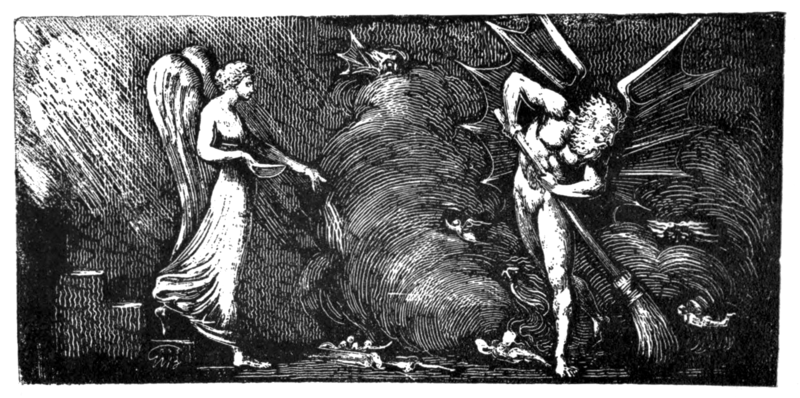
Some time between 1660 and 1675 when John Bunyan was twice imprisoned for holding religious services out of the auspice of the established church, he began work on Pilgrim's Progress his allegory of Christian's progress from 'this world to that which is to come'. He describes a stop on Christian's journey at the House of the Interpreter who was to instruct him on the right way to live the Christian life. In 1822, William Blake made an illustration for one of the lessons taught in the House of the Interpreter. Pilgrim was led into a parlor filled with dust; a man was called to sweep but he only stirred up the dust. A damsel was called to sprinkle the room with water with the result that the room was easily swept clean.

The Interpreter explained to Pilgrim: "This parlor is the heart of a man that was never sanctified by the sweet grace of the gospel: the dust is his original sin, and inward corruptions that have defiled the whole man. He that began to sweep at first, is the Law; but she that brought water, and did sprinkle it, is the Gospel. Now, whereas thou sawest that so soon as the first began to sweep, the dust did so fly about that the room by him could not be cleansed, but that thou wast almost choked therewith; this is to show thee, that the Law, instead of cleansing the heart (by its working) from sin, doth revive, put strength into, and increase it in the soul, even as it doth discover and forbid it, but doth not give power to subdue."
Blake's understanding of the roles of the law and the gospel is set forth in these passages in Jerusalem. In this first section Blake is saying that the forgiveness of God does not require 'Moral Virtue' but that we mutually sacrifice for, and continually forgive one another.

Jerusalem, Plate 61, (E 212)
"Saying, Doth Jehovah Forgive a Debt only on condition that it shall
Be Payed? Doth he Forgive Pollution only on conditions of Purity
That Debt is not Forgiven! That Pollution is not Forgiven
Such is the Forgiveness of the Gods, the Moral Virtues of the
Heathen, whose tender Mercies are Cruelty. But Jehovahs Salvation
Is without Money & without Price, in the Continual Forgiveness of Sins
In the Perpetual Mutual Sacrifice in Great Eternity! for behold!
There is none that liveth & Sinneth not! And this is the Covenant
Of Jehovah: If you Forgive one-another, so shall Jehovah Forgive You:
That He Himself may Dwell among You."

Here Blake tells us that 'accusation of sin & judgment' is the root of our quarrels and violence leading to Eternal Death.

Jerusalem, Plate 64, (E215)
"All Quarrels arise from Reasoning. the secret Murder, and
The violent Man-slaughter. these are the Spectres double Cave
The Sexual Death living on accusation of Sin & judgment
To freeze Love & Innocence into the gold & silver of the Merchant
Without Forgiveness of Sin Love is Itself Eternal Death"

Now Blake contrasts the message of Jesus: self-denial, forgiveness of sin, casting out devils, healing, pity, and setting prisoners free with that of the Pharisees (the chief proponents of the law): smiting with terror and punishment, crucifying, and proselyting to tyranny and wrath.

Jerusalem, Plate 77, (E 232)
"But Jesus is the bright Preacher of Life
Creating Nature from this fiery Law,
By self-denial & forgiveness of Sin.

Go therefore, cast out devils in Christs name
Heal thou the sick of spiritual disease
Pity the evil, for thou art not sent
To smite with terror & with punishments
Those that are sick, like the Pharisees
Crucifying &,encompassing sea & land
For proselytes to tyranny & wrath,
But to the Publicans & Harlots go!
Teach them True Happiness, but let no curse
Go forth out of thy mouth to blight their peace
For Hell is opend to heaven; thine eyes beheld
The dungeons burst & the Prisoners set free."

Blake and Bunyan were both teaching the message of Paul in the second chapter of Galatians: "
a man is justified not by performing what the Law commands but by faith in Jesus Christ. We ourselves are justified by our faith and not by our obedience to the Law, for we have recognised that no one can achieve justification by doing the 'works of the Law'. Bunyan continues; "when the gospel comes in the sweet and precious influences thereof to the heart...so is sin vanquished and subdued, and the soul made clean."

The little circle of younger artists who gathered around Blake in his later years referred to his humble home as the House of the Interpreter.