Showing posts with label Bunyan. Show all posts

Sunday, January 23, 2011

BLAKE'S RAINBOW

Blake uses the rainbow more as a visual image than a verbal image. Jerusalem appears here as a butterfly within the arc of a rainbow in the image at the bottom of Plate 14 of Jerusalem which shows Albion in his death-sleep. The heavenly bodies are portrayed as images in the plate, reminders of the universe measured in eons not minutes.

Jerusalem, Plate 13&14, (E 158)
"And all that has existed in the space of six thousand years:
Permanent, & not lost not lost nor vanishd, & every little act,
Word, work, & wish, that has existed, all remaining still
In those Churches ever consuming & ever building by the Spectres
Of all the inhabitants of Earth wailing to be Created:
Shadowy to those who dwell not in them, meer possibilities:
But to those who enter into them they seem the only substances
For every thing exists & not one sigh nor smile nor tear,

PLATE 14
One hair nor particle of dust, not one can pass away.

He views the Cherub at the Tree of Life, also the Serpent,
Orc the first born coild in the south: the Dragon Urizen:
Tharmas the Vegetated Tongue even the Devouring Tongue:
A threefold region, a false brain: a false heart:
And false bowels: altogether composing the False Tongue,
Beneath Beulah: as a watry flame revolving every way
And as dark roots and stems: a Forest of affliction, growing
In seas of sorrow. Los also views the Four Females:
Ahania, and Enion, and Vala, and Enitharmon lovely.
And from them all the lovely beaming Daughters of Albion,
Ahania & Enion & Vala, are three evanescent shades:
Enitharmon is a vegetated mortal Wife of Los:
His Emanation, yet his Wife till the sleep of death is past.

Such are the Buildings of Los! & such are the Woofs of
Enitharmon!"

The permanence and the multiplicity of the created world are described in the text. Blake has used words and images to remind us that there is an eternal world which underlies the vicissitudes of the temporal world. Because the image of the rainbow (which appeared after the Flood of Noah), is seen on this plate, Blake is going beyond the idea of an account of the physical body or the world of matter. The use of the rainbow makes the plate a token of a benevolent God's infinite care. We must remember that Blake uses water as a symbol for the material. To say that the world will not be destroyed by flood is to say the materiality shall not overcome spirituality.

When we seek out the biblical references for the rainbow we find this passage in Genesis 9:

[11] And I will establish my covenant with you; neither shall
all flesh be cut off any more by the waters of a flood; neither shall
there any more be a flood to destroy the earth.
[12] And God said, This is the token of the covenant which I make between me and you and every living creature that is with you, for perpetual generations:
[13] I do set my bow in the cloud, and it shall be for a token of a covenant between me and the earth.
[14] And it shall come to pass, when I bring a cloud over the earth, that the bow shall be seen in the cloud:
[15] And I will remember my covenant, which is between me and you and every living creature of all flesh; and the waters shall no more become a flood to destroy all flesh.
[16] And the bow shall be in the cloud; and I will look upon it, that I may remember the everlasting covenant between God and every living creature of all flesh that is upon the earth.
[17] And God said unto Noah, This is the token of the covenant, which I have established between me and all flesh that is upon the earth.

Genesis states that God covenants not to repeat the destruction of the earth and all living things by flood. The covenant is among God, man and the living creatures of the earth. The rainbow is a token of the covenant which is everlasting.

In Blake's 28 illustrations to Pilgrim's progress the rainbow colors appear frequently as reminders of the rainbow as a token. The rainbow image itself is prominent in three plates: the first, the last, and Plate 17 - CHRISTIAN AT THE ARBOR. In Plate One the arc of the rainbow previews the pilgrim's journey as a reminder of God's providence as man travels through life. Christian at the Arbor shows the linkage between God and man, a reference to the incarnation through which physicality and spirituality become one. The rainbow above the arbor symbolizes that linkage. In the final picture, in which the fourfold ascension is portrayed, the pilgrims and angels are embedded in the rainbow becoming themselves tokens of the process of reaching the visionary goal.
Plate I, THE DREAMER DREAMS A DREAM

Friday, January 21, 2011

BLAKE AS PILGRIM

Blake made one illustration to Pilgrim's Progress which is not considered to be a part of the 28 plate series which Norvig focused her attention on. It belongs to the National Gallery of Art in Washington, DC rather than to the Frick Collection in New York. It was once called A Warrior with Angels but now goes by the name of Christian with the Shield of Faith, Taking Leave of His Companions.


A friend has made the observation that the central character in this image which represents Christian, has the appearance of William Blake himself as a young man. Perhaps Blake cast himself and his loved ones or his characters in the roles of Christian and his companions. The appearance of Christian in this image does not resemble Christian in the series, and these companions don't appear elsewhere in the illustration to Pilgrim's Progress.

If Blake identified with Bunyan's Christian and inserted himself in an illustration, who would be the lovely ladies who accompany him? Could one be Catherine (the one to Blake's left), his companion in life, his Enitharmon? I suggest that the woman to Christian's (Blake's) right is his Jerusalem the source of his inspiration and imagination, the Divine Vision which he recognized in every individual. Vala the shadow of Jerusalem is shown perhaps as the woman behind Jerusalem in the second tier. The fourth woman who is reaching upward as if a connecting link to the Celestial City may be Enion of whom Damon says "The eternal [not the temporal] Enion rises in the dawn of the third day, in a whirlwind...she casts off her death-clothes, for the winter is gone, and all nature is rejuvenated. Tharmas embraces her and raises her through the heavens, sounding his trumpet to wake the dead." These identifications would turn the image into an illustration for Blake's life and myth rather than for Bunyan's allegory.

Jerusalem, PLATE 54 (E 203)
"In Great Eternity, every particular Form gives forth or Emanates
Its own peculiar Light, & the Form is the Divine Vision
And the Light is his Garment This is Jerusalem in every Man
A Tent & Tabernacle of Mutual Forgiveness Male & Female
Clothings.
And Jerusalem is called Liberty among the Children of Albion"

Jerusalem, PLATE 39 [44],(E 187)
"Man is adjoind to Man by his Emanative portion:
Who is Jerusalem in every individual Man: and her
Shadow is Vala, builded by the Reasoning power in Man
O search & see: turn your eyes inward: open O thou World
Of Love & Harmony in Man: expand thy ever lovely Gates."

If Blake broke away from the overall structure of his series, it is understandable that he would withdraw the illustration from the series. It would have become his personal record of his role as a pilgrim or traveller to Eternity.

Blake's ideas about the destination of the traveller are different from Bunyan's since Bunyan was a Puritan who adhered to the doctrine of predestination including eternal damnation. Bake's traveller's journey would not be measured by moral virtue or inclusion in the class of the elect. Blake would not be receptive to the accumulation of doctrine through which the Puritans sought to regulate and demonstrate their status as among the saved. Bunyan stopped short of the entry into the divine province by his dreamer, although the pilgrims entered the city after crossing the river of death. Bunyan's Celestial City was to be the destiny in the afterlife of those who followed the path outlined for the repentant sinner. One of Bunyan's final scenes shows that one ignorant of the requirements of that route would find himself destined for hell. In contrast Blake's teaching was that error would be annihilated so that all may experience Eternity through connecting with the inner Divinity (that of God in every man as Quakers say.)

Consider the words in the following passage from the beginning of Jerusalem as Blake's response to Bunyan's dreamer who followed the journey of the pilgrim. Awake from the dream that 'states' through which men pass are human existence. Awake from the image of God as afar rather than within. Awake from the idea that Evil must be punished rather than forgiven. Awake to the idea that the Emanation is to be interiorized not projected or rejected.

Jerusalem, Plate 4,(E 146)
"Awake! awake O sleeper of the land of shadows, wake! expand!
I am in you and you in me, mutual in love divine:
Fibres of love from man to man thro Albions pleasant land.
In all the dark Atlantic vale down from the hills of Surrey
A black water accumulates, return Albion! return!
Thy brethren call thee, and thy fathers, and thy sons,
Thy nurses and thy mothers, thy sisters and thy daughters
Weep at thy souls disease, and the Divine Vision is darkend:
Thy Emanation that was wont to play before thy face,
Beaming forth with her daughters into the Divine bosom
[Where!!]
Where hast thou hidden thy Emanation lovely Jerusalem
From the vision and fruition of the Holy-one?
I am not a God afar off, I am a brother and friend;
Within your bosoms I reside, and you reside in me:
Lo! we are One; forgiving all Evil; Not seeking recompense!
Ye are my members O ye sleepers of Beulah, land of shades!"

Wednesday, January 19, 2011

BUNYAN'S 'TRAVELLER'

A remarkable aspect of Norvig's book is the way she traces themes which appear in Blake's Bunyan illustrations through the work of his lifetime. This is prominent in the work she does in linking The Gates of Paradise with the Pilgrim illustrations. 'Gates' itself was evidence of the continuity of Blake's work stretching over decades.

The fact that Blake produced his images through engravings gave them an existence beyond the printed page; they also existed as copper plates. As Blake modified or developed his ideas, the printed images of the same plates could evolve with his thought. It has frequently been noted that the pages of his books were rearranged in various of the printings, or that additional pages were included. Also 'Minute Particulars' were added or emphasized or obscured according to the meaning he wished to convey at a particular time or to a particular audience. Norvig gives substance to the appearance of Blake's ideas as they resurfaced in unexpected places.

The Gates of Paradise initially printed with the prefix of For Children in 1793, was reissued in 1818 prefixed For the Sexes. Three additional plates were engraved with the Keys to the Gates and a final poem and image as an epilogue. This final plate Norvig sees as a link to the Bunyan illustrations which were produced in 1824. That is a period of 35 years over which Blake was communicating related ideas on the development of the psyche in the framework of the journey of a pilgrim (or 'traveller' as Blake called him).

Norvig states on Page 114 of
Dark Figures in the Desired Country: Blake's Illustrations to the Pilgrim's Progress:
"In this late revision of the emblem series, however, by alluding to Christian's identity scroll in The Pilgrim's Progress, the walking stick of the epilogue plate serves to emblemize the function of the eternal personality, which is shown to be basically at odds with those states of change we enter into and out of all the time, like sleep. The message is a terse development of the whole metaphysics of individuals versus states as Blake had refined in the years since his experiences at Felpham; and it is given expression in the poem accompanying the emblem in terms of the difference between "Man" and "Garment" - a difference that Satan (our own intrapsychic Accuser aspect) has not learned 'distinct to know.
"Once again, then we see Bunyan's image of the Christan mental Traveler linked by Blake with his own system of imaginal representation with which the concept of individuation via the route of differentiating self from "state," from his garment, permanent identity from temporary condition, the "Eternal Human" from "those States or Worlds in which the Spirit travels." (J 49).

Jerusalem , Plate 49, (E 198)
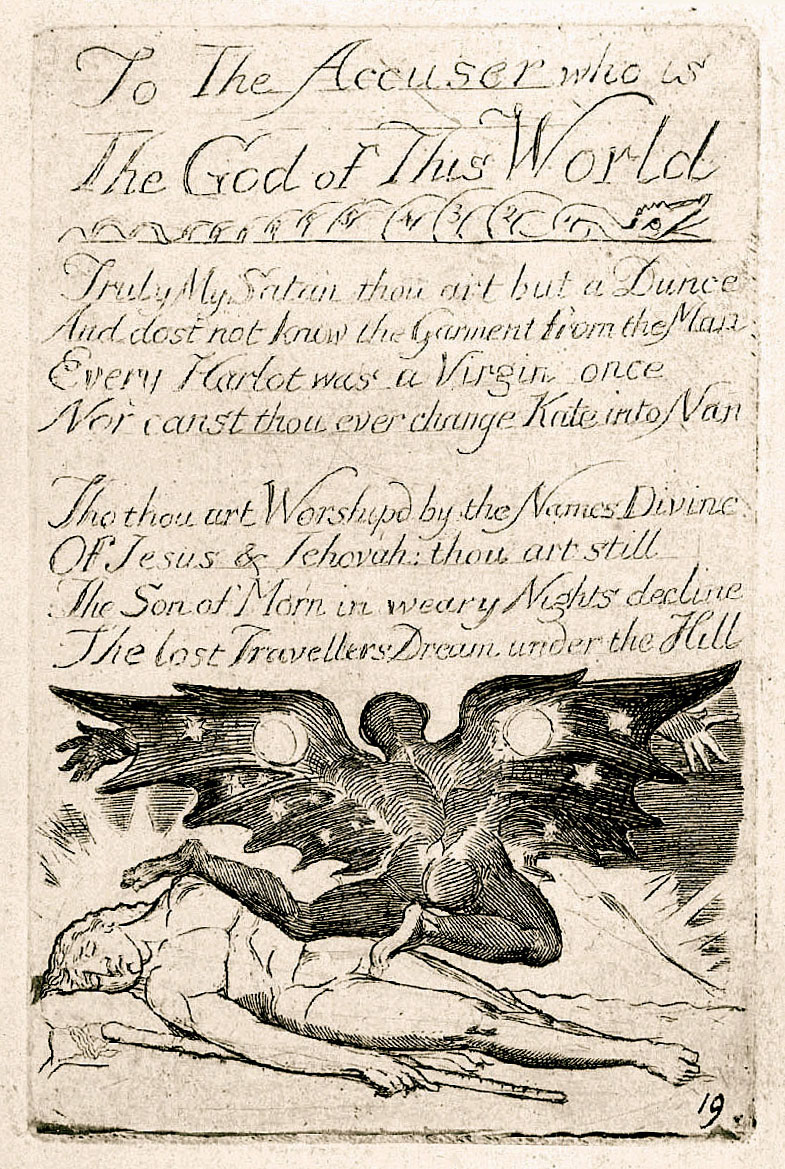
"Satan is the State of Death, & not a Human existence:
But Luvah is named Satan, because he has enterd that State.
A World where Man is by Nature the enemy of Man
Because the Evil is Created into a State. that Men
May be deliverd time after time evermore. Amen.
Learn therefore O Sisters to distinguish the Eternal Human
That walks about among the stones of fire in bliss & woe
Alternate! from those States or Worlds in which the Spirit
travels:
This is the only means to Forgiveness of Enemies[.]"


In this picture Christian has recovered his lost identity scroll which will allow him passage into heaven. Norvig sees Christian "retrieving his testament of selfhood from the zone of the state of grace (the arbor) so that it can serve him in the forward journey through all other states." (Page 177)


CHRISTIAN AT THE ARBOR
Plate 17

Monday, January 17, 2011

BUNYAN'S DREAM

The dream motif within which Pilgrim's Progress is enclosed was developed and enhanced by Blake's imagery. Dreaming is a metaphor for a level of consciousness below ego-consciousness as we ordinarily experience it. Since Christian exists within the dream; his experiences are associated with a level of consciousness which has access to archetypal material from the collective unconscious as well as the personal unconscious. Blake is picking up on and presenting the psychological implications of milestones Christian passes through as indications of internal development of the psyche itself. The narrator, the dreamer, the pilgrim, the companions, and the interpreter are all represented as archetypes which play roles in individuation.

The midpoint of the series of Blake's illustrations, the plate on which Pilgrim encounters Christ is preceded by the plate titled THE MAN WHO DREAMED OF A DAY OF JUDGMENT. So within the narrator's dream of Pilgrim's journey we find an encounter with another dreaming man - a dream within a dream - symbolic of descending to a deeper psychological level. It is at this level that it is possible that the burden which Christian has been bearing - the consciousness of sin - can be removed. In Blake as in Genesis, the division of reality into the categories of Good and Evil precipitates the divisions in man which constitute the 'fall'. The reversal of this consciousness (of sin) opens the way for the appearance of Christ and reunification.

This is plate 13 of Blake's illustrations to Bunyan's Pilgrim's Progress - THE MAN WHO DREAMED OF A DAY OF JUDGMENT. The observer is Christian - the pilgrim with the burden of sin strapped to his back as it has been represented since Plate 2. Norvig sees the encounter represented in Plate 13 as bringing into consciousness the image of the Last Judgment as a scene of fear and punishment. Encountering this dream content allows Pilgrim to move to the next scene - an encounter with the Christ and a release from the burden which he had been carrying. Just as the consciousness of sin had become an ever present burden to Pilgrim, the fear of punishment at judgment was acting as a detriment to encountering Christ.

In
Gerda S.Norvig's book Dark Figures in the Desired Country: Blake's Illustrations to the Pilgrim's Progress she comments on Plate 13, THE MAN WHO DREAMED OF THE DAY OF JUDGMENT:
"From Bunyan's text we know that the man in this emblem is meant to he a warning to Christian, just as the subject of the previous illustration was. But there is a big difference in the mentality of the two characters, a difference Blake picks up on and generously amplifies to his own interpretive purpose. For although Bunyan's version of this emblematic dreamer-within-a dream shakes and trembles from his haunting fear that he is doomed, he is not so fixated or developed in his anxiety that he has lost all perspective on it. Unlike the man in the iron cage, he talks about his fear and about his vision. He thus creates a certain amount of figural and dialogic distance between himself and his feeling state figured in his dream. That is the saving grace, and indeed for Blake this figure from the Progress typifies the very possibility of a saving grace in everyone's psychic organization. Thus, despite the man's dream-vision that he will be rejected by God at the Last Day, he has two valuable attributes (themselves God-given) that help to counteract the implosive effects of his negative intuition: he has the visionary power to create a clear embodiment of his fear and the capacity to reflect consciously on its imaged content." (Page 164-5)

This is the crux of the issue as Norvig sees it: "It is as though the articulation of the damnation-fantasy held by the man dreaming of the Last Judgment in the House of the Interpreter released this contrary image of deliverance through his own visionary opening in obedience to an inner law of psychological compensation in the mind of the original dreamer."

Romans:
8:1-2 - No condemnation now hangs over the head of those who are "in" Jesus Christ. For the new spiritual principle of life "in" Christ lifts me out of the old vicious circle of sin and death.

Norvig: "It is the identification Christian himself
makes between his [own] imaginative nature and Christ's resurrection that permits and denotes the falling away of the burden. Therefore, the burden in its death throes appropriately recalls the burial of Jesus, whereby a corruptible body was converted to an incorruptible. To enhance the hints Bunyan gives of this connection, Blake fashions the burden to look like an unborn human embryo crouched by the transept of the sepulcher's doorway. It also has the appearance of crumpled clothing, a possible allusion to the linen cloths found folded up beside Christ's tomb after the resurrection." (p 169)


The point of return has been achieved; challenges remain but the result is assured.

Jerusalem, PLATE 43 [29], E(191)
"Then the Divine Vision like a silent Sun appeard above
Albions dark rocks: setting behind the Gardens of Kensington
On Tyburns River, in clouds of blood: where was mild Zion Hills
Most ancient promontory, and in the Sun, a Human Form appeard
And thus the Voice Divine went forth upon the rocks of Albion"

Saturday, January 15, 2011

BLAKE'S BUNYAN

"My dark and cloudy words, they do but hold
The truth, as cabinets enclose the gold." Bunyan

The process of learning invariably involves going from the known into the unknown. We begin with what we are capable of doing and proceed to what is beyond our present capabilities. In our lives we have crossed this threshold many times from the very first times when we learned to suck air into our lungs and milk from our mothers' breast. Nevertheless learning always involves overcoming inertia and taking risk. Reluctance to relinquish our present positions for the uncertain prospect of finding security in that hazy possibilities which may replace them is perceived as threat.

Learning to see as Blake sees may seem a particularly threatening activity because we have invested so much in learning to think rationally - trusting only evidence and proof and linear thought patterns. Blake has devised an approach to design and writing which breaks down the patterns or rationality to facilitate imaginative activity.

In one sense Norvig's book (Dark Figures in the Desired Country: Blake's Illustrations to the Pilgrim's Progress) is an account of her learning Visionary Hermeneutics. She says: "Normally hermeneutics refers to a set of predetermined interpretive strategies that a reader brings to and imposes on a work for one or more ulterior purposes..." (Page 4) However Blake's strategy was to apply the imagination in such a way that the internal and external context of the work interact to stimulate the activity of the imagination of the reader. But the imagination is not just put to use for interpretation, but gains self awareness and is strengthened through the process. "I have been speaking of visionary hermeneutics as a process that depends less on rules of interpretation than on an imaginative perspective, meaning both a perspective we learn to take toward the image and a perspective the imagination gradually gains on itself." (Page 6)

Plate 28, AT THE GATES OF HEAVEN
Norvig attempts to enlighten her audience on Blake's practice of Visionary Hermeneutics which she learned from her teacher William Blake by studying his illustrations to Bunyan's Pilgrim's Progress. The heart of her book is her commentary on each of Blake's 28 illustrations. But the illustrations are not to be viewed individually but as a whole, commenting on one another and complementing others as do Blake's Illustration to the Book of Job. She compares the process that they illustrate in detail to the process delineated in Gates of Paradise. In the illustrations to Pilgrim's Progress as in his work from beginning to end, Blake sought to open the avenue to the visionary world he experienced to his readers.

Descriptive Catalogue, Penance of Jane Shore,(E 550)
"This Drawing was done above Thirty Years ago, and proves
to the Author, and he thinks will prove to any discerning eye,
that the productions of our youth and of our maturer age
are equal in all essential points."

Norvig observes:
"Even in the Songs [of Innocence and Experience] itself a much more intricate pattern of mutual commentary, plotted by the progressive permutations of repeated verbal and pictorial motifs shown in changing contexts throughout the song cycle, emerges to enrich the work as a sort of primer of visionary literacy." (Page 5)

Thursday, January 13, 2011

BUNYAN'S DARK FIGURES

We were fortunate to purchase (for less the $20) a copy of Gerda S. Norvig's book Dark Figures in the Desired Country in which she presents her study of Blake's illustrations of Pilgrim's Progress.

It is refreshing to read Blake criticism from a scholar who thinks with a psychological perspective. Norvig is a qualified clinical psychologist as well a professor of English literature. Her book was assembled over a period of twenty years during which she was refining her understanding of Blake and of the human psyche. She sees Blake's development as being a process in which he gained the self-understanding which allowed him to understand the process through which Bunyan produced Pilgrim's Progress.

Norvig says "When in the following chapters I explore Blake's psychologizing of Bunyan's myth, I draw often, as mentioned in the preface, on the vocabulary of Jungian and post-Jungian theory to articulate some of Blake's most characteristic moves. What led me to choose the Jungian perspectives of analytical and archetypal psychology for this task is that the central vision of these approaches so clearly echoes the conception of the imagination dominating Blake's every word and every stroke of graphic expression...
for both Blake and the Jungians, "imagination is not a state" (M 32, E132/K522), nor is it just one of the many faculties of the mind; rather, it is the root capacity conditioning all mental functioning. [Page 17]..

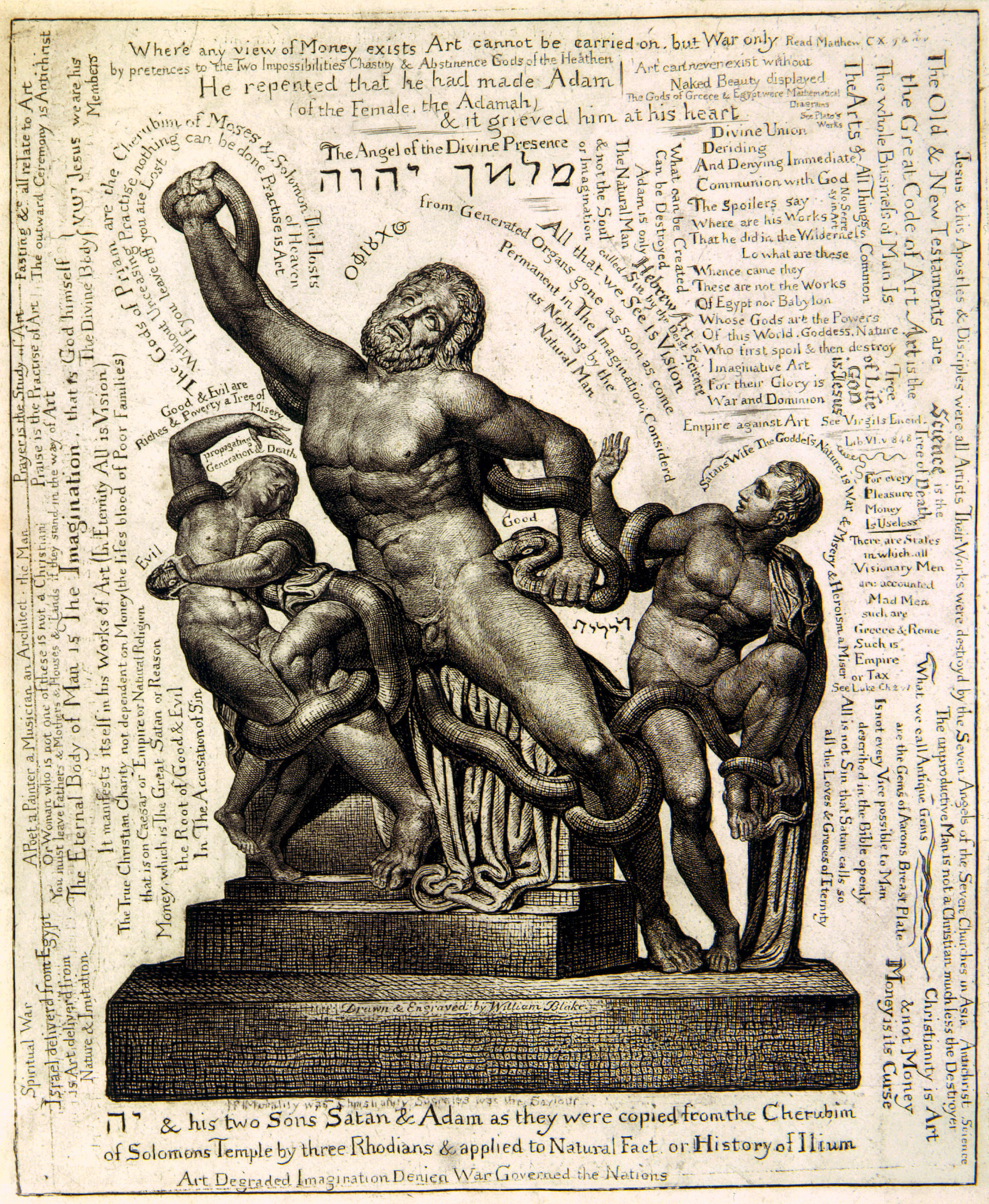
"For him, too, the archetypal structures, functions, fictions and images of the human imagination have both primacy over and ontological independence from the psychodynamics of any individuals case history. Thus his statement that "The Eternal Body of Man is the IMAGINATION that is God himself The Divine Body...JESUS we are his Members" (Laocoon, E273/K776) creates a picture of the psyche as larger than the body and life of the the individual subjects who articulate it." [Page 18]

Bringing these strategies to bear in discerning the meaning which Blake perceives in Bunyan's allegory and presents through images of archetypal experiences, Norvig reveals Bunyan and Blake delving into the collective psyche.


Blake's Laocoon
Text on Laocoon

Tuesday, January 11, 2011

BLAKE & PILGRIM'S PROGRESS

Our posts mentioning Bunyan.

There were three great English dissenting poets:

John Milton (9 December 1608 - 8 November 1674)

John Bunyan (28 November 1628 - 31 August 1688)

William Blake (28 November 1757 - 12 August 1827)

The first two were influential on the third - William Blake - the subject of this blog. Milton's influence has frequently been mentioned here but we have said less about Bunyan's. Gerda S. Norvig's book Dark Figures in the Desired Country: Blake's Illustrations to the Pilgrim's Progress gives deserved attention to the primary way in which Blake interacted with Bunyan's writing.

Blake was slow to acknowledge a debt to Bunyan. It was not until near the end of his life that he took the task of illustrating Pilgrim's Progress. Blake's Bunyan illustrations were made around 1824 after the completion of Illustrations to Book of Job. He had no prospect of having them published in a new edition of Pilgrim's Progress. They were done like most of his work in response to the promptings of his imagination to present his vision in a form which may someday be received.


_______________Plate 8, Christian Fears the Fire from the Mountain
_______________Click on image, then click on enlargement for detail

Blake's early opinion of Bunyan as compared to Milton is expressed in this letter to Hayley:

Letter 52, (E 758)
To William Hayley Esqre Felpham
near Chichester, Sussex

Sth Molton St 4 Decr. 1804
"-- I was about to
have written to you to express my wish that two so unequal
labourers might not be yoked to the same Plow & to desire you if
you could to get Flaxman to do the whole because I thought it
would be (to say the best of myself) like putting John Milton
with John Bunyan"

In Blake's opinion, allegory, as was employed by Bunyan, was a lower form of communication than vision which Blake aimed to use himself as alluded to in this passage:

Vision of the Last Judgment, (E 554)
"The Hebrew Bible & the Gospel of
Jesus are not Allegory but Eternal Vision or Imagination of All
that Exists Fable [al] <&> Allegory]
[<& Visions of Imagination>] ought
to be known as Two Distinct Things & so calld for the Sake of
Eternal Life Plato has made Socrates say that Poets & Prophets do
not Know or Understand what they write or Utter this is a most
Pernicious Falshood. If they do not pray is an inferior Kind to
be calld Knowing Plato confutes himself>"

As Blake matured as an artist and as a Christian (which were one and the same thing to him), he found ways to probe the depths of meaning in Bunyan according to Norvig:

"But in the active days of the Lambeth period (1790 -1800, when Blake lived at 13 Hercules Building, Lambeth), absorbed in the dynamic relations and counterposes of his own prophetic art to the energies of Milton's religious Poetics, Blake evidently did not consider Bunyan compatriot or rival worthy of systematic attention.
...
By the time he had developed a style of serial illustration adequate to handle literary critiques that were, simultaneously, visions of individuation, he was ready to turn to the hermeneutic complexity of the Progress and give it the innovative treatment I will be examining in Chapter 3." (Page 47)

The illustrations to Pilgrim's Progress have continued to be neglected compared to Blake's other work. Norvig's book, deep as it is, has created an opening for the illustrations to receive the attention they deserve.

"In part the relative neglect of the Bunyan designs is due to the fact that the watercolors themselves, currently among the holdings of the Frick collection in New York city, have been on general view only four times since their arrival in the United States during World War II, and before that in England only once."

Norvig's book is available online.The twenty-eight plates are included following page 128; you will find it hard to locate them elsewhere.

Monday, August 16, 2010

BLAKE & BUNYAN

I haven't been able to track down digital images of Blake's illustrations to Pilgrim's Progress, but I have seen one image in an Online Exhibit from UNCG's library. Last week I wrote to the Head of Special Collections at University of North Carolina Greensboro inquiring about the possibility of seeing online pictures of William Blake's Illustrations to John Bunyan's Pilgrim's Progress. Mr Finley was kind enough to make this reply:
"Thank you for your inquiry about the William Blake exhibit. This exhibit actually was mounted about nine years ago as a physical exhibit, to highlight the acquisition by Jackson Library at the University of North Carolina at Greensboro of a first edition of Blake's Illustrations of the Book of Job, the library's one-millionth volume.
Since this exhibit is far in the past, I do not have much recollection of the particular items included other than what is mentioned in the exhibit captions. I am afraid I do not have any other illustrations from Pilgrim's Progress, since this particular work is not among my department's holdings. (The illustration in the exhibit is from the Heritage Press edition of Bunyan's famous work.) Most of the illustrations for Blake's own works came from my library's collection of Trianon Press editions of Blake.
I am sorry not to be able to provide you with further illustrations from Pilgrim's Progress. Of course, not every edition of this title carries Blake's illustrations, but a number do. If you are interested in acquiring a copy with the Blake illustrations, I would suggest searching ABE (the Antiquarian Book Exchange) (www.abe.com) under their "Advanced Search," which will allow you to indicate copies with Blake's illustrations as a keyword.
The originals of the other images in the exhibit are located in a wide variety of places, some in the U. S. and many in England. The exhibit generally did not indicate the location of the originals, although I know that the Huntington Library in California is a major repository for Blake titles and images. The Huntington also had a much larger Blake exhibit some six years ago, I believe, and it may have an exhibit catalog for that exhibit.
Thank you again for your inquiry and your kind words about the exhibit.
Sincerely,
William K. Finley
Head, Special Collections & University Archives
The University of North Carolina at Greensboro

You may enjoy visiting this website to see samples of Blake's images and the introductions to a variety of his works. See the Online Exhibit from 2001, titled William Blake Dreamer of Dreams.

Take special notice of two illustrations from UNCG's copy of the first printing of Blake's Illustrations to the Book of Job.

PS

I later found the copy of Pilgrim's Progress given to us by a friend has a few of the watercolor illustrations by William Blake.

Click on picture for clear enlargement. Click again for more lovely detail.

Monday, May 24, 2010

LAW & GOSPEL

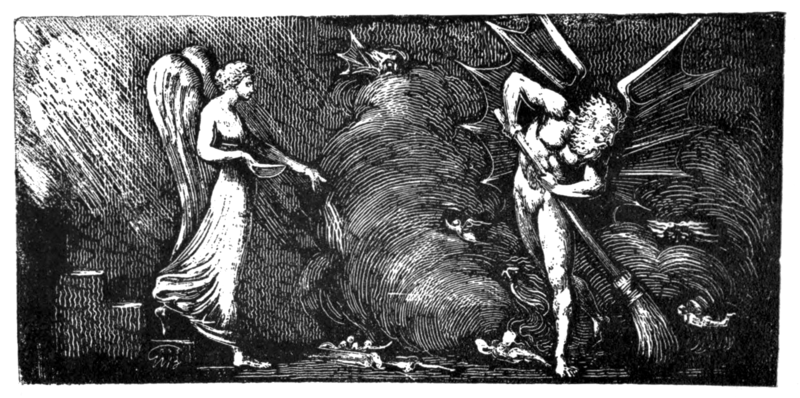
Some time between 1660 and 1675 when John Bunyan was twice imprisoned for holding religious services out of the auspice of the established church, he began work on Pilgrim's Progress his allegory of Christian's progress from 'this world to that which is to come'. He describes a stop on Christian's journey at the House of the Interpreter who was to instruct him on the right way to live the Christian life. In 1822, William Blake made an illustration for one of the lessons taught in the House of the Interpreter. Pilgrim was led into a parlor filled with dust; a man was called to sweep but he only stirred up the dust. A damsel was called to sprinkle the room with water with the result that the room was easily swept clean.

The Interpreter explained to Pilgrim: "This parlor is the heart of a man that was never sanctified by the sweet grace of the gospel: the dust is his original sin, and inward corruptions that have defiled the whole man. He that began to sweep at first, is the Law; but she that brought water, and did sprinkle it, is the Gospel. Now, whereas thou sawest that so soon as the first began to sweep, the dust did so fly about that the room by him could not be cleansed, but that thou wast almost choked therewith; this is to show thee, that the Law, instead of cleansing the heart (by its working) from sin, doth revive, put strength into, and increase it in the soul, even as it doth discover and forbid it, but doth not give power to subdue."
Blake's understanding of the roles of the law and the gospel is set forth in these passages in Jerusalem. In this first section Blake is saying that the forgiveness of God does not require 'Moral Virtue' but that we mutually sacrifice for, and continually forgive one another.

Jerusalem, Plate 61, (E 212)
"Saying, Doth Jehovah Forgive a Debt only on condition that it shall
Be Payed? Doth he Forgive Pollution only on conditions of Purity
That Debt is not Forgiven! That Pollution is not Forgiven
Such is the Forgiveness of the Gods, the Moral Virtues of the
Heathen, whose tender Mercies are Cruelty. But Jehovahs Salvation
Is without Money & without Price, in the Continual Forgiveness of Sins
In the Perpetual Mutual Sacrifice in Great Eternity! for behold!
There is none that liveth & Sinneth not! And this is the Covenant
Of Jehovah: If you Forgive one-another, so shall Jehovah Forgive You:
That He Himself may Dwell among You."

Here Blake tells us that 'accusation of sin & judgment' is the root of our quarrels and violence leading to Eternal Death.

Jerusalem, Plate 64, (E215)
"All Quarrels arise from Reasoning. the secret Murder, and
The violent Man-slaughter. these are the Spectres double Cave
The Sexual Death living on accusation of Sin & judgment
To freeze Love & Innocence into the gold & silver of the Merchant
Without Forgiveness of Sin Love is Itself Eternal Death"

Now Blake contrasts the message of Jesus: self-denial, forgiveness of sin, casting out devils, healing, pity, and setting prisoners free with that of the Pharisees (the chief proponents of the law): smiting with terror and punishment, crucifying, and proselyting to tyranny and wrath.

Jerusalem, Plate 77, (E 232)
"But Jesus is the bright Preacher of Life
Creating Nature from this fiery Law,
By self-denial & forgiveness of Sin.

Go therefore, cast out devils in Christs name
Heal thou the sick of spiritual disease
Pity the evil, for thou art not sent
To smite with terror & with punishments
Those that are sick, like the Pharisees
Crucifying &,encompassing sea & land
For proselytes to tyranny & wrath,
But to the Publicans & Harlots go!
Teach them True Happiness, but let no curse
Go forth out of thy mouth to blight their peace
For Hell is opend to heaven; thine eyes beheld
The dungeons burst & the Prisoners set free."

Blake and Bunyan were both teaching the message of Paul in the second chapter of Galatians: "
a man is justified not by performing what the Law commands but by faith in Jesus Christ. We ourselves are justified by our faith and not by our obedience to the Law, for we have recognised that no one can achieve justification by doing the 'works of the Law'. Bunyan continues; "when the gospel comes in the sweet and precious influences thereof to the heart...so is sin vanquished and subdued, and the soul made clean."

The little circle of younger artists who gathered around Blake in his later years referred to his humble home as the House of the Interpreter.