Showing posts with label Jesus. Show all posts

Monday, January 3, 2011

EDEN & GENERATION

Saturated as was Blake's mind with the thought of Milton, his writings and paintings are permeated with Milton's ideas. Blake painted three sets of illustrations to Milton's Paradise Lost - one each for his supporters Butts, Thomas and Linnell. In Book 5 the Archangel Raphael is sent by God to warn Adam and Eve of the threat that Satan poses. Book 7 of Paradise Lost recounts the Biblical story of creation as told to Adam by Raphael. The Genesis account is embellished with the fall of Lucifer which is not included in the Bible. In Book 8 Adam narrates to Raphael the aspects of creation which took place after his own creation.

Book 5 - Raphael warns Adam and
Eve about Satan
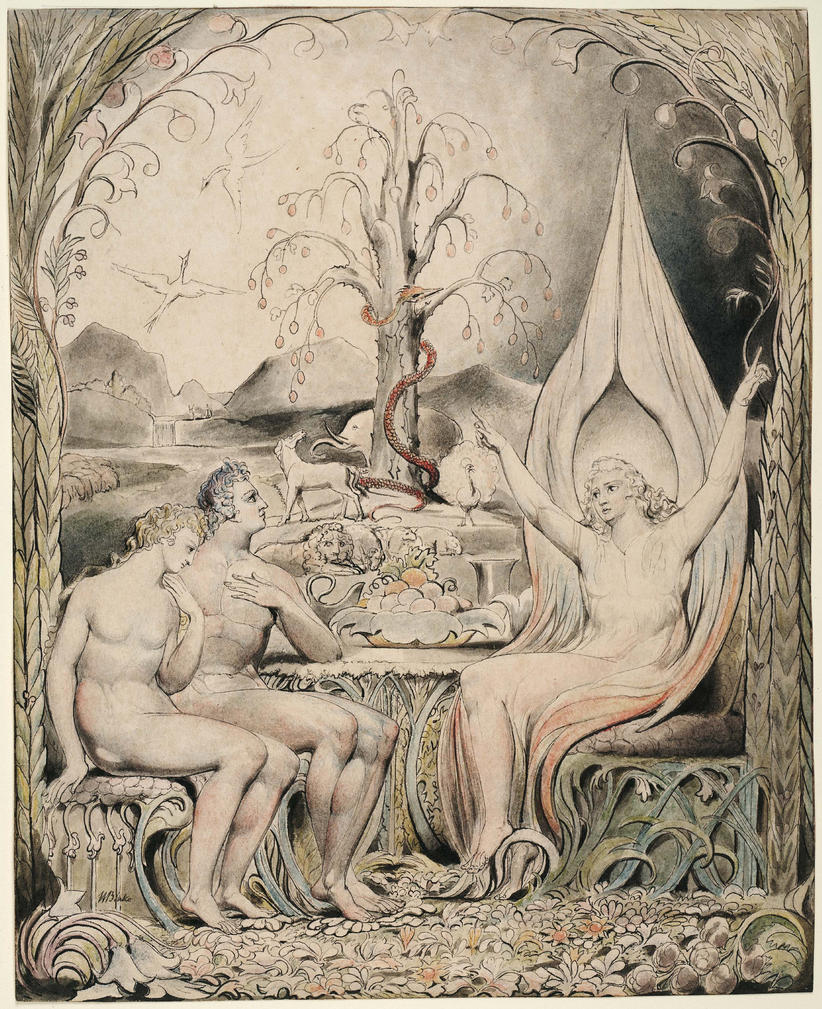


This illustration for Book 5 represents the warning. The idyllic world as pictured has not been disturbed, but symbols of division (or contraries) are manifest: the lion and the lamb, the horse and the peacock. The tree bears its tempting fruit and the Serpent has made his appearance.

The scene is set for the fall which leads to Blake's world of Generation: Los' world, our world.


The world in which we live is meant to be the path through experience by which fallen man can return to consciousness of the Eternal. Blake's world of Generation affords fallen man the opportunity to realize the incarnation and return to Eden as a new being. The path through generation is not easy but this is where man finds himself. The outcome should be regeneration. Blake's progression is from innocence through experience to Eternity. He offers many levels, many gates and many paths. Only the destination is single - the return to Eternity. This can be reached any time (because it is not in time) by its realization - which he calls the Last Judgment:

Vision of the Last Judgment, (E 562)
"Thus My Picture is a
History of Art & Science [& /its/] Which is Humanity itself. What are all the Gifts of the
Spirit but Mental Gifts whenever any Individual Rejects Error &
Embraces Truth a Last Judgment passes upon that Individual"

Many people understand the Biblical Garden of Eden as an idealized material world with a creator God who is outside of creation; with man being given 'dominion' over the animals; and with man walking with an external God in the cool of the evening. Blake's Eden was the state of mind in which the vision of God was not obscured. William Blake's personal goal was to spend as much time in Eden as possible. To transcend to fourfold vision - the ability to perceive the Infinite - was his supreme delight. But to him Eden meant more than vision it also meant creative energy, forgiveness, brotherhood and the oneness of wholeness. Eden to Blake was an internal not an external experience.

MILTON: BOOK THE SECOND, PLATE 30 [33], (E 129)
"Beulah is evermore Created around Eternity; appearing
To the Inhabitants of Eden, around them on all sides.
But Beulah to its Inhabitants appears within each district
As the beloved infant in his mothers bosom round incircled
With arms of love & pity & sweet compassion. But to
The Sons of Eden the moony habitations of Beulah,
Are from Great Eternity a mild & pleasant Rest."

Jerusalem, Plate 12, (E 156)
"fourfold,
The great City of Golgonooza: fourfold toward the north
And toward the south fourfold, & fourfold toward the east & west
Each within other toward the four points: that toward
Eden, and that toward the World of Generation,
And that toward Beulah, and that toward Ulro:
Ulro is the space of the terrible starry wheels of Albions sons:
But that toward Eden is walled up, till time of renovation:
Yet it is perfect in its building, ornaments & perfection.

Jerusalem, PLATE 34 [38],(E 179)
"Turning from Universal Love petrific as he [Albion] went,
His cold against the warmth of Eden rag'd with loud
Thunders of deadly war (the fever of the human soul)
Fires and clouds of rolling smoke! but mild the Saviour follow'd
him,"

Tuesday, December 14, 2010

NATIVITY V

Nativity I, II, III and IV

Last December I posted four time on the nativity using Blake's illustrations to Milton's On the Morning of Christ's Nativity. The fifth illustration of the series "The Flight of Molock" faithfully presents these lines from Milton's ode:

XXIII
And sullen Moloch fled,
Hath left in shadows dread
His burning Idol all of blackest hue;
In vain with Cymbals' ring
They call the grisly king,
In dismal dance about the furnace blue,Moloch, the second of Blake's Seven Eyes of God, called the executioner, required child sacrifice. Blake presents the theme of sacrificing children by showing the infant Jesus emerging from a 'fiery furnace.' Daniel tells of three men who emerged from such a furnace unscathed having met in the furnace a fourth who appeared as the 'Son of God.'

On plate 31 (E 177) of Jerusalem Blake tells us that:

"And the appearance of a Man was seen in the Furnaces;
Saving those who have sinned from the punishment of the Law,
(In pity of the punisher whose state is eternal death,)
And keeping them from Sin by the mild counsels of his love."

Two women (cf.1st Kings 3:16ff) are touching the child emerging from the furnace. One appears to be Jerusalem, the other Vala or Rahab. Both turn away from the child as they reach out to touch him. In The Mental Traveller we read of a babe whom none could touch:

The Mental Traveller, (E 484)
"Till from the fire on the hearth
A little Female Babe does spring

And she is all of solid fire
And gems & gold that none his hand
Dares stretch to touch her Baby form
Or wrap her in his swaddling-band"

Blake and Milton have supplemented the picture of the child who was laid in the manger as provided by Luke.

Friday, December 10, 2010

SIN & FORGIVENESS


Listen to Blake and the Bible commenting on Jesus, Sin, Error, Forgiveness, Satan and Judgment. These quotes from the two sources allow us to compare New Testament concepts and how similar ideas appear in Blake's :


CHRIST AS THE REDEEMER OF MAN

1)Jesus not the accuser (Satan) is our judge.


1John.2
[1] My little children, these things write I unto you, that ye sin not. And if any man sin, we have an advocate with the Father, Jesus Christ the righteous:

Vision of the Last Judgment, (E 565)
"Forgiveness of Sin is only at the Judgment Seat of Jesus the
Saviour where the Accuser is cast out. not because he Sins but
because he torments the Just & makes them do what he condemns as
Sin & what he knows is opposite to their own Identity"

2) The accuser has no power over us.

Rev.12
[10] And I heard a loud voice saying in heaven, Now is come salvation, and strength, and the kingdom of our God, and the power of his Christ: for the accuser of our brethren is cast down, which accused them before our God day and night.

Vision of the Last Judgment,(E 564)
"Christ comes
as he came at first to deliver those who were bound under the
Knave not to deliver the Knave He Comes to Deliver Man the
[Forgiven] not Satan the Accuser we do not
find any where that Satan is Accused of Sin he is only accused of
Unbelief & thereby drawing Man into Sin that he may accuse him.
Such is the Last Judgment a Deliverance from Satans Accusation
Satan thinks that Sin is displeasing to God he ought to know that
Nothing is displeasing to God but Unbelief & Eating of the Tree
of Knowledge of Good & Evil"

3) The light of Truth leads us to the new creation.

Acts.26
[18] To open their eyes, and to turn them from darkness to light, and from the power of Satan unto God, that they may receive forgiveness of sins, and inheritance among them which are sanctified by faith that is in me. [PAUL]

Vision of the Last Judgment, (E 565)
"I will not Flatter them Error is
Created Truth is Eternal [,] Error or Creation will be Burned Up &
then & not till then Truth or Eternity will appear It is Burnt up
the Moment Men cease to behold it I assert for My self that I do
not behold the Outward Creation & that to me it is hindrance &
not Action it is as the Dirt upon my feet No part of Me."

4) Forgiveness of sins is God's will.

Matt.9
[2] And, behold, they brought to him a man sick of the palsy, lying on a bed: and Jesus seeing their faith said unto the sick of the palsy; Son, be of good cheer; thy sins be forgiven thee.
[5] For whether is easier, to say, Thy sins be forgiven thee; or to say, Arise, and walk?
[6] But that ye may know that the Son of man hath power on earth to forgive sins, (then saith he to the sick of the palsy,) Arise, take up thy bed, and go unto thine house.

Jerusalem,
Plate 20, (E 165)

"Jerusalem answer'd with soft tears over the valleys.

O Vala what is Sin? that thou shudderest and weepest
At sight of thy once lov'd Jerusalem! What is Sin but a little
Error & fault that is soon forgiven; but mercy is not a Sin
Nor pity nor love nor kind forgiveness! O! if I have Sinned
Forgive & pity me! O! unfold thy Veil in mercy & love!
Slay not my little ones, beloved Virgin daughter of Babylon
Slay not my infant loves & graces, beautiful daughter of Moab"

5) The religion of Jesus practices mercy not vengeance.

Matt.23
[23] Woe unto you, scribes and Pharisees, hypocrites! for ye pay tithe of mint and anise and cummin, and have omitted the weightier matters of the law, judgment, mercy, and faith: these ought ye to have done, and not to leave the other undone.

Jerusalem, Plate 52, (E 201)
"Man must & will have Some Religion; if he has not the Religion
of Jesus, he will have the Religion of Satan, & will erect the
Synagogue of Satan. calling the Prince of this World, God; and
destroying all who do not worship Satan under the Name of God.
Will any one say: Where are those who worship Satan under the
Name of God! Where are they? Listen! Every Religion that Preaches
Vengeance for Sins the Religion of the Enemy & Avenger; and not
the Forgiver of Sin, and their God is Satan, Named by the Divine
Name Your Religion O Deists: Deism, is the Worship of the God
of this World by the means of what you call Natural Religion and
Natural Philosophy, and of Natural Morality or
Self-Righteousness, the Selfish Virtues of the Natural Heart.
This was the Religion of the Pharisees who murderd Jesus. Deism
is the same & ends in the same."

6) Practicing Forgiveness builds the Kingdom of God

Matthew 18
[21] Then came Peter to him, and said, Lord, how oft shall my brother sin against me, and I forgive him? till seven times?
[22] Jesus saith unto him, I say not unto thee, Until seven times: but, Until seventy times seven.

Jerusalem, Plate 77, (E 232)
"And remember: He who despises & mocks a Mental Gift in another;
calling it pride & selfishness & sin; mocks Jesus the giver of
every Mental Gift, which always appear to the ignorance-loving
Hypocrite, as Sins. but that which is a Sin in the sight of cruel
Man, is not so in the sight of our kind God.
Let every Christian as much as in him lies engage himself
openly & publicly before all the World in some Mental pursuit for
the Building up of Jerusalem "

The influence that the Bible had on shaping the mind of Blake led him to become a religious poet. He used the Christian metaphors in unique ways but always with the goal of opening the minds of men to the 'perception of the Infinite'.

Friday, November 26, 2010

JESUS & MORAL VIRTUE

Blake did not think that Jesus was sent to uphold the law or teach moral virtue. In The Marriage of Heaven and Hell Blake presents Jesus as a law breaker justifying his later statement that the Lamb of God was numbered among the transgressors. (Isaiah 53)

MHH, Plate 21, (E 43)
"if Jesus Christ is the
greatest man, you ought to love him in the greatest degree; now
hear how he has given his sanction to the law of ten
commandments: did he not mock at the sabbath, and so mock the
sabbaths God? murder those who were murderd because of him? turn
away the law from the woman taken in adultery? steal the labor of
others to support him? bear false witness when he omitted making
a defence before Pilate? covet when he pray'd for his disciples,
and when he bid them shake off the dust of their feet against
such as refused to lodge them? I tell you, no virtue can exist
without breaking these ten commandments: Jesus was all virtue,
and acted from impulse: not from rules."

The moral principle which Blake subscribed to was Forgiveness which replaced the whole of system of law, accusation, judgment and punishment. Blake along with the apostle Paul was convinced that encountering the law created a consciousness of sin, which resulted in a bondage to the 'law of sin and death'. Paul stated in the 8th chapter of Romans that 'the law of the Spirit of life in Christ Jesus has set [us] free from the law of sin and death'. Blake agreed that the hold of the law on the minds of men would be broken by the continual practice of forgiveness exemplified by Jesus. Vengeance, which resulted from enforcement of the law, had no place in Blake's religion or morality.

Everlasting Gospel, (E 876)
"It was when Jesus said to Me
Thy Sins are all forgiven thee
The Christian trumpets loud proclaim
Thro all the World in Jesus name
Mutual forgiveness of each Vice
And oped the Gates of Paradise
The Moral Virtues in Great fear
Formed the Cross & Nails & Spear
And the Accuser standing by
Cried out Crucify Crucify
Our Moral Virtues neer can be
Nor Warlike pomp & Majesty
For Moral Virtues all begin
In the Accusations of Sin"

Image from Milton's Paradise Regained

Wednesday, November 24, 2010

MORAL VIRTUE

Visions of the Daughters of Albion

Why was Blake so opposed to 'moral virtue'? He was a man of character who had compassion for his fellow man. What he defined as 'moral virtue' was opposite to all that fostered benevolence among men or brought man closer to God. 'Moral virtue' grew from false reasoning which Blake incorporated in Urizen. A proliferation of characters evolve from Urizen's fallen reasoning - Rahab, Babylon, Vala, Tirza, Hyle, Hand and Satan himself. The book of Jerusalem is occupied with Albion's infection with the false ideas of Urizen.

Moral virtue is one law for all.
Moral virtue is putting abstractions above persons.
Moral virtue is attempting to impose one's values on another.
Moral virtue is justifying cruelty to implement obedience.
Moral virtue is destroying the works of others.
Moral virtue is the disguise used to hide the Selfhood.

You will find many of the characteristics of 'moral virtue' among the Pharisees of the New Testament. Blake's anger against 'moral virtue' like Jesus' anger against the Pharisees, fell upon upholders of law rather than upon lawbreakers.

Matt 23:1-5 "Then Jesus spoke to the multitudes and to His disciples, saying: "The scribes and the Pharisees sit in Moses' seat. Therefore whatever they tell you to observe, that observe and do, but do not do according to their works; for they say, and do not do. For they bind heavy burdens, hard to bear, and lay them on men's shoulders; but they themselves will not move them with one of their fingers. But all their works they do to be seen by men."

Matt 23:13 "But woe to you, scribes and Pharisees, hypocrites! For you shut up the kingdom of heaven against men; for you neither go in yourselves, nor do you allow those who are entering to go in."

This is Blake's explanation of why he is so opposed to the false religion deriving from the false reason:

Four Zoas, PAGE 121, (E 390)
"My anger against thee is greater than against this Luvah
For war is energy Enslavd but thy religion
The first author of this war & the distracting of honest minds
Into confused perturbation & strife & honour & pride
Is a deceit so detestable that I will cast thee out
If thou repentest not & leave thee as a rotten branch to be burnd
With Mystery the Harlot & with Satan for Ever & Ever
Error can never be redeemd in all Eternity
But Sin Even Rahab is redeemd in blood & fury & jealousy
That line of blood that stretchd across the windows of the morning
Redeemd from Errors power. Wake thou dragon of the Deeps
Urizen wept in the dark deep anxious his Scaly form
To reassume the human & he wept in the dark deep"

These passages epitomize the exercise the 'moral virtue' which Blake so opposed:

Jerusalem, Plate 28, (E 174)
"And Albion spoke from his secret seat and said

All these ornaments are crimes, they are made by the labours
Of loves: of unnatural consanguinities and friendships
Horrid to think of when enquired deeply into; and all
These hills & valleys are accursed witnesses of Sin
I therefore condense them into solid rocks, stedfast!
A foundation and certainty and demonstrative truth:
That Man be separate from Man, & here I plant my seat.

Cold snows drifted around him: ice coverd his loins around
He sat by Tyburns brook, and underneath his heel, shot up!
A deadly Tree, he nam'd it Moral Virtue, and the Law
Of God who dwells in Chaos hidden from the human sight.

The Tree spread over him its cold shadows, (Albion groand)
They bent down, they felt the earth and again enrooting
Shot into many a Tree! an endless labyrinth of woe!"

Jerusalem, PLATE 45 [31],(E 194)
"every minute particular, the jewels of Albion, running down
The kennels of the streets & lanes as if they were abhorrd.
Every Universal Form, was become barren mountains of Moral
Virtue: and every Minute Particular hardend into grains of sand:
And all the tendernesses of the soul cast forth as filth & mire,
Among the winding places of deep contemplation intricate"

Tuesday, September 28, 2010

MARTHA & MARY

The biblical story of Mary and Martha presents two sisters who view life differently. Martha is the efficient housekeeper whose goal is to provide material comforts for her family and guests. When Jesus visits her and her sister Mary and her brother Lazarus, Martha has many duties in the kitchen and in serving her honored friend. Her sister Mary wishes only to enjoy Jesus' presence. Mary express the spiritual nature which can focus all its attention on things of the spirit neglecting outer interests and circumstances. Jesus accepted each sister for what she was and what she offered him. Martha could not recognize Mary's gifts; she wanted her sister to serve in the same way she herself did.

Luke 10
[38] Now it came to pass, as they went, that he entered into a certain village: and a certain woman named Martha received him into her house.
[39] And she had a sister called Mary, which also sat at Jesus' feet, and heard his word.
[40] But Martha was cumbered about much serving, and came to him, and said, Lord, dost thou not care that my sister hath left me to serve alone? bid her therefore that she help me.
[41] And Jesus answered and said unto her, Martha, Martha, thou art careful and troubled about many things:
[42] But one thing is needful: and Mary hath chosen that good part, which shall not be taken away from her.

Martha's complaint to Jesus that she was left alone to serve provoked Jesus' reply that, "Mary hath chosen that good part, which shall not be taken away from her." Jesus like Blake valued the spiritual nature which often went unexpressed while the material world absorbed the total attention.
Mary sits at Jesus' feet and meditates on his words while Martha holds a serving tray and questions Jesus' reaction to Mary's behavior. Blake, himself, was inclined to neglect worldly things when he heard the voice of prophetic imagination. I have no evidence that Jesus neglected worldly things but his mother and brothers may have thought he neglected family duties. (Mark 3: 31-34)

People who embark on the journey of psychological development often find themselves in a similar situation. Friends or family may resent the time and effort that is spent by an individual in looking inward to discern the dimensions and dynamics of the psyche.

When Blake was living at Felpham he was especially aware of the conflict between fulfilling the outer requirements of pleasing others and earning a living, and the inner requirement of living under the direction of his 'Messengers from Heaven'. It was impossible for Blake to reject the demands of the spirit in favor of 'Natural Fears or Natural Desires'. He resolved his conflict by determining to 'go on again with my Task Fearless' and forgo worldly wealth and success.

Letters, 24, Mr Butts, (E 424)
"I find on all hands great objections to my doing any thing but the meer
drudgery of business & intimations that if I do not confine
myself to this I shall not live. this has always pursud me. You
will understand by this the source of all my uneasiness This from
Johnson & Fuseli brought me down here & this from Mr H will
bring me back again for that I cannot live without doing my duty
to lay up treasures in heaven is Certain & Determined & to this I
have long made up my mind & why this should be made an objection
to Me while Drunkenness Lewdness Gluttony & even Idleness itself
does not hurt other men let Satan himself Explain--The Thing I
have most at Heart! more than life or all that seems to make life
comfortable without. Is the Interest of True Religion & Science
& whenever any thing appears to affect that Interest. (Especially
if I myself omit any duty to my [self] as a
Soldier of Christ) It gives me the greatest of torments, I am not
ashamed afraid or averse to tell You what Ought to be Told. That
I am under the direction of Messengers from Heaven Daily &
Nightly but the nature of such things is not as some suppose.
without trouble or care. Temptations are on the right hand &
left behind the sea of time & space roars & follows swiftly he
who keeps not right onward is lost & if our footsteps slide in
clay how can we do otherwise than fear & tremble. but I should
not have troubled You with this account of my spiritual state
unless it had been necessary in explaining the actual cause of my
uneasiness into which you are so kind as to Enquire for I never
obtrude such things on others unless questiond & then I never
disguise the truth--But if we fear to do the dictates of our
Angels & tremble at the Tasks set before us. if we refuse to do
Spiritual Acts. because of Natural Fears or Natural Desires! Who
can describe the dismal torments of such a state!--I too well
remember the Threats I heard!--If you who are organized by Divine
Providence for Spiritual communion. Refuse & bury your Talent in
the Earth even tho you should want Natural Bread. Sorrow &
Desperation pursues you thro life!"

In the wilderness Jesus too was tempted by Satan with success and power in the world and choose the course of following spiritual direction.

Tuesday, July 13, 2010

CARPENTER SHOP

The New Art Gallery Walsall, West Midlands of England
The Garman Ryan Collection

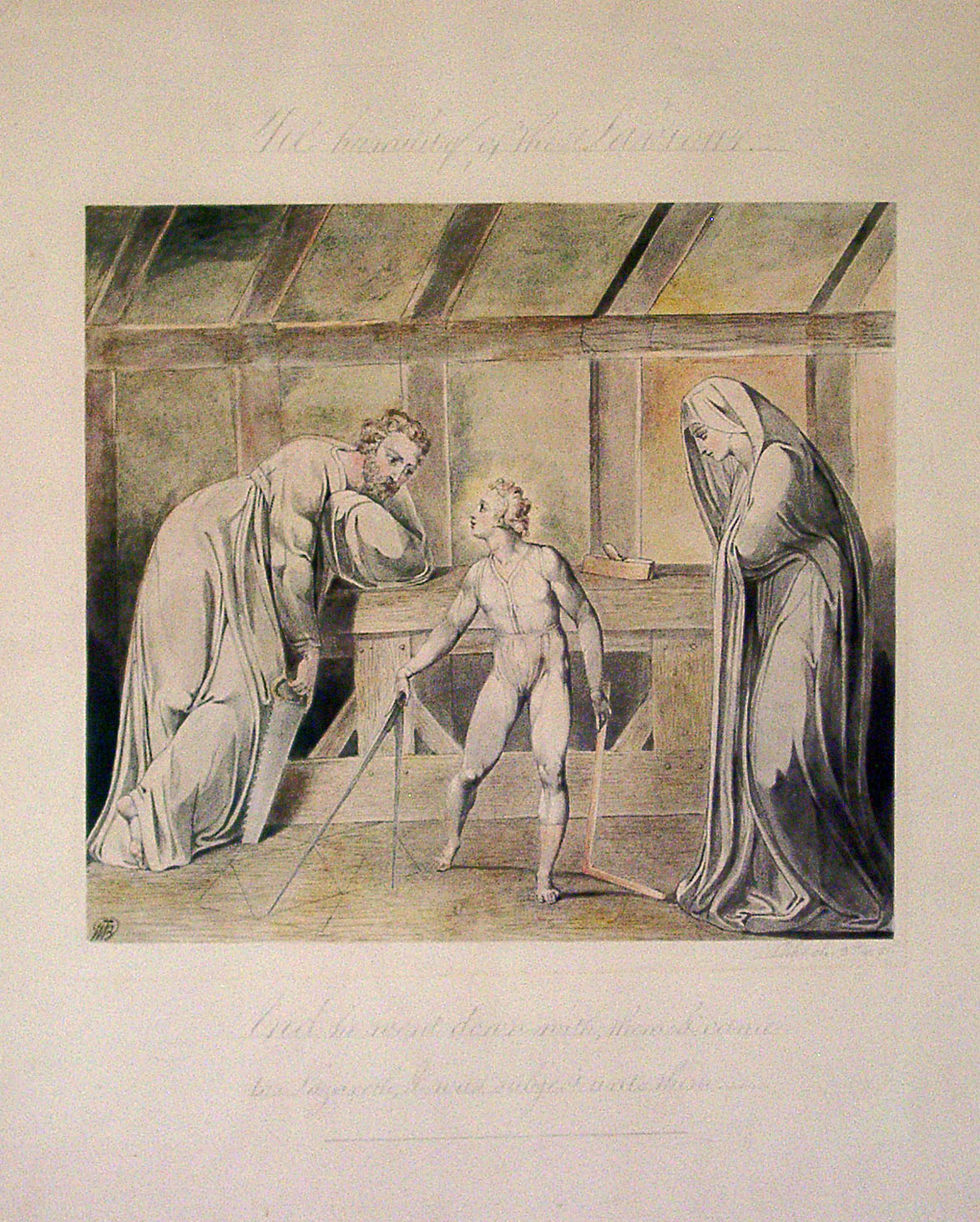
Christ in the Carpenter's Shop
"This illustration is one of the Bible series commissioned by Blake's patron Thomas Butts. Eight others from the series are in the Tate Gallery. Christ is pictured as a youth, demonstrating his knowledge of carpentry with the geometric drawing on the floor. The artist's love for symbolism is evident here - Christ's compass indicating rational knowledge and reason, and Christ himself a symbol of imagination and creativity. In actual fact, in the original biblical text the scene refers to (Luke 2:51), nowhere is a carpenter's shop referred to. Blake has interpreted the meaning to relate to Christ's family trade." From the Walsall website.

Legend above picture - The Humility of the Savior
Below picture - "And he went down with them and came to Nazareth, and was subject unto them." [Luke 2:51]

As usual Blake is doing more in this picture than represent an actual scene from the life of Jesus. The figures we take to be Mary and Joseph seem to be shown symbolically. Christ looks away from Mary as if saying 'what have I to do with thee' (the question asked in To Tirzah), although she focuses her complete loving attention on him. The clothing Mary wears is the thick draped fabric seen in classical painting. So Mary as the material side is covered in dark thick garments (robes.)

The youth focuses his attention on Joseph as an image of the Father, perhaps even with the appearance of Los (the Eternal Prophet.) Joseph shows his left heel, a favorite position of Blake; according to Erdman the heel, synonymous with the word tarsus, suggests the conversion of Paul (of Tarsus).

The boy Jesus engrossed in conversation with the man, is a reminder of the encounter Jesus had had earlier in Luke's gospel with the teachers in the temple as he was engaged in discussions which lasted three days.

The youth holds the two symbols associated with Masonic organization. The compass toward Joseph, the square toward Mary. So the representation is of the male and female, the sky and earth, the spirit and matter, the eternal and the transient. The figure inscribed on the floor (squares and triangles), reminds me that Jesus traced figures in the dust when the woman was taken in adultery, which lead to her forgiveness.

On a more prosaic note, I see Jesus portrayed as a carpenter, an artisan with the tools he used in his work. I don't doubt that Blake had the same tools in his art and printing shop and used them daily. Newton (ever the mathematician) in Blake's portrayal, too, is shown holding the compass and inscribing a figure on paper as Blake himself did, and as was done in the carpenter's shop. The image from the frontispiece of Europe often called the Ancient of Days, shows either the creator God or Urizen, inscribing the world of matter with the compass. The picture I get is that Jesus, Newton, Blake, the Creator and Urizen shared the same instrument as well as some of the same activity. That activity was giving body to ideas.


Sunday, July 11, 2010

JESUS & REPROBATES

Luke 7:44-47 - "Exactly," replied Jesus, and then turning to the woman, he said to Simon, "You can see this woman? I came into your house but you provided no water to wash my feet. But she has washed my feet with her tears and dried them with her hair. There was no warmth in your greeting, but she, from the moment I came in, has not stopped covering my feet with kisses. You gave me no oil for my head, but she has put perfume on my feet. That is why I tell you, Simon, that her sins, many as they are, are forgiven; for she has shown me so much love. But the man who has little to be forgiven has only a little love to give."

Of the three classes of men, the reprobate is the one Blake associated with Jesus.

Jerusalem, Plate 31 [35], (E 177)
"And the appearance of a Man was seen in the Furnaces;
Saving those who have sinned from the punishment of the Law,
(In pity of the punisher whose state is eternal death,)
And keeping them from Sin by the mild counsels of his love."

Here we have Jesus saving the reprobate (sinners) from punishment of the law, and thereby saving the elect (accusers) from administering punishment. The love of Jesus keeps both classes from sin. But a question remained: why were the innocent condemned for the guilty?

Milton, Plate 11 [12], (E 105)
"And it was enquir'd: Why in a Great Solemn Assembly
The Innocent should be condemn'd for the Guilty? Then an Eternal rose
Saying. If the Guilty should be condemn'd, he must be an Eternal Death
And one must die for another throughout all Eternity.
Satan is fall'n from his station & never can be redeem'd
But must be new created continually moment by moment
And therefore the Class of Satan shall be calld the Elect, & those
Of Rintrah. the Reprobate, & those of Palamabron the Redeem'd
For he is redeem'd from Satans Law, the wrath falling on Rintrah,
And therefore Palamabron dared not to call a solemn Assembly
Till Satan had assum'd Rintrahs wrath in the day of mourning
In a feminine delusion of false pride self-deciev'd."

The guilty in this case was Satan (the Elect) but the guilt fell upon Rintrah (the Reprobate). The representative of the Eternals answers that it is to avoid sending the guilty to Eternal Death.

Milton, Plate 7, (E 101)
"[Palamabron says] prophetic I behold
His future course thro' darkness and despair to eternal death
But we must not be tyrants also! he hath assum'd my place
For one whole day, under pretence of pity and love to me:
My horses hath he maddend! and my fellow servants injur'd:
How should he[,] he[,] know the duties of another? O foolish
forbearance
Would I had told Los, all my heart! but patience O my friends.
All may be well: silent remain, while I call Los and Satan."

Palamabron is confident that a solution will be found. The solution turns out to be that the Lamb of God take on the sin and guilt among the reprobates.

There Is No Natural Religion, (E 3)
"Therefore God becomes as we are, that we may be as he is"

Milton, Plate 13 [14], (E107)
"For then the Body of Death was perfected in hypocritic holiness,
Around the Lamb, a Female Tabernacle woven in Cathedrons Looms
He died as a Reprobate. he was Punish'd as a Transgressor!
Glory! Glory! Glory! to the Holy Lamb of God
I touch the heavens as an instrument to glorify the Lord!

The Elect shall meet the Redeem'd. on Albions rocks they shall meet
Astonish'd at the Transgressor, in him beholding the Saviour.
And the Elect shall say to the Redeemd. We behold it is of Divine
Mercy alone! of Free Gift and Election that we live.
Our Virtues & Cruel Goodnesses, have deserv'd Eternal Death.
Thus they weep upon the fatal Brook of Albions River."

The Body of death forms around the Lamb of God. The Elect and Redeemed are given to see the Savior in the Transgressor.

Milton, 32 [35], (E 132)
"Distinguish therefore States from Individuals in those States.
States Change: but Individual Identities never change nor cease:
You cannot go to Eternal Death in that which can never Die.
Satan & Adam are States Created into Twenty-seven Churches
And thou O Milton art a State about to be Created
Called Eternal Annihilation that none but the Living shall
Dare to enter: & they shall enter triumphant over Death
And Hell & the Grave! States that are not, but ah! Seem to be."

The Elect, Redeemed and Reprobates are not the true identities of man but states which can be terminated. The Individual Identity never dies.

Milton, Plate 14, (E 108)
"I in my Selfhood am that Satan: I am that Evil One!
He is my Spectre! in my obedience to loose him from my Hells
To claim the Hells, my Furnaces, I go to Eternal Death.

And Milton said. I go to Eternal Death! Eternity shudder'd
For he took the outside course, among the graves of the dead
A mournful shade. Eternity shudderd at the image of eternal death"

Recognizing the state as a psychological condition to which we ourselves give reality, we are in a position to forgive and annihilate it.

Milton, PLATE 38 [43],(E 139)
"Satan! my Spectre! I know my power thee to annihilate
And be a greater in thy place, & be thy Tabernacle
A covering for thee to do thy will, till one greater comes
And smites me as I smote thee & becomes my covering.
Such are the Laws of thy false Heavns! but Laws of Eternity
Are not such: know thou: I come to Self Annihilation
Such are the Laws of Eternity that each shall mutually
Annihilate himself for others good, as I for thee".

If the reprobate were not an inner reality in each man, Jesus, the God within, would have no cause to associate with him. If there were no darkness within man, there would not be no need for the light.
The Body of Able found by Adam and Eve - Cain Fleeing

Friday, July 9, 2010

JESUS & EXODUS

This passage from Jerusalem is particularly rich in Biblical references. Jesus speaks to Jerusalem to support her in her time of troubles. Blake uses the experiences of Jesus from the New Testament and the experiences from the exodus in the Old Testament to intimate the journey that must be undertaken to arrive at what may be described as the 'Promised Land.' Biblical scholars point out the parallels between what was achieved in the Israelites release from slavery in Egypt, through their sojourn in the wilderness and their arrival in the promised land; and what Jesus achieved through his incarnation, crucifixion and resurrection. The alteration in consciousness achieved through each of these examples of 'exodus' made possible new beginnings in mankind's psychic and spiritual development.

Here is an article linking Jesus and the Exodus: "The Exodus in the New Testament", by R.E. Nixon, M.A.

Jerusalem, Plate 62, (E 213)
"Jesus replied. I am the Resurrection & the Life.
John 11: 25

Jesus said unto her, I am the resurrection, and the life: he that believeth in me, though he were dead, yet shall he live:

I
Die & pass the limits of possibility, as it appears
To individual perception. Luvah must be Created
And Vala; for I cannot leave them in the gnawing Grave.
John 11
[17] Then when Jesus came, he found that he had lain in the grave four days already.
[31] The Jews then which were with her in the house, and comforted her, when they saw Mary, that she rose up hastily and went out, followed her, saying, She goeth unto the grave to weep there.
[43] And when he thus had spoken, he cried with a loud voice, Lazarus, come forth.
[44] And he that was dead came forth, bound hand and foot with graveclothes: and his face was bound about with a napkin. Jesus saith unto them, Loose him, and let him go.

But will prepare a way for my banished-ones to return
John 14:2
In my Father's house are many mansions: if it were not so, I would have told you. I go to prepare a place for you.
Come now with me into the villages. walk thro all the cities.
Tho thou art taken to prison & judgment, starved in the streets
I will command the cloud to give thee food & the hard rock
To flow with milk & wine,
Deuteronomy 8
[15] Who led thee through that great and terrible wilderness wherein were fiery serpents, and scorpions, and drought, where there was no water; who brought thee forth water out of the rock of flint;
[16] Who fed thee in the wilderness with manna, which thy fathers knew not, that he might humble thee, and that he might prove thee, to do thee good at thy latter end;
tho thou seest me not a season
John 16:16
A little while, and ye shall not see me: and again, a little while, and ye shall see me, because I go to the Father.
Even a long season & a hard journey & a howling wilderness!
Numbers 32
[13] And the LORD's anger was kindled against Israel, and he made them wander in the wilderness forty years, until all the generation, that had done evil in the sight of the LORD, was consumed.
Tho Valas cloud hide thee & Luvahs fires follow thee!
Exodus 13
[21] And the LORD went before them by day in a pillar of a cloud, to lead them the way; and by night in a pillar of fire, to give them light; to go by day and night:
[22] He took not away the pillar of the cloud by day, nor the pillar of fire by night, from before the people.
Only believe & trust in me,
Mark 5
[36] As soon as Jesus heard the word that was spoken, he saith unto the ruler of the synagogue, Be not afraid, only believe.
Lo. I am always with thee!
Matthew 28
[20] Teaching them to observe all things whatsoever I have commanded you: and, lo, I am with you alway, even unto the end of the world. Amen.

___________________________________________Moses


Blake, through his prophetic writings, was proposing that man once again go on a journey of exodus out of the slavery of the limitations produced by our own inability to perceive the infinite world of the spirit which we can access through imagination. The world we live in reflects the minds which we choose to limit through being blind, deaf, and insensitive to the infinite, perfect and ever changing Eternal world. Jesus taught the same lessons that Blake taught, and demonstrated the path of death and rebirth, which leads to Eternal Life. Blake invites us to put aside selfhood in forgiveness, jealousy in brotherhood, sensation in vision, outward development in inward development, and Eternal Death in Eternal Life.

Larry reminds us to read this passage in Luke which speaks of the exodus Jesus was about to accomplish: Luke 9: 28-36. (Note verse 31.)

Monday, July 5, 2010

DIVINE HAND

God's Providence

At critical junctures in Blake's poetry the Divine Hand intervenes to change the direction of the developing myth. The interventions usually involve the limits - contraction and opacity, Adam and Satan.

Adam, man who is formed to live as a physical body in a physical world with spiritual consciousness, is the limit of contraction. The Eternal Man, Albion may fall and divide but within him is planted a seed which connects him to the Eternal world. Humanity is not to become animal or vegetable but he is limited to remaining human. This is the condition which is preserved in the state called generation which will be put off in regeneration, or mortality which will be put off in immortality.

Jerusalem, Plate 31 [35], (E 177)
Satan the limit of opacity has lost his ability to perceive the spiritual world but he has not lost his reasoning power. He is unable to accept the Divine Vision, Jesus, the Imagination, but he attempts use reason to build a world based on moral law to replace the Divine Vision he has lost. The state of Satan, selfhood, which tries to impose the temporal on the eternal, the finite on the infinite, will be recognized as error when it appears as it is.

The limits were set by the Divine Hand that the fall may be reversed and fallen man may be regenerated. The Divine Hand is a name for God's providence, for his protective guidance in providing that man may return to the Eternal source. The Divine Hand seems to be the transcendent God who acts from outside of the individual to provide a framework through which the Divine Vision (the incarnate Jesus) may act through the Divine Body (the Imagination).

The Divine Hand finds the two limits and names them:
Milton, Plate 13[14], (E 107)
"The Divine hand found the Two Limits: first of Opacity, then of
Contraction
Opacity was named Satan, Contraction was named Adam."

The Divine Hand provides the sleep of Albion:
Jerusalem, Plate 15, (E 159)
"But first Albion must sleep, divided from the Nations

I see Albion sitting upon his Rock in the first Winter
And thence I see the Chaos of Satan & the World of Adam
When the Divine Hand went forth on Albion in the mid Winter
And at the place of Death when Albion sat in Eternal Death"

The Limits are found within each man:
Jerusalem, Plate 31, (E 177)
"Then the Divine hand found the Two Limits, Satan and Adam,
In Albions bosom: for in every Human bosom those Limits stand."

The Divine Hand strengthens Los as he awaits the fury of the dead:
Jerusalem, Plate 42, (E 189)
"Los stood before his Furnaces awaiting the fury of the Dead:
And the Divine hand was upon him, strengthening him mightily."

The Divine Hand assists Los and Enitharmon as they escape:
Jerusalem, PLATE 44 [30], (E 193)
"And the Divine hand was upon them bearing them thro darkness
Back safe to their Humanity as doves to their windows:"

The Divine Hand provides that vengeance not be taken against sinners:
Jerusalem, Plate 45, (E 194)
"I could not dare to take vengeance; for all things are so
constructed
And builded by the Divine hand, that the sinner shall always
escape,"

The Divine Hand who set the limits of Satan and Adam, sets the limit to Eternal Death and touches Los' furnaces. Los knows that his furnaces are not punishment for sin:
Four Zoas, Page 56, (E 338)
"And first he found the Limit of Opacity & namd it Satan
In Albions bosom for in every human bosom these limits stand
And next he found the Limit of Contraction & namd it Adam
While yet those beings were not born nor knew of good or Evil

Then wondrously the Starry Wheels felt the divine hand. Limit
Was put to Eternal Death Los felt the Limit & saw
The Finger of God touch the Seventh furnace in terror
And Los beheld the hand of God over his furnaces
Beneath the Deeps in dismal Darkness beneath immensity
And he who takes vengeance alone is the criminal of Providence;"

The work of the Divine Hand may be unseen but discerned through hope:
Four Zoas, Page 9,(E 305)
"They saw not yet the Hand Divine for it was not yet reveald
But they went on in Silent Hope & Feminine repose"

Friday, June 25, 2010

JERUSALEM & VALA

Four Zoas, Page 103, (E 376)
"Enitharmon wove in tears Singing Songs of Lamentations
.........
In Golgonoozas Furnaces among the Anvils of time & space
Thus forming a Vast family wondrous in beauty & love
And they appeard a Universal female form created
From those who were dead in Ulro from the Spectres of the dead
And Enitharmon namd the Female Jerusa[le]m the holy
Wondring she saw the Lamb of God within Jerusalems Veil
The divine Vision seen within the inmost deep recess
Of fair Jerusalems bosom in a gently beaming fire"

Jerusalem, Plate 20, (E 165)
"Wherefore hast thou shut me into the winter of human life
And clos'd up the sweet regions of youth and virgin innocence:
Where we live, forgetting error, not pondering on evil:
Among my lambs & brooks of water, among my warbling birds:
Where we delight in innocence before the face of the Lamb:
Going in and out before him in his love and sweet affection.

Vala replied weeping & trembling, hiding in her veil.

When winter rends the hungry family and the snow falls:
Upon the ways of men hiding the paths of man and beast,
Then mourns the wanderer: then he repents his wanderings & eyes
The distant forest; then the slave groans in the dungeon of stone.
The captive in the mill of the stranger, sold for scanty hire.
They view their former life: they number moments over and over;
Stringing them on their remembrance as on a thread of sorrow.
Thou art my sister and my daughter! thy shame is mine also!
Ask me not of my griefs! thou knowest all my griefs.

Jerusalem answer'd with soft tears over the valleys.

O Vala what is Sin? that thou shudderest and weepest
At sight of thy once lov'd Jerusalem! What is Sin but a little
Error & fault that is soon forgiven; but mercy is not a Sin
Nor pity nor love nor kind forgiveness! O! if I have Sinned
Forgive & pity me! O! unfold thy Veil in mercy & love!
Slay not my little ones, beloved Virgin daughter of Babylon
Slay not my infant loves & graces, beautiful daughter of Moab
I cannot put off the human form I strive but strive in vain
When Albion rent thy beautiful net of gold and silver twine;
Thou hadst woven it with art, thou hadst caught me in the bands
Of love; thou refusedst to let me go: Albion beheld thy beauty
Beautiful thro' our Love's comeliness, beautiful thro' pity.
The Veil shone with thy brightness in the eyes of Albion,
Because it inclosd pity & love; because we lov'd one-another!
Albion lov'd thee! he rent thy Veil! he embrac'd thee! he lov'd thee!
Astonish'd at his beauty & perfection, thou forgavest his furious love:
I redounded from Albions bosom in my virgin loveliness.
The Lamb of God reciev'd me in his arms he smil'd upon us:
He made me his Bride & Wife: he gave thee to Albion.
Then was a time of love: O why is it passed away!
"

Jerusalem asks the question, 'Why?' Why am I who lived in Eden or Eternity now locked in this body in the world of generation? Why are the ordinary pleasures of innocence and continual forgiveness in association with the Saviour shut off from me? Vala seems to know what has happened: the Eternal family has been torn apart,
Jerusalem is not in her accustomed home and the way of return is unknown. Vala explains the the usual behavior of wandering and return will instead now lead to confusion, limitations and the reasoning abstract. Man is trapped in the pattern of remembering instead of imagining. Jerusalem knows these restrictions to be 'mind forged manacles'.

Vala reminds Jerusalem that she is aware of conditions in which they now live. But Jerusalem tells Vala that what she calls sin was but error in Eternity and quickly forgiven. Jerusalem knows that her desire to love and pity and forgive is not sin. Jerusalem seeks forgiveness herself but pleads that her creative output not be destroyed. Jerusalem's involvement in the material world was not sought by her but came about through love and pity as did Vala's and Albion's. Now a new arrangement has been made (another mercy to lead to regeneration). Vala has been given to Albion: involvement in the natural to the Eternal/Fallen Man. Jerusalem has been given to Jesus: the spiritual consciousness to the Divine Body.


As one of the illustrations which Blake created for potential publication in Night Thoughts, this picture is not explicitly of Vala and Jerusalem. But as an image in which we can see the implicit as well as the explicit, they are present. The reclining woman is Vala as so portrayed in other pictures. She wears a crown and gazes into a mirror: the vegetable glass, a symbol for the material world. Cupid is her companion from the world of generation or the sexes. Sitting on the chair and playing the flute, as a symbol of imagination, is a figure not tuned to Vala's world. Her crown is not of gold but of laurel leaves. Unfortunately she cannot flee to the world which is her home because she is chained to the chair.

Thursday, June 10, 2010

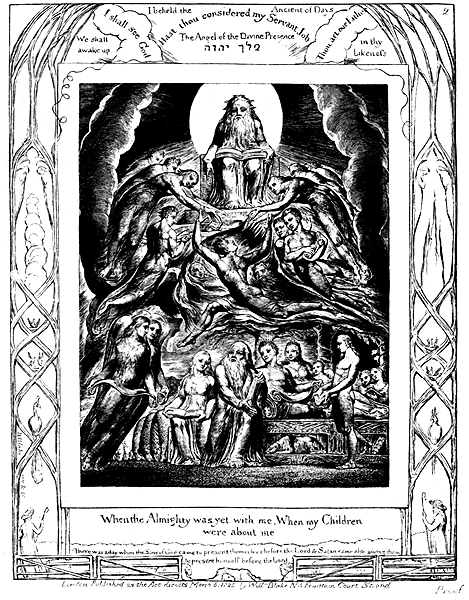
Job: Picture 2

This one resembles Picture 1 in its lower part, but now the well behaved children also have books or scrolls, obviously growing up to be Establishment types.

At the top the Establishment God has the BOOK that we're to go by; go by the book, and only good things will happen.
"God is in his Heaven, and all's right with the world." (Browning).

But between the righteous God and the righteous Job and family something strange is happening: look at that strange figure below God, arms and legs spread widely (in violent motion); he's enveloped in fire.

"Hast thou considered my servant Job" inscribed above the picture: the words of God. The picture concerns a conversation God had with Satan (on the left hand of God?) about Job. Back in MHH days the devil wasn't so bad (Blake said Milton "was of the devil's party without knowing it" (MHH plate six). For Blake at that time, in contrast to the passive Elect, Satan represented the satisfaction of Desire; he represented Revolution: anathema for the Established, longed for by the poor and needy.

Some people's identity rests on the opinion of others; without reflection, they're called outer directed. But the ability to reflect on yourself is required in order to become an individual, and through the 'dark night of the soul' Job will come to see the whole bit, not just the persona or ego, but the shadow side as well (Jung's terms).

The O.T. God was certainly not altogether good; according to Job's code when you behave all is well; when you misbehave there's hell to pay.

Throughout the Illustrations Job's (and our) Innocence are sacrificed by Experience, which is obligatory if you are to grow beyond Goody Two Shoes.

So the Devil is commissioned to test us; after he tested Job, he tested Jesus (in the wilderness), and he tests us. Job met the test; so did Jesus, and became our Savior; we may and become sons of God. That's Job's message for us today.

Monday, May 24, 2010

LAW & GOSPEL

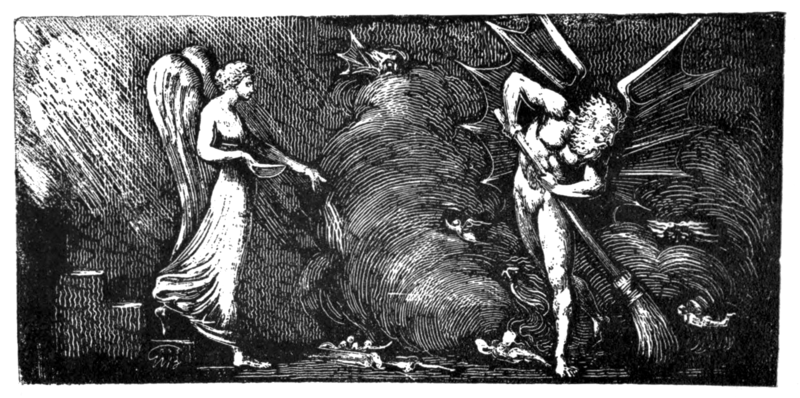
Some time between 1660 and 1675 when John Bunyan was twice imprisoned for holding religious services out of the auspice of the established church, he began work on Pilgrim's Progress his allegory of Christian's progress from 'this world to that which is to come'. He describes a stop on Christian's journey at the House of the Interpreter who was to instruct him on the right way to live the Christian life. In 1822, William Blake made an illustration for one of the lessons taught in the House of the Interpreter. Pilgrim was led into a parlor filled with dust; a man was called to sweep but he only stirred up the dust. A damsel was called to sprinkle the room with water with the result that the room was easily swept clean.

The Interpreter explained to Pilgrim: "This parlor is the heart of a man that was never sanctified by the sweet grace of the gospel: the dust is his original sin, and inward corruptions that have defiled the whole man. He that began to sweep at first, is the Law; but she that brought water, and did sprinkle it, is the Gospel. Now, whereas thou sawest that so soon as the first began to sweep, the dust did so fly about that the room by him could not be cleansed, but that thou wast almost choked therewith; this is to show thee, that the Law, instead of cleansing the heart (by its working) from sin, doth revive, put strength into, and increase it in the soul, even as it doth discover and forbid it, but doth not give power to subdue."
Blake's understanding of the roles of the law and the gospel is set forth in these passages in Jerusalem. In this first section Blake is saying that the forgiveness of God does not require 'Moral Virtue' but that we mutually sacrifice for, and continually forgive one another.

Jerusalem, Plate 61, (E 212)
"Saying, Doth Jehovah Forgive a Debt only on condition that it shall
Be Payed? Doth he Forgive Pollution only on conditions of Purity
That Debt is not Forgiven! That Pollution is not Forgiven
Such is the Forgiveness of the Gods, the Moral Virtues of the
Heathen, whose tender Mercies are Cruelty. But Jehovahs Salvation
Is without Money & without Price, in the Continual Forgiveness of Sins
In the Perpetual Mutual Sacrifice in Great Eternity! for behold!
There is none that liveth & Sinneth not! And this is the Covenant
Of Jehovah: If you Forgive one-another, so shall Jehovah Forgive You:
That He Himself may Dwell among You."

Here Blake tells us that 'accusation of sin & judgment' is the root of our quarrels and violence leading to Eternal Death.

Jerusalem, Plate 64, (E215)
"All Quarrels arise from Reasoning. the secret Murder, and
The violent Man-slaughter. these are the Spectres double Cave
The Sexual Death living on accusation of Sin & judgment
To freeze Love & Innocence into the gold & silver of the Merchant
Without Forgiveness of Sin Love is Itself Eternal Death"

Now Blake contrasts the message of Jesus: self-denial, forgiveness of sin, casting out devils, healing, pity, and setting prisoners free with that of the Pharisees (the chief proponents of the law): smiting with terror and punishment, crucifying, and proselyting to tyranny and wrath.

Jerusalem, Plate 77, (E 232)
"But Jesus is the bright Preacher of Life
Creating Nature from this fiery Law,
By self-denial & forgiveness of Sin.

Go therefore, cast out devils in Christs name
Heal thou the sick of spiritual disease
Pity the evil, for thou art not sent
To smite with terror & with punishments
Those that are sick, like the Pharisees
Crucifying &,encompassing sea & land
For proselytes to tyranny & wrath,
But to the Publicans & Harlots go!
Teach them True Happiness, but let no curse
Go forth out of thy mouth to blight their peace
For Hell is opend to heaven; thine eyes beheld
The dungeons burst & the Prisoners set free."

Blake and Bunyan were both teaching the message of Paul in the second chapter of Galatians: "
a man is justified not by performing what the Law commands but by faith in Jesus Christ. We ourselves are justified by our faith and not by our obedience to the Law, for we have recognised that no one can achieve justification by doing the 'works of the Law'. Bunyan continues; "when the gospel comes in the sweet and precious influences thereof to the heart...so is sin vanquished and subdued, and the soul made clean."

The little circle of younger artists who gathered around Blake in his later years referred to his humble home as the House of the Interpreter.

Saturday, May 22, 2010

NIGHT THOUGHTS

During 1795 and 1796 William Blake spent a large part of his time preparing illustrations for a new edition of Edward Young's Night Thoughts a popular book which had been issued first in 1742. There were to be 4 new volumes published for which over 500 illustrations were needed. With impressive energy Blake produced watercolor designs at a fast pace.

In the book William Blake, by Hamlyn, Phillips, Ackroyd and Butler, we read that: "[Blake] gave emphasis to the poem as a Christian narrative by including numerous images of Jesus Christ; for example, at the beginning of the collected watercolor designs Blake added images of the Resurrection of Christ, a subject of minor interest in the poem."

An example of image of Christ: arm'd them with fierce flames. Click on Image to zoom.

The first volume with Blake's images was published in 1797 with 43 engravings which Blake made from his designs. These were to be the only images to be published since the publisher went out of business before additional volumes were issued. The 43 engraved plates of the published volume can be viewed in the Blake Archive.The watercolors which represented the bulk of the work and the labor of 2 years of Blake's life are in the British Museum and can be viewed online but it takes some patience.

For his work in producing 537 watercolor designs and 43 engravings Blake earned 20 guineas!

A recent publication values his work more highly:
The only full, colour facsimile ever published. Your chance to own this magnificent Limited Edition facsimile with 537 illustrations by William Blake. Last few copies remaining. Published price: US$ 1,975.00
The Folio Society Night Thoughts

Where I can find appropriate designs to accompany my posts, I will provide links to images in the British Museum.

Tuesday, May 18, 2010

READING SYMBOLS

In 1904 two scholars at the Victoria and Albert Museum published the text for Blake's Jerusalem together with their introduction. Eric Maclagen and Archibald Russell had a gift for a profound understanding of Blake symbolic system. They were able to see in the poem at the beginning of the second chapter of Jerusalem a precis of the entire contents of of the book Jerusalem . I hope you will find this section as enlightening in developing an ability to read Blake with understanding as I do.

Jerusalem, Plate 27, (E 171)

"The fields from Islington to Marybone,
To Primrose Hill and Saint Johns Wood:
Were builded over with pillars of gold,
And there Jerusalems pillars stood.

Her Little-ones ran on the fields
The Lamb of God among them seen
And fair Jerusalem his Bride:
Among the little meadows green.

Pancrass & Kentish-town repose
Among her golden pillars high:
Among her golden arches which
Shine upon the starry sky.

The Jews-harp-house & the Green Man;
The Ponds where Boys to bathe delight:
The fields of Cows by Willans farm:
Shine in Jerusalems pleasant sight.

She walks upon our meadows green:
The Lamb of God walks by her side:
And every English Child is seen,
Children of Jesus & his Bride,

Forgiving trespasses and sins
Lest Babylon with cruel Og,
With Moral & Self-righteous Law
Should Crucify in Satans Synagogue!

What are those golden Builders doing
Near mournful ever-weeping Paddington
Standing above that mighty Ruin
Where Satan the first victory won.

Where Albion slept beneath the Fatal Tree
And the Druids golden Knife,
Rioted in human gore,
In Offerings of Human Life

They groan'd aloud on London Stone
They groand aloud on Tyburns Brook
Albion gave his deadly groan,
And all the Atlantic Mountains shook

Albions Spectre from his Loins
Tore forth in all the pomp of War!
Satan his name: in flames of fire
He stretch'd his Druid Pillars far.

Jerusalem fell from Lambeth's Vale,
Down thro Poplar & Old Bow;
Thro Malden & acros the Sea,
In War & howling death & woe.

The Rhine was red with human blood:
The Danube rolld a purple tide:
On the Euphrates Satan stood:
And over Asia stretch'd his pride.

He witherd up sweet Zions Hill,
From every Nation of the Earth:
He witherd up Jerusalems Gates,
And in a dark Land gave her birth.

He witherd up the Human Form,
By laws of sacrifice for sin:
Till it became a Mortal Worm:
But O! translucent all within.

The Divine Vision still was seen
Still was the Human Form, Divine
Weeping in weak & mortal clay
O Jesus still the Form was thine.

And thine the Human Face & thine
The Human Hands & Feet & Breath
Entering thro' the Gates of Birth
And passing thro' the Gates of Death

And O thou Lamb of God, whom I
Slew in my dark self-righteous pride:
Art thou return'd to Albions Land!
And is Jerusalem thy Bride?

Come to my arms & never more
Depart; but dwell for ever here:
Create my Spirit to thy Love:
Subdue my Spectre to thy Fear,

Spectre of Albion! warlike Fiend!
In clouds of blood & ruin roll'd:
I here reclaim thee as my own
My Selfhood! Satan! armd in gold.

Is this thy soft Family-Love
Thy cruel Patriarchal pride
Planting thy Family alone
Destroying all the World beside.

A mans worst enemies are those
Of his own house & family;
And he who makes his law a curse,
By his own law shall surely die.

In my Exchanges every Land
Shall walk, & mine in every Land,
Mutual shall build Jerusalem:
Both heart in heart & hand in hand."

Jesus reaching down

This is the section from the introduction to Jerusalem By William Blake, Eric Robert Dalrymple Maclagan, Archibald George Blomefield Russell:


"In this unfallen state the " fields " in the north, from east to west, the regions, that is, of instinctive life both on the side of emotion and on that of sensual perception, were the supports of the holy Imagination, through the pillars of intellect (gold being the metal of Urizen). The Imagination was the Bride of the Lamb of God, happy in many lovely and innocent ways, and every idea of man was the " child of Jesus and his Bride " in the religion of forgiveness, refusing to impute sin. But the peace is broken: the intellectual powers are busied with the western region of bodily things (and in particular the sense of the Tongue, through which came the first sin): and man falls into the sleep that we call the life of the body, shadowed by the tree of mystery, and passing from inspired religion to that false faith which demands bodily instead of mental sacrifice. He enters into mortal sorrow, and his hard rational power, called by Blake "Satan," separates itself from his loins (the place of judgment), and furiously enforces its legal morality. By this separation the imagination also is forced to depart, and passing eastward through mere emotionalism it is lost in grief. Further and further the reason asserts its dominion over the emotional life, and the happinesses of man (rivers) become stained with sensuality: in every phase of mental life the place of the imagination is restricted, and the power itself is forced into the dark land of corporeal life. By such a system of religion man is convinced of his own mortality, equaling himself with the worms: but nothing can wholly obscure the glory of the divine within him, even in the weakness and transience of the life between birth and death. This state is common to all mankind; and the poet identifies himself with the man whose fall he has narrated, and calls on the Lamb of God, the Divine Image whom he crucified, but who still makes his perpetual appeal to the heart of man: he implores him to mould the spiritual and to repress the merely rational life with the love and fear of God. For the reason is to be mastered, not to be abandoned; in all its selfish cruelty and pride of intellectual war it is still a true part of man, even when it tries to claim that its own children (the logical ideas) have alone the right to exist, though such a system is bound at last to be its own destruction. The true life knows no compulsion, but consists in mutual acceptance and forgiveness: for so can man be joined with man to build up Christianity, the religion of the Imagination."
______________
The poem leads us through sights and locations familiar to Blake, changes which he has observed, and the possibilities for further changes in a positive direction. Recognizing this as being written in symbolic language, the authors restate it in prosaic language. The restatement functions as a summation of the book Jerusalem itself. The poem makes more sense to our ordinary way of thinking when its symbols are revealed. Through the paraphrase of the poem we can see that it represents an outline of the whole book.