Showing posts with label Annihilate. Show all posts

Wednesday, January 5, 2011

BLAKE & 'DEAD MAN'

In 1995 Jim Jarmusch directed a movie, Dead Man, which follows the character named William Blake through harrowing experiences. Although the character has no knowledge of William Blake's poetry he is befriended by a Native American under the influence of Blake. To a person familiar with Blake's writing, the movie is presenting Blake's thought in a contemporary media. To one unfamiliar with Blake the film may be either a slow moving Western exhibiting sex and violence, or an opportunity to become acquainted with quotes from Blake. If a person can view the movie psychologically as a myth of psychic and spiritual development, he may experience some of what one experiences in reading Blake's poetry.

The website 366 Weird Movies comments on the movie Dead Man:
"On it’s release, Dead Man received mostly negative reviews. It was criticized as too slow and too pretentious, appearing to be thoughtful but actually delivering no ideas worth mentioning. Time has been kind to the movie, however, which has emerged as Jarmusch’s best work to date. In Dead Man, a measured journey into an odd, somber, dark and funny wilderness of the spirit, Jarmusch created a myth with staying power. Filled with poetic images like Johnny Depp reclining with a slaughtered fawn, Dead Man has proven a mysterious power to linger in the memory. It may never yield up its meaning, but that doesn’t make it empty."

It would be impossible to explain the movie Dead Man in the same way that it is impossible to explain Jerusalem. But there are a few things it might be beneficial to say about it. It is not just a movie which takes the name William Blake and attaches it to a character in a Western. It is a movie which attempts to emulate Blake's enigmatic methods of communication and present Blakean images and ideas in an alternate media. If one is prepared to discern repeated references to the processes enacted in Blake's poetry as well as to listen for quotes from Blake's work, the movie will become more than a series of killings.

The theme of annihilation is prominent in Jerusalem and Milton as the means of eliminating error and fostering forgiveness. The furnaces of Los through which characters must pass on the way to redemption play a large part in the activity which reverses the fall. Annihilation through killing is repeated throughout Dead Man. If the killing is meant to portray the murder of men, the movie is only about senseless violence. If error or wrong ideas are being destroyed to promote the journey of William Blake through the underworld, it makes more sense. Milton O. Percival, in Circle of Destiny says "In the destruction of these forms by the restless energy of time lies man's hope of release from error. 'All that can be annihilated must be annihilated.' [Milton, E 142] The eternal will live on. For that reason error must be provided with a mortal body capable of destruction by the energy of time."

The title of the movie, Dead Man, suggests that the protagonist, William Blake (played by Johnny Depp), is dead from the beginning. At least the suggestion is that he died immediately (early in the movie) when he was shot in Thel's room. The action takes on different meaning if William Blake is not a living man trying to escape from multiple pursuers. As a myth we see the journey of a man attempting to reach his home in a world beyond the trials and errors of ordinary life.

This is Blake's advice on viewing symbolic images like those that are abundant in the movie.

Vision of the Last Judgment , (E 560):
"If the Spectator could Enter into these Images in his
Imagination approaching them on the Fiery Chariot of his
Contemplative Thought, if he could Enter into Noahs Rainbow or into his bosom or could make a Friend & Companion of one of these Images of wonder which always intreats him to leave mortal things as he must know then would he arise from his Grave then would he meet the Lord in the Air & then he would be happy"

The following passage helps us understand how Blake viewed existence in this world compared to existence in the permanent world.

Jerusalem , Plate 13, (E 157)
"Los walks round the walls night and day.

He views the City of Golgonooza, & its smaller Cities:
The Looms & Mills & Prisons & Work-houses of Og & Anak:
The Amalekite: the Canaanite: the Moabite: the Egyptian:
And all that has existed in the space of six thousand years:
Permanent, & not lost not lost nor vanishd, & every little act,
Word, work, & wish, that has existed, all remaining still
In those Churches ever consuming & ever building by the Spectres
Of all the inhabitants of Earth wailing to be Created:
Shadowy to those who dwell not in them, meer possibilities:
But to those who enter into them they seem the only substances
For every thing exists & not one sigh nor smile nor tear,
PLATE 14
One hair nor particle of dust, not one can pass away."

This next section in Blake may be correlated with the 'men' who pursue William Blake in the movie. They 'die' because they are negations which must be compelled into non-entity.

Jerusalem, Plate 17, (E 162)
"Negations are not Contraries: Contraries mutually Exist:
But Negations Exist Not: Exceptions & Objections & Unbeliefs
Exist not: nor shall they ever be Organized for ever & ever:
If thou separate from me, thou art a Negation: a meer
Reasoning & Derogation from Me, an Objecting & cruel Spite
And Malice & Envy: but my Emanation, Alas! will become
My Contrary: O thou Negation, I will continually compell
Thee to be invisible to any but whom I please, & when
And where & how I please, and never! never! shalt thou be Organized
But as a distorted & reversed Reflexion in the Darkness
And in the Non Entity: nor shall that which is above
Ever descend into thee: but thou shalt be a Non Entity for ever
And if any enter into thee, thou shalt be an Unquenchable Fire
And he shall be a never dying Worm, mutually tormented by
Those that thou tormentest, a Hell & Despair for ever & ever."

A future post will bring up the quotes from Blake which are included in the movie.

Tuesday, November 9, 2010

Satan and the Spectre

Years ago, sitting in a young adult group in a Methodist church I listened to the pastor trying to convince us that Satan was a real person; a young rebel maintained that people had created Satan just like they created God. In regard to Satan the 'young rebel' was right.

Satan is the God of this World; both will pass away, but we may (will!) be translated to the Eternal Realm from which we came; such is Blake's theology.
--------------------------------------------
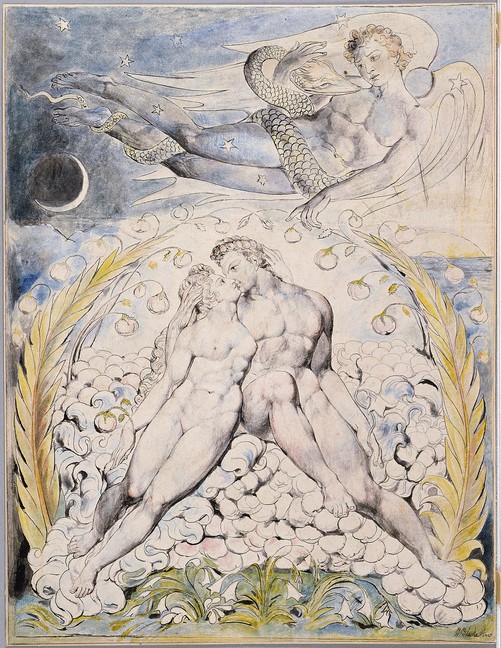
To all intents and purposes John Milton's epic, Paradise Lost has become a part of the Bible; most Bible students have their concept of Satan and his doings from Milton. Blake was deeply influenced by the prophet he considered his predecessor; he produced a series of pictures illustrating the work:

Are these apples (or some
other fruit)? Adam and Eve are in the lower plane, Satan up in the air.

We see Adam and Eve comfortably ensconced in the lower level.

Satan seems equally comfortable on a cloud with his pet snake.

In the story in Genesis 3 Satan is not named, but from that time the Serpent and Satan are two have been seen as two names for the same entity.


One of Blake's last works, Illustrations to the Book of Job, has several representations of Satan; here's one:
Satan has just been given permission by God (Job 2 to work his will on Job, but he can't take his life.)

(You may find here in this blog the whole series of pictures of Blake's Illustrations to the Book of Job. They are scattered through the posts of this blog between June 8 and July 25, 2010.)

When writing of a personal Satan Blake generally used the term, Spectre. In general Satan is the ruler of the (material) world; the Spectre is the ruler of you and me whenever we give in to a temptation to be less (spiritually) than we can be.

Once again in the system Blake created Satan and the Spectre are to be annihilated, but people go on to Eden (or perhaps a boot camp for it).

Friday, October 29, 2010

BLAKE'S MIND

I think that Blake's IQ was off the charts. His mind was capable of maximum development in multiple fields of endeavor. Obviously his senses were acutely capable of receiving and processing more data than most of us can handle. He was sensitive to ethical and philosophical issues as well as religious and aesthetic ones. His sexual responses were so acute that he recognized them as an avenue to the Divine. Intellectually he could have gone in any direction he chose.

Judging from the issues he treats in his mature writing, he felt that his intellect might overbalance the development of his other gifts to the detriment of expressing his total being. Perhaps Blake's early unfinished prose satire, An Island in the Moon, with its frivolous, clever approach, represents a succumbing to the temptation to allow the intellect to have free rein to dominate and go in directions that his identity would not choose, and which would quash the development of imagination and desire.

In his student days, Blake scholar Joseph Viscomi adapted the satire for a production which was presented at Cornell University. Read the manuscript of Island in the Moon in Blake's complete works or learn more about it on Wikisource.

Blake did not pursue the avenue of writing, thinking or entertainment displayed in An Island in the Moon. His fans believe that he went on to other and better things.

Morning Chasing Away the Phantoms
from Milton's Paradise Regained

Sensation, reason, and emotion are all subject to being overvalued, distorted and corrupted. Blake's desire to 'cleanse the doors of perception' represented the efforts he put into removing the impediments from expressing the Identity. Through attempting continually to annihilate the Selfhood, Blake tried to avoid allowing the fallen sensation and intellect to mar or replace the Eternal intellect and sensation which he trusted and valued.


Vision of the Last Judgment, (E 554)
"The Last Judgment when all those are Cast away who trouble
Religion with Questions concerning Good & Evil or Eating of the
Tree of those Knowledges or Reasonings which hinder the Vision of
God turning all into a Consuming fire Imaginative Art &
Science & all Intellectual Gifts all the Gifts of the Holy Ghost
are [despisd] lookd upon as of no use & only Contention
remains to Man then the Last Judgment begins & its Vision is seen
by the [Imaginative Eye] of Every one according to the
situation he holds"

Tuesday, October 19, 2010

BETTER WORLD

In 1933 John Middleton Murry published his book William Blake, which continued in print until 1977. Murry's book comes close to being a spiritual biography of Blake, although it is directed toward understanding his poetry. The poetry, letters and descriptive material themselves are such a revelation of the psychic and spiritual development of Blake that Murry finds ample material to describe the issues and outcomes of Blake's inner struggles. The evolution of the concept of the Selfhood grows from its first recognition to it eventual assimilation.

Murry summarizes Blake' Selfhood or Spectre on Page 235:
"Blake's experience of the Selfhood was very deep. He had seen it face to face; known it, so to speak, in essence. For the Selfhood had grown to power in him in pondering the mystery of that finite creation which he knew to be infinite. Out of the effort to exorcize the Selfhood in men, his Selfhood had grown. Once he could accept that mystery, in all humility, and know himself forgiven; once he could see that this was the inevitable destiny of the pilgrim towards Eternity, and that the process of Life itself, at its very acme of spiritual intensity and candour, created the Selfhood as the means by which it grew - the heart of 'the mystery of iniquity' lay open to him. Providence had begun indeed."

Four Zoas, Page 95, (E 367)
"Thou never canst embrace sweet Enitharmon terrible Demon. Till
Thou art united with thy Spectre Consummating by pains &
labours
That mortal body & by Self annihilation back returning
To Life Eternal be assurd I am thy real Self
Tho thus divided from thee & the Slave of Every passion
Of thy fierce Soul Unbar the Gates of Memory look upon me
Not as another but as thy real Self I am thy Spectre
Thou didst subdue me in old times by thy Immortal Strength
When I was a ravning hungring & thirsting cruel lust & murder
Tho horrible & Ghastly to thine Eyes tho buried beneath
The ruins of the Universe. hear what inspird I speak & be silent

If we unite in one[,] another better world will be
Opend within your heart & loins & wondrous brain
Threefold as it was in Eternity & this the fourth Universe
Will be Renewd by the three & consummated in Mental fires
But if thou dost refuse Another body will be prepared"

Drawing for Thornton's Virgil

Thursday, October 14, 2010

Blake's Death


For Blake the word, death, had many meanings:

1. Physical death:
Quoting Damon p. 99: 
"Death of the physical body is the shedding of the shell (garment, robe) which the soul, or spiritual body has grown for protection in this world.  It's the return of the soul to Eternity.  It is an episode of life, a state through which one passes, awakening to Eternal life (J 4:1-2)".

Blake indicated the nature of physical death, particularly of his brother, Robert's death in a letter (9) to Hayley he wrote:

      "Thirteen years ago. I lost a  brother & with his spirit  I  converse daily & hourly in the  spirit. & See him in my
remembrance in the regions of my  imagination.
I hear his advice & even now write from his  Dictate--"

2. For Blake Eternal Death, itself seemed to have many meanings:
Among other things it seems to concern Ulro and the Spectre. Looking at The Four Zoas we read:
"There is from Great Eternity a mild & pleasant rest
Namd Beulah a Soft Moony Universe feminine lovely
Pure mild & Gentle given in Mercy to those who sleep
Eternally. Created by the Lamb of God around
On all sides within & without the Universal Man
The Daughters of Beulah follow sleepers in all their Dreams
Creating Spaces lest they fall into Eternal Death

The Circle of Destiny complete they gave to it a Space
And namd the Space Ulro & brooded over it in care & love
They said The Spectre is in every man insane & most
Deformd Thro the three heavens descending in fury & fire
We meet it with our Songs & loving blandishments & give
To it a form of vegetation But this Spectre of Tharmas
Is Eternal Death
What shall we do O God pity & help"
(The Four Zoas [Nt 1], 5.42; E303)  
Elsewhere in  Milton 4.15; Erdman 98 he reported this
conversation between Los and Satan:

"Satan was going to reply, but Los roll'd his loud thunders.
Anger me not! thou canst not drive the Harrow in pitys paths.
Thy Work is Eternal Death, with Mills & Ovens & Cauldrons.
Trouble me no more. thou canst not have Eternal Life
So Los spoke! Satan trembling obeyd weeping along the way.
Mark well my words, they are of your eternal Salvation"
Satan and the Spectre of course are synonymous. 
"And Milton said, I go to Eternal Death!" 
If you get the picture Milton, in Heaven, choses the path the 
Savior trod; he incarnated; he came down from Heaven into
Earth and for a similar purpose.  But here the meaning of
Eternal seems very clearly mortal life.
There are many other instances of the words in Milton.

Turning to Jerusalem Blake makes it pretty clear in Plate 4:
"Of the Sleep of Ulro! and of the passage through
Eternal Death! and of the awaking to Eternal Life."
It would be very worthwhile to read this plate carefully.
The last occurrence of Eternal Death in Jerusalem occurs in 
Plate 98 lines 21-24:
"Driving outward the Body of Death in an Eternal Death &
Resurrection
Awaking it to Life among the Flowers of Beulah rejoicing in Unity
In the Four Senses in the Outline the Circumference & Form, for
ever
In Forgiveness of Sins which is Self Annihilation." (E257)

(I wonder if he was thinking of Romans 7 when he spoke of the 
Body of Death.  The forgiveness of sins is Self Annihilation, the
end of mortal life.)                                                 
                                               

Monday, September 6, 2010

EMBRACE the SPECTRE

In Blake's system the root cause of the woes of the world is the division and dispute among the Zoas. Speaking psychologically, when the four aspects of the psyche - sensation, emotion, reason and intuition - are not in balance the individual has no internal or external harmony. When the functions compete for control instead of cooperating to express the identity, the dissension creates inhibition, dissatisfaction, projection, destructiveness and war. Blake saw his own psychological imbalance as a dispute between Urizen and Luvah with Los as a kind of referee. Without free expression of his emotions his work of imagination would be stifled. To manage his life in the world reason had to control a large part of his psyche. So he expressed this battle in his poetry.

Blake's struggle to be free of constraints that prevented his imaginative expression became externalized in his relationship with his patron Haley who sought to control Blake's freely following the inspiration to paint and write as his vision led. In working through his relationship with Haley, Blake faced his own Selfhood. He became aware that the cause of the dispute arose with himself.

Without explicitly stating the circumstances of his feud with Hayley or the resolution of it, Blake includes these phrases in a letter to Hayley indicating that he had worked through a dilemma which had vexed him for years.

Letter to Hayley
( E 757)
23 October 1804
"I thank God with entire confidence that
it shall be so no longer--he is become my servant who domineered
over me, he is even as a brother who was my enemy."

Relating an event such as he experienced in forgiving Hayley, Blake writes the following passage. Remember that the Selfhood is selfishness or self-centeredness and the Spectre is the rationalizing state.

Four Zoas, Night 7, Page 95, (E 367)
"Los embracd the Spectre first as a brother
Then as another Self; astonishd humanizing & in tears
In Self abasement Giving up his Domineering lust

Thou never canst embrace sweet Enitharmon terrible Demon. Till
Thou art united with thy Spectre Consummating by pains &
labours
That mortal body & by Self annihilation back returning
To Life Eternal be assurd I am thy real Self
Tho thus divided from thee & the Slave of Every passion
Of thy fierce Soul Unbar the Gates of Memory look upon me
Not as another but as thy real Self I am thy Spectre
Thou didst subdue me in old times by thy Immortal Strength
When I was a ravning hungring & thirsting cruel lust & murder
Tho horrible & Ghastly to thine Eyes tho buried beneath
The ruins of the Universe. hear what inspird I speak & be silent

If we unite in one[,] another better world will be
Opend within your heart & loins & wondrous brain
Threefold as it was in Eternity & this the fourth Universe
Will be Renewd by the three & consummated in Mental fires
But if thou dost refuse Another body will be prepared"

By embracing the Spectre, Los recognizes him as brother and an aspect of himself. In unifying with the Spectre he annihilated him as dark and destructive and accepted him into his real Self. The earlier attempt to subdue the Spectre by his strength had forced him further into the unconscious where he created more rivalries and dissension.

The act of embracing the Spectre, if undertaken, will reunite the Zoas and open the path to Eternity.

Thursday, July 22, 2010

A Turning Point

The Moment of Grace

Life is made up of turning points, but if you're fortunate, then somewhere along life's crooked path you may take a most significant turning point to the right:

"When he came to himself"(verse 17): the fundamental biblical archetype), and there have been other similar ones since Jesus spoke those words.

In our poet's life that Moment has for me an endless fascination. He might have been a famous man, teacher to the Royal Family, world wide artist; he might have dedicated his life to the Main Chance, but he found a better way. The critical Moment (the darkness before the dawn) came when Hayley had given William and Catherine, a comfortable cottage, a comfortable care free life as a miniaturist, but "he came to himself". He returned to London, penniless, but free. Thereafter the main chance ceased to be a temptation. Blake celebrated that decisive Moment in letter 16 to his true (spiritual) friend, Captain Butts (the First Vision of Light):"...O thou Ram hornd with gold
Who awakest from sleep").

He also mentioned it in another letter, this one Letter 51, to William Hayley....

"I have entirely reduced that spectrous Fiend to his station, whose annoyance has been the ruin of my labours for the last passed twenty years of my life. He is the enemy of conjugal love and is the Jupiter of the Greeks, an iron-hearted tyrant, the ruiner of ancient Greece.......I was again enlightened with the light I enjoyed in my youth, and which has for exactly twenty years been closed from me as by a door and by window-shutters.

The prints of that Moment fill the pages of his poetry:

In the 9th Night of The Four Zoas (in Erdman 395-6) you may read of the regeneration and awakening of Vala, the sinless soul" the incorrigible female (this passage owes a lot to the Greek myth, Cupid and Psyche).

After the Moment of Grace annihilation of the Selfhood became a primary theme for Blake. In Milton he put these words in the mouth of the hero returned from Heaven, addressed to Ololon, his emanation:

"But turning toward Ololon in terrible majesty Milton
Replied. Obey thou the Words of the Inspired Man
All that can be annihilated must be annihilated
That the Children of Jerusalem may be saved from slavery
There is a Negation, & there is a Contrary
The Negation must be destroyd to redeem the Contraries
The Negation is the Spectre; the Reasoning Power in Man
This is a false Body: an Incrustation over my Immortal
Spirit; a Selfhood, which must be put off & annihilated alway
To cleanse the Face of my Spirit by Self-examination.

[Milton PLATE 41 [48]:
To bathe in the Waters of Life; to wash off the Not Human
I come in Self-annihilation & the grandeur of Inspiration
To cast off Rational Demonstration by Faith in the Saviour
To cast off the rotten rags of Memory by Inspiration
To cast off Bacon, Locke & Newton from Albions covering
To take off his filthy garments, & clothe him with Imagination
To cast aside from Poetry, all that is not Inspiration"
(Erdman 142)

Milton is a difficult poem, but Blake must have written it shortly after his Moment of Grace.

Blake celebrated the (miraculous?) turning point in Odysseus (my, your, Albion's, Everyman's) with his famous Arlington Tempera, called the Circle of Destiny.

In Blake's poetry, above all autobiographical, he marked the moment of truth for Los and all the rest of his characters who made up various elements of his psyche, of mine, yours, Albion's.

Sunday, July 11, 2010

JESUS & REPROBATES

Luke 7:44-47 - "Exactly," replied Jesus, and then turning to the woman, he said to Simon, "You can see this woman? I came into your house but you provided no water to wash my feet. But she has washed my feet with her tears and dried them with her hair. There was no warmth in your greeting, but she, from the moment I came in, has not stopped covering my feet with kisses. You gave me no oil for my head, but she has put perfume on my feet. That is why I tell you, Simon, that her sins, many as they are, are forgiven; for she has shown me so much love. But the man who has little to be forgiven has only a little love to give."

Of the three classes of men, the reprobate is the one Blake associated with Jesus.

Jerusalem, Plate 31 [35], (E 177)
"And the appearance of a Man was seen in the Furnaces;
Saving those who have sinned from the punishment of the Law,
(In pity of the punisher whose state is eternal death,)
And keeping them from Sin by the mild counsels of his love."

Here we have Jesus saving the reprobate (sinners) from punishment of the law, and thereby saving the elect (accusers) from administering punishment. The love of Jesus keeps both classes from sin. But a question remained: why were the innocent condemned for the guilty?

Milton, Plate 11 [12], (E 105)
"And it was enquir'd: Why in a Great Solemn Assembly
The Innocent should be condemn'd for the Guilty? Then an Eternal rose
Saying. If the Guilty should be condemn'd, he must be an Eternal Death
And one must die for another throughout all Eternity.
Satan is fall'n from his station & never can be redeem'd
But must be new created continually moment by moment
And therefore the Class of Satan shall be calld the Elect, & those
Of Rintrah. the Reprobate, & those of Palamabron the Redeem'd
For he is redeem'd from Satans Law, the wrath falling on Rintrah,
And therefore Palamabron dared not to call a solemn Assembly
Till Satan had assum'd Rintrahs wrath in the day of mourning
In a feminine delusion of false pride self-deciev'd."

The guilty in this case was Satan (the Elect) but the guilt fell upon Rintrah (the Reprobate). The representative of the Eternals answers that it is to avoid sending the guilty to Eternal Death.

Milton, Plate 7, (E 101)
"[Palamabron says] prophetic I behold
His future course thro' darkness and despair to eternal death
But we must not be tyrants also! he hath assum'd my place
For one whole day, under pretence of pity and love to me:
My horses hath he maddend! and my fellow servants injur'd:
How should he[,] he[,] know the duties of another? O foolish
forbearance
Would I had told Los, all my heart! but patience O my friends.
All may be well: silent remain, while I call Los and Satan."

Palamabron is confident that a solution will be found. The solution turns out to be that the Lamb of God take on the sin and guilt among the reprobates.

There Is No Natural Religion, (E 3)
"Therefore God becomes as we are, that we may be as he is"

Milton, Plate 13 [14], (E107)
"For then the Body of Death was perfected in hypocritic holiness,
Around the Lamb, a Female Tabernacle woven in Cathedrons Looms
He died as a Reprobate. he was Punish'd as a Transgressor!
Glory! Glory! Glory! to the Holy Lamb of God
I touch the heavens as an instrument to glorify the Lord!

The Elect shall meet the Redeem'd. on Albions rocks they shall meet
Astonish'd at the Transgressor, in him beholding the Saviour.
And the Elect shall say to the Redeemd. We behold it is of Divine
Mercy alone! of Free Gift and Election that we live.
Our Virtues & Cruel Goodnesses, have deserv'd Eternal Death.
Thus they weep upon the fatal Brook of Albions River."

The Body of death forms around the Lamb of God. The Elect and Redeemed are given to see the Savior in the Transgressor.

Milton, 32 [35], (E 132)
"Distinguish therefore States from Individuals in those States.
States Change: but Individual Identities never change nor cease:
You cannot go to Eternal Death in that which can never Die.
Satan & Adam are States Created into Twenty-seven Churches
And thou O Milton art a State about to be Created
Called Eternal Annihilation that none but the Living shall
Dare to enter: & they shall enter triumphant over Death
And Hell & the Grave! States that are not, but ah! Seem to be."

The Elect, Redeemed and Reprobates are not the true identities of man but states which can be terminated. The Individual Identity never dies.

Milton, Plate 14, (E 108)
"I in my Selfhood am that Satan: I am that Evil One!
He is my Spectre! in my obedience to loose him from my Hells
To claim the Hells, my Furnaces, I go to Eternal Death.

And Milton said. I go to Eternal Death! Eternity shudder'd
For he took the outside course, among the graves of the dead
A mournful shade. Eternity shudderd at the image of eternal death"

Recognizing the state as a psychological condition to which we ourselves give reality, we are in a position to forgive and annihilate it.

Milton, PLATE 38 [43],(E 139)
"Satan! my Spectre! I know my power thee to annihilate
And be a greater in thy place, & be thy Tabernacle
A covering for thee to do thy will, till one greater comes
And smites me as I smote thee & becomes my covering.
Such are the Laws of thy false Heavns! but Laws of Eternity
Are not such: know thou: I come to Self Annihilation
Such are the Laws of Eternity that each shall mutually
Annihilate himself for others good, as I for thee".

If the reprobate were not an inner reality in each man, Jesus, the God within, would have no cause to associate with him. If there were no darkness within man, there would not be no need for the light.
The Body of Able found by Adam and Eve - Cain Fleeing

Saturday, July 3, 2010

LEVELS of EXISTENCE II

Continuation of July 1 post.

BEULAH

Through Los generation supplies belief in the Eternal values using reason and the senses, (although confined in the illusion of time and space). Beulah supplies knowledge of the Eternal through the imagination which can transcend material limits. Beulah like generation is a world of the sexes, but in Beulah the male and female are married, each plays a role and accepts the designed functions. Beulah is a place of rest and repose where the contraries are equally true. The active nature of the male is in abeyance and the female is obedient. The delicate balance of Beulah however is maintained through illusion which is not to be taken for reality. Reality is unified as in Eden; Beulah maintains the illusion of duality.

Page 86: "...so long as love remains self-sacrificing, man retains his faith in a spiritual reality beyond the world of appearance. When, however, love fails, faith is lost and the finite mind seeks for reality within the finite form."Percival

Man is not meant to remain in Beulah for it is a place of retreat and renewal. Upward to Eden or downward to Generation are the options offered. A desire to remain in Beulah destroys the beautiful balance and sends man backward. Beulah shares with Eden evanescence, fluidity the ability to escape time and space. Love and forgiveness are the methods of maintaining Beulah as the environs of Eden.

EDEN

William Blake's personal goal was to spend as much time in Eden as possible. To transcend to fourfold vision, the ability to perceive the infinite, was his supreme delight. But Eden meant more than vision it also means creative energy, forgiveness, brotherhood and the oneness of wholeness. Beulah is the condition of rest and repose for a purpose - that of returning to the energetic activity of Eden.

Page 50: "In Eden 'there is no restraint from the greatest of all restraints on imaginative living - the selfhood. The self knows it, too, but fixes and makes manifest the energy which flows into it from God.'"

In this life the intensity and clarity of Eden is more than the soul can long endure. Thus the visionary world is fled for the worlds of appearance which have already been described.

Three Levels of Existence are pictured in Plate 9 of Jerusalem:
Pastoral world - Beulah
Dualistic world -Generation
Disintegrated World - Ulro.

A Descriptive Catalogue (E 541)
"The Prophets describe what they saw in Vision as real and existing men whom they saw with their imaginative and immortal organs; the Apostles the same; the clearer the organ the more distinct the object. A Spirit and a Vision are not, as the modern philosophy supposes, a cloudy vapour or a nothing: they are organized and minutely articulated beyond all that the mortal and perishing nature can produce. He who does not imagine in stronger and better lineaments, and in stronger and better light than his perishing mortal eye can see does not imagine at all. The painter of this work asserts that all his imaginations appear to him infinitely more perfect and more minutely organized than any thing seen by his mortal eye"

Thursday, November 19, 2009

ANNIHILATION

When Blake talks about annihilation he is talking about annihilation of the Selfhood. It is an internal activity. It is not accomplished by force or violence but by forgiveness and receiving the Selfhood as a brother. As Blake portrays it, annihilation is not a single event but a way of life. Since the Selfhood continually asserts itself, the process of forgiveness must continually be active.

Blake sees the processes which takes place in the individual as also taking place in the One Man, Albion, who is the body of which we all are part. As the Book of Milton reaches its climax, Milton annihilates his Selfhood as seen in Plate 45. The struggle has been completed, but not in victory of one over the other. The Selfhood has lost its power but is embraced tenderly.

Milton, Plate 39 [44] (E141)

"He [Albion] strove to rise to walk into the Deep. but strength failing
Forbad & down with dreadful groans he sunk upon his Couch
In moony Beulah. Los his strong Guard walks round beneath the Moon

Urizen faints in terror striving among the Brooks of Arnon
With Miltons Spirit: as the Plowman or Artificer or Shepherd
While in the labours of his Calling sends his Thought abroad
To labour in the ocean or in the starry heaven. So Milton
Labourd in Chasms of the Mundane Shell, tho here before
My Cottage midst the Starry Seven, where the Virgin Ololon
Stood trembling in the Porch: loud Satan thunderd on the stormy Sea
Circling Albions Cliffs in which the Four-fold World resides
Tho seen in fallacy outside: a fallacy of Satans Churches
PLATE 40 [46]
Before Ololon Milton stood & percievd the Eternal Form
Of that mild Vision; wondrous were their acts by me unknown
Except remotely; and I heard Ololon say to Milton

I see thee strive upon the Brooks of Arnon. there a dread
And awful Man I see, oercoverd with the mantle of years.
I behold Los & Urizen. I behold Orc & Tharmas;
The Four Zoa's of Albion & thy Spirit with them striving
In Self annihilation giving thy life to thy enemies"

Milton, Plate 45, Blake's Image


Blake left it indefinite exactly who is being portrayed in this picture. Since this whole book is about Milton, the standing man with his feet near the water of the brook is said to be Milton; but it could be Los or Jesus or Blake himself, whose tale is told through Milton. The leaning figure could be identified as Ololon, Milton's emanation; or Urizen; or Satan; or the text suggests Albion as the Fourfold Man. The process portrayed is annihilation, forgiveness, being joined to the Selfhood through recognition or self awareness. Perhaps it is best thought of as breaking out of the limiting walls of the self into the unlimited existence in Eternity through imagination. The forgiveness is mutual, the annihilation is mutual, the release is mutual, the regeneration too is mutual.

Milton, Plate 38[43] (E138)
"In the Eastern porch of Satans Universe Milton stood & said

Satan! my Spectre! I know my power thee to annihilate
And be a greater in thy place, & be thy Tabernacle
A covering for thee to do thy will, till one greater comes
And smites me as I smote thee & becomes my covering.
Such are the Laws of thy false Heavns! but Laws of Eternity
Are not such: know thou: I come to Self Annihilation
Such are the Laws of Eternity that each shall mutually
Annihilate himself for others good, as I for thee"