Showing posts with label Four Zoas. Show all posts

Tuesday, January 25, 2011

BLAKE & EZEKIEL

The book of Ezekiel in the Old Testament begins with Ezekiel's vision which inludes the Four Living Creatures which Blake used as inspiration for the Four Zoas.

Ezekiel, Chapter 1:
1 "In the thirtieth year, in the fourth month, on the fifth day of the month, as I was among the exiles by the river Chebar, the heavens were opened, and I saw visions of God.
2 On the fifth day of the month (it was the fifth year of the exile of King Jehoi'achin),
3 the word of the LORD came to Ezekiel the priest, the son of Buzi, in the land of the Chalde'ans by the river Chebar; and the hand of the LORD was upon him there.
4 As I looked, behold, a stormy wind came out of the north, and a great cloud, with brightness round about it, and fire flashing forth continually, and in the midst of the fire, as it were gleaming bronze.
5 And from the midst of it came the likeness of four living creatures. And this was their appearance: they had the form of men,
6 but each had four faces, and each of them had four wings.
7 Their legs were straight, and the soles of their feet were like the sole of a calf's foot; and they sparkled like burnished bronze.
8 Under their wings on their four sides they had human hands. And the four had their faces and their wings thus:
9 their wings touched one another; they went every one straight forward, without turning as they went.
10 As for the likeness of their faces, each had the face of a man in front; the four had the face of a lion on the right side, the four had the face of an ox on the left side, and the four had the face of an eagle at the back.
11 Such were their faces. And their wings were spread out above; each creature had two wings, each of which touched the wing of another, while two covered their bodies.
12 And each went straight forward; wherever the spirit would go, they went, without turning as they went.
13 In the midst of the living creatures there was something that looked like burning coals of fire, like torches moving to and fro among the living creatures; and the fire was bright, and out of the fire went forth lightning.
14 And the living creatures darted to and fro, like a flash of lightning.
15 Now as I looked at the living creatures, I saw a wheel upon the earth beside the living creatures, one for each of the four of them.
16 As for the appearance of the wheels and their construction: their appearance was like the gleaming of a chrysolite; and the four had the same likeness, their construction being as it were a wheel within a wheel.
17 When they went, they went in any of their four directions without turning as they went.
18 The four wheels had rims and they had spokes; and their rims were full of eyes round about.
19 And when the living creatures went, the wheels went beside them; and when the living creatures rose from the earth, the wheels rose.
20 Wherever the spirit would go, they went, and the wheels rose along with them; for the spirit of the living creatures was in the wheels.
21 When those went, these went; and when those stood, these stood; and when those rose from the earth, the wheels rose along with them; for the spirit of the living creatures was in the wheels.
22 Over the heads of the living creatures there was the likeness of a firmament, shining like crystal, spread out above their heads.
23 And under the firmament their wings were stretched out straight, one toward another; and each creature had two wings covering its body.
24 And when they went, I heard the sound of their wings like the sound of many waters, like the thunder of the Almighty, a sound of tumult like the sound of a host; when they stood still, they let down their wings.
25 And there came a voice from above the firmament over their heads; when they stood still, they let down their wings.
26 And above the firmament over their heads there was the likeness of a throne, in appearance like sapphire; and seated above the likeness of a throne was a likeness as it were of a human form.
27 And upward from what had the appearance of his loins I saw as it were gleaming bronze, like the appearance of fire enclosed round about; and downward from what had the appearance of his loins I saw as it were the appearance of fire, and there was brightness round about him.
28 Like the appearance of the bow that is in the cloud on the day of rain, so was the appearance of the brightness round about. Such was the appearance of the likeness of the glory of the LORD. And when I saw it, I fell upon my face, and I heard the voice of one speaking."

Here is Blake's image of Ezekiel's vision in the Book of Ezekiel in the Old Testament from the Museum of Fine Arts Boston.
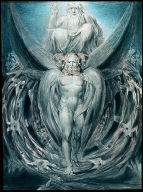
Notice the four faced living creature, the starry wheels with eyes, the six wings, the four additional faces, the throne on which sits the likeness of God, and between the feet of the creature the tiny man who is Ezekiel observing the vision. Not apparent in this image is the light of the rainbow around the image of God displaying his glory. The image in the Blake Archive better displays the light.

This vision described in the words of the Bible and later illustrated by Blake, has prepared Ezekiel to hear the voice. In Marriage of Heaven and Hell Ezekiel converses with Blake:

Marriage of Heaven and Hell, Plate 12, (E 38)
"The Prophets Isaiah and Ezekiel dined with me, and I asked
them how they dared so roundly to assert. that God spake to them;
and whether they did not think at the time, that they would be
misunderstood, & so be the cause of imposition.
...
Then Ezekiel said. The philosophy of the east taught the first
principles of human perception some nations held one
principle for the origin & some another, we of Israel taught
that the Poetic Genius (as you now call it) was the first
principle and all the others merely derivative, which was the
cause of our despising the Priests & Philosophers of other
countries, and prophecying that all Gods [PL 13] would at last be
proved. to originate in ours & to be the tributaries of the
Poetic Genius,"

Blake was convinced that it is the Poetic Genius, the Human Imagination, the voice of the poet and prophet, that was the voice which spoke to Ezekiel, and through Ezekiel, and which continues to speak to those who have 'ears to hear'.

All Religions Are One, (E 1)
PRINCIPLE. 5. The Religions of all Nations are derived from
each Nations different reception of the Poetic Genius which is
every where call'd the Spirit of Prophecy.
PRINCIPLE 6 The Jewish & Christian Testaments are An original
derivation from the Poetic Genius. this is necessary from the
confined nature of bodily sensation

Thursday, October 14, 2010

Blake's Death


For Blake the word, death, had many meanings:

1. Physical death:
Quoting Damon p. 99: 
"Death of the physical body is the shedding of the shell (garment, robe) which the soul, or spiritual body has grown for protection in this world.  It's the return of the soul to Eternity.  It is an episode of life, a state through which one passes, awakening to Eternal life (J 4:1-2)".

Blake indicated the nature of physical death, particularly of his brother, Robert's death in a letter (9) to Hayley he wrote:

      "Thirteen years ago. I lost a  brother & with his spirit  I  converse daily & hourly in the  spirit. & See him in my
remembrance in the regions of my  imagination.
I hear his advice & even now write from his  Dictate--"

2. For Blake Eternal Death, itself seemed to have many meanings:
Among other things it seems to concern Ulro and the Spectre. Looking at The Four Zoas we read:
"There is from Great Eternity a mild & pleasant rest
Namd Beulah a Soft Moony Universe feminine lovely
Pure mild & Gentle given in Mercy to those who sleep
Eternally. Created by the Lamb of God around
On all sides within & without the Universal Man
The Daughters of Beulah follow sleepers in all their Dreams
Creating Spaces lest they fall into Eternal Death

The Circle of Destiny complete they gave to it a Space
And namd the Space Ulro & brooded over it in care & love
They said The Spectre is in every man insane & most
Deformd Thro the three heavens descending in fury & fire
We meet it with our Songs & loving blandishments & give
To it a form of vegetation But this Spectre of Tharmas
Is Eternal Death
What shall we do O God pity & help"
(The Four Zoas [Nt 1], 5.42; E303)  
Elsewhere in  Milton 4.15; Erdman 98 he reported this
conversation between Los and Satan:

"Satan was going to reply, but Los roll'd his loud thunders.
Anger me not! thou canst not drive the Harrow in pitys paths.
Thy Work is Eternal Death, with Mills & Ovens & Cauldrons.
Trouble me no more. thou canst not have Eternal Life
So Los spoke! Satan trembling obeyd weeping along the way.
Mark well my words, they are of your eternal Salvation"
Satan and the Spectre of course are synonymous. 
"And Milton said, I go to Eternal Death!" 
If you get the picture Milton, in Heaven, choses the path the 
Savior trod; he incarnated; he came down from Heaven into
Earth and for a similar purpose.  But here the meaning of
Eternal seems very clearly mortal life.
There are many other instances of the words in Milton.

Turning to Jerusalem Blake makes it pretty clear in Plate 4:
"Of the Sleep of Ulro! and of the passage through
Eternal Death! and of the awaking to Eternal Life."
It would be very worthwhile to read this plate carefully.
The last occurrence of Eternal Death in Jerusalem occurs in 
Plate 98 lines 21-24:
"Driving outward the Body of Death in an Eternal Death &
Resurrection
Awaking it to Life among the Flowers of Beulah rejoicing in Unity
In the Four Senses in the Outline the Circumference & Form, for
ever
In Forgiveness of Sins which is Self Annihilation." (E257)

(I wonder if he was thinking of Romans 7 when he spoke of the 
Body of Death.  The forgiveness of sins is Self Annihilation, the
end of mortal life.)                                                 
                                               

Tuesday, September 21, 2010

Female Love

What does it mean? Understanding what Blake meant by Female Love is a vital key to the meaning of Blake's poetry and pictures; the same thing is true for the more general case, love (he only used the word 782 times!). What did he mean??

It helps when you realize that unlike the great majority of members of the Enlightenment Age, Blake's vocabulary was informed by millennia of intellectual tradition, dating back to the pre Socratic age and earlier ones from Egyptian and Asian cultures. These ideas were subjects of contempt and ignorance to his neighbors--as are ours for that matter. But not for Blake; for him they were his bread and butter, the stuff of life. Once you understand that about Blake you're in a position to query 'female love' without outraged feministic feelings.

So what did he mean? In the ancient traditions (the perennial philosophy) masculine is active, feminine passive, with a masculine sky God and a feminine Earth Goddess. In another pair masculine and feminine relate to thinking and feeling; this came down in Blake to Urizen and Luvah, and more like 'common English' in Jung's two similar functions.

In Blake's system we find the two in their fallen state. In the beginning of his myth we meet among others Urizen (who presumes to be God and is actually the Prince of Light), and Luvah who gets possession of the Sun (symbol of Light) so that he acts as Prince of Light.

If this sufficiently confuses you go on. (As Blake said, 'if the fool would persist in his folly he would become wise'.) MHH, Plate 7, (E 36)

Many of Blake's poems need to be translated into 'common English' in order to grasp what love meant for Blake. However Blake's love meant different things at different times as he went through life. Near the end of his career he got around to using 'common English' with "
I've a Wife I love & that loves me" (Notebook; Erdman 481). But in earlier days the word meant several things very different from his mutual love to and from his wife.

Love, like all things, has contrary senses, in fact many senses--for example an ironic sense: speaking of something very repulsive: "Oh I just love that". Blake's love was generally not quite ironic; it was more like 'sick love', The Clod and the Pebble give us a basic introduction into two contrary uses of 'love'.

He used love in a more innocent way with The Little Black Boy which ends with: "
And be like him [the white boy], and he will then love me" (Songs of Innocence; Erdman 9).

The Torments of Love and Jealousy, the subtitle of The Four Zoas, is an entirely different matter: selfish love, Love as Power, control, and much such unpleasant reality appears over and over in The Four Zoas.

Wisely or not Blake called that 'female love'.It was embodied in some unsavory women like:

Rahab, (taken from the Bible), the biblical Rahab had more character than the Blakean one. Blake used Rahab as a symbol for a fallen Jerusalem.
Tirzah, ('what have I to do with thee"); this of course is a direct quote from John 2:4; traditionally the mother concerns physical well being while the father represents spirit.

(The fallen) Vala: In Erdman's plate 32 of Jerusalem you will see a shadowed Vala on the left side of the picture. She represents all of the sick kinds of love, such as the Net of Religion (Urizen, plate 25.22 Erdman 82).

Taken together all of these symbols are exemplars of female love:

"Till I turn from Female Love
And root up the Infernal Grove
I shall never worthy be
To Step into Eternity
.....
Let us agree to give up Love
And root up the infernal grove
Then shall we return & see
the worlds of happy Eternity"
......

All in all love was a bad word for Blake,
although occasionally as we've seen he slipped back into the language of Zion. But 'female love' represents those kinds of 'bad love' that we've mentioned.

Monday, September 6, 2010

EMBRACE the SPECTRE

In Blake's system the root cause of the woes of the world is the division and dispute among the Zoas. Speaking psychologically, when the four aspects of the psyche - sensation, emotion, reason and intuition - are not in balance the individual has no internal or external harmony. When the functions compete for control instead of cooperating to express the identity, the dissension creates inhibition, dissatisfaction, projection, destructiveness and war. Blake saw his own psychological imbalance as a dispute between Urizen and Luvah with Los as a kind of referee. Without free expression of his emotions his work of imagination would be stifled. To manage his life in the world reason had to control a large part of his psyche. So he expressed this battle in his poetry.

Blake's struggle to be free of constraints that prevented his imaginative expression became externalized in his relationship with his patron Haley who sought to control Blake's freely following the inspiration to paint and write as his vision led. In working through his relationship with Haley, Blake faced his own Selfhood. He became aware that the cause of the dispute arose with himself.

Without explicitly stating the circumstances of his feud with Hayley or the resolution of it, Blake includes these phrases in a letter to Hayley indicating that he had worked through a dilemma which had vexed him for years.

Letter to Hayley
( E 757)
23 October 1804
"I thank God with entire confidence that
it shall be so no longer--he is become my servant who domineered
over me, he is even as a brother who was my enemy."

Relating an event such as he experienced in forgiving Hayley, Blake writes the following passage. Remember that the Selfhood is selfishness or self-centeredness and the Spectre is the rationalizing state.

Four Zoas, Night 7, Page 95, (E 367)
"Los embracd the Spectre first as a brother
Then as another Self; astonishd humanizing & in tears
In Self abasement Giving up his Domineering lust

Thou never canst embrace sweet Enitharmon terrible Demon. Till
Thou art united with thy Spectre Consummating by pains &
labours
That mortal body & by Self annihilation back returning
To Life Eternal be assurd I am thy real Self
Tho thus divided from thee & the Slave of Every passion
Of thy fierce Soul Unbar the Gates of Memory look upon me
Not as another but as thy real Self I am thy Spectre
Thou didst subdue me in old times by thy Immortal Strength
When I was a ravning hungring & thirsting cruel lust & murder
Tho horrible & Ghastly to thine Eyes tho buried beneath
The ruins of the Universe. hear what inspird I speak & be silent

If we unite in one[,] another better world will be
Opend within your heart & loins & wondrous brain
Threefold as it was in Eternity & this the fourth Universe
Will be Renewd by the three & consummated in Mental fires
But if thou dost refuse Another body will be prepared"

By embracing the Spectre, Los recognizes him as brother and an aspect of himself. In unifying with the Spectre he annihilated him as dark and destructive and accepted him into his real Self. The earlier attempt to subdue the Spectre by his strength had forced him further into the unconscious where he created more rivalries and dissension.

The act of embracing the Spectre, if undertaken, will reunite the Zoas and open the path to Eternity.

Saturday, August 7, 2010

UNHOLY BIBLE

IMAGE FROM PLATE 3 MHH
June Singer, a Jungian psychologist, wrote several books on psychology but only one book on Blake. Her first book which developed from her thesis for her analysts diploma from the C. G. Jung Institute in Zurich, is titled The Unholy Bible: Blake, Jung and the Collective Unconscious. Although most of the book is a psychological analysis of The Marriage of Heaven and Hell, she provides insight into the later prophetic writings as well. In this passage she explains The Four Zoas in terms of individuation. The quote from Blake represents the reassembling of the pieces after 'all things are changd'.

"The long poem , The Four Zoas, describes the many aspects of man as they are differentiated from one another.The symbolism amazingly parallels the analytic process of differentiating the many unconscious contents from the other, and then gradually reintegrating them into a new and productive unity. The parallel is even more impressive when we consider that Blake uses the schema of nine nights of dreams, since dreams in analytical psychology provide the key to understanding the unconscious processes. It is with this key that Blake has unlocked 'the doors of perception' as he promised he would in The Marriage of Heaven and Hell. At the end of the ninth night man beholds the infinite vision, and he sings the Ode to Joy (we recall the first two lines, first uttered by the enslaved wives and children of America): [Four Zoas, Page 138, (E 406)]

'The Sun has left his blackness & has found a fresher morning
And the mild moon rejoices in the clear & cloudless night
And Man walks forth from midst of the fires the evil is all
consumd
His eyes behold the Angelic spheres arising night & day
The stars consumd like a lamp blown out & in their stead behold
The Expanding Eyes of Man behold the depths of wondrous worlds
One Earth one sea beneath nor Erring Globes wander but Stars
Of fire rise up nightly from the Ocean & one Sun
Each morning like a New born Man issues with songs & Joy
Calling the Plowman to his Labour & the Shepherd to his rest
He walks upon the Eternal Mountains raising his heavenly voice
Conversing with the Animal forms of wisdom night & day
That risen from the Sea of fire renewd walk oer the Earth

For Tharmas brought his flocks upon the hills & in the Vales
Around the Eternal Mans bright tent the little Children play
Among the wooly flocks The hammer of Urthona sounds
In the deep caves beneath his limbs renewd his Lions roar
Around the Furnaces & in Evening sport upon the plains
They raise their faces from the Earth conversing with the Man

How is it we have walkd thro fires & yet are not consumd
How is it that all things are changd even as in ancient times' "

Friday, August 6, 2010

Origin of the Four Functions

Jung postulated four functions: two rational ones (thinking and feeling) and two irrational ones (intuition and sensation). On the surface an unlearned layman might wonder if he got them from Blake, whom he tells us that he had read extensively and admired. The Four Zoas bear a close resemblance to Jung's Four Functions. But the problem of the origin or source is more complex.

Both had access to much earlier sources and gathered them into their own understanding: Jung's psychology and Blake's poetic myth.

You may find much information about the functions in the Cube of Space.

Cornerstones of the Psyche treat fourness in a more comprehensive way.

Classical Elements shows this figure going back to the 18th century B.C.

The Bible spoke of the four living creatures: Ezekiel 1 and Revelation 4 and 5. I found 50 uses of four in Ezekiel, 13 in the first chapter.

Earth, Water, Air and Fire had various understanding during the past 38 centuries. These four elements are closely associated with Blake's four zoas: Urthona (Los in mortality) to Earth, Tharmas to Water, Urizen to Air, and Luvah to Fire.

You will find more discussion of the four Zoas in my Blake Primer. (In the Provisional Table of Contents click on Characters.)

The Four Zoas of course are central to Blake's myth and psychology. They apply equally to human beings and to the world, but much less so to the cosmos, which for Blake was unitary.

Tuesday, August 3, 2010

THARMAS


Each of the Four Zoas is associated with one of the four elements: Urizen with air, Luvah with fire, Urthona with earth, and Tharmas with water. The four elements appear in the Book of Urizen, but in this early work they had different names. Here is a vivid picture of the four as they appear on Plate 24 of the Book of Urizen. Individual images appear in the Gates of Paradise.

For one of the images of the Small Book of Designs, Blake reused Plate 24 of the Book of Urizen, but he redesigned the image to include only Tharmas submerged in a rough sea with only his face above water. The other elements were covered over in the print with the sea, the mountains and red light from a rising or setting sun. The role of Tharmas is given prominence apropos for his importance in Blake's system. Tharmas as the body, is the avenue of sensory perception which in the fallen state, overloads man's mind leading to the exclusion of spiritual perception. Drowning in a watery world is a good image for living by the precepts of 'Bacon, Newton and Locke' which Blake deplored.

Tharmas occurs as the first building block the psyche, but he is the last to be recognized as deserving of a position among the Zoas. He takes a back seat as the dynamics of the struggle for the structuring of the psychic life occurs. In the end he becomes a unifying principle which represents the possibility of further development beyond a simple return to the original status.

At some points in Blake's myth, there is a close association between Urthona and Tharmas. In the final stage of The Four Zoas the two of them recognize their closeness and recall being friends in earlier times. Urthona and Tharmas are the two Zoas that function most unconsciously, just as intuition and sensation are the less conscious functions in Jung's system. Earth is the element from which Adam was formed in the Bible. Water is the element from which life arises in the evolutionary process. Earth and Water; Imagination (or the Spiritual Sense) and the Body (or sensation); Urthona and Tharmas are the foundational materials for building life in both a physical and psychological sense. Blake presents them as forces that held the unified man together before the fall, and as the unifying forces available to man as he enters the new age.

Four Zoas, Page 137, (E 405)
"Then Los who is Urthona rose in all his regenerate power
The Sea that rolld & foamd with darkness & the shadows of death
Vomited out & gave up all the floods lift up their hands
Singing & shouting to the Man they bow their hoary heads
And murmuring in their channels flow & circle round his feet
Page 138
Then Dark Urthona took the Corn out of the Stores of Urizen
He ground it in his rumbling Mills Terrible the distress
Of all the Nations of Earth ground in the Mills of Urthona
In his hand Tharmas takes the Storms. he turns the whirlwind Loose
Upon the wheels the stormy seas howl at his dread command
And Eddying fierce rejoice in the fierce agitation of the wheels
Of Dark Urthona Thunders Earthquakes Fires Water floods
Rejoice to one another loud their voices shake the Abyss
Their dread forms tending the dire mills The grey hoar frost was there
And his pale wife the aged Snow they watch over the fires
They build the Ovens of Urthona Nature in darkness groans
And Men are bound to sullen contemplations in the night
Restless they turn on beds of sorrow. in their inmost brain
Feeling the crushing Wheels they rise they write the bitter words
Of Stern Philosophy & knead the bread of knowledge with tears & groans"

Saturday, July 24, 2010

Vala

In the beginning Blake called The Four Zoas Vala. The emanation of Luvah, she has a checkered career. In Eternity she is Jerusalem; fallen she became Vala, somewhat comparable to Eve in the garden. She carries all creation, all love, but in Ulro love is totally bad (not so in regeneration and in Eternity).

Vala was the contrary (opposite) of Jerusalem (the bride of Christ). She represents all the negativity of the feminine character. She also goes by the names of Rahab and Tirzah.

Hear Vala in the beginning of the poem:

"Hear! I will sing a Song of Death! it is a Song of Vala!
The Fallen Man takes his repose: Urizen sleeps in the porch
Luvah and Vala woke & flew up from the Human Heart
Into the Brain; from thence upon the pillow Vala slumber'd.
And Luvah seiz'd the Horses of Light, & rose into the Chariot of Day
Sweet laughter siezd me in my sleep! silent & close I laughd
For in the visions of Vala I walkd with the mighty Fallen One
I heard his voice among the branches, & among sweet flowers."
(Four Zoas 1:10-16, E 305)

So we can see that in Blake's myth Vala occupied the same symbolic role that Eve did in the Garden.

In The Four Zoas Blake used two kinds of daughters , who collectively represented Jerusalem and Vala:
1. Daughters of Beulah (Inspiration) are devoted to the well-being of man. They guarded the body of Albion in his mortal sleep on the Rock of Ages.

2. Daughters of Albion (Memory), obeying Reason weave the natural world of spiritual depravity.

In the poem Jerusalem we read: "The fallen Albion meets Vala and hears her say "Know me now Albion: look upon me. I alone am Beauty The Imaginative Human Form is but a breathing of Vala. I breathe him forth into the Heaven from my secret Cave, Born of the Woman to obey the Woman O Albion the mighty For the Divine appearance is Brotherhood, but I am love." (Jerusalem 29.49-52; E176)

And this from wiki : "Albion and Vala are deeply connected in Blake's myth. Originally, Albion was also with Jerusalem, but he abandons her after she claims that both Vala and Albion are too obsessed with the idea of sin. Jerusalem's fall provokes Vala to claim that she is the triumphant beauty and embraces materialism along with statements that women are dominant. Los rejects these claims and defends mankind. Although she has entered into a fallen state, from her line Jesus would be born. In the fallen state, she promotes revenge, jealousy, and justice during war. When she is redeemed after the Final Judgment, she is joined [as Jerusalem] with Albion as his bride. This allows for a union between mankind and the divine."

More on Vala may be found here and here.

Wednesday, July 7, 2010

REASON & EMOTION


Erdman, in The Illuminated Blake
says: "Phaeton-like, down hurdle a naked man and sword and a horse with saddle cloth and broken chariot wheel...The man's spread hands are braced to hit the ground, but it is already in flames. Reason must have forgotten to let the horse do the pulling; a sword is not a bridle. But Energy must have restraint. Between them they have let the sun fall, connoting universal ruin."


The Marriage of Heaven and Hell was written in 1791 when Blake was a young man; he might be called an angry young man.

Marriage of Heaven and Hell, Plate 5, (E 34)
"Those who restrain desire, do so because theirs
is weak enough to be restrained; and the restrainer or
reason usurps its place & governs the unwilling.
And being restraind it by degrees becomes passive
till it is only the shadow of desire.
The history of this is written in Paradise Lost. & the
Governor or Reason is call'd Messiah.
And the original Archangel or possessor of the com-
mand of the heavenly host, is calld the Devil or Satan
and his children are call'd Sin & Death
But in the Book of Job Miltons Messiah is call'd
Satan. For this history has been adopted by both parties
It indeed appear'd to Reason as if Desire was
cast out. but the Devils account is, that the Messiah
fell. & formed a heaven of what he stole from the Abyss
This is shewn in the Gospel, where he prays to the
Father to send the comforter or Desire that Reason
may have Ideas to build on, the Jehovah of the Bible
being no other than he, who dwells in flaming fire.
Know that after Christs death, he became Jehovah.
But in Milton; the Father is Destiny, the Son, a
Ratio of the five senses. & the Holy-ghost, Vacuum!
Note. The reason Milton wrote in fetters when
he wrote of Angels & God, and at liberty when of
Devils & Hell, is because he was a true Poet and
of the Devils party without knowing it"

Blake was continually striving to free his imagination from constraints. The internal constraints of which he was most aware (excluding the selfhood) were misguided reason and emotion. In Plate 5 of Marriage of Heaven and Hell he expresses the concern that reason will succeed in restraining the emotions to the point that the imagination is bound. Emotion or desire is the source of energy which is required for the creative process.

As a poet, Blake identifies with Milton whose Paradise Lost was of consuming interest to Blake. In this Plate Blake deals with the poet's work (his own and Milton's), Biblical characters who becomes fictional characters for both the poets, and the abstract ideas of reason and emotion.

Blake became so interested in correcting the misconceptions of his friend (his spiritual, intellectual but not corporeal friend), that he addressed the issue in his poem Milton. Since Milton died 83 years before Blake was born, this was a friendship on the level of Eternity; time was not of the essence.

The crux of Milton's error in Blake's system is stated concisely as:
"But in Milton; the Father is Destiny, the Son, a Ratio of the
five senses. & the Holy-ghost, Vacuum!"

In Blake the Father is the Divine Humanity, in whose Image man is created; the Son is the Divine Vision, God in Man, the Incarnation; and the Holy Spirit is the Divine Body, the Human Imagination, the activity of expressing the Divine.

Or in other terms for Blake:
Father = Urizen = reason
Son = Luvah = emotions
Holy Spirit = Los = intuition or imagination
Unified man = Tharmas = body

Wednesday, April 14, 2010

ANCIENT BRITONS

When Blake moved back to London from Felpham for a time he opened an exhibit of his paintings in the shop of his brother James. He wrote an extended Descriptive Catalogue of the works he was exhibiting. The quotes about Albion and Arthur in a previous post were from that catalogue. A picture which has been lost was the subject of the comments Blake made about Albion and Arthur.

Blake's picture according to his description was of three ancient Britons who were the sole survivors of a battle against the Romans. Descriptive Catalogue, NUMBER 5, (E 542-5):

" THE ANCIENT BRITONS--Three Ancient Britons overthrowing the Army of armed Romans; the Figures full as
large as Life--From the Welch Triades.
In the last Battle that Arthur fought, the most Beautiful was one
That return'd, and the most Strong another: with them also return'd
The most Ugly, and no other beside return'd from the bloody Field.

The most Beautiful, the Roman Warriors trembled before and worshipped:
The most Strong, they melted before him and dissolved in his presence:
The most Ugly they fled with outcries and contortion of their Limbs."

To Blake:

"The Strong man represents the human sublime. The Beautiful man represents the human pathetic, which was
in the wars of Eden divided into male and female. The Ugly man represents the human reason. They were originally one man, who was fourfold; he was self-divided, and his real humanity slain on the stems of generation, and the form of the fourth was like the Son of God. How he became divided is a subject of great sublimity and pathos. The Artist has written it under inspiration, and will, if God please, publish it; it is voluminous, and contains the ancient history of Britain, and the world of Satan and of Adam. In the mean time he has painted this Picture,"
...
"It will be necessary for the Painter to say something concerning his ideas of Beauty, Strength and Ugliness.
The Beauty that is annexed and appended to folly, is a lamentable accident and error of the mortal and perishing life; it does but seldom happen; but with this unnatural mixture the sublime Artist can have nothing to do; it is fit for the burlesque. The Beauty proper for sublime art, is lineaments, or forms and features that are capable of being the receptacles of intellect; accordingly the Painter has given in his beautiful man, his own idea of intellectual Beauty. The face and limbs that deviates or alters least, from infancy to old age, is the face and limbs of greatest Beauty and perfection.
The Ugly likewise, when accompanied and annexed to imbecility and disease, is a subject for burlesque and not for historical grandeur; the Artist has imagined his Ugly man; one approaching to the beast in features and form, his forehead small, without frontals; his jaws large; his nose high on the ridge, and narrow; his chest and he stamina of his make, comparatively little, and his joints and his extremities large; his eyes with scarce any whites, narrow and cunning, and every thing tending toward what is truly Ugly; the incapability of intellect.
The Artist has considered his strong Man as a receptacle of Wisdom, a sublime energizer; his features and limbs do not spindle out into length, without strength, nor are they too large and unwieldy for his brain and bosom. Strength consists in accumulation of power to the principal seat, and from thence a regular gradation and subordination; strength is compactness, not extent nor bulk.
The strong Man acts from conscious superiority, and marches on in fearless dependance on the divine decrees, raging with the inspirations of a prophetic mind. The Beautiful Man acts from duty, and anxious solicitude for the fates of those for whom he combats. The Ugly Man acts from love of carnage, and delight in the savage barbarities of war, rushing with sportive precipitation into the very teeth of the affrighted enemy."

Although there is no exact correlation between the three survivors and the Four Zoas, it is worth looking for some resemblances. The Strong Man is most like Tharmas, the physical body and source of man's energy. The Beautiful Man resembles Luvah who incorporates all the emotions and in his Eternal form is referred to a 'beauteous'. The Ugly man is Urizen who has become ugly through his hate, cruelty, and vengeance. The fourth man is like to the Son of God as was the fourth man in Daniel's fiery furnace. Los plays that role in Blake's myth since he is the force that initiates reunification.

Since the original picture is lost, I have tried to find images which may resemble the three men Blake describes.
Strong
Beautiful
Ugly

Thursday, February 18, 2010

The Rock

The Blake concordance shows 324 occurences of the word rock .

The Dome of the Rock is sacred to Judaism, Christianity, and Islam. We can be sure that Blake was fully cognizant of these, and it seems likely in this common awareness he used the terms: Rock of Eternity ( the Rock of eternity), Rock of Ages, Rock of Albion, and many other significant Rocks..

Rock of Eternity:
FZ5-59.9-12; E340:
He [Albion] wept & he divided & he laid his gloomy head
Down on the Rock of Eternity on darkness of the deep
Torn by black storms & ceaseless torrents of consuming fire
Within his breast his fiery sons chaind down & filld with cursings

Rock of Ages:
M15.36-40; E109;
First Milton saw Albion upon the Rock of Ages,
Deadly pale outstretchd and snowy cold, storm coverd;
A Giant form of perfect beauty outstretchd on the rock
In solemn death: the Sea of Time & Space thunderd aloud
Against the rock, which was inwrapped with the weeds of death

Also FZ1-18.11-15 E310:
Now Man was come to the Palm tree & to the Oak of Weeping
Which stand upon the Edge of Beulah he [Albion] sunk down
From the Supporting arms of the Eternal Saviour; who disposd
The pale limbs of his Eternal Individuality
Upon The Rock of Ages. Watching over him with Love & Care"

Rock of Albion:
FZ2-24.5-8; E314|:
Luvah & Vala trembling & shrinking, beheld the great Work master [Urizen]
And heard his Word! Divide ye bands influence by influence
Build we a Bower for heavens darling in the grizly deep
Build we the Mundane Shell around the Rock of Albion

Albion Cold Lays on His Rock

The Rock, above the Sea of Time and Space, lies on the verge of Beulah, where Albion, forgiven and saved, awaits the Resurrection.

Monday, February 8, 2010

WEB OF LIFE

http://upload.wikimedia.org/wikipedia/commons/6/62/Blake_The_Clod.jpg


The field of Ecology which developed in the twentieth century, has a friend in William Blake of the nineteenth century. Both look at the world as a whole - one organic body with interconnections, and inter-dependences. Patterns are embodied in structures which are fluid and multi-dimensional.


The Web of Life: A New Scientific Understanding of Living Systems, Fritjoe Carpa, Page 295

"According to the Santiago theory, we bring forth the self just as we bring forth objects. Our self or ego, does not have any independent existence. This then is the crux of the human condition. We are autonomous individuals, shaped by our own history of structural changes. We are self-aware, aware of our individual identity - and yet when we look for an independent self within our world of experience we cannot find any such entity.

"Autopoiesis , or 'self-making,' is a network pattern in which the function of each component is to participate in the production or transformation of other components in the network. In this way the network is continually makes itself. It is produced by its components and in turn produces those components."

Jerusalem, Plate 99, (E 257)
"All Human Forms identified even Tree Metal Earth & Stone. all
Human Forms identified, living going forth & returning wearied
Into the Planetary lives of Years Months Days & Hours reposing
And then Awaking into his Bosom in the Life of Immortality.
And I heard the Name of their Emanations they are named Jerusalem

The End of The Song
of Jerusalem"
______________
Four Zoas, Page 133 (E 400)

"And One of the Eternals spoke All was silent at the feast

Man is a Worm wearied with joy he seeks the caves of sleep
Among the Flowers of Beulah in his Selfish cold repose
Forsaking Brotherhood & Universal love in selfish clay
Folding the pure wings of his mind seeking the places dark
Abstracted from the roots of Science then inclosd around
In walls of Gold we cast him like a Seed into the Earth
Till times & spaces have passd over him duly every morn
We visit him covering with a Veil the immortal seed
With windows from the inclement sky we cover him & with walls
And hearths protect the Selfish terror till divided all
In families we see our shadows born. & thence we know
That Man subsists by Brotherhood & Universal Love
We fall on one anothers necks more closely we embrace
| Ephesians iii c 10 v |

Not for ourselves but for the Eternal family we live
Man liveth not by Self alone but in his brothers face
Each shall behold the Eternal Father & love & joy abound

So spoke the Eternal at the Feast they embracd the New born Man
Calling him Brother image of the Eternal Father. they sat down
At the immortal tables sounding loud their instruments of joy
Calling the Morning into Beulah the Eternal Man rejoicd"

Wednesday, January 6, 2010

COUCH OF DEATH

At a critical moment in Blake's myth, he represents one of the low points in the condition of Albion, the Universal Man. Although this picture is labeled "Christ in the Sepulcher", the angels duplicate those described at the beginning of Night VIII of the Four Zoas. The appearance of the Lamb of God signals the impending resolution of Albion's plight.

Guarded by Angels

Four Zoas, Night VIII, Page 99 (E 370)
"The Fallen Man stretchd like a Corse upon the oozy Rock
Washd with the tides Pale overgrown with weeds
Two winged immortal shapes one standing at his feet
Toward the East one standing at his head toward the west
Their wings joind in the Zenith over head
Such is a Vision of All Beulah hovring over the Sleeper

The limit of Contraction now was fixd & Man began
To wake upon the Couch of Death he sneezed seven times
A tear of blood dropped from either eye again he reposd
In the saviours arms, in the arms of tender mercy & loving
kindness

Then Los said I behold the Divine Vision thro the broken Gates
Of thy poor broken heart astonishd melted into Compassion & Love
And Enitharmon said I see the Lamb of God upon Mount Zion
Wondring with love & Awe they felt the divine hand upon them"

Although Blake never completed and illuminated the Four Zoas, the image of Albion in the arms of Jesus appears on Plate 33 of Jerusalem, along with a description of Los attempting to turn Albion in the right direction.

Albion in the Arms of Jesus

Tuesday, December 29, 2009

URIZEN & SHADOW

The character Urizen dominates much of Blake's writing. He appears and reappears from the First Book of Urizen to the end of the Four Zoas. Why was his configuration of characteristics so important in the mind of Blake?

Trying to recall Urizen to his former self and to union with the Botherhood, Albion speaks thus to Urizen in Four Zoas, Night IX, PAGE 120 (E 389):

"The Eternal Man sat on the Rocks & cried with awful voice

O Prince of Light where art thou I behold thee not as once
In those Eternal fields in clouds of morning stepping forth
With harps & songs where bright Ahania sang before thy face
And all thy sons & daughters gatherd round my ample table
See you not all this wracking furious confusion
Come forth from slumbers of thy cold abstraction come forth
Arise to Eternal births shake off thy cold repose
Schoolmaster of souls great opposer of change arise
That the Eternal worlds may see thy face in peace & joy
That thou dread form of Certainty maist sit in town & village

While little children play around thy feet in gentle awe
Fearing thy frown loving thy smile O Urizen Prince of light"

Reclining Urizen This is an image of a man who lives almost entirely in his head; his body is atrophied and his hand rests on a second skull.

These are the characteristics which Albion sees as dividing Urizen from his Eternal form. He is cold, he deals in abstractions, he is asleep, and repetitive, and certain of his own correctness. Albion's hope is that he can return to a condition in which the Eternals as well as little children may enjoy his former demeanor.

During the unfolding of Blake's myth, Urizen's characteristics become expressed in the law. Urizen is portrayed as projecting his inner characteristics onto his outer experience; including his attitude as to how the world should function and the people in it should behave.

Blake himself outwardly rejects Urizen's attitudes of distance, rigidness, non-involvement, inflexibility, blindness, and fear of the unknown. But his poetry may reveal that he struggled internally against the very characteristics he objected to. His Shadow may have been expressed in Urizen.

Thursday, December 24, 2009

NATIVITY IV

Chorus of Angels

Since the first image we form of ourselves is that of a body, we may formulate the idea that at some point the spirit enters the body and begins to express itself through the body. But as Blake explains here, it is the bodies which are made for the spirits which pre-exist.

As Albion represents the Universal Man, Jerusalem represents the Universal Woman: the 'vast family wondrous in beauty and love.' Albion is fourfold, Jerusalem is unified: the expression of the Divine Vision within the Universal Man.

In this passage, Blake presents the idea that redemption begins when 'the Lamb of God' becomes visible within the Unified Spiritual Body which is Jerusalem. The song of the angels, sung when the birth of Jesus was announced to the shepherds, is echoed in Blake's verses at this point.

GOSPEL OF LUKE
2:8-12 - "There were some shepherds living in the same part of the country, keeping guard throughout the night over their flocks in the open fields. Suddenly an angel of the Lord stood by their side, the splendour of the Lord blazed around them, and they were terror-stricken. But the angel said to them, 'Do not be afraid! Listen, I bring you glorious news of great joy which is for all the people. This very day, in David's town, a Saviour has been born for you. He is Christ, the Lord. Let this prove it to you: you will find a baby, wrapped up and lying in a manger.'
2:13-14 - And in a flash there appeared with the angel a vast host of the armies of Heaven, praising God, saying, 'Glory to God in the highest Heaven! Peace upon earth among men of goodwill!'"

Four Zoas: Night the Eighth, Page 103 (E376):

"Enitharmon wove in tears Singing Songs of Lamentations
And pitying comfort as she sighd forth on the wind the spectres
And wove them bodies calling them her belovd sons and daughters

Employing the daughters in her looms & Los employd the Sons
In Golgonoozas Furnaces among the Anvils of time & space
Thus forming a Vast family wondrous in beauty & love
And they appeard a Universal female form created
From those who were dead in Ulro from the Spectres of the dead

PAGE 104 (FIRST PORTION)
And Enitharmon namd the Female Jerusa[le]m the holy
Wondring
she saw the Lamb of God within Jerusalems Veil
The divine Vision seen within the inmost deep recess
Of fair Jerusalems bosom in a gently beaming fire


Then sang the Sons of Eden round the Lamb of God & said
Glory Glory Glory to the holy Lamb of God
Who now beginneth to put off the dark Satanic body

Now we behold redemption Now we know that life Eternal
Depends alone upon the Universal hand & not in us
"

GOSPEL OF LUKE
2:25-32 - "In Jerusalem was a man by the name of Simeon. He was an upright man, devoted to the service of God, living in expectation of the 'salvation of Israel'. His heart was open to the Holy Spirit, and it had been revealed to him that he would not die before he saw the Lord's Christ. He had been led by the Spirit to go into the Temple, and when Jesus' parents brought the child in to have done to him what the Law required, he took him up in his arms, blessed God, and said - 'At last, Lord, you can dismiss your servant in peace, as you promised! For with my own eyes I have seen your salvation which you have made ready for every people - a light to show truth to the Gentiles and bring glory to your people Israel.'"

Saturday, November 28, 2009

ALBION & LAZARUS

The plight of Albion as he falls from his original unity as an Eternal, is portrayed in Night the First of the Four Zoas.

PAGE 21
"Then those in Great Eternity met in the Council of God
As one Man for contracting their Exalted Senses
- 310 -
They behold Multitude or Expanding they behold as one
As One Man all the Universal family & that one Man
They call Jesus the Christ & they in him & he in them
Live in Perfect harmony in Eden the land of life
Consulting as One Man above the Mountain of Snowdon Sublime

For messengers from Beulah come in tears & darkning clouds
Saying Shiloh is in ruins our brother is sick Albion He
Whom thou lovest is sick he wanders from his house of Eternity
The daughters of Beulah terrified have closd the Gate of the
Tongue
Luvah & Urizen contend in war around the holy tent

So spoke the Ambassadors from Beulah & with solemn mourning
They were introducd to the divine presence & they kneeled down
In Conways Vale thus recounting the Wars of Death Eternal

The Eternal Man wept in the holy tent Our Brother in Eternity
Even Albion whom thou lovest wept in pain his family
Slept round on hills & valleys in the regions of his love
But Urizen awoke & Luvah woke & thus conferrd

Thou Luvah said the Prince of Light behold our sons & daughters
Reposd on beds. let them sleep on."

It is confusing but enlightening that Blake brings to our minds a reference to the death and resurrection of Jesus's friend Lazarus by including familiar words from the story as told in John's Gospel. Lazarus is Jesus's friend whom he loves. Jesus knows his friend is sick but holds back from visiting until Lazarus has been in the grave four days. Jesus weeps over his friend and then brings him back to life.

John, Chapter 11

When Jesus revives Lazarus it is a four stage process: he has the stone removed from the entrance to the grave, he wakes him up, he removes the grave clothes that restrain him, then he calls him forth.

Albion will be brought back from the brink of Eternal Death, but it will be a multi-stage process involving the four Zoas, the Emanations, the Spectres, and ultimately Jesus himself.

In John, the account of the raising of Lazarus is followed immediately by the passage in which the determination is made by the priests and Pharisees that Jesus must be killed.

Blake, through the retelling of the Christian myth using psychological and mythopoeic methods, aims to follow Jesus as described in this verse:

11:4 - When Jesus received the message, he said, "This illness is not meant to end in death; it is going to bring glory to God - for it will show the glory of the Son of God."

The raising of Lazarus as shown by Blake in three different ways:

Lazarus in No Natural Religion

Lazarus in Tate Gallery

Lazarus in Young's Night Thoughts

Friday, November 13, 2009

FALLEN ZOAS

Albion in His Fallen State

Before Los initiates the process of restoring Albion to the
Humanity
Divine, each of the four Zoas has fallen to the
point that his outlook is totally opposite to his role in eternity.

Jerusalem, Plate 38, (E184)

"They [the Four Zoas] saw their Wheels rising up poisonous against Albion
Urizen, cold & scientific: Luvah, pitying & weeping
Tharmas, indolent & sullen: Urthona, doubting & despairing
Victims to one another & dreadfully plotting against each other
To prevent Albion walking about in the Four Complexions."


Urizen, meant to be the active intellect involving itself in interfacing with information and developing understanding of relationships, has become cold and detached. He has reduced interactions to measurements, and objective descriptions from his frozen mind.

Luvah, meant to be the source of empathy and delight through the expression of emotional attachments, has been reduced to regret and depression. The spontaneous outpouring of approval or disapproval no longer flows from his detached heart.

Tharmas, meant to be energetic and active, involved in giving outer expression to inner dynamics, is passive and lifeless. The energy which should be generated through sensory perception and the impetus to create life is not flowing in his lethargic body.

Urthona, meant to be faith and vision, the connective function which holds together disparate parts, has lost the 'blessed assurance' and fallen into a dark pit of isolation. The connection of the body with the wholeness of purposeful living finds no expression without imagination.

One's greatest gifts can turn into one's worst liabilities if not recognized as gifts and put to work in the service of the giver. The Zoas will recover their gifts as Albion is restored to Eternity through the work of Jesus and Los.

Thursday, October 29, 2009

FEMALE & MALE

Nobody can really explain Blake, and that's the way he wanted it. We can listen to him, try to experience with him, and draw from our own lives scraps and pictures to associate with his words and images. So do what you can with what he says here.

Four Zoas, Night 5, Verse 2 (E302)

"In Eden Females sleep the winter in soft silken veils
But Males immortal live renewd by female deaths. in soft
Delight they die & they revive in spring with music & songs
Enion said Farewell I die I hide from thy searching eyes"

Milton Percival says in Circle of Destiny on page 56:

"The form dies in order that the imaginative impulse may be released for new expression. The masculine creative world of Eden is continually sustained by feminine self-sacrifice in Beulah."Males immortal live, renewed by female deaths." The obedience of outward form to inner vision extends even to the landscape....(spaces of Beulah)...are merciful illusions, provided for the repose of the mind which has wearied of the visionary reality of Eden. They characterize the hypothetical age in which the visionary life that Blake enjoyed in ecstasy was a habitual experience. In contrast to the spaces of Beulah, which are so readily transcended, are the "Satanic spaces" of Ulro, which limit and enslave the mind that beholds them."

Damon called the Emanation the '''counterpart" of the fundamentally bisexual male.'

In Jerusalem, plate 88 (E246), we learn why the female Emanations are so essential to man.

"When in Eternity Man converses with Man they enter
Into each others Bosom (which are Universes of delight)
In mutual interchange. and first their Emanations meet
Surrounded by their Children. if they embrace & comingle
The Human Four-fold Forms mingle also in thunders of Intellect
But if the Emanations mingle not; with storms & agitations
Of earthquakes & consuming fires they roll apart in fear
For Man cannot unite with Man but by their Emanations
Which stand both Male & Female at the Gates of each Humanity"

Blake didn't depreciate the role of the female, nor did he mean what we usually mean when we use the term. The female to Blake is an image which carries many meanings but without her, man would never reach Eternity.

Albion Asleep, Jerusalem as Butterfly

Sunday, September 6, 2009

The Four Zoas

A Subjective Reading
A Personal Experience

(A valued friend put me on to a discussion of 4Z found
on pages 203-32 of Blake's Sublime Allegory. Most
[or all?] of this post derives from that essay: On Reading the Four Zoas by Mary Lynn Johnson and Brian Wilkie. Hopefully there may be other posts to come on 4Z.)

"...we want most to encourage the sort of visceral and
personal response to this deeply introspective poem
that we believe Blake demands of his readers." (203)

"...we must recognize that the movement of the poem...yields its meaning in proportion to our
willingness to examine what happens within us."

After those lines on the first page the writers proceed
with a cursory statement of the plot; that's revealed
in the first page of 4Z:

"Four Mighty Ones are in every Man;
a Perfect Unity
(John XVII c. 21 & 22 & 23 v)

Cannot Exist. but from the Universal
Brotherhood of Eden
(John I c. 14. v)

The Universal Man. To Whom be
Glory Evermore Amen"
(John I c. 14. v)

The Universal Man of course is Albion-- representing
an eternal Great Britain, representing the people of
the world in Eternity, representing the perfect you.

"Albion looks up, rises from the rock in just wrath and is about to walk 'into the Heavens'" (Erdman)

The "Four Mighty Ones" (the four Zoas) are Tharmas,
Urthona, Urizen, and Luvah. Blake "begins with
Tharmas..", but before the "beginning " he tell us about
Los (the worldly version of Urthona), "Urthona was his
name", who represents here all the Zoas, in Eternity
with "days and nights of revolving joy", then the plot
is announced:


"His fall into Division & his Resurrection to Unity His
fall into the Generation of Decay & Death & his
Regeneration by the Resurrection from the dead."

It's the old, old story everyone can read in the Bible;
In 4Z Blake gave us his version of it -- one of course
of many.

Monday, August 24, 2009

Blake's Image of Saints in Dante

Toward the end of his life William Blake began a series
of illustrations for Dante's DIVINE COMEDY for his
patron and friend John Linnell. Blake left 102 of these
watercolor illustrations when he died: seventy-two for
the Inferno, twenty for the Purgatorio, and ten for the
Paradiso. Blake's designs are said to be not mere
illustrations but commentary on Dante's text.
(Martin Butlin)

One illustration for the Paradiso particularly caught my
attention in the Blake Archive:
Link to Blake Archive

In Martin Butlin's WILLIAM BLAKE, published by the
Tate, he makes these comments on the picture I noticed:
"Blake illustrates the successive appearances of
St. Peter, St. James and St. John. St. Peter, who
questions Dante on Faith, is represented by Blake's
type for Urizen; St. James, who questions Dante on
Hope, as Luvah; and St. John, who questions Dante on
Love, as Los or the Poetic Genius. Together they
represent Reason, Feeling and Imagination. The
overlapping of the three globes in which they are
shown, embracing Dante and Beatrice whose echoing
gestures reflect harmony, is a marvelously vivid image
of reunion of Man's various elements that is requisite
of true salvation."

Quite a summation of the Bible, Blake's myth, religion
and psychology!

The picture named 'St. Peter, St. James, Dante and
Beatrice with St. John also' can be found at:

Blake's image from Dante

In this picture it is fascinating to see how Blake
integrated Dante's poetry into his own visual
vocabulary.

Dante's three conversations with St. Peter, St. James
and St. John about faith, hope and love respectively
are amalgamated into one scene. Blake himself
wouldn't be left out of the creative process, so he gives
the three saints correspondence to three of his Zoas.
He skews the character of the Zoas to align them with
the saints .

Urizen is a pretty good fit with St. Peter since Blake has
identified Urizen with the fallen church consistently.
The association of Urizen with faith is perhaps by his
building a structure to try to make sense of being.
Peter's first recognition of Jesus as the Messiah is a
prime example of his faith. The identification of Peter
with Urizen is implied by his facial appearance which is
congruent with multiple images of Urizen as he is
associated with the vengeful God of the Old Testament,
and by the faint image of the scroll which Peter holds in
his left hand.

For a rare image of the Four Zoes together, see:

4z's in Book of Urizen

If Luvah is paired with St. James, it might be on the
basis of putting into practice the spiritual truth we
receive, which is emphasized in the New Testament
'Letter of James.' I don't know why hope would be
associated with either St. James or Luvah.

Los, the Eternal Prophet, pictured as the descending
Holy Spirit becomes in the picture, St. John, the author
of the Apocalypse or 'Book of Revelation.' Although it is
not the characteristic usually assigned to Los, love is
entirely appropriate to him in his role as the Poetic
Genius opening the world to imagination. St. John
exemplifies love as the author of the gospel stressing
unity among men, and between God and man.

In his characteristic way of making his figures
ambiguous or subject to multiple interpretations, Blake
may have been thinking of the lower central image of
Dante and Beatrice as Albion, (Humanity as realized in
the one Man) or as Tharmas the fourth of the Four
Zoas, who can be associated with the senses or the
physical body.

Better students than I, of Dante, Blake and the Bible
should be able to see much more in this picture than I do.