Showing posts with label Damon. Show all posts

Wednesday, February 2, 2011

BLAKE & PLATO

Commentary on Blake's six illustrations to Milton's Il Penseroso is found in Bette Charlene Werner's book Blake's vision of the poetry of Milton: illustrations to six poems. Blake 'invented', (he signed images WBlake inv), the third illustration The Spirit of Plato as a means of presenting a number of Plato's ideas as Milton contemplated them.

Il Penseroso

"Or let my lamp, at midnight hour,
Be seen in some high lonely tower,
Where I may oft outwatch the Bear,
With thrice great Hermes, or unsphere
The spirit of Plato, to unfold
What worlds or what vast regions hold
The immortal mind that hath forsook
Her mansion in this fleshly nook;
And of those demons that are found
In fire, air, flood, or underground,"
(lines 85-95)
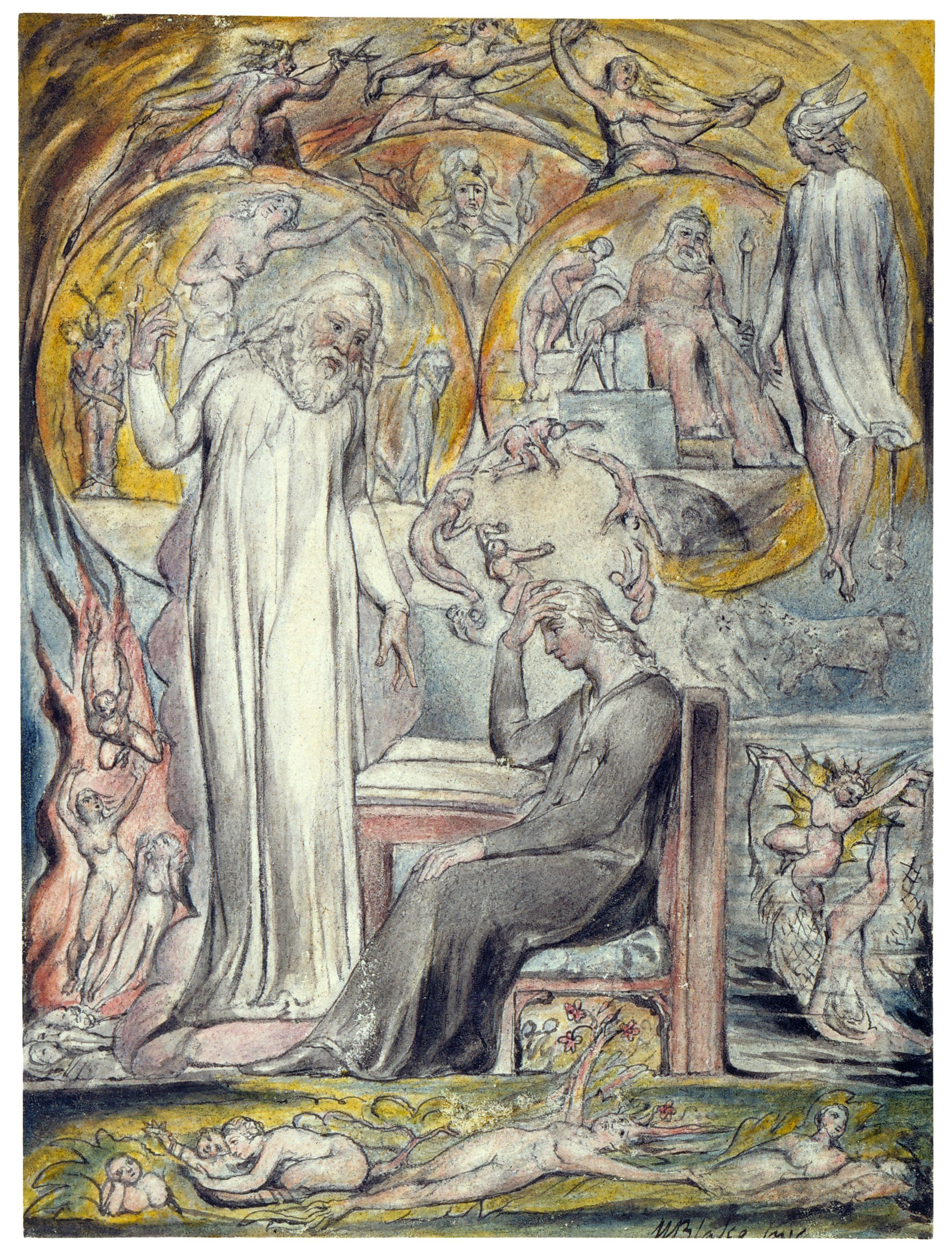
In the picture we see how Plato divided the soul between the three worlds of Venus, Jupiter, Mars - senses, reason and energy. The Great Bear is the constellation around which the constellations revolve; it never sets - symbolizing an ever circling round.

Blake added a few lines of descriptive material to each of his illustrations to Il Penseroso.
Blake's description: "The Spirit of Plato unfolds his Worlds to Milton in Contemplation. The three destinies sit on the Circles of Plato's Heavens weaving their Thread of Mortal Life; these Heavens are Venus Jupiter and Mars. Hermes flies before as attending on the Heaven of Jupiter, the Great Bear is seen in the Sky beneath Hermes & The Spirits of Fire, Air, Water & Earth Surround Milton's Chair."

In this the third illustration to Il Penseroso illustrating lines 85-95 of Milton's poem, Blake goes to pains to include the import of the lines of the poem but adds details to indicate the ideas of Plato to which he objected.

Damon enumerates the points at which Plato's thought differed from Blake's:
"Thus it is that although Plato banished poets from his Republic, made God a geometrician, preached morality, was a fatalist when he accepted the Three Fates, debased love to homosexuality, admitted war to his ideal state, and considered Art an imitation of Nature (hence second rate), Blake was indebted to him." Blake knew that there was much to be admired in Plato's thought although he said that "What Jesus came to remove was the Heathen or Platonic Philosophy, which blinds the eye to Imagination, The real Man." (E 664 ). Blake portrays the Greek learned and wise among the saved in the Last Judgment.

The prominence in the illustration of Hermes perhaps in his role of as the guide for souls in the underworld, may be Blake's assertion that both Plato and Milton are still in need of guidance in matters of the soul. None of the Platonic images contemplated by Milton seems to show the positive outcome for Man's plight for which Blake is working.

Blake's ambivalence to Plato and Greek thought can be seen in these 2 short passages:

Songs and Ballads,(E 479)
Twas the Greeks love of war
Turnd Love into a Boy
And Woman into a Statue of Stone
And away fled every joy

Letter to Trusler, (E 702)
"The wisest of the Ancients considerd what is not
too Explicit as the fittest for Instruction because it rouzes the
faculties to act. I name Moses Solomon Esop Homer Plato"

Monday, January 31, 2011

BLAKE & STARS

To begin figuring out Blake's use of the symbol 'stars' let's start with some of his geography.

Milton, Plate 13, (E 156)
"Around Golgonooza lies the land of death eternal; a Land
Of pain and misery and despair and ever brooding melancholy:
In all the Twenty-seven Heavens, numberd from Adam to Luther;
From the blue Mundane Shell, reaching to the Vegetative Earth.

The Vegetative Universe, opens like a flower from the Earths center:
In which is Eternity. It expands in Stars to the Mundane Shell
And there it meets Eternity again, both within and without,
And the abstract Voids between the Stars are the Satanic Wheels."

Damon (A Blake Dictionary) says of the stars in Blake: "They are the visible machinery of the astronomical universe," and "Albion's limbs once contained all the starry heavens."


Percival (William Blake's Circle of Destiny) explains :
"As Albion falls he carries his celestial light with him in ever diminishing strength and splendor. The heavenly light with which his world is illuminated at all times, therefore an indication of his spiritual condition. The eternal world of Eden and Beulah is lighted by the sun and moon in their diurnal courses. When that world fails and the Mundane Shell is created as a barrier against utter dissolution, light is provided by the stars which in their multiplicity represent the break-up of the eternal sun and in their unified westward movement represent the effort to maintain some vestige of eternal values. When the starry Mundane Shell crashes into the darkness of the abyss, the Planets, moving irregularly eastward, make their appearance. To counteract their maleficent influence Los creates a temporal sun and a temporal moon, feeble but indispensable replicas of their eternal counterparts.
The first diminution of light is indicated, as we have just said, by the star world. This world was created to keep the body of man from falling into the abyss, when both sun and moon had failed. When knowledge ceased to be intuitive and love ceased to be spontaneous, when in astrological imagery, the eternal order was threatened by the departure of Urizen, the sun, into the north (the realm sacred Urthona), and of Luvah, the moon, into the south (The realm sacred to Urizen), the diminished reason became Albion's guiding light. Out of fear it built the world of law that Albion might descend into chaos. The ordered round of constellations is Blake's beautiful and appropriate symbol for the order imposed by law upon a world from which unity has fled." (page 148)

Marriage of Heaven and Hell
, Plate 26, (E 44)
16. Falling, rushing, ruining! buried in the ruins, on Urthona's
dens.
17. All night beneath the ruins, then their sullen flames faded
emerge round the gloomy king,
18. With thunder and fire: leading his starry hosts thro' the
waste wilderness he promulgates his ten commands,
glancing his beamy eyelids over the deep in dark dismay,

America, Plate 8, (E 54)
The terror answerd: I am Orc, wreath'd round the accursed tree:
The times are ended; shadows pass the morning gins to break;
The fiery joy, that Urizen perverted to ten commands,
What night he led the starry hosts thro' the wide wilderness:

Milton, Plate 4, (E 98)
Every Mans Wisdom is peculiar to his own Individ[u]ality
O Satan my youngest born, art thou not Prince of the Starry Hosts
And of the Wheels of Heaven, to turn the Mills day & night?

Song of Los, Plate 5, (E 68)
Thus the terrible race of Los & Enitharmon gave
Laws & Religions to the sons of Har binding them more
And more to Earth: closing and restraining:
Till a Philosophy of Five Senses was complete
Urizen wept & gave it into the hands of Newton & Locke

Percival calls the stars the 'remnant of light left to the falling Albion'. From this remnant of light is built the Mundane Shell which embodies the law in 'beneficence and majesty'. So the trail left by the fall becomes the chain which restricts the fall. The voids between the stars are the 'doubt and negation of the spectrous mind'.
Percival calls to our minds that the appearance of the stars in the 12th of the Illustrations to the Book of Job 'marks Job's emergence out of the darkness of Ulro.

Thursday, December 16, 2010

CRYSTAL CABINET II

First post on The Crystal Cabinet.

Blake's Water-Colours for the Poems of Thomas Gray, Page 44
'With me the Muse shall sit, and think,'


The Pickering Manuscript, The Crystal Cabinet, (E 488)
"The Maiden caught me in the Wild
Where I was dancing merrily
She put me into her Cabinet
And Lockd me up with a golden Key

This Cabinet is formd of Gold
And Pearl & Crystal shining bright
And within it opens into a World
And a little lovely Moony Night

Another England there I saw
Another London with its Tower
Another Thames & other Hills
And another pleasant Surrey Bower

Another Maiden like herself
Translucent lovely shining clear
Threefold each in the other closd
O what a pleasant trembling fear

O what a smile a threefold Smile
Filld me that like a flame I burnd
I bent to Kiss the lovely Maid
And found a Threefold Kiss returnd

I strove to sieze the inmost Form
With ardor fierce & hands of flame
But burst the Crystal Cabinet
And like a Weeping Babe became

A weeping Babe upon the wild
And Weeping Woman pale reclind
And in the outward air again
I filld with woes the passing Wind"

Blake's poem The Crystal Cabinet is more complex than it may appear on the surface. It is filled with symbols which appear repeatedly in Blake's writing. He seems to have locked up the meaning of the poem in the same way that the maiden locked up the narrator. We are looking for the golden Key which may either let us in or let us out.

This post will give insights from three prominent Blake scholars. Later we will connect the poem to writings from C.S. Lewis and will look at the poem psychologically.

Thoughts on The Crystal Cabinet from Damon, Bloom and Frye:

S. Foster Damon, A Blake Dictionary, page 95:

"The Crystal Cabinet symbolizes the delusions of love. It may be the record of some casual affair in Surrey which ended unhappily."

Harold Bloom, The Visionary Company: A Reading of English Romantic Poetry, page 57:

"But the 'inmost Form' cannot be seized in Beulah; as Thel lamented, there is no unwavering or ultimate form there.The youth has attempted finality in the sexual, which cannot sustain it. As the Cabinet's precarious reality bursts, the youth and former maiden are thrown 'upon the wild' of Ulro; they are no longer 'in the wild' of untried Innocence or lost Experience. The youth is reduced to the schizoid second infancy or idiocy of Ulro, and the Maiden who initiated the act seem to regret the experience that made her a woman:
"A weeping Babe upon the wild,
And Weeping Woman pale reclin'd,
And in the outward air again
I fill'd with woes the passing Wind"
...
The image of sensual fulfillment, so eloquent in D. H. Lawrence, is inadequate and finally dangerous to Blake. Finality is not in the onefold Self of Ulro, the twofold subject-object world of Generation, or the threefold world of lovers and their love of Beulah. The inmost form is reserved for art, and achieved art for Blake is a harmony of the fourfold man, in whom the living creatures of imagination, wisdom, love and power have found again their human form."

Northrop Frye, Fearful Symmetry, page 234:

"If dwelt in too long, Beulah will soon turn into Ulro. For Ulro is to our world what Beulah is to Eden, and as in Beulah we have not yet got clear of our world, there is an affinity between Beulah and Ulro which in the crisis of vision becomes identity. This highly technical but crucial point in Blake's argument will meet us again. It is illustrated in 'The Crystal Cabinet,' in the Pickering MS, where the poet enters, perhaps through sexual intercourse, a 'crystal' world of a 'little Moony Night,' is kissed by a 'threefold' maiden, tries out of this complicated embrace to achieve something that is not transient but infinite, and collapses at once back into Generation to begin all over again. The triple mirror is Beulah, but the maiden is Rahab, the apocalyptic Whore who at this point is the world order of nature, including the Enitharmon of the sky and the Vala of the earth."

Northrop Frye, Angela Esterhammer, Northrop Frye on Milton and Blake, p 353:

"But in this world all creative achievements are inherited by someone else and are lost to their creator. This failure to take possession of one's deepest experience is the theme of 'The Crystal Cabinet' (by comparing the imagery of this latter poem with 'Jerusalem', plate 70, we discover that the Female Babe's name, in this context, is Rahab)."

Jerusalem, Plate 70, (E 224)
"when the lips
Recieve a kiss from Gods or Men, a threefold kiss returns
From the pressd loveliness: so her whole immortal form three-fold
Three-fold embrace returns: consuming lives of Gods & Men
In fires of beauty melting them as gold & silver in the furnace
Her Brain enlabyrinths the whole heaven of her bosom & loins
To put in act what her Heart wills; O who can withstand her power
Her name is Vala in Eternity: in Time her name is Rahab"

Considering various commentaries enables us to look more deeply into the poem, to fit it into the context of Blake's larger design, and to ferret out associations in our own experience which relate to its ideas.

Tuesday, November 30, 2010

MORAL VIRTUE & RAHAB


Jerusalem, Plate 75 (color image from Blake Archive)

The consequences of practicing a religion of Moral Virtue are personified in Rahab. The codification of the law elevates the law above the individuals it is meant to serve. The law, elevated to the ultimate status becomes an idol which replaces God. The law which was meant to bring man to God, instead emphasizes obedience which is an external operation. Inspiration which takes place internally from the spirit is the contrary of law. Blake came to believe that the Old Testament revelation was a necessary step in the evolution of spiritual consciousness. However it brought about a State of Error which must be transcended by the incarnation through which man has direct internal connection with spiritual reality.

In A Blake Dictionary, Damon gives us details about the character Rahab:
[she] "symbolizes the false church of this world, the opponent of Jerusalem, and the crucifier of Jesus (FZ viii:406)"..."Rahab is Natural Religion. She is 'Vala drawn down into a Vegetated Body' (FZ,viii:280) "... "She is the system of Moral Virtue (J 39:10). She imputes Sin and Righteousness to individuals (J70:18), although Los tells her to distinguish between States and the Individual in them (FZviii:379)."..."Rahab, as Natural Religion, is the seductive harlot."..."Rahab as the Female Will seeks dominion by means of sex".

In Damon's description Rahab may not seem very appealing but her power lies in her seductive beauty. Both the orderliness of the law and the intricacies of nature offer the same seductive appeal. Blake associates Rahab's attractiveness with the threefold character by which Blake meant the materialized body - Head, Heart, and Loins. The fourth element of man was absent - Urthona, the unifying principle, the intuition or imagination. The Chariot without its driver was less than human which is Fourfold not threefold.

Jerusalem, Plate 70, (E 224)
"Imputing Sin & Righteousness to Individuals; Rahab
Sat deep within him hid: his Feminine Power unreveal'd
Brooding Abstract Philosophy. to destroy Imagination, the Divine-
-Humanity A Three-fold Wonder: feminine: most beautiful: Three-fold
Each within other. On her white marble & even Neck, her Heart
Inorb'd and bonified: with locks of shadowing modesty, shining
Over her beautiful Female features, soft flourishing in beauty
Beams mild, all love and all perfection, that when the lips
Recieve a kiss from Gods or Men, a threefold kiss returns
>From the pressd loveliness: so her whole immortal form three-fold
Three-fold embrace returns: consuming lives of Gods & Men
In fires of beauty melting them as gold & silver in the furnace
Her Brain enlabyrinths the whole heaven of her bosom & loins
To put in act what her Heart wills; O who can withstand her power
Her name is Vala in Eternity: in Time her name is Rahab

The Starry Heavens all were fled from the mighty limbs of Albion
PLATE 71
And above Albions Land was seen the Heavenly Canaan
As the Substance is to the Shadow: and above Albions Twelve Sons
Were seen Jerusalems Sons: and all the Twelve Tribes spreading
Over Albion. As the Soul is to the Body, so Jerusalems Sons,
Are to the Sons of Albion: and Jerusalem is Albions Emanation

What is Above is Within, for every-thing in Eternity is translucent:
The Circumference is Within: Without, is formed the Selfish Center
And the Circumference still expands going forward to Eternity.
And the Center has Eternal States! these States we now explore."

Jerusalem, Plate 98, (E 257)
"A Sun of blood red wrath surrounding heaven on all sides around
Glorious incompreh[en]sible by Mortal Man & each Chariot was Sexual Threefold
And every Man stood Fourfold, each Four Faces had. One to the West
One toward the East One to the South One to the North. the Horses Fourfold
And the dim Chaos brightend beneath, above, around! Eyed as the Peacock
According to the Human Nerves of Sensation, the Four Rivers of the Water of Life"

Four Zoas, Page 85, (E 368)
"If we unite in one[,] another better world will be
Opend within your heart & loins & wondrous brain
Threefold as it was in Eternity & this the fourth Universe
Will be Renewd by the three & consummated in Mental fires
But if thou dost refuse Another body will be prepared"

Monday, November 8, 2010

MYSTICAL MARRIAGE

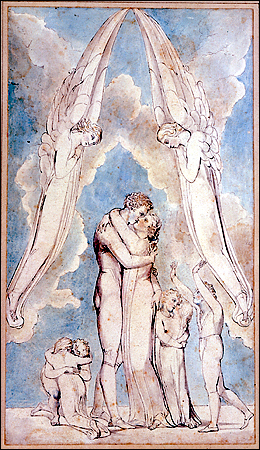
From Robert Blair's The Grave
The Meeting of the Family in Heaven


Both Blake and Jung involved themselves in the study of alchemy as a source of symbols for the regeneration of the primordial wholeness of the psyche. The union, reunion, or marriage of the contraries represented by male and female appears in the work of Jung and Blake as it does in alchemy, as the means to resolve the divisions in the psyche.


Here are two passages concerning Jung's use of the symbol of marriage:

From Man and His Symbols, Edited by Carl Jung
"Man's knowledge (logos) encounters women's relatedness (Eros) and their union is represented as that symbolic ritual of a sacred marriage..." Page 126

From Cambridge Companion to Jung, (Page 96, chapter by David L. Hart)
"That the work of wholeness is involved in alchemical symbolism is shown by the constant conjunction of opposites in its imagery: the marriage of sun and moon, of fire and water, of king and queen. This last conjunction forms the basis of Jung's study of the inner processes of the transference, that mysterious and unique relationship that undergirds the work of individuation as it proceeds in analysis. The transference, for Jung, is not a one-sided affair, nor is it merely the projection of parental images from the client onto the analyst. It is not even all that combined with the analyst's projections onto the client. It is, rather, a truly symbolic event in which both persons are changed, and inner 'marriage' leading, as one would expect, to a new, third being, comprising both individuals and yet transcending them."

Blake's use of the symbol of marriage is treated here in Northrup Frye's Fearful Symmetry:
"In eternity all the homes of the soul, the body, the palace, the city and the garden are one; and the eternal community of men is also the real presence of a divine body, whose blood is the new wine created from the water of nature." (Page 351)
"This enlightenment destroys the 'female will' for Milton and enables him to attain his emanation Ololon. We have spoken before of the ambiguity of the word 'consummation' in referring to the two chief aspects of the Last Judgment, the burning world and the sacred marriage. In Milton, too, the sacred marriage follows the vision of the absorption of nature into a fiery city." (Page 354)
"In the second part of Milton, Ololon appears in the world as a twelve-year-old girl, a child with a child's untouchable beauty, not yet a bride of a sacred marriage but a breastless 'little sister' like the one in the Song of Songs. She is respectfully referred to as the 'Virgin Ololon' for several pages; but as the physical world burns up before Milton's eyes, all images of a separated female will cease to mean anything, her virginity splits away from her and runs shrieking into chaos, as the bride Ololon, purified of the stain of virginity, stands before the poet in his final consummation." (Page 355)

Milton, Plate 40 [46], (E143)
"Then trembled the Virgin Ololon & replyd in clouds of despair

Is this our Femin[in]e Portion the Six-fold Miltonic Female
Terribly this Portion trembles before thee O awful Man
Altho' our Human Power can sustain the severe contentions
Of Friendship, our Sexual cannot: but flies into the Ulro.
Hence arose all our terrors in Eternity! & now remembrance
Returns upon us! are we Contraries O Milton, Thou & I
O Immortal! how were we led to War the Wars of Death
Is this the Void Outside of Existence, which if enterd into
Plate 42 [49]
Becomes a Womb? & is this the Death Couch of Albion
Thou goest to Eternal Death & all must go with thee

So saying, the Virgin divided Six-fold & with a shriek
Dolorous that ran thro all Creation a Double Six-fold Wonder!
Away from Ololon she divided & fled into the depths
Of Miltons Shadow as a Dove upon the stormy Sea.

Then as a Moony Ark Ololon descended to Felphams Vale
In clouds of blood, in streams of gore, with dreadful thunderings
Into the Fires of Intellect that rejoic'd in Felphams Vale
Around the Starry Eight: with one accord the Starry Eight became
One Man Jesus the Saviour. wonderful! round his limbs
The Clouds of Ololon folded as a Garment dipped in blood
Written within & without in woven letters: & the Writing
Is the Divine Revelation in the Litteral expression:
A Garment of War, I heard it namd the Woof of Six Thousand Years

And I beheld the Twenty-four Cities of Albion
Arise upon their Thrones to Judge the Nations of the Earth
And the Immortal Four in whom the Twenty-four appear Four-fold
Arose around Albions body: Jesus wept & walked forth
From Felphams Vale clothed in Clouds of blood, to enter into
Albions Bosom, the bosom of death & the Four surrounded him
In the Column of Fire in Felphams Vale; then to their mouths the Four
Applied their Four Trumpets & them sounded to the Four winds

Terror struck in the Vale I stood at that immortal sound
My bones trembled. I fell outstretchd upon the path
A moment, & my Soul returnd into its mortal state
To Resurrection & Judgment in the Vegetable Body
And my sweet Shadow of Delight stood trembling by my side

Immediately the Lark mounted with a loud trill from Felphams Vale
And the Wild Thyme from Wimbletons green & impurpled Hills
And Los & Enitharmon rose over the Hills of Surrey
Their clouds roll over London with a south wind, soft Oothoon
Pants in the Vales of Lambeth weeping oer her Human Harvest
Los listens to the Cry of the Poor Man: his Cloud
Over London in volume terrific, low bended in anger.

Rintrah & Palamabron view the Human Harvest beneath
Their Wine-presses & Barns stand open; the Ovens are prepar'd
The Waggons ready: terrific Lions & Tygers sport & play
All Animals upon the Earth, are prepard in all their strength
Plate 43 [50]
To go forth to the Great Harvest & Vintage of the Nations"


S. Foster Damon clarifies it all in A Blake Dictionary, Page 308:
"But then the sixfold Emanation divides from Ololon and like the repentant wife seeks refuge in Milton's bosom. Then 'as a Moony Ark Ololon descended ... into the Fires of Intellect': love and wisdom are combined. The Starry Eight become Jesus; Ololon's clouds are his wedding garment; and Jesus becomes one with mankind. The mystical union has been achieved, and Blake falls fainting on his garden path." (Milton, Plate 42)

Sunday, November 7, 2010

The 27 Churches


In Milton Plate 37 you may read:
"And these the names of the Twenty-seven Heavens & their Churches Adam, Seth, Enos, Cainan, Mahalaleel, Jared, Enoch, Methuselah, Lamech: these are Giants mighty Hermaphroditic
Noah, Shem, Arphaxad, Cainan the second, Salah, Heber, Peleg, Reu, Serug, Nahor, Terah, these are the Female-Males

A Male within a Female hid as in an Ark & Curtains, Abraham, Moses, Solomon, Paul, Constantine, Charlemaine Luther, these seven are the Male-Females, the Dragon Forms
Religion hid in War, a Dragon red & hidden Harlot"

You may find more detail on the twenty-seven Churches at Jerusalem Plate 75:
"And these the names of the Twenty-seven Heavens & their Churches Adam, Seth, Enos, Cainan, Mahalaleel, Jared, Enoch, .....
Noah, Shem, Arphaxad, Cainan the Second, Salah, Heber, Peleg, Reu, Serug, Nahor, Terah:
....
(these are the pagan gods of Asia):
Abraham, Moses, Solomon, Paul, Constantine, Charlemaine, Luther. (these are the course of judaism and Christianity) ....these Seven are the Male Females: the Dragon Forms
The Female hid within a Male: thus Rahab is reveald Mystery Babylon the Great: the Abomination of Desolation Religion hid in War: a Dragon red, & hidden Harlot
But Jesus breaking thro' the Central Zones of Death & Hell Opens Eternity in Time & Space; triumphant in Mercy"

The twenty-seven Churches are encapsulated in the Whore of Babylon and her seven-headed beast (the double organization of Church and State):

"Thus are the Heavens formd by Los within the Mundane Shell
And where Luther ends Adam begins again in Eternal Circle To awake the Prisoners of Death, to bring Albion again With Luvah into light eternal, in his eternal day."

So what in the world can all this mean? I can't explain it completely, but here's a try: look especially at this line:
"And where Luther ends Adam begins again in Eternal Circle".

He's talking of course about the Circle of Destiny.

Blake has given these names to various ages or cultures found in the pre-biblical period, the two testaments, and the 2000 years after; Blake perceived a period of 6000 years in all (very much like some fundamental Christians who think the world was created in 4004 B.C).

Damon in A Blake Dictionary (pp 34-35) casts much light on the twenty seven churches: they all exist in Ulro.

Sunday, October 17, 2010

HARVEST & VINTAGE

Revelations 14
[15] And another angel came out of the temple, crying with a loud voice to him that sat on the cloud, Thrust in thy sickle, and reap: for the time is come for thee to reap; for the harvest of the earth is ripe.
[16] And he that sat on the cloud thrust in his sickle on the earth; and the earth was reaped.
[17] And another angel came out of the temple which is in heaven, he also having a sharp sickle.
[18] And another angel came out from the altar, which had power over fire; and cried with a loud cry to him that had the sharp sickle, saying, Thrust in thy sharp sickle, and gather the clusters of the vine of the earth; for her grapes are fully ripe.
[19] And the angel thrust in his sickle into the earth, and gathered the vine of the earth, and cast it into the great winepress of the wrath of God.
[20] And the winepress was trodden without the city, and blood came out of the winepress, even unto the horse bridles, by the space of a thousand and six hundred furlongs.

S. Foster Damon, William Blake: Philosophy and Symbols, in commenting on the final scenes in the Four Zoas, says (Page 164):

AND GOD BLESSED THE SEVENTH
DAY AND SANCTIFIED IT
"In six days heaven and earth had been created, according to Genesis, and on the seventh day the Lord rested. In six days, therefore, that work is to be reversed, before the Sabbath of the Millennium can arise. These six days are spent in a final Harvest and Vintage of the world, to make the Bread and Wine of Eternity. Urizen threshes the corn which Urthona bakes into the Bread of Philosophy, while Luvah presses the grapes into the Wine of Ecstacy; and all the chaff and refuse is cast into Non-Entity. This lovely festival in the spiritual world is the reality of what on earth seems to be the final catastrophes of the Apocalypse. During this time Orc burns himself out: Ahania and Enion rise to their former Glory; Luvah and Vala regain their original State of Innocence; while Los takes on his original form, Urthona. The terrific vision ends in a splendid peace:

[Four Zoas, PAGE 139, Night the Ninth, (E 406)]:
"How is it we have walkd thro fires & yet are not consumd
How is it that all things are changd even as in ancient times

The Sun arises from his dewy bed & the fresh airs
Play in his smiling beams giving the seeds of life to grow
And the fresh Earth beams forth ten thousand thousand springs of
life
Urthona is arisen in his strength no longer now
Divided from Enitharmon no longer the Spectre Los
Where is the Spectre of Prophecy where the delusive Phantom
Departed & Urthona rises from the ruinous walls
In all his ancient strength to form the golden armour of science
For intellectual War The war of swords departed now
The dark Religions are departed & sweet Science reigns

End of The Dream"

The image of the harvest and vintage appears in Milton as well:

Milton, PLATE 25 [27] (E 121)
"The Wine-press on the Rhine groans loud, but all its central beams
Act more terrific in the central Cities of the Nations
Where Human Thought is crushd beneath the iron hand of Power.
There Los puts all into the Press, the Opressor & the Opressed
Together, ripe for the Harvest & Vintage & ready for the Loom.

They sang at the Vintage. This is the Last Vintage! & Seed
Shall no more be sown upon Earth, till all the Vintage is over
And all gatherd in, till the Plow has passd over the Nations
And the Harrow & heavy thundering Roller upon the mountains

And loud the Souls howl round the Porches of Golgonooza

Crying O God deliver us to the Heavens or to the Earths,
That we may preach righteousness & punish the sinner with death
But Los refused, till all the Vintage of Earth was gatherd in.

And Los stood & cried to the Labourers of the Vintage in voice of
awe.

Fellow Labourers! The Great Vintage & Harvest is now upon Earth
The whole extent of the Globe is explored: Every scatterd Atom
Of Human Intellect now is flocking to the sound of the Trumpet
All the Wisdom which was hidden in caves & dens, from ancient
Time; is now sought out from Animal & Vegetable & Mineral

The Awakener is come. outstretchd over Europe! the Vision of God
is fulfilled
The Ancient Man upon the Rock of Albion Awakes,
He listens to the sounds of War astonishd & ashamed;"

Milton, PLATE 27 [29] (E 124)
"This Wine-press is call'd War on Earth, it is the Printing-Press
Of Los; and here he lays his words in order above the mortal
brain
As cogs are formd in a wheel to turn the cogs of the adverse
wheel.

Milton, PLATE 43 [50], (E 144)
"To go forth to the Great Harvest & Vintage of the Nations

Finis"

As Damon says, Blake wrote on multiple levels simultaneously. On the historical level the harvest and vintage appeared as the battles and wars which were taking place in his own times - the Napoleonic Wars ("Wine-press on the Rhine groans loud".) In Blake's personal experience the activities of his publishing work were his participation in the 'Great Harvest & Vintage' ("the Printing-Press Of Los; and here he lays his words in order above the mortal brain"). At the spiritual level they were the rewinding of the 'golden string' which had begun to be unwound with the material creation which Blake pictured in the Book of Urizen ("Every scatterd Atom Of Human Intellect now is flocking to the sound of the Trumpet").

Genesis 1
[5] And God called the light Day, and the darkness he called Night. And the evening and the morning were the first day.
[8] And God called the firmament Heaven. And the evening and the morning were the second day.
[12] And the earth brought forth grass, and herb yielding seed after his kind, and the tree yielding fruit, whose seed was in itself, after his kind: and God saw that it was good.
[13] And the evening and the morning were the third day.
[17] And God set them in the firmament of the heaven to give light upon the earth,
[18] And to rule over the day and over the night, and to divide the light from the darkness: and God saw that it was good.
[19] And the evening and the morning were the fourth day.
[22] And God blessed them, saying, Be fruitful, and multiply, and fill the waters in the seas, and let fowl multiply in the earth.
[23] And the evening and the morning were the fifth day.
[27] So God created man in his own image, in the image of God created he him; male and female created he them
[31] And God saw every thing that he had made, and, behold, it was very good. And the evening and the morning were the sixth day.

Sunday, July 25, 2010

JOB SUMMATION

After reading in A Blake Dictionary, Damon's description of Blake's Illustrations to the Book of Job, I came up with one word titles for each plate: ............................................................ Vision - Plate 13
1. Innocence
2. Doubt
3. Wrath
4. Disasters
5. Temptation
6. Shame
7. Experience
8. Anger
9. Disillusionment
10. Rejection
11. Insight
12. New Birth
13. Vision
14. Synthesis
15. Encounter with Unconscious
16. Reversal
17. God of Love
18. Forgiveness
19. Humility
20. Self-giving

21. Wholeness

Blake's Illustration to the Book of Job from the Boston College website and from Gutenberg Press .

Damon also associated the stages which Job traverses with the Eyes of God. Since the Seven Eyes are the stages of psychic, social and religious development of man, Job in his ordeal of individuation recapitulates each of the phases.
1-2. Lucifer - the selfhood
2-4. Molech - the executioner
5-6. Elohim - the judge
7-8. Shaddai - the accuser
9-10. Pahad - terror
11-12. Jehovah - commandments
13-14. Jesus - God in humanity

Here is an earlier post on the Eyes of God.

Each of the Eyes is represented in two plates in the descent/ascent of Job into his self-knowledge. On Job's return from the nadir each Eye is revisited with a single plate, but in it the Eye takes on its positive or redeemed nature.

15. Jehovah reveals the unconscious depths.
16. Jesus causes the Last Judgment.
17. Pahad reveals love.
18. Shaddai becomes forgiveness.
19. Elohim practices charity.
20. Molech brings forth the feminine.
21. Lucifer is freed of the selfhood.

A post on Job , Blake & Jung.

Friday, July 23, 2010

THIRALATHA

I enjoy locating Blake images which are rarely seen. Last week I came across an image in the British Museum collection which I had not seen before. It is from A Large Book of Designs which Blake was commissioned to make for Ozias Humphry (a painter of miniatures) in 1794.
The images from the book include:
plate 1: "Albion rose from where he laboured at the Mill with Slaves
Giving himself for the Nations he danc'd the dance of Eternal Death"
plate 2: The Accusers of Theft Adultery Murder, used as frontispiece of copy B of The Marriage of Heaven and Hell
plate 3: Plate 21 of Book of Urizen - Los, Enitharmon, Orc
plate 4: Plate 4 of Visions of the Daughters of Albion
plate 5: Frontispiece to Visions of the Daughters of Albion
plate 6: Joseph of Arimathea Preaching to the Inhabitants of Britain
plate 7: Plate 8 of Book of Urizen
plate 8: A Dream of Thiralatha from a canceled plate for America

Most of the images in A Large Book of Designs are familiar from other sources but this one was new to me: A Dream of Thiralatha. To see images from the Small and Large books of designs in the British Museum click on link.

These are two mentions of Thiralatha in Blake's early works.
Following America (E 59) [Fragment] [d]

"As when a dream of Thiralatha flies the midnight hour:
In vain the dreamer grasps the joyful images, they fly
Seen in obscured traces in the Vale of Leutha, So
The British Colonies beneath the woful Princes fade.

And so the Princes fade from earth, scarce seen by souls of men
But tho' obscur'd, this is the form of the Angelic land."

Europe, Plate 14, (E 66)
"Sotha & Thiralatha, secret dwellers of dreamful caves,
Arise and please the horrent fiend with your melodious songs.
Still all your thunders golden hoofd, & bind your horses black.
Orc! smile upon my children!
Smile son of my afflictions.
Arise O Orc and give our mountains joy of thy red light."

On page 124 of A Blake Dictionary, Damon provides a diagram of THE REPRESSION OF SEX UNDER ENITHARMON. On the female side the regression is from Ethinthus (the body) to Leutha (guilt) to Oothoon (frustrated desire) to Thiralatha (the erotic dream).
Although Damon calls Thiralatha "the last overt expression of thwarted sex," something of the imagination remains in her as seen in the lovely woman and child of the dream.

Wednesday, May 26, 2010

LIVING SYMBOLS

Songs of Innocence (E 16)
Infant Joy

"Sweet Joy Befall Thee"

Besides his well know (to Blake students), A Blake Dictionary, S. Foster Damon wrote William Blake: His Philosophy and Symbols which also has much to teach about Blake's poetry and how it can be understood. This quote about various levels of meaning which the symbol can represent is found on page 65.

"Practically the whole existence of poetry consists of imposing of human values on natural objects...
Symbolism is the recognition and fixation of these values. It is the highest form of that process usually performed by the weaker metaphor and the still weaker simile. The simile states a resemblance, the metaphor states an identity, and the symbol assumes the identity without direct statement. In the first case love would be likened to a rose; in the second case, Love would be called a rose; in the third, the Rose would appear unexplained. There is a still higher rung in this Jacob's Ladder: the rung popularly known as Prophecy. Here the Rose would indicate some particular act in the past, present, or future. A specific temporal significance is thus imposed upon the Symbol, which hitherto dealt with Eternities...
Let us return , then, to the symbol. Blake, of course, knew perfectly well what he was doing. He deliberately interpreted objects to show their relation to, and their expression of, mankind. Everything he saw revealed to him its inner essence, which was in turn the revelation of a truth. Only through this method could Truth be approached. Isis cannot be seen unveiled, for the mortal eye itself is her vesture. The great secrets cannot be told; the very syllables are their mask....
And thus we learn a strange fact: that the clearer, the more precise, Blake's writings become, the more obscure they seem. The trouble is not with Blake, it lies in our own inability to understand. The fires of Hell still seem like torment and insanity to us, the Angles. Therefore Blake cried so fiercely: 'Go! put off Holiness, and put on Intellect!' "

It is not difficult to find passages in Blake to illustrate the use of the symbol to reveal multiple layers of psychological, poetic and spiritual meanings. How does this speak to you?

Four Zoas, Night VIII, Page 113-114, (E 384) [Enion speaking:]
"Listen: I will tell you what is done in the caverns of the grave
the lamb of God has rent the veil of mystery
When the mortal disappears in improved knowledge cast away
The former things so shall the Mortal gently fade away
And so become invisible to those who still remain
Listen I will tell thee what is done in the caverns of the grave

The Lamb of God has rent the Veil of Mystery soon to return
In Clouds & Fires around the rock & the Mysterious tree
As the seed waits Eagerly watching for its flower & fruit
Anxious its little soul looks out into the clear expanse
To see if hungry winds are abroad with their invisible army
So Man looks out in tree & herb & fish & bird & beast
Collecting up the scatterd portions of his immortal body
Into the Elemental forms of every thing that grows
He tries the sullen north wind riding on its angry furrows
The sultry south when the sun rises & the angry east
When the sun sets when the clods harden & the cattle stand
Drooping & the birds hide in their silent nests. he stores his
thoughts
As in a store house in his memory he regulates the forms
Of all beneath & all above & in the gentle West
Reposes where the Suns heat dwells he rises to the Sun
And to the Planets of the Night & to the stars that gild
The Zodiac & the stars that sullen stand to north & south
He touches the remotest pole & in the Center weeps
That Man should Labour & sorrow & learn & forget & return
To the dark valley whence he came to begin his labours anew
In pain he sighs in pain he labours in his universe
Screaming in birds over the deep & howling in the Wolf
Over the slain & moaning in the cattle & in the winds
And weeping over Orc & Urizen in clouds & flaming fires
And in the cries of birth & in the groans of death his voice
Is heard throughout the Universe whereever a grass grows
Or a leaf buds The Eternal Man is seen is heard is felt
And all his Sorrows till he reassumes his ancient bliss"

This is symbolic language at its finest; not allegory, simile or metaphor but living symbols which may enter the Soul of Man: an opportunity to collect the 'scattered portions of [our] immortal bodies.'

Saturday, January 16, 2010

Some Significant Symbols

Much of this is taken from Digby's 'Symbol and Image in William Blake':

ALBION (Glad Day) was Blake's name for Everyman, Adam Kadman, Cosmic Man, the Eternal Great Humanity Divine (See Milton, plates 2 and 30) or in Quakereze 'that of God in Everyone'. Albion asleep is an apt commentary on Blake's age-- and ours.

"Every human life is part of Albion and can realize more or less the Cosmic Man's total nature... Albion suffers and triumphs in each individual, as is described in ...Jerusalem
..
The Dance of Eternal Death" Digby p.12.

ETERNAL DEATH: Blake used this phrase 78 times; it's mortal life;I translate it to 'this vale of tears', the Sea of Time and Space from which we may emerge at the end; "whenever any Individual Rejects Error & Embraces Truth a Last Judgment passes upon that Individual.." [[A Vision of the Last Judgment] PAGE 85] (Erdman 562)

From Milton: In Heaven, having heard the Bard's Song,
"Milton said, I go to Eternal Death! The Nations still
Follow after the detestable Gods of Priam; in pomp
Of warlike selfhood, contradicting and blaspheming.
When will the Resurrection come; to deliver the sleeping body.."

JERUSALEM: This image cannot be defined; we can only begin a journey of 1000 miles. The Concordance has 288 occurences and Damon has 7 pages trying to describe it. Blake used it as the title for his largest poem; 'Jerusalem' the (smaller) poem, appears in the Preface to Milton (and in many hymnbooks): "till we have built Jerusalem in Englands green and pleasant land."

Jerusalem is the bride of Christ (the conventional church considers itself to be the bride of Christ, but to Blake the bride of Christ was the human race). Jerusalem was Albion's wife-- until he went to sleep; at that point he turned to Vala.

VALA is fallen Jerusalem. A picture is worth a thousand words, and the relationship betwem Vala and Jerusalem can be best understood in this plate (click on the pic for an enlargement). Jerusalem stands out in light with (supposedly) her three daughter, while Vala, in a dark vale, attempts to entice Jerusalem into her darkness. The two battle through The Four Zoas and Jerusalem (the large poem). In your life you can see the 'good girl' and 'bad girl' fighting for supremacy. A woman may become a thief, and/or she may give birth to a spiritual genius. Such is life.

Blake did not believe in 'good and bad'; he believed in Truth and Error. At the Last Judgment Error is burned up and we live (eternally) in Truth.

Thursday, October 29, 2009

FEMALE & MALE

Nobody can really explain Blake, and that's the way he wanted it. We can listen to him, try to experience with him, and draw from our own lives scraps and pictures to associate with his words and images. So do what you can with what he says here.

Four Zoas, Night 5, Verse 2 (E302)

"In Eden Females sleep the winter in soft silken veils
But Males immortal live renewd by female deaths. in soft
Delight they die & they revive in spring with music & songs
Enion said Farewell I die I hide from thy searching eyes"

Milton Percival says in Circle of Destiny on page 56:

"The form dies in order that the imaginative impulse may be released for new expression. The masculine creative world of Eden is continually sustained by feminine self-sacrifice in Beulah."Males immortal live, renewed by female deaths." The obedience of outward form to inner vision extends even to the landscape....(spaces of Beulah)...are merciful illusions, provided for the repose of the mind which has wearied of the visionary reality of Eden. They characterize the hypothetical age in which the visionary life that Blake enjoyed in ecstasy was a habitual experience. In contrast to the spaces of Beulah, which are so readily transcended, are the "Satanic spaces" of Ulro, which limit and enslave the mind that beholds them."

Damon called the Emanation the '''counterpart" of the fundamentally bisexual male.'

In Jerusalem, plate 88 (E246), we learn why the female Emanations are so essential to man.

"When in Eternity Man converses with Man they enter
Into each others Bosom (which are Universes of delight)
In mutual interchange. and first their Emanations meet
Surrounded by their Children. if they embrace & comingle
The Human Four-fold Forms mingle also in thunders of Intellect
But if the Emanations mingle not; with storms & agitations
Of earthquakes & consuming fires they roll apart in fear
For Man cannot unite with Man but by their Emanations
Which stand both Male & Female at the Gates of each Humanity"

Blake didn't depreciate the role of the female, nor did he mean what we usually mean when we use the term. The female to Blake is an image which carries many meanings but without her, man would never reach Eternity.

Albion Asleep, Jerusalem as Butterfly

Tuesday, October 20, 2009

ANIMA & EMANATION


Blake’s women - Enitharman, Enion, Ahania, Vala, and Jerusalem are each associated with a male - Los, Tharmas, Urizen, Luvah, and Albion as an Emanation. In Eternity the Emanations do not have a separate existence. As the fall occurs they acquire outer forms, independent wills and the desire to dominate. Daman says they ”fight regeneration (which seems to them like annihilation).”


Marriage of Heaven and Hell, Title page (How many paired figures do you see? and Why is she suspended above the abyss?)

In Jungian psychology there is an aspect of the unconscious which is called the Anima. In the process of individuation, the Anima which has been projected on the people to whom one is related (mother, sister, wife, boss) is explored and assimilated through bringing unconscious material to light. Since the unconscious inner Anima determines relationships to outer persons by projecting the inner content onto real people, outer relationships are repaired by withdrawing projections (removing the Anima’s will or ability to dominate.)

Carl Jung states:
“The projection-forming factor is the anima. Wherever she appears in dreams, phantasies or visions, she appears personified, thereby demonstrating that basically she possesses all the outstanding characteristics of a female person. She is not an invention of the conscious, but a spontaneous production of the unconscious; neither is she a substitute figure for the mother. On the contrary, there is every likelihood that those numinous attributes which make the Mother imago so dangerously powerful derive from the collective archetype, the anima, which is incarnated anew in every male child." (Spring, 1950, p. 5)

Quoted in an article By Paul Watsky

As Blake dealt with unconscious factors in the psyche as characters in his mythic constructions, he explored the relationships and the dynamics of achieving mental wholeness which he associated with Albion and his Emanation Jerusalem. In describing the conclusion of Jerusalem Damon says, “Albion awakes and rises; Jesus appears; and Albion sacrifices himself;...Then Eternity is re-established, and all becomes one in the Divine Vision.” (A Blake Dictionary, page 213)

The following interchange between Enitharmon and Los (Jerusalem, Plate 92) expresses Enitharmon’s fear that she will be replaced by another female if she accepts annihilation but Los reveals that there will be no division into sexes in Eternity.

“My Looms will be no more & I annihilate vanish for ever
Then thou wilt Create another Female according to thy Will.

Los answerd swift as the shuttle of gold. Sexes must vanish & cease
To be, when Albion arises from his dread repose O lovely Enitharmon:”

But as Los states, it is not that the Emanations are lost in Eternity, but that the division into ‘sexes‘ will be no more. The multiple facets of the psyche will be acknowledged, balanced, and restored to their proper roles as they are integrated into a unified functioning whole.

In Blake as in Jung, masculine and feminine aspects of the personality contribute to the complete individual. The Anima in Jung and the Emanations in Blake can be the root of harmful behaviors; but when properly recognized and attended to, they fulfill vital roles in the human psyche.