Showing posts with label Genesis. Show all posts

Monday, January 3, 2011

EDEN & GENERATION

Saturated as was Blake's mind with the thought of Milton, his writings and paintings are permeated with Milton's ideas. Blake painted three sets of illustrations to Milton's Paradise Lost - one each for his supporters Butts, Thomas and Linnell. In Book 5 the Archangel Raphael is sent by God to warn Adam and Eve of the threat that Satan poses. Book 7 of Paradise Lost recounts the Biblical story of creation as told to Adam by Raphael. The Genesis account is embellished with the fall of Lucifer which is not included in the Bible. In Book 8 Adam narrates to Raphael the aspects of creation which took place after his own creation.

Book 5 - Raphael warns Adam and
Eve about Satan
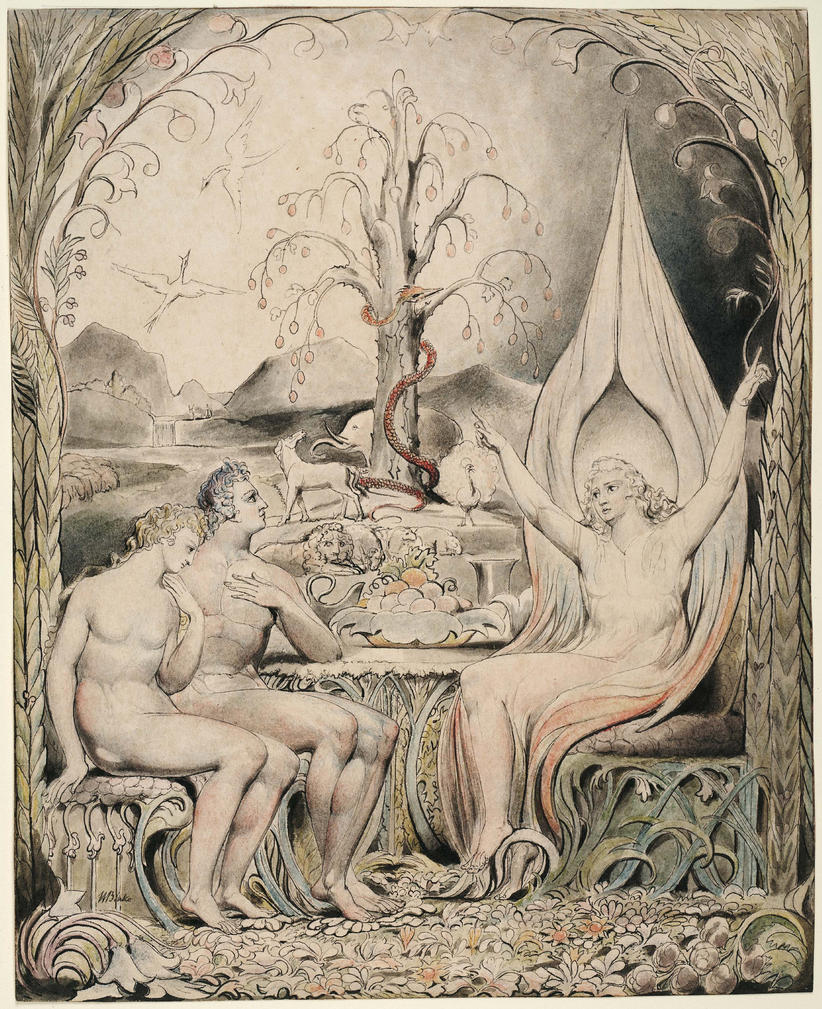


This illustration for Book 5 represents the warning. The idyllic world as pictured has not been disturbed, but symbols of division (or contraries) are manifest: the lion and the lamb, the horse and the peacock. The tree bears its tempting fruit and the Serpent has made his appearance.

The scene is set for the fall which leads to Blake's world of Generation: Los' world, our world.


The world in which we live is meant to be the path through experience by which fallen man can return to consciousness of the Eternal. Blake's world of Generation affords fallen man the opportunity to realize the incarnation and return to Eden as a new being. The path through generation is not easy but this is where man finds himself. The outcome should be regeneration. Blake's progression is from innocence through experience to Eternity. He offers many levels, many gates and many paths. Only the destination is single - the return to Eternity. This can be reached any time (because it is not in time) by its realization - which he calls the Last Judgment:

Vision of the Last Judgment, (E 562)
"Thus My Picture is a
History of Art & Science [& /its/] Which is Humanity itself. What are all the Gifts of the
Spirit but Mental Gifts whenever any Individual Rejects Error &
Embraces Truth a Last Judgment passes upon that Individual"

Many people understand the Biblical Garden of Eden as an idealized material world with a creator God who is outside of creation; with man being given 'dominion' over the animals; and with man walking with an external God in the cool of the evening. Blake's Eden was the state of mind in which the vision of God was not obscured. William Blake's personal goal was to spend as much time in Eden as possible. To transcend to fourfold vision - the ability to perceive the Infinite - was his supreme delight. But to him Eden meant more than vision it also meant creative energy, forgiveness, brotherhood and the oneness of wholeness. Eden to Blake was an internal not an external experience.

MILTON: BOOK THE SECOND, PLATE 30 [33], (E 129)
"Beulah is evermore Created around Eternity; appearing
To the Inhabitants of Eden, around them on all sides.
But Beulah to its Inhabitants appears within each district
As the beloved infant in his mothers bosom round incircled
With arms of love & pity & sweet compassion. But to
The Sons of Eden the moony habitations of Beulah,
Are from Great Eternity a mild & pleasant Rest."

Jerusalem, Plate 12, (E 156)
"fourfold,
The great City of Golgonooza: fourfold toward the north
And toward the south fourfold, & fourfold toward the east & west
Each within other toward the four points: that toward
Eden, and that toward the World of Generation,
And that toward Beulah, and that toward Ulro:
Ulro is the space of the terrible starry wheels of Albions sons:
But that toward Eden is walled up, till time of renovation:
Yet it is perfect in its building, ornaments & perfection.

Jerusalem, PLATE 34 [38],(E 179)
"Turning from Universal Love petrific as he [Albion] went,
His cold against the warmth of Eden rag'd with loud
Thunders of deadly war (the fever of the human soul)
Fires and clouds of rolling smoke! but mild the Saviour follow'd
him,"

Wednesday, December 22, 2010

WEEPING BABE

Ian Marshall and Danah Zohar wrote a book, Who's Afraid of Schrodinger's Cat, to explain the concepts of the new physics in the context of classical science. This quote crosses the dividing line between physics and cosmology:

"In Quantum Field Theory, things existing in the universe are conceived of as patterns of dynamic energy. The ground state of energy in the universe, the lowest possible state, is known as the quantum vacuum. It is called a vacuum because it cannot be measured directly; it is empty of "things." When we try to perceive the vacuum directly we are confronted with a "void", a background without features that therefore seems to be empty. In fact the vacuum is filled with every potentiality of everything in the universe.
"...Unseen and not directly measurable, the vacuum exerts a subtle push on the surface of existence, like water pushing on things immersed in it . ... It is as though all surface things are in constant interaction with a tenuous background of evanescent reality. ...The universe is not "filled" with the vacuum. Rather it is "written on" it or emerges out of it."

__________________________Illustration for Milton's Paradise Lost


The following passages scattered through Blake's writing give the impression that the 'weeping babe' or 'weeping infant' is man in his potential form holding all possibilities. Like the Quantum Vacuum mentioned above the babe does not contain but 'allows the patterns of dynamic energy' to take form. The babe cannot be measured or defined but awaits 'fill[ing] with every potentiality of everything in the universe.' Into this babe we become immersed and become expressed through his potential.

The Pickering Manuscript, The Crystal Cabinet, (E 488)
"I strove to sieze the inmost Form
With ardor fierce & hands of flame
But burst the Crystal Cabinet
And like a Weeping Babe became

A weeping Babe upon the wild
And Weeping Woman pale reclind
And in the outward air again
I filld with woes the passing Wind"

Jerusalem, Plate 62, (E 214)
"And Jehovah stood in the Gates of the Victim, & he appeared
A weeping Infant in the Gates of Birth in the midst of Heaven"

Jerusalem, Plate 63, (E 214)
"The Cities & Villages of Albion became Rock & Sand Unhumanized
The Druid Sons of Albion & the Heavens a Void around unfathomable
No Human Form but Sexual & a little weeping Infant pale reflected
Multitudinous in the Looking Glass of Enitharmon, on all sides
Around in the clouds of the Female, on Albions Cliffs of the Dead"

Jerusalem, Plate 81, (E 239)
"Humanity is become
A weeping Infant in ruind lovely Jerusalems folding Cloud:
In Heaven Love begets Love! but Fear is the Parent of Earthly
Love!"
------------
Plate 82, (E 239)
"the mighty Hyle is become a weeping infant;
Soon shall the Spectres of the Dead follow my weaving threads."
------------
Plate 82, (E 240)
"She drew aside her Veil from Mam-Tor to Dovedale
Discovering her own perfect beauty to the Daughters of Albion
And Hyle a winding Worm beneath [her Loom upon the scales.
Hyle was become a winding Worm:] & not a weeping Infant.
Trembling & pitying she screamd & fled upon the wind:
Hyle was a winding Worm and herself perfect in beauty:
The desarts tremble at his wrath: they shrink themselves in fear."

Four Zoas, PAGE 27, (E 317)
"And I commanded the Great deep to hide her in his hand
Till she became a little weeping Infant a span long
I carried her in my bosom as a man carries a lamb
I loved her I gave her all my soul & my delight
I hid her in soft gardens & in secret bowers of Summer
Weaving mazes of delight along the sunny Paradise
Inextricable labyrinths, She bore me sons & daughters
And they have taken her away & hid her from my sight"

Thel, PLATE 4, (E 6)
"Then Thel astonish'd view'd the Worm upon its dewy bed.

Art thou a Worm? image of weakness. art thou but a Worm?
I see thee like an infant wrapped in the Lillys leaf:
Ah weep not little voice, thou can'st not speak. but thou can'st
weep;
Is this a Worm? I see thee lay helpless & naked: weeping,
And none to answer, none to cherish thee with mothers smiles.

The Clod of Clay heard the Worms voice, & raisd her pitying head;
She bowd over the weeping infant, and her life exhal'd
In milky fondness, then on Thel she fix'd her humble eyes.

O beauty of the vales of Har. we live not for ourselves,
Thou seest me the meanest thing, and so I am indeed;
My bosom of itself is cold. and of itself is dark,"

Four Zoas, PAGE 35, (E 324)
"The deep lifts up his rugged head
And lost in infinite hum[m]ing wings vanishes with a cry
The living voice is ever living in its inmost joy

Arise you little glancing wings & sing your infant joy
Arise & drink your bliss
For every thing that lives is holy for the source of life
Descends to be a weeping babe
For the Earthworm renews the moisture of the sandy plain"

Tuesday, November 9, 2010

Satan and the Spectre

Years ago, sitting in a young adult group in a Methodist church I listened to the pastor trying to convince us that Satan was a real person; a young rebel maintained that people had created Satan just like they created God. In regard to Satan the 'young rebel' was right.

Satan is the God of this World; both will pass away, but we may (will!) be translated to the Eternal Realm from which we came; such is Blake's theology.
--------------------------------------------
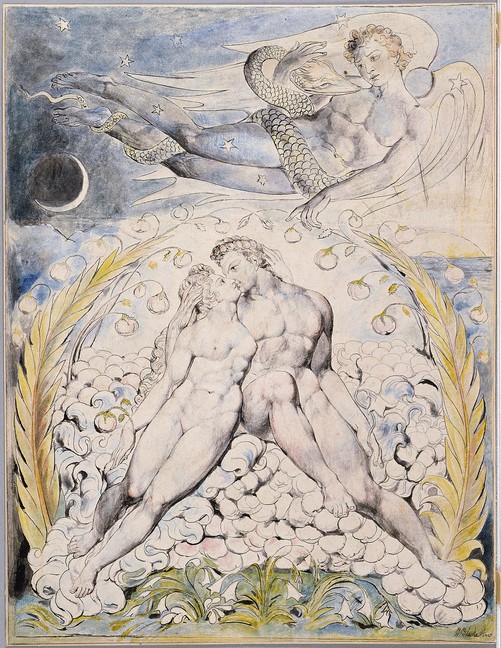
To all intents and purposes John Milton's epic, Paradise Lost has become a part of the Bible; most Bible students have their concept of Satan and his doings from Milton. Blake was deeply influenced by the prophet he considered his predecessor; he produced a series of pictures illustrating the work:

Are these apples (or some
other fruit)? Adam and Eve are in the lower plane, Satan up in the air.

We see Adam and Eve comfortably ensconced in the lower level.

Satan seems equally comfortable on a cloud with his pet snake.

In the story in Genesis 3 Satan is not named, but from that time the Serpent and Satan are two have been seen as two names for the same entity.


One of Blake's last works, Illustrations to the Book of Job, has several representations of Satan; here's one:
Satan has just been given permission by God (Job 2 to work his will on Job, but he can't take his life.)

(You may find here in this blog the whole series of pictures of Blake's Illustrations to the Book of Job. They are scattered through the posts of this blog between June 8 and July 25, 2010.)

When writing of a personal Satan Blake generally used the term, Spectre. In general Satan is the ruler of the (material) world; the Spectre is the ruler of you and me whenever we give in to a temptation to be less (spiritually) than we can be.

Once again in the system Blake created Satan and the Spectre are to be annihilated, but people go on to Eden (or perhaps a boot camp for it).

Sunday, October 17, 2010

HARVEST & VINTAGE

Revelations 14
[15] And another angel came out of the temple, crying with a loud voice to him that sat on the cloud, Thrust in thy sickle, and reap: for the time is come for thee to reap; for the harvest of the earth is ripe.
[16] And he that sat on the cloud thrust in his sickle on the earth; and the earth was reaped.
[17] And another angel came out of the temple which is in heaven, he also having a sharp sickle.
[18] And another angel came out from the altar, which had power over fire; and cried with a loud cry to him that had the sharp sickle, saying, Thrust in thy sharp sickle, and gather the clusters of the vine of the earth; for her grapes are fully ripe.
[19] And the angel thrust in his sickle into the earth, and gathered the vine of the earth, and cast it into the great winepress of the wrath of God.
[20] And the winepress was trodden without the city, and blood came out of the winepress, even unto the horse bridles, by the space of a thousand and six hundred furlongs.

S. Foster Damon, William Blake: Philosophy and Symbols, in commenting on the final scenes in the Four Zoas, says (Page 164):

AND GOD BLESSED THE SEVENTH
DAY AND SANCTIFIED IT
"In six days heaven and earth had been created, according to Genesis, and on the seventh day the Lord rested. In six days, therefore, that work is to be reversed, before the Sabbath of the Millennium can arise. These six days are spent in a final Harvest and Vintage of the world, to make the Bread and Wine of Eternity. Urizen threshes the corn which Urthona bakes into the Bread of Philosophy, while Luvah presses the grapes into the Wine of Ecstacy; and all the chaff and refuse is cast into Non-Entity. This lovely festival in the spiritual world is the reality of what on earth seems to be the final catastrophes of the Apocalypse. During this time Orc burns himself out: Ahania and Enion rise to their former Glory; Luvah and Vala regain their original State of Innocence; while Los takes on his original form, Urthona. The terrific vision ends in a splendid peace:

[Four Zoas, PAGE 139, Night the Ninth, (E 406)]:
"How is it we have walkd thro fires & yet are not consumd
How is it that all things are changd even as in ancient times

The Sun arises from his dewy bed & the fresh airs
Play in his smiling beams giving the seeds of life to grow
And the fresh Earth beams forth ten thousand thousand springs of
life
Urthona is arisen in his strength no longer now
Divided from Enitharmon no longer the Spectre Los
Where is the Spectre of Prophecy where the delusive Phantom
Departed & Urthona rises from the ruinous walls
In all his ancient strength to form the golden armour of science
For intellectual War The war of swords departed now
The dark Religions are departed & sweet Science reigns

End of The Dream"

The image of the harvest and vintage appears in Milton as well:

Milton, PLATE 25 [27] (E 121)
"The Wine-press on the Rhine groans loud, but all its central beams
Act more terrific in the central Cities of the Nations
Where Human Thought is crushd beneath the iron hand of Power.
There Los puts all into the Press, the Opressor & the Opressed
Together, ripe for the Harvest & Vintage & ready for the Loom.

They sang at the Vintage. This is the Last Vintage! & Seed
Shall no more be sown upon Earth, till all the Vintage is over
And all gatherd in, till the Plow has passd over the Nations
And the Harrow & heavy thundering Roller upon the mountains

And loud the Souls howl round the Porches of Golgonooza

Crying O God deliver us to the Heavens or to the Earths,
That we may preach righteousness & punish the sinner with death
But Los refused, till all the Vintage of Earth was gatherd in.

And Los stood & cried to the Labourers of the Vintage in voice of
awe.

Fellow Labourers! The Great Vintage & Harvest is now upon Earth
The whole extent of the Globe is explored: Every scatterd Atom
Of Human Intellect now is flocking to the sound of the Trumpet
All the Wisdom which was hidden in caves & dens, from ancient
Time; is now sought out from Animal & Vegetable & Mineral

The Awakener is come. outstretchd over Europe! the Vision of God
is fulfilled
The Ancient Man upon the Rock of Albion Awakes,
He listens to the sounds of War astonishd & ashamed;"

Milton, PLATE 27 [29] (E 124)
"This Wine-press is call'd War on Earth, it is the Printing-Press
Of Los; and here he lays his words in order above the mortal
brain
As cogs are formd in a wheel to turn the cogs of the adverse
wheel.

Milton, PLATE 43 [50], (E 144)
"To go forth to the Great Harvest & Vintage of the Nations

Finis"

As Damon says, Blake wrote on multiple levels simultaneously. On the historical level the harvest and vintage appeared as the battles and wars which were taking place in his own times - the Napoleonic Wars ("Wine-press on the Rhine groans loud".) In Blake's personal experience the activities of his publishing work were his participation in the 'Great Harvest & Vintage' ("the Printing-Press Of Los; and here he lays his words in order above the mortal brain"). At the spiritual level they were the rewinding of the 'golden string' which had begun to be unwound with the material creation which Blake pictured in the Book of Urizen ("Every scatterd Atom Of Human Intellect now is flocking to the sound of the Trumpet").

Genesis 1
[5] And God called the light Day, and the darkness he called Night. And the evening and the morning were the first day.
[8] And God called the firmament Heaven. And the evening and the morning were the second day.
[12] And the earth brought forth grass, and herb yielding seed after his kind, and the tree yielding fruit, whose seed was in itself, after his kind: and God saw that it was good.
[13] And the evening and the morning were the third day.
[17] And God set them in the firmament of the heaven to give light upon the earth,
[18] And to rule over the day and over the night, and to divide the light from the darkness: and God saw that it was good.
[19] And the evening and the morning were the fourth day.
[22] And God blessed them, saying, Be fruitful, and multiply, and fill the waters in the seas, and let fowl multiply in the earth.
[23] And the evening and the morning were the fifth day.
[27] So God created man in his own image, in the image of God created he him; male and female created he them
[31] And God saw every thing that he had made, and, behold, it was very good. And the evening and the morning were the sixth day.

Sunday, July 4, 2010

Job Picture 14

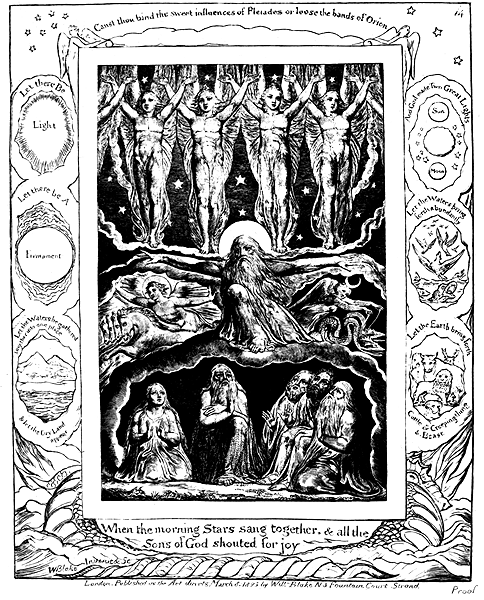
Picture 14:
We're still in Job 38; Edinger wrote on page 53 "At first Yahweh had appeared as an undifferentiated energy-phenomenon, the whirlwind; in this picture a structured universe is revealed in an image of totality."

I would say 13 was intensely awesome and 14 intensely creative--and beautiful. He said "out of the ordeal a world is born".

Following seven stars above the picture Blake wrote: "Canst thou bind the sweet influences of the Pleiades or loose the bands of Orion (Job 38:31).

Note the quotes on the Creation from Genesis 1 in the margins, on the left:
"Let there be light",
"Let there be a firmament"
"Let the waters be gathered
together in one place, and let the dry land appear"

And on the right:
"And God made two great lights"
"Let the waters bring forth abundantly"
"Let the earth bring forth cattle, and creeping thing, and beast" (These are all verses from Genesis 1.)

Underneath the picture Blake wrote: "When the morning Stars sang together, and all the Sons of God shouted for joy" (Job 38:7)

This is the dawn after the darkness; we might consider it a mark of Job's rebirth. As gruesome as Job's test appeared, good things happen from now on (Picture 15 appears pretty awful, but it's something that Job and his wife watch rather than suffer.) Hereafter the Illustrations for The Book of Job get increasingly sunny!