Showing posts with label Joy. Show all posts

Friday, December 24, 2010

BLAKEAN CHRISTMAS CARD

This is Our Blakean Christmas Card.
The picture was inspired by one of Blake's images in the Small Book of Designs which is in the collection of the British Museum.

Read about Tharmas and this image in this post on our blog.

Northrop Frye has this to say about Tharmas on page 354 of Northrop Frey on Milton and Blake:
"The passage from death to rebirth is represented in Blake's symbolism by Tharmas, the power of renewing life. The ability of the individual to renew his life in resurrection is a break with the cycle, but in ordinary life such a renewal takes place only in the group or species, and within the cycle. Tharmas is symbolized by the sea, the end and beginning of life."


Picture after Blake’s Small Book of Designs in British Museum

William Blake: Vision of the Last Judgment
"There Exist in that Eternal
World the Permanent Realities of Every Thing which we
see are reflected in this Vegetable Glass of Nature All
Things are comprehended in their Eternal Forms in the
Divine body of the Saviour the True Vine of Eternity
The Human Imagination who appeard to Me as Coming to
Judgment. among his Saints & throwing off the Temporal
that the Eternal might be Establishd."

Luke 2:28-32
Then took he him up in his arms, and blessed God, and said, Lord,
now lettest thou thy servant depart in peace, according to thy word:
For mine eyes have seen thy salvation,
Which thou hast prepared before the face of all people;
A light to lighten the Gentiles, and the glory of thy people Israel.

Wednesday, August 25, 2010

CONTEMPLATION

One of Blake's very early poems which appeared in Poetical Sketches, soars to the height of affirmation and plunges to the depths of depression. Although this is one of the group of poems which were actually published in conventional book form by some of Blake's friends in his youth, Blake was not pleased enough with them to want them circulated. The value to us in reading them, is in noticing the intimations of the themes and symbolism which he would develop with greater depth and complexity in his later work. Contemplation also can be enjoyed for its imagery which is reminiscent of other romantics. The poem ends abruptly as if the author had not reached a point in his life where he could find any reconciliation between the joys and sorrows of life.

Poetical Sketches, (E 442)
CONTEMPLATION.

"Who is this, that with unerring step dares tempt the wilds, where
only Nature's foot hath trod? 'Tis Contemplation, daughter of the
grey Morning! Majestical she steppeth, and with her pure quill on
every flower writeth Wisdom's name. Now lowly bending, whispers
in mine ear, "O man, how great, how little thou! O man, slave of
each moment, lord of eternity! seest thou where Mirth sits on the
painted cheek? doth it not seem ashamed of such a place, and grow
immoderate to brave it out? O what an humble garb true joy puts
on! Those who want Happiness must stoop to find it; it is a
flower that grows in every vale. Vain foolish man, that roams on
lofty rocks! where, 'cause his garments are swoln with wind, he
fancies he is grown into a giant! Lo then, Humility, take it, and
wear it in thine heart; lord of thyself, thou then art lord of
all. Clamour brawls along the streets, and destruction hovers in
the city's smoak; but on these plains, and in these silent woods,
true joys descend: here build thy nest; here fix thy staff;
delights blossom around; numberless beauties blow; the green
grass springs in joy, and the nimble air kisses the leaves; the
brook stretches its arms along the velvet meadow, its silver
inhabitants sport and play; the youthful sun joys like a hunter
rouzed to the chace: he rushes up the sky, and lays hold on the
immortal coursers of day; the sky glitters with the jingling
trappings! Like a triumph, season follows season, while the airy
music fills the world with joyful sounds." I answered, "Heavenly
goddess! I am wrapped in mortality, my flesh is a prison, my
bones the bars of death, Misery builds over our cottage roofs,
and Discontent runs like a brook. Even in childhood, Sorrow
slept with me in my cradle; he followed me up and down in the
house when I grew up; he was my school-fellow: thus he was in my
steps and in my play, till he became to me as my brother. I
walked through dreary places with him, and in church-yards; and I
oft found myself sitting by Sorrow on a tomb-stone!"

Monday, July 19, 2010

OLOLON

In Plate 31 of Milton, a contrast is seen between the way things appear in the fallen world and in the unfallen world. The first paragraph quoted below concerns Satan and Rahab, Generation, Kingdoms of the Earth, War and Strife. All of the Living creatures of the Four Element are wailing in bitter lament. They weep because "they see the Lord coming in the Clouds of Ololon with Power & Great Glory!"

Beulah is said to weep also, but the lamentation of Beulah is seen as a vision the greatest beauty, joy and hope. The eyes of vision see the loveliest things of the natural world as expressing the culmination which will result from Ololon's sacrificial descent following Milton in his return to the world of matter.

The world of suffering, war, and strife should welcome the prospect of the Lord's arrival, for it will initiate the world of love, and peace and brotherhood. But it is not so. First an open mind, a receptive heart, a gentle hand, and an intuitive soul must grow in man. The vision cannot appear until we have prepared ourselves for it.

Milton, Plate 31 [34], (E 130)
"And all the Living Creatures of the Four Elements, wail'd
With bitter wailing: these in the aggregate are named Satan
And Rahab: they know not of Regeneration, but only of Generation
The Fairies, Nymphs, Gnomes & Genii of the Four Elements
Unforgiving & unalterable: these cannot be Regenerated
But must be Created, for they know only of Generation
These are the Gods of the Kingdoms of the Earth: in contrarious
And cruel opposition: Element against Element, opposed in War
Not Mental, as the Wars of Eternity, but a Corporeal Strife
In Los's Halls continual labouring in the Furnaces of Golgonooza
Orc howls on the Atlantic: Enitharmon trembles: All Beulah weeps

Thou hearest the Nightingale begin the Song of Spring;
The Lark sitting upon his earthy bed: just as the morn
Appears; listens silent; then springing from the waving
Corn-field! loud
He leads the Choir of Day! trill, trill, trill, trill,
Mounting upon the wings of light into the Great Expanse:
Reecchoing against the lovely blue & shining heavenly Shell:
His little throat labours with inspiration; every feather
On throat & breast & wings vibrates with the effluence Divine
All Nature listens silent to him & the awful Sun
Stands still upon the Mountain looking on this little Bird

With eyes of soft humility, & wonder love & awe.
Then loud from their green covert all the Birds begin their Song
The Thrush, the Linnet & the Goldfinch, Robin & the Wren
Awake the Sun from his sweet reverie upon the Mountain:
The Nightingale again assays his song, & thro the day,
And thro the night warbles luxuriant; every Bird of Song
Attending his loud harmony with admiration & love.
This is a Vision of the lamentation of Beulah over Ololon!

Thou percievest the Flowers put forth their precious Odours!
And none can tell how from so small a center comes such sweets
Forgetting that within that Center Eternity expands
Its ever during doors, that Og & Anak fiercely guard[.]
First eer the morning breaks joy opens in the flowery bosoms
Joy even to tears, which the Sun rising dries; first the Wild Thyme
And Meadow-sweet downy & soft waving among the reeds.
Light springing on the air lead the sweet Dance: they wake
The Honeysuckle sleeping on the Oak: the flaunting beauty
Revels along upon the wind; the White-thorn lovely May
Opens her many lovely eyes: listening the Rose still sleeps
None dare to wake her. soon she bursts her crimson curtaind bed
And comes forth in the majesty of beauty; every Flower:
The Pink, the Jessamine, the Wall-flower, the Carnation
The Jonquil, the mild Lilly opes her heavens! every Tree,
And Flower & Herb soon fill the air with an innumerable Dance
Yet all in order sweet & lovely, Men are sick with Love!
Such is a Vision of the lamentation of Beulah over Ololon"

Advice from the apostle Paul:
Philippians
4:6-7 - Don't worry over anything whatever; tell God every detail of your needs in earnest and thankful prayer, and the peace of God which transcends human understanding, will keep constant guard over your hearts and minds as they rest in Christ Jesus.
4:8-9 - Here is a last piece of advice. If you believe in goodness and if you value the approval of God, fix your minds on the things which are holy and right and pure and beautiful and good. Model your conduct on what you have learned from me, on what I have told you and shown you, and you will find the God of peace will be with you.

J. B. Phillips translation of the New Testament

Sunday, July 4, 2010

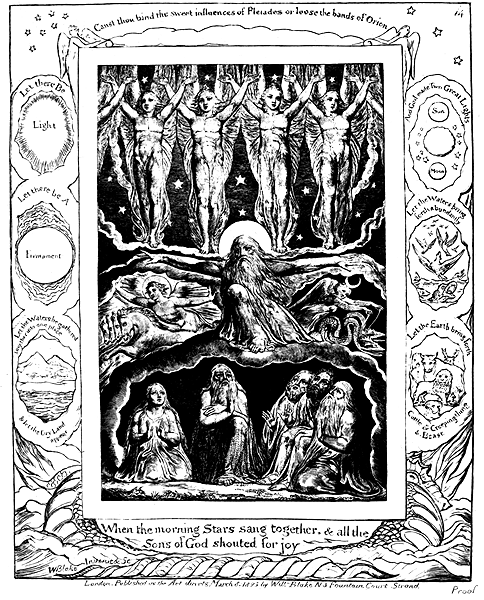
Job Picture 14

Picture 14:
We're still in Job 38; Edinger wrote on page 53 "At first Yahweh had appeared as an undifferentiated energy-phenomenon, the whirlwind; in this picture a structured universe is revealed in an image of totality."

I would say 13 was intensely awesome and 14 intensely creative--and beautiful. He said "out of the ordeal a world is born".

Following seven stars above the picture Blake wrote: "Canst thou bind the sweet influences of the Pleiades or loose the bands of Orion (Job 38:31).

Note the quotes on the Creation from Genesis 1 in the margins, on the left:
"Let there be light",
"Let there be a firmament"
"Let the waters be gathered
together in one place, and let the dry land appear"

And on the right:
"And God made two great lights"
"Let the waters bring forth abundantly"
"Let the earth bring forth cattle, and creeping thing, and beast" (These are all verses from Genesis 1.)

Underneath the picture Blake wrote: "When the morning Stars sang together, and all the Sons of God shouted for joy" (Job 38:7)

This is the dawn after the darkness; we might consider it a mark of Job's rebirth. As gruesome as Job's test appeared, good things happen from now on (Picture 15 appears pretty awful, but it's something that Job and his wife watch rather than suffer.) Hereafter the Illustrations for The Book of Job get increasingly sunny!

Thursday, May 20, 2010

JOY & WOE

Auguries of Innocence (E491)
...
"It is right it should be so
Man was made for Joy & Woe
And when this we rightly know
Thro the World we safely go
Joy & Woe are woven fine
A Clothing for the soul divine
Under every grief & pine
Runs a joy with silken twine
The Babe is more than swadling Bands
Throughout all these Human Lands"

In these few line Blake tells us a lot about his system: his means of organizing or giving meaning to life as it has come to him. He recognizes that our minds operate through dualistic processing. It is right that we experience and understand things by splitting them into opposites. But here is a danger in identifying an aspect of the divided world as 'the good' and another as the 'not good'. The opposites should be woven together and recognized as not the reality itself, but as the garment that clothes the Identity which is Eternal. In this world we are inclined to see the outer woes and miss the inner joys which are hidden beneath them. Within each us of is a 'Babe' prepared to develop its spiritual nature which allows one to live Eternally even when bound in the clothes of time and matter.

....................Contraries......................
Joy________ Woe
Imagination__ Reason and Emotion
Eternity_____ This World
Innocence___ Experience

The 'Babe' is neither joy nor woe, but 'that of God in everyone' (Quaker), 'Christ in you' (Paul), the 'Divine Humanity' (Blake) or the 'Divine Child' (Jung).

God Becomes as We Are
There is No Natural Religion (E 3)