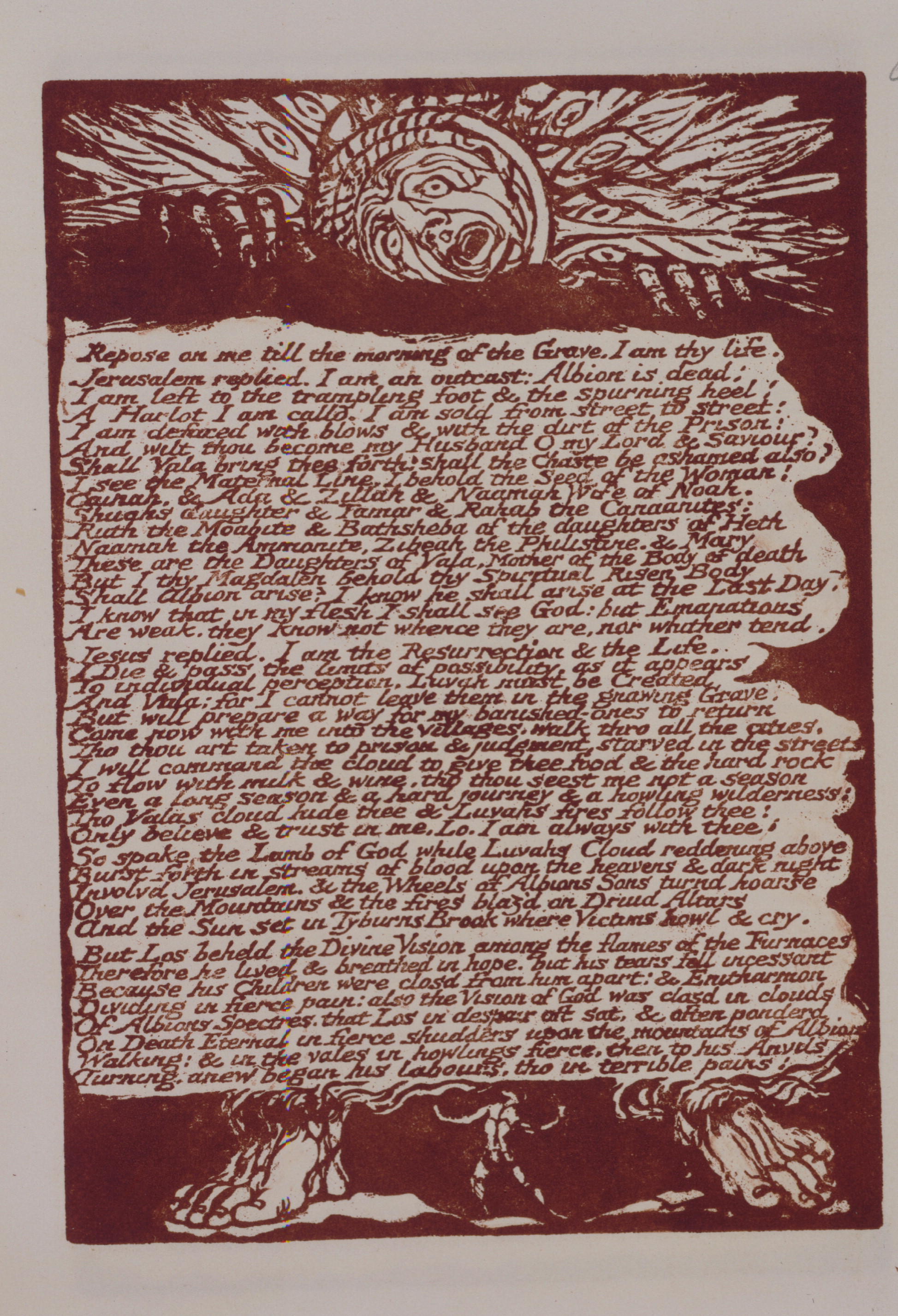
Showing posts with label Jerusalem. Show all posts

Sunday, February 6, 2011

JERUSALEM'S SORROW


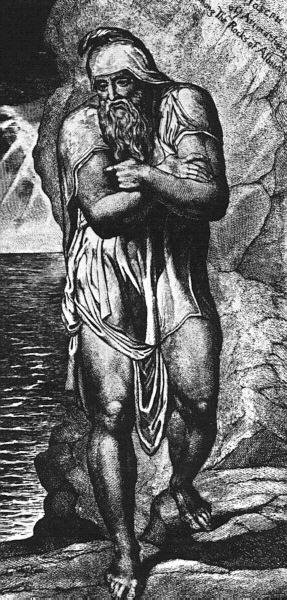
Illustration of Robert Blair's The Grave (1808), painted by William Blake and engraved by Luigi Schiavonetti.


I've tried to discern what Blake is saying psychologically in this passage about Jerusalem. It seems he is describing the awakening of an archetype from the unconscious. The idea of Jerusalem existed in a mind which was unified, in which there was no duality, in which the contraries were equally true. Blake is describing his vision of Eternity or of the unconscious when he talks of 'sports of intellect', 'Thunder in the midst of kindness', 'love that kills', death 'for a period.'


Jerusalem, Plate 48, (E 196)
"Beneath the bottoms of the Graves, which is Earths central joint,
There is a place where Contrarieties are equally true:
(To protect from the Giant blows in the sports of intellect,
Thunder in the midst of kindness, & love that kills its beloved:
Because Death is for a period, and they renew tenfold.)
From this sweet Place Maternal Love awoke Jerusalem
With pangs she forsook Beulah's pleasant lovely shadowy Universe
Where no dispute can come; created for those who Sleep.

Weeping was in all Beulah, and all the Daughters of Beulah
Wept for their Sister the Daughter of Albion, Jerusalem:
When out of Beulah the Emanation of the Sleeper descended
With solemn mourning out of Beulahs moony shades and hills:
Within the Human Heart, whose Gates closed with solemn sound.

And this the manner of the terrible Separation
The Emanations of the grievously afflicted Friends of Albion
Concenter in one Female form an Aged pensive Woman.
Astonish'd! lovely! embracing the sublime shade: the Daughters of Beulah
Beheld her with wonder! With awful hands she took
A Moment of Time, drawing it out with many tears & afflictions
And many sorrows: oblique across the Atlantic Vale
Which is the Vale of Rephaim dreadful from East to West,
Where the Human Harvest waves abundant in the beams of Eden
Into a Rainbow of jewels and gold, a mild Reflection from
Albions dread Tomb. Eight thousand and five hundred years
In its extension. Every two hundred years has a door to Eden
She also took an Atom of Space, with dire pain opening it a Center
Into Beulah: trembling the Daughters of Beulah dried
Her tears. she ardent embrac'd her sorrows. occupied in labours
Of sublime mercy in Rephaims Vale. Perusing Albions Tomb
She sat: she walk'd among the ornaments solemn mourning.
The Daughters attended her shudderings, wiping the death sweat
Los also saw her in his seventh Furnace, he also terrified
Saw the finger of God go forth upon his seventh Furnace:
Away from the Starry Wheels to prepare Jerusalem a place.
When with a dreadful groan the Emanation mild of Albion.
Burst from his bosom in the Tomb like a pale snowy cloud,
Female and lovely, struggling to put off the Human form
Writhing in pain. The Daughters of Beulah in kind arms reciev'd
Jerusalem: weeping over her among the Spaces of Erin,
In the Ends of Beulah, where the Dead wail night & day."

The awakening of Jerusalem is a way to express the differentiation of her archetype from the undifferentiated, fluid, malleable, expandable unconscious. The pangs she suffered as the 'forsook' the 'shadow Universe' are indicative of the struggle to bring content from the unconscious to the conscious mind. The gates of the unconscious closed behind her; passage between the two is restricted. Entering the conscious mind exposes the archetype to time and space which were unknown in the unconscious. Jerusalem whose character is developed as Unified Man's spiritual awareness is being given form, the Human Form. The conscious mind can now begin to understand the meaning of the archetype, how it functions, what it brings to the totality.

Los has a fond appreciation for Jerusalem which he expresses on Plate 86:

Jerusalem, PLATE 86, (E 244)
"I see thy Form O lovely mild Jerusalem, Wingd with Six Wings
In the opacous Bosom of the Sleeper, lovely Three-fold
In Head & Heart & Reins, three Universes of love & beauty
Thy forehead bright: Holiness to the Lord, with Gates of pearl
Reflects Eternity beneath thy azure wings of feathery down
Ribbd delicate & clothd with featherd gold & azure & purple
From thy white shoulders shadowing, purity in holiness!"

Thursday, January 27, 2011

RAINBOW of REVELATIONS

The three principle Biblical passages which make use of the image of the rainbow are the passage in Genesis (Noah), the section of Ezekiel in my last post, and the 10th chapter of Revelations:

Rev.10
[1] And I saw another mighty angel come down from heaven, clothed with a cloud: and a rainbow was upon his head, and his face was as it were the sun, and his feet as pillars of fire:
[2] And he had in his hand a little book open: and he set his right foot upon the sea, and his left foot on the earth,
[3] And cried with a loud voice, as when a lion roareth: and when he had cried, seven thunders uttered their voices.
[4] And when the seven thunders had uttered their voices, I was about to write: and I heard a voice from heaven saying unto me, Seal up those things which the seven thunders uttered, and write them not.
[5] And the angel which I saw stand upon the sea and upon the earth lifted up his hand to heaven,
[6] And sware by him that liveth for ever and ever, who created heaven, and the things that therein are, and the earth, and the things that therein are, and the sea, and the things which are therein, that there should be time no longer:
[7] But in the days of the voice of the seventh angel, when he shall begin to sound, the mystery of God should be finished, as he hath declared to his servants the prophets.
[8] And the voice which I heard from heaven spake unto me again, and said, Go and take the little book which is open in the hand of the angel which standeth upon the sea and upon the earth.
[9] And I went unto the angel, and said unto him, Give me the little book. And he said unto me, Take it, and eat it up; and it shall make thy belly bitter, but it shall be in thy mouth sweet as honey.
[10] And I took the little book out of the angel's hand, and ate it up; and it was in my mouth sweet as honey: and as soon as I had eaten it, my belly was bitter.
[11] And he said unto me, Thou must prophesy again before many peoples, and nations, and tongues, and kings.

The passage in Revelation like the passage in Ezekiel ends a vision with a voice calling to prophesy. Blake has once again chosen to illustrate the passage literally. We see with our eyes what John of Patmos saw as vision: the angel, the cloud the rainbow colors, the radiance of the face, the right foot and left foot on sea and earth, the little book in the left hand, the seven thunders as horsemen in the dark cloud and feet as pillars of fire. John himself is seen between the feet of the angel recording as directed.

The rainbow is one of many clues that this event of transition, the Revelation of the Apocalypse, is to link God and man. As a covenant was announced with the first rainbow appearance to Noah, a new dispensation is announced in Revelation. A new spiritual Jerusalem will replace the former Jerusalem whose temple had been intended to link God and man.

Blake's Vision of the Last Judgment provides us with images in words and pictures of the new dispensation which emanates from the Last Judgment. Blake includes these images of the new Jerusalem which is to replace the mortal with the immortal.

Vision of the Last Judgment,(E 561)
"The Cloud that opens rolling apart before the throne &
before the New Heaven & the New Earth is Composed of Various
Groupes of Figures particularly the Four Living Creatures
mentiond in Revelations as Surrounding the Throne these I suppose
to have the chief agency in removing the
old heavens & the old Earth
to make way for the New Heaven & the
New Earth to descend from the throne of God & of the Lamb."

Vision of the Last Judgment, (E 562)
"Jesus is surrounded by Beams of Glory in which are
seen all around him Infants emanating from him these represent
the Eternal Births of Intellect from the divine Humanity A
Rainbow surrounds the throne & the Glory in which youthful
Nuptials recieve the infants in their hands"

Perhaps the rainbow should always be seen as an invitation and a promise such as Blake issues here:

Vision of the Last Judgment, (E 560)
"If the Spectator could Enter into these Images in his
Imagination approaching them on the Fiery Chariot of his
Contemplative Thought if he could Enter into Noahs Rainbow or
into his bosom or could make a Friend & Companion of one of these
Images of wonder which always intreats him to leave mortal things
as he must know then would he arise from his Grave then would he
meet the Lord in the Air & then he would be happy"

Sunday, January 23, 2011

BLAKE'S RAINBOW

Blake uses the rainbow more as a visual image than a verbal image. Jerusalem appears here as a butterfly within the arc of a rainbow in the image at the bottom of Plate 14 of Jerusalem which shows Albion in his death-sleep. The heavenly bodies are portrayed as images in the plate, reminders of the universe measured in eons not minutes.

Jerusalem, Plate 13&14, (E 158)
"And all that has existed in the space of six thousand years:
Permanent, & not lost not lost nor vanishd, & every little act,
Word, work, & wish, that has existed, all remaining still
In those Churches ever consuming & ever building by the Spectres
Of all the inhabitants of Earth wailing to be Created:
Shadowy to those who dwell not in them, meer possibilities:
But to those who enter into them they seem the only substances
For every thing exists & not one sigh nor smile nor tear,

PLATE 14
One hair nor particle of dust, not one can pass away.

He views the Cherub at the Tree of Life, also the Serpent,
Orc the first born coild in the south: the Dragon Urizen:
Tharmas the Vegetated Tongue even the Devouring Tongue:
A threefold region, a false brain: a false heart:
And false bowels: altogether composing the False Tongue,
Beneath Beulah: as a watry flame revolving every way
And as dark roots and stems: a Forest of affliction, growing
In seas of sorrow. Los also views the Four Females:
Ahania, and Enion, and Vala, and Enitharmon lovely.
And from them all the lovely beaming Daughters of Albion,
Ahania & Enion & Vala, are three evanescent shades:
Enitharmon is a vegetated mortal Wife of Los:
His Emanation, yet his Wife till the sleep of death is past.

Such are the Buildings of Los! & such are the Woofs of
Enitharmon!"

The permanence and the multiplicity of the created world are described in the text. Blake has used words and images to remind us that there is an eternal world which underlies the vicissitudes of the temporal world. Because the image of the rainbow (which appeared after the Flood of Noah), is seen on this plate, Blake is going beyond the idea of an account of the physical body or the world of matter. The use of the rainbow makes the plate a token of a benevolent God's infinite care. We must remember that Blake uses water as a symbol for the material. To say that the world will not be destroyed by flood is to say the materiality shall not overcome spirituality.

When we seek out the biblical references for the rainbow we find this passage in Genesis 9:

[11] And I will establish my covenant with you; neither shall
all flesh be cut off any more by the waters of a flood; neither shall
there any more be a flood to destroy the earth.
[12] And God said, This is the token of the covenant which I make between me and you and every living creature that is with you, for perpetual generations:
[13] I do set my bow in the cloud, and it shall be for a token of a covenant between me and the earth.
[14] And it shall come to pass, when I bring a cloud over the earth, that the bow shall be seen in the cloud:
[15] And I will remember my covenant, which is between me and you and every living creature of all flesh; and the waters shall no more become a flood to destroy all flesh.
[16] And the bow shall be in the cloud; and I will look upon it, that I may remember the everlasting covenant between God and every living creature of all flesh that is upon the earth.
[17] And God said unto Noah, This is the token of the covenant, which I have established between me and all flesh that is upon the earth.

Genesis states that God covenants not to repeat the destruction of the earth and all living things by flood. The covenant is among God, man and the living creatures of the earth. The rainbow is a token of the covenant which is everlasting.

In Blake's 28 illustrations to Pilgrim's progress the rainbow colors appear frequently as reminders of the rainbow as a token. The rainbow image itself is prominent in three plates: the first, the last, and Plate 17 - CHRISTIAN AT THE ARBOR. In Plate One the arc of the rainbow previews the pilgrim's journey as a reminder of God's providence as man travels through life. Christian at the Arbor shows the linkage between God and man, a reference to the incarnation through which physicality and spirituality become one. The rainbow above the arbor symbolizes that linkage. In the final picture, in which the fourfold ascension is portrayed, the pilgrims and angels are embedded in the rainbow becoming themselves tokens of the process of reaching the visionary goal.
Plate I, THE DREAMER DREAMS A DREAM

Thursday, October 14, 2010

Blake's Death


For Blake the word, death, had many meanings:

1. Physical death:
Quoting Damon p. 99: 
"Death of the physical body is the shedding of the shell (garment, robe) which the soul, or spiritual body has grown for protection in this world.  It's the return of the soul to Eternity.  It is an episode of life, a state through which one passes, awakening to Eternal life (J 4:1-2)".

Blake indicated the nature of physical death, particularly of his brother, Robert's death in a letter (9) to Hayley he wrote:

      "Thirteen years ago. I lost a  brother & with his spirit  I  converse daily & hourly in the  spirit. & See him in my
remembrance in the regions of my  imagination.
I hear his advice & even now write from his  Dictate--"

2. For Blake Eternal Death, itself seemed to have many meanings:
Among other things it seems to concern Ulro and the Spectre. Looking at The Four Zoas we read:
"There is from Great Eternity a mild & pleasant rest
Namd Beulah a Soft Moony Universe feminine lovely
Pure mild & Gentle given in Mercy to those who sleep
Eternally. Created by the Lamb of God around
On all sides within & without the Universal Man
The Daughters of Beulah follow sleepers in all their Dreams
Creating Spaces lest they fall into Eternal Death

The Circle of Destiny complete they gave to it a Space
And namd the Space Ulro & brooded over it in care & love
They said The Spectre is in every man insane & most
Deformd Thro the three heavens descending in fury & fire
We meet it with our Songs & loving blandishments & give
To it a form of vegetation But this Spectre of Tharmas
Is Eternal Death
What shall we do O God pity & help"
(The Four Zoas [Nt 1], 5.42; E303)  
Elsewhere in  Milton 4.15; Erdman 98 he reported this
conversation between Los and Satan:

"Satan was going to reply, but Los roll'd his loud thunders.
Anger me not! thou canst not drive the Harrow in pitys paths.
Thy Work is Eternal Death, with Mills & Ovens & Cauldrons.
Trouble me no more. thou canst not have Eternal Life
So Los spoke! Satan trembling obeyd weeping along the way.
Mark well my words, they are of your eternal Salvation"
Satan and the Spectre of course are synonymous. 
"And Milton said, I go to Eternal Death!" 
If you get the picture Milton, in Heaven, choses the path the 
Savior trod; he incarnated; he came down from Heaven into
Earth and for a similar purpose.  But here the meaning of
Eternal seems very clearly mortal life.
There are many other instances of the words in Milton.

Turning to Jerusalem Blake makes it pretty clear in Plate 4:
"Of the Sleep of Ulro! and of the passage through
Eternal Death! and of the awaking to Eternal Life."
It would be very worthwhile to read this plate carefully.
The last occurrence of Eternal Death in Jerusalem occurs in 
Plate 98 lines 21-24:
"Driving outward the Body of Death in an Eternal Death &
Resurrection
Awaking it to Life among the Flowers of Beulah rejoicing in Unity
In the Four Senses in the Outline the Circumference & Form, for
ever
In Forgiveness of Sins which is Self Annihilation." (E257)

(I wonder if he was thinking of Romans 7 when he spoke of the 
Body of Death.  The forgiveness of sins is Self Annihilation, the
end of mortal life.)                                                 
                                               

Saturday, October 9, 2010

BLAKE'S TRIAL

Image from "William Blake's illustrations to the Divine Comedy"

William Blake had the misfortune of being placed on trial for sedition in 1803. Although Blake was acquitted in the matter, David Erdman believes that the ordeal caused Blake to become cautious in speaking out on the subject of politics. The episode began with Blake removing from his garden a private in the Royal Dragoons. Schofield brought charges of 'assault and Seditious words.' For five months it was uncertain if Blake would be found guilty and imprisoned or could resume his normal artistic pursuits without fear of harassment. Britain was at war and there was little tolerance for dissent against the empire. The stress took a toll on William and Catherine.

David V Erdman, in William Blake: Prophet Against Empire commented on the incident which led to the accusations and the effect it had on Blake and his poetry in his chapter 'Another England There'.

These are quotes from Erdman's Chapter 22:

Page 412
"Inevitably the effect of the experience was to intensify Blake's self-censorship and the tension between man and prophet. He parades his name and address and declares his theme to be social and contemporary - 'I write in South Molton Street, what I both see and hear In regions of Humanity, in London's opening streets' (J 34[38]). Yet he seeks to prevent 'Satan's Watch-fiends' from entering into the meaning of what he writes by concealing, as he says in riddles, the 'Gate' in his own head (J 35[39]. He tempts the curious with reverse writing which must be read in a mirror."...
Page 414
"The most immediate poetic record of Blake's suffering in time of trial, however, is the plaintive notebook ballad partly incorporated in the preface to the third chapter of Jerusalem and partly transcribed into another manuscript as The Grey Monk. This story of a tortured pacifist who will not recant is associated with Blake's trial by the fact that the Gothic courtroom of Chichester was known to have been the chancel of a Grey Friars convent church. The monk's martyrdom is that of an honest man who has written against war and empire and whose writings have been found out."
Page 415
"To write against War has nevertheless been his duty as a soldier of Christ, and he is ready to endure the tortures of 'the wrack & grinding chain' for the sake of his 'Brother,' the poor man, 'starved between two walls' (that is to say, in the street) and the poor man's children, whose cry ever 'my Soul appalls.'"

Erdman tells us that in the original draft the 'lazy monk' was the 'seditious monk'.

Here is the passage in Jerusalem, (Plate 52, (E 201)) associated with Blake's 'run in with the law':

"I saw a Monk of Charlemaine
Arise before my sight
I talkd with the Grey Monk as we stood
In beams of infernal light

Gibbon arose with a lash of steel
And Voltaire with a wracking wheel
The Schools in clouds of learning rolld
Arose with War in iron & gold.

Thou lazy Monk they sound afar
In vain condemning glorious War
And in your Cell you shall ever dwell
Rise War & bind him in his Cell.

The blood. red ran from the Grey Monks side
His hands & feet were wounded wide
His body bent, his arms & knees
Like to the roots of ancient trees

When Satan first the black bow bent
And the Moral Law from the Gospel rent
He forgd the Law into a Sword
And spilld the blood of mercys Lord.

Titus! Constantine! Charlemaine!
O Voltaire! Rousseau! Gibbon! Vain
Your Grecian Mocks & Roman Sword
Against this image of his Lord!

For a Tear is an Intellectual thing;
And a Sigh is the Sword of an Angel King
And the bitter groan of a Martyrs woe
Is an Arrow from the Almighties Bow!"

Here is a link to the longer poem,
The Grey Monk, from the Pickering Manuscript, (E 489).

Saturday, July 24, 2010

Vala

In the beginning Blake called The Four Zoas Vala. The emanation of Luvah, she has a checkered career. In Eternity she is Jerusalem; fallen she became Vala, somewhat comparable to Eve in the garden. She carries all creation, all love, but in Ulro love is totally bad (not so in regeneration and in Eternity).

Vala was the contrary (opposite) of Jerusalem (the bride of Christ). She represents all the negativity of the feminine character. She also goes by the names of Rahab and Tirzah.

Hear Vala in the beginning of the poem:

"Hear! I will sing a Song of Death! it is a Song of Vala!
The Fallen Man takes his repose: Urizen sleeps in the porch
Luvah and Vala woke & flew up from the Human Heart
Into the Brain; from thence upon the pillow Vala slumber'd.
And Luvah seiz'd the Horses of Light, & rose into the Chariot of Day
Sweet laughter siezd me in my sleep! silent & close I laughd
For in the visions of Vala I walkd with the mighty Fallen One
I heard his voice among the branches, & among sweet flowers."
(Four Zoas 1:10-16, E 305)

So we can see that in Blake's myth Vala occupied the same symbolic role that Eve did in the Garden.

In The Four Zoas Blake used two kinds of daughters , who collectively represented Jerusalem and Vala:
1. Daughters of Beulah (Inspiration) are devoted to the well-being of man. They guarded the body of Albion in his mortal sleep on the Rock of Ages.

2. Daughters of Albion (Memory), obeying Reason weave the natural world of spiritual depravity.

In the poem Jerusalem we read: "The fallen Albion meets Vala and hears her say "Know me now Albion: look upon me. I alone am Beauty The Imaginative Human Form is but a breathing of Vala. I breathe him forth into the Heaven from my secret Cave, Born of the Woman to obey the Woman O Albion the mighty For the Divine appearance is Brotherhood, but I am love." (Jerusalem 29.49-52; E176)

And this from wiki : "Albion and Vala are deeply connected in Blake's myth. Originally, Albion was also with Jerusalem, but he abandons her after she claims that both Vala and Albion are too obsessed with the idea of sin. Jerusalem's fall provokes Vala to claim that she is the triumphant beauty and embraces materialism along with statements that women are dominant. Los rejects these claims and defends mankind. Although she has entered into a fallen state, from her line Jesus would be born. In the fallen state, she promotes revenge, jealousy, and justice during war. When she is redeemed after the Final Judgment, she is joined [as Jerusalem] with Albion as his bride. This allows for a union between mankind and the divine."

More on Vala may be found here and here.

Sunday, June 27, 2010

AWAKE, AWAKE


Speaking of this plate, Erdman informs us in The Illuminated Blake: "The full picture adumbrates the full plot of the poem, while illustrating the opening lines".


At the beginning of the first chapter of Jerusalem Blake sets forth a theme: he writes about the passage through Eternal Death (the inability to discern the Divine Image), and the awakening to Eternal Life (the life lived as a member of the Divine Family).


Jerusalem, Chap I, Plate 4, (E 146)

"Of the Sleep of Ulro! and of the passage through
Eternal Death! and of the awaking to Eternal Life.

This theme calls me in sleep night after night, & ev'ry morn
Awakes me at sun-rise, then I see the Saviour over me
Spreading his beams of love, & dictating the words of this mild
song.

Awake! awake O sleeper of the land of shadows, wake! expand!
I am in you and you in me, mutual in love divine:
Fibres of love from man to man thro Albions pleasant land.
In all the dark Atlantic vale down from the hills of Surrey
A black water accumulates, return Albion! return!
Thy brethren call thee, and thy fathers, and thy sons,
Thy nurses and thy mothers, thy sisters and thy daughters
Weep at thy souls disease, and the Divine Vision is darkend:
Thy Emanation that was wont to play before thy face,
Beaming forth with her daughters into the Divine bosom
[Where!!]
Where hast thou hidden thy Emanation lovely Jerusalem
From the vision and fruition of the Holy-one?
I am not a God afar off, I am a brother and friend;
Within your bosoms I reside, and you reside in me:
Lo! we are One; forgiving all Evil; Not seeking recompense!
Ye are my members O ye sleepers of Beulah, land of shades!

But the perturbed Man away turns down the valleys dark;"

Blake tells us the journey he wants us to take and the destination he wishes us to reach but his guidance is not necessarily adequate to insure our success. This website may give us some light for the dark valleys. Here we find an introduction to the book Jerusalem which can act as a primer in grasping the meaning of the book.

The author however offers this caveat: "Indeed, nearly every commentator has qualified their assessment of the poem by admitting that it is likely that no one will ever be able to explain fully the scope of Blake's poetic vision."

"Jerusalem: The Emanation of the Giant Albion, William Blake - Introduction." Nineteenth-Century Literary Criticism. Ed. Lynn M. Zott. Vol. 127. Gale Cengage, 2003. eNotes.com. 2006.

Friday, June 25, 2010

JERUSALEM & VALA

Four Zoas, Page 103, (E 376)
"Enitharmon wove in tears Singing Songs of Lamentations
.........
In Golgonoozas Furnaces among the Anvils of time & space
Thus forming a Vast family wondrous in beauty & love
And they appeard a Universal female form created
From those who were dead in Ulro from the Spectres of the dead
And Enitharmon namd the Female Jerusa[le]m the holy
Wondring she saw the Lamb of God within Jerusalems Veil
The divine Vision seen within the inmost deep recess
Of fair Jerusalems bosom in a gently beaming fire"

Jerusalem, Plate 20, (E 165)
"Wherefore hast thou shut me into the winter of human life
And clos'd up the sweet regions of youth and virgin innocence:
Where we live, forgetting error, not pondering on evil:
Among my lambs & brooks of water, among my warbling birds:
Where we delight in innocence before the face of the Lamb:
Going in and out before him in his love and sweet affection.

Vala replied weeping & trembling, hiding in her veil.

When winter rends the hungry family and the snow falls:
Upon the ways of men hiding the paths of man and beast,
Then mourns the wanderer: then he repents his wanderings & eyes
The distant forest; then the slave groans in the dungeon of stone.
The captive in the mill of the stranger, sold for scanty hire.
They view their former life: they number moments over and over;
Stringing them on their remembrance as on a thread of sorrow.
Thou art my sister and my daughter! thy shame is mine also!
Ask me not of my griefs! thou knowest all my griefs.

Jerusalem answer'd with soft tears over the valleys.

O Vala what is Sin? that thou shudderest and weepest
At sight of thy once lov'd Jerusalem! What is Sin but a little
Error & fault that is soon forgiven; but mercy is not a Sin
Nor pity nor love nor kind forgiveness! O! if I have Sinned
Forgive & pity me! O! unfold thy Veil in mercy & love!
Slay not my little ones, beloved Virgin daughter of Babylon
Slay not my infant loves & graces, beautiful daughter of Moab
I cannot put off the human form I strive but strive in vain
When Albion rent thy beautiful net of gold and silver twine;
Thou hadst woven it with art, thou hadst caught me in the bands
Of love; thou refusedst to let me go: Albion beheld thy beauty
Beautiful thro' our Love's comeliness, beautiful thro' pity.
The Veil shone with thy brightness in the eyes of Albion,
Because it inclosd pity & love; because we lov'd one-another!
Albion lov'd thee! he rent thy Veil! he embrac'd thee! he lov'd thee!
Astonish'd at his beauty & perfection, thou forgavest his furious love:
I redounded from Albions bosom in my virgin loveliness.
The Lamb of God reciev'd me in his arms he smil'd upon us:
He made me his Bride & Wife: he gave thee to Albion.
Then was a time of love: O why is it passed away!
"

Jerusalem asks the question, 'Why?' Why am I who lived in Eden or Eternity now locked in this body in the world of generation? Why are the ordinary pleasures of innocence and continual forgiveness in association with the Saviour shut off from me? Vala seems to know what has happened: the Eternal family has been torn apart,
Jerusalem is not in her accustomed home and the way of return is unknown. Vala explains the the usual behavior of wandering and return will instead now lead to confusion, limitations and the reasoning abstract. Man is trapped in the pattern of remembering instead of imagining. Jerusalem knows these restrictions to be 'mind forged manacles'.

Vala reminds Jerusalem that she is aware of conditions in which they now live. But Jerusalem tells Vala that what she calls sin was but error in Eternity and quickly forgiven. Jerusalem knows that her desire to love and pity and forgive is not sin. Jerusalem seeks forgiveness herself but pleads that her creative output not be destroyed. Jerusalem's involvement in the material world was not sought by her but came about through love and pity as did Vala's and Albion's. Now a new arrangement has been made (another mercy to lead to regeneration). Vala has been given to Albion: involvement in the natural to the Eternal/Fallen Man. Jerusalem has been given to Jesus: the spiritual consciousness to the Divine Body.


As one of the illustrations which Blake created for potential publication in Night Thoughts, this picture is not explicitly of Vala and Jerusalem. But as an image in which we can see the implicit as well as the explicit, they are present. The reclining woman is Vala as so portrayed in other pictures. She wears a crown and gazes into a mirror: the vegetable glass, a symbol for the material world. Cupid is her companion from the world of generation or the sexes. Sitting on the chair and playing the flute, as a symbol of imagination, is a figure not tuned to Vala's world. Her crown is not of gold but of laurel leaves. Unfortunately she cannot flee to the world which is her home because she is chained to the chair.

Wednesday, June 9, 2010

WITNESS to TRUTH

Stuart Curran in his chapter in Sublime Allegory (page 341) says, "Except for the apocalyptic concluding plates there are few distinct events in Jerusalem, which is why the reader feels himself caught in a labyrinth, fated to return again and again to the same land marks without discovering an egress." It is not about truth and falsehood, good and evil, consistency and confusion. Curren states that, "Los's striving is for comprehension, and progression in Blake's epic derives from the slowly maturing consolidation of error by which Los defines the logic of man's fallen state. What Los consolidates, significantly enough, is archetypes, and the underlying structure of Jerusalem is a single archetypal pattern successively repeated until Los can fathom the symbolic meaning of its 'Universal Attributes' (90:32) and use it to transfigure the fallen into the regenerated. The mind expands within like a spiral that at last encompasses the universe."

Jerusalem, Chapter 1, Plate 5, (E 148)
"For the Male is a Furnace of beryll: the Female is a golden Loom

Los cries: No Individual ought to appropriate to Himself
Or to his Emanation, any of the Universal Characteristics
Of David or of Eve, of the Woman, or of the Lord.
Of Reuben or of Benjamin, of Joseph or Judah or Levi
Those who dare appropriate to themselves Universal Attributes
Are the Blasphemous Selfhoods & must be broken asunder
A Vegetated Christ & a Virgin Eve, are the Hermaphroditic
Blasphemy, by his Maternal Birth he is that Evil-One
And his Maternal Humanity must be put off Eternally
Lest the Sexual Generation swallow up Regeneration
Come Lord Jesus take on thee the Satanic Body of Holiness

So Los cried in the Valleys of Middlesex in the Spirit of
Prophecy
While in Selfhood Hand & Hyle & Bowen & Skofeld appropriate
The Divine Names: seeking to Vegetate the Divine Vision
In a corporeal & ever dying Vegetation & Corruption
Mingling with Luvah in One. they become One Great Satan

Loud scream the Daughters of Albion beneath the Tongs & Hammer
Dolorous are their lamentations in the burning Forge
They drink Reuben & Benjamin as the iron drinks the fire
They are red hot with cruelty: raving along the Banks of Thames
And on Tyburns Brook among the howling Victims in loveliness
While Hand & Hyle condense the Little-ones & erect them into
A mighty Temple even to the stars: but they Vegetate
Beneath Los's Hammer, that Life may not be blotted out.

For Los said: When the Individual appropriates Universality
He divides into Male & Female: & when the Male & Female,
Appropriate Individuality, they become an Eternal Death.
Hermaphroditic worshippers of a God of cruelty & law!
Your Slaves & Captives; you compell to worship a God of Mercy.
These are the Demonstrations of Los, & the blows of my mighty
Hammer"

Blake's goal was to transform the world and he relentlessly pursued that goal. He knew that he could not impose his vision on the world or reach enough ears with his message to convince mankind of his truth. He knew that man will transform his world through transforming himself. So Blake left his testimony of what went on is his own soul as he was transformed through the Imagination within him.

Blake invites us to enter the struggle he underwent knowing that each individual will undergo his own struggle not a repeat of that of Blake. That is why Blake left no recipe or set of instruction for developing spiritually. What ever speaks to your inner being from Blake's accounts is what Blake has to provide for your development. What can any of us do but be a witness to the truth that became manifest through our experience? Blake was gifted in seeing into his own depths, and in communicating in images. His message has been broadcast, we have receivers to acquire the signal and put it to use.

Looking Down or Looking Up

Tuesday, May 18, 2010

READING SYMBOLS

In 1904 two scholars at the Victoria and Albert Museum published the text for Blake's Jerusalem together with their introduction. Eric Maclagen and Archibald Russell had a gift for a profound understanding of Blake symbolic system. They were able to see in the poem at the beginning of the second chapter of Jerusalem a precis of the entire contents of of the book Jerusalem . I hope you will find this section as enlightening in developing an ability to read Blake with understanding as I do.

Jerusalem, Plate 27, (E 171)

"The fields from Islington to Marybone,
To Primrose Hill and Saint Johns Wood:
Were builded over with pillars of gold,
And there Jerusalems pillars stood.

Her Little-ones ran on the fields
The Lamb of God among them seen
And fair Jerusalem his Bride:
Among the little meadows green.

Pancrass & Kentish-town repose
Among her golden pillars high:
Among her golden arches which
Shine upon the starry sky.

The Jews-harp-house & the Green Man;
The Ponds where Boys to bathe delight:
The fields of Cows by Willans farm:
Shine in Jerusalems pleasant sight.

She walks upon our meadows green:
The Lamb of God walks by her side:
And every English Child is seen,
Children of Jesus & his Bride,

Forgiving trespasses and sins
Lest Babylon with cruel Og,
With Moral & Self-righteous Law
Should Crucify in Satans Synagogue!

What are those golden Builders doing
Near mournful ever-weeping Paddington
Standing above that mighty Ruin
Where Satan the first victory won.

Where Albion slept beneath the Fatal Tree
And the Druids golden Knife,
Rioted in human gore,
In Offerings of Human Life

They groan'd aloud on London Stone
They groand aloud on Tyburns Brook
Albion gave his deadly groan,
And all the Atlantic Mountains shook

Albions Spectre from his Loins
Tore forth in all the pomp of War!
Satan his name: in flames of fire
He stretch'd his Druid Pillars far.

Jerusalem fell from Lambeth's Vale,
Down thro Poplar & Old Bow;
Thro Malden & acros the Sea,
In War & howling death & woe.

The Rhine was red with human blood:
The Danube rolld a purple tide:
On the Euphrates Satan stood:
And over Asia stretch'd his pride.

He witherd up sweet Zions Hill,
From every Nation of the Earth:
He witherd up Jerusalems Gates,
And in a dark Land gave her birth.

He witherd up the Human Form,
By laws of sacrifice for sin:
Till it became a Mortal Worm:
But O! translucent all within.

The Divine Vision still was seen
Still was the Human Form, Divine
Weeping in weak & mortal clay
O Jesus still the Form was thine.

And thine the Human Face & thine
The Human Hands & Feet & Breath
Entering thro' the Gates of Birth
And passing thro' the Gates of Death

And O thou Lamb of God, whom I
Slew in my dark self-righteous pride:
Art thou return'd to Albions Land!
And is Jerusalem thy Bride?

Come to my arms & never more
Depart; but dwell for ever here:
Create my Spirit to thy Love:
Subdue my Spectre to thy Fear,

Spectre of Albion! warlike Fiend!
In clouds of blood & ruin roll'd:
I here reclaim thee as my own
My Selfhood! Satan! armd in gold.

Is this thy soft Family-Love
Thy cruel Patriarchal pride
Planting thy Family alone
Destroying all the World beside.

A mans worst enemies are those
Of his own house & family;
And he who makes his law a curse,
By his own law shall surely die.

In my Exchanges every Land
Shall walk, & mine in every Land,
Mutual shall build Jerusalem:
Both heart in heart & hand in hand."

Jesus reaching down

This is the section from the introduction to Jerusalem By William Blake, Eric Robert Dalrymple Maclagan, Archibald George Blomefield Russell:


"In this unfallen state the " fields " in the north, from east to west, the regions, that is, of instinctive life both on the side of emotion and on that of sensual perception, were the supports of the holy Imagination, through the pillars of intellect (gold being the metal of Urizen). The Imagination was the Bride of the Lamb of God, happy in many lovely and innocent ways, and every idea of man was the " child of Jesus and his Bride " in the religion of forgiveness, refusing to impute sin. But the peace is broken: the intellectual powers are busied with the western region of bodily things (and in particular the sense of the Tongue, through which came the first sin): and man falls into the sleep that we call the life of the body, shadowed by the tree of mystery, and passing from inspired religion to that false faith which demands bodily instead of mental sacrifice. He enters into mortal sorrow, and his hard rational power, called by Blake "Satan," separates itself from his loins (the place of judgment), and furiously enforces its legal morality. By this separation the imagination also is forced to depart, and passing eastward through mere emotionalism it is lost in grief. Further and further the reason asserts its dominion over the emotional life, and the happinesses of man (rivers) become stained with sensuality: in every phase of mental life the place of the imagination is restricted, and the power itself is forced into the dark land of corporeal life. By such a system of religion man is convinced of his own mortality, equaling himself with the worms: but nothing can wholly obscure the glory of the divine within him, even in the weakness and transience of the life between birth and death. This state is common to all mankind; and the poet identifies himself with the man whose fall he has narrated, and calls on the Lamb of God, the Divine Image whom he crucified, but who still makes his perpetual appeal to the heart of man: he implores him to mould the spiritual and to repress the merely rational life with the love and fear of God. For the reason is to be mastered, not to be abandoned; in all its selfish cruelty and pride of intellectual war it is still a true part of man, even when it tries to claim that its own children (the logical ideas) have alone the right to exist, though such a system is bound at last to be its own destruction. The true life knows no compulsion, but consists in mutual acceptance and forgiveness: for so can man be joined with man to build up Christianity, the religion of the Imagination."
______________
The poem leads us through sights and locations familiar to Blake, changes which he has observed, and the possibilities for further changes in a positive direction. Recognizing this as being written in symbolic language, the authors restate it in prosaic language. The restatement functions as a summation of the book Jerusalem itself. The poem makes more sense to our ordinary way of thinking when its symbols are revealed. Through the paraphrase of the poem we can see that it represents an outline of the whole book.

Monday, April 12, 2010

ALBION & ARTHUR

THE SLEEP OF ALBION is a chapter in Kathleen Raine's book, Golgoonoza: City of Imagination. In it Raine explores the relationship between King Arthur and Albion (the oldest name for Great Britain) in the mind of the British. She shows how Blake's Albion partakes of the legends surrounding King Arthur. As the legends of King Arthur end, he is entombed but not dead, sleeping until he is called to return to 'restore just rule to his kingdom and repel its enemies'.

Blake writes:
(Descriptive Catalogue, Number V, (E 543)):
"The giant Albion, was Patriarch of the Atlantic, he is
the Atlas of the Greeks, one of those the Greeks
called Titans. The stories of Arthur are the acts of
Albion, applied to a Prince of the fifth century, who
conquered Europe, and held the Empire of the world
in the dark age, which the Romans never again
recovered."

In Jerusalem, it is the Giant Albion who is "imagined in the similitude of Arthur". Albion's sleep is the sleep of Arthur. Raine says, "in recounting the 'acts of Albion' [Blake] considered himself to be recounting the sacred history - the inner history of the British nation from ancient times, with prophetic foresight of that future when Albion, like Arthur, is to wake from sleep."

To Raine the 'sleep' of Albion "is conceived by Blake not as the mere passage of time but as a state of apathy, of lowering of consciousness, of forgetfulness of higher things...Blake tells the story of how the nation has come to lapse into spiritual ignorance and forgetfulness...

"Blake is quite specific in his diagnosis of England's national disease: it is precisely that secular materialism ... upon which modern Western civilization is founded...

"Our society is forever thinking in terms of changing our circumstances; Blake's revolution will come when we change ourselves. From inner awakenings outer changes will follow...

"When Albion awakens he will find himself in his lost kingdom restored to its former glory; for the kingdom is ourselves...

"Paradise is not a place but a state of being, the lost kingdom to which the sleepers of Albion must someday awake."

Descriptive Catalogue, NUMBER V, (E 542)

The Ancient Britons:

"In the last Battle of King Arthur only Three Britons
escaped,
these were the Strongest Man, the
Beautifullest Man, and the
Ugliest Man; these three
marched through the field unsubdued, as
Gods,
and the Sun of Britain s[e]t, but shall arise again with

tenfold splendor when Arthur shall awake from sleep,
and resume
his dominion over earth and ocean."

Jerusalem, Plate19, Albion 'in pain & tears'

Monday, February 8, 2010

WEB OF LIFE

http://upload.wikimedia.org/wikipedia/commons/6/62/Blake_The_Clod.jpg


The field of Ecology which developed in the twentieth century, has a friend in William Blake of the nineteenth century. Both look at the world as a whole - one organic body with interconnections, and inter-dependences. Patterns are embodied in structures which are fluid and multi-dimensional.


The Web of Life: A New Scientific Understanding of Living Systems, Fritjoe Carpa, Page 295

"According to the Santiago theory, we bring forth the self just as we bring forth objects. Our self or ego, does not have any independent existence. This then is the crux of the human condition. We are autonomous individuals, shaped by our own history of structural changes. We are self-aware, aware of our individual identity - and yet when we look for an independent self within our world of experience we cannot find any such entity.

"Autopoiesis , or 'self-making,' is a network pattern in which the function of each component is to participate in the production or transformation of other components in the network. In this way the network is continually makes itself. It is produced by its components and in turn produces those components."

Jerusalem, Plate 99, (E 257)
"All Human Forms identified even Tree Metal Earth & Stone. all
Human Forms identified, living going forth & returning wearied
Into the Planetary lives of Years Months Days & Hours reposing
And then Awaking into his Bosom in the Life of Immortality.
And I heard the Name of their Emanations they are named Jerusalem

The End of The Song
of Jerusalem"
______________
Four Zoas, Page 133 (E 400)

"And One of the Eternals spoke All was silent at the feast

Man is a Worm wearied with joy he seeks the caves of sleep
Among the Flowers of Beulah in his Selfish cold repose
Forsaking Brotherhood & Universal love in selfish clay
Folding the pure wings of his mind seeking the places dark
Abstracted from the roots of Science then inclosd around
In walls of Gold we cast him like a Seed into the Earth
Till times & spaces have passd over him duly every morn
We visit him covering with a Veil the immortal seed
With windows from the inclement sky we cover him & with walls
And hearths protect the Selfish terror till divided all
In families we see our shadows born. & thence we know
That Man subsists by Brotherhood & Universal Love
We fall on one anothers necks more closely we embrace
| Ephesians iii c 10 v |

Not for ourselves but for the Eternal family we live
Man liveth not by Self alone but in his brothers face
Each shall behold the Eternal Father & love & joy abound

So spoke the Eternal at the Feast they embracd the New born Man
Calling him Brother image of the Eternal Father. they sat down
At the immortal tables sounding loud their instruments of joy
Calling the Morning into Beulah the Eternal Man rejoicd"

Saturday, February 6, 2010

VENGEANCE

Jesus taught forgiveness not vengeance. Blake rejected the God of vengeance of the Old Testament for the God of forgiveness of the New Testament.

Matthew 5:43-45 - "You have heard that it used to be said, 'You shall love your neighbour', and 'hate your enemy', but I tell you, Love your enemies, and pray for those who persecute you, so that you may be sons of your Heavenly Father. For he makes the sun rise upon evil men as well as good, and he sends his rain upon honest and dishonest men alike."

Matthew 7:1-5
Judge not, that ye be not judged.
For with what judgment ye judge, ye shall be judged: and with what measure ye mete, it shall be measured unto you.
And why beholdest thou the mote that is in thy brother's eye, but considerest not the beam that is in thine own eye?
Or how wilt thou say to thy brother, Let me cast out the mote out of thine eye; and lo, the beam is in thine own eye?
Thou hypocrite, cast out first the beam out of thine own eye; and then shalt thou see clearly to cast out the mote out of thy brother's eye.

In Jerusalem, Blake explains his attitude toward taking retribution for offense. He realizes that executing vengeful punishment does greater harm to the person who has been offended than it does to the offender. Doing harm - hindering your brother - does harm within yourself and hinders your spiritual development. The person who harms others, harms himself. Forgiving your brother opens your heart to receiving God's love and mending divisions in the unity of the whole body.

Jerusalem, Plate 25, (E 169)
"But Vengeance is the destroyer of Grace & Repentance in the bosom
Of the Injurer: in which the Divine Lamb is cruelly slain:
Descend O Lamb of God & take away the imputation of Sin
By the Creation of States & the deliverance of Individuals
Evermore Amen"

Jerusalem, Plate 47, (E 193)
"What shall I [Los] do! what could I do, if I could find these Criminals
I could not dare to take vengeance; for all things are so constructed
And builded by the Divine hand, that the sinner shall always escape,
And he who takes vengeance alone is the criminal of Providence;
If I should dare to lay my finger on a grain of sand
In way of vengeance; I punish the already punishd: O whom
Should I pity if I pity not the sinner who is gone astray!
O Albion, if thou takest vengeance; if thou revengest thy wrongs
Thou art for ever lost! What can I do to hinder the Sons
Of Albion from taking vengeance? or how shall I them perswade.
PLATE 48
These were his [Albion's] last words, and the merciful Saviour in his arms
Reciev'd him, in the arms of tender mercy and repos'd
The pale limbs of his Eternal Individuality
Upon the Rock of Ages."
Vala, Hyle, and SkofieldBlake created an image on Plate 51, which illustrates the harm which comes to the individual when he does harm to others. The three in the illustration are Vala, Hyle and Skofield; three whom Blake might consider his worst enemies. Vala is materiality, fallen Nature, the obscuring and distorting principle which hides Eternity and restrictes his imagination. Pictured as dark and frozen she bears no resemblance to the rich and glorious unfallen Nature. Hyle is Blake's representation of Hayley who wanted to prevent Blake from following his Imagination in exercising his artistic and poetic talents; pretending to be a friend he wanted to direct Blake's work to popular media. Hyle is pictured as if he were enclosed in a cube, his 'doors of perception' to this world as well as the other, are closed and locked. Skofield who brought Blake to law by false accusation, is pictured in the chains with which he hoped to manacle Blake. He is burning with the fire of wrath rather then sitting in darkness as is Vala.

But I think Blake presented these three, not as the vengeful but as 'the sinners' who 'always escape' although they have 'gone astray.'

Saturday, January 16, 2010

Some Significant Symbols

Much of this is taken from Digby's 'Symbol and Image in William Blake':

ALBION (Glad Day) was Blake's name for Everyman, Adam Kadman, Cosmic Man, the Eternal Great Humanity Divine (See Milton, plates 2 and 30) or in Quakereze 'that of God in Everyone'. Albion asleep is an apt commentary on Blake's age-- and ours.

"Every human life is part of Albion and can realize more or less the Cosmic Man's total nature... Albion suffers and triumphs in each individual, as is described in ...Jerusalem
..
The Dance of Eternal Death" Digby p.12.

ETERNAL DEATH: Blake used this phrase 78 times; it's mortal life;I translate it to 'this vale of tears', the Sea of Time and Space from which we may emerge at the end; "whenever any Individual Rejects Error & Embraces Truth a Last Judgment passes upon that Individual.." [[A Vision of the Last Judgment] PAGE 85] (Erdman 562)

From Milton: In Heaven, having heard the Bard's Song,
"Milton said, I go to Eternal Death! The Nations still
Follow after the detestable Gods of Priam; in pomp
Of warlike selfhood, contradicting and blaspheming.
When will the Resurrection come; to deliver the sleeping body.."

JERUSALEM: This image cannot be defined; we can only begin a journey of 1000 miles. The Concordance has 288 occurences and Damon has 7 pages trying to describe it. Blake used it as the title for his largest poem; 'Jerusalem' the (smaller) poem, appears in the Preface to Milton (and in many hymnbooks): "till we have built Jerusalem in Englands green and pleasant land."

Jerusalem is the bride of Christ (the conventional church considers itself to be the bride of Christ, but to Blake the bride of Christ was the human race). Jerusalem was Albion's wife-- until he went to sleep; at that point he turned to Vala.

VALA is fallen Jerusalem. A picture is worth a thousand words, and the relationship betwem Vala and Jerusalem can be best understood in this plate (click on the pic for an enlargement). Jerusalem stands out in light with (supposedly) her three daughter, while Vala, in a dark vale, attempts to entice Jerusalem into her darkness. The two battle through The Four Zoas and Jerusalem (the large poem). In your life you can see the 'good girl' and 'bad girl' fighting for supremacy. A woman may become a thief, and/or she may give birth to a spiritual genius. Such is life.

Blake did not believe in 'good and bad'; he believed in Truth and Error. At the Last Judgment Error is burned up and we live (eternally) in Truth.

Monday, January 11, 2010

Blake a Gnostic?

Blake was not a Gnostic!  But he freely used gnostic ideas 
like he freely used biblical ideas, platonic and neo-platonic 
ideas and many other ideologies.  Here's an extract from a 
google book (click on the image to blow it up):


But there is certainly a relationship. Blake's myth involved
four levels: Eternity, Beulah, Ulro, generation/regeneration.

"In the Gnostic view, Hylics, also called Somatics (from Gk το σώμα, soma the body or of the body), were the lowest order of the three types of human. The other two were the Psychics and the Pneumatics (from Gk το πνεύμα, spirit, breath). So humanity comprised matter-bound beings, matter-dwelling spirits and the matter-free or immaterial, souls." in the Free Dictionary.

"When the Morning Stars Sang Together" Illustrations to the Book of Job (Butts Set) Click on picture for details.

The somatic (or hylic) level corresponds roughly to Paul's
appellation
or his 'slackers': "their god is their stomach"
(Philippians 3:19).
For Blake they dwell in Ulro.

The psychic dwell in matter, but that's not the only thing on their
minds. For Blake they are the created, the redeemed, those
struggling for a spiritual dimension under the care of Los.
They may eventually rise to Beulah.

The Pneumatic is matter free. We're told that in the gospel of
Judas
Jesus was pneumatic and his disciples were somatic.
Jesus, the
Universal Man, came down from Eternity for our
sakes. Blake calls his
universal man Albion. He came down to
Beulah, passed through the
two lower types, and finally at the
end of Jerusalem became
synonymous with Jesus.

Blake perceived that as the eventual fate of all of us.

So did Blake get his levels of humanity from this gnostic
system?
Who can tell? He may have developed his system
from any number of
sources. He was a voracious reader. A
good way to learn about Blake's sources is by reading the
Perennial Philosphy, which contains thousands of sources of
divine meaning throughout Western civilization.

Wednesday, January 6, 2010

COUCH OF DEATH

At a critical moment in Blake's myth, he represents one of the low points in the condition of Albion, the Universal Man. Although this picture is labeled "Christ in the Sepulcher", the angels duplicate those described at the beginning of Night VIII of the Four Zoas. The appearance of the Lamb of God signals the impending resolution of Albion's plight.

Guarded by Angels

Four Zoas, Night VIII, Page 99 (E 370)
"The Fallen Man stretchd like a Corse upon the oozy Rock
Washd with the tides Pale overgrown with weeds
Two winged immortal shapes one standing at his feet
Toward the East one standing at his head toward the west
Their wings joind in the Zenith over head
Such is a Vision of All Beulah hovring over the Sleeper

The limit of Contraction now was fixd & Man began
To wake upon the Couch of Death he sneezed seven times
A tear of blood dropped from either eye again he reposd
In the saviours arms, in the arms of tender mercy & loving
kindness

Then Los said I behold the Divine Vision thro the broken Gates
Of thy poor broken heart astonishd melted into Compassion & Love
And Enitharmon said I see the Lamb of God upon Mount Zion
Wondring with love & Awe they felt the divine hand upon them"

Although Blake never completed and illuminated the Four Zoas, the image of Albion in the arms of Jesus appears on Plate 33 of Jerusalem, along with a description of Los attempting to turn Albion in the right direction.

Albion in the Arms of Jesus

Tuesday, January 5, 2010

ALBION & LOS


FOLLOWUP TO 'LAMB OF GOD'
Since it is hard to correlate the text of Plate 62 of Jerusalem with the picture, we can look elsewhere for text that matches the image. We find it on Plates 33 and 34.

IMAGE: Jerusalem, Plate 62, Albion and Los


TEXT: Jerusalem, PLATE 33 [37] (E 179):


"And One stood forth from the Divine Family &, said

I feel my Spectre rising upon me! Albion! arouze thyself!
Why dost thou thunder with frozen Spectrous wrath against us?
The Spectre is, in Giant Man; insane, and most deform'd.
Thou wilt certainly provoke my Spectre against thine in fury!
He has a Sepulcher hewn out of a Rock ready for thee:
And a Death of Eight thousand years forg'd by thyself, upon
The point of his Spear! if thou persistest to forbid with Laws
Our Emanations, and to attack our secret supreme delights

So Los spoke: But when he saw blue death in Albions feet,
Again he join'd the Divine Body, following merciful;
While Albion fled more indignant! revengeful covering

PLATE 34 [38]
"His face and bosom with petrific hardness, and his hands
And feet, lest any should enter his bosom & embrace
His hidden heart; his Emanation wept & trembled within him:
Uttering not his jealousy, but hiding it as with
Iron and steel, dark and opake, with clouds & tempests brooding:
His strong limbs shudderd upon his mountains high and dark.

Turning from Universal Love petrific as he went,
His cold against the warmth of Eden rag'd with loud
Thunders of deadly war (the fever of the human soul)
Fires and clouds of rolling smoke! but mild the Saviour follow'd
him,
Displaying the Eternal Vision! the Divine Similitude!
In loves and tears of brothers, sisters, sons, fathers, and
friends
Which if Man ceases to behold, he ceases to exist:"

So we see Albion hard and cold and crazed, (with his blue feet), but under the protection of the seven eyes of God which surround his head in the picture. Los, as a tiny figure between the gigantic feet, is the One who stood forth to warn Albion of his fate.

Albion has mounted his defenses, but he is not abandoned by the Savior who follows him. This is the link forward to Plate 62 with the promise of the Lamb of God to be with us always.

I believe that Blake would be pleased that his readers are persistent enough to ferret out the more obscure references and hidden connections. Those who like to work puzzles or solve mysteries should find Blake fascinating.

Saturday, January 2, 2010

LAST YEARS

Third Temptation of Christ

In addition to editing the Complete Poetry and Prose of William Blake, and producing The Illuminated Blake: William Blake's Complete Illuminated Works with a Plate by Plate Commentary, David V. Erdman, wrote Blake: Prophet Against Empire. On page 494 of this volume we read:
"Pleasant labors occupied Blake's final years - the printing and illumination of Jerusalem in two or three black and white copies and as many more colored ones; the recollection of the rural delights of Felpham in a series of woodcuts for a Virgilian Eclogue; the organization of the Book of Job into an emblematic epic; the illustration of Paradise Lost and of the Divine Comedy - though Blake found in Dante vanity and hate - and of Genesis and the apocalyptic Book of Enoch, not finished at his death. During his last two years Blake had the pleasure of a worshipful following among the younger painters Palmer, Calvert, Richmond, Walter, and Finch. These disciples took Blake into the countryside and learned from him to see through the eye, to see the pastures and cottages of Sussex and Kent as corners of Paradise."

Here in Jerusalem, Blake is using the images of his world to open our eyes to Eternal truth.

Jerusalem (E 170) PLATE 26:
"SUCH VISIONS HAVE APPEARD TO ME
AS I MY ORDERD RACE HAVE RUN
JERUSALEM IS NAMED LIBERTY
AMONG THE SONS OF ALBION"

PLATE 27,"To the Jews....
The fields from Islington to Marybone,
To Primrose Hill and Saint Johns Wood:
Were builded over with pillars of gold,
And there Jerusalems pillars stood.

Her Little-ones ran on the fields
The Lamb of God among them seen
And fair Jerusalem his Bride:
Among the little meadows green.

Pancrass & Kentish-town repose
Among her golden pillars high:
Among her golden arches which
Shine upon the starry sky.

The Jews-harp-house & the Green Man;
The Ponds where Boys to bathe delight:
The fields of Cows by Willans farm:
Shine in Jerusalems pleasant sight.

She walks upon our meadows green:
The Lamb of God walks by her side:
And every English Child is seen,
Children of Jesus & his Bride,...

The Divine Vision still was seen
Still was the Human Form, Divine
Weeping in weak & mortal clay
O Jesus still the Form was thine.


And thine the Human Face & thine
The Human Hands & Feet & Breath
Entering thro' the Gates of Birth
And passing thro' the Gates of Death


And O thou Lamb of God, whom I
Slew in my dark self-righteous pride:
Art thou return'd to Albions Land!
And is Jerusalem thy Bride?

Come to my arms & never more
Depart; but dwell for ever here:
Create my Spirit to thy Love:
Subdue my Spectre to thy Fear,


Spectre of Albion! warlike Fiend!
In clouds of blood & ruin roll'd:
I here reclaim thee as my own
My Selfhood! Satan! armd in gold...


A mans worst enemies are those
Of his own house & family;
And he who makes his law a curse,
By his own law shall surely die.

In my Exchanges every Land
Shall walk, & mine in every Land,
Mutual shall build Jerusalem:
Both heart in heart & hand in hand.

Thursday, December 24, 2009

NATIVITY IV

Chorus of Angels

Since the first image we form of ourselves is that of a body, we may formulate the idea that at some point the spirit enters the body and begins to express itself through the body. But as Blake explains here, it is the bodies which are made for the spirits which pre-exist.

As Albion represents the Universal Man, Jerusalem represents the Universal Woman: the 'vast family wondrous in beauty and love.' Albion is fourfold, Jerusalem is unified: the expression of the Divine Vision within the Universal Man.

In this passage, Blake presents the idea that redemption begins when 'the Lamb of God' becomes visible within the Unified Spiritual Body which is Jerusalem. The song of the angels, sung when the birth of Jesus was announced to the shepherds, is echoed in Blake's verses at this point.

GOSPEL OF LUKE
2:8-12 - "There were some shepherds living in the same part of the country, keeping guard throughout the night over their flocks in the open fields. Suddenly an angel of the Lord stood by their side, the splendour of the Lord blazed around them, and they were terror-stricken. But the angel said to them, 'Do not be afraid! Listen, I bring you glorious news of great joy which is for all the people. This very day, in David's town, a Saviour has been born for you. He is Christ, the Lord. Let this prove it to you: you will find a baby, wrapped up and lying in a manger.'
2:13-14 - And in a flash there appeared with the angel a vast host of the armies of Heaven, praising God, saying, 'Glory to God in the highest Heaven! Peace upon earth among men of goodwill!'"

Four Zoas: Night the Eighth, Page 103 (E376):

"Enitharmon wove in tears Singing Songs of Lamentations
And pitying comfort as she sighd forth on the wind the spectres
And wove them bodies calling them her belovd sons and daughters

Employing the daughters in her looms & Los employd the Sons
In Golgonoozas Furnaces among the Anvils of time & space
Thus forming a Vast family wondrous in beauty & love
And they appeard a Universal female form created
From those who were dead in Ulro from the Spectres of the dead

PAGE 104 (FIRST PORTION)
And Enitharmon namd the Female Jerusa[le]m the holy
Wondring
she saw the Lamb of God within Jerusalems Veil
The divine Vision seen within the inmost deep recess
Of fair Jerusalems bosom in a gently beaming fire


Then sang the Sons of Eden round the Lamb of God & said
Glory Glory Glory to the holy Lamb of God
Who now beginneth to put off the dark Satanic body

Now we behold redemption Now we know that life Eternal
Depends alone upon the Universal hand & not in us
"

GOSPEL OF LUKE
2:25-32 - "In Jerusalem was a man by the name of Simeon. He was an upright man, devoted to the service of God, living in expectation of the 'salvation of Israel'. His heart was open to the Holy Spirit, and it had been revealed to him that he would not die before he saw the Lord's Christ. He had been led by the Spirit to go into the Temple, and when Jesus' parents brought the child in to have done to him what the Law required, he took him up in his arms, blessed God, and said - 'At last, Lord, you can dismiss your servant in peace, as you promised! For with my own eyes I have seen your salvation which you have made ready for every people - a light to show truth to the Gentiles and bring glory to your people Israel.'"

Wednesday, December 9, 2009

Jerusalem

The Bible story reports that Joseph of Arimathea lent his tomb for the burial of the crucified Jesus.

Legend suggests that Joseph of Arimathea, was the Lord's uncle (maternal no doubt), that he owned tin mines in Cornwall (England), and that Jesus may have accompanied him in a trip to Britain as a youngster. From that the legend grew.

Blake of course was familiar with both stories (the biblical one and the legendary one), and they led to the famous poem and hymn called Jerusalem that appears in the Preface of Milton. Here are the tune and words:

And did those feet in ancient time,
Walk upon Englands mountains green:
And was the holy Lamb of God,
On Englands pleasant pastures seen!

And did the Countenance Divine,
Shine forth upon our clouded hills?
And was Jerusalem builded here,
Among these dark Satanic Mills?
Bring me my Bow of burning gold:

Bring me my Arrows of desire:
Bring me my Spear: O clouds unfold!
Bring me my Chariot of fire!
I will not cease from Mental Fight,
Nor shall my sword sleep in my hand:
Till we have built Jerusalem,
In Englands green & pleasant Land.

(Would to God that all the Lords people were Prophets.) Numbers XI. ch 29 v.
This hymn became immensely popular and bid fair
to replace God Save the King (at least in some circles.)