I am indebted to Milton O Percival's William Blake's Circle of Destiny for the understanding I have of this subject. Quotations are from his book. This book is rarely for sale at a modest price but is available in many libraries. To find a library near you from which it is available try worldcat.com. If your local library doesn't have the book, you can ask them to obtain it on interlibrary loan.
Blake sees the status of man in terms of levels of existence. At each level man is capable of living according to certain principles which represent his level of consciousness. In ascending order the worlds through man may progress are Ulro, Generation, Beulah and Eden. Each level is characterized by the ability of man to perceive at that level, and the structure which results from that level of perception.
ULRO
So we have in Ulro the ability to perceive at only the level of single or literal vision. Meaning beyond the superficial material level escapes single vision. Looking for information about the relationship between William and Catherine Blake in the prophetic books is confining oneself to Ulro thought, since it is looking for outward sensory data about outward sensory events. The most striking facet of perception in Ulro is the inability to see spiritual significance in anything that comes to us. Perception is turned outward only; the inner world is thought to be non-existent. Seeing only an outward existence creates the world of matter, rigid and passive.
Page 87: "This void in the empty East is Ulro, the Hell of Blake's myth. In this void the selfish emotions are activated by rational doubts and fears. ..Everything in this world is 'without internal light.' The souls which inhabit it have 'neither lineament nor form.'"
Ulro is the bottom of man's fall from eternity. If the fall had continued man would have fallen into the abyss of non-entity. The limits of Adam and Satan were set to prevent that from happening. When the limits were defined, man could start the rebuilding and return.
GENERATION
The agent for the the process of rising or returning is Los who gives form or concrete expression to the abstractions of Urizen in Ulro. In this way error is revealed for what it is and can be repudiated. This is our world where ideas and emotions are expressed in behaviors and personalities.
This is man's condition in the generative world: he is confined to the world of time and space, he is vegetated in a body whose limitations he cannot escape, he is receiving his information from shrunken senses. But there is more going on in generation; it is the world of transition from the outward and corporeal to the inward and spiritual. Los in the role of the holy Spirit is the agent of transformation.
Los's job is breaking down and building up. Breaking down by revealing error for what it is. Building up by creating Golgonooza in which man may exercise imagination. Spiritual vision becomes possible through the development of symbolic thinking. The object seen outwardly and corporeally becomes capable of carrying meaning which is inward and spiritual. 'The world of generation might indeed be thought of as a training school in vision.' (Page 272)
Page 273: "When the struggle is over, and the world and all that is therein can be seen, calm and assuredly, as the manifestation of spirit - then the soul has arrived at threefold vision and soft Beulah's light."
'To Be Continued' in my next post.
Showing posts with label Golgoonooza. Show all posts
Showing posts with label Golgoonooza. Show all posts
Thursday, July 1, 2010

Tuesday, June 15, 2010
NOTHING LOST
Northrup Frye has a good bit to say that adds to the picture of Golgoonoza which we have been developing. Here is a paragraph which clarifies the purpose and the eventual outcome for Blake's City of Imagination. Notice that he emphasizes that Golgonooza as it becomes the New Jerusalem, 'the total form of all culture and civilization', will make permanent (but not static) all the imaginative work which has been contributed to its building. It reminds me of a phrase which I picked up somewhere along the way: nothing lost, nothing wasted.
This is from page 91 of Fearful Symmetry:
"Inspiration is the artist's empirical proof of the divinity of his imagination; and all inspiration is divine in origin whether used, perverted, hidden or frittered away in reverie. All imaginative and creative arts, being eternal, go to build up a permanent structure, which Blake called Golgonooza, above time, and, when this structure is finished, nature, its scaffolding, will be knocked away and man will live in it. Golgonooza will be the city of God, the New Jerusalem which is the total form of all culture and civilization. Nothing that the heroes, martyrs, prophets and poets of the past have done for it has been wasted; no anonymous and unrecognized contribution to it has been overlooked. In it is conserved all the good man has done, and in it is completed all he hoped and intended to do. And the artist who uses the same energy and genius that Homer and Isaiah had will find that he not only lives in the same palace of art as Homer and Isaiah, but lives at the same time."
 JERUSALEM
"this gate cannot be found
PLATE 35 [39] (E 181)
This is from page 91 of Fearful Symmetry:
"Inspiration is the artist's empirical proof of the divinity of his imagination; and all inspiration is divine in origin whether used, perverted, hidden or frittered away in reverie. All imaginative and creative arts, being eternal, go to build up a permanent structure, which Blake called Golgonooza, above time, and, when this structure is finished, nature, its scaffolding, will be knocked away and man will live in it. Golgonooza will be the city of God, the New Jerusalem which is the total form of all culture and civilization. Nothing that the heroes, martyrs, prophets and poets of the past have done for it has been wasted; no anonymous and unrecognized contribution to it has been overlooked. In it is conserved all the good man has done, and in it is completed all he hoped and intended to do. And the artist who uses the same energy and genius that Homer and Isaiah had will find that he not only lives in the same palace of art as Homer and Isaiah, but lives at the same time."
Perhaps Blake is even more inclusive in the passage about Los' work.

Jerusalem, Plate 13,(E 157)
"Golgonooza: Los walks round the walls night and day.

He views the City of Golgonooza, & its smaller Cities:
The Looms & Mills & Prisons & Work-houses of Og & Anak:
The Amalekite: the Canaanite: the Moabite: the Egyptian:
And all that has existed in the space of six thousand years:
Permanent, & not lost not lost nor vanishd, & every little act,
Word, work, & wish, that has existed, all remaining still
In those Churches ever consuming & ever building by the Spectres
Of all the inhabitants of Earth wailing to be Created:
Shadowy to those who dwell not in them, meer possibilities:
But to those who enter into them they seem the only substances
For every thing exists & not one sigh nor smile nor tear,

PLATE 14
One hair nor particle of dust, not one can pass away."
Satan's Watch-fiends Never Find the Gate of Los 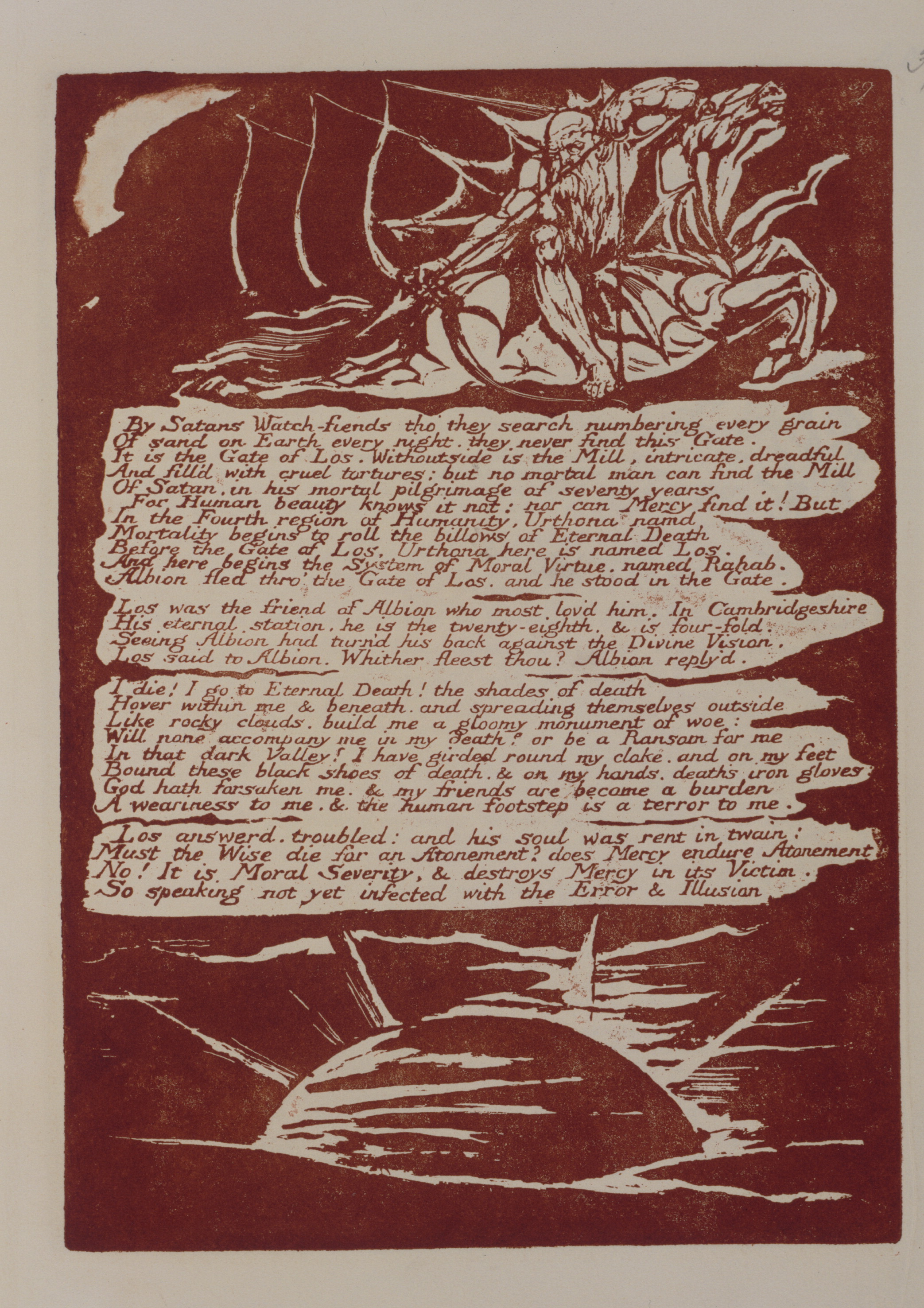 JERUSALEM
"this gate cannot be found
PLATE 35 [39] (E 181)
By Satans Watch-fiends
tho' they search numbering
every grain
Of sand on Earth every night,
they never find this Gate.
It is the Gate of Los.
Withoutside is the Mill,
intricate,  dreadful
And fill'd with cruel tortures;
but no mortal man can find
the Mill
Of Satan, in his mortal
pilgrimage of seventy years"
Monday, April 12, 2010
ALBION & ARTHUR
THE SLEEP OF ALBION is a chapter in Kathleen Raine's book, Golgoonoza: City of Imagination. In it Raine explores the relationship between King Arthur and Albion (the oldest name for Great Britain) in the mind of the British. She shows how Blake's Albion partakes of the legends surrounding King Arthur. As the legends of King Arthur end, he is entombed but not dead, sleeping until he is called to return to 'restore just rule to his kingdom and repel its enemies'.
Blake writes:
(Descriptive Catalogue, Number V, (E 543)):
"The giant Albion, was Patriarch of the Atlantic, he is
the Atlas of the Greeks, one of those the Greeks
called Titans. The stories of Arthur are the acts of
Albion, applied to a Prince of the fifth century, who
conquered Europe, and held the Empire of the world
in the dark age, which the Romans never again
recovered."
In Jerusalem, it is the Giant Albion who is "imagined in the similitude of Arthur". Albion's sleep is the sleep of Arthur. Raine says, "in recounting the 'acts of Albion' [Blake] considered himself to be recounting the sacred history - the inner history of the British nation from ancient times, with prophetic foresight of that future when Albion, like Arthur, is to wake from sleep."
To Raine the 'sleep' of Albion "is conceived by Blake not as the mere passage of time but as a state of apathy, of lowering of consciousness, of forgetfulness of higher things...Blake tells the story of how the nation has come to lapse into spiritual ignorance and forgetfulness...
"Blake is quite specific in his diagnosis of England's national disease: it is precisely that secular materialism ... upon which modern Western civilization is founded...
"Our society is forever thinking in terms of changing our circumstances; Blake's revolution will come when we change ourselves. From inner awakenings outer changes will follow...
"When Albion awakens he will find himself in his lost kingdom restored to its former glory; for the kingdom is ourselves...
"Paradise is not a place but a state of being, the lost kingdom to which the sleepers of Albion must someday awake."
Descriptive Catalogue, NUMBER V, (E 542)
"In the last Battle of King Arthur only Three Britons
escaped, these were the Strongest Man, the
Beautifullest Man, and the Ugliest Man; these three
marched through the field unsubdued, as Gods,
and the Sun of Britain s[e]t, but shall arise again with
tenfold splendor when Arthur shall awake from sleep,
and resume his dominion over earth and ocean."
Jerusalem, Plate19, Albion 'in pain & tears'
Blake writes:
(Descriptive Catalogue, Number V, (E 543)):
"The giant Albion, was Patriarch of the Atlantic, he is
the Atlas of the Greeks, one of those the Greeks
called Titans. The stories of Arthur are the acts of
Albion, applied to a Prince of the fifth century, who
conquered Europe, and held the Empire of the world
in the dark age, which the Romans never again
recovered."
In Jerusalem, it is the Giant Albion who is "imagined in the similitude of Arthur". Albion's sleep is the sleep of Arthur. Raine says, "in recounting the 'acts of Albion' [Blake] considered himself to be recounting the sacred history - the inner history of the British nation from ancient times, with prophetic foresight of that future when Albion, like Arthur, is to wake from sleep."
To Raine the 'sleep' of Albion "is conceived by Blake not as the mere passage of time but as a state of apathy, of lowering of consciousness, of forgetfulness of higher things...Blake tells the story of how the nation has come to lapse into spiritual ignorance and forgetfulness...
"Blake is quite specific in his diagnosis of England's national disease: it is precisely that secular materialism ... upon which modern Western civilization is founded...
"Our society is forever thinking in terms of changing our circumstances; Blake's revolution will come when we change ourselves. From inner awakenings outer changes will follow...
"When Albion awakens he will find himself in his lost kingdom restored to its former glory; for the kingdom is ourselves...
"Paradise is not a place but a state of being, the lost kingdom to which the sleepers of Albion must someday awake."
Descriptive Catalogue, NUMBER V, (E 542)
The Ancient Britons:
"In the last Battle of King Arthur only Three Britons
escaped, these were the Strongest Man, the
Beautifullest Man, and the Ugliest Man; these three
marched through the field unsubdued, as Gods,
and the Sun of Britain s[e]t, but shall arise again with
tenfold splendor when Arthur shall awake from sleep,
and resume his dominion over earth and ocean."
Jerusalem, Plate19, Albion 'in pain & tears'
Subscribe to:
Posts (Atom)