Showing posts with label Consciousness. Show all posts

Sunday, February 6, 2011

JERUSALEM'S SORROW


Illustration of Robert Blair's The Grave (1808), painted by William Blake and engraved by Luigi Schiavonetti.


I've tried to discern what Blake is saying psychologically in this passage about Jerusalem. It seems he is describing the awakening of an archetype from the unconscious. The idea of Jerusalem existed in a mind which was unified, in which there was no duality, in which the contraries were equally true. Blake is describing his vision of Eternity or of the unconscious when he talks of 'sports of intellect', 'Thunder in the midst of kindness', 'love that kills', death 'for a period.'


Jerusalem, Plate 48, (E 196)
"Beneath the bottoms of the Graves, which is Earths central joint,
There is a place where Contrarieties are equally true:
(To protect from the Giant blows in the sports of intellect,
Thunder in the midst of kindness, & love that kills its beloved:
Because Death is for a period, and they renew tenfold.)
From this sweet Place Maternal Love awoke Jerusalem
With pangs she forsook Beulah's pleasant lovely shadowy Universe
Where no dispute can come; created for those who Sleep.

Weeping was in all Beulah, and all the Daughters of Beulah
Wept for their Sister the Daughter of Albion, Jerusalem:
When out of Beulah the Emanation of the Sleeper descended
With solemn mourning out of Beulahs moony shades and hills:
Within the Human Heart, whose Gates closed with solemn sound.

And this the manner of the terrible Separation
The Emanations of the grievously afflicted Friends of Albion
Concenter in one Female form an Aged pensive Woman.
Astonish'd! lovely! embracing the sublime shade: the Daughters of Beulah
Beheld her with wonder! With awful hands she took
A Moment of Time, drawing it out with many tears & afflictions
And many sorrows: oblique across the Atlantic Vale
Which is the Vale of Rephaim dreadful from East to West,
Where the Human Harvest waves abundant in the beams of Eden
Into a Rainbow of jewels and gold, a mild Reflection from
Albions dread Tomb. Eight thousand and five hundred years
In its extension. Every two hundred years has a door to Eden
She also took an Atom of Space, with dire pain opening it a Center
Into Beulah: trembling the Daughters of Beulah dried
Her tears. she ardent embrac'd her sorrows. occupied in labours
Of sublime mercy in Rephaims Vale. Perusing Albions Tomb
She sat: she walk'd among the ornaments solemn mourning.
The Daughters attended her shudderings, wiping the death sweat
Los also saw her in his seventh Furnace, he also terrified
Saw the finger of God go forth upon his seventh Furnace:
Away from the Starry Wheels to prepare Jerusalem a place.
When with a dreadful groan the Emanation mild of Albion.
Burst from his bosom in the Tomb like a pale snowy cloud,
Female and lovely, struggling to put off the Human form
Writhing in pain. The Daughters of Beulah in kind arms reciev'd
Jerusalem: weeping over her among the Spaces of Erin,
In the Ends of Beulah, where the Dead wail night & day."

The awakening of Jerusalem is a way to express the differentiation of her archetype from the undifferentiated, fluid, malleable, expandable unconscious. The pangs she suffered as the 'forsook' the 'shadow Universe' are indicative of the struggle to bring content from the unconscious to the conscious mind. The gates of the unconscious closed behind her; passage between the two is restricted. Entering the conscious mind exposes the archetype to time and space which were unknown in the unconscious. Jerusalem whose character is developed as Unified Man's spiritual awareness is being given form, the Human Form. The conscious mind can now begin to understand the meaning of the archetype, how it functions, what it brings to the totality.

Los has a fond appreciation for Jerusalem which he expresses on Plate 86:

Jerusalem, PLATE 86, (E 244)
"I see thy Form O lovely mild Jerusalem, Wingd with Six Wings
In the opacous Bosom of the Sleeper, lovely Three-fold
In Head & Heart & Reins, three Universes of love & beauty
Thy forehead bright: Holiness to the Lord, with Gates of pearl
Reflects Eternity beneath thy azure wings of feathery down
Ribbd delicate & clothd with featherd gold & azure & purple
From thy white shoulders shadowing, purity in holiness!"

Monday, January 17, 2011

BUNYAN'S DREAM

The dream motif within which Pilgrim's Progress is enclosed was developed and enhanced by Blake's imagery. Dreaming is a metaphor for a level of consciousness below ego-consciousness as we ordinarily experience it. Since Christian exists within the dream; his experiences are associated with a level of consciousness which has access to archetypal material from the collective unconscious as well as the personal unconscious. Blake is picking up on and presenting the psychological implications of milestones Christian passes through as indications of internal development of the psyche itself. The narrator, the dreamer, the pilgrim, the companions, and the interpreter are all represented as archetypes which play roles in individuation.

The midpoint of the series of Blake's illustrations, the plate on which Pilgrim encounters Christ is preceded by the plate titled THE MAN WHO DREAMED OF A DAY OF JUDGMENT. So within the narrator's dream of Pilgrim's journey we find an encounter with another dreaming man - a dream within a dream - symbolic of descending to a deeper psychological level. It is at this level that it is possible that the burden which Christian has been bearing - the consciousness of sin - can be removed. In Blake as in Genesis, the division of reality into the categories of Good and Evil precipitates the divisions in man which constitute the 'fall'. The reversal of this consciousness (of sin) opens the way for the appearance of Christ and reunification.

This is plate 13 of Blake's illustrations to Bunyan's Pilgrim's Progress - THE MAN WHO DREAMED OF A DAY OF JUDGMENT. The observer is Christian - the pilgrim with the burden of sin strapped to his back as it has been represented since Plate 2. Norvig sees the encounter represented in Plate 13 as bringing into consciousness the image of the Last Judgment as a scene of fear and punishment. Encountering this dream content allows Pilgrim to move to the next scene - an encounter with the Christ and a release from the burden which he had been carrying. Just as the consciousness of sin had become an ever present burden to Pilgrim, the fear of punishment at judgment was acting as a detriment to encountering Christ.

In
Gerda S.Norvig's book Dark Figures in the Desired Country: Blake's Illustrations to the Pilgrim's Progress she comments on Plate 13, THE MAN WHO DREAMED OF THE DAY OF JUDGMENT:
"From Bunyan's text we know that the man in this emblem is meant to he a warning to Christian, just as the subject of the previous illustration was. But there is a big difference in the mentality of the two characters, a difference Blake picks up on and generously amplifies to his own interpretive purpose. For although Bunyan's version of this emblematic dreamer-within-a dream shakes and trembles from his haunting fear that he is doomed, he is not so fixated or developed in his anxiety that he has lost all perspective on it. Unlike the man in the iron cage, he talks about his fear and about his vision. He thus creates a certain amount of figural and dialogic distance between himself and his feeling state figured in his dream. That is the saving grace, and indeed for Blake this figure from the Progress typifies the very possibility of a saving grace in everyone's psychic organization. Thus, despite the man's dream-vision that he will be rejected by God at the Last Day, he has two valuable attributes (themselves God-given) that help to counteract the implosive effects of his negative intuition: he has the visionary power to create a clear embodiment of his fear and the capacity to reflect consciously on its imaged content." (Page 164-5)

This is the crux of the issue as Norvig sees it: "It is as though the articulation of the damnation-fantasy held by the man dreaming of the Last Judgment in the House of the Interpreter released this contrary image of deliverance through his own visionary opening in obedience to an inner law of psychological compensation in the mind of the original dreamer."

Romans:
8:1-2 - No condemnation now hangs over the head of those who are "in" Jesus Christ. For the new spiritual principle of life "in" Christ lifts me out of the old vicious circle of sin and death.

Norvig: "It is the identification Christian himself
makes between his [own] imaginative nature and Christ's resurrection that permits and denotes the falling away of the burden. Therefore, the burden in its death throes appropriately recalls the burial of Jesus, whereby a corruptible body was converted to an incorruptible. To enhance the hints Bunyan gives of this connection, Blake fashions the burden to look like an unborn human embryo crouched by the transept of the sepulcher's doorway. It also has the appearance of crumpled clothing, a possible allusion to the linen cloths found folded up beside Christ's tomb after the resurrection." (p 169)


The point of return has been achieved; challenges remain but the result is assured.

Jerusalem, PLATE 43 [29], E(191)
"Then the Divine Vision like a silent Sun appeard above
Albions dark rocks: setting behind the Gardens of Kensington
On Tyburns River, in clouds of blood: where was mild Zion Hills
Most ancient promontory, and in the Sun, a Human Form appeard
And thus the Voice Divine went forth upon the rocks of Albion"

Monday, December 20, 2010

CRYSTAL CABINET IV

To complete this series of posts on the Crystal Cabinet, let's consider what I call the psychological meaning. We will look at the poem solely as it concerns interior mental processing.

The Crystal Cabinet, (E 488)
"The Maiden caught me in the Wild
Where I was dancing merrily
She put me into her Cabinet
And Lockd me up with a golden Key

The unconscious, innocent is caught by the beginning of awareness.

This Cabinet is formd of Gold
And Pearl & Crystal shining bright
And within it opens into a World
And a little lovely Moony Night

The altered consciousness takes possession of the mind and begins to reveal the unknown.

Another England there I saw
Another London with its Tower
Another Thames & other Hills
And another pleasant Surrey Bower

The ability to see more and differently expands ordinary perception.

Another Maiden like herself
Translucent lovely shining clear
Threefold each in the other closd
O what a pleasant trembling fear

The original experience becomes an avenue to further experience.

O what a smile a threefold Smile
Filld me that like a flame I burnd
I bent to Kiss the lovely Maid
And found a Threefold Kiss returnd

Head, heart and loins are sensitized, reinforcing the experience.

I strove to sieze the inmost Form
With ardor fierce & hands of flame
But burst the Crystal Cabinet
And like a Weeping Babe became

The spontaneous experience is destroyed when an attempt is made to possess it.

A weeping Babe upon the wild
And Weeping Woman pale reclind
And in the outward air again
I filld with woes the passing Wind"

The return to the previous consciousness feels like a loss and regression.
The outer world is sullied in comparison to the imaginative world which has been revealed.

Image - Book of Thel, plate 4


Blake as usual leaves his statement open-ended. Where do 'I' go from here? Is the altered state of consciousness attractive enough that I want to pursue it? Is seeing the pale, reclining, weeping woman a result of visiting the Crystal Cabinet?
The carefree boy of the first verse has become burdened with woes he cannot control, but a world of possibility has been opened to him.


Marriage of Heaven and Hell
, PLATE 12 (E 38)
A Memorable Fancy
"Isaiah answer'd. I saw no God. nor heard any, in a finite
organical perception; but my senses discover'd the infinite in
every thing, and as I was then perswaded. & remain confirm'd;"

I am reminded of this statement from Fritjof Capra in The Web of Life.
"At a certain level of complexity a living organism couples structurally not only to its the environment but also to itself, and thus brings forth not only an external but also and inner world. In human beings the bringing forth of such an inner world is linked intimately to language, thought and consciousness."

Monday, November 22, 2010

FRAGMENTS


Blake's ability to handle multiple aspects of reality at multiple levels of existence leaves most of us mystified. In this little passage we have the Eternals who, though multiple, speak with one voice; we have four forms of Milton in different locations and performing different acts; we have Urizen being molded from the clay by Milton; we have Blake negotiating with God as did Moses when he got his assignment; we have the Seven Angels of the Presence and all they imply; and we have Orc in chains.


Blake's mind operates in this fragmented, multiple way but so does every mind and every complex system. To provide order - to make connections - is the task of finding the meaning in the chaos. Meaninglessness is an affliction of the mind which has not reached the level where there is a cohesive wholeness which can assemble the pieces into a picture. Collect the pieces, look at them in the light of your own experience, follow the threads to their origins, associate the pieces which fit together: gradually out of the indistinct haze clear 'lineaments' may come into focus.

Milton, Plate 20 [22],(E 114)
"So spoke they as in one voice! Silent Milton stood before
The darkend Urizen; as the sculptor silent stands before
His forming image; he walks round it patient labouring.
Thus Milton stood forming bright Urizen, while his Mortal part
Sat frozen in the rock of Horeb:
and his Redeemed portion,
Thus form'd the Clay of Urizen
; but within that portion
His real Human walkd above in power and majesty

Tho darkend; and the Seven Angels of the Presence attended him.
O how can I with my gross tongue that cleaveth to the dust,
Tell of the Four-fold Man, in starry numbers fitly orderd
Or how can I with my cold hand of clay! But thou O Lord
Do with me as thou wilt! for I am nothing, and vanity.
If thou chuse to elect a worm, it shall remove the mountains.
For that portion namd the Elect: the Spectrous body of Milton:
Redounding from my left foot into Los's Mundane space,
Brooded over his Body in Horeb against the Resurrection
Preparing it for the Great Consummation; red the Cherub on Sinai
Glow'd; but in terrors folded round his clouds of blood.
...
At last when desperation almost tore his heart in twain
He recollected an old Prophecy in Eden recorded,
And often sung to the loud harp at the immortal feasts
That Milton of the Land of Albion should up ascend
Forwards from Ulro from the Vale of Felpham; and set free
Orc from his Chain of Jealousy, he started at the thought"

To add another wrinkle to this complex scenario Erdman brings our attention to Felpham's Vale and Blake's subsequent return to London. In commenting on Plate 20 [22] of Milton, Erdman states in The Illuminated Blake (Page 238):
"The cheering thought is that Milton, whose descent to Felpham's vale is rehearsed from many angles in this poem, will then ascend 'up' and 'Forwards' (59-60). (The personal parallel is Blake's retreat from Lambeth to Felpham - a journey for which he borrows the sandals of Los in Lambeth [24: 9-11] - seen as preparation for his return to mental war in London. The two moves are the pulsations between which the whole poem lives.)"

Tuesday, October 19, 2010

BETTER WORLD

In 1933 John Middleton Murry published his book William Blake, which continued in print until 1977. Murry's book comes close to being a spiritual biography of Blake, although it is directed toward understanding his poetry. The poetry, letters and descriptive material themselves are such a revelation of the psychic and spiritual development of Blake that Murry finds ample material to describe the issues and outcomes of Blake's inner struggles. The evolution of the concept of the Selfhood grows from its first recognition to it eventual assimilation.

Murry summarizes Blake' Selfhood or Spectre on Page 235:
"Blake's experience of the Selfhood was very deep. He had seen it face to face; known it, so to speak, in essence. For the Selfhood had grown to power in him in pondering the mystery of that finite creation which he knew to be infinite. Out of the effort to exorcize the Selfhood in men, his Selfhood had grown. Once he could accept that mystery, in all humility, and know himself forgiven; once he could see that this was the inevitable destiny of the pilgrim towards Eternity, and that the process of Life itself, at its very acme of spiritual intensity and candour, created the Selfhood as the means by which it grew - the heart of 'the mystery of iniquity' lay open to him. Providence had begun indeed."

Four Zoas, Page 95, (E 367)
"Thou never canst embrace sweet Enitharmon terrible Demon. Till
Thou art united with thy Spectre Consummating by pains &
labours
That mortal body & by Self annihilation back returning
To Life Eternal be assurd I am thy real Self
Tho thus divided from thee & the Slave of Every passion
Of thy fierce Soul Unbar the Gates of Memory look upon me
Not as another but as thy real Self I am thy Spectre
Thou didst subdue me in old times by thy Immortal Strength
When I was a ravning hungring & thirsting cruel lust & murder
Tho horrible & Ghastly to thine Eyes tho buried beneath
The ruins of the Universe. hear what inspird I speak & be silent

If we unite in one[,] another better world will be
Opend within your heart & loins & wondrous brain
Threefold as it was in Eternity & this the fourth Universe
Will be Renewd by the three & consummated in Mental fires
But if thou dost refuse Another body will be prepared"

Drawing for Thornton's Virgil

Thursday, August 12, 2010

Two Kinds of Seeing

The prophet Ezekiel reported (in 4:4-8) that God told him to lay on his right side for three months, then on his left side for three months, as a warning to the Hebrews. In a vision Blake asked him why he did it and got this reply: "the desire of raising other men into a perception of the infinite" (Blake reported this to us in MHH Plate 13 (line 21ff).

"The desire of raising other men into a perception of the infinite": by and large that was Blake's main purpose in his creative endeavors.

There are many kinds of seeing and many levels of consciousness, but, resorting to the natural proclivity for the dialectic, we might say there are two:

1. The sense-based, natural, materialistic time and space consciousness, with no spiritual awareness. Blake called this Ulro; Jesus called it Hell.

2. Vision, coming forth from the inner man, the Light, the Now. It's a different kind of consciousness, a perception of the infinite (Blake called it Eden; Jesus called it the Kingdom of Heaven or the Kingdom of God).

Jesus showed us with his life how to live eternally; and he told us we could do it. Blake did it, periodically at least, and like Jesus he wanted us to share that heavenly gift.

He called it Vision; that's what he lived for; those eternal moments when he perceived the infinite were all that mattered. If you can't do it continuously, then you can talk about it, write about it, draw it, paint it. He did (and you can) show us how to see.

(This material was largely taken from the Blake Primer, near the beginning.)

Re double vision: "This is a cogent description of what he calls double vision, an attribute of schizophrenics as well as artists; they see what's not there to the sense based person." (Double vision appears to be closely related to intuition.)

Look also at twofold.

Write me if you need further information, or just comment and ask a question.

Tuesday, August 3, 2010

THARMAS


Each of the Four Zoas is associated with one of the four elements: Urizen with air, Luvah with fire, Urthona with earth, and Tharmas with water. The four elements appear in the Book of Urizen, but in this early work they had different names. Here is a vivid picture of the four as they appear on Plate 24 of the Book of Urizen. Individual images appear in the Gates of Paradise.

For one of the images of the Small Book of Designs, Blake reused Plate 24 of the Book of Urizen, but he redesigned the image to include only Tharmas submerged in a rough sea with only his face above water. The other elements were covered over in the print with the sea, the mountains and red light from a rising or setting sun. The role of Tharmas is given prominence apropos for his importance in Blake's system. Tharmas as the body, is the avenue of sensory perception which in the fallen state, overloads man's mind leading to the exclusion of spiritual perception. Drowning in a watery world is a good image for living by the precepts of 'Bacon, Newton and Locke' which Blake deplored.

Tharmas occurs as the first building block the psyche, but he is the last to be recognized as deserving of a position among the Zoas. He takes a back seat as the dynamics of the struggle for the structuring of the psychic life occurs. In the end he becomes a unifying principle which represents the possibility of further development beyond a simple return to the original status.

At some points in Blake's myth, there is a close association between Urthona and Tharmas. In the final stage of The Four Zoas the two of them recognize their closeness and recall being friends in earlier times. Urthona and Tharmas are the two Zoas that function most unconsciously, just as intuition and sensation are the less conscious functions in Jung's system. Earth is the element from which Adam was formed in the Bible. Water is the element from which life arises in the evolutionary process. Earth and Water; Imagination (or the Spiritual Sense) and the Body (or sensation); Urthona and Tharmas are the foundational materials for building life in both a physical and psychological sense. Blake presents them as forces that held the unified man together before the fall, and as the unifying forces available to man as he enters the new age.

Four Zoas, Page 137, (E 405)
"Then Los who is Urthona rose in all his regenerate power
The Sea that rolld & foamd with darkness & the shadows of death
Vomited out & gave up all the floods lift up their hands
Singing & shouting to the Man they bow their hoary heads
And murmuring in their channels flow & circle round his feet
Page 138
Then Dark Urthona took the Corn out of the Stores of Urizen
He ground it in his rumbling Mills Terrible the distress
Of all the Nations of Earth ground in the Mills of Urthona
In his hand Tharmas takes the Storms. he turns the whirlwind Loose
Upon the wheels the stormy seas howl at his dread command
And Eddying fierce rejoice in the fierce agitation of the wheels
Of Dark Urthona Thunders Earthquakes Fires Water floods
Rejoice to one another loud their voices shake the Abyss
Their dread forms tending the dire mills The grey hoar frost was there
And his pale wife the aged Snow they watch over the fires
They build the Ovens of Urthona Nature in darkness groans
And Men are bound to sullen contemplations in the night
Restless they turn on beds of sorrow. in their inmost brain
Feeling the crushing Wheels they rise they write the bitter words
Of Stern Philosophy & knead the bread of knowledge with tears & groans"

Wednesday, July 14, 2010

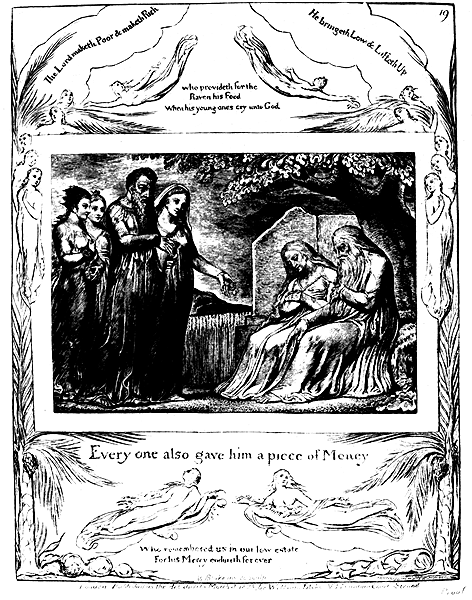
Job Picture 19

Picture 19:
Above the Picture: Job 38:41 "41Who provideth for the raven his food"

And I Samuel 2:7 "7The LORD maketh poor, and maketh rich: he bringeth low, and lifteth up."

Below the picture: Job 42:11:
"Everyone also gave him a piece of Money"

42:11 Then came there unto him all his brethren, and all his sisters, and all they that had been of his acquaintance before, and did eat bread with him in his house: and they bemoaned him, and comforted him over all the evil that the LORD had brought upon him: every man also gave him a piece of money, and every one an earring of gold."
(The Jerusalem Bible says, "each of them gave him a silver coin, and each a gold ring").
Carl Jung said a gold ring is an emblem of the union of opposites in the psyche, like bringing the old repressed negative stuff into consciousness where something can be done about it.

Note a field of ripe corn in the background.

Below the picture you may see a smaller picture with two human figures, perhaps symbolic of the brotherhood of man.

And below the two figures this quote from
Psalm 136:23"who remembered us in our low estate: for his mercy endureth for ever"

Quoting Edinger (page 69) "Job's fortunes have not only been restored but there has also been an enlargement of the personality as a result of the encounter with the 'numinosum'. As Jung puts it "the widening of the consciousness is at first upheaval and darkness, then a broadening out of man to the whole man."

Friday, July 9, 2010

JESUS & EXODUS

This passage from Jerusalem is particularly rich in Biblical references. Jesus speaks to Jerusalem to support her in her time of troubles. Blake uses the experiences of Jesus from the New Testament and the experiences from the exodus in the Old Testament to intimate the journey that must be undertaken to arrive at what may be described as the 'Promised Land.' Biblical scholars point out the parallels between what was achieved in the Israelites release from slavery in Egypt, through their sojourn in the wilderness and their arrival in the promised land; and what Jesus achieved through his incarnation, crucifixion and resurrection. The alteration in consciousness achieved through each of these examples of 'exodus' made possible new beginnings in mankind's psychic and spiritual development.

Here is an article linking Jesus and the Exodus: "The Exodus in the New Testament", by R.E. Nixon, M.A.

Jerusalem, Plate 62, (E 213)
"Jesus replied. I am the Resurrection & the Life.
John 11: 25

Jesus said unto her, I am the resurrection, and the life: he that believeth in me, though he were dead, yet shall he live:

I
Die & pass the limits of possibility, as it appears
To individual perception. Luvah must be Created
And Vala; for I cannot leave them in the gnawing Grave.
John 11
[17] Then when Jesus came, he found that he had lain in the grave four days already.
[31] The Jews then which were with her in the house, and comforted her, when they saw Mary, that she rose up hastily and went out, followed her, saying, She goeth unto the grave to weep there.
[43] And when he thus had spoken, he cried with a loud voice, Lazarus, come forth.
[44] And he that was dead came forth, bound hand and foot with graveclothes: and his face was bound about with a napkin. Jesus saith unto them, Loose him, and let him go.

But will prepare a way for my banished-ones to return
John 14:2
In my Father's house are many mansions: if it were not so, I would have told you. I go to prepare a place for you.
Come now with me into the villages. walk thro all the cities.
Tho thou art taken to prison & judgment, starved in the streets
I will command the cloud to give thee food & the hard rock
To flow with milk & wine,
Deuteronomy 8
[15] Who led thee through that great and terrible wilderness wherein were fiery serpents, and scorpions, and drought, where there was no water; who brought thee forth water out of the rock of flint;
[16] Who fed thee in the wilderness with manna, which thy fathers knew not, that he might humble thee, and that he might prove thee, to do thee good at thy latter end;
tho thou seest me not a season
John 16:16
A little while, and ye shall not see me: and again, a little while, and ye shall see me, because I go to the Father.
Even a long season & a hard journey & a howling wilderness!
Numbers 32
[13] And the LORD's anger was kindled against Israel, and he made them wander in the wilderness forty years, until all the generation, that had done evil in the sight of the LORD, was consumed.
Tho Valas cloud hide thee & Luvahs fires follow thee!
Exodus 13
[21] And the LORD went before them by day in a pillar of a cloud, to lead them the way; and by night in a pillar of fire, to give them light; to go by day and night:
[22] He took not away the pillar of the cloud by day, nor the pillar of fire by night, from before the people.
Only believe & trust in me,
Mark 5
[36] As soon as Jesus heard the word that was spoken, he saith unto the ruler of the synagogue, Be not afraid, only believe.
Lo. I am always with thee!
Matthew 28
[20] Teaching them to observe all things whatsoever I have commanded you: and, lo, I am with you alway, even unto the end of the world. Amen.

___________________________________________Moses


Blake, through his prophetic writings, was proposing that man once again go on a journey of exodus out of the slavery of the limitations produced by our own inability to perceive the infinite world of the spirit which we can access through imagination. The world we live in reflects the minds which we choose to limit through being blind, deaf, and insensitive to the infinite, perfect and ever changing Eternal world. Jesus taught the same lessons that Blake taught, and demonstrated the path of death and rebirth, which leads to Eternal Life. Blake invites us to put aside selfhood in forgiveness, jealousy in brotherhood, sensation in vision, outward development in inward development, and Eternal Death in Eternal Life.

Larry reminds us to read this passage in Luke which speaks of the exodus Jesus was about to accomplish: Luke 9: 28-36. (Note verse 31.)

Monday, April 12, 2010

ALBION & ARTHUR

THE SLEEP OF ALBION is a chapter in Kathleen Raine's book, Golgoonoza: City of Imagination. In it Raine explores the relationship between King Arthur and Albion (the oldest name for Great Britain) in the mind of the British. She shows how Blake's Albion partakes of the legends surrounding King Arthur. As the legends of King Arthur end, he is entombed but not dead, sleeping until he is called to return to 'restore just rule to his kingdom and repel its enemies'.

Blake writes:
(Descriptive Catalogue, Number V, (E 543)):
"The giant Albion, was Patriarch of the Atlantic, he is
the Atlas of the Greeks, one of those the Greeks
called Titans. The stories of Arthur are the acts of
Albion, applied to a Prince of the fifth century, who
conquered Europe, and held the Empire of the world
in the dark age, which the Romans never again
recovered."

In Jerusalem, it is the Giant Albion who is "imagined in the similitude of Arthur". Albion's sleep is the sleep of Arthur. Raine says, "in recounting the 'acts of Albion' [Blake] considered himself to be recounting the sacred history - the inner history of the British nation from ancient times, with prophetic foresight of that future when Albion, like Arthur, is to wake from sleep."

To Raine the 'sleep' of Albion "is conceived by Blake not as the mere passage of time but as a state of apathy, of lowering of consciousness, of forgetfulness of higher things...Blake tells the story of how the nation has come to lapse into spiritual ignorance and forgetfulness...

"Blake is quite specific in his diagnosis of England's national disease: it is precisely that secular materialism ... upon which modern Western civilization is founded...

"Our society is forever thinking in terms of changing our circumstances; Blake's revolution will come when we change ourselves. From inner awakenings outer changes will follow...

"When Albion awakens he will find himself in his lost kingdom restored to its former glory; for the kingdom is ourselves...

"Paradise is not a place but a state of being, the lost kingdom to which the sleepers of Albion must someday awake."

Descriptive Catalogue, NUMBER V, (E 542)

The Ancient Britons:

"In the last Battle of King Arthur only Three Britons
escaped,
these were the Strongest Man, the
Beautifullest Man, and the
Ugliest Man; these three
marched through the field unsubdued, as
Gods,
and the Sun of Britain s[e]t, but shall arise again with

tenfold splendor when Arthur shall awake from sleep,
and resume
his dominion over earth and ocean."

Jerusalem, Plate19, Albion 'in pain & tears'

Sunday, January 24, 2010

BLAKE'S HERO

Albion Rose - Blakes's inscription: 'Albion rose from where he labourd at the Mill with Slaves / Giving himself for the Nations he danc'd the dance of Eternal Death'.

"...myth is the secret opening through which the inexhaustible energies of the cosmos pour into human cultural manifestations." Joseph Campbell

It is interesting to observe the parallels visible between the mythological tradition and Blake's created myth. Here we have Joseph Campbell showing how the same concepts of fall and return which we encounter in Blake's poetry pervade the hero story.

From Joseph Campbell's, The Hero with a Thousand Faces, Page 259:

"'For,' as Jesus states it, 'behold, the Kingdom of God is within you.' Indeed, the lapse of superconsciousness into the state of unconsciousness is precisely the meaning of the Biblical image of the Fall. The constriction of consciousness, to which we owe the fact that we see not the source of the universal power but only the phenomenal forms reflected from that power, turns superconsciousness into unconsciousness and, at the same time creates the world. Redemption consists in the return to superconsciousness and therewith the dissolution of the world. This is the great image and theme of the cosmogonic cycle, the mythical image of the world's coming into manifestation and subsequent return into the nonmanifest condition. Equally, the birth, life, and death of the individual may be regarded as a descent into unconsciousness and return. The hero is the one who, while still alive, knows and represents the claim of the superconsciouness which throughout creation is more or less unconscious. The adventure of the hero represents the moment in his life when he achieved illumination - the nuclear moment when, while still alive, he found and opened the road to the light beyond the dark walls of our living death."...
"In any case, they are telling metaphors of the destiny of man, man's hope, man's faith, and man's dark mystery."

These are the processes of the human mind or of life as we experience it: analysis and synthesis (Chemistry), differentiation and integration (Mathematics), destruction and construction (Architecture), death and birth (Biology).

As Blake describes the breaking apart and bringing together and we join in the experience, hopefully we can focus as much on the synthesis as on the analysis.

Here Blake portrays Los as the Hero:
Jerusalem, Plate 38, (E 184)

"Then Los grew furious raging: Why stand we here trembling around
Calling on God for help; and not ourselves in whom God dwells
Stretching a hand to save the falling Man: are we not Four
Beholding Albion upon the Precipice ready to fall into Non-Entity:
Seeing these Heavens & Hells conglobing in the Void."


Wednesday, August 26, 2009

WHOLENESS

Quotes from Edward F Edinger a Jungian psychologist :
THE ETERNAL DRAMA: The Inner Meaning of Greek Mythology

"Nothing new can emerge unless one is willing to dip into chaos and pull it out. ...
"Once it is out it promptly splits in two, into earth and sky in terms of the myth. This is something we see whenever something is coming into awareness: the very process of achieving consciousness involves a split into opposites. Things can remain in their state of oneness only as long as they are unconscious. When they reach consciousness, they must divide into opposites and then we have the experience of conflict."

"At first, the encounter with the Self is indeed a defeat of the ego; but with perseverance, /Deo volente,/ light is born from the darkness. One meets the"Immortal One" who wounds and heals, who casts down and raises up, who makes small and makes large - in a word the one who makes one whole."

Blake is willing to dip into that chaos and endure the splitting. He follows the process through its inner and outer manifestations and describes the unification process on the other side at a higher level of consciousness.

In plate 96 of JERUSALEM Blake writes:

"Then Jesus appeared standing by Albion as the Good Shepherd
By the lost Sheep that he hath found & Albion knew that it
Was the Lord the Universal Humanity, & Albion saw his Form
A Man. & they conversed as Man with Man, in Ages of Eternity
And the Divine Appearance was the likeness & similitude of Los"

This passage is symbolically dense. Practically every word in it is pregnant with meaning. Focus on any word within its context and it leads toward the transcending of divisions which is about to be achieved. From the oneness of unconsciousness, through recognition, awareness, sifting, and integration the Divine Appearance (unification) is being activated.

Think of Jesus on the mount of transfiguration. Fourfold in humanity encountering the Eternal.