Showing posts with label Vision. Show all posts

Wednesday, February 2, 2011

BLAKE & PLATO

Commentary on Blake's six illustrations to Milton's Il Penseroso is found in Bette Charlene Werner's book Blake's vision of the poetry of Milton: illustrations to six poems. Blake 'invented', (he signed images WBlake inv), the third illustration The Spirit of Plato as a means of presenting a number of Plato's ideas as Milton contemplated them.

Il Penseroso

"Or let my lamp, at midnight hour,
Be seen in some high lonely tower,
Where I may oft outwatch the Bear,
With thrice great Hermes, or unsphere
The spirit of Plato, to unfold
What worlds or what vast regions hold
The immortal mind that hath forsook
Her mansion in this fleshly nook;
And of those demons that are found
In fire, air, flood, or underground,"
(lines 85-95)
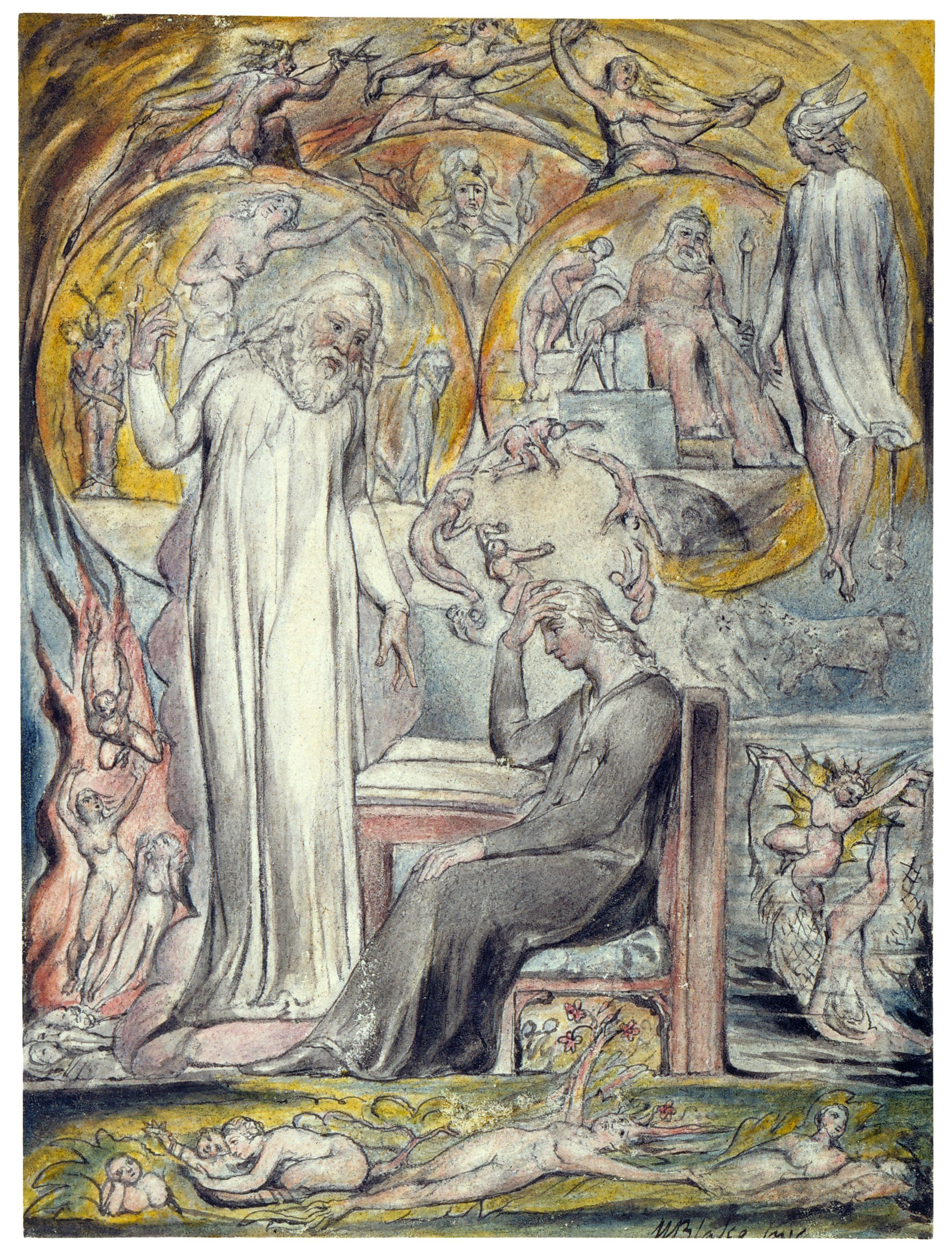
In the picture we see how Plato divided the soul between the three worlds of Venus, Jupiter, Mars - senses, reason and energy. The Great Bear is the constellation around which the constellations revolve; it never sets - symbolizing an ever circling round.

Blake added a few lines of descriptive material to each of his illustrations to Il Penseroso.
Blake's description: "The Spirit of Plato unfolds his Worlds to Milton in Contemplation. The three destinies sit on the Circles of Plato's Heavens weaving their Thread of Mortal Life; these Heavens are Venus Jupiter and Mars. Hermes flies before as attending on the Heaven of Jupiter, the Great Bear is seen in the Sky beneath Hermes & The Spirits of Fire, Air, Water & Earth Surround Milton's Chair."

In this the third illustration to Il Penseroso illustrating lines 85-95 of Milton's poem, Blake goes to pains to include the import of the lines of the poem but adds details to indicate the ideas of Plato to which he objected.

Damon enumerates the points at which Plato's thought differed from Blake's:
"Thus it is that although Plato banished poets from his Republic, made God a geometrician, preached morality, was a fatalist when he accepted the Three Fates, debased love to homosexuality, admitted war to his ideal state, and considered Art an imitation of Nature (hence second rate), Blake was indebted to him." Blake knew that there was much to be admired in Plato's thought although he said that "What Jesus came to remove was the Heathen or Platonic Philosophy, which blinds the eye to Imagination, The real Man." (E 664 ). Blake portrays the Greek learned and wise among the saved in the Last Judgment.

The prominence in the illustration of Hermes perhaps in his role of as the guide for souls in the underworld, may be Blake's assertion that both Plato and Milton are still in need of guidance in matters of the soul. None of the Platonic images contemplated by Milton seems to show the positive outcome for Man's plight for which Blake is working.

Blake's ambivalence to Plato and Greek thought can be seen in these 2 short passages:

Songs and Ballads,(E 479)
Twas the Greeks love of war
Turnd Love into a Boy
And Woman into a Statue of Stone
And away fled every joy

Letter to Trusler, (E 702)
"The wisest of the Ancients considerd what is not
too Explicit as the fittest for Instruction because it rouzes the
faculties to act. I name Moses Solomon Esop Homer Plato"

Monday, January 17, 2011

BUNYAN'S DREAM

The dream motif within which Pilgrim's Progress is enclosed was developed and enhanced by Blake's imagery. Dreaming is a metaphor for a level of consciousness below ego-consciousness as we ordinarily experience it. Since Christian exists within the dream; his experiences are associated with a level of consciousness which has access to archetypal material from the collective unconscious as well as the personal unconscious. Blake is picking up on and presenting the psychological implications of milestones Christian passes through as indications of internal development of the psyche itself. The narrator, the dreamer, the pilgrim, the companions, and the interpreter are all represented as archetypes which play roles in individuation.

The midpoint of the series of Blake's illustrations, the plate on which Pilgrim encounters Christ is preceded by the plate titled THE MAN WHO DREAMED OF A DAY OF JUDGMENT. So within the narrator's dream of Pilgrim's journey we find an encounter with another dreaming man - a dream within a dream - symbolic of descending to a deeper psychological level. It is at this level that it is possible that the burden which Christian has been bearing - the consciousness of sin - can be removed. In Blake as in Genesis, the division of reality into the categories of Good and Evil precipitates the divisions in man which constitute the 'fall'. The reversal of this consciousness (of sin) opens the way for the appearance of Christ and reunification.

This is plate 13 of Blake's illustrations to Bunyan's Pilgrim's Progress - THE MAN WHO DREAMED OF A DAY OF JUDGMENT. The observer is Christian - the pilgrim with the burden of sin strapped to his back as it has been represented since Plate 2. Norvig sees the encounter represented in Plate 13 as bringing into consciousness the image of the Last Judgment as a scene of fear and punishment. Encountering this dream content allows Pilgrim to move to the next scene - an encounter with the Christ and a release from the burden which he had been carrying. Just as the consciousness of sin had become an ever present burden to Pilgrim, the fear of punishment at judgment was acting as a detriment to encountering Christ.

In
Gerda S.Norvig's book Dark Figures in the Desired Country: Blake's Illustrations to the Pilgrim's Progress she comments on Plate 13, THE MAN WHO DREAMED OF THE DAY OF JUDGMENT:
"From Bunyan's text we know that the man in this emblem is meant to he a warning to Christian, just as the subject of the previous illustration was. But there is a big difference in the mentality of the two characters, a difference Blake picks up on and generously amplifies to his own interpretive purpose. For although Bunyan's version of this emblematic dreamer-within-a dream shakes and trembles from his haunting fear that he is doomed, he is not so fixated or developed in his anxiety that he has lost all perspective on it. Unlike the man in the iron cage, he talks about his fear and about his vision. He thus creates a certain amount of figural and dialogic distance between himself and his feeling state figured in his dream. That is the saving grace, and indeed for Blake this figure from the Progress typifies the very possibility of a saving grace in everyone's psychic organization. Thus, despite the man's dream-vision that he will be rejected by God at the Last Day, he has two valuable attributes (themselves God-given) that help to counteract the implosive effects of his negative intuition: he has the visionary power to create a clear embodiment of his fear and the capacity to reflect consciously on its imaged content." (Page 164-5)

This is the crux of the issue as Norvig sees it: "It is as though the articulation of the damnation-fantasy held by the man dreaming of the Last Judgment in the House of the Interpreter released this contrary image of deliverance through his own visionary opening in obedience to an inner law of psychological compensation in the mind of the original dreamer."

Romans:
8:1-2 - No condemnation now hangs over the head of those who are "in" Jesus Christ. For the new spiritual principle of life "in" Christ lifts me out of the old vicious circle of sin and death.

Norvig: "It is the identification Christian himself
makes between his [own] imaginative nature and Christ's resurrection that permits and denotes the falling away of the burden. Therefore, the burden in its death throes appropriately recalls the burial of Jesus, whereby a corruptible body was converted to an incorruptible. To enhance the hints Bunyan gives of this connection, Blake fashions the burden to look like an unborn human embryo crouched by the transept of the sepulcher's doorway. It also has the appearance of crumpled clothing, a possible allusion to the linen cloths found folded up beside Christ's tomb after the resurrection." (p 169)


The point of return has been achieved; challenges remain but the result is assured.

Jerusalem, PLATE 43 [29], E(191)
"Then the Divine Vision like a silent Sun appeard above
Albions dark rocks: setting behind the Gardens of Kensington
On Tyburns River, in clouds of blood: where was mild Zion Hills
Most ancient promontory, and in the Sun, a Human Form appeard
And thus the Voice Divine went forth upon the rocks of Albion"

Saturday, January 15, 2011

BLAKE'S BUNYAN

"My dark and cloudy words, they do but hold
The truth, as cabinets enclose the gold." Bunyan

The process of learning invariably involves going from the known into the unknown. We begin with what we are capable of doing and proceed to what is beyond our present capabilities. In our lives we have crossed this threshold many times from the very first times when we learned to suck air into our lungs and milk from our mothers' breast. Nevertheless learning always involves overcoming inertia and taking risk. Reluctance to relinquish our present positions for the uncertain prospect of finding security in that hazy possibilities which may replace them is perceived as threat.

Learning to see as Blake sees may seem a particularly threatening activity because we have invested so much in learning to think rationally - trusting only evidence and proof and linear thought patterns. Blake has devised an approach to design and writing which breaks down the patterns or rationality to facilitate imaginative activity.

In one sense Norvig's book (Dark Figures in the Desired Country: Blake's Illustrations to the Pilgrim's Progress) is an account of her learning Visionary Hermeneutics. She says: "Normally hermeneutics refers to a set of predetermined interpretive strategies that a reader brings to and imposes on a work for one or more ulterior purposes..." (Page 4) However Blake's strategy was to apply the imagination in such a way that the internal and external context of the work interact to stimulate the activity of the imagination of the reader. But the imagination is not just put to use for interpretation, but gains self awareness and is strengthened through the process. "I have been speaking of visionary hermeneutics as a process that depends less on rules of interpretation than on an imaginative perspective, meaning both a perspective we learn to take toward the image and a perspective the imagination gradually gains on itself." (Page 6)

Plate 28, AT THE GATES OF HEAVEN
Norvig attempts to enlighten her audience on Blake's practice of Visionary Hermeneutics which she learned from her teacher William Blake by studying his illustrations to Bunyan's Pilgrim's Progress. The heart of her book is her commentary on each of Blake's 28 illustrations. But the illustrations are not to be viewed individually but as a whole, commenting on one another and complementing others as do Blake's Illustration to the Book of Job. She compares the process that they illustrate in detail to the process delineated in Gates of Paradise. In the illustrations to Pilgrim's Progress as in his work from beginning to end, Blake sought to open the avenue to the visionary world he experienced to his readers.

Descriptive Catalogue, Penance of Jane Shore,(E 550)
"This Drawing was done above Thirty Years ago, and proves
to the Author, and he thinks will prove to any discerning eye,
that the productions of our youth and of our maturer age
are equal in all essential points."

Norvig observes:
"Even in the Songs [of Innocence and Experience] itself a much more intricate pattern of mutual commentary, plotted by the progressive permutations of repeated verbal and pictorial motifs shown in changing contexts throughout the song cycle, emerges to enrich the work as a sort of primer of visionary literacy." (Page 5)

Tuesday, January 11, 2011

BLAKE & PILGRIM'S PROGRESS

Our posts mentioning Bunyan.

There were three great English dissenting poets:

John Milton (9 December 1608 - 8 November 1674)

John Bunyan (28 November 1628 - 31 August 1688)

William Blake (28 November 1757 - 12 August 1827)

The first two were influential on the third - William Blake - the subject of this blog. Milton's influence has frequently been mentioned here but we have said less about Bunyan's. Gerda S. Norvig's book Dark Figures in the Desired Country: Blake's Illustrations to the Pilgrim's Progress gives deserved attention to the primary way in which Blake interacted with Bunyan's writing.

Blake was slow to acknowledge a debt to Bunyan. It was not until near the end of his life that he took the task of illustrating Pilgrim's Progress. Blake's Bunyan illustrations were made around 1824 after the completion of Illustrations to Book of Job. He had no prospect of having them published in a new edition of Pilgrim's Progress. They were done like most of his work in response to the promptings of his imagination to present his vision in a form which may someday be received.


_______________Plate 8, Christian Fears the Fire from the Mountain
_______________Click on image, then click on enlargement for detail

Blake's early opinion of Bunyan as compared to Milton is expressed in this letter to Hayley:

Letter 52, (E 758)
To William Hayley Esqre Felpham
near Chichester, Sussex

Sth Molton St 4 Decr. 1804
"-- I was about to
have written to you to express my wish that two so unequal
labourers might not be yoked to the same Plow & to desire you if
you could to get Flaxman to do the whole because I thought it
would be (to say the best of myself) like putting John Milton
with John Bunyan"

In Blake's opinion, allegory, as was employed by Bunyan, was a lower form of communication than vision which Blake aimed to use himself as alluded to in this passage:

Vision of the Last Judgment, (E 554)
"The Hebrew Bible & the Gospel of
Jesus are not Allegory but Eternal Vision or Imagination of All
that Exists Fable [al] <&> Allegory]
[<& Visions of Imagination>] ought
to be known as Two Distinct Things & so calld for the Sake of
Eternal Life Plato has made Socrates say that Poets & Prophets do
not Know or Understand what they write or Utter this is a most
Pernicious Falshood. If they do not pray is an inferior Kind to
be calld Knowing Plato confutes himself>"

As Blake matured as an artist and as a Christian (which were one and the same thing to him), he found ways to probe the depths of meaning in Bunyan according to Norvig:

"But in the active days of the Lambeth period (1790 -1800, when Blake lived at 13 Hercules Building, Lambeth), absorbed in the dynamic relations and counterposes of his own prophetic art to the energies of Milton's religious Poetics, Blake evidently did not consider Bunyan compatriot or rival worthy of systematic attention.
...
By the time he had developed a style of serial illustration adequate to handle literary critiques that were, simultaneously, visions of individuation, he was ready to turn to the hermeneutic complexity of the Progress and give it the innovative treatment I will be examining in Chapter 3." (Page 47)

The illustrations to Pilgrim's Progress have continued to be neglected compared to Blake's other work. Norvig's book, deep as it is, has created an opening for the illustrations to receive the attention they deserve.

"In part the relative neglect of the Bunyan designs is due to the fact that the watercolors themselves, currently among the holdings of the Frick collection in New York city, have been on general view only four times since their arrival in the United States during World War II, and before that in England only once."

Norvig's book is available online.The twenty-eight plates are included following page 128; you will find it hard to locate them elsewhere.

Wednesday, October 27, 2010

TRUST II


MARY AT HER DISTAFF WATCHED OVER BY TWO ANGELS
from Milton's Paradise Regained

What may one trust (see post TRUST):

In contrast to things which Blake thought that we could not trust, there were things in which he placed implicit trust. These were the manifestations of the Spirit which increased in his consciousness as he traveled his journey.
_________________________________________________
The Eternal Realities

Jerusalem, Plate 34 [38], (E 180)
"We live as One Man; for contracting our infinite senses
We behold multitude; or expanding: we behold as one,
As One Man all the Universal Family; and that One Man
We call Jesus the Christ: and he in us, and we in him,
Live in perfect harmony in Eden the land of life,
"

Jerusalem, Plate 71, (E 225)
"For all are Men in Eternity. Rivers Mountains Cities Villages,
All are Human & when you enter into their Bosoms you walk
In Heavens & Earths; as in your own Bosom you bear your Heaven
And Earth, & all you behold, tho it appears Without it is Within
In your Imagination of which this World of Mortality is but a
Shadow."

___________________________________________
The Imagination

Milton, Plate 32 [35], (E 132)
"Judge then of thy Own Self: thy Eternal Lineaments explore
What is Eternal & what Changeable? & what Annihilable!
The Imagination is not a State: it is the Human Existence itself
Affection or Love becomes a State, when divided from Imagination
The Memory is a State always, & the Reason is a State
Created to be Annihilated & a new Ratio Created "

Jerusalem, Plate 77, (E 231)
"I know of no other
Christianity and of no other Gospel than the liberty both of body
& mind to exercise the Divine Arts of Imagination.
Imagination the real & eternal World of which this Vegetable
Universe is but a faint shadow & in which we shall live in our
Eternal or Imaginative Bodies, when these Vegetable Mortal Bodies
are no more."

_________________________________________________
The Identity in oneself and in others


Vision of the Last Judgment, Page 80, (E 556)
"These States Exist now Man Passes on but States remain for Ever he passes thro them like a traveller who may as well suppose that the places he has passed thro exist no more as a Man may suppose that the States he has passd thro exist no more Every Thing is Eternal In Eternity one Thing never Changes into another Thing Each Identity is Eternal"

Jerusalem, Plate 38 [43], (E 185)
"Swelld & bloated General Forms, repugnant to the Divine-
Humanity, who is the Only General and Universal Form
To which all Lineaments tend & seek with love & sympathy
All broad & general principles belong to benevolence
Who protects minute particulars, every one in their own identity."

Jerusalem, Plate 55, (E 205)
"The Infinite alone resides in Definite & Determinate Identity
Establishment of Truth depends on destruction of Falshood
continually"
________________________________________________
Our own ability to discern God's presence within Humanity

Milton, Plate 30 [33], (E 129)
"Lo the Eternal Great Humanity
To whom be Glory & Dominion Evermore Amen
Walks among all his awful Family seen in every face
As the breath of the Almighty. such are the words of man to man
In the great Wars of Eternity, in fury of Poetic Inspiration,
To build the Universe stupendous: Mental forms Creating "

Milton, Plate 20 [22], (E 114)
"It has a heart like thee; a brain open to heaven & hell,
Wthinside wondrous & expansive; its gates are not clos'd,
I hope thine are not: hence it clothes itself in rich array;
Hence thou art cloth'd with human beauty O thou mortal man.
Seek not thy heavenly father then beyond the skies:"

If we reject or destroy the verities on which we have relied without a means of replacing them, we are left with a void to fill. If we do not have Truth to fill the emptiness, fear and falsehood will invade the empty space. Blake offered alternatives to those who came to reject their reliance on sense data, rationalization, following authority and accepting systems of deception.

Reliance on sense data is to be replaced with awareness of the Eternal Realities.
Reliance on the reasoning mind is to be replaced by the ability to use the Imagination.
Reliance on established authority is to be replaced by the ability to discern God's presence in humanity
The reliance on systems created by others is to be replaced by the ability to recognize the Identity in oneself and others.

In vision Blake was able to see the new world which could replace this fallen existence:

Vision of the Last Judgment, (E 555)
"There Exist in that Eternal
World the Permanent Realities of Every Thing which we
see are reflected in this Vegetable Glass of Nature All
Things are comprehended in their Eternal Forms in the
Divine body of the Saviour the True Vine of Eternity
The Human Imagination who appeard to Me as Coming to
Judgment. among his Saints & throwing off the Temporal
that the Eternal might be Establishd."

Saturday, August 14, 2010

The Happy Child

Before the loss of innocence the average child has an inner vision absent to most adults; it's generally stripped away by the age of six. Under the influence of early public education a socialization or social conditioning process takes place, and conventional thought forms take the place of the child's inner thoughts.

Most Blake students remember the vision of the angry God that Blake found in his window at the age of four. You can be sure that such a fancy is likely to be trained out of a small child-- in most cases but not in Blake's. We know very little about his parents other than a generally dissenting faith (Swedenborgians, Moravians, etc.).

But they must have had liberal ideas about child rearing because a few years later when he reported seeing a tree filled with angels, his mother talked his father out of a disciplinary response. Another liberal idea was their permission for him to leave school after the first day (when the schoolmaster flogged a boy).

All this leads to the conclusion that Blake never lost the faculty of inner vision, which has been conditioned out of most of us. With no hindrance to his childhood visions and freedom from organized schooling Blake became an autodidact; in all likelihood regarding pre-Enlightenment thought he became the most learned man of his generation.

Jesus is reported to have said, "Whosoever shall not receive the kingdom of God as a little child, he shall not enter therein" in Mark 10:15. That's often thought to mean that the child trusts his father, but might it not also mean he has a child's imagination?

One might say Blake remained like a child his entire life. The four year old who had seen the angry God in his window, who a bit later had seen the tree full of angels continued to see those sorts of things as the years went by.

In the course of time the 'angry God' became Nobodaddy and a large variety of other 'god-like' figures. And the 'tree full of angels'? who knows.

How could that be? Unlike you and me Blake (after the first day) never went to school, the place where most of the 'child' has been drilled out of us. For Blake? no! "I must Create a System or be enslav'd by another Mans". He didn't heed what the priests told him about God; he already knew the God within (the Quaker Way). He spent twenty years wrestling with the God he knew.

In Songs of Innocence he gave delightful portraits of the child within himself, and in Songs of Experience he showed us what this cruel vale in tears where we live had done to those lovely children. Look at Version 1 and Version 2 of Holy Thursday and at Version 1 and 2 of the Chimney Sweeper.

The Little Black Boy showed a child put upon by a cruel society, but not embittered thereby. Blake's poetry is often bitter, ironic, satiric, condemnatory! "Blake's poetry has the unpleasantness of great poetry" (T.S.Eliot). So much like Isaiah and Jeremiah: pages and pages of bitter excoriation.

But in the midst of the cries, just like Isaiah, you suddenly find passages of ethereal beauty and joy. Like a child: either delighted or miserable!

Finally the child is creative! I haven't found any poet who matches Blake's creativity; his System is like discovering another planet.


Thursday, August 12, 2010

Two Kinds of Seeing

The prophet Ezekiel reported (in 4:4-8) that God told him to lay on his right side for three months, then on his left side for three months, as a warning to the Hebrews. In a vision Blake asked him why he did it and got this reply: "the desire of raising other men into a perception of the infinite" (Blake reported this to us in MHH Plate 13 (line 21ff).

"The desire of raising other men into a perception of the infinite": by and large that was Blake's main purpose in his creative endeavors.

There are many kinds of seeing and many levels of consciousness, but, resorting to the natural proclivity for the dialectic, we might say there are two:

1. The sense-based, natural, materialistic time and space consciousness, with no spiritual awareness. Blake called this Ulro; Jesus called it Hell.

2. Vision, coming forth from the inner man, the Light, the Now. It's a different kind of consciousness, a perception of the infinite (Blake called it Eden; Jesus called it the Kingdom of Heaven or the Kingdom of God).

Jesus showed us with his life how to live eternally; and he told us we could do it. Blake did it, periodically at least, and like Jesus he wanted us to share that heavenly gift.

He called it Vision; that's what he lived for; those eternal moments when he perceived the infinite were all that mattered. If you can't do it continuously, then you can talk about it, write about it, draw it, paint it. He did (and you can) show us how to see.

(This material was largely taken from the Blake Primer, near the beginning.)

Re double vision: "This is a cogent description of what he calls double vision, an attribute of schizophrenics as well as artists; they see what's not there to the sense based person." (Double vision appears to be closely related to intuition.)

Look also at twofold.

Write me if you need further information, or just comment and ask a question.

Sunday, August 8, 2010

Man and State

Look first at what Blake meant by state: at Milton plate 32.

For Blake everything was a man (Look at Letter 16; verse 26-32); Things are material objects, but in Heaven, where Blake generally lived when he created, matter is absent; "everything is a man".

In his ordinary experience as well as his heavenly ones Blake customarily referred to objects as people, much like Jesus referred to the demons in Matthew...

Look at Letter 23 verse 24ff:
"With my inward Eye 'tis an old Man grey
With my outward a Thistle across my way";
Blake proceeds to have a conversation with the thistle, or if you prefer, the 'old Man grey'.

Recall that in the Book of Thel Thel converses with the clod of clay, the lilly, the worm, the cloud; these were all men in Blake's imaginative world.

Some apparent men we immediately see are not:
Satan is a state; the Spectre is a state; however at times they are treated as men:
"Truly My Satan thou art but a Dunce."

Are the four zoas men or states? In Eternity Albion is a Unity; fallen into the Sea of Time and Space he is divided into four elements, treated like people in Blake's myth. But we can call them states:

So we might speak of a man dominated by Urizen, or Luvah, or Los. Tharmas presents more of a problem. Carrying this idea a bit further we might say that a man may have much of Urizen and a little of Luvah, etc.

In this way Blake's four zoas (and Jung's four functions) may provide a valuable instrument for understanding ourselves as well as our friends and other associates.

Blake went through life talking to non-human entities and describing them in human terms; he had a great disinterest in things as such; he always personalized; in that way he included everything in Eternity. "Not one Milton 22; line 19-26.
In this of course he was not alone. Jesus said something about the stones crying out and talked with devils (Matt 8:31-32) and was himself described as the cornerstone.

You, too may pick up this habit.

Wednesday, July 21, 2010

INTERPRETATIONS

To demonstrate how an individual can give different interpretations to Blake's illustrations at different times and in different circumstances, lets look at Plate 64 of Jerusalem.

In The Illuminated Blake (page 343), Erdman has this to say about the figure at the bottom of plate 64: "At the bottom this scroll of Natural Religion reaches the Rational Power, and the "Indefinite Spectre" Urizen, with fingers on book, checking with his index finger the message of the blots and blurs on the veil. At the top of the page: "The figure blindly writing the scroll, sleeping on it, yet with a sunburst (yellow against pink) of potential halo around her head is evidently Vala..."

In choosing the picture from Plate 64, as the illustration on the cover of The Complete Poetry and Poems of William Blake, Erdman sees the picture in a more personal manner:

"The design on our cover, constructed upon plate 64 of the Mellon copy of Jerusalem, was inspired by our editorial respect for the Committee on Scholarly Editions (CSE). The proofreader at the bottom with knuckles on text represents the five of us who, as required by the Committee "to prevent recontamination of the text," will have been "scrupulously and repeatedly" proofreading during the course of this book's production. Why that left hand held to shield the text from the light shining from the inspired (but nodding) author, with quill on scroll beautifully unfolding to constitute a New Heaven? Our attention must be upon what the author wrote, not upon our vision of his vision, even though we keep watching. That greater liberty is the reader's privilege."
The Complete Poetry and Prose of William Blake, page XXVII

It is a privilege to read the words of Blake as Erdman and his committee provided them the to us. The greater liberty of trying to discern Blake's vision through the text, we pursue as diligently as Erdman pursued his editing. Without the diligent and meticulous work of Erdman and his associstes, Blake's vision would not be so easily available to us.

Here is the Plate 64 image from the Blake Archive, which allows us to view the only color copy of Jerusalem in existence.

Tuesday, June 29, 2010

SENSES SHRINK

An image that Blake uses for the Fall of Man (the division into duality or multiplicity), is presented in the limitation of man's sensory acuity. The senses of Eternity are flexible, expanding and contracting at will: their perceptions are infinite.

The Book of Urizen dramatizes the process of the infinite senses becoming the senses five that we recognize and enjoy today. It is not a happy sight to see the powers of Eternity being defined and limited into the narrow range of sight, sound, smell, and taste and touch to which we have access.

Book of Urizen, Plate 12, (E 76) ................Plate 13

"8. In harrowing fear rolling round;
His nervous brain shot branches
Round the branches of his heart.
On high into two little orbs
And fixed in two little eaves
Hiding carefully from the wind,
His Eyes beheld the deep,
And a third Age passed over:
And a state of dismal woe.

9. The pangs of hope began,
In heavy pain striving, struggling.
Two Ears in close volutions.
From beneath his orbs of vision
Shot spiring out and petrified
As they grew. And a fourth Age passed
And a state of dismal woe.

10. In ghastly torment sick;
Hanging upon the wind;

PLATE 13

Two Nostrils bent down to the deep.
And a fifth Age passed over;
And a state of dismal woe.

11. In ghastly torment sick;
Within his ribs bloated round,
A craving Hungry Cavern;
Thence arose his channeld Throat,
And like a red flame a Tongue
Of thirst & of hunger appeard.
And a sixth Age passed over:
And a state of dismal woe.

PLATE 22, (E 82)
The Senses inward rush'd shrinking,
Beneath the dark net of infection.

2. Till the shrunken eyes clouded over
Discernd not the woven hipocrisy
But the streaky slime in their heavens
Brought together by narrowing perceptions
Appeard transparent air; for their eyes
Grew small like the eyes of a man
And in reptile forms shrinking together"

The inability to perceive reality shows itself in man's forgetting Eternity from which he originated. This limits his ability to discern the possibility of living as he is meant to live. His limited perceptions further cloud his mind to the distorted conditions which he becomes satisfied with living under in the world he has made for himself.

Letter to Truxler, (E 702)
"As a man is So he Sees.
As the Eye is formed such are its Powers"

We are limited in what we see by who we are; likewise we are limited in who we are by what we see. In our present circumstances the distortions of our perceptions cause us to accept war, imprisonment, impoverishment, exploitation, and destruction of the environment. Likewise we are diminished in our self-perception by what we see is happening around us. Cleansing the windows of perception is a way to alter the direction in which we are heading. Blake has the journey to regeneration begin by Los recognizing himself in his enemy Urizen. Our return journey can begin with a recognition that we are creating the self-destructing world in our own image. Healing ourselves can heal our world.

Monday, June 7, 2010

VISION of GOD

We are fortunate to have Northrup Frye's Fearful Symmetry as a Google book even though we are not able to read all the pages there. Click here to go to Chapter 5 of Fearful Symmetry.

In the first paragraph of Chapter 5, Frey delineates the relationship between the individual mind and mind of God. He refers to fallen man as the ego which perceives the general. As a part of the Universal Creator, man perceives or creates as a mental form. It is in the mind of the totality of creative power that we are able to perceive the particular. If we see through that seed of truth planted within us, we perceive this world as a 'single creature' fallen and redeemed. Frey states, 'This is the vision of God (subjective genitive: the vision which God in us has).'

This is the fourfold vision of which Blake speaks in a Letter to Thomas Butts, (E 722):
"Now I a fourfold vision see
And a fourfold vision is given to me
Tis fourfold in my supreme delight
And three fold in soft Beulahs night
And twofold Always. May God us keep
From Single vision & Newtons sleep"

Blake's idea that we must see not with but through the eye, is true at the level of vision as well; we are not to see the vision, or with the vision but through the vision to the transcendent reality which provides the vision and the means of apprehending it.

Auguries of Innocence, (E 520)
"This Lifes dim Windows of the Soul
Distorts the Heavens from Pole to Pole
And leads you to Believe a Lie
When you see with not thro the Eye
That was born in a night to perish in a night
When the Soul slept in the beams of Light."


Christ in circle

Wednesday, May 19, 2010

Gates of Paradise Picture 13


(It's actuallly 15.) The inscription is Fear and Hope are--Vision. Digby (p 47) speaks of the relativity of everything, especially mental values. "Without Contraries is no progression. Attraction and Repulsion, Reason and Energy, Love and Hate, are necessary to Human existence" (Marriage of Heaven and Hell, Plate 3. Erdman 34). But before he wrote that here is this verse (a complete mystification to the novice!) "Now is the dominion of Edom, & the return of Adam into Paradise; see Isaiah XXXIV & XXXV Chap"; (It would certainly help to read Isaiah 34 and 35).

You could call 34 "the day of the Lord's vengeance" and 35 "the new Jerusalem" (Blake called it "the return of Adam (us) into Paradise"). In the picture Blake has called them Hope and Fear.

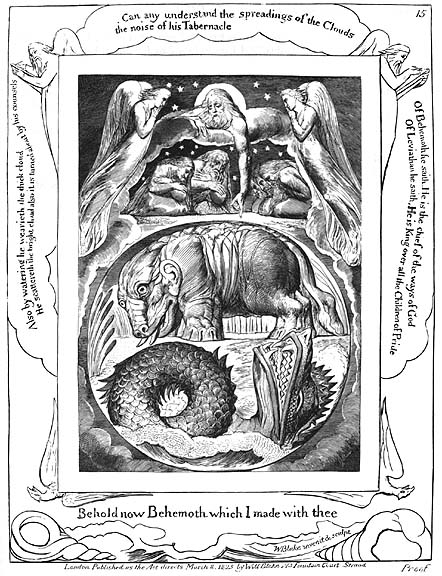
"Vision, or imagination gives insight into the positive and negative aspects of life... it sees the limits of things, and therefore it is the great unifier." Digby then refers us to Blake's Illustrations of the Book of Job (Plate 15) "Behold now Behemoth which I made with thee": Blake is quoting here Job 40:15, which goes on to say "he eateth grass as an ox."

This picture (15 of Gates of Paradise) kind of sums up all that has gone before. When we resort to (or achieve) Vision (which I identify as the intuitive faculty exemplified by Blake's Los), then Good and Evil, Love and Hate, Beautiful and Ghastly, White and Black, Heaven and Hell take on a New Light. The course of life, or the journey through life begin to hold greater meaning for us.

It also gives new insight into the meaning of what Blake was trying to say in The Marriage of Heaven and Hell, which ends with the magnificent aphorism "Everything that lives is holy";
in The Four Zoas (Night the Second) he amplified it like this
"for the source of life Descends to be a weeping babe" (Oh Wow!)