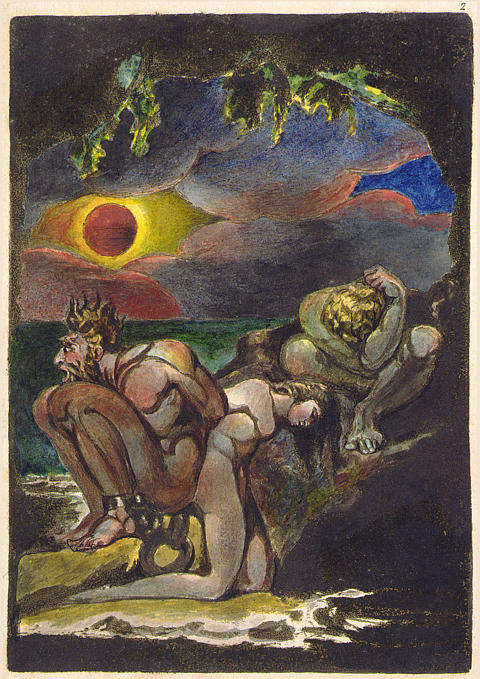
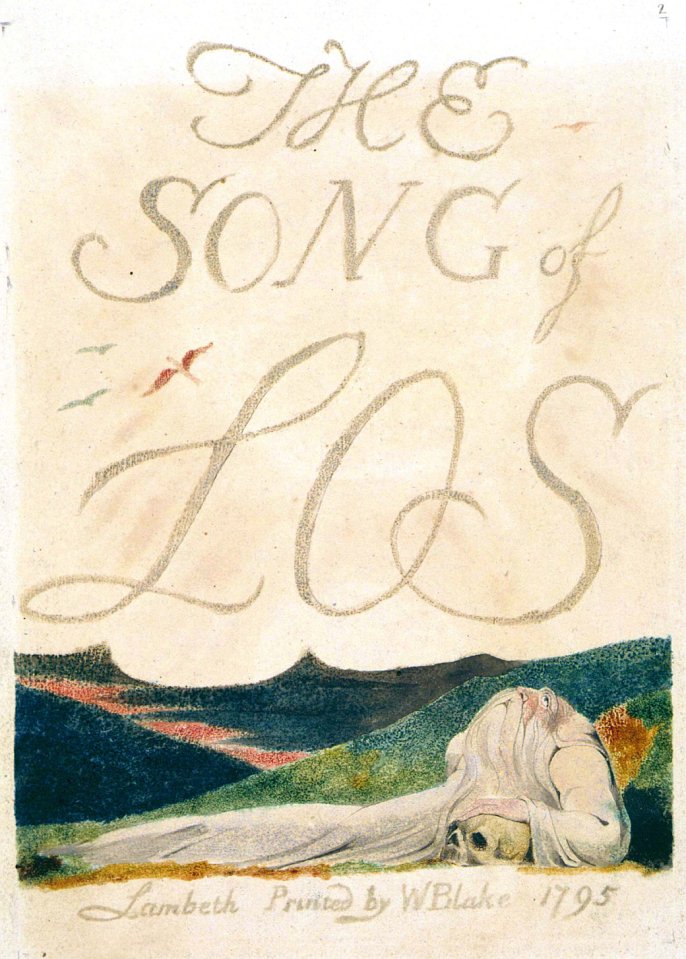
Showing posts with label Urizen. Show all posts

Thursday, February 3, 2011

Blake's Joy

Count it all joy when ye fall into divers temptations; Knowing this, that the trying of your faith worketh patience. But let patience have her perfect work, that ye may be perfect and entire, wanting nothing. (James 1:2-4)

Th
e epigram says it all!

This little poem sets the natural scene:
"Man was made for Joy & Woe;
And when this we rightly know
Thro' the World we safely go.
Joy & Woe are woven fine,
A Clothing for the Soul divine;"
(From Auguries of Innocence; Erdman page 491)

We might wonder what meanings joy and woe had for Blake in the spiritual development of his life.

Blake must have been a joyous child to see a tree full of angels, but like all children he also knew woe at an early age; that is symbolized by the angry God at the window who left him screaming (I wonder how many of the small children of fundamentalist Christians have a similar experience.)

The angry God became Blake's chief source of woe and set him to writing feverishly over the years. It led to the system he created, the Myth, begun with a Fall. It led to a systematic study of human psychology with the division of the psyche into four fractions, namely Urizen, Luvah, Los, and Tharmas or in modern day parlance Thinking, Feeling, Intuition or Imagination, and Sensation.

Blake's Thinking became a bane to him; he identified Urizen with the Angry God, the Lawgiver, the Schoolmaster. He wrote thousands of words and produced a multitude of images dealing with Urizen.

He is first mentioned in 1793 in Visions of the Daughters of Albion: "O Urizen! Creator of men! mistaken Demon of heaven: Thy joys are tears! thy labour vain, to form men to thine image."(Erdman 48)

Also in 1793 Blake mentioned Urizen three times in America. (Erdman 54ff) Here's one of them:
"The fiery joy, that Urizen perverted to ten commands"; here he has identified Urizen with the God who directed Moses in the Exodus, but this Exodus was not to liberty, but from Eternity to a rule bound life .

In 1794 Blake began to describe Urizen's career with the Book of Urizen. The story is amplified in great detail. In The Four Zoas. (Put urizen in the concordance if you want to know where it occurs.)

Blake hated the dominance of Urizen over his mind, but in the course of time he dealt creatively with Urizen. After many, many scenes showing Urizen making things worse and beginning to fear for Futurity he encountered and was confronted by Los. The contest was arduous-- between imagination and what had become fear. The enmity went on and on until finally Los subdued Urizen.

Then strangely enough Los found that he no longer hated Urizen; in fact he had come to love him. (He forgave one who had sinned against him!) Urizen was in his power. With the shivering Urizen subdued by Los, Blake laid to rest the Angry God.

For Blake the thump on the head was replaced by the healing balm of the Jesus he had come to love and worship. Facing God he said:
"Throughout Eternity I forgive you; you forgive me." ([Notebook], "MySpectre"54; E477)
A powerful general statement about the consequences of grace. You is everyone of course, but Blake particularly addressed God in this statement. (We may not know it, but a host of us need to forgive God for the things that have appeared to us to be unjust.) Making that decision is infinitely liberating to the human soul.

For Blake having made it led to an immediate release of the visionary power he had lost twenty years before; like C.S.Lewis he was Surprised by Joy. He began to write and draw with power and vigor. In fact he became an evangelist. Unlike Francis of Assisi he used words by choice; words were his forte.

Milton, Jerusalem, Job (Illustrations): three of many ways of telling the old, old story.

Sunday, January 9, 2011

BLAKE READS THE BIBLE

Bishop Richard Watson’s An Apology for the Bible was published in 1796 and annotated by Blake in 1798.

When Blake annoted Watson's Apology for the Bible he expressd his unorthodox, inclusive views. He argued that man should realize he has direct access to God through the faculty of the imagination. He urged his reader to look within for the work of God in his own life and to be receptive to God's gifts.

Annotation to an Apology for the Bible (Bishop Watson)
E 615
"That the Jews assumed a right to the benefits
of God. will be a lasting witness against them. & the same will
it be [of] against Christians"

E 615
"The Bible or Word of God, Exclusive of Conscience
or the Word of God Universal, is that Abomination which like the
Jewish ceremonies is for ever removed & henceforth every man may
converse with God & be a King & Priest in his own house"

E 615
"It is strange that God should speak to man formerly & not
now. because it is not true"

E 615
"The Bible tells me that the plan of Providence was Subverted
at the Fall of Adam & that it was not restored till [we
in] Christ [?made ?restoration]"

E 616
"He who writes things for true which none could write. but
the actor. such are most of the acts of Moses. must either be the
actor or a fable writer or a liar. If Moses did not write the
history of his acts, it takes away the authority altogether it
ceases to be history & becomes a Poem of probable impossibilities
fabricated for pleasure as moderns say but I say by Inspiration."

E 617
"look over the events of your own life & if you do not find that
you have both done such miracles & lived by such you do not see
as I do True I cannot do a miracle thro experiment & to
domineer over & prove to others my superior power as neither
could Christ But I can & do work such as both astonish &
comfort me & mine"

E 617
"a Prophet is a Seer not an Arbitrary Dictator.
It is mans fault if God is not able to do him good. for he gives
to the just & to the unjust but the unjust reject his gift"

E 617
"for the facts are such as none but the actor
could tell, if it is True Moses & none but he could write it
unless we allow it to be Poetry & that poetry inspired"

Blake's heart was touched by man's failure to open the doors of perception. It grieved him that man had built walls to separate himself from the Divine. He showed us that the manacles we endure are forged in our own minds.


Book of Urizen, Plate 27, (E 83)
"5. And their children wept, & built
Tombs in the desolate places,
And form'd laws of prudence, and call'd them
The eternal laws of God"


Image from
Book of Urizen, Plate 26
____________________________________________________
Learn more about Blake's annotation in this review of
Blake's Margins: An Interpretive Study of the Annotations, by Hazard Adam (Reviewed by Morton D. Paley on 2010-05-22).

Wednesday, November 24, 2010

MORAL VIRTUE

Visions of the Daughters of Albion

Why was Blake so opposed to 'moral virtue'? He was a man of character who had compassion for his fellow man. What he defined as 'moral virtue' was opposite to all that fostered benevolence among men or brought man closer to God. 'Moral virtue' grew from false reasoning which Blake incorporated in Urizen. A proliferation of characters evolve from Urizen's fallen reasoning - Rahab, Babylon, Vala, Tirza, Hyle, Hand and Satan himself. The book of Jerusalem is occupied with Albion's infection with the false ideas of Urizen.

Moral virtue is one law for all.
Moral virtue is putting abstractions above persons.
Moral virtue is attempting to impose one's values on another.
Moral virtue is justifying cruelty to implement obedience.
Moral virtue is destroying the works of others.
Moral virtue is the disguise used to hide the Selfhood.

You will find many of the characteristics of 'moral virtue' among the Pharisees of the New Testament. Blake's anger against 'moral virtue' like Jesus' anger against the Pharisees, fell upon upholders of law rather than upon lawbreakers.

Matt 23:1-5 "Then Jesus spoke to the multitudes and to His disciples, saying: "The scribes and the Pharisees sit in Moses' seat. Therefore whatever they tell you to observe, that observe and do, but do not do according to their works; for they say, and do not do. For they bind heavy burdens, hard to bear, and lay them on men's shoulders; but they themselves will not move them with one of their fingers. But all their works they do to be seen by men."

Matt 23:13 "But woe to you, scribes and Pharisees, hypocrites! For you shut up the kingdom of heaven against men; for you neither go in yourselves, nor do you allow those who are entering to go in."

This is Blake's explanation of why he is so opposed to the false religion deriving from the false reason:

Four Zoas, PAGE 121, (E 390)
"My anger against thee is greater than against this Luvah
For war is energy Enslavd but thy religion
The first author of this war & the distracting of honest minds
Into confused perturbation & strife & honour & pride
Is a deceit so detestable that I will cast thee out
If thou repentest not & leave thee as a rotten branch to be burnd
With Mystery the Harlot & with Satan for Ever & Ever
Error can never be redeemd in all Eternity
But Sin Even Rahab is redeemd in blood & fury & jealousy
That line of blood that stretchd across the windows of the morning
Redeemd from Errors power. Wake thou dragon of the Deeps
Urizen wept in the dark deep anxious his Scaly form
To reassume the human & he wept in the dark deep"

These passages epitomize the exercise the 'moral virtue' which Blake so opposed:

Jerusalem, Plate 28, (E 174)
"And Albion spoke from his secret seat and said

All these ornaments are crimes, they are made by the labours
Of loves: of unnatural consanguinities and friendships
Horrid to think of when enquired deeply into; and all
These hills & valleys are accursed witnesses of Sin
I therefore condense them into solid rocks, stedfast!
A foundation and certainty and demonstrative truth:
That Man be separate from Man, & here I plant my seat.

Cold snows drifted around him: ice coverd his loins around
He sat by Tyburns brook, and underneath his heel, shot up!
A deadly Tree, he nam'd it Moral Virtue, and the Law
Of God who dwells in Chaos hidden from the human sight.

The Tree spread over him its cold shadows, (Albion groand)
They bent down, they felt the earth and again enrooting
Shot into many a Tree! an endless labyrinth of woe!"

Jerusalem, PLATE 45 [31],(E 194)
"every minute particular, the jewels of Albion, running down
The kennels of the streets & lanes as if they were abhorrd.
Every Universal Form, was become barren mountains of Moral
Virtue: and every Minute Particular hardend into grains of sand:
And all the tendernesses of the soul cast forth as filth & mire,
Among the winding places of deep contemplation intricate"

Sunday, September 5, 2010

The Fall I

I need at least 8 posts to do justice to The Fall as Blake understood it. The Fall (as a preliminary to the Redemption and Return is a fundamental facet of his myth. Throughout his Complete Works he presented it in a thousand ways. It has been discussed repeatedly in this blog (look first at Urizen's Confession, which actually deals with the Fall and the Rise).

The Four Zoas might well be considered an initial sketch for Blake's myth, and it has much to tell us about The Fall:

Albion went to Beulah for R and R; he divided into the Four Zoas. Albion fell asleep after delegating the leadership to Urizen;
In Night V we hear Urizen's confession:
"
O Fool could I forget the light that filled my bright spheres
Was a reflection of his face who calld me from the deep?
I well remember for I heard the mild & holy voice saying
'O light spring up and shine' and I sprang up from the deep
He gave to me a silver scepter & crownd me with a golden crown and said
Go forth & guide my Son who wanders on the ocean."
The golden crown and the silver scepter (signifying love) signified the leadership; it included the material sun signifying Light; Urizen was the charioteer of the sun pulled by the horses of Light (instruction and a few other things).

On a fateful night of drunkeness Urizen gave Luvah his "steeds of Light":
"I went not forth. I hid myself in black clouds of my wrath
I calld the stars around my feet in the night of councils dark
The stars threw down their spears and fled naked away.
We fell"

Four Zoas, Night 5, 64:20-28, (E 344)

We fell! What a pregnant statement! The course of the Fall was thuswise; according to Damon (p. 419):
"the cause of Urizen's downfall into the state of Satan was that of the traditional (Miltonic?) Satan: the desire for dominion" (to attempt to dominate others is a way to fall into a state of Satan).

Urizen's loss of his "immortal steeds of light" to Luvah is a central metaphor mentioned often in 4Z. Some of its incidents may be explored in another post, but here is one of Urizen's emanation, Ahania's laments that revealed to some extent what happened:


"
Ahania bow'd her head & wept seven days before the King [Urizen of course]
And on the eighth day when his clouds unfolded from his throne
She rais'd her bright head sweet perfumd & thus with heavenly voice
O Prince the Eternal One hath set thee leader of his hosts

Leave all futurity to him Resume thy fields of Light
Why didst thou listen to the voice of Luvah that dread morn
To give the immortal steeds of light to his deceitful hands
No longer now obedient to thy will thou art compell'd
To forge the curbs of iron & brass to build the iron mangers
To feed them with intoxication from the wine presses of Luvah
Till the Divine Vision & Fruition is quite obliterated
They call thy lions to the fields of blood, they rowze thy tygers
Out of the halls of justice, till these dens thy wisdom framd
Golden & beautiful but O how unlike those sweet fields of bliss
Where liberty was justice & eternal science was mercy
Then O my dear lord listen to Ahania, listen to the vision
The vision of Ahania in the slumbers of Urizen
When Urizen slept in the porch & the Ancient Man was smitten"
(Erdman 326-7)

Wednesday, September 1, 2010

The Book of Urizen

This early prophetic book first appeared in 1794 and had it's last printing in 1815. In the Marriage of Heaven and Hell Blake promised a Bible of Hell, and the Book of Urizen might well be considered the demonic version of Genesis. It's in the form of nine chapters (perhaps representing the 9 months of human gestation), a form repeated with the 9 nights of The Four Zoas. The primary character, Urizen, creates a world of rigid laws, a completely materialistic world with no vestige of any sort of spiritual reality.

The Book of Urizen might well be thought of as a sort of Introduction or Preface to The Four Zoas. Here we meet zoas, who will be fleshed out with tremendous detail in the major prophesies (The Four Zoas, Milton, and Jerusalem).
There are 27 plates in all, and each of them might provide a source for further study and understanding of Urizen and of Blake's myth as a whole.

Urizen

The word strongly suggests reason, the primary quality of Urizen. Blake felt that the hegemony of rational thinking since The Enlightenment had had a stultifying and destructive influence on the British culture. He chose Bacon, Newton and Locke to epitomize that destructive influence. He chose Urizen to exemplify it in his myth.

At the final consummation Blake rehabilitated Bacon, Newton and Locke. They appeared counterbalancing Blake's three great poets.

'The Druid Spectre was Annihilate loud thundring
rejoicing terrific vanishing
Fourfold Annihilation & at the clangor of the
Arrows of Intellect
The innumerable Chariots of the Almighty appeard
in Heaven
And Bacon & Newton & Locke, & Milton &
Shakspear & Chaucer"
(Jerusalem 98: 6-9 [257])

In Night II of The Four Zoas Urizen lost his faith and
in vision saw the world collapsing into darkness:

"Urizen rose from the bright Feast like a star thro' the evening sky
Exulting at the voice that calld him from the Feast of envy
First he beheld the body of Man pale, cold, the horrors of death
Beneath his feet shot thro' him as he stood in he Human Brain
And all its golden porches grew pale with his sickening light
No more Exulting for he saw Eternal Death beneath
Pale he beheld futurity; pale he beheld the Abyss...[he said]
Build we a Bower for heavens darling in the grizly deep
Build we the Mundane Shell around the Rock of Albion"
FZ2: 23:9-24.8; (E 314)

The darkness led Urizen to this confession:

"O Fool could I forget the light that filled my bright spheres
Was a reflection of his face who calld me from the deep?
I well remember for I heard the mild & holy voice saying
'O light spring up and shine' and I sprang up from the deep
He gave to me a silver scepter & crownd me with a golden crown and said
Go forth & guide my Son who wanders on the ocean.
I went not forth. I hid myself in black clouds of my wrath
I calld the stars around my feet in the night of councils dark
The stars threw down their spears and fled naked away.
We fell"

(Four Zoas Night 5 64:20-28, [344]

Urizen symbolized the demiurge, used by gnostic and other philosophers as the lesser god who created this vale of tears, our world. Urizen often shaded into a Moses like figure, constantly looking at and working on his books of the law, the vengeful Old Testament God, and other uncomplimentary names. In the fallen condition he shades into Satan:

"Urizen calld together the Synagogue of Satan in dire Sanhedrin

To Judge the Lamb of God to Death as a murderer & robber."

(FZ8-109:6-7) [378])

Urizen was less prominent in the later epics. But in Jerusalem Plate 96 he joined with the other four zoas in the common redemption. Hear these words from the awakened Albion:

"Do I sleep amidst danger to Friends! O my Cities & Counties
Do you sleep! rouze up! rouze up. Eternal Death is abroad
So Albion spoke & threw himself into the Furnaces of affliction
All was a Vision, all a Dream: the Furnaces became Fountains of Living Waters How[l]ng from the Humanity Divine"

"And all the Cities of Albion rose from their Slumbers, and All
The Sons & Daughters of Albion on soft clouds Waking from Sleep

Soon all around remote the Heavens burnt with flaming fires

And Urizen & Luvah & Tharmas & Urthona arose into

Albions Bosom: Then Albion stood before Jesus in the Clouds

Of Heaven Fourfold among the Visions of God in Eternity"

(Jerusalem plate 96: near the end; Erdman 256)

Wednesday, July 28, 2010

LOST & FOUND

Early in 2010 the Tate gallery announced that it was purchasing a set of Blake prints which had long been lost. The group of eight prints was in the possession of Blake when he died and was inherited by his wife Catherine. An inscription on the back of one of the pictures indicates that they were given by Catherine to Frederick Tatum with whom Catherine lived after William's death. They did not surface again into public view until the were found in a secondhand railway timetable purchased in a used book sale in 1978. The owner offered them for sale as a set to the Tate Gallery which purchased them for 441000 pounds.

The group of eight includes six images from the Book of Urizen, one from the Marriage of Heaven and Hell, and one from The Book of Thel. The images are etchings from plates produced for the earlier works. They are finished with pen and ink, watercolor and tempera to be viewed as individual works of art. Text was left off of the engravings. Have a look for yourself courtesy of the BBC.

Keri Davies has studied the pictures since they were first shown at the Tate in 2007 and suggests that they were a part of Copy B of the Small Book of Designs. She provides the captions which appear on the newly discovered set which are absent in the set called Copy A. The pictures go on exhibit at the Tate this month and will be included in an exhibit at the Pushkin State Museum of Fine Art, Moscow in November 2011.

Wednesday, July 7, 2010

REASON & EMOTION


Erdman, in The Illuminated Blake
says: "Phaeton-like, down hurdle a naked man and sword and a horse with saddle cloth and broken chariot wheel...The man's spread hands are braced to hit the ground, but it is already in flames. Reason must have forgotten to let the horse do the pulling; a sword is not a bridle. But Energy must have restraint. Between them they have let the sun fall, connoting universal ruin."


The Marriage of Heaven and Hell was written in 1791 when Blake was a young man; he might be called an angry young man.

Marriage of Heaven and Hell, Plate 5, (E 34)
"Those who restrain desire, do so because theirs
is weak enough to be restrained; and the restrainer or
reason usurps its place & governs the unwilling.
And being restraind it by degrees becomes passive
till it is only the shadow of desire.
The history of this is written in Paradise Lost. & the
Governor or Reason is call'd Messiah.
And the original Archangel or possessor of the com-
mand of the heavenly host, is calld the Devil or Satan
and his children are call'd Sin & Death
But in the Book of Job Miltons Messiah is call'd
Satan. For this history has been adopted by both parties
It indeed appear'd to Reason as if Desire was
cast out. but the Devils account is, that the Messiah
fell. & formed a heaven of what he stole from the Abyss
This is shewn in the Gospel, where he prays to the
Father to send the comforter or Desire that Reason
may have Ideas to build on, the Jehovah of the Bible
being no other than he, who dwells in flaming fire.
Know that after Christs death, he became Jehovah.
But in Milton; the Father is Destiny, the Son, a
Ratio of the five senses. & the Holy-ghost, Vacuum!
Note. The reason Milton wrote in fetters when
he wrote of Angels & God, and at liberty when of
Devils & Hell, is because he was a true Poet and
of the Devils party without knowing it"

Blake was continually striving to free his imagination from constraints. The internal constraints of which he was most aware (excluding the selfhood) were misguided reason and emotion. In Plate 5 of Marriage of Heaven and Hell he expresses the concern that reason will succeed in restraining the emotions to the point that the imagination is bound. Emotion or desire is the source of energy which is required for the creative process.

As a poet, Blake identifies with Milton whose Paradise Lost was of consuming interest to Blake. In this Plate Blake deals with the poet's work (his own and Milton's), Biblical characters who becomes fictional characters for both the poets, and the abstract ideas of reason and emotion.

Blake became so interested in correcting the misconceptions of his friend (his spiritual, intellectual but not corporeal friend), that he addressed the issue in his poem Milton. Since Milton died 83 years before Blake was born, this was a friendship on the level of Eternity; time was not of the essence.

The crux of Milton's error in Blake's system is stated concisely as:
"But in Milton; the Father is Destiny, the Son, a Ratio of the
five senses. & the Holy-ghost, Vacuum!"

In Blake the Father is the Divine Humanity, in whose Image man is created; the Son is the Divine Vision, God in Man, the Incarnation; and the Holy Spirit is the Divine Body, the Human Imagination, the activity of expressing the Divine.

Or in other terms for Blake:
Father = Urizen = reason
Son = Luvah = emotions
Holy Spirit = Los = intuition or imagination
Unified man = Tharmas = body

Tuesday, June 29, 2010

SENSES SHRINK

An image that Blake uses for the Fall of Man (the division into duality or multiplicity), is presented in the limitation of man's sensory acuity. The senses of Eternity are flexible, expanding and contracting at will: their perceptions are infinite.

The Book of Urizen dramatizes the process of the infinite senses becoming the senses five that we recognize and enjoy today. It is not a happy sight to see the powers of Eternity being defined and limited into the narrow range of sight, sound, smell, and taste and touch to which we have access.

Book of Urizen, Plate 12, (E 76) ................Plate 13

"8. In harrowing fear rolling round;
His nervous brain shot branches
Round the branches of his heart.
On high into two little orbs
And fixed in two little eaves
Hiding carefully from the wind,
His Eyes beheld the deep,
And a third Age passed over:
And a state of dismal woe.

9. The pangs of hope began,
In heavy pain striving, struggling.
Two Ears in close volutions.
From beneath his orbs of vision
Shot spiring out and petrified
As they grew. And a fourth Age passed
And a state of dismal woe.

10. In ghastly torment sick;
Hanging upon the wind;

PLATE 13

Two Nostrils bent down to the deep.
And a fifth Age passed over;
And a state of dismal woe.

11. In ghastly torment sick;
Within his ribs bloated round,
A craving Hungry Cavern;
Thence arose his channeld Throat,
And like a red flame a Tongue
Of thirst & of hunger appeard.
And a sixth Age passed over:
And a state of dismal woe.

PLATE 22, (E 82)
The Senses inward rush'd shrinking,
Beneath the dark net of infection.

2. Till the shrunken eyes clouded over
Discernd not the woven hipocrisy
But the streaky slime in their heavens
Brought together by narrowing perceptions
Appeard transparent air; for their eyes
Grew small like the eyes of a man
And in reptile forms shrinking together"

The inability to perceive reality shows itself in man's forgetting Eternity from which he originated. This limits his ability to discern the possibility of living as he is meant to live. His limited perceptions further cloud his mind to the distorted conditions which he becomes satisfied with living under in the world he has made for himself.

Letter to Truxler, (E 702)
"As a man is So he Sees.
As the Eye is formed such are its Powers"

We are limited in what we see by who we are; likewise we are limited in who we are by what we see. In our present circumstances the distortions of our perceptions cause us to accept war, imprisonment, impoverishment, exploitation, and destruction of the environment. Likewise we are diminished in our self-perception by what we see is happening around us. Cleansing the windows of perception is a way to alter the direction in which we are heading. Blake has the journey to regeneration begin by Los recognizing himself in his enemy Urizen. Our return journey can begin with a recognition that we are creating the self-destructing world in our own image. Healing ourselves can heal our world.

Tuesday, December 29, 2009

URIZEN & SHADOW

The character Urizen dominates much of Blake's writing. He appears and reappears from the First Book of Urizen to the end of the Four Zoas. Why was his configuration of characteristics so important in the mind of Blake?

Trying to recall Urizen to his former self and to union with the Botherhood, Albion speaks thus to Urizen in Four Zoas, Night IX, PAGE 120 (E 389):

"The Eternal Man sat on the Rocks & cried with awful voice

O Prince of Light where art thou I behold thee not as once
In those Eternal fields in clouds of morning stepping forth
With harps & songs where bright Ahania sang before thy face
And all thy sons & daughters gatherd round my ample table
See you not all this wracking furious confusion
Come forth from slumbers of thy cold abstraction come forth
Arise to Eternal births shake off thy cold repose
Schoolmaster of souls great opposer of change arise
That the Eternal worlds may see thy face in peace & joy
That thou dread form of Certainty maist sit in town & village

While little children play around thy feet in gentle awe
Fearing thy frown loving thy smile O Urizen Prince of light"

Reclining Urizen This is an image of a man who lives almost entirely in his head; his body is atrophied and his hand rests on a second skull.

These are the characteristics which Albion sees as dividing Urizen from his Eternal form. He is cold, he deals in abstractions, he is asleep, and repetitive, and certain of his own correctness. Albion's hope is that he can return to a condition in which the Eternals as well as little children may enjoy his former demeanor.

During the unfolding of Blake's myth, Urizen's characteristics become expressed in the law. Urizen is portrayed as projecting his inner characteristics onto his outer experience; including his attitude as to how the world should function and the people in it should behave.

Blake himself outwardly rejects Urizen's attitudes of distance, rigidness, non-involvement, inflexibility, blindness, and fear of the unknown. But his poetry may reveal that he struggled internally against the very characteristics he objected to. His Shadow may have been expressed in Urizen.

Saturday, November 28, 2009

ALBION & LAZARUS

The plight of Albion as he falls from his original unity as an Eternal, is portrayed in Night the First of the Four Zoas.

PAGE 21
"Then those in Great Eternity met in the Council of God
As one Man for contracting their Exalted Senses
- 310 -
They behold Multitude or Expanding they behold as one
As One Man all the Universal family & that one Man
They call Jesus the Christ & they in him & he in them
Live in Perfect harmony in Eden the land of life
Consulting as One Man above the Mountain of Snowdon Sublime

For messengers from Beulah come in tears & darkning clouds
Saying Shiloh is in ruins our brother is sick Albion He
Whom thou lovest is sick he wanders from his house of Eternity
The daughters of Beulah terrified have closd the Gate of the
Tongue
Luvah & Urizen contend in war around the holy tent

So spoke the Ambassadors from Beulah & with solemn mourning
They were introducd to the divine presence & they kneeled down
In Conways Vale thus recounting the Wars of Death Eternal

The Eternal Man wept in the holy tent Our Brother in Eternity
Even Albion whom thou lovest wept in pain his family
Slept round on hills & valleys in the regions of his love
But Urizen awoke & Luvah woke & thus conferrd

Thou Luvah said the Prince of Light behold our sons & daughters
Reposd on beds. let them sleep on."

It is confusing but enlightening that Blake brings to our minds a reference to the death and resurrection of Jesus's friend Lazarus by including familiar words from the story as told in John's Gospel. Lazarus is Jesus's friend whom he loves. Jesus knows his friend is sick but holds back from visiting until Lazarus has been in the grave four days. Jesus weeps over his friend and then brings him back to life.

John, Chapter 11

When Jesus revives Lazarus it is a four stage process: he has the stone removed from the entrance to the grave, he wakes him up, he removes the grave clothes that restrain him, then he calls him forth.

Albion will be brought back from the brink of Eternal Death, but it will be a multi-stage process involving the four Zoas, the Emanations, the Spectres, and ultimately Jesus himself.

In John, the account of the raising of Lazarus is followed immediately by the passage in which the determination is made by the priests and Pharisees that Jesus must be killed.

Blake, through the retelling of the Christian myth using psychological and mythopoeic methods, aims to follow Jesus as described in this verse:

11:4 - When Jesus received the message, he said, "This illness is not meant to end in death; it is going to bring glory to God - for it will show the glory of the Son of God."

The raising of Lazarus as shown by Blake in three different ways:

Lazarus in No Natural Religion

Lazarus in Tate Gallery

Lazarus in Young's Night Thoughts

Thursday, November 19, 2009

ANNIHILATION

When Blake talks about annihilation he is talking about annihilation of the Selfhood. It is an internal activity. It is not accomplished by force or violence but by forgiveness and receiving the Selfhood as a brother. As Blake portrays it, annihilation is not a single event but a way of life. Since the Selfhood continually asserts itself, the process of forgiveness must continually be active.

Blake sees the processes which takes place in the individual as also taking place in the One Man, Albion, who is the body of which we all are part. As the Book of Milton reaches its climax, Milton annihilates his Selfhood as seen in Plate 45. The struggle has been completed, but not in victory of one over the other. The Selfhood has lost its power but is embraced tenderly.

Milton, Plate 39 [44] (E141)

"He [Albion] strove to rise to walk into the Deep. but strength failing
Forbad & down with dreadful groans he sunk upon his Couch
In moony Beulah. Los his strong Guard walks round beneath the Moon

Urizen faints in terror striving among the Brooks of Arnon
With Miltons Spirit: as the Plowman or Artificer or Shepherd
While in the labours of his Calling sends his Thought abroad
To labour in the ocean or in the starry heaven. So Milton
Labourd in Chasms of the Mundane Shell, tho here before
My Cottage midst the Starry Seven, where the Virgin Ololon
Stood trembling in the Porch: loud Satan thunderd on the stormy Sea
Circling Albions Cliffs in which the Four-fold World resides
Tho seen in fallacy outside: a fallacy of Satans Churches
PLATE 40 [46]
Before Ololon Milton stood & percievd the Eternal Form
Of that mild Vision; wondrous were their acts by me unknown
Except remotely; and I heard Ololon say to Milton

I see thee strive upon the Brooks of Arnon. there a dread
And awful Man I see, oercoverd with the mantle of years.
I behold Los & Urizen. I behold Orc & Tharmas;
The Four Zoa's of Albion & thy Spirit with them striving
In Self annihilation giving thy life to thy enemies"

Milton, Plate 45, Blake's Image


Blake left it indefinite exactly who is being portrayed in this picture. Since this whole book is about Milton, the standing man with his feet near the water of the brook is said to be Milton; but it could be Los or Jesus or Blake himself, whose tale is told through Milton. The leaning figure could be identified as Ololon, Milton's emanation; or Urizen; or Satan; or the text suggests Albion as the Fourfold Man. The process portrayed is annihilation, forgiveness, being joined to the Selfhood through recognition or self awareness. Perhaps it is best thought of as breaking out of the limiting walls of the self into the unlimited existence in Eternity through imagination. The forgiveness is mutual, the annihilation is mutual, the release is mutual, the regeneration too is mutual.

Milton, Plate 38[43] (E138)
"In the Eastern porch of Satans Universe Milton stood & said

Satan! my Spectre! I know my power thee to annihilate
And be a greater in thy place, & be thy Tabernacle
A covering for thee to do thy will, till one greater comes
And smites me as I smote thee & becomes my covering.
Such are the Laws of thy false Heavns! but Laws of Eternity
Are not such: know thou: I come to Self Annihilation
Such are the Laws of Eternity that each shall mutually
Annihilate himself for others good, as I for thee"

Friday, November 13, 2009

FALLEN ZOAS

Albion in His Fallen State

Before Los initiates the process of restoring Albion to the
Humanity
Divine, each of the four Zoas has fallen to the
point that his outlook is totally opposite to his role in eternity.

Jerusalem, Plate 38, (E184)

"They [the Four Zoas] saw their Wheels rising up poisonous against Albion
Urizen, cold & scientific: Luvah, pitying & weeping
Tharmas, indolent & sullen: Urthona, doubting & despairing
Victims to one another & dreadfully plotting against each other
To prevent Albion walking about in the Four Complexions."


Urizen, meant to be the active intellect involving itself in interfacing with information and developing understanding of relationships, has become cold and detached. He has reduced interactions to measurements, and objective descriptions from his frozen mind.

Luvah, meant to be the source of empathy and delight through the expression of emotional attachments, has been reduced to regret and depression. The spontaneous outpouring of approval or disapproval no longer flows from his detached heart.

Tharmas, meant to be energetic and active, involved in giving outer expression to inner dynamics, is passive and lifeless. The energy which should be generated through sensory perception and the impetus to create life is not flowing in his lethargic body.

Urthona, meant to be faith and vision, the connective function which holds together disparate parts, has lost the 'blessed assurance' and fallen into a dark pit of isolation. The connection of the body with the wholeness of purposeful living finds no expression without imagination.

One's greatest gifts can turn into one's worst liabilities if not recognized as gifts and put to work in the service of the giver. The Zoas will recover their gifts as Albion is restored to Eternity through the work of Jesus and Los.

Sunday, September 6, 2009

The Four Zoas

A Subjective Reading
A Personal Experience

(A valued friend put me on to a discussion of 4Z found
on pages 203-32 of Blake's Sublime Allegory. Most
[or all?] of this post derives from that essay: On Reading the Four Zoas by Mary Lynn Johnson and Brian Wilkie. Hopefully there may be other posts to come on 4Z.)

"...we want most to encourage the sort of visceral and
personal response to this deeply introspective poem
that we believe Blake demands of his readers." (203)

"...we must recognize that the movement of the poem...yields its meaning in proportion to our
willingness to examine what happens within us."

After those lines on the first page the writers proceed
with a cursory statement of the plot; that's revealed
in the first page of 4Z:

"Four Mighty Ones are in every Man;
a Perfect Unity
(John XVII c. 21 & 22 & 23 v)

Cannot Exist. but from the Universal
Brotherhood of Eden
(John I c. 14. v)

The Universal Man. To Whom be
Glory Evermore Amen"
(John I c. 14. v)

The Universal Man of course is Albion-- representing
an eternal Great Britain, representing the people of
the world in Eternity, representing the perfect you.

"Albion looks up, rises from the rock in just wrath and is about to walk 'into the Heavens'" (Erdman)

The "Four Mighty Ones" (the four Zoas) are Tharmas,
Urthona, Urizen, and Luvah. Blake "begins with
Tharmas..", but before the "beginning " he tell us about
Los (the worldly version of Urthona), "Urthona was his
name", who represents here all the Zoas, in Eternity
with "days and nights of revolving joy", then the plot
is announced:


"His fall into Division & his Resurrection to Unity His
fall into the Generation of Decay & Death & his
Regeneration by the Resurrection from the dead."

It's the old, old story everyone can read in the Bible;
In 4Z Blake gave us his version of it -- one of course
of many.

Monday, August 24, 2009

Blake's Image of Saints in Dante

Toward the end of his life William Blake began a series
of illustrations for Dante's DIVINE COMEDY for his
patron and friend John Linnell. Blake left 102 of these
watercolor illustrations when he died: seventy-two for
the Inferno, twenty for the Purgatorio, and ten for the
Paradiso. Blake's designs are said to be not mere
illustrations but commentary on Dante's text.
(Martin Butlin)

One illustration for the Paradiso particularly caught my
attention in the Blake Archive:
Link to Blake Archive

In Martin Butlin's WILLIAM BLAKE, published by the
Tate, he makes these comments on the picture I noticed:
"Blake illustrates the successive appearances of
St. Peter, St. James and St. John. St. Peter, who
questions Dante on Faith, is represented by Blake's
type for Urizen; St. James, who questions Dante on
Hope, as Luvah; and St. John, who questions Dante on
Love, as Los or the Poetic Genius. Together they
represent Reason, Feeling and Imagination. The
overlapping of the three globes in which they are
shown, embracing Dante and Beatrice whose echoing
gestures reflect harmony, is a marvelously vivid image
of reunion of Man's various elements that is requisite
of true salvation."

Quite a summation of the Bible, Blake's myth, religion
and psychology!

The picture named 'St. Peter, St. James, Dante and
Beatrice with St. John also' can be found at:

Blake's image from Dante

In this picture it is fascinating to see how Blake
integrated Dante's poetry into his own visual
vocabulary.

Dante's three conversations with St. Peter, St. James
and St. John about faith, hope and love respectively
are amalgamated into one scene. Blake himself
wouldn't be left out of the creative process, so he gives
the three saints correspondence to three of his Zoas.
He skews the character of the Zoas to align them with
the saints .

Urizen is a pretty good fit with St. Peter since Blake has
identified Urizen with the fallen church consistently.
The association of Urizen with faith is perhaps by his
building a structure to try to make sense of being.
Peter's first recognition of Jesus as the Messiah is a
prime example of his faith. The identification of Peter
with Urizen is implied by his facial appearance which is
congruent with multiple images of Urizen as he is
associated with the vengeful God of the Old Testament,
and by the faint image of the scroll which Peter holds in
his left hand.

For a rare image of the Four Zoes together, see:

4z's in Book of Urizen

If Luvah is paired with St. James, it might be on the
basis of putting into practice the spiritual truth we
receive, which is emphasized in the New Testament
'Letter of James.' I don't know why hope would be
associated with either St. James or Luvah.

Los, the Eternal Prophet, pictured as the descending
Holy Spirit becomes in the picture, St. John, the author
of the Apocalypse or 'Book of Revelation.' Although it is
not the characteristic usually assigned to Los, love is
entirely appropriate to him in his role as the Poetic
Genius opening the world to imagination. St. John
exemplifies love as the author of the gospel stressing
unity among men, and between God and man.

In his characteristic way of making his figures
ambiguous or subject to multiple interpretations, Blake
may have been thinking of the lower central image of
Dante and Beatrice as Albion, (Humanity as realized in
the one Man) or as Tharmas the fourth of the Four
Zoas, who can be associated with the senses or the
physical body.

Better students than I, of Dante, Blake and the Bible
should be able to see much more in this picture than I do.