Showing posts with label Forgiveness. Show all posts

Thursday, February 10, 2011

BLAKE & HIS READER

Blake's Sublime Allegory, Essays on The Four Zoas, Milton, & Jerusalem, Edited by Stuart Curran & Joseph Anthony Wittreich, Jr. is an excellent book to add to your library or download to your computer. Of interest is Roger R. Easson's essay, Blake and His Reader in Jerusalem.

In attempting to assist Blake students in making sense out of Jerusalem, Roger Easson says that "Jerusalem may be read as a poem about the experience of reading Jerusalem; it is a poem which enjoins the reader to participate in the creative process." Easson uses Blake's metaphor of the Golden String to demonstrate that the reader is expected to break down his dependence of reasoning and analysis in trying to work his way through the labyrinth or Jerusalem.

"...recalling the string metaphor in the Theseus myth, where Ariadne shows Theseus how to escape from the labyrinth after he has killed the Minotaur - he is to wind up the ball of string he unwound as he entered. Traditionally, the guide gives the ball of string to the adventurer as he enters the confusion of the labyrinth. Here however, Blake hands the reader the end of the string, which is unwound, indicating that the reader is in the depths of the labyrinth already. In this case, though, to follow the mythic parallel to its conclusion, before the reader can wind up the ball of string, he must conquer his spiritual Minotaur, the selfhood. At that point, winding the string may, in fact lead 'in Heavens gate,/Built in Jerusalem's wall'; for he will then be traveling in the 'Spirit of Jesus' which is 'continual forgiveness of Sin.' If however the reader does not subdue the selfhood, then the essential task enjoined by the metaphor - the destruction of the Minotaur - is unfulfilled and the reader succumbs to the selfhood, leaving Jerusalem a literary puzzle without solution.
As we have noted before, Jerusalem mirrors the state of the reader; and if the reader is still dominated by the spectral reason when he attempts to thread his way through the verbal maze, then he will be led deeper and deeper into the enigma, into the darkness of Blake's allegoric night." ( page 314).

AMERICA, Plate 11

Easson's view is that Blake's aim is to transform the accusing, rational reader to the forgiving, faithful reader by altering his perception.

On our blog we have often returned to the metaphors of Golden String from the 77th plate of
Jerusalem. Read more.

Heaven's Gate in Jerusalem's Wall
Ariadne's Thread
Return to the Fount of Life
Door to Heaven
Following the String
The Gate in the Arlington Tempera

Tuesday, February 8, 2011

DEAR MOTHER

Songs of Experience, Song 45, (E 26)
The Little Vagabond

"Dear Mother, dear Mother, the Church is cold,
But the Ale-house is healthy & pleasant & warm;
Besides I can tell where I am use'd well,
Such usage in heaven will never do well.

But if at the Church they would give us some Ale.
And a pleasant fire, our souls to regale;
We'd sing and we'd pray, all the live-long day;
Nor ever once wish from the Church to stray,

Then the Parson might preach & drink & sing.
And we'd be as happy as birds in the spring:
And modest dame Lurch, who is always at Church,
Would not have bandy children nor fasting nor birch.

And God like a father rejoicing to see,
His children as pleasant and happy as he:
Would have no more quarrel with the Devil or the Barrel
But kiss him & give him both drink and apparel."

The gentle father welcomes the penitent son in the picture for The Little Vagabond but the poem is not about Luke's story (verses 11-32) of the prodigal being welcomed home by a forgiving father. It is about the need for forgiveness, and becoming aware of the need to be forgiven on the part of the church. If a penitent is to be received into the arms of the father, it is the church.

"Dear Mother, dear Mother, the Church is cold," addresses the poem to the mother church herself, the church of the world. Blake was not known to be a church attender; his membership was in the Church Eternal, the Body of Christ which is the Church Universal.


He found fault with a worldly church which was cold, judgmental, exclusive and cruel. The name of the poem which is not overtly about a vagabond, calls our attention to the outsider, the lost and needy whom the church in Blake's day (as in our own day) neglected and rejected.

The Gentle Father's desire is to take into his arms not only the vagabonds and outcasts, but a church who is becoming a true expression of Christ's Body.

Saturday, January 1, 2011

ILLUSTRATING THE BIBLE

The Blake Archive has recently announced the addition of a series of Blake's paintings produced for Thomas Butts and identified as Paintings Illustrating the Bible. The index lists the nineteen subjects for the Old and New Testaments.

Although I cannot post images from the Blake Archive, I can post this image of The Circumcision from the site named William Blake: The Complete Works which does not restrict the use of the images (which are obviously beyond the period for which copyright protection applies.) .
The final picture of the group in the Archive is particularly appealing : "Christ The Mediator": Christ Pleading Before the Father for St. Mary Magdalene. In this picture Blake portrays the theme of forgiveness. Christ acting as the advocate for the sinner intervenes with Jehovah on the part of Magdalene who was said to have been a harlot.

Mark 16
[9] Now when Jesus was risen early the first day of the week, he appeared first to Mary Magdalene, out of whom he had cast seven devils.

On this the eighth day after the celebration of the birth of Jesus (the first day of the new year), the day on which circumcision is performed according to the Law of Moses, it is appropriate to observe Christ intervening in the exercise of the Law before the Father on the part of the woman who both was forgiven and discovered the empty grave.

Friday, December 10, 2010

SIN & FORGIVENESS


Listen to Blake and the Bible commenting on Jesus, Sin, Error, Forgiveness, Satan and Judgment. These quotes from the two sources allow us to compare New Testament concepts and how similar ideas appear in Blake's :


CHRIST AS THE REDEEMER OF MAN

1)Jesus not the accuser (Satan) is our judge.


1John.2
[1] My little children, these things write I unto you, that ye sin not. And if any man sin, we have an advocate with the Father, Jesus Christ the righteous:

Vision of the Last Judgment, (E 565)
"Forgiveness of Sin is only at the Judgment Seat of Jesus the
Saviour where the Accuser is cast out. not because he Sins but
because he torments the Just & makes them do what he condemns as
Sin & what he knows is opposite to their own Identity"

2) The accuser has no power over us.

Rev.12
[10] And I heard a loud voice saying in heaven, Now is come salvation, and strength, and the kingdom of our God, and the power of his Christ: for the accuser of our brethren is cast down, which accused them before our God day and night.

Vision of the Last Judgment,(E 564)
"Christ comes
as he came at first to deliver those who were bound under the
Knave not to deliver the Knave He Comes to Deliver Man the
[Forgiven] not Satan the Accuser we do not
find any where that Satan is Accused of Sin he is only accused of
Unbelief & thereby drawing Man into Sin that he may accuse him.
Such is the Last Judgment a Deliverance from Satans Accusation
Satan thinks that Sin is displeasing to God he ought to know that
Nothing is displeasing to God but Unbelief & Eating of the Tree
of Knowledge of Good & Evil"

3) The light of Truth leads us to the new creation.

Acts.26
[18] To open their eyes, and to turn them from darkness to light, and from the power of Satan unto God, that they may receive forgiveness of sins, and inheritance among them which are sanctified by faith that is in me. [PAUL]

Vision of the Last Judgment, (E 565)
"I will not Flatter them Error is
Created Truth is Eternal [,] Error or Creation will be Burned Up &
then & not till then Truth or Eternity will appear It is Burnt up
the Moment Men cease to behold it I assert for My self that I do
not behold the Outward Creation & that to me it is hindrance &
not Action it is as the Dirt upon my feet No part of Me."

4) Forgiveness of sins is God's will.

Matt.9
[2] And, behold, they brought to him a man sick of the palsy, lying on a bed: and Jesus seeing their faith said unto the sick of the palsy; Son, be of good cheer; thy sins be forgiven thee.
[5] For whether is easier, to say, Thy sins be forgiven thee; or to say, Arise, and walk?
[6] But that ye may know that the Son of man hath power on earth to forgive sins, (then saith he to the sick of the palsy,) Arise, take up thy bed, and go unto thine house.

Jerusalem,
Plate 20, (E 165)

"Jerusalem answer'd with soft tears over the valleys.

O Vala what is Sin? that thou shudderest and weepest
At sight of thy once lov'd Jerusalem! What is Sin but a little
Error & fault that is soon forgiven; but mercy is not a Sin
Nor pity nor love nor kind forgiveness! O! if I have Sinned
Forgive & pity me! O! unfold thy Veil in mercy & love!
Slay not my little ones, beloved Virgin daughter of Babylon
Slay not my infant loves & graces, beautiful daughter of Moab"

5) The religion of Jesus practices mercy not vengeance.

Matt.23
[23] Woe unto you, scribes and Pharisees, hypocrites! for ye pay tithe of mint and anise and cummin, and have omitted the weightier matters of the law, judgment, mercy, and faith: these ought ye to have done, and not to leave the other undone.

Jerusalem, Plate 52, (E 201)
"Man must & will have Some Religion; if he has not the Religion
of Jesus, he will have the Religion of Satan, & will erect the
Synagogue of Satan. calling the Prince of this World, God; and
destroying all who do not worship Satan under the Name of God.
Will any one say: Where are those who worship Satan under the
Name of God! Where are they? Listen! Every Religion that Preaches
Vengeance for Sins the Religion of the Enemy & Avenger; and not
the Forgiver of Sin, and their God is Satan, Named by the Divine
Name Your Religion O Deists: Deism, is the Worship of the God
of this World by the means of what you call Natural Religion and
Natural Philosophy, and of Natural Morality or
Self-Righteousness, the Selfish Virtues of the Natural Heart.
This was the Religion of the Pharisees who murderd Jesus. Deism
is the same & ends in the same."

6) Practicing Forgiveness builds the Kingdom of God

Matthew 18
[21] Then came Peter to him, and said, Lord, how oft shall my brother sin against me, and I forgive him? till seven times?
[22] Jesus saith unto him, I say not unto thee, Until seven times: but, Until seventy times seven.

Jerusalem, Plate 77, (E 232)
"And remember: He who despises & mocks a Mental Gift in another;
calling it pride & selfishness & sin; mocks Jesus the giver of
every Mental Gift, which always appear to the ignorance-loving
Hypocrite, as Sins. but that which is a Sin in the sight of cruel
Man, is not so in the sight of our kind God.
Let every Christian as much as in him lies engage himself
openly & publicly before all the World in some Mental pursuit for
the Building up of Jerusalem "

The influence that the Bible had on shaping the mind of Blake led him to become a religious poet. He used the Christian metaphors in unique ways but always with the goal of opening the minds of men to the 'perception of the Infinite'.

Friday, November 26, 2010

JESUS & MORAL VIRTUE

Blake did not think that Jesus was sent to uphold the law or teach moral virtue. In The Marriage of Heaven and Hell Blake presents Jesus as a law breaker justifying his later statement that the Lamb of God was numbered among the transgressors. (Isaiah 53)

MHH, Plate 21, (E 43)
"if Jesus Christ is the
greatest man, you ought to love him in the greatest degree; now
hear how he has given his sanction to the law of ten
commandments: did he not mock at the sabbath, and so mock the
sabbaths God? murder those who were murderd because of him? turn
away the law from the woman taken in adultery? steal the labor of
others to support him? bear false witness when he omitted making
a defence before Pilate? covet when he pray'd for his disciples,
and when he bid them shake off the dust of their feet against
such as refused to lodge them? I tell you, no virtue can exist
without breaking these ten commandments: Jesus was all virtue,
and acted from impulse: not from rules."

The moral principle which Blake subscribed to was Forgiveness which replaced the whole of system of law, accusation, judgment and punishment. Blake along with the apostle Paul was convinced that encountering the law created a consciousness of sin, which resulted in a bondage to the 'law of sin and death'. Paul stated in the 8th chapter of Romans that 'the law of the Spirit of life in Christ Jesus has set [us] free from the law of sin and death'. Blake agreed that the hold of the law on the minds of men would be broken by the continual practice of forgiveness exemplified by Jesus. Vengeance, which resulted from enforcement of the law, had no place in Blake's religion or morality.

Everlasting Gospel, (E 876)
"It was when Jesus said to Me
Thy Sins are all forgiven thee
The Christian trumpets loud proclaim
Thro all the World in Jesus name
Mutual forgiveness of each Vice
And oped the Gates of Paradise
The Moral Virtues in Great fear
Formed the Cross & Nails & Spear
And the Accuser standing by
Cried out Crucify Crucify
Our Moral Virtues neer can be
Nor Warlike pomp & Majesty
For Moral Virtues all begin
In the Accusations of Sin"

Image from Milton's Paradise Regained

Thursday, October 14, 2010

Blake's Death


For Blake the word, death, had many meanings:

1. Physical death:
Quoting Damon p. 99: 
"Death of the physical body is the shedding of the shell (garment, robe) which the soul, or spiritual body has grown for protection in this world.  It's the return of the soul to Eternity.  It is an episode of life, a state through which one passes, awakening to Eternal life (J 4:1-2)".

Blake indicated the nature of physical death, particularly of his brother, Robert's death in a letter (9) to Hayley he wrote:

      "Thirteen years ago. I lost a  brother & with his spirit  I  converse daily & hourly in the  spirit. & See him in my
remembrance in the regions of my  imagination.
I hear his advice & even now write from his  Dictate--"

2. For Blake Eternal Death, itself seemed to have many meanings:
Among other things it seems to concern Ulro and the Spectre. Looking at The Four Zoas we read:
"There is from Great Eternity a mild & pleasant rest
Namd Beulah a Soft Moony Universe feminine lovely
Pure mild & Gentle given in Mercy to those who sleep
Eternally. Created by the Lamb of God around
On all sides within & without the Universal Man
The Daughters of Beulah follow sleepers in all their Dreams
Creating Spaces lest they fall into Eternal Death

The Circle of Destiny complete they gave to it a Space
And namd the Space Ulro & brooded over it in care & love
They said The Spectre is in every man insane & most
Deformd Thro the three heavens descending in fury & fire
We meet it with our Songs & loving blandishments & give
To it a form of vegetation But this Spectre of Tharmas
Is Eternal Death
What shall we do O God pity & help"
(The Four Zoas [Nt 1], 5.42; E303)  
Elsewhere in  Milton 4.15; Erdman 98 he reported this
conversation between Los and Satan:

"Satan was going to reply, but Los roll'd his loud thunders.
Anger me not! thou canst not drive the Harrow in pitys paths.
Thy Work is Eternal Death, with Mills & Ovens & Cauldrons.
Trouble me no more. thou canst not have Eternal Life
So Los spoke! Satan trembling obeyd weeping along the way.
Mark well my words, they are of your eternal Salvation"
Satan and the Spectre of course are synonymous. 
"And Milton said, I go to Eternal Death!" 
If you get the picture Milton, in Heaven, choses the path the 
Savior trod; he incarnated; he came down from Heaven into
Earth and for a similar purpose.  But here the meaning of
Eternal seems very clearly mortal life.
There are many other instances of the words in Milton.

Turning to Jerusalem Blake makes it pretty clear in Plate 4:
"Of the Sleep of Ulro! and of the passage through
Eternal Death! and of the awaking to Eternal Life."
It would be very worthwhile to read this plate carefully.
The last occurrence of Eternal Death in Jerusalem occurs in 
Plate 98 lines 21-24:
"Driving outward the Body of Death in an Eternal Death &
Resurrection
Awaking it to Life among the Flowers of Beulah rejoicing in Unity
In the Four Senses in the Outline the Circumference & Form, for
ever
In Forgiveness of Sins which is Self Annihilation." (E257)

(I wonder if he was thinking of Romans 7 when he spoke of the 
Body of Death.  The forgiveness of sins is Self Annihilation, the
end of mortal life.)                                                 
                                               

Sunday, September 19, 2010

How to Forgive God

That's the primary job in life-- for all of us. Blake was no exception. Jacob wrestled with God all night. Blake accused God, denounced Him, despised Him, annihilated Him, but God always returned as He always does sooner or later. This is the way he finally learned to deal with God; he addressed God as follows:
"And throughout Eternity
I forgive you I forgive you You forgive me
As the dear Redeemer said
This the wine and this the bread"

How did Blake deal with God before he learned that. I've posted and posted on that subject, and there's still much to say:

Consider the 'four year old' angry God at the window; many or most of us have had this experience in some form: there was
something out there that you didn't know, didn't trust, not like Mom (sad are you if Mom was like that; unfortunately there are too many such people). For many this experience of an unfriendly Reality deeply covers their lives.

But note the 'tree full of angels'; that's archetypal, too. "
Somebody up there likes me". Good things happen to people, and they have no idea how or why or by whom. Blake was surrounded by angels all his life (not the angels of MHH, but there was that, too).

So Blake's earliest days witnessed the essential otherness and ambiguity of Divinity, a quandary that he spent his life resolving. Blake was a mortal, but his true life was in Eternity, as was that of Jesus, and perhaps us all.


As a projection Blake was able to 'wrestle with God', and he did that for many years; he projected a multitude of (frequently unpleasant) experiences on God:

His matrimonial endeavors suffered a setback and then a glad recovery when Catherine offered herself (she pitied him!) For forty years she proved to be his greatest friend.


Blake was disappointment at the Royal Academy in the person of Joshua Reynolds. This led to comparative artistic obscurity the rest of his life.
However to say that he lived as an isolate would not be quite true:

He had a chance to associate with some creative people: James Basire, the kindly engraver who gave Blake many opportunities at creative work;
the kindly publisher, Joseph Johnson, who not only published some of his work, but invited him into the inner circle where other intellectuals gathered; John Flaxman introduced him to Mrs Henry Matthew who invited him into her drawing room where he met many artists and musicians; she and Flaxman also arranged for the publication of Poetical Sketches (1783); Robert Blake, William's brother was a kindred spirit who meant a great deal to him (even after death Blake often met Robert and got advice from); the Swiss Painter, Fuseli, was another kindred spirit:
("The only man that ever I knew

Who did not make me almost spew

Was Fuseli: he was both Turk and Jew -

And so, dear Christian Friends, how do you do?")

(Erdman 507)

And of course in his last years Blake enjoyed the friendship and encouragement of the Shoreham Ancients, who sat at his feet and gladly took in much of his wisdom.

Each of these friends, and all of them together showed Blake that 'somebody up there liked him'. The fully mature Blake was happy in his acquaintance with and love of the God who had emerged after all the struggles of his youth.
"I rose up at the dawn of day
Get thee away get thee away
Prayst thou for Riches away away
This is the Throne of Mammon grey

Said I this sure is very odd
I took it to be the Throne of God
For every Thing besides I have
It is only for Riches that I can crave

I have Mental Joy & Mental Health
And Mental Friends & Mental wealth
I've a Wife I love & that loves me
I've all But Riches Bodily

I am in Gods presence night & day
And he never turns his face away
The accuser of sins by my side does stand
And he holds my money bag in his hand"
(Erdman 481)

At this point in his life Blake was keenly aware of the
loving God--and his accuser (Satan, the Spectre, the Selfhood.

Sunday, July 11, 2010

JESUS & REPROBATES

Luke 7:44-47 - "Exactly," replied Jesus, and then turning to the woman, he said to Simon, "You can see this woman? I came into your house but you provided no water to wash my feet. But she has washed my feet with her tears and dried them with her hair. There was no warmth in your greeting, but she, from the moment I came in, has not stopped covering my feet with kisses. You gave me no oil for my head, but she has put perfume on my feet. That is why I tell you, Simon, that her sins, many as they are, are forgiven; for she has shown me so much love. But the man who has little to be forgiven has only a little love to give."

Of the three classes of men, the reprobate is the one Blake associated with Jesus.

Jerusalem, Plate 31 [35], (E 177)
"And the appearance of a Man was seen in the Furnaces;
Saving those who have sinned from the punishment of the Law,
(In pity of the punisher whose state is eternal death,)
And keeping them from Sin by the mild counsels of his love."

Here we have Jesus saving the reprobate (sinners) from punishment of the law, and thereby saving the elect (accusers) from administering punishment. The love of Jesus keeps both classes from sin. But a question remained: why were the innocent condemned for the guilty?

Milton, Plate 11 [12], (E 105)
"And it was enquir'd: Why in a Great Solemn Assembly
The Innocent should be condemn'd for the Guilty? Then an Eternal rose
Saying. If the Guilty should be condemn'd, he must be an Eternal Death
And one must die for another throughout all Eternity.
Satan is fall'n from his station & never can be redeem'd
But must be new created continually moment by moment
And therefore the Class of Satan shall be calld the Elect, & those
Of Rintrah. the Reprobate, & those of Palamabron the Redeem'd
For he is redeem'd from Satans Law, the wrath falling on Rintrah,
And therefore Palamabron dared not to call a solemn Assembly
Till Satan had assum'd Rintrahs wrath in the day of mourning
In a feminine delusion of false pride self-deciev'd."

The guilty in this case was Satan (the Elect) but the guilt fell upon Rintrah (the Reprobate). The representative of the Eternals answers that it is to avoid sending the guilty to Eternal Death.

Milton, Plate 7, (E 101)
"[Palamabron says] prophetic I behold
His future course thro' darkness and despair to eternal death
But we must not be tyrants also! he hath assum'd my place
For one whole day, under pretence of pity and love to me:
My horses hath he maddend! and my fellow servants injur'd:
How should he[,] he[,] know the duties of another? O foolish
forbearance
Would I had told Los, all my heart! but patience O my friends.
All may be well: silent remain, while I call Los and Satan."

Palamabron is confident that a solution will be found. The solution turns out to be that the Lamb of God take on the sin and guilt among the reprobates.

There Is No Natural Religion, (E 3)
"Therefore God becomes as we are, that we may be as he is"

Milton, Plate 13 [14], (E107)
"For then the Body of Death was perfected in hypocritic holiness,
Around the Lamb, a Female Tabernacle woven in Cathedrons Looms
He died as a Reprobate. he was Punish'd as a Transgressor!
Glory! Glory! Glory! to the Holy Lamb of God
I touch the heavens as an instrument to glorify the Lord!

The Elect shall meet the Redeem'd. on Albions rocks they shall meet
Astonish'd at the Transgressor, in him beholding the Saviour.
And the Elect shall say to the Redeemd. We behold it is of Divine
Mercy alone! of Free Gift and Election that we live.
Our Virtues & Cruel Goodnesses, have deserv'd Eternal Death.
Thus they weep upon the fatal Brook of Albions River."

The Body of death forms around the Lamb of God. The Elect and Redeemed are given to see the Savior in the Transgressor.

Milton, 32 [35], (E 132)
"Distinguish therefore States from Individuals in those States.
States Change: but Individual Identities never change nor cease:
You cannot go to Eternal Death in that which can never Die.
Satan & Adam are States Created into Twenty-seven Churches
And thou O Milton art a State about to be Created
Called Eternal Annihilation that none but the Living shall
Dare to enter: & they shall enter triumphant over Death
And Hell & the Grave! States that are not, but ah! Seem to be."

The Elect, Redeemed and Reprobates are not the true identities of man but states which can be terminated. The Individual Identity never dies.

Milton, Plate 14, (E 108)
"I in my Selfhood am that Satan: I am that Evil One!
He is my Spectre! in my obedience to loose him from my Hells
To claim the Hells, my Furnaces, I go to Eternal Death.

And Milton said. I go to Eternal Death! Eternity shudder'd
For he took the outside course, among the graves of the dead
A mournful shade. Eternity shudderd at the image of eternal death"

Recognizing the state as a psychological condition to which we ourselves give reality, we are in a position to forgive and annihilate it.

Milton, PLATE 38 [43],(E 139)
"Satan! my Spectre! I know my power thee to annihilate
And be a greater in thy place, & be thy Tabernacle
A covering for thee to do thy will, till one greater comes
And smites me as I smote thee & becomes my covering.
Such are the Laws of thy false Heavns! but Laws of Eternity
Are not such: know thou: I come to Self Annihilation
Such are the Laws of Eternity that each shall mutually
Annihilate himself for others good, as I for thee".

If the reprobate were not an inner reality in each man, Jesus, the God within, would have no cause to associate with him. If there were no darkness within man, there would not be no need for the light.
The Body of Able found by Adam and Eve - Cain Fleeing

Wednesday, June 23, 2010

WRATH & PITY

Wrath and Pity were two central facets of Blake's theology, and both words meant to him something very different from the common connotations. Re his reading of them we may exhibit one or the others of these two contraries, the critical faculty and the affirmative one.

Wrath and pity are two aspects of prophetic activity. Wrath personified by Rintrah is the energetic destructive phase. Palamabron epitomizes the gentler constructive expressions.These are the threat and promise of the Old Testament prophets. To make a difference in a world embroiled in exploitation and oppression and tyranny, the first impulse is to express anger and attempt to break down the instruments of oppression. The extreme example is to participate in riot and revolution, but there are milder forms of subversion and non-cooperation all aimed at destroying the structure that perpetuates a system of masters and slaves.

Wrath is motivated by anger at seeing injustice, pity is motivated by compassion at seeing suffering. Pity seeks to comfort and heal, to alleviate the pain of those wounded by the system. Wrath and Pity are contraries not enemies. Their activities supplement each other in fostering change but their functions are incompatible if exercised simultaneously. In a world distorted by misapprehension, wrath may fall on the oppressed and pity on the oppressor.

Wrath and pity can also be viewed in terms of punishment and forgiveness. In comparing Old and New Testament theology, wrath characterizes an aspect of the an Old Testament God who expects obedience to the law and punishes infractions. Jesus teaches in the New Testament that our relationship with the God of mercy, pity, peace and love may be renewed by forgiveness.

Wrath and pity both have creative and destructive aspects. Pity becomes destructive in the hand of Vala who uses the passive emotions as a weapon of control in her outward, feminine, material agenda.

This section from Percival explains how the feminine emotions can be used to build up or tear down; the active masculine could be used to build up as in exposing abuse or to tear down as in promoting war.

Milton O Percival, William Blake's Circle of Destiny, Page 45:
"...Blake has several sets of composite characters. Foremost among them are the Daughters of Beulah and the Daughters of Albion. They are man's feminine powers in two antithetical attitudes. In the Daughters of Beulah we have these powers devoted to the well-being of man; in the Daughters of Albion we have them, in obedience to reason, weaving the "natural" world of spiritual depravity. The one is Jerusalem seen in multiple, the other is Vala-Rahab. The Daughters of Beulah are said to guard the body of Albion during his mortal sleep on the rock of Ages; the Daughters of Albion, to bind down his perceptive powers and submit him to the corporeal illusion. The Daughters of Beulah personify a mercy and pity that is spontaneous and genuine; the Daughters of Albion, a spiritual hate masquerading as mercy and pity in the cruel and spurious forms of the moral law. The Daughters of Beulah, who by their selflessness keep man's senses open, prepare the conditions for a visionary life and are called Daughters of Inspiration. The Daughters of Albion, who in their selfishness bind down man's immortal senses, are called Daughters of Memory."

These passages will give a flavor of Blake's use of wrath and pity in Jerusalem.

Jerusalem, PLATE 88, (E 247)
"The blow of his Hammer is Justice. the swing of his Hammer:
Mercy.
The force of Los's Hammer is eternal Forgiveness;"

Jerusalem, PLATE 65, (E 216)
"To decide Two Worlds with a great decision: a World of Mercy, and
A World of justice: the World of Mercy for Salvation
To cast Luvah into the Wrath, and Albion into the Pity
In the Two Contraries of Humanity & in the Four Regions."

Jerusalem, Plate 77, (E 232)
"But Jesus is the bright Preacher of Life
Creating Nature from this fiery Law,
By self-denial & forgiveness of Sin."

Jerusalem, Plate 79, (E 236)
"For in our battles we the Slain men view with pity and love:
We soon revive them in the secret of our tabernacles
But I Vala, Luvahs daughter, keep his body embalmd in moral laws
With spices of sweet odours of lovely jealous stupefaction:
Within my bosom, lest he arise to life & slay my Luvah
Pity me then O Lamb of God! O Jesus pity me!
Come into Luvahs Tents, and seek not to revive the Dead!"

Jerusalem, Plate 80, (E 237)
"The Spindle turnd in blood & fire: loud sound the trumpets
Of war: the cymbals play loud before the Captains
With Cambel & Gwendolen in dance and solemn song
The Cloud of Rahab vibrating with the Daughters of Albion
Los saw terrified, melted with pity & divided in wrath
He sent them over the narrow seas in pity and love
Among the Four Forests of Albion which overspread all the Earth
They go forth & return swift as a flash of lightning.
Among the tribes of warriors: among the Stones of power!
Against Jerusalem they rage thro all the Nations of Europe
Thro Italy & Grecia, to Lebanon & Persia & India.
The dungeons burst & the Prisoners set free."

Monday, May 24, 2010

LAW & GOSPEL

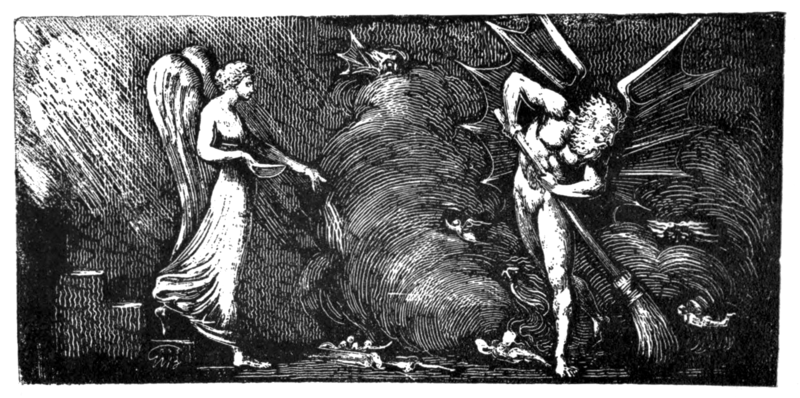
Some time between 1660 and 1675 when John Bunyan was twice imprisoned for holding religious services out of the auspice of the established church, he began work on Pilgrim's Progress his allegory of Christian's progress from 'this world to that which is to come'. He describes a stop on Christian's journey at the House of the Interpreter who was to instruct him on the right way to live the Christian life. In 1822, William Blake made an illustration for one of the lessons taught in the House of the Interpreter. Pilgrim was led into a parlor filled with dust; a man was called to sweep but he only stirred up the dust. A damsel was called to sprinkle the room with water with the result that the room was easily swept clean.

The Interpreter explained to Pilgrim: "This parlor is the heart of a man that was never sanctified by the sweet grace of the gospel: the dust is his original sin, and inward corruptions that have defiled the whole man. He that began to sweep at first, is the Law; but she that brought water, and did sprinkle it, is the Gospel. Now, whereas thou sawest that so soon as the first began to sweep, the dust did so fly about that the room by him could not be cleansed, but that thou wast almost choked therewith; this is to show thee, that the Law, instead of cleansing the heart (by its working) from sin, doth revive, put strength into, and increase it in the soul, even as it doth discover and forbid it, but doth not give power to subdue."
Blake's understanding of the roles of the law and the gospel is set forth in these passages in Jerusalem. In this first section Blake is saying that the forgiveness of God does not require 'Moral Virtue' but that we mutually sacrifice for, and continually forgive one another.

Jerusalem, Plate 61, (E 212)
"Saying, Doth Jehovah Forgive a Debt only on condition that it shall
Be Payed? Doth he Forgive Pollution only on conditions of Purity
That Debt is not Forgiven! That Pollution is not Forgiven
Such is the Forgiveness of the Gods, the Moral Virtues of the
Heathen, whose tender Mercies are Cruelty. But Jehovahs Salvation
Is without Money & without Price, in the Continual Forgiveness of Sins
In the Perpetual Mutual Sacrifice in Great Eternity! for behold!
There is none that liveth & Sinneth not! And this is the Covenant
Of Jehovah: If you Forgive one-another, so shall Jehovah Forgive You:
That He Himself may Dwell among You."

Here Blake tells us that 'accusation of sin & judgment' is the root of our quarrels and violence leading to Eternal Death.

Jerusalem, Plate 64, (E215)
"All Quarrels arise from Reasoning. the secret Murder, and
The violent Man-slaughter. these are the Spectres double Cave
The Sexual Death living on accusation of Sin & judgment
To freeze Love & Innocence into the gold & silver of the Merchant
Without Forgiveness of Sin Love is Itself Eternal Death"

Now Blake contrasts the message of Jesus: self-denial, forgiveness of sin, casting out devils, healing, pity, and setting prisoners free with that of the Pharisees (the chief proponents of the law): smiting with terror and punishment, crucifying, and proselyting to tyranny and wrath.

Jerusalem, Plate 77, (E 232)
"But Jesus is the bright Preacher of Life
Creating Nature from this fiery Law,
By self-denial & forgiveness of Sin.

Go therefore, cast out devils in Christs name
Heal thou the sick of spiritual disease
Pity the evil, for thou art not sent
To smite with terror & with punishments
Those that are sick, like the Pharisees
Crucifying &,encompassing sea & land
For proselytes to tyranny & wrath,
But to the Publicans & Harlots go!
Teach them True Happiness, but let no curse
Go forth out of thy mouth to blight their peace
For Hell is opend to heaven; thine eyes beheld
The dungeons burst & the Prisoners set free."

Blake and Bunyan were both teaching the message of Paul in the second chapter of Galatians: "
a man is justified not by performing what the Law commands but by faith in Jesus Christ. We ourselves are justified by our faith and not by our obedience to the Law, for we have recognised that no one can achieve justification by doing the 'works of the Law'. Bunyan continues; "when the gospel comes in the sweet and precious influences thereof to the heart...so is sin vanquished and subdued, and the soul made clean."

The little circle of younger artists who gathered around Blake in his later years referred to his humble home as the House of the Interpreter.

Wednesday, April 7, 2010

Blake's Love

He used the word 782 times in The Complete Works.
Some of them are innocuous:
"53. I hate scarce smiles I
love laughing  (Annotations to Lavater; Erdman 585)

Some are sacred:
"63. my mother; & St John. Whoso dwelleth in love dwelleth in God ....
64. God in him. & such an one cannot judge of any but in love" (Annotations Erdman 599)

Others in the purest sense:
71. He who Loves feels love descend into him & if he has wisdom may perceives it is from the Poetic Genius which is the Lord. (Ann.Swedenborg, Erdman 603)

This from the Clod of Clay in Thel:
"O beauty of the vales of Har, we live not for ourselves.
Thou seest me the meanest thing, and so I am indeed:
My bosom of itself is cold, and of itself is dark,
But he that loves the lowly pours his oil upon my head,
And kisses me, and binds his nuptial bands around my breast,
And says: "Thou mother of my children, I have loved  thee,
And I have given thee a crown that none can take away."
But how this is, sweet maid, I know not, and I cannot know;
I ponder, and I cannot ponder, yet I live and  love.'"

This one is so rich! The Clod of Clay represents Mother Earth. 'He who loves the lowly' can only be God (the godlike!).

In general one gets the feeling that Blake was very reticent in his prophetic works in using godly love.
Instead he most often seemed to speak of female love.

In the poem that has been given the name Broken Love Blake tried to distinguish between what theologicans might call carnal love and godly love. Blake's term for the first is female love directed by the Spectre or the Selfhood.

He had tersely and succinctly made the distinction in
The Clod and the Pebble:
"Love seeketh not itself to please,
Nor for itself hath any care,
But for another gives its ease,
And builds a heaven in hell's despair."

So sung a little Clod of Clay,
Trodden with the cattle's feet,
But a Pebble of the brook
Warbled out these metres meet:

"Love seeketh only Self to please,
To bind another to its delight,
Joys in another's loss of ease,
And builds a hell in heaven's despite."

In the closing plates of Jerusalem Blake went to great length in setting forth the distinction between selfish love and godly love, but to grasp this well the reader would require much study.

Saturday, February 6, 2010

VENGEANCE

Jesus taught forgiveness not vengeance. Blake rejected the God of vengeance of the Old Testament for the God of forgiveness of the New Testament.

Matthew 5:43-45 - "You have heard that it used to be said, 'You shall love your neighbour', and 'hate your enemy', but I tell you, Love your enemies, and pray for those who persecute you, so that you may be sons of your Heavenly Father. For he makes the sun rise upon evil men as well as good, and he sends his rain upon honest and dishonest men alike."

Matthew 7:1-5
Judge not, that ye be not judged.
For with what judgment ye judge, ye shall be judged: and with what measure ye mete, it shall be measured unto you.
And why beholdest thou the mote that is in thy brother's eye, but considerest not the beam that is in thine own eye?
Or how wilt thou say to thy brother, Let me cast out the mote out of thine eye; and lo, the beam is in thine own eye?
Thou hypocrite, cast out first the beam out of thine own eye; and then shalt thou see clearly to cast out the mote out of thy brother's eye.

In Jerusalem, Blake explains his attitude toward taking retribution for offense. He realizes that executing vengeful punishment does greater harm to the person who has been offended than it does to the offender. Doing harm - hindering your brother - does harm within yourself and hinders your spiritual development. The person who harms others, harms himself. Forgiving your brother opens your heart to receiving God's love and mending divisions in the unity of the whole body.

Jerusalem, Plate 25, (E 169)
"But Vengeance is the destroyer of Grace & Repentance in the bosom
Of the Injurer: in which the Divine Lamb is cruelly slain:
Descend O Lamb of God & take away the imputation of Sin
By the Creation of States & the deliverance of Individuals
Evermore Amen"

Jerusalem, Plate 47, (E 193)
"What shall I [Los] do! what could I do, if I could find these Criminals
I could not dare to take vengeance; for all things are so constructed
And builded by the Divine hand, that the sinner shall always escape,
And he who takes vengeance alone is the criminal of Providence;
If I should dare to lay my finger on a grain of sand
In way of vengeance; I punish the already punishd: O whom
Should I pity if I pity not the sinner who is gone astray!
O Albion, if thou takest vengeance; if thou revengest thy wrongs
Thou art for ever lost! What can I do to hinder the Sons
Of Albion from taking vengeance? or how shall I them perswade.
PLATE 48
These were his [Albion's] last words, and the merciful Saviour in his arms
Reciev'd him, in the arms of tender mercy and repos'd
The pale limbs of his Eternal Individuality
Upon the Rock of Ages."
Vala, Hyle, and SkofieldBlake created an image on Plate 51, which illustrates the harm which comes to the individual when he does harm to others. The three in the illustration are Vala, Hyle and Skofield; three whom Blake might consider his worst enemies. Vala is materiality, fallen Nature, the obscuring and distorting principle which hides Eternity and restrictes his imagination. Pictured as dark and frozen she bears no resemblance to the rich and glorious unfallen Nature. Hyle is Blake's representation of Hayley who wanted to prevent Blake from following his Imagination in exercising his artistic and poetic talents; pretending to be a friend he wanted to direct Blake's work to popular media. Hyle is pictured as if he were enclosed in a cube, his 'doors of perception' to this world as well as the other, are closed and locked. Skofield who brought Blake to law by false accusation, is pictured in the chains with which he hoped to manacle Blake. He is burning with the fire of wrath rather then sitting in darkness as is Vala.

But I think Blake presented these three, not as the vengeful but as 'the sinners' who 'always escape' although they have 'gone astray.'

Thursday, January 7, 2010

Blake's God

Here we go again:
We start of course with the four year old who ran screaming to his mother after seeing an angry God in the window. This certainly suggests exposure to one of the angry preachers who (then and now) project their own misery onto the God they describe for their parishioners. It set for Blake the mode for 25 years of defiance for a God so destructive to the human psyche. Christians through the ages have repressed the anger they feel toward such a God. But Blake did not repress! He let it all out.

By the age of 33 in MHH he had learned to express complete skepticism re the God and the Church that directed the religious life of the multitude. In particular he saw it as a conspiracy of rogues (look again at Plate 11).

Now look again at Milton, plate 37:
"The Monstrous Churches of Beulah, the Gods of Ulro
Twelve monstrous dishumanizd terrors Synagogues of Satan.
A Double Twelve & Thrice Nine: such their divisions:"

Here Blake named twelve (prechristian) "Gods, the Twelve Spectre Sons of the Druid Albion " and twenty-seven "Heavens & their Churches" in three groups: the antediluvian ones, the Judaic ones, and the supposed Christian ones. So he's talking about fallen religion, where many of us attend every Sunday (that would be the church of Luther).

The religious denomination that goes by the name of 'Witnesses' would take great issue with the description that Blake made of Jehovah:

Jehovah was Urizen, even Satan, the Angel of the Divine Presence, the Gnostic demiurge who made a hash of his Creation. So much for that God. He was called everything but 'Loving'.

Blake mentioned Jehovah 64 times; here is a fairly representative

one from his notes on The Last Judgment:

" The Aged Figure with Wings having a writing tablet & taking
account of the numbers who arise is That Angel of the Divine
Presence mentiond in Exodus XIVc 19v & in other Places
this Angelis frequently calld by the Name of Jehovah Elohim The I am of the Oaks of Albion"

Jehovah was too often identified with condemnation:

In the Epilogue to Gates of Paradise we read:
" To The Accuser Who is
The God of This World
Truly My Satan thou art but a Dunce
And dost not know the Garment from the Man
Every Harlot was a Virgin once
Nor canst thou ever change Kate into Nan
Tho thou art Worshipd by the Names Divine
Of Jesus & Jehovah thou art still
The Son of Morn in weary Nights decline
The lost Travellers Dream under the Hill"

The most derogatory figure Blake used for authorities
such as King George or Jehovah is in Nobodaddy, a term
used again in an indelicate doggerel on Erdman 499.

Blake accurately portrayed the leading spirit of the Old Testament in the above discussion.

We come now to the gospel. Blake considered Jesus the only God. In his mind Jesus was largely about forgiveness; many examples of Blake's forgiveness (the forgiveness Jesus taught can be found throughout his poetry.) The most succinct one has
appeared in these posts before: the little unnamed poem
going by the name of My Spectre; here's the end of it:

"And Throughout all Eternity I forgive you; you forgive me.
As the dear Redeemer said, this the Wine and this the Bread."

If you want more on Blake and God, look at the
Spiritual Autobiography, Chapter Five.

Thursday, November 19, 2009

ANNIHILATION

When Blake talks about annihilation he is talking about annihilation of the Selfhood. It is an internal activity. It is not accomplished by force or violence but by forgiveness and receiving the Selfhood as a brother. As Blake portrays it, annihilation is not a single event but a way of life. Since the Selfhood continually asserts itself, the process of forgiveness must continually be active.

Blake sees the processes which takes place in the individual as also taking place in the One Man, Albion, who is the body of which we all are part. As the Book of Milton reaches its climax, Milton annihilates his Selfhood as seen in Plate 45. The struggle has been completed, but not in victory of one over the other. The Selfhood has lost its power but is embraced tenderly.

Milton, Plate 39 [44] (E141)

"He [Albion] strove to rise to walk into the Deep. but strength failing
Forbad & down with dreadful groans he sunk upon his Couch
In moony Beulah. Los his strong Guard walks round beneath the Moon

Urizen faints in terror striving among the Brooks of Arnon
With Miltons Spirit: as the Plowman or Artificer or Shepherd
While in the labours of his Calling sends his Thought abroad
To labour in the ocean or in the starry heaven. So Milton
Labourd in Chasms of the Mundane Shell, tho here before
My Cottage midst the Starry Seven, where the Virgin Ololon
Stood trembling in the Porch: loud Satan thunderd on the stormy Sea
Circling Albions Cliffs in which the Four-fold World resides
Tho seen in fallacy outside: a fallacy of Satans Churches
PLATE 40 [46]
Before Ololon Milton stood & percievd the Eternal Form
Of that mild Vision; wondrous were their acts by me unknown
Except remotely; and I heard Ololon say to Milton

I see thee strive upon the Brooks of Arnon. there a dread
And awful Man I see, oercoverd with the mantle of years.
I behold Los & Urizen. I behold Orc & Tharmas;
The Four Zoa's of Albion & thy Spirit with them striving
In Self annihilation giving thy life to thy enemies"

Milton, Plate 45, Blake's Image


Blake left it indefinite exactly who is being portrayed in this picture. Since this whole book is about Milton, the standing man with his feet near the water of the brook is said to be Milton; but it could be Los or Jesus or Blake himself, whose tale is told through Milton. The leaning figure could be identified as Ololon, Milton's emanation; or Urizen; or Satan; or the text suggests Albion as the Fourfold Man. The process portrayed is annihilation, forgiveness, being joined to the Selfhood through recognition or self awareness. Perhaps it is best thought of as breaking out of the limiting walls of the self into the unlimited existence in Eternity through imagination. The forgiveness is mutual, the annihilation is mutual, the release is mutual, the regeneration too is mutual.

Milton, Plate 38[43] (E138)
"In the Eastern porch of Satans Universe Milton stood & said

Satan! my Spectre! I know my power thee to annihilate
And be a greater in thy place, & be thy Tabernacle
A covering for thee to do thy will, till one greater comes
And smites me as I smote thee & becomes my covering.
Such are the Laws of thy false Heavns! but Laws of Eternity
Are not such: know thou: I come to Self Annihilation
Such are the Laws of Eternity that each shall mutually
Annihilate himself for others good, as I for thee"

Thursday, September 21, 2006

Blake and the Bible

(Look also at Blake's Bible.)

If you think the Bible is inerrant, and that every word has one and only one meaning, then you don't need to read this any further.

Blake had an unparalleled freedom with the Bible. Northrup Frye referred to him as a Bible soaked protestant. He was Bible soaked, but the meanings he found in most of the Bible were distinctive and often unique: "Both read the Bible day and night,But thou read’st black where I read white."

Blake's 'white' reading will excite you and/or repel you. Or perhaps you will add your Blake to the canon; that happens.

1. The idea of Nobodaddy implies an explicit and emphatic rejection of the "sub-Christian" elements of the O.T.

Blake spent half his life figuring out who/what Christ was, after which he measured the quality and value of everything in the Bible in accordance with Christ's identity.

He rejected the thump on the head for the "healing balm".

2. He put the same value on his own visions (and vision) as he did the Bible. In visions he conversed with Isaiah and Ezekiel (see the second Memorable Fancy). My wife's favorite Blake quoted Ezekiel's conversation with Blake thusly: when Blake asked him why he behaved so erratically re living in his underwear and spending 3 months on his left side, etc., Ezekiel responded "'the desire of raising other men into a perception of the infinite". That has in fact became our calling in life.

To use slightly more orthodox terminology we could say the desire to get people thinking about Heaven (in it's larger meaning). That's a good subject for another post.

When our youngest was married (an outdoor Catholic marriage, I had a chance to read some scripture. I finished with the quotation from "Saint William Blake":
"Throughout Eternity I forgive you, you forgive me;
as the dear Redeemer said, this the wine and this the bread."

Blake was very free with his use of the Bible, as I, too strive to be, God willing.

There's much further information on this subject at Chapter Six of my Blake website.