Showing posts with label God. Show all posts

Tuesday, February 8, 2011

DEAR MOTHER

Songs of Experience, Song 45, (E 26)
The Little Vagabond

"Dear Mother, dear Mother, the Church is cold,
But the Ale-house is healthy & pleasant & warm;
Besides I can tell where I am use'd well,
Such usage in heaven will never do well.

But if at the Church they would give us some Ale.
And a pleasant fire, our souls to regale;
We'd sing and we'd pray, all the live-long day;
Nor ever once wish from the Church to stray,

Then the Parson might preach & drink & sing.
And we'd be as happy as birds in the spring:
And modest dame Lurch, who is always at Church,
Would not have bandy children nor fasting nor birch.

And God like a father rejoicing to see,
His children as pleasant and happy as he:
Would have no more quarrel with the Devil or the Barrel
But kiss him & give him both drink and apparel."

The gentle father welcomes the penitent son in the picture for The Little Vagabond but the poem is not about Luke's story (verses 11-32) of the prodigal being welcomed home by a forgiving father. It is about the need for forgiveness, and becoming aware of the need to be forgiven on the part of the church. If a penitent is to be received into the arms of the father, it is the church.

"Dear Mother, dear Mother, the Church is cold," addresses the poem to the mother church herself, the church of the world. Blake was not known to be a church attender; his membership was in the Church Eternal, the Body of Christ which is the Church Universal.


He found fault with a worldly church which was cold, judgmental, exclusive and cruel. The name of the poem which is not overtly about a vagabond, calls our attention to the outsider, the lost and needy whom the church in Blake's day (as in our own day) neglected and rejected.

The Gentle Father's desire is to take into his arms not only the vagabonds and outcasts, but a church who is becoming a true expression of Christ's Body.

Sunday, November 21, 2010

Blake's Humanism

With idols no longer possible what's left to worship? The answer depends upon your experience. With all the idols gone the true God remains, for those who can meet him (her, it). For others the highest possible may be the Human Form, and here Blake settled before he came to see Jesus as God. He began by worshiping the Human Form, the Highest and Best Imaginable, and in 1800 he recognized this Highest and Best in Jesus. In terms of conventional theology Blake was a humanist before he became a committed Christian. In The Marriage of Heaven and Hell he loudly proclaimed his humanism: "God only Acts and Is, in existing beings or Men". And a few pages later:

The worship of God is: "Honouring his gifts in other men, each according to his genius, and loving the greatest men best: those who envy or calumniate great men hate God; for there is no other God."

According to Kathleen Raine it was "the central doctrine of the Swedenborgian New Church that God can only be known in human form". Blake illustrated this with his quatrain at the end of "Auguries of Innocence":

"God Appears and God is Light
To those poor Souls who dwell in Night,
But does a Human Form Display
To those who Dwell in Realms of day."

Finally in his "Annotations to Berkeley's Siris", which he read about 1820, he wrote "God is Man and exists in us and we in him" (E664). He was still a humanist, but his humanism had gained a strong Christian dimension. Blake's argument against the conventional images of God, from beginning to end, hinged upon their sub-human nature. The biblical writers frequently ascribed to their God attitudes and behaviour beneath the moral level of any self respecting human. God cannot be less than man; therefore the appropriate response to such an image is derision, especially in the face of the common credulous awe.

The spiritually open person, free of the common credulous awe and capable of a clear eyed gaze at the Bible, no longer finds it possible to view all the biblical images as portraying a God worthy of worship. Furthermore when one looks freely at the actions of political and religious leaders of Christendom of the past 2000 years, it becomes clear that they were often worshipping something other than the true God. Finally the actions and attitudes of our contemporaries and even our own point to domination by a vision that is something less than the Highest and Best. In his poetry Blake documents these three observations with voluminous detail. They led to his ultimate evaluation of the universal false God. The name he settled upon is refreshingly biblical and authentic:

"To the Accuser, who is
The God of this World
...
Tho' thou art Worship'd by the Names Divine
Of Jesus and Jehovah, thou art still
The Son of Morn in weary Night's decline,
The Lost Traveller's Dream under the Hill."

(Gates of Paradise)

See also the chapter on God

Saturday, November 20, 2010

SELF & SOUL

Writing of the work of individuation, David L. Hart, (The Cambridge Companion to Jung, edited by Polly Young-Eisendrath and Terence Dawson ) points out the spiritual nature of the process:

" Many younger people, myself included, have found new meaning and purpose in life through the direct inspiration and guidance of Jung. What it does emphasize is that individuation is a spiritual undertaking. It is the conscious response to an instinct not recognized in biological thought, an innate and powerful drive toward spiritual realization and ultimate meaning. As such, it involves the whole person, who, in the process of emerging into wholeness, is progressively transformed - not into something different, but into the true Self: out of its potential and into its reality. Whoever, in any age or condition, is prepared to heed and respond to this spiritual and fundamentally human drive, is prepared for the process of individuation." (PAGE 99)

The spiritual undertaking which Jung acknowledged and supported is affirmed extravagantly in Blake's writing. The Self which Jung defines as the 'God image' within the psyche is the realization achieved by the process of individuation. What was referred to as Self by Jung might traditionally have been called soul, the image of God in which Genesis states that man was created.

The thrust of Blake's writing is directed to the same realization of the presence of God within man. A beauty of Blake's poetry is that it provides images and symbols in which the experience of touching the Divine may be expressed and communicated. Jung's and Blake's gifts are complementary, one provides the analysis the other the synthesis.

Jerusalem, PLATE 38 [43], (E 185)
"Swelld & bloated General Forms, repugnant to the Divine-
Humanity, who is the Only General and Universal Form
To which all Lineaments tend & seek with love & sympathy
All broad & general principles belong to benevolence
Who protects minute particulars, every one in their own identity.
But here the affectionate touch of the tongue is closd in by
deadly teeth
And the soft smile of friendship & the open dawn of benevolence
Become a net & a trap, & every energy renderd cruel,
Till the existence of friendship & benevolence is denied:
The wine of the Spirit & the vineyards of the Holy-One."

Visions of the Daughters of Albion, Plate 8, (E 54)
"For every thing that lives is holy, life delights in life;
Because the soul of sweet delight can never be defil'd.
Fires inwrap the earthly globe, yet man is not consumd;
Amidst the lustful fires he walks: his feet become like brass,
His knees and thighs like silver, & his breast and head like gold."

Jerusalem, Plate 5, (E147)
"To open the Eternal Worlds, to open the immortal Eyes
Of Man inwards into the Worlds of Thought: into Eternity
Ever expanding in the Bosom of God. the Human Imagination"

Monday, October 11, 2010

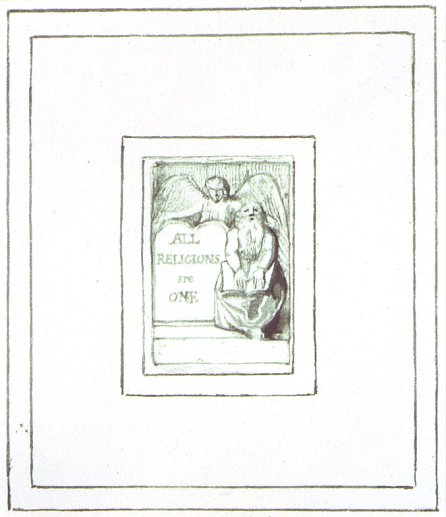
ALL RELIGIONS ARE ONE


View all the 10 Plates of All Religions Are One (E 1) in the Blake Archive.

It could be said that Blake began his prophetic ministry with the little book, All Religions Are One (of which only one copy survives). A close look at it will give us a concise preview of his message, his methods and his goal: "the desire of raising other men into a perception of the infinite." My comments on the poem are in blue.

Plate 1
The voice of one crying in the wilderness

The ministry of John the Baptist was a lonely one. He placed himself outside of his tribe, living in the wilderness and depriving himself of the normal comforts of life. His role was that of a forerunner for the prophet who was to follow him. Blake identified with the role of the outsider who choose to have his voice heard with the aim of pointing toward a new age. (Matthew 3)

All Religions Are One

Each religion claims uniqueness and exclusive access to God and truth. Not so asserts Blake. Religions can be united as one.

The Arguement

As the true meth-
-od of knowledge
is experiment,
the true faculty
of knowing must
be the faculty which
experiences. This
faculty I treat of.

Our knowledge is acquired through our experience. The faculty through which we gain experience will be the subject of this argument. The argument will not be based on authority or second hand knowledge.

Principle 1st

That the Poetic Genius is
the True Man, and that
the body or outward form
of Man is derived from the
Poetic Genius. Likewise
that the forms of all things
are derived from their
Genius, which by the
Ancients was calld an
Angel & Spirit & Demon.

The outer form or appearance of man is not the True Man. The spirit which resides in Man and in all things is what the outer forms derive from.

Principle 2nd

As all men are alike in
outward form, So (and
with the same infinite
variety) all are alike in the Poetic Genius

Humanity shares some qualities in spite of outer variety of appearance. So does man share the inner spiritual nature.

Principle 3rd

No man can think write
or speak from his
heart, but he must intend
truth. Thus all sects of
Philosophy are from the
Poetic Genius, adapted
to the weaknesses of
every individual.

All humanity intends to speak truth when he speaks from his inmost nature. Differences in philosophy result from individual weaknesses (inability to perceive the infinite).

Principle 4th

As none by trave
ling over known
lands can find out
the unknown, So,
from already ac
quired knowledge
Man could not ac
quire more; there
fore an universal
Poetic Genius exists

Man is not dependent upon the knowledge which comes only from his individual experience because a Universal Source, the Poetic Genius, provides knowledge he cannot acquire elsewhere.

Principle 5th

The Religions of all Nat-
-ions are derived from each
Nations different reception
of the Poetic Genius which
is every where call'd the Spi
rit of Prophecy

Different abilities to receive the Poetic Genius result in variety, although the Spirit of Prophecy is universally recognized.

Principle 6th

The Jewish & Chris-
tian Testaments are
An original derivati-
-on from the Poetic Ge-
nius: this is necessary
from the confined natu
re of bodily sensation

The Old and New Testaments of the Bible although deriving from the Poetic Genius, result from limited perceptions according to the varied ability to perceive the Poetic Genius.

Principle 7th

As all men are alike
(tho' infinitely vari
ous) So all Religions:
& as all similars have
one source,
The true Man is the
source, he being the
Poetic Genius

Religions - Man's attempts to perceive the Poetic Genius - though varied, have one Source. That source coming through the True Man is One and not many. So religions likewise are One and not many.

The true or inner man which is in touch with the Poetic Genius and is the Poetic Genius as experienced by each man as he journeys into his inner being, is indistinguishable from the Self as described by Carl Jung.

Here is an article by a psychologist on self and religion:
CARL JUNG AND HIS IDEAS ON SELF
Stephen A. Martin, Psy.D.
"To Jung our Self was not our ego. Our Self was not who we thought we were. Our Self rather was who we really are, all of us, both the known and the unknown, the integrated and that which is yet to be integrated. Our perception of ourselves is hence our ego, but our true Self is a great deal more. "

Thursday, October 7, 2010

GOD IN US

Jeremiah 23
[23] Am I a God at hand, saith the LORD, and not a God afar off?
[24]Can any hide himself in secret places that I shall not see him? saith the LORD. Do not I fill heaven and earth? saith the LORD.

From the beginning to the end of his work Blake attempted to communicate his image of God. Primarily Blake's experience was of what theologians call the immanent God, a God who is accessible and ever-present. When we gather together a number of Blake's references to God it is obvious that Blake's God was the incarnate God present within the whole of creation and particularly within humanity.

THERE IS NO NATURAL RELIGION (E 2)
"VII The desire of Man being Infinite the possession is Infinite
& himself Infinite
Conclusion, If it were not for the Poetic or Prophetic
character. the Philosophic & Experimental would soon be at the
ratio of all things & stand still, unable to do other than repeat
the same dull round over again
Application. He who sees the Infinite in all things sees
God. He who sees the Ratio only sees himself only.

Therefore God becomes as we are, that we may be as he is"

Songs of Innocence and Experience, (E 9)
Little Black Boy
"Look on the rising sun: there God does live
And gives his light, and gives his heat away.
And flowers and trees and beasts and men recieve
Comfort in morning joy in the noon day.

And we are put on earth a little space,
That we may learn to bear the beams of love,
And these black bodies and this sun-burnt face
Is but a cloud, and like a shady grove."

_______________________________
Milton Plate 45, Forgiveness
Songs of Innocence, (E 12)
The Divine Image.


"To Mercy Pity Peace and Love,
All pray in their distress:
And to these virtues of delight

Return their thankfulness.

For Mercy Pity Peace and Love,
Is God our father dear:
And Mercy Pity Peace and Love,
Is Man his child and care.

For Mercy has a human heart
Pity, a human face:
And Love, the human form divine,
And Peace, the human dress.

Then every man of every clime,
That prays in his distress,
Prays to the human form divine
Love Mercy Pity Peace.

And all must love the human form,
In heathen, turk or jew.
Where Mercy, Love & Pity dwell,
There God is dwelling too"

Milton, PLATE 32 [35],(E 131)
"But the Divine Humanity & Mercy gave us a Human [Hebrew text -multitudes]
Form as multitudes
Because we were combind in Freedom & holy Vox Populi [voice of the people]
Brotherhood"

Milton, Plate 32 [35], (E 131)
"For God himself enters Death's Door always with those that enter
And lays down in the Grave with them, in Visions of Eternity
Till they awake & see Jesus & the Linen Clothes lying
That the Females had Woven for them, & the Gates of their Fathers
House"

Jerusalem, Plate 4, (E 146)
"I am not a God afar off, I am a brother and friend;
Within your bosoms I reside, and you reside in me:
Lo! we are One; forgiving all Evil; Not seeking recompense!"

Jerusalem, Plate 5, (E 147)
"Trembling I sit day and night, my friends are astonish'd at me.
Yet they forgive my wanderings, I rest not from my great task!
To open the Eternal Worlds, to open the immortal Eyes
Of Man inwards into the Worlds of Thought: into Eternity
Ever expanding in the Bosom of God. the Human Imagination
O Saviour pour upon me thy Spirit of meekness & love:
Annihilate the Selfhood in me, be thou all my life!
Guide thou my hand which trembles exceedingly upon the rock of
ages,

While I write of the building of Golgonooza
Ye are my members O ye sleepers of Beulah, land of shades!"

Jerusalem
, Plate 38 [43], (E 184)
"O God of Albion descend! deliver Jerusalem from the Oaken Groves!

Then Los grew furious raging: Why stand we here trembling around
Calling on God for help; and not ourselves in whom God dwells
Stretching a hand to save the falling Man: are we not Four
Beholding Albion upon the Precipice ready to fall into
Non-Entity:"

Jerusalem, Plate 45 [31],(E 195)
"So spoke Los, travelling thro darkness & horrid solitude:
And he beheld Jerusalem in Westminster & Marybone,
Among the ruins of the Temple: and Vala who is her Shadow,
Jerusalems Shadow bent northward over the Island white.
At length he sat on London Stone, & heard Jerusalems voice.

Albion I cannot be thy Wife. thine own Minute Particulars,
Belong to God alone. and all thy little ones are holy
They are of Faith & not of Demonstration: wherefore is Vala
Clothd in black mourning upon my rivers currents, Vala awake!
I hear thy shuttles sing in the sky, and round my limbs
I feel the iron threads of love & jealousy & despair."

Satiric Verses, (E 516)
"To God

If you have formd a Circle to go into
Go into it yourself & see how you would do"

Annotations to Lavater (E 599)
"God is in the lowest effects as well as in the highest
causes for he is become a worm that he may nourish the weak
For let it be rememberd that creation is. God descending
according to the weakness of man for our Lord is the word of God
& every thing on earth is the word of God & in its essence is God"

As well as expressing the sentiments of the prophet Jeremiah, Blake was reflecting the message of the New Testament as stated by Paul in Colossians 1:

[26] Even the mystery which hath been hid from ages and from generations, but now is made manifest to his saints:
[27] To whom God would make known what is the riches of the glory of this mystery among the Gentiles; which is Christ in you, the hope of glory:

Thursday, September 30, 2010

MAN IS A WORM

Some have suggested that Blake meant butterfly by fly, and caterpillar by worm.

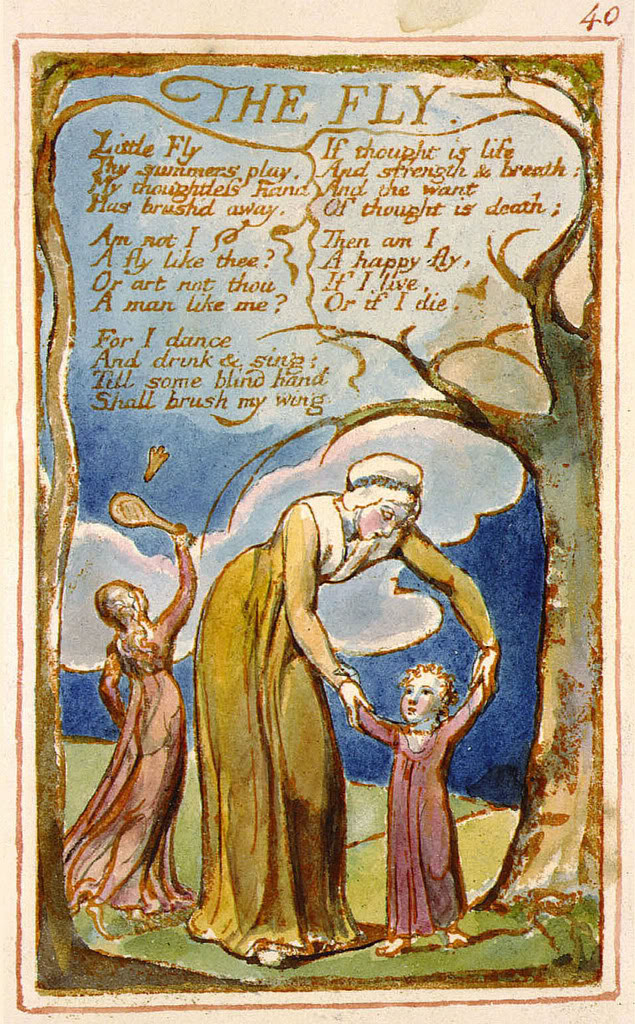
SONGS OF EXPERIENCE, 40, THE FLY,(E 23)

Little Fly
Thy summers play,
My thoughtless hand
Has brush'd away.

Am not I
A fly like thee?
Or art not thou
A man like me?

For I dance
And drink & sing:
Till some blind hand
Shall brush my wing.

If thought is life
And strength & breath:
And the want
Of thought is death;

Then am I
A happy fly,
If I live,
Or if I die.

Man who knows himself to be a mind and spirit frequently seeks an explanation for his being a material being in a world of matter.

Here are some explanations which have been devised:

*It pleased God to have some companions.
*Man is being punished for some disobedience.
*Life is meant to be a learning experience.
*The material world spontaneously produced life including mind.
*We are placed here to figure out why we were placed here.
*We are paced here to love God and serve him forever.
*Matter is a manifestation and expression of Spirit.

Blake of course had his explanation which he expressed in poetic language. At the Golden Feast these words were spoken:

Four Zoas, Page 133, (E 401)
"This is the Generative world they rememberd the Days of old
And One of the Eternals spoke All was silent at the feast

Man is a Worm wearied with joy he seeks the caves of sleep
Among the Flowers of Beulah in his Selfish cold repose
Forsaking Brotherhood & Universal love in selfish clay
Folding the pure wings of his mind seeking the places dark
Abstracted from the roots of Science then inclosd around
In walls of Gold we cast him like a Seed into the Earth
Till times & spaces have passd over him duly every morn
We visit him covering with a Veil the immortal seed
With windows from the inclement sky we cover him & with walls
And hearths protect the Selfish terror till divided all

In families we see our shadows born. & thence we know | Ephesians
That Man subsists by Brotherhood & Universal Love | iii c.
We fall on one anothers necks more closely we embrace | 10 v

Not for ourselves but for the Eternal family we live
Man liveth not by Self alone but in his brothers face
Each shall behold the Eternal Father & love & joy abound

So spoke the Eternal at the Feast they embracd the New born Man
Calling him Brother image of the Eternal Father."

The Bible verse referenced in the passage in the Four Zoas:
Ephesians 3
[10] To the intent that now unto the principalities and powers in heavenly places might be known by the church the manifold wisdom of God,

The above verse in context:
[9] And to make all men see what is the fellowship of the mystery, which from the beginning of the world hath been hid in God, who created all things by Jesus Christ:
[10] To the intent that now unto the principalities and powers in heavenly places might be known by the church the manifold wisdom of God,
[11] According to the eternal purpose which he purposed in Christ Jesus our Lord:

I think that you can say unequivocally that Blake does not think that life in the physical world is a punishment. Blake affirms that God in his love presents man with life as a mercy, grace and gift. Time and matter are gifts too, to incubate the seed which is to grow into a replica and brother of the Eternal Father.

Wednesday, September 15, 2010

A Golden String

Perfect Peace

"Thou wilt keep him in perfect Peace, whose mind is stayed on thee" (Isaiah 26:3)
How do you "stay your mind" on God? That's a hard matter; I try and try and sometimes succeed for a moment, but then 'things' intrude; I leave the air (spirit) and return to the sea (matter). It seems impossible although some Quakers I know seem to have done it to a considerable degree. One wonders.

What about Blake; he was Bible soaked; did he focus on -- 'Nobodaddy'? My gosh, no! the Eternal, Heaven! (Mrs. Blake said he spent too much time like that.) William Blake was one of a small handful of human beings who had ready access to "thee".

By 'thee' Isaiah obviously meant the Hebrew God. But is that what God meant??? (One of the attributes of poetry is that the writer frequently doesn't understand the meaning of his words, and rarely or never the full meaning. Something may mean a particular thing to the poet and something entirely different years or centuries later.


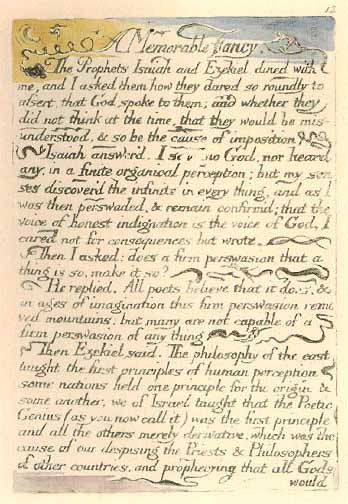
Isaiah meant Jehovah, but Christians mean Jesus. Our poet, Blake, knew Isaiah all too well; in fact he had dinner with him once (MHH plate 12); but he also knew that Jehovah was not worth 'staying his mind' on. He spent many years trying to dispose of that mental construct; at times it was Nobodaddy; then it became Urizen ("Schoolmaster of souls great
opposer of change" {
The Four Zoas [Nt 9], 120.21; E389}). He had many other ways to describing his enemy.

Actually he thought about Jehovah for many years, denounced him, defied him, particularly Jehovah in the shape of King George; that led to a meeting with a judge that might well have ended in the gallows (near the end of his three years at Felpham).


As a young man Blake had ready access to 'thee' (thee being the Eternal and Heaven). But as a married man the world took him in thrall and shut out his access to his 'thee' (the Eternal)--for twenty years. Then, like Jesus, 'he overcame the world'. He told about that in Letter 51 to Hayley:
"I was a slave bound in a mill among beasts and
devils; these beasts and these devils are now,
together with myself, become children of light and
liberty, and my feet and my wife's feet are free from
fetters. O lovely Felpham, parent of Immortal
Friendship, to thee I am eternally indebted for my
three years' rest from perturbation and the strength
I now enjoy. Suddenly, on the day after visiting the
Truchsessian Gallery of pictures, I was again
enlightened with the light I enjoyed in my youth, and
which has for exactly twenty years been closed from
me as by a door and by window-shutters."
Heaven came back; he was a new man; now he stayed his mind, not on Isaiah's 'thee', but on Jesus. Blake's 'Jesus' was no thing; he was the door to Heaven.

"I give you the end of a Golden String
Only wind it into a ball;
It will let you in at heaven's gate
Built in Jerusalem's wall."

Saturday, August 28, 2010

Not of This World

"you are not of this world" (John 15:19)

The committed Christian may eventually come to realize that; secular people may be oblivious to it. . Most of us jump back and forth between the Kingdom of this World, (which Blake called the Sea of Time and Space) and the Kingdom of God;
a handful of spiritual geniuses may see in it their own nature. Such a person was our poet.

Blake has often been called the First Romantic. In Blake's day the word romantic denoted a train of thought outside of what the materialists of the Enlightenment allowed themselves for general discourse; religion was supposed to be private and in positivistic terms
meaningless.

But Blake was different: religion (in the fullest sense) was all that mattered to him-- yes, we have to live in the world, but the less we do it the better we are (in Blake that meant in order to put bread on the table).

Here's a morsel from the Vision of the Last Judgment:
"I assert for My self that I do not behold the Outward Creation & that to me it is hindrance &
not Action it is as the Dirt upon my feet No part of Me. What it will be Questiond When the Sun rises do you not see a round disk of fire somewhat like a Guinea O no no I see an Innumerable company of the Heavenly host crying Holy Holy Holy is the Lord God Almighty" (Erdman 565)

The Hound of Heaven powerfully portrayed the two kingdoms. The early Blake portrayed the same thing in a contrary way: his (negative) Spectre was just as persistent as Thompson's (positive) hound. Most people carefully hide those ideas from consciousness; for Blake they were a conscious and continuous reality-- "round me night and day".

In Blake's poetry The two kingdom's were first expressed in The Marriage of Heaven and Hell. In his contrary way Blake considered angels to be those most conformed to the world, and devils to be those free from it. (Read it again in that light!)

Announcing that position Blake found himself to a very great degree persona non grata; only a handful of people had any sympathy for his point of view. He proposed a new Way, and his life in many ways resembled that of Paul , uniformly ignored by the intellectual public whom he tried to reach.

For half of Blake's life he had focused on the Spectre, but the true 'hound' came with his meeting with Jesus at the Moment of Truth.

In the Sea of Time and Space various Blake interpreters identify the man on the shore with Apollo or Odysseus; Damon identified him as the red robed Luvah. (
The Four Zoas [Nt 1], 13.9; E308. All of these are meaningful.)

What do you make of "one like the Son of God" in the furnace? How about the red robed Luvah in the furnace? Blake had a lot to say about furnaces, but it wasn't until he reached spiritual maturity that he understood who was in the furnace.

"he came into the world", and the world did to him what it would. In Jerusalem Blake identified the redeemed Luvah as Jesus- in contrast to the satanic Urizen.

Thursday, August 19, 2010

GOD IN ALL

A close friend of William Blake and an associate of his in publishing through the radical publisher Joseph Johnson, Henry Fuselli was instrumental in the publication of Aphorisms on Man. Johann Caspar Lavater, Fusilli's friend, with whom he had been a theology student in Zurich, wrote the manuscript and Fuselli translated it into English and facilitated its publication in London. Blake engraved five illustrations for the work based on preliminary drawings by Fuselli.

Blake's annotation to his copy of Aphorisms on Man are included in his complete works, and are the chief reason Lavater's book is read today. The comment I focus on is an unequivocal statement of Blake's belief about the relationship of man to God which he wrote in annotating Lavater's book. That Blake felt that God related intimately with man as a companion and brother is made clear in this passage. Blake supports his belief by quoting John 6:56, "He that eateth my flesh, and drinketh my blood, dwelleth in me, and I in him." Blake replaces the phrase "eateth my flesh and drinketh my blood" with "dwelleth in love."

Blake continues by saying that it is this relationship with God that removes the need and ability of a man to judge another except in love.

The God Blake affirms bridges divisions because he who is the cause of all, humbles himself in order to nourish the weak. Blake then defines creation in terms of God descending to become the word which is in everything and which makes everything into God in it's essence.

Annotations to Lavater, (E 599)

"It is the God in all that is our companion & friend, for our God himself says, you are my brother my sister & my mother; & St John. Whoso dwelleth in love dwelleth in God & God in him. & such an one cannot judge of any but in love. & his feelings will be attractions or repulses
God is in the lowest effects as well as in the highest causes for he is become a worm that he may nourish the weak
For let it be rememberd that creation is. God descending according to the weakness of man for our Lord is the word of God & every thing on earth is the word of God & in its essence is God"

Blake's statement bears a close resemblance to Paul's statement in Philippians 2:6–8:
"Who, being in the form of God, thought it not robbery to be equal with God: But made himself of no reputation, and took upon him the form of a servant, and was made in the likeness of men: And being found in fashion as a man, he humbled himself, and became obedient unto death, even the death of the cross."

The Morgan Museum's exhibition of work of Blake and his associates is available online: A New Heaven Is Begun.

Monday, August 2, 2010

Blake and Religion

Northrup Frye, an ordained Canadian minister, as a young man wrote a thesis entitled Fearful Symmetry, which became the magisterial exposure of Blake's thought to the academic world. His primary calling became English Literary Criticism, and he won signal distinction in that field (especially a book called The Anatomy of Criticism).

Later in life Frye said that if he had it to do over he would not write a sophisticated academic work about Blake, but something more like Percival's introductory survey. He called his last (monumental!) two volume work The Great Code of Art or The Bible as Literature. That's an invaluable work for learning Blake.

In Britain's early 19th Century the Enlightenment had a marked effect on religious thought; Deism was ascendant, the idea that God created the world and wound it up like a clock and thereafter retired from any interest in it. We are to God what ants are to us.

As you can imagine Bible soaked and God intoxicated Blake despised Deism. But he equally despised what he took to be the opposite, which he called (among other things) Druidism, the most primitive form of religion, including human sacrifice.

Druidism fit Blake's concept of established religion, whose leaders enthusiastically supported the king's wars; in the same way the religious leaders today have emphatically supported the government's wars. (The government, established religion and the military industrial complex were like three peas in a pod in Blake's day.)

Here's one of Blake's reactions to that sad reality:

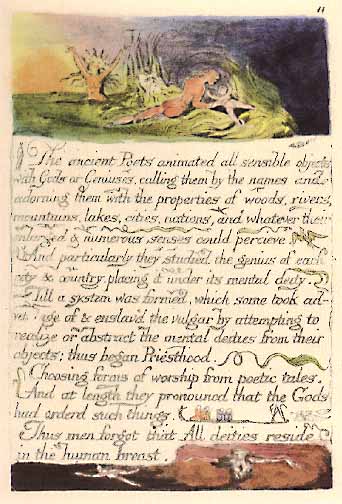
(Plate 11) (of the Marriage of Heaven and Hell)
"The ancient Poets animated all sensible objects with Gods or Geniuses, calling them by the names and adorning them with the properties of woods, rivers, mountains, lakes, cities, nations, and whatever their enlarged & numerous senses could percieve.

And particularly they studied the genius of each city & country, placing it under its mental deity.

Till a system was formed, which some took advantage of & enslav'd the vulgar by attempting to realize or abstract the mental deities from their objects; thus began Priesthood.

Choosing forms of worship from poetic tales.
And at length they pronounc'd that the Gods had order'd such things.
Thus men forgot that All deities reside in the human breast."
According to Blake God is within-- you and me, everyone. In this he closely resembled the Quakers who fundamentally speak of that of God in you/me/everyone. The God within is creative, a Creator of Art. This depends upon imagination, intuition, the expression of spiritual/eternal ideas in tangible things-- like words (the Bible), music, and representations of the human form in its various states.

Here's an example in the Laocoon (E274) of how Blake expressed this idea:
"Prayer is the Study of Art
Praise is the Practise of Art
Fasting &c. all relate to Art
The outward Ceremony is Antichrist
Without Unceasing Practise nothing can be done

Practise is Art If you leave off you are Lost

A Poet a Painter a Musician an Architect: the Man
Or Woman who is not one of these is not a
Christian"

Sunday, July 25, 2010

JOB SUMMATION

After reading in A Blake Dictionary, Damon's description of Blake's Illustrations to the Book of Job, I came up with one word titles for each plate: ............................................................ Vision - Plate 13
1. Innocence
2. Doubt
3. Wrath
4. Disasters
5. Temptation
6. Shame
7. Experience
8. Anger
9. Disillusionment
10. Rejection
11. Insight
12. New Birth
13. Vision
14. Synthesis
15. Encounter with Unconscious
16. Reversal
17. God of Love
18. Forgiveness
19. Humility
20. Self-giving

21. Wholeness

Blake's Illustration to the Book of Job from the Boston College website and from Gutenberg Press .

Damon also associated the stages which Job traverses with the Eyes of God. Since the Seven Eyes are the stages of psychic, social and religious development of man, Job in his ordeal of individuation recapitulates each of the phases.
1-2. Lucifer - the selfhood
2-4. Molech - the executioner
5-6. Elohim - the judge
7-8. Shaddai - the accuser
9-10. Pahad - terror
11-12. Jehovah - commandments
13-14. Jesus - God in humanity

Here is an earlier post on the Eyes of God.

Each of the Eyes is represented in two plates in the descent/ascent of Job into his self-knowledge. On Job's return from the nadir each Eye is revisited with a single plate, but in it the Eye takes on its positive or redeemed nature.

15. Jehovah reveals the unconscious depths.
16. Jesus causes the Last Judgment.
17. Pahad reveals love.
18. Shaddai becomes forgiveness.
19. Elohim practices charity.
20. Molech brings forth the feminine.
21. Lucifer is freed of the selfhood.

A post on Job , Blake & Jung.

Thursday, July 8, 2010

Job Picture 16

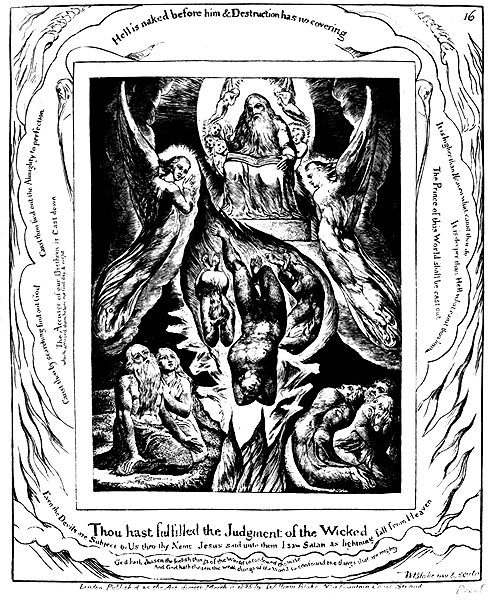
Picture 16 is not about Job per-se, but celebrates a statement made by Jesus in Luke 10:18, "I saw Satan fall like lightning from heaven" (incidentally leading to Paradise Lost in a nutshell). In the legends he continued with a proliferation of Bible verses, some in Job and then moving on to the New Testament.

"Hell is naked before him and Destruction has no covering" (Job 26:6). It has the usual three layered Universe and on the left border Blake wrote, "Canst thou by searching find out God -- canst thou find out the Almighty to perfection" (Job 11:7) and below that "the Accuser of our Brethen is Cast down".

And on the right border: "It is higher than Heaven what canst thou do" "it is deeper than Hell what canst thou know" (Job 11:8) "the Prince of this world shall be cast out" (John 12:31)

Below the picture he wrote:
"Thou hast fulfilled the Judgment of the Wicked" (Job 36:17) and "even the Devils are Subject to Us through thy Name" (Luke 10:17) and I saw Satan" etc.

Then "God hath chosen the foolish things of the World to confound the wise and God hath chosen the weak things of the World to confound the things that are mighty"
(I Corinthians 1:27)


Blow this picture up with ctrl + several times and look carefully at the figure of God--with several babies? (cherubs?) around him. (You may find a child about to be born to your favorite mother.) Now compare this picture with Picture 2. The difference indicates a change in Job's evaluation of God (reflecting a more personal change in Blake's attitude toward the O.T. God.)

Let your imagination run wild (Like Blake's?) and you may see the new children God had prepared for Job.

Monday, July 5, 2010

DIVINE HAND

God's Providence

At critical junctures in Blake's poetry the Divine Hand intervenes to change the direction of the developing myth. The interventions usually involve the limits - contraction and opacity, Adam and Satan.

Adam, man who is formed to live as a physical body in a physical world with spiritual consciousness, is the limit of contraction. The Eternal Man, Albion may fall and divide but within him is planted a seed which connects him to the Eternal world. Humanity is not to become animal or vegetable but he is limited to remaining human. This is the condition which is preserved in the state called generation which will be put off in regeneration, or mortality which will be put off in immortality.

Jerusalem, Plate 31 [35], (E 177)
Satan the limit of opacity has lost his ability to perceive the spiritual world but he has not lost his reasoning power. He is unable to accept the Divine Vision, Jesus, the Imagination, but he attempts use reason to build a world based on moral law to replace the Divine Vision he has lost. The state of Satan, selfhood, which tries to impose the temporal on the eternal, the finite on the infinite, will be recognized as error when it appears as it is.

The limits were set by the Divine Hand that the fall may be reversed and fallen man may be regenerated. The Divine Hand is a name for God's providence, for his protective guidance in providing that man may return to the Eternal source. The Divine Hand seems to be the transcendent God who acts from outside of the individual to provide a framework through which the Divine Vision (the incarnate Jesus) may act through the Divine Body (the Imagination).

The Divine Hand finds the two limits and names them:
Milton, Plate 13[14], (E 107)
"The Divine hand found the Two Limits: first of Opacity, then of
Contraction
Opacity was named Satan, Contraction was named Adam."

The Divine Hand provides the sleep of Albion:
Jerusalem, Plate 15, (E 159)
"But first Albion must sleep, divided from the Nations

I see Albion sitting upon his Rock in the first Winter
And thence I see the Chaos of Satan & the World of Adam
When the Divine Hand went forth on Albion in the mid Winter
And at the place of Death when Albion sat in Eternal Death"

The Limits are found within each man:
Jerusalem, Plate 31, (E 177)
"Then the Divine hand found the Two Limits, Satan and Adam,
In Albions bosom: for in every Human bosom those Limits stand."

The Divine Hand strengthens Los as he awaits the fury of the dead:
Jerusalem, Plate 42, (E 189)
"Los stood before his Furnaces awaiting the fury of the Dead:
And the Divine hand was upon him, strengthening him mightily."

The Divine Hand assists Los and Enitharmon as they escape:
Jerusalem, PLATE 44 [30], (E 193)
"And the Divine hand was upon them bearing them thro darkness
Back safe to their Humanity as doves to their windows:"

The Divine Hand provides that vengeance not be taken against sinners:
Jerusalem, Plate 45, (E 194)
"I could not dare to take vengeance; for all things are so
constructed
And builded by the Divine hand, that the sinner shall always
escape,"

The Divine Hand who set the limits of Satan and Adam, sets the limit to Eternal Death and touches Los' furnaces. Los knows that his furnaces are not punishment for sin:
Four Zoas, Page 56, (E 338)
"And first he found the Limit of Opacity & namd it Satan
In Albions bosom for in every human bosom these limits stand
And next he found the Limit of Contraction & namd it Adam
While yet those beings were not born nor knew of good or Evil

Then wondrously the Starry Wheels felt the divine hand. Limit
Was put to Eternal Death Los felt the Limit & saw
The Finger of God touch the Seventh furnace in terror
And Los beheld the hand of God over his furnaces
Beneath the Deeps in dismal Darkness beneath immensity
And he who takes vengeance alone is the criminal of Providence;"

The work of the Divine Hand may be unseen but discerned through hope:
Four Zoas, Page 9,(E 305)
"They saw not yet the Hand Divine for it was not yet reveald
But they went on in Silent Hope & Feminine repose"

Friday, July 2, 2010

Job Picture 13


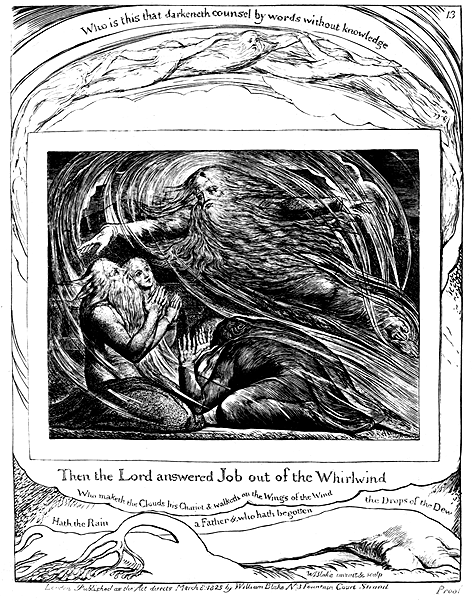
"(Job 38:1-11:) [1] Then the LORD answered Job out of the whirlwind, and said, [2] Who is this that darkeneth counsel by words without knowledge? [3] Gird up now thy loins like a man; for I will demand of thee, and answer thou me. [4] Where wast thou when I laid the foundations of the earth? declare, if thou hast understanding. [5] Who hath laid the measures thereof, if thou knowest? or who hath stretched the line upon it? [6] Whereupon are the foundations thereof fastened? or who laid the corner stone thereof; [7] When the morning stars sang together, and all the sons of God shouted for joy? [8] Or who shut up the sea with doors, when it brake forth, as if it had issued out of the womb? [9] When I made the cloud the garment thereof, and thick darkness a swaddling band for it, [10] And brake up for it my decreed place, and set bars and doors, [11] And said, Hitherto shalt thou come, but no further: and here shall thy proud waves be stayed?

In the Bible the whirlwind is a symbol of the immediate active Presence of the Lord. In 2 Kings 2:11 it's associated with a chariot of fire "and Elijah went up by a whirlwind into heaven".

The whirlwind appears in Job 38 and 40. (For other instances turn to the Bible Gateway.)

Notice that Job and his wife are facing God while his three friends have their heads buried in the sand.

Edinger p. 50: "Job's encounter with Yahweh in the whirlwind taught him a basic lesson. In his innocence, like orthodox theologians of all creeds, Job has assumed that God's reality must correspond to his conception of it. [But] the living experience [of surviving the whirlwind] shatters that assumption." God is nothing like what we suppose!

No one has a complete God in their mind; they have only their vision of God, and their vision depends upon their experience (and every person's experience is unique!)

John 1:18 "No man hath seen God at any time, the only begotten Son, which is in the bosom of the Father, he hath declared him."

Monday, June 28, 2010

Job Picture 11


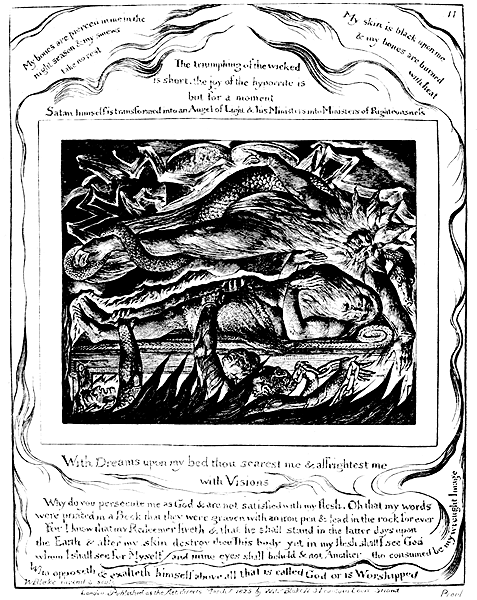
A nightmare: (Job 7:)
13 When I think my bed will comfort me
and my couch will ease my complaint,
14 even then you frighten me with dreams
and terrify me with visions,

An excellent resource for studying Blake's Illustrations to the Book of Job is this website:

Jung, William Blake and our answer to Job by David Hiles. (Ellie's May 30.2009 post entitled "Job's Image of God")


Speaking of Blake's overall structure and emphasis in his presentation of Job, David Hiles says:
"... it is clear that Blake makes a significant departure from the biblical text in terms of both the structure and emphasis of the series of plates. He eschews the cycle of speeches which occupy approximately 34 of the 42 Chapters of The Book of Job. Instead, Blake seems to concentrate on Job’s experience, and process of transformation. Blake also significantly expands the final stage of Job’s transformation, the stage of Return. Blake here seems to be acknowledging both his creative work and his own experience of suffering, i.e. through his work as a poet, artist and engraver, he is able to offer up a creative synthesis as an authentic expression to his readers."

Text and images are provided by Boston College.
Plate 11 When you click on this illustration you will see the watercolor painting which corresponds to it.

The 11th of the 21 pictures is the midpoint and illustrates the lowest psychological point that Job reaches. Job is shown prostrate and vulnerable in the center of the picture; above him is Satan masquerading as God as he points to the stone tablets of the law. The cloven hoof and the encircling serpent reveal his identity as Satan. The background is the chaos of the abyss. Below Job, who lies on a slab as if to be sacrificed, are fearful images taking hold of Job's body. Notice the flames the scaly arm the chains and the distorted faces. The mind and body of Job are assaulted by forces beyond his control, but Blake does not acknowledge that those forces represent the work of God.

Blake provides Biblical quotes to describe experience of Job which he is illustrating.
My bones are pierced in me in the night season: and my sinews take no rest (Job xxx: 17).
My skin is black upon me, and my bones are burned with heat (Job xxx: 30).
...the triumphing of the wicked is short, and the joy of the hypocrite but for a moment (Job xx: 5).
...for Satan himself is transformed into an angel of light....his ministers also be transformed as the ministers of righteousness (Second Corinthians xi: 14-15).
Then thou scarest me with dreams, and terrifiest me through visions (Job vii: 14).
Why do ye persecute me as God, and are not satisfied with my flesh? Oh that my words were now written! oh that they were printed in a book! That they were graven with an iron pen and lead into the rock forever! For I know that my redeemer liveth, and that he shall stand at the latter day upon the earth: And though after my skin worms destroy this body, yet in my flesh shall I see God: Whom I shall see for myself, and mine eyes shall behold, and not another; though my reins be consumed within me ["though consumed be my wrought Image" in above text] (Job xix: 22-27)
Who opposeth and exaulted himself above all that is called God, or that is worshipped
(Second Thessalonians ii: 4).

The Biblical quotes (with locations identified in the Boston College website) make it possible for us to understand some of what Blake wishes to convey in this plate.
As portrayed by Blake, Job in his extreme condition, is able to recognize that a vengeful punishing God who would be the source of such pain and suffering, is not the God who is the object of his worship. He recognizes that this image of God which has been distorted by his suffering, does not describe his relationship to God: Satan can't be given the power to define God. The terrifying vision does not negate the redeeming God whom Job knows will preserve the eternal man who sees God with his own eyes. Satan is not to be exalted above God himself.

Blake sees this point in Job's experience as a revelation that Job must revise the whole pattern through which he himself views God: that he must reestablish a relationship with God which is not controlled by the legalistic Satanic paradigm of reward for obedience and punishment for failure. In the next ten plates Blake reveals the process of rebuilding Job's psyche and his experience of the nature of God.

Thursday, June 10, 2010

Job: Picture 2

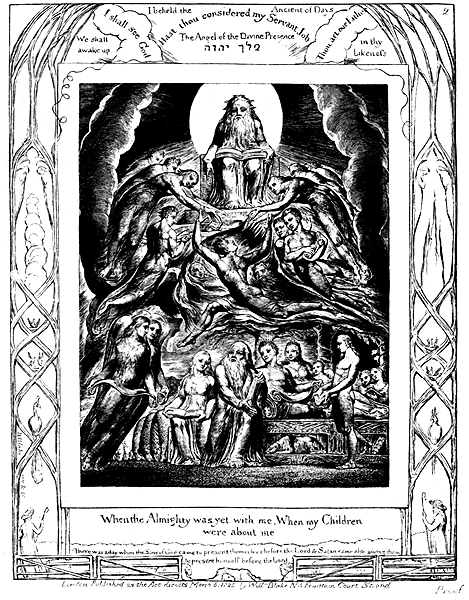
This one resembles Picture 1 in its lower part, but now the well behaved children also have books or scrolls, obviously growing up to be Establishment types.

At the top the Establishment God has the BOOK that we're to go by; go by the book, and only good things will happen.
"God is in his Heaven, and all's right with the world." (Browning).

But between the righteous God and the righteous Job and family something strange is happening: look at that strange figure below God, arms and legs spread widely (in violent motion); he's enveloped in fire.

"Hast thou considered my servant Job" inscribed above the picture: the words of God. The picture concerns a conversation God had with Satan (on the left hand of God?) about Job. Back in MHH days the devil wasn't so bad (Blake said Milton "was of the devil's party without knowing it" (MHH plate six). For Blake at that time, in contrast to the passive Elect, Satan represented the satisfaction of Desire; he represented Revolution: anathema for the Established, longed for by the poor and needy.

Some people's identity rests on the opinion of others; without reflection, they're called outer directed. But the ability to reflect on yourself is required in order to become an individual, and through the 'dark night of the soul' Job will come to see the whole bit, not just the persona or ego, but the shadow side as well (Jung's terms).

The O.T. God was certainly not altogether good; according to Job's code when you behave all is well; when you misbehave there's hell to pay.

Throughout the Illustrations Job's (and our) Innocence are sacrificed by Experience, which is obligatory if you are to grow beyond Goody Two Shoes.

So the Devil is commissioned to test us; after he tested Job, he tested Jesus (in the wilderness), and he tests us. Job met the test; so did Jesus, and became our Savior; we may and become sons of God. That's Job's message for us today.

Thursday, June 3, 2010

REPLY TO SUSAN

Susan has commented on the post Jerusalem Speaks:
"my one stumbling block is Blake's apparent equating of 'Lord & Savior' with 'Human Imagination'" and
"When I pray 'help me help me help me Lord' I sure hope there's someone beyond myself (even my best self, my highest self, the image of Christ in me) there to answer...."

We are all making an effort to grasp the way Blake understands and presents God. His emphasis seems to focus on the Divine Humanity although there are numerous other names he uses. I choose these Biblical references to support the concept of the God within.

"God created man in his image."
1. God is Spirit, man is created a spirit.

"In the beginning was the word."
2. That possibility (for spiritual development) which can be manifest is Eternal.

"The word was made flesh and dwelt among us."
3. The Eternal possible becomes manifest in matter.

"The love of God is shed abroad in our hearts by the inspiration of the Holy Spirit."
4. God's activity expresses itself in man through the indwelling of His spirit.

"All who follow the leading of God's Spirit are God's own sons."
5. Our likeness with God is shown by our following in the spirit.

"you have been made whole in spirit; you have been justified before God in the name of the Lord Jesus and in his very Spirit."
6. Man is linked to God by the unity of his own spirit with God through Christ.

Here is one of Blake's statements about the Divine Humanity.
Jerusalem, Plate 38, (E 185)
" building Heavens Twenty-seven-fold.
Swelld & bloated General Forms, repugnant to the Divine-
Humanity, who is the Only General and Universal Form
To which all Lineaments tend & seek with love & sympathy
All broad & general principles belong to benevolence
Who protects minute particulars, every one in their own identity."

In these lines Blake names the Divine Humanity the only general and Universal Form. By this he may mean that the pattern in man which may be called spirit, is the image of God. Man in his inner being, is led to seek and follow this pattern. The general pattern and the expression in individuals belong together in the intended purpose which is good. God provides nurture and protection for the individual to develop in spirit.

Here are two earlier posts which deal with some special terminology which Blake uses in the quote.

Blog post on Lineaments
Blog post on Identity

To sum up my understanding; God makes himself known to us through the indwelling spirit but our knowledge of God is limited until we see him 'face to face'.

Jesus and Thomas

Sunday, May 30, 2010

Job's IMAGE of GOD

An excellent resource for studying Blake's Illustrations to the Book of Job is this website:

Jung, William Blake and our answer to Job
David Hiles
De Montfort University, Leicester, UK.

Speaking of Blake's overall structure and emphasis in his presentation of Job, David Hiles says:
"... it is clear that Blake makes a significant departure from the biblical text in terms of both the structure and emphasis of the series of plates. He eschews the cycle of speeches which occupy approximately 34 of the 42 Chapters of The Book of Job. Instead, Blake seems to concentrate on Job’s experience, and process of transformation. Blake also significantly expands the final stage of Job’s transformation, the stage of Return. Blake here seems to be acknowledging both his creative work and his own experience of suffering, i.e. through his work as a poet, artist and engraver, he is able to offer up a creative synthesis as an authentic expression to his readers."

Text and images are provided by Boston College.
Plate 11 When you click on this illustration you will see the watercolor painting which corresponds to it.

The 11th of the 21 pictures is the midpoint and illustrates the lowest psychological point that Job reaches. Job is shown prostrate and vulnerable in the center of the picture; above him is Satan masquerading as God as he points to the stone tablets of the law. The cloven hoof and the encircling serpent reveal his identity as Satan. The background is the chaos of the abyss. Below Job, who lies on a slab as if to be sacrificed, are fearful images taking hold of Job's body. Notice the flames the scaly arm the chains and the distorted faces. The mind and body of Job are assaulted by forces beyond his control, but Blake does not acknowledge those forces represent the work of God.

Blake provides Biblical quotes to describe experience of Job which he is illustrating.

My bones are pierced in me in the night season: and my sinews take no rest (Job xxx: 17).

My skin is black upon me, and my bones are burned with heat (Job xxx: 30).

...the triumphing of the wicked is short, and the joy of the hypocrite but for a moment (Job xx: 5).

...for Satan himself is transformed into an angel of light....his ministers also be transformed as the ministers of righteousness (Second Corinthians xi: 14-15).

Then thou scarest me with dreams, and terrifiest me through visions (Job vii: 14).

Why do ye persecute me as God, and are not satisfied with my flesh? Oh that my words were now written! oh that they were printed in a book! That they were graven with an iron pen and lead into the rock forever! For I know that my redeemer liveth, and that he shall stand at the latter day upon the earth: And though after my skin worms destroy this body, yet in my flesh shall I see God: Whom I shall see for myself, and mine eyes shall behold, and not another; though my reins be consumed within me ["though consumed be my wrought Image" in above text] (Job xix: 22-27)

Who opposeth and exalteth himself above all that is called God, or that is worshipped (Second Thessalonians ii: 4).

The Biblical quotes (with locations identified in the Boston College website) make it possible for us to understand some of what Blake wishes to convey in this plate.
As portrayed by Blake, Job in his extreme condition, is able to recognize that a vengeful punishing God who would be the source of such pain and suffering, is not the God who is the object of his worship. He recognizes that this image of God which has been distorted by his suffering, does not describe his relationship to God: Satan can't be given the power to define God. The terrifying vision does not negate the redeeming God whom Job knows will preserve the eternal man who sees God with his own eyes. Satan is not to be exalted above God himself.

Blake sees this point in Job's experience as a revelation that Job must revise the whole pattern through which he himself views God: that he must reestablish a relationship with God which is not controlled by the legalistic Satanic paradigm of reward for obedience and punishment for failure. In the next ten plates Blake reveals the process of rebuilding Job's psyche and his experience of the nature of God.

Saturday, December 5, 2009

Father and Son

"In the beginning was the Word, and the Word was
with God, and the Word was God" (John 1:1).

God was the Father. Christ was the Son.

The relationship between God, the Father, and Christ, the Son was central to Blake's theology (and mine).

This was the first pair, father and son. Every man since 'the beginning' has also been part of a pair.

Read Jerusalem plate 42 again; here Albion is the father, Los is the son. What's happening?

Blake celebrates the usual conflict between father and son-- like a 20th century father and a 21st century son, like the sixties flower boys and their fathers, like America and King George in 1776, and on and on we could go adding types of this archetypal relationship.

My Son, My Son!

The Generation Gap is always with us; Blake used it here to humanize God, much as C.G.Jung was to do with Answer to Job. They also help us (poor suffering sinners) to rise above the conventional image of God imprinted upon the public by our so called religious leaders.

Before the end of Jerusalem Albion and Los had achieved an amiable (loving?) relationship, as most of us rebels do with our fathers when we mature (fortunate if they are still alive).