Showing posts with label Prophet. Show all posts

Thursday, January 27, 2011

RAINBOW of REVELATIONS

The three principle Biblical passages which make use of the image of the rainbow are the passage in Genesis (Noah), the section of Ezekiel in my last post, and the 10th chapter of Revelations:

Rev.10
[1] And I saw another mighty angel come down from heaven, clothed with a cloud: and a rainbow was upon his head, and his face was as it were the sun, and his feet as pillars of fire:
[2] And he had in his hand a little book open: and he set his right foot upon the sea, and his left foot on the earth,
[3] And cried with a loud voice, as when a lion roareth: and when he had cried, seven thunders uttered their voices.
[4] And when the seven thunders had uttered their voices, I was about to write: and I heard a voice from heaven saying unto me, Seal up those things which the seven thunders uttered, and write them not.
[5] And the angel which I saw stand upon the sea and upon the earth lifted up his hand to heaven,
[6] And sware by him that liveth for ever and ever, who created heaven, and the things that therein are, and the earth, and the things that therein are, and the sea, and the things which are therein, that there should be time no longer:
[7] But in the days of the voice of the seventh angel, when he shall begin to sound, the mystery of God should be finished, as he hath declared to his servants the prophets.
[8] And the voice which I heard from heaven spake unto me again, and said, Go and take the little book which is open in the hand of the angel which standeth upon the sea and upon the earth.
[9] And I went unto the angel, and said unto him, Give me the little book. And he said unto me, Take it, and eat it up; and it shall make thy belly bitter, but it shall be in thy mouth sweet as honey.
[10] And I took the little book out of the angel's hand, and ate it up; and it was in my mouth sweet as honey: and as soon as I had eaten it, my belly was bitter.
[11] And he said unto me, Thou must prophesy again before many peoples, and nations, and tongues, and kings.

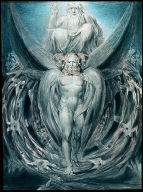
The passage in Revelation like the passage in Ezekiel ends a vision with a voice calling to prophesy. Blake has once again chosen to illustrate the passage literally. We see with our eyes what John of Patmos saw as vision: the angel, the cloud the rainbow colors, the radiance of the face, the right foot and left foot on sea and earth, the little book in the left hand, the seven thunders as horsemen in the dark cloud and feet as pillars of fire. John himself is seen between the feet of the angel recording as directed.

The rainbow is one of many clues that this event of transition, the Revelation of the Apocalypse, is to link God and man. As a covenant was announced with the first rainbow appearance to Noah, a new dispensation is announced in Revelation. A new spiritual Jerusalem will replace the former Jerusalem whose temple had been intended to link God and man.

Blake's Vision of the Last Judgment provides us with images in words and pictures of the new dispensation which emanates from the Last Judgment. Blake includes these images of the new Jerusalem which is to replace the mortal with the immortal.

Vision of the Last Judgment,(E 561)
"The Cloud that opens rolling apart before the throne &
before the New Heaven & the New Earth is Composed of Various
Groupes of Figures particularly the Four Living Creatures
mentiond in Revelations as Surrounding the Throne these I suppose
to have the chief agency in removing the
old heavens & the old Earth
to make way for the New Heaven & the
New Earth to descend from the throne of God & of the Lamb."

Vision of the Last Judgment, (E 562)
"Jesus is surrounded by Beams of Glory in which are
seen all around him Infants emanating from him these represent
the Eternal Births of Intellect from the divine Humanity A
Rainbow surrounds the throne & the Glory in which youthful
Nuptials recieve the infants in their hands"

Perhaps the rainbow should always be seen as an invitation and a promise such as Blake issues here:

Vision of the Last Judgment, (E 560)
"If the Spectator could Enter into these Images in his
Imagination approaching them on the Fiery Chariot of his
Contemplative Thought if he could Enter into Noahs Rainbow or
into his bosom or could make a Friend & Companion of one of these
Images of wonder which always intreats him to leave mortal things
as he must know then would he arise from his Grave then would he
meet the Lord in the Air & then he would be happy"

Tuesday, January 25, 2011

BLAKE & EZEKIEL

The book of Ezekiel in the Old Testament begins with Ezekiel's vision which inludes the Four Living Creatures which Blake used as inspiration for the Four Zoas.

Ezekiel, Chapter 1:
1 "In the thirtieth year, in the fourth month, on the fifth day of the month, as I was among the exiles by the river Chebar, the heavens were opened, and I saw visions of God.
2 On the fifth day of the month (it was the fifth year of the exile of King Jehoi'achin),
3 the word of the LORD came to Ezekiel the priest, the son of Buzi, in the land of the Chalde'ans by the river Chebar; and the hand of the LORD was upon him there.
4 As I looked, behold, a stormy wind came out of the north, and a great cloud, with brightness round about it, and fire flashing forth continually, and in the midst of the fire, as it were gleaming bronze.
5 And from the midst of it came the likeness of four living creatures. And this was their appearance: they had the form of men,
6 but each had four faces, and each of them had four wings.
7 Their legs were straight, and the soles of their feet were like the sole of a calf's foot; and they sparkled like burnished bronze.
8 Under their wings on their four sides they had human hands. And the four had their faces and their wings thus:
9 their wings touched one another; they went every one straight forward, without turning as they went.
10 As for the likeness of their faces, each had the face of a man in front; the four had the face of a lion on the right side, the four had the face of an ox on the left side, and the four had the face of an eagle at the back.
11 Such were their faces. And their wings were spread out above; each creature had two wings, each of which touched the wing of another, while two covered their bodies.
12 And each went straight forward; wherever the spirit would go, they went, without turning as they went.
13 In the midst of the living creatures there was something that looked like burning coals of fire, like torches moving to and fro among the living creatures; and the fire was bright, and out of the fire went forth lightning.
14 And the living creatures darted to and fro, like a flash of lightning.
15 Now as I looked at the living creatures, I saw a wheel upon the earth beside the living creatures, one for each of the four of them.
16 As for the appearance of the wheels and their construction: their appearance was like the gleaming of a chrysolite; and the four had the same likeness, their construction being as it were a wheel within a wheel.
17 When they went, they went in any of their four directions without turning as they went.
18 The four wheels had rims and they had spokes; and their rims were full of eyes round about.
19 And when the living creatures went, the wheels went beside them; and when the living creatures rose from the earth, the wheels rose.
20 Wherever the spirit would go, they went, and the wheels rose along with them; for the spirit of the living creatures was in the wheels.
21 When those went, these went; and when those stood, these stood; and when those rose from the earth, the wheels rose along with them; for the spirit of the living creatures was in the wheels.
22 Over the heads of the living creatures there was the likeness of a firmament, shining like crystal, spread out above their heads.
23 And under the firmament their wings were stretched out straight, one toward another; and each creature had two wings covering its body.
24 And when they went, I heard the sound of their wings like the sound of many waters, like the thunder of the Almighty, a sound of tumult like the sound of a host; when they stood still, they let down their wings.
25 And there came a voice from above the firmament over their heads; when they stood still, they let down their wings.
26 And above the firmament over their heads there was the likeness of a throne, in appearance like sapphire; and seated above the likeness of a throne was a likeness as it were of a human form.
27 And upward from what had the appearance of his loins I saw as it were gleaming bronze, like the appearance of fire enclosed round about; and downward from what had the appearance of his loins I saw as it were the appearance of fire, and there was brightness round about him.
28 Like the appearance of the bow that is in the cloud on the day of rain, so was the appearance of the brightness round about. Such was the appearance of the likeness of the glory of the LORD. And when I saw it, I fell upon my face, and I heard the voice of one speaking."

Here is Blake's image of Ezekiel's vision in the Book of Ezekiel in the Old Testament from the Museum of Fine Arts Boston.

Notice the four faced living creature, the starry wheels with eyes, the six wings, the four additional faces, the throne on which sits the likeness of God, and between the feet of the creature the tiny man who is Ezekiel observing the vision. Not apparent in this image is the light of the rainbow around the image of God displaying his glory. The image in the Blake Archive better displays the light.

This vision described in the words of the Bible and later illustrated by Blake, has prepared Ezekiel to hear the voice. In Marriage of Heaven and Hell Ezekiel converses with Blake:

Marriage of Heaven and Hell, Plate 12, (E 38)
"The Prophets Isaiah and Ezekiel dined with me, and I asked
them how they dared so roundly to assert. that God spake to them;
and whether they did not think at the time, that they would be
misunderstood, & so be the cause of imposition.
...
Then Ezekiel said. The philosophy of the east taught the first
principles of human perception some nations held one
principle for the origin & some another, we of Israel taught
that the Poetic Genius (as you now call it) was the first
principle and all the others merely derivative, which was the
cause of our despising the Priests & Philosophers of other
countries, and prophecying that all Gods [PL 13] would at last be
proved. to originate in ours & to be the tributaries of the
Poetic Genius,"

Blake was convinced that it is the Poetic Genius, the Human Imagination, the voice of the poet and prophet, that was the voice which spoke to Ezekiel, and through Ezekiel, and which continues to speak to those who have 'ears to hear'.

All Religions Are One, (E 1)
PRINCIPLE. 5. The Religions of all Nations are derived from
each Nations different reception of the Poetic Genius which is
every where call'd the Spirit of Prophecy.
PRINCIPLE 6 The Jewish & Christian Testaments are An original
derivation from the Poetic Genius. this is necessary from the
confined nature of bodily sensation

Monday, October 11, 2010

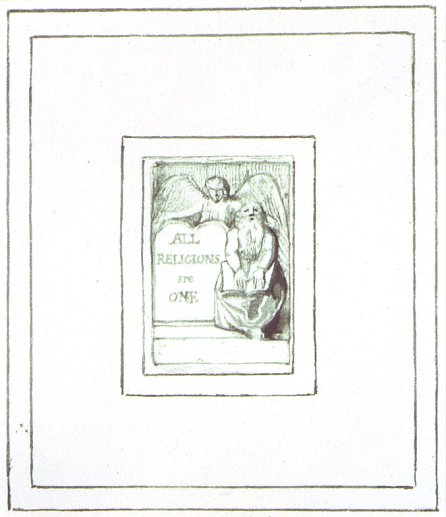
ALL RELIGIONS ARE ONE


View all the 10 Plates of All Religions Are One (E 1) in the Blake Archive.

It could be said that Blake began his prophetic ministry with the little book, All Religions Are One (of which only one copy survives). A close look at it will give us a concise preview of his message, his methods and his goal: "the desire of raising other men into a perception of the infinite." My comments on the poem are in blue.

Plate 1
The voice of one crying in the wilderness

The ministry of John the Baptist was a lonely one. He placed himself outside of his tribe, living in the wilderness and depriving himself of the normal comforts of life. His role was that of a forerunner for the prophet who was to follow him. Blake identified with the role of the outsider who choose to have his voice heard with the aim of pointing toward a new age. (Matthew 3)

All Religions Are One

Each religion claims uniqueness and exclusive access to God and truth. Not so asserts Blake. Religions can be united as one.

The Arguement

As the true meth-
-od of knowledge
is experiment,
the true faculty
of knowing must
be the faculty which
experiences. This
faculty I treat of.

Our knowledge is acquired through our experience. The faculty through which we gain experience will be the subject of this argument. The argument will not be based on authority or second hand knowledge.

Principle 1st

That the Poetic Genius is
the True Man, and that
the body or outward form
of Man is derived from the
Poetic Genius. Likewise
that the forms of all things
are derived from their
Genius, which by the
Ancients was calld an
Angel & Spirit & Demon.

The outer form or appearance of man is not the True Man. The spirit which resides in Man and in all things is what the outer forms derive from.

Principle 2nd

As all men are alike in
outward form, So (and
with the same infinite
variety) all are alike in the Poetic Genius

Humanity shares some qualities in spite of outer variety of appearance. So does man share the inner spiritual nature.

Principle 3rd

No man can think write
or speak from his
heart, but he must intend
truth. Thus all sects of
Philosophy are from the
Poetic Genius, adapted
to the weaknesses of
every individual.

All humanity intends to speak truth when he speaks from his inmost nature. Differences in philosophy result from individual weaknesses (inability to perceive the infinite).

Principle 4th

As none by trave
ling over known
lands can find out
the unknown, So,
from already ac
quired knowledge
Man could not ac
quire more; there
fore an universal
Poetic Genius exists

Man is not dependent upon the knowledge which comes only from his individual experience because a Universal Source, the Poetic Genius, provides knowledge he cannot acquire elsewhere.

Principle 5th

The Religions of all Nat-
-ions are derived from each
Nations different reception
of the Poetic Genius which
is every where call'd the Spi
rit of Prophecy

Different abilities to receive the Poetic Genius result in variety, although the Spirit of Prophecy is universally recognized.

Principle 6th

The Jewish & Chris-
tian Testaments are
An original derivati-
-on from the Poetic Ge-
nius: this is necessary
from the confined natu
re of bodily sensation

The Old and New Testaments of the Bible although deriving from the Poetic Genius, result from limited perceptions according to the varied ability to perceive the Poetic Genius.

Principle 7th

As all men are alike
(tho' infinitely vari
ous) So all Religions:
& as all similars have
one source,
The true Man is the
source, he being the
Poetic Genius

Religions - Man's attempts to perceive the Poetic Genius - though varied, have one Source. That source coming through the True Man is One and not many. So religions likewise are One and not many.

The true or inner man which is in touch with the Poetic Genius and is the Poetic Genius as experienced by each man as he journeys into his inner being, is indistinguishable from the Self as described by Carl Jung.

Here is an article by a psychologist on self and religion:
CARL JUNG AND HIS IDEAS ON SELF
Stephen A. Martin, Psy.D.
"To Jung our Self was not our ego. Our Self was not who we thought we were. Our Self rather was who we really are, all of us, both the known and the unknown, the integrated and that which is yet to be integrated. Our perception of ourselves is hence our ego, but our true Self is a great deal more. "

Tuesday, June 1, 2010

FEARFUL SYMMETRY

It is not easy to understand Blake's attitude toward Good & Evil. Northrup Frye, a renowned student of Blake has given some explanations in Fearful Symmetry. Let's go to him and to Mr. Blake himself for some help.


Northrup Frey, Fearful Symmetry, Page 197

"Moral good and moral evil do not represent any genuine opposition. The one wages wars and executes criminals; the other murders. The one exploits labor; the other robs. The one exploits marriage on the destruction of virginity; the other rapes. But they have a common enemy, the power of genius and prophecy. In terms of moral good it is not the murderer or the robber but the prophet who is really evil. Barabbas can be safely released, for it is impossible that his robberies can destroy the social structure of Pilate and Caiphas; but there is deadly danger in Jesus and John the Baptist, who must be got rid of at all costs."


Northrup Frey, Fearful Symmetry, Page 56

"Hence evil is a negative: all evil consists either in self-restraint or restraint of others. There can be no such thing, strictly speaking, as an evil act; all acts are good, and evil comes when activity is perverted into the frustration of activity, in oneself or others...

This death-impulse, this perverted wish to cut down and restrict the scope of life, is the touchstone not only of all the obvious vices, but of many acts often not classified as such, like teasing, instilling fear or discouragement, or exaction unthinking obedience."


William Blake, Annotations to Lavater (E 601)

"But as I understand Vice it is a Negative...Accident is the omission of act in self & the hindering of act in another, This is Vice but all Act [<from Individual propensity>] is Virtue. To hinder another is not an act it is the contrary it is a restraint on action both in ourselves & in the person hinderd. for he who hinders another omits his own duty. at the time

Murder is Hindering Another

Theft is Hindering Another

Backbiting. Undermining C[i]rcumventing & whatever is Negative is Vice."


Northrup Frey, Fearful Symmetry, Page 58

"But self-development leads us into a higher state of integration with a larger imaginative unit which is ultimately God. Hence the paradox that one gains his life by losing it, which Jesus taught. The selfish or egocentric are incapable of developing themselves; that comes from expansion outward not withdrawal inward. Hence there are two selves in man absolutely opposed to one another, the better self that grows and lives and the worse self that rots and withers, the good and evil angel:"


William Blake, Annotation to Lavater (E 594)

"Man is a twofold being. one part capable of evil & the other

capable of good that which is capable of good is not also

capable of evil. but that which is capable of evil is also

capable of good. this aphorism seems to consider man as

simple & yet capable of evil. now both evil & good cannot

exist in a simple being. for thus 2 contraries would. spring

from one essence which is impossible. but if man is

considerd as only evil. & god only good. how then is

regeneration effected which turns the evil to good. by

casting out the evil. by the good.

See Matthew XII. Ch. 26. 27. 28. 29 vs"

["If it is Satan who is expelling Satan, then he is divided against himself - so how do you suppose that his kingdom can continue? And if I expel devils because I am an ally of Beelzebub, what alliance do your sons make when they do the same thing? They can settle that question for you! But if I am expelling devils by the Spirit of God, then the kingdom of God has swept over you unawares! How do you suppose anyone could get into a strong man's house and steal his property unless he first tied up the strong man? But if he did that, he could ransack his whole house."]


Northrup Frey, Fearful Symmetry, Page 58

"Man has within him the principle of life and the principle of death: one is the imagination, the other the natural man.

...

The only possible cure for the original sin of this Selfhood of the natural man is vision, the revelation that this world is fallen and therefore not ultimate."


I think this leads us right back to the first quote; which says in essence that the enemy of the moral system is the prophet who can destroy the status quo.


Los and his Spectre

Jerusalem, Plate 6