Showing posts with label Ezekiel. Show all posts

Tuesday, January 25, 2011

BLAKE & EZEKIEL

The book of Ezekiel in the Old Testament begins with Ezekiel's vision which inludes the Four Living Creatures which Blake used as inspiration for the Four Zoas.

Ezekiel, Chapter 1:
1 "In the thirtieth year, in the fourth month, on the fifth day of the month, as I was among the exiles by the river Chebar, the heavens were opened, and I saw visions of God.
2 On the fifth day of the month (it was the fifth year of the exile of King Jehoi'achin),
3 the word of the LORD came to Ezekiel the priest, the son of Buzi, in the land of the Chalde'ans by the river Chebar; and the hand of the LORD was upon him there.
4 As I looked, behold, a stormy wind came out of the north, and a great cloud, with brightness round about it, and fire flashing forth continually, and in the midst of the fire, as it were gleaming bronze.
5 And from the midst of it came the likeness of four living creatures. And this was their appearance: they had the form of men,
6 but each had four faces, and each of them had four wings.
7 Their legs were straight, and the soles of their feet were like the sole of a calf's foot; and they sparkled like burnished bronze.
8 Under their wings on their four sides they had human hands. And the four had their faces and their wings thus:
9 their wings touched one another; they went every one straight forward, without turning as they went.
10 As for the likeness of their faces, each had the face of a man in front; the four had the face of a lion on the right side, the four had the face of an ox on the left side, and the four had the face of an eagle at the back.
11 Such were their faces. And their wings were spread out above; each creature had two wings, each of which touched the wing of another, while two covered their bodies.
12 And each went straight forward; wherever the spirit would go, they went, without turning as they went.
13 In the midst of the living creatures there was something that looked like burning coals of fire, like torches moving to and fro among the living creatures; and the fire was bright, and out of the fire went forth lightning.
14 And the living creatures darted to and fro, like a flash of lightning.
15 Now as I looked at the living creatures, I saw a wheel upon the earth beside the living creatures, one for each of the four of them.
16 As for the appearance of the wheels and their construction: their appearance was like the gleaming of a chrysolite; and the four had the same likeness, their construction being as it were a wheel within a wheel.
17 When they went, they went in any of their four directions without turning as they went.
18 The four wheels had rims and they had spokes; and their rims were full of eyes round about.
19 And when the living creatures went, the wheels went beside them; and when the living creatures rose from the earth, the wheels rose.
20 Wherever the spirit would go, they went, and the wheels rose along with them; for the spirit of the living creatures was in the wheels.
21 When those went, these went; and when those stood, these stood; and when those rose from the earth, the wheels rose along with them; for the spirit of the living creatures was in the wheels.
22 Over the heads of the living creatures there was the likeness of a firmament, shining like crystal, spread out above their heads.
23 And under the firmament their wings were stretched out straight, one toward another; and each creature had two wings covering its body.
24 And when they went, I heard the sound of their wings like the sound of many waters, like the thunder of the Almighty, a sound of tumult like the sound of a host; when they stood still, they let down their wings.
25 And there came a voice from above the firmament over their heads; when they stood still, they let down their wings.
26 And above the firmament over their heads there was the likeness of a throne, in appearance like sapphire; and seated above the likeness of a throne was a likeness as it were of a human form.
27 And upward from what had the appearance of his loins I saw as it were gleaming bronze, like the appearance of fire enclosed round about; and downward from what had the appearance of his loins I saw as it were the appearance of fire, and there was brightness round about him.
28 Like the appearance of the bow that is in the cloud on the day of rain, so was the appearance of the brightness round about. Such was the appearance of the likeness of the glory of the LORD. And when I saw it, I fell upon my face, and I heard the voice of one speaking."

Here is Blake's image of Ezekiel's vision in the Book of Ezekiel in the Old Testament from the Museum of Fine Arts Boston.
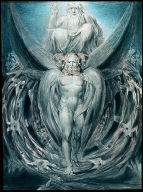
Notice the four faced living creature, the starry wheels with eyes, the six wings, the four additional faces, the throne on which sits the likeness of God, and between the feet of the creature the tiny man who is Ezekiel observing the vision. Not apparent in this image is the light of the rainbow around the image of God displaying his glory. The image in the Blake Archive better displays the light.

This vision described in the words of the Bible and later illustrated by Blake, has prepared Ezekiel to hear the voice. In Marriage of Heaven and Hell Ezekiel converses with Blake:

Marriage of Heaven and Hell, Plate 12, (E 38)
"The Prophets Isaiah and Ezekiel dined with me, and I asked
them how they dared so roundly to assert. that God spake to them;
and whether they did not think at the time, that they would be
misunderstood, & so be the cause of imposition.
...
Then Ezekiel said. The philosophy of the east taught the first
principles of human perception some nations held one
principle for the origin & some another, we of Israel taught
that the Poetic Genius (as you now call it) was the first
principle and all the others merely derivative, which was the
cause of our despising the Priests & Philosophers of other
countries, and prophecying that all Gods [PL 13] would at last be
proved. to originate in ours & to be the tributaries of the
Poetic Genius,"

Blake was convinced that it is the Poetic Genius, the Human Imagination, the voice of the poet and prophet, that was the voice which spoke to Ezekiel, and through Ezekiel, and which continues to speak to those who have 'ears to hear'.

All Religions Are One, (E 1)
PRINCIPLE. 5. The Religions of all Nations are derived from
each Nations different reception of the Poetic Genius which is
every where call'd the Spirit of Prophecy.
PRINCIPLE 6 The Jewish & Christian Testaments are An original
derivation from the Poetic Genius. this is necessary from the
confined nature of bodily sensation

Wednesday, December 8, 2010

EVIDENT TO THE CHILD

___________________________Image from Songs of Innocence,
___________________________Little Black Boy

Blake with his unusually high intelligence can be assumed to have to have learned to read very early in his life. Very likely the Bible was among his preferred reading material. He seems to have been attracted to the Old Testament prophets such as Isaiah, Ezekiel, Jeremiah, Amos whose influence is seen in his poetry.
It is interesting to think of Blake as a young child reading the Bible without instruction or supervision, as interacting in his own unique, superintelligent way. He got into some scholarship later and also absorbed the general understanding from his culture. Nevertheless his interaction and interpretation continued to be direct and unusual.

Annotations to Berkeley, (E 664)
"Jesus supposes every Thing to be Evident to the Child & to
the Poor & Unlearned Such is the Gospel
The Whole Bible is filld with Imaginations & Visions from
End to End & not with Moral virtues that is the baseness of Plato
& the Greeks & all Warriors The Moral Virtues are continual
Accusers of Sin & promote Eternal Wars & Domineering over others"

Annotations to Berkeley, (E 664)
"Man is All Imagination God is Man & exists in us & we in him"

Jonathan Roberts and Christopher Rowland contributed a chapter to the Blackwell Companion to the Bible in English Literature in which they present their views on Blake's use of the Bible (Page 376):
"This emphasis on the importance of individuals (and their social contexts) in interpreting the Bible means that Blake is particularly concerned with replacing a literalist hermeneutic with one that considers the Bible to be a stimulus to the imagination. This means above all engaging readers in the interpretation of the text, rather than demanding they accept it as in object above and beyond them. To this end Blake provides a consistent polemic against the preoccupation with the literal sense of the text, and against a reverence for the text that comes at the expense of what an imaginative and life-affirming encounter with the Bible might offer. These two tasks required a thoroughgoing assault on the ways in which the Bible had been constructed and reduced to a focus on the sacrificial death of Jesus and a religion of moral virtue. Blake would have no truck, for example, with the view that humans are inherently sinful: that God must be appeased by a sacrifice (of Christ); and that God - having made that sacrifice - then expects humanity to behave morally in order to stay in relationship with him (i.e. by keeping his commandments). Such an outlook, Blake thought, led to a denial of aspects of the human person and the subjection of some human beings to others."

Blake seemed to continue to read the Bible as he had as a child - with an open mind. He didn't look back to what the words had meant when they were written exclusively, but to what they meant in the immediate present to his own imaginative ability. His conversations with Ezekiel and Isaiah may have begun long before he wrote The Marriage of Heaven and Hell and continued long after.

Thursday, August 12, 2010

Two Kinds of Seeing

The prophet Ezekiel reported (in 4:4-8) that God told him to lay on his right side for three months, then on his left side for three months, as a warning to the Hebrews. In a vision Blake asked him why he did it and got this reply: "the desire of raising other men into a perception of the infinite" (Blake reported this to us in MHH Plate 13 (line 21ff).

"The desire of raising other men into a perception of the infinite": by and large that was Blake's main purpose in his creative endeavors.

There are many kinds of seeing and many levels of consciousness, but, resorting to the natural proclivity for the dialectic, we might say there are two:

1. The sense-based, natural, materialistic time and space consciousness, with no spiritual awareness. Blake called this Ulro; Jesus called it Hell.

2. Vision, coming forth from the inner man, the Light, the Now. It's a different kind of consciousness, a perception of the infinite (Blake called it Eden; Jesus called it the Kingdom of Heaven or the Kingdom of God).

Jesus showed us with his life how to live eternally; and he told us we could do it. Blake did it, periodically at least, and like Jesus he wanted us to share that heavenly gift.

He called it Vision; that's what he lived for; those eternal moments when he perceived the infinite were all that mattered. If you can't do it continuously, then you can talk about it, write about it, draw it, paint it. He did (and you can) show us how to see.

(This material was largely taken from the Blake Primer, near the beginning.)

Re double vision: "This is a cogent description of what he calls double vision, an attribute of schizophrenics as well as artists; they see what's not there to the sense based person." (Double vision appears to be closely related to intuition.)

Look also at twofold.

Write me if you need further information, or just comment and ask a question.

Thursday, September 21, 2006

Blake and the Bible

(Look also at Blake's Bible.)

If you think the Bible is inerrant, and that every word has one and only one meaning, then you don't need to read this any further.

Blake had an unparalleled freedom with the Bible. Northrup Frye referred to him as a Bible soaked protestant. He was Bible soaked, but the meanings he found in most of the Bible were distinctive and often unique: "Both read the Bible day and night,But thou read’st black where I read white."

Blake's 'white' reading will excite you and/or repel you. Or perhaps you will add your Blake to the canon; that happens.

1. The idea of Nobodaddy implies an explicit and emphatic rejection of the "sub-Christian" elements of the O.T.

Blake spent half his life figuring out who/what Christ was, after which he measured the quality and value of everything in the Bible in accordance with Christ's identity.

He rejected the thump on the head for the "healing balm".

2. He put the same value on his own visions (and vision) as he did the Bible. In visions he conversed with Isaiah and Ezekiel (see the second Memorable Fancy). My wife's favorite Blake quoted Ezekiel's conversation with Blake thusly: when Blake asked him why he behaved so erratically re living in his underwear and spending 3 months on his left side, etc., Ezekiel responded "'the desire of raising other men into a perception of the infinite". That has in fact became our calling in life.

To use slightly more orthodox terminology we could say the desire to get people thinking about Heaven (in it's larger meaning). That's a good subject for another post.

When our youngest was married (an outdoor Catholic marriage, I had a chance to read some scripture. I finished with the quotation from "Saint William Blake":
"Throughout Eternity I forgive you, you forgive me;
as the dear Redeemer said, this the wine and this the bread."

Blake was very free with his use of the Bible, as I, too strive to be, God willing.

There's much further information on this subject at Chapter Six of my Blake website.