Showing posts with label Fearful Symmetry. Show all posts

Friday, August 27, 2010

BLAKE, FRYE & BIBLE

Urizen's Bible was not Blake's Bible

We have often spoken of the distinctive way in which Blake read, studied and interpreted the Bible. Northrup Frey who was an ordained minister of the United Church of Canada before he was a literary critic, shows in this passage from Fearful Symmetry (page 370) how he and Blake were able to read the Bible according to the light which was given to them:

"The career of Jesus is visualized in the gospels as a recreation or epitome of the story of Israel. He comes of the seed of "David" that is, he is the new Orc or Luvah. A "father" who did not begat him, named Joseph, leads him to "Egypt," Herod's slaughter of the innocents being in counterpoint to the earlier Passover story. Returning from Egypt,he grows up and is baptized in the Jordon, corresponding to the crossing of the Red Sea; then he wanders forty days in the wilderness as the Israelites wandered forty years, resisting all the temptations the Israelites fell prey to, including at least one not presented as such in the earlier vision, the miraculous provision of bread. He emerges from the wilderness, gathers twelve followers, appears on a mountain with Moses and Elijah, enters and clenses the Temple, and is finally lifted up like the brazen serpent in the harlot Jerusalem he came to redeem. In the mean time he raised up a new civilization through the power of the unlearned and oppressed people who were most receptive to his teaching.The new historical cycle is symbolized in Blake by Lazarus of Bethany and the Lazarus of the parable, and who is, like Samson, a vision of Orc suggesting the larger contours of Albion, whose resurrection may not be far off. Thus the "life" of Jesus presented in the Gospels is really a visionary drama based on the earlier vision of Jehovah, worked out not, in terms of historical accuracy or evidence but purely as a clarification of the prophetic visions of the Messiah."


Milton, PLATE 24 [26], (E 120)
"When Jesus raisd Lazarus from the Grave I stood & saw
Lazarus who is the Vehicular Body of Albion the Redeemd
Arise into the Covering Cherub who is the Spectre of Albion
By martyrdoms to suffer: to watch over the Sleeping Body.
Upon his Rock beneath his Tomb. I saw the Covering Cherub
Divide Four-fold into Four Churches when Lazarus arose
Paul, Constantine, Charlemaine, Luther;"

Here is an earlier post on Albion and Lazarus.

Blake created his own 'visionary dramas' to present his prophetic visions of the Messiah which he was convinced could reveal the contours of a New Age.

Monday, August 2, 2010

Blake and Religion

Northrup Frye, an ordained Canadian minister, as a young man wrote a thesis entitled Fearful Symmetry, which became the magisterial exposure of Blake's thought to the academic world. His primary calling became English Literary Criticism, and he won signal distinction in that field (especially a book called The Anatomy of Criticism).

Later in life Frye said that if he had it to do over he would not write a sophisticated academic work about Blake, but something more like Percival's introductory survey. He called his last (monumental!) two volume work The Great Code of Art or The Bible as Literature. That's an invaluable work for learning Blake.

In Britain's early 19th Century the Enlightenment had a marked effect on religious thought; Deism was ascendant, the idea that God created the world and wound it up like a clock and thereafter retired from any interest in it. We are to God what ants are to us.

As you can imagine Bible soaked and God intoxicated Blake despised Deism. But he equally despised what he took to be the opposite, which he called (among other things) Druidism, the most primitive form of religion, including human sacrifice.

Druidism fit Blake's concept of established religion, whose leaders enthusiastically supported the king's wars; in the same way the religious leaders today have emphatically supported the government's wars. (The government, established religion and the military industrial complex were like three peas in a pod in Blake's day.)

Here's one of Blake's reactions to that sad reality:

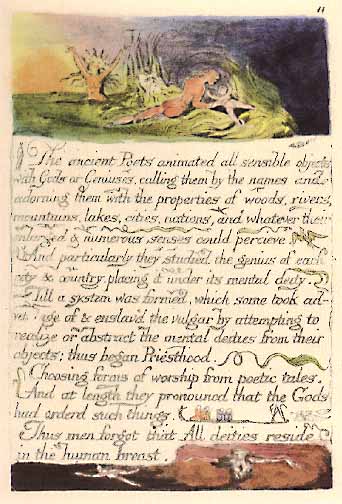
(Plate 11) (of the Marriage of Heaven and Hell)
"The ancient Poets animated all sensible objects with Gods or Geniuses, calling them by the names and adorning them with the properties of woods, rivers, mountains, lakes, cities, nations, and whatever their enlarged & numerous senses could percieve.

And particularly they studied the genius of each city & country, placing it under its mental deity.

Till a system was formed, which some took advantage of & enslav'd the vulgar by attempting to realize or abstract the mental deities from their objects; thus began Priesthood.

Choosing forms of worship from poetic tales.
And at length they pronounc'd that the Gods had order'd such things.
Thus men forgot that All deities reside in the human breast."
According to Blake God is within-- you and me, everyone. In this he closely resembled the Quakers who fundamentally speak of that of God in you/me/everyone. The God within is creative, a Creator of Art. This depends upon imagination, intuition, the expression of spiritual/eternal ideas in tangible things-- like words (the Bible), music, and representations of the human form in its various states.

Here's an example in the Laocoon (E274) of how Blake expressed this idea:
"Prayer is the Study of Art
Praise is the Practise of Art
Fasting &c. all relate to Art
The outward Ceremony is Antichrist
Without Unceasing Practise nothing can be done

Practise is Art If you leave off you are Lost

A Poet a Painter a Musician an Architect: the Man
Or Woman who is not one of these is not a
Christian"

Thursday, July 15, 2010

GIVE BODY to IDEAS

I ended my last post by saying: "The picture I get is that Jesus, Newton, Blake, the Creator and Urizen shared the same instrument as well as some of the same activity. That activity was giving body to ideas."

Here is the passage from Northrup Frye' s Fearful Symmetry (Page 267) about giving body to ideas.

"The artist does not use natural images to clothe his ideas so much as to give body to them. An abstract idea is a spectre, a collapsing skeleton; a concrete image has flesh and blood. Hence the rather violent image of woven bodies which Blake employs in this context: from the skeleton's point of view it is rather difficult to say whether the flesh is body or clothing.
In making the familiar intelligible, in imposing a permanent vision on the flux of time, the artist creates a body out of nature which has a mental form. He thereby teaches us to see, in the small part of mystery which he has made coherent, the image, that is, the form of reality, of a universal coherence; he suggests, in other words, that if his natural body is a mental form, then the entire body of nature, from atoms to stars, may also be form of the human mind, if the imagination could get hold of it. Our fallen senses hollow out a tiny grotto in a boundless stretch of mystery, and this grotto is our home. But the center of the real universe is wherever we happen to be, and its circumference the limit of the radius of our experience. In the perspective of the awakened mind, the radius of of our experience is the universe, and art reveals to the senses of distant contact, eyesight and hearing, a universal home or Paradise which is ready for us to inhabit."

Jerusalem, Plate 92, (E 252)
"Los answerd swift as the shuttle of gold. Sexes must vanish & cease
To be, when Albion arises from his dread repose O lovely Enitharmon:
When all their Crimes, their Punishments their Accusations of Sin:
All their Jealousies Revenges. Murders. hidings of Cruelty in Deceit
Appear only in the Outward Spheres of Visionary Space and Time.
In the shadows of Possibility by Mutual Forgiveness forevermore
And in the Vision & in the Prophecy, that we may Foresee & Avoid
The terrors of Creation & Redemption & Judgment. Beholding them
Displayd in the Emanative Visions of Canaan in Jerusalem & in Shiloh
And in the Shadows of Remembrance, & in the Chaos of the Spectre
Amalek, Edom, Egypt, Moab, Ammon, Ashur, Philistea, around
Jerusalem"


This is the world turned upside down.
What we have called reality is seen
to be illusion; what we have called
illusion is seen to be reality. The
powers which have controlled us
have become powerless. Albion
arises and a new day dawns.


Tuesday, June 15, 2010

NOTHING LOST

Northrup Frye has a good bit to say that adds to the picture of Golgoonoza which we have been developing. Here is a paragraph which clarifies the purpose and the eventual outcome for Blake's City of Imagination. Notice that he emphasizes that Golgonooza as it becomes the New Jerusalem, 'the total form of all culture and civilization', will make permanent (but not static) all the imaginative work which has been contributed to its building. It reminds me of a phrase which I picked up somewhere along the way: nothing lost, nothing wasted.

This is from page 91 of Fearful Symmetry:

"Inspiration is the artist's empirical proof of the divinity of his imagination; and all inspiration is divine in origin whether used, perverted, hidden or frittered away in reverie. All imaginative and creative arts, being eternal, go to build up a permanent structure, which Blake called Golgonooza, above time, and, when this structure is finished, nature, its scaffolding, will be knocked away and man will live in it. Golgonooza will be the city of God, the New Jerusalem which is the total form of all culture and civilization. Nothing that the heroes, martyrs, prophets and poets of the past have done for it has been wasted; no anonymous and unrecognized contribution to it has been overlooked. In it is conserved all the good man has done, and in it is completed all he hoped and intended to do. And the artist who uses the same energy and genius that Homer and Isaiah had will find that he not only lives in the same palace of art as Homer and Isaiah, but lives at the same time."
Perhaps Blake is even more inclusive in the passage about Los' work.

Jerusalem, Plate 13,(E 157)
"Golgonooza: Los walks round the walls night and day.

He views the City of Golgonooza, & its smaller Cities:
The Looms & Mills & Prisons & Work-houses of Og & Anak:
The Amalekite: the Canaanite: the Moabite: the Egyptian:
And all that has existed in the space of six thousand years:
Permanent, & not lost not lost nor vanishd, & every little act,
Word, work, & wish, that has existed, all remaining still
In those Churches ever consuming & ever building by the Spectres
Of all the inhabitants of Earth wailing to be Created:
Shadowy to those who dwell not in them, meer possibilities:
But to those who enter into them they seem the only substances
For every thing exists & not one sigh nor smile nor tear,

PLATE 14
One hair nor particle of dust, not one can pass away."
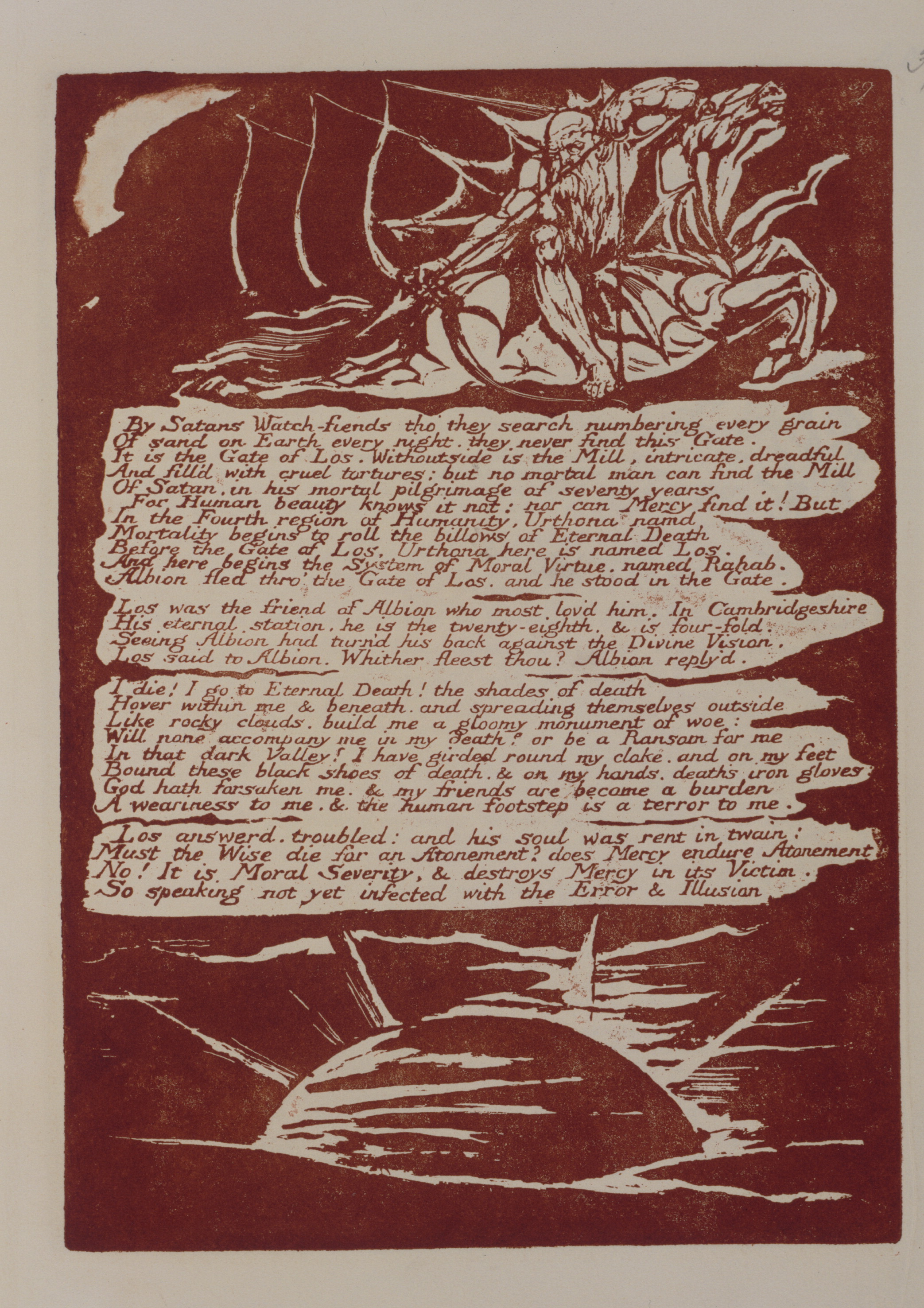
Satan's Watch-fiends Never Find the Gate of Los
JERUSALEM
"this gate cannot be found

PLATE 35 [39] (E 181)
By Satans Watch-fiends
tho' they search numbering
every grain
Of sand on Earth every night,
they never find this Gate.
It is the Gate of Los.
Withoutside is the Mill,
intricate, dreadful
And fill'd with cruel tortures;
but no mortal man can find
the Mill
Of Satan, in his mortal
pilgrimage of seventy years"

Monday, June 7, 2010

VISION of GOD

We are fortunate to have Northrup Frye's Fearful Symmetry as a Google book even though we are not able to read all the pages there. Click here to go to Chapter 5 of Fearful Symmetry.

In the first paragraph of Chapter 5, Frey delineates the relationship between the individual mind and mind of God. He refers to fallen man as the ego which perceives the general. As a part of the Universal Creator, man perceives or creates as a mental form. It is in the mind of the totality of creative power that we are able to perceive the particular. If we see through that seed of truth planted within us, we perceive this world as a 'single creature' fallen and redeemed. Frey states, 'This is the vision of God (subjective genitive: the vision which God in us has).'

This is the fourfold vision of which Blake speaks in a Letter to Thomas Butts, (E 722):
"Now I a fourfold vision see
And a fourfold vision is given to me
Tis fourfold in my supreme delight
And three fold in soft Beulahs night
And twofold Always. May God us keep
From Single vision & Newtons sleep"

Blake's idea that we must see not with but through the eye, is true at the level of vision as well; we are not to see the vision, or with the vision but through the vision to the transcendent reality which provides the vision and the means of apprehending it.

Auguries of Innocence, (E 520)
"This Lifes dim Windows of the Soul
Distorts the Heavens from Pole to Pole
And leads you to Believe a Lie
When you see with not thro the Eye
That was born in a night to perish in a night
When the Soul slept in the beams of Light."


Christ in circle

Tuesday, June 1, 2010

FEARFUL SYMMETRY

It is not easy to understand Blake's attitude toward Good & Evil. Northrup Frye, a renowned student of Blake has given some explanations in Fearful Symmetry. Let's go to him and to Mr. Blake himself for some help.


Northrup Frey, Fearful Symmetry, Page 197

"Moral good and moral evil do not represent any genuine opposition. The one wages wars and executes criminals; the other murders. The one exploits labor; the other robs. The one exploits marriage on the destruction of virginity; the other rapes. But they have a common enemy, the power of genius and prophecy. In terms of moral good it is not the murderer or the robber but the prophet who is really evil. Barabbas can be safely released, for it is impossible that his robberies can destroy the social structure of Pilate and Caiphas; but there is deadly danger in Jesus and John the Baptist, who must be got rid of at all costs."


Northrup Frey, Fearful Symmetry, Page 56

"Hence evil is a negative: all evil consists either in self-restraint or restraint of others. There can be no such thing, strictly speaking, as an evil act; all acts are good, and evil comes when activity is perverted into the frustration of activity, in oneself or others...

This death-impulse, this perverted wish to cut down and restrict the scope of life, is the touchstone not only of all the obvious vices, but of many acts often not classified as such, like teasing, instilling fear or discouragement, or exaction unthinking obedience."


William Blake, Annotations to Lavater (E 601)

"But as I understand Vice it is a Negative...Accident is the omission of act in self & the hindering of act in another, This is Vice but all Act [<from Individual propensity>] is Virtue. To hinder another is not an act it is the contrary it is a restraint on action both in ourselves & in the person hinderd. for he who hinders another omits his own duty. at the time

Murder is Hindering Another

Theft is Hindering Another

Backbiting. Undermining C[i]rcumventing & whatever is Negative is Vice."


Northrup Frey, Fearful Symmetry, Page 58

"But self-development leads us into a higher state of integration with a larger imaginative unit which is ultimately God. Hence the paradox that one gains his life by losing it, which Jesus taught. The selfish or egocentric are incapable of developing themselves; that comes from expansion outward not withdrawal inward. Hence there are two selves in man absolutely opposed to one another, the better self that grows and lives and the worse self that rots and withers, the good and evil angel:"


William Blake, Annotation to Lavater (E 594)

"Man is a twofold being. one part capable of evil & the other

capable of good that which is capable of good is not also

capable of evil. but that which is capable of evil is also

capable of good. this aphorism seems to consider man as

simple & yet capable of evil. now both evil & good cannot

exist in a simple being. for thus 2 contraries would. spring

from one essence which is impossible. but if man is

considerd as only evil. & god only good. how then is

regeneration effected which turns the evil to good. by

casting out the evil. by the good.

See Matthew XII. Ch. 26. 27. 28. 29 vs"

["If it is Satan who is expelling Satan, then he is divided against himself - so how do you suppose that his kingdom can continue? And if I expel devils because I am an ally of Beelzebub, what alliance do your sons make when they do the same thing? They can settle that question for you! But if I am expelling devils by the Spirit of God, then the kingdom of God has swept over you unawares! How do you suppose anyone could get into a strong man's house and steal his property unless he first tied up the strong man? But if he did that, he could ransack his whole house."]


Northrup Frey, Fearful Symmetry, Page 58

"Man has within him the principle of life and the principle of death: one is the imagination, the other the natural man.

...

The only possible cure for the original sin of this Selfhood of the natural man is vision, the revelation that this world is fallen and therefore not ultimate."


I think this leads us right back to the first quote; which says in essence that the enemy of the moral system is the prophet who can destroy the status quo.


Los and his Spectre

Jerusalem, Plate 6