Showing posts with label Psychology. Show all posts

Thursday, February 3, 2011

Blake's Joy

Count it all joy when ye fall into divers temptations; Knowing this, that the trying of your faith worketh patience. But let patience have her perfect work, that ye may be perfect and entire, wanting nothing. (James 1:2-4)

Th
e epigram says it all!

This little poem sets the natural scene:
"Man was made for Joy & Woe;
And when this we rightly know
Thro' the World we safely go.
Joy & Woe are woven fine,
A Clothing for the Soul divine;"
(From Auguries of Innocence; Erdman page 491)

We might wonder what meanings joy and woe had for Blake in the spiritual development of his life.

Blake must have been a joyous child to see a tree full of angels, but like all children he also knew woe at an early age; that is symbolized by the angry God at the window who left him screaming (I wonder how many of the small children of fundamentalist Christians have a similar experience.)

The angry God became Blake's chief source of woe and set him to writing feverishly over the years. It led to the system he created, the Myth, begun with a Fall. It led to a systematic study of human psychology with the division of the psyche into four fractions, namely Urizen, Luvah, Los, and Tharmas or in modern day parlance Thinking, Feeling, Intuition or Imagination, and Sensation.

Blake's Thinking became a bane to him; he identified Urizen with the Angry God, the Lawgiver, the Schoolmaster. He wrote thousands of words and produced a multitude of images dealing with Urizen.

He is first mentioned in 1793 in Visions of the Daughters of Albion: "O Urizen! Creator of men! mistaken Demon of heaven: Thy joys are tears! thy labour vain, to form men to thine image."(Erdman 48)

Also in 1793 Blake mentioned Urizen three times in America. (Erdman 54ff) Here's one of them:
"The fiery joy, that Urizen perverted to ten commands"; here he has identified Urizen with the God who directed Moses in the Exodus, but this Exodus was not to liberty, but from Eternity to a rule bound life .

In 1794 Blake began to describe Urizen's career with the Book of Urizen. The story is amplified in great detail. In The Four Zoas. (Put urizen in the concordance if you want to know where it occurs.)

Blake hated the dominance of Urizen over his mind, but in the course of time he dealt creatively with Urizen. After many, many scenes showing Urizen making things worse and beginning to fear for Futurity he encountered and was confronted by Los. The contest was arduous-- between imagination and what had become fear. The enmity went on and on until finally Los subdued Urizen.

Then strangely enough Los found that he no longer hated Urizen; in fact he had come to love him. (He forgave one who had sinned against him!) Urizen was in his power. With the shivering Urizen subdued by Los, Blake laid to rest the Angry God.

For Blake the thump on the head was replaced by the healing balm of the Jesus he had come to love and worship. Facing God he said:
"Throughout Eternity I forgive you; you forgive me." ([Notebook], "MySpectre"54; E477)
A powerful general statement about the consequences of grace. You is everyone of course, but Blake particularly addressed God in this statement. (We may not know it, but a host of us need to forgive God for the things that have appeared to us to be unjust.) Making that decision is infinitely liberating to the human soul.

For Blake having made it led to an immediate release of the visionary power he had lost twenty years before; like C.S.Lewis he was Surprised by Joy. He began to write and draw with power and vigor. In fact he became an evangelist. Unlike Francis of Assisi he used words by choice; words were his forte.

Milton, Jerusalem, Job (Illustrations): three of many ways of telling the old, old story.

Thursday, January 13, 2011

BUNYAN'S DARK FIGURES

We were fortunate to purchase (for less the $20) a copy of Gerda S. Norvig's book Dark Figures in the Desired Country in which she presents her study of Blake's illustrations of Pilgrim's Progress.

It is refreshing to read Blake criticism from a scholar who thinks with a psychological perspective. Norvig is a qualified clinical psychologist as well a professor of English literature. Her book was assembled over a period of twenty years during which she was refining her understanding of Blake and of the human psyche. She sees Blake's development as being a process in which he gained the self-understanding which allowed him to understand the process through which Bunyan produced Pilgrim's Progress.

Norvig says "When in the following chapters I explore Blake's psychologizing of Bunyan's myth, I draw often, as mentioned in the preface, on the vocabulary of Jungian and post-Jungian theory to articulate some of Blake's most characteristic moves. What led me to choose the Jungian perspectives of analytical and archetypal psychology for this task is that the central vision of these approaches so clearly echoes the conception of the imagination dominating Blake's every word and every stroke of graphic expression...
for both Blake and the Jungians, "imagination is not a state" (M 32, E132/K522), nor is it just one of the many faculties of the mind; rather, it is the root capacity conditioning all mental functioning. [Page 17]..

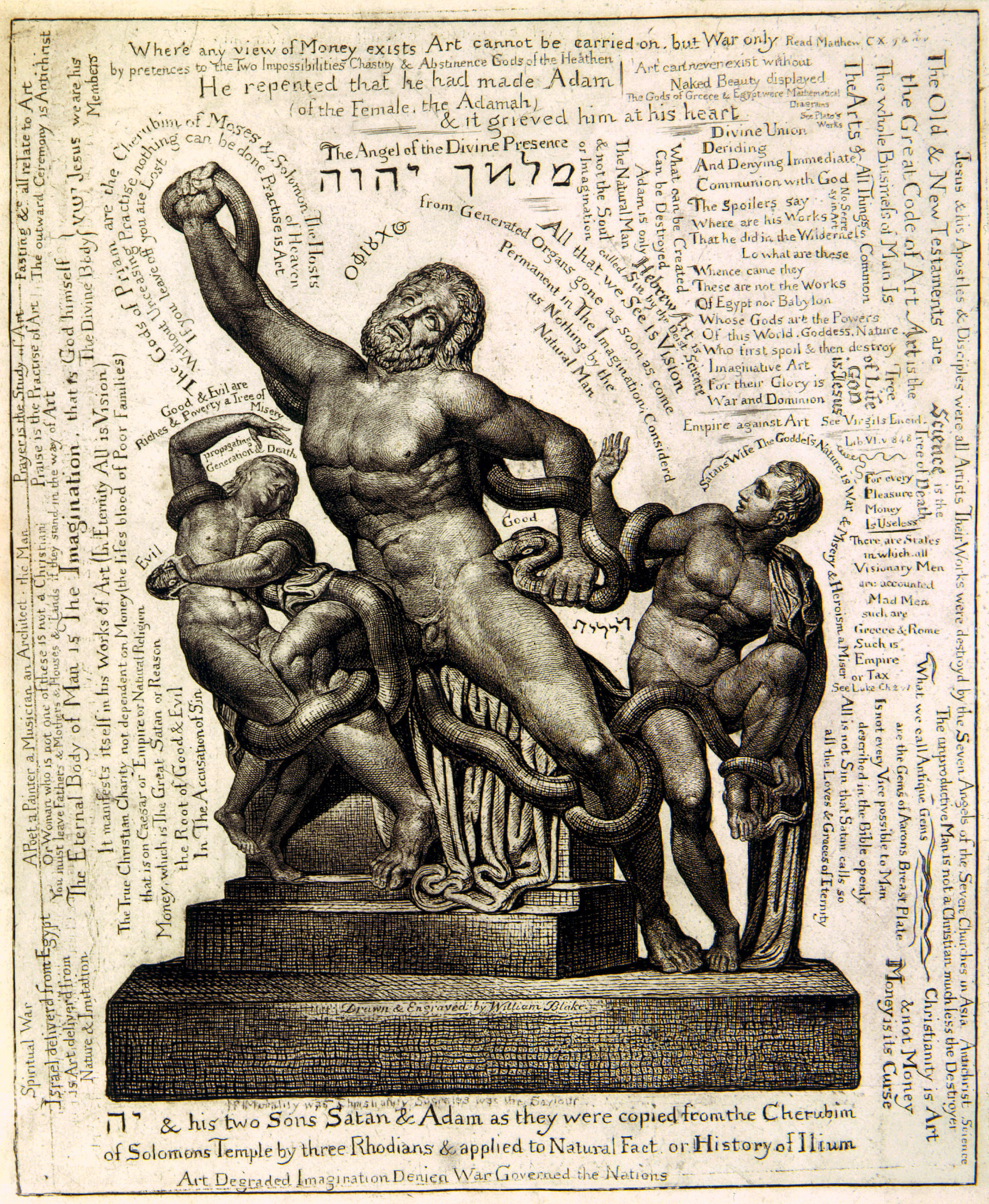
"For him, too, the archetypal structures, functions, fictions and images of the human imagination have both primacy over and ontological independence from the psychodynamics of any individuals case history. Thus his statement that "The Eternal Body of Man is the IMAGINATION that is God himself The Divine Body...JESUS we are his Members" (Laocoon, E273/K776) creates a picture of the psyche as larger than the body and life of the the individual subjects who articulate it." [Page 18]

Bringing these strategies to bear in discerning the meaning which Blake perceives in Bunyan's allegory and presents through images of archetypal experiences, Norvig reveals Bunyan and Blake delving into the collective psyche.


Blake's Laocoon
Text on Laocoon

Monday, December 20, 2010

CRYSTAL CABINET IV

To complete this series of posts on the Crystal Cabinet, let's consider what I call the psychological meaning. We will look at the poem solely as it concerns interior mental processing.

The Crystal Cabinet, (E 488)
"The Maiden caught me in the Wild
Where I was dancing merrily
She put me into her Cabinet
And Lockd me up with a golden Key

The unconscious, innocent is caught by the beginning of awareness.

This Cabinet is formd of Gold
And Pearl & Crystal shining bright
And within it opens into a World
And a little lovely Moony Night

The altered consciousness takes possession of the mind and begins to reveal the unknown.

Another England there I saw
Another London with its Tower
Another Thames & other Hills
And another pleasant Surrey Bower

The ability to see more and differently expands ordinary perception.

Another Maiden like herself
Translucent lovely shining clear
Threefold each in the other closd
O what a pleasant trembling fear

The original experience becomes an avenue to further experience.

O what a smile a threefold Smile
Filld me that like a flame I burnd
I bent to Kiss the lovely Maid
And found a Threefold Kiss returnd

Head, heart and loins are sensitized, reinforcing the experience.

I strove to sieze the inmost Form
With ardor fierce & hands of flame
But burst the Crystal Cabinet
And like a Weeping Babe became

The spontaneous experience is destroyed when an attempt is made to possess it.

A weeping Babe upon the wild
And Weeping Woman pale reclind
And in the outward air again
I filld with woes the passing Wind"

The return to the previous consciousness feels like a loss and regression.
The outer world is sullied in comparison to the imaginative world which has been revealed.

Image - Book of Thel, plate 4


Blake as usual leaves his statement open-ended. Where do 'I' go from here? Is the altered state of consciousness attractive enough that I want to pursue it? Is seeing the pale, reclining, weeping woman a result of visiting the Crystal Cabinet?
The carefree boy of the first verse has become burdened with woes he cannot control, but a world of possibility has been opened to him.


Marriage of Heaven and Hell
, PLATE 12 (E 38)
A Memorable Fancy
"Isaiah answer'd. I saw no God. nor heard any, in a finite
organical perception; but my senses discover'd the infinite in
every thing, and as I was then perswaded. & remain confirm'd;"

I am reminded of this statement from Fritjof Capra in The Web of Life.
"At a certain level of complexity a living organism couples structurally not only to its the environment but also to itself, and thus brings forth not only an external but also and inner world. In human beings the bringing forth of such an inner world is linked intimately to language, thought and consciousness."

Saturday, November 20, 2010

SELF & SOUL

Writing of the work of individuation, David L. Hart, (The Cambridge Companion to Jung, edited by Polly Young-Eisendrath and Terence Dawson ) points out the spiritual nature of the process:

" Many younger people, myself included, have found new meaning and purpose in life through the direct inspiration and guidance of Jung. What it does emphasize is that individuation is a spiritual undertaking. It is the conscious response to an instinct not recognized in biological thought, an innate and powerful drive toward spiritual realization and ultimate meaning. As such, it involves the whole person, who, in the process of emerging into wholeness, is progressively transformed - not into something different, but into the true Self: out of its potential and into its reality. Whoever, in any age or condition, is prepared to heed and respond to this spiritual and fundamentally human drive, is prepared for the process of individuation." (PAGE 99)

The spiritual undertaking which Jung acknowledged and supported is affirmed extravagantly in Blake's writing. The Self which Jung defines as the 'God image' within the psyche is the realization achieved by the process of individuation. What was referred to as Self by Jung might traditionally have been called soul, the image of God in which Genesis states that man was created.

The thrust of Blake's writing is directed to the same realization of the presence of God within man. A beauty of Blake's poetry is that it provides images and symbols in which the experience of touching the Divine may be expressed and communicated. Jung's and Blake's gifts are complementary, one provides the analysis the other the synthesis.

Jerusalem, PLATE 38 [43], (E 185)
"Swelld & bloated General Forms, repugnant to the Divine-
Humanity, who is the Only General and Universal Form
To which all Lineaments tend & seek with love & sympathy
All broad & general principles belong to benevolence
Who protects minute particulars, every one in their own identity.
But here the affectionate touch of the tongue is closd in by
deadly teeth
And the soft smile of friendship & the open dawn of benevolence
Become a net & a trap, & every energy renderd cruel,
Till the existence of friendship & benevolence is denied:
The wine of the Spirit & the vineyards of the Holy-One."

Visions of the Daughters of Albion, Plate 8, (E 54)
"For every thing that lives is holy, life delights in life;
Because the soul of sweet delight can never be defil'd.
Fires inwrap the earthly globe, yet man is not consumd;
Amidst the lustful fires he walks: his feet become like brass,
His knees and thighs like silver, & his breast and head like gold."

Jerusalem, Plate 5, (E147)
"To open the Eternal Worlds, to open the immortal Eyes
Of Man inwards into the Worlds of Thought: into Eternity
Ever expanding in the Bosom of God. the Human Imagination"

Thursday, November 18, 2010

MID LIFE CRISIS

The parallels are so apparent in the thinking of Jung and Blake that we must recognize that they were under many of the same influences. I have been looking for ways in which Jung's insights are apparent in Blake's writing and have found what I was looking for. Each of the men had immersed himself in the perennial philosophy. Each was introverted and intuitive. Each had experienced a mid-life crisis which involved new self-awareness and new prioritization. The internal and external experiences of the two men led them to understand their own mental landscape and to extrapolate it to humanity. Coming from different perspectives and using different disciplines, they were each led to awareness of congruent interpretations of the nature of man and God.

I have found it a worthwhile enterprise is to read Blake looking for Jungian ideas, and to read Jung looking for Blakean ideas. The minds of two giants give insight into the messages of the other.

David L. Hart writing in The Cambridge Compannion to Jung, edited by Polly Young-Eisendrathand Terence Dawson gives an overview of the process of psychological development as seen by Jung on page 100:

"In a general way the whole development of an individual's life is seen by Jung as a gradual emergence out of the ego's control and into the realm of the Self - out of merely personal values and into those of more impersonal and collective meaning. The first half of life normally devoted to establishing a secure place in the world; education, profession, family, a personal identity. But at mid-life that crisis threatens whose ubiquity and importance Jung helped to clarify in the public mind. It is at bottom a spiritual crisis, the challenge to seek and discover the meaning of life. To meet this challenge, none of the tools of the first half of life are adequate. It is not a question of further conquests or acquisitions; it is more a question of exploration of the soul, for its own sake, letting go of the familiar demands of the ego to be fed and gratified. Therefore it is often felt as a loss, and is often powerfully resisted; and yet the psyche, with its own powerful demand to be realized, will persist in confronting consciousness with new and unheard-of views of life's meanings and possibilities. It is here that Jung sees the real work of individuation beginning, for from this point on, everything depends on the broadening of consciousness. Without a real sense that this change carries the true meaning of one's life, and a willingness to take on the inner voyage of discovery, one can fall into despair and a repetitive existence, which in effect only marks time until the end. The challenge of the second half of life is to prepare for death in a questioning, seeking, and conscious way accepting both the pain of disillusionment and the wonder of growth into ever new views of spiritual and psychological reality."


The following passage can be seen as describing Los's mid-life crisis. It focuses on Los' recognition of the contribution he made to his alienation from Enitharmon, the benefits he becomes aware of in cooperation, and the positive outcome that results from working together. Blake uses this incident as a turning point in his myth leading to the climactic restructuring of regeneration.


Four Zoas
, Page 98 [90], (E 369)
"O Enitharmon
Couldst thou but cease from terror & trembling & affright
When I appear before thee in forgiveness of ancient injuries
Why shouldst thou remember & be afraid. I surely have died in pain
Often enough to convince thy jealousy & fear & terror
Come hither be patient let us converse together because
I also tremble at myself & at all my former life

...
Enitharmon spread her beaming locks upon the wind & said
O Lovely terrible Los wonder of Eternity O Los my defence & guide
Thy works are all my joy. & in thy fires my soul delights
If mild they burn in just proportion & in secret night
And silence build their day in shadow of soft clouds & dews
Then I can sigh forth on the winds of Golgonooza piteous forms
That vanish again into my bosom but if thou my Los
Wilt in sweet moderated fury. fabricate forms sublime
Such as the piteous spectres may assimilate themselves into
They shall be ransoms for our Souls that we may live...
But Los loved them & refusd to Sacrifice their infant limbs
And Enitharmons smiles & tears prevaild over self protection
They rather chose to meet Eternal death than to destroy
The offspring of their Care & Pity Urthonas spectre was comforted
But Tharmas most rejoicd in hope of Enions return
For he beheld new Female forms born forth upon the air
Who wove soft silken veils of covering in sweet rapturd trance
Mortal & not as Enitharmon without a covering veil

First his immortal spirit drew Urizen[s] Shadow away
From out the ranks of war separating him in sunder
Leaving his Spectrous form which could not be drawn away
Then he divided Thiriel the Eldest of Urizens sons
Urizen became Rintrah Thiriel became Palamabron
Thus dividing the powers of Every Warrior
Startled was Los he found his Enemy Urizen now
In his hands. he wonderd that he felt love & not hate
His whole soul loved him he beheld him an infant
Lovely breathd from Enitharmon he trembled within himself

End of The Seventh Night "

Tuesday, November 16, 2010

BLAKE & PERSONA

Another of Jung's archetypes of the unconscious is the persona. This is the aspect on the individual which is presented to the outer world. The persona is thought of as a mask behind which is hidden one's less presentable characteristics. The interaction with the outer world is transacted by the persona. This is exhibited in an artificial and superficial level of relationship which prevents individuals from making deep or real connections with others.

Here is a quote from C G Jung in
"The Relations between the Ego and the Unconscious" (1928), in CW 7: Two Essays on Analytical Psychology. (Page 305): "The persona is a complicated system of relations between individual consciousness and society, fittingly enough a kind of mask, designed on the one hand to make a definite impression upon others, and, on the other, to conceal the true nature of the individual." More quotes are available at this website.

Carl Rogers developed person-centered therapy as a means of connecting with the real person hidden beneath the superficial persona. By not hiding behind his own persona or being distracted by the client's persona, he subverted defense mechanisms which hinder therapy.

Quoting from the Wiki site:
"Rogers suggested that the incongruent individual, who is always on the defensive and cannot be open to all experiences, is not functioning ideally and may even be malfunctioning. They work hard at maintaining/protecting their self concept. Because their lives are not authentic this is a difficult task and they are under constant threat. They deploy defense mechanisms to achieve this. He describes two mechanisms: distortion and denial. Distortion occurs when the individual perceives a threat to their self concept. They distort the perception until it fits their self concept."

There are several ways in which Blake uses psychological constructs similar to the persona to delineate the multiplicity of psychic phenomena. One is his use of 'states' as passing stages through which man proceeds along his journey. The states must be discarded if the Identity is to be achieved.

Milton, PLATE 32 [35], (E 132)
"Distinguish therefore States from Individuals in those States.
States Change: but Individual Identities never change nor cease:
You cannot go to Eternal Death in that which can never Die.
Satan & Adam are States Created into Twenty-seven Churches
And thou O Milton art a State about to be Created
Called Eternal Annihilation that none but the Living shall
Dare to enter: & they shall enter triumphant over Death
And Hell & the Grave! States that are not, but ah! Seem to be."

Blake also creates a scenario in which man is prevented from connection from his inner self, as he is when the persona acts a mask behind which a person hides. Blake uses the Emanation as a connective force between individuals. If a man is not in contact with his Emanation he becomes unable to sympathize with other people (According to Damon).

Jerusalem, Plate 39, (E 187)
"Man is adjoind to Man by his Emanative portion:
Who is Jerusalem in every individual Man"

Jerusalem, Plate 53, (E 203)
"Because
Man divided from his Emanation is a dark Spectre
His Emanation is an ever-weeping melancholy Shadow"

Jerusalem, Plate 54, (E 203)
"In Great Eternity, every particular Form gives forth or Emanates
Its own peculiar Light, & the Form is the Divine Vision
And the Light is his Garment This is Jerusalem in every Man
A Tent & Tabernacle of Mutual Forgiveness Male & Female Clothings."

An additional form of seeing characteristics of the persona in Blake is apparent on Plate 16 of Milton. We have Milton removing his garment as he prepares to undertake his mission of reconciling with his false or mistaken dimensions. We can see the clothing which he wore as an obstruction to his development. Later he says:

"To bathe in the Waters of Life; to wash off the Not Human
I come in Self-annihilation & the grandeur of Inspiration
To cast off Rational Demonstration by Faith in the Saviour
To cast off the rotten rags of Memory by Inspiration
To cast off Bacon, Locke & Newton from Albions covering
To take off his filthy garments, & clothe him with Imagination
To cast aside from Poetry, all that is not Inspiration"
Milton, PLATE 41 [48], (Erdman 142)

So removing garments can represent breaking through the unreal facade so that the Eternal can be expressed and connect humanity in brotherhood.

Sunday, November 14, 2010

BLAKE & SHADOW

Quote from the New York Association of Analytic Psychology web page:
"The SHADOW contains the unconscious aspects of our personality that have been lost, rejected or never integrated. If we can identify and acknowledge these unconscious, unrecognized or disowned parts of ourselves we are less likely to blame others for our problems. In addition, the conscious integration of the energy inherent in shadow material can enrich and enliven us. Thus Jung viewed shadow integration as a moral as well as a psychological process which, he believed, holds the most hope for us as individuals and for society as a whole."

On page 5 of Meeting the Shadow, The Hidden Power of the Dark Side of Human Nature, edited by Connie Zweig and Jeremiah Abrams we read that:
"Many forces play a role in forming our shadow selves, ultimately determining what is permitted expression and what is not. Parents, siblings, teachers, clergy, and friends create a complex environment in which we learn what is kind, proper, moral behavior, and what is mean-spirited, shameful, and sinful...
We cannot look directly into this hidden domain. The shadow by nature is difficult to apprehend. It is dangerous, disorderly, and forever in hiding, as if the light of consciousness would steal its very life."

We cannot look directly into Blake's shadow nor did he write directly about what Jung called the shadow. Blake did understand that the psyche may be governed by aspects of the unconscious which take over the functions of other portions.

Marriage of Heaven and Hell, PLATE 5, (E 34)
"Those who restrain desire, do so because theirs is weak enough
to be restrained; and the restrainer or reason usurps its place & governs the unwilling.
And being restraind it by degrees becomes passive till it is only the shadow of desire."

John Middleton Murry's book William Blake, speaks of Blake's dealing with the Selfhood which, though not the shadow, is a psychic force which shares characteristics with it. According to Murry, the Selfhood in Blake's unconscious had grown because of his recognition of the world's opacity of Urizen; "But when Los was in the condition of forgiveness, visited by the Eternal Vision, he loved Urizen; and Urizen being loved, became other."

Murry's description of Blake's experience with his Selfhood resembles accounts of experiences of shadow encounters in Jungian therapy. "Blake's experience of the Selfhood was very deep. He had seen it face to face; known it, so to speak, in essence. For the Selfhhood had grown to power in him in pondering the mystery of that finite creation which he knew to be infinite. Out of the effort to exorcise the Selfhood in men, his Selfhood had grown. Once he could accept that mystery, in all humanity, and know himself forgiven; once he could see that this was the inevitable destiny of the pilgrim towards Eternity, and that the process of Life itself, at its very acme of spiritual intensity and candor, created the Selfhood as a means by which it grew - the heart of the 'mystery of iniquity' lay open to him. He knew the origin, in himself. Providence had begun indeed."

Four Zoas, Night 7, Page 95, (E 367)
"Los embracd the Spectre first as a brother
Then as another Self; astonishd humanizing & in tears
In Self abasement Giving up his Domineering lust

Thou never canst embrace sweet Enitharmon terrible Demon. Till
Thou art united with thy Spectre Consummating by pains &
labours
That mortal body & by Self annihilation back returning
To Life Eternal be assurd I am thy real Self
Tho thus divided from thee & the Slave of Every passion
Of thy fierce Soul Unbar the Gates of Memory look upon me
Not as another but as thy real Self I am thy Spectre"

Blake acknowledged that our dark side, the unaccepted and unacceptable, will play havoc with our intentions until it is brought into the light and seen as a vital part of our make-up.
ELOHIM CREATING ADAM

Friday, November 12, 2010

BLAKE & WHOLENESS

Jerusalem, PLATE 63, (E 213)
"Jehovah stood among the Druids in the Valley of Annandale
When the Four Zoas of Albion, the Four Living Creatures, the Cherubim
Of Albion tremble before the Spectre, in the starry likeness of the Plow
Of Nations. And their Names are Urizen & Luvah & Tharmas & Urthona"

Milton Percival, author of William Blake's Circle of Destiny, was capable of revealing psychological meaning in Blake's poetry and pictures. He understood that Blake was depicting internal dynamics as he presented his Four Mighty ones in the one giant body of Albion.

On page 20 we read:
"It is in his presentation of the Zoas that much of the power of Blake's myth lies. They are not the bloodless abstractions common to allegory. Blake believed in them. They are in consequence realities of the imagination, with power to terrify us as they terrified their creator. No other poet has given us so profound a sense of the helplessness of man before the primal forces of life; and no other poet, so passionate a denial of that helplessness. He fears these forces, because he sees them as demonic, with power over him; but he takes hope from the fact that these forces are in him - that they are himself. When man shall have brought them again into harmony, they will become his willing servants."

Jung touches on several of the same paradigms of psychic development as does Percival in this passage from his Psychological Commentary in Tibetan Book of the Dead, Edited by W. Y. Evans-Wentz:

"Fear of self-sacrifice lurks deep in every ego, and this fear is often only [of] the precariously controlled demand of the unconscious forces to burst out in full strength. No one who strives for selfhood (individuation) is spared this dangerous passage, for that which is feared also belongs to the wholeness of the self -- the sub-human, or supra-human world of psychic ‘dominants’ (archetypes) from which the ego originally emancipated itself with enormous effort, and then only partially, for the sake of a more or less illusory freedom. This liberation is certainly a very necessary and very heroic undertaking, but it represents nothing final: it is merely the creation of a subject, who, in order to find fulfillment, has still to be confronted by an object. This [object], at first sight, would appear to be the world, which is swelled out with projections for that very purpose. Here we seek and find our difficulties, here we seek and find our enemy, here we seek and find what is dear and precious to us; and it is comforting to know that all evil and all good is to be found out there, in the visible object, where it can be conquered, punished, destroyed, or enjoyed. But nature herself does not allow this paradisal state of innocence to continue for ever. There are, and always have been, those who cannot help but see that the world and its experiences are in the nature of a symbol, and that it really reflects something that lies hidden in the subject himself, in his own trans-subjective reality."

In the beginning of the Book of Urizen Blake expresses a recognition of the disturbance in the psyche which has given power to a force which is 'Obscure, shadowy, void, solitary.' He gladly hears the call to have the 'dark visions of torment' revealed to him.

Urizen, PLATE 2, (E 74)
"PRELUDIUM TO THE [FIRST] BOOK OF URIZEN

Of the primeval Priests assum'd power,
When Eternals spurn'd back his religion;
And gave him a place in the north,
Obscure, shadowy, void, solitary.

Eternals I hear your call gladly,
Dictate swift winged words, & fear not
To unfold your dark visions of torment."

Entering in the dark, unknown aspects of the psyche changes the occupation of the mind to the experience of emotional states which are both pleasant and painful and which appear to be outside of the mind.

Jerusalem, Plate 68, (E 222)
"Sometimes I curse & sometimes bless thy fascinating beauty
Once Man was occupied in intellectual pleasures & energies
But now my soul is harrowd with grief & fear & love & desire
And now I hate & now I love & Intellect is no more:
There is no time for any thing but the torments of love & desire
The Feminine & Masculine Shadows soft, mild & ever varying
In beauty: are Shadows now no more, but Rocks in Horeb"

To be torn asunder, to be under the control of your own wrath, to experience fury, anguish and terror - these are the 'far worse' things of which Los and Blake know. But they know too that Albion will be made whole.

Jerusalem, Plate 7, (E 150)
"Los answer'd. Altho' I know not this! I know far worse than this:
I know that Albion hath divided me, and that thou O my Spectre,
Hast just cause to be irritated: but look stedfastly upon me:
Comfort thyself in my strength the time will arrive,
When all Albions injuries shall cease, and when we shall
Embrace him tenfold bright, rising from his tomb in immortality.
They have divided themselves by Wrath. they must be united by
Pity: let us therefore take example & warning O my Spectre,
O that I could abstain from wrath! O that the Lamb
Of God would look upon me and pity me in my fury.
In anguish of regeneration! in terrors of self annihilation:
Pity must join together those whom wrath has torn in sunder,
And the Religion of Generation which was meant for the destruction
Of Jerusalem, become her covering, till the time of the End."

The reunification of Albion, the archetype of the complete (individuated) individual and of the undivided mankind, restores the connection between humanity and the 'Universal Father' in 'Infinitude.'

Jerusalem, PLATE 97, (E 256)
"Awake! Awake Jerusalem! O lovely Emanation of Albion
Awake and overspread all Nations as in Ancient Time
For lo! the Night of Death is past and the Eternal Day
Appears upon our Hills: Awake Jerusalem, and come away

So spake the Vision of Albion & in him so spake in my hearing
The Universal Father. Then Albion stretchd his hand into Infinitude."


Image from Jerusalem, Plate 99

Wednesday, November 10, 2010

BLAKE'S PSYCHE


In 1946 W. P. Witcutt published a little book named Blake a psychological study. In his introduction he states: "It is only in recent years that the problems of mythology and symbolism have been attacked scientifically, by the psychologists of the school of Jung, and the instrument of the Jungian psychology can provide a key to understanding Blake." He proceeds to present the psychology of Blake himself and of Blake's writing in Jungian thought forms.

He describes Blake as an intuitive introvert. Witcutt quotes from Jung : "Introverted intuition perceives all the background of consciousness with almost the same distinctness as extroverted sensation senses outer objects. For intuition, therefore, the unconscious images attain to the dignity of things or objects."
"Introverted intuition apprehends the images which arise from the a priori, i.e., the inherited foundations of the unconscious mind." (Jung, Psychological Types) Page 24

Continuing with quotes from Witcutt:
Page 24
"The intuitive introvert perceives, waking, what others only dream.' ...To the Intuitive poet Nature is a screen drawn across the face of reality; of value in that it provides symbols for his exuberant imagination to use."

Page 33
"Blake's Four Zoas are not, then, peculiar to himself. They form a theme running through all literature though only Blake presents them as it were in the crude mythological form.
One function of the four is always dominant, with whom the ego or conscious self identifies itself; the other three are repressed into the unconscious, some more and some less. With Blake the dominant function was obviously intuition; in Blakean mythology this function is symbolized by the daemon Los."

Page 44
"Jung opposes thought to feeling and intuition to sensation. A man of dominant thought represses feeling to the lowest place in his unconscious mind, and the intuitive does the same for sensation. Thought and feeling, and intuition and sensation therefore stand at opposite poles from one another."

Page 35
"The thinking function in Blake's Mythology is personified in the figure Urizen, 'the Eternal Mind,' 'the Prince of Light,' the possessor of 'the steeds of Urizen, once swifter than light, which symbolize thoughts, and of 'the mountains of Urizen, once of silver, where the sons of Wisdom dwelt.' ...He is Zeus, the God of the soul, the lawgiver."

Page 26
"The reasoning faculty was not Blake's strong point. He tells us himself that he repressed it. We cannot have it all ways, and the intuitive is not a reasoner. His value lies in the poetry - an everlasting of the English race - and in the light it sheds upon the inner structure of the soul. He is not a philosopher, but a guide to the inner world of symbols."

Page 114
"Thought was not Blake's dominant function, but in all probability it was his secondary or auxiliary function. The auxiliary function, Jung tells us, partakes of the outward conscious attitude of the dominant function; that is to say, in Blake's case it was introverted. It is the nature of introverted thought to be original; not to derive from the thought of other men - or from facts - but from the array of unconscious images."
................................................................................Europe, Plate 2

Page 123
"What to thought appears as an abstract concept appears to intuition as a symbol; thus Blake personifies thought itself as the kingly figure of Urizen. Thought processes are not the real object of poetry... High poetry is of two kinds, imaginative (or intuitive), and the poetry derived from the of the things of the senses, derived from the function of sensation; that is, derived from the two 'irrational' functions of intuition and sensation, irrational 'because their commissions and omissions are based not upon reasoned judgment but upon the absolute intensity of perception.'" ( quote from Jung, Psychological Types)

I have selected quotes from throughout Witcutt to show how he treats Blake as a person and how he treats the myth Blake created - both as stemming from the psychological profile of Blake's mind. Running through the passages are the concepts of intuition and reason which seemed to dominate Blake's self-perception and the subject matter of his writing.

Witcutt has taken the system of Blake and the system of Jung and examined them in such a way that each enlightens our understanding of the other. You may not agree with the system which Witcutt creates, but you may find considering it stimulates your thought about your own system.

Annotations to Wordsworth's Poems (E 665)
"One Power alone makes a Poet: Imagination, the Divine Vision."

Jerusalem
, Plate 77, (E 231)
"Imagination the real & eternal World of which this Vegetable
Universe is but a faint shadow & in which we shall live in our
Eternal or Imaginative Bodies, when these Vegetable Mortal Bodies
are no more."

Saturday, November 6, 2010

BLAKE & INDIVIDUATION


Image from Book of Urizen
'Eternity shutter'd when they saw
Man begatting his likeness
On his own divided image."


The process of individuation was developed by Carl Jung to make the unconscious known to the conscious mind in order to reveal the whole person. It has been called a process of self-actualization.

Claire Dunne, who wrote Carl Jung, Wounded Healer of the Soul, explains individuation thus:
"Individuation is the experience of a natural law, an inner self-regulating process by which man becomes a whole human being acknowledging and living the total range of himself. In the process the ego is ultimately faced with something larger than itself, a force that it yields to and serves. The human being thus recognizes itself as both material and spiritual, conscious and unconscious." (Page 61)

She quotes Jung in this statement on Page 62:
"Individuation does not only mean that man has become truly human as distinct from animal, but that he is to become partially divine as well. That means practically that he becomes adult, responsible for his existence, knowing that he does not only depend on God but that God also depends on man." (L2, P316, letter to Elined Kotschnig)

Jung's process of individuation involves the willingness to recognize components of the unconscious, to look at how they they relate to the conscious mind and integrate then into a whole which is larger than the ego's domain. Blake describes the recognition of multiple internal forces which must be acknowledged and assimilated into a functioning whole. Both men are preoccupied with the process of taking apart the buried influences which direct and control the outer man and reassembling them consciously into a true man in touch with the Totality beyond the individual.

The dividing, subduing, and restoring is repeated in Blake uncountable times; here's one example:

Jerusalem, PLATE 17, (E 161)
"His Spectre divides & Los in fury compells it to divide:
To labour in the fire, in the water, in the earth, in the air,
To follow the Daughters of Albion as the hound follows the scent
Of the wild inhabitant of the forest, to drive them from his own:
To make a way for the Children of Los to come from the Furnaces
But Los himself against Albions Sons his fury bends, for he
Dare not approach the Daughters openly lest he be consumed
In the fires of their beauty & perfection & be Vegetated beneath
Their Looms, in a Generation of death & resurrection to forgetfulness
They wooe Los continually to subdue his strength: he continually
Shews them his Spectre: sending him abroad over the four points of heaven
In the fierce desires of beauty & in the tortures of repulse! He is
The Spectre of the Living pursuing the Emanations of the Dead.
Shuddring they flee: they hide in the Druid Temples in cold chastity:
Subdued by the Spectre of the Living & terrified by undisguisd desire.

For Los said: Tho my Spectre is divided: as I am a Living Man
I must compell him to obey me wholly: that Enitharmon may not
Be lost: & lest he should devour Enitharmon: Ah me!
Piteous image of my soft desires & loves: O Enitharmon!
I will compell my Spectre to obey: I will restore to thee thy Children.
No one bruises or starves himself to make himself fit for labour!"

Thursday, November 4, 2010

BLAKE & UNCONSCIOUS

Robert Blair's The Grave
The conscious mind is generally thought to be under the control of the Ego although the Ego's control is far from complete. Aspects of the Unconscious mind may influence perception and behavior more than the Ego does. Blake often speaks of the personified aspects on the Unconscious as they act within the human mind. In these passages we have the six women in John Milton's actual earthly life playing roles in Blake's poem Milton. Blake sees that the six females had 'represented and contained' mental constructs of Milton's psyche. Now they are to play multiple roles in Blake's poem. Their Human Imaginative essences remain in 'their eternal spheres'; their bodies are separated from the Divine Vision in dark Ulro where Milton also wandered.

The drama of the struggle is played out in the unconscious.

Milton, PLATE I7 [19], (E 110)
"In those three females whom his Wives, & those three whom his Daughters
Had represented and containd, that they might be resum'd
By giving up of Selfhood: & they distant view'd his journey
In their eternal spheres, now Human, tho' their Bodies remain clos'd
In the dark Ulro till the Judgment: also Milton knew: they and
Himself was Human, tho' now wandering thro Death's Vale
In conflict with those Female forms, which in blood & jealousy
Surrounded him, dividing & uniting without end or number.

He saw the Cruelties of Ulro, and he wrote them down
In iron tablets: and his Wives & Daughters names were these
Rahab and Tirzah, & Milcah & Malah & Noah & Hoglah,
They sat rangd round him as the rocks of Horeb round the land
Of Canaan: and they wrote in thunder smoke and fire
His dictate; and his body was the Rock Sinai; that body,
Which was on earth born to corruption: & the six Females
Are Hor & Peor & Bashan & Abarim & Lebanon & Hermon
Seven rocky masses terrible in the Desarts of Midian.

But Miltons Human Shadow continu'd journeying above
The rocky masses of The Mundane Shell; in the Lands
Of Edom & Aram & Moab & Midian & Amalek."

Milton, PLATE 21 [23] (E 115)
And down descended into Udan-Adan; it was night:
And Satan sat sleeping upon his Couch in Udan-Adan:
His Spectre slept, his Shadow woke; when one sleeps th'other wakes"

Milton, Plate 21 [23] (E 116)
"This World beneath, unseen before: this refuge from the wars
Of Great Eternity! unnatural refuge! unknown by us till now!
Or are these the pangs of repentance? let us enter into them

Then the Divine Family said. Six Thousand Years are now
Accomplish'd in this World of Sorrow; Miltons Angel knew
The Universal Dictate; and you also feel this Dictate.
And now you know this World of Sorrow, and feel Pity. Obey
The Dictate! Watch over this World, and with your brooding wings,
Renew it to Eternal Life: Lo! I am with you alway
But you cannot renew Milton he goes to Eternal Death

So spake the Family Divine as One Man even Jesus
Uniting in One with Ololon & the appearance of One Man
Jesus the Saviour appeard coming in the Clouds of Ololon!

Tho driven away with the Seven Starry Ones into the Ulro
Yet the Divine Vision remains Every-where For-ever. Amen."


Claire Dunn in her book Carl Jung: Wounded Healer of the Soul, quotes Jung in in Memories, Dreams, Reflections saying:

"The aim of both of these dreams is to effect a reversal of the relationship between ego-consciousness and the unconscious, and to represent the unconscious as the generator of the empirical personality. This reversal suggests that in the opinion of the 'other side,' our unconscious existence is the real one and our conscious world a kind of illusion, an apparent reality constructed for a specific purpose, like a dream which seems a reality as long as we are in it. It is clear that this state of affairs resembles very closely the Oriental concept of Maya." ( Page 205)

Tuesday, November 2, 2010

BLAKE & ARCHETYPES

ARCHETYPE (ANALYTICAL PSYCHOLOGY)

"The scientific hypothesis of the archetype was proposed by Jung as an innate formal element that structures the psyche at its most basic levels. In itself psychoid and therefore anchored in reality beyond the psyche (in "spirit" or nous, the non-biological mind), the archetype is responsible for coordinating and organizing the psyche's homeostatic balance and its programs for development and maturation. Essentially there is one master archetype, the self, which defines the skeletal form of human wholeness. The archetype itself is not available directly to experience—only its images and created patterns can become manifest ..."

In 1946 W.P. Witcutt wrote a little book called Blake a psychological study, which makes this statement on Page 17:

"There is in the unconscious mind a substratum of images which are fundamentally the same for all men, no matter what the period or race. Jung has called the collectivity of them the 'collective unconscious,' and the images themselves the archetypes of the unconscious, or the primordial images."

The following two passages evoke the archetypes as Blake was aware of them. Although Blake did not use the word 'archetype' he understood the concept. In the first quote we read of the permanence of the images which are beyond time and space. The outward manifestations vanish from sight but the 'destind lineaments' which underlie them remain. Jung's archetypes are not lost either but surface in the human mind through dreams which bring forth unconscious content.

Milton, PLATE 22 [24], (E117)
"I am that Shadowy Prophet who Six Thousand Years ago
Fell from my station in the Eternal bosom. Six Thousand Years
Are finishd. I return! both Time & Space obey my will.
I in Six Thousand Years walk up and down: for not one Moment
Of Time is lost, nor one Event of Space unpermanent
But all remain: every fabric of Six Thousand Years
Remains permanent: tho' on the Earth where Satan
Fell, and was cut off all things vanish & are seen no more
They vanish not from me & mine, we guard them first & last
The generations of men run on in the tide of Time
But leave their destind lineaments permanent for ever & ever."

The second passage more dramatically presents Blake's understanding of the psychic patterns which exist outside of our conscious awareness and influence the way we perceive events in the outer world. How very like Jung's archetypes are the 'Sculptures of Los's Halls' whose 'combinations wrought with wondrous Art [portray] All that can happen to Man.' To complete the passage Blake adds the archetypal events of the Old and New Testaments which are repeated in humanity as each individual man travels his 'pilgrimage of seventy years.'

Jerusalem, Plate 16, (E 161)
"All things acted on Earth are seen in the bright Sculptures of
Los's Halls & every Age renews its powers from these Works
With every pathetic story possible to happen from Hate or
Wayward Love & every sorrow & distress is carved here
Every Affinity of Parents Marriages & Friendships are here
In all their various combinations wrought with wondrous Art
All that can happen to Man in his pilgrimage of seventy years
Such is the Divine Written Law of Horeb & Sinai:
And such the Holy Gospel of Mount Olivet & Calvary:"

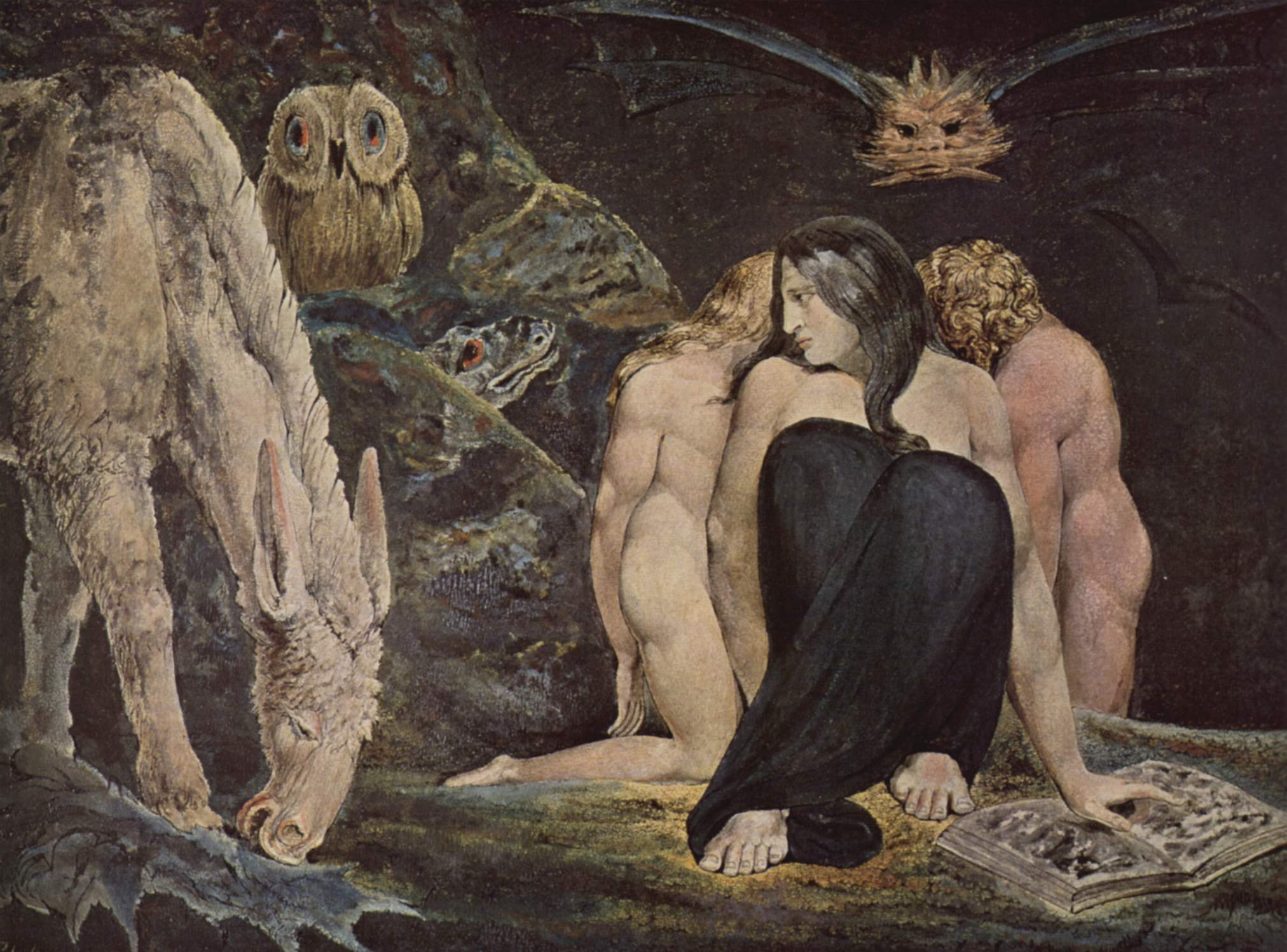
One of Blake's pictures which I find particularly archetypal is called 'Hecate or The Night of Enitharmon's Joy', c. 1795.

Tuesday, September 28, 2010

MARTHA & MARY

The biblical story of Mary and Martha presents two sisters who view life differently. Martha is the efficient housekeeper whose goal is to provide material comforts for her family and guests. When Jesus visits her and her sister Mary and her brother Lazarus, Martha has many duties in the kitchen and in serving her honored friend. Her sister Mary wishes only to enjoy Jesus' presence. Mary express the spiritual nature which can focus all its attention on things of the spirit neglecting outer interests and circumstances. Jesus accepted each sister for what she was and what she offered him. Martha could not recognize Mary's gifts; she wanted her sister to serve in the same way she herself did.

Luke 10
[38] Now it came to pass, as they went, that he entered into a certain village: and a certain woman named Martha received him into her house.
[39] And she had a sister called Mary, which also sat at Jesus' feet, and heard his word.
[40] But Martha was cumbered about much serving, and came to him, and said, Lord, dost thou not care that my sister hath left me to serve alone? bid her therefore that she help me.
[41] And Jesus answered and said unto her, Martha, Martha, thou art careful and troubled about many things:
[42] But one thing is needful: and Mary hath chosen that good part, which shall not be taken away from her.

Martha's complaint to Jesus that she was left alone to serve provoked Jesus' reply that, "Mary hath chosen that good part, which shall not be taken away from her." Jesus like Blake valued the spiritual nature which often went unexpressed while the material world absorbed the total attention.
Mary sits at Jesus' feet and meditates on his words while Martha holds a serving tray and questions Jesus' reaction to Mary's behavior. Blake, himself, was inclined to neglect worldly things when he heard the voice of prophetic imagination. I have no evidence that Jesus neglected worldly things but his mother and brothers may have thought he neglected family duties. (Mark 3: 31-34)

People who embark on the journey of psychological development often find themselves in a similar situation. Friends or family may resent the time and effort that is spent by an individual in looking inward to discern the dimensions and dynamics of the psyche.

When Blake was living at Felpham he was especially aware of the conflict between fulfilling the outer requirements of pleasing others and earning a living, and the inner requirement of living under the direction of his 'Messengers from Heaven'. It was impossible for Blake to reject the demands of the spirit in favor of 'Natural Fears or Natural Desires'. He resolved his conflict by determining to 'go on again with my Task Fearless' and forgo worldly wealth and success.

Letters, 24, Mr Butts, (E 424)
"I find on all hands great objections to my doing any thing but the meer
drudgery of business & intimations that if I do not confine
myself to this I shall not live. this has always pursud me. You
will understand by this the source of all my uneasiness This from
Johnson & Fuseli brought me down here & this from Mr H will
bring me back again for that I cannot live without doing my duty
to lay up treasures in heaven is Certain & Determined & to this I
have long made up my mind & why this should be made an objection
to Me while Drunkenness Lewdness Gluttony & even Idleness itself
does not hurt other men let Satan himself Explain--The Thing I
have most at Heart! more than life or all that seems to make life
comfortable without. Is the Interest of True Religion & Science
& whenever any thing appears to affect that Interest. (Especially
if I myself omit any duty to my [self] as a
Soldier of Christ) It gives me the greatest of torments, I am not
ashamed afraid or averse to tell You what Ought to be Told. That
I am under the direction of Messengers from Heaven Daily &
Nightly but the nature of such things is not as some suppose.
without trouble or care. Temptations are on the right hand &
left behind the sea of time & space roars & follows swiftly he
who keeps not right onward is lost & if our footsteps slide in
clay how can we do otherwise than fear & tremble. but I should
not have troubled You with this account of my spiritual state
unless it had been necessary in explaining the actual cause of my
uneasiness into which you are so kind as to Enquire for I never
obtrude such things on others unless questiond & then I never
disguise the truth--But if we fear to do the dictates of our
Angels & tremble at the Tasks set before us. if we refuse to do
Spiritual Acts. because of Natural Fears or Natural Desires! Who
can describe the dismal torments of such a state!--I too well
remember the Threats I heard!--If you who are organized by Divine
Providence for Spiritual communion. Refuse & bury your Talent in
the Earth even tho you should want Natural Bread. Sorrow &
Desperation pursues you thro life!"

In the wilderness Jesus too was tempted by Satan with success and power in the world and choose the course of following spiritual direction.

Monday, September 6, 2010

EMBRACE the SPECTRE

In Blake's system the root cause of the woes of the world is the division and dispute among the Zoas. Speaking psychologically, when the four aspects of the psyche - sensation, emotion, reason and intuition - are not in balance the individual has no internal or external harmony. When the functions compete for control instead of cooperating to express the identity, the dissension creates inhibition, dissatisfaction, projection, destructiveness and war. Blake saw his own psychological imbalance as a dispute between Urizen and Luvah with Los as a kind of referee. Without free expression of his emotions his work of imagination would be stifled. To manage his life in the world reason had to control a large part of his psyche. So he expressed this battle in his poetry.

Blake's struggle to be free of constraints that prevented his imaginative expression became externalized in his relationship with his patron Haley who sought to control Blake's freely following the inspiration to paint and write as his vision led. In working through his relationship with Haley, Blake faced his own Selfhood. He became aware that the cause of the dispute arose with himself.

Without explicitly stating the circumstances of his feud with Hayley or the resolution of it, Blake includes these phrases in a letter to Hayley indicating that he had worked through a dilemma which had vexed him for years.

Letter to Hayley
( E 757)
23 October 1804
"I thank God with entire confidence that
it shall be so no longer--he is become my servant who domineered
over me, he is even as a brother who was my enemy."

Relating an event such as he experienced in forgiving Hayley, Blake writes the following passage. Remember that the Selfhood is selfishness or self-centeredness and the Spectre is the rationalizing state.

Four Zoas, Night 7, Page 95, (E 367)
"Los embracd the Spectre first as a brother
Then as another Self; astonishd humanizing & in tears
In Self abasement Giving up his Domineering lust

Thou never canst embrace sweet Enitharmon terrible Demon. Till
Thou art united with thy Spectre Consummating by pains &
labours
That mortal body & by Self annihilation back returning
To Life Eternal be assurd I am thy real Self
Tho thus divided from thee & the Slave of Every passion
Of thy fierce Soul Unbar the Gates of Memory look upon me
Not as another but as thy real Self I am thy Spectre
Thou didst subdue me in old times by thy Immortal Strength
When I was a ravning hungring & thirsting cruel lust & murder
Tho horrible & Ghastly to thine Eyes tho buried beneath
The ruins of the Universe. hear what inspird I speak & be silent

If we unite in one[,] another better world will be
Opend within your heart & loins & wondrous brain
Threefold as it was in Eternity & this the fourth Universe
Will be Renewd by the three & consummated in Mental fires
But if thou dost refuse Another body will be prepared"

By embracing the Spectre, Los recognizes him as brother and an aspect of himself. In unifying with the Spectre he annihilated him as dark and destructive and accepted him into his real Self. The earlier attempt to subdue the Spectre by his strength had forced him further into the unconscious where he created more rivalries and dissension.

The act of embracing the Spectre, if undertaken, will reunite the Zoas and open the path to Eternity.

Friday, August 6, 2010

Origin of the Four Functions

Jung postulated four functions: two rational ones (thinking and feeling) and two irrational ones (intuition and sensation). On the surface an unlearned layman might wonder if he got them from Blake, whom he tells us that he had read extensively and admired. The Four Zoas bear a close resemblance to Jung's Four Functions. But the problem of the origin or source is more complex.

Both had access to much earlier sources and gathered them into their own understanding: Jung's psychology and Blake's poetic myth.

You may find much information about the functions in the Cube of Space.

Cornerstones of the Psyche treat fourness in a more comprehensive way.

Classical Elements shows this figure going back to the 18th century B.C.

The Bible spoke of the four living creatures: Ezekiel 1 and Revelation 4 and 5. I found 50 uses of four in Ezekiel, 13 in the first chapter.

Earth, Water, Air and Fire had various understanding during the past 38 centuries. These four elements are closely associated with Blake's four zoas: Urthona (Los in mortality) to Earth, Tharmas to Water, Urizen to Air, and Luvah to Fire.

You will find more discussion of the four Zoas in my Blake Primer. (In the Provisional Table of Contents click on Characters.)

The Four Zoas of course are central to Blake's myth and psychology. They apply equally to human beings and to the world, but much less so to the cosmos, which for Blake was unitary.

Sunday, July 11, 2010

JESUS & REPROBATES

Luke 7:44-47 - "Exactly," replied Jesus, and then turning to the woman, he said to Simon, "You can see this woman? I came into your house but you provided no water to wash my feet. But she has washed my feet with her tears and dried them with her hair. There was no warmth in your greeting, but she, from the moment I came in, has not stopped covering my feet with kisses. You gave me no oil for my head, but she has put perfume on my feet. That is why I tell you, Simon, that her sins, many as they are, are forgiven; for she has shown me so much love. But the man who has little to be forgiven has only a little love to give."

Of the three classes of men, the reprobate is the one Blake associated with Jesus.

Jerusalem, Plate 31 [35], (E 177)
"And the appearance of a Man was seen in the Furnaces;
Saving those who have sinned from the punishment of the Law,
(In pity of the punisher whose state is eternal death,)
And keeping them from Sin by the mild counsels of his love."

Here we have Jesus saving the reprobate (sinners) from punishment of the law, and thereby saving the elect (accusers) from administering punishment. The love of Jesus keeps both classes from sin. But a question remained: why were the innocent condemned for the guilty?

Milton, Plate 11 [12], (E 105)
"And it was enquir'd: Why in a Great Solemn Assembly
The Innocent should be condemn'd for the Guilty? Then an Eternal rose
Saying. If the Guilty should be condemn'd, he must be an Eternal Death
And one must die for another throughout all Eternity.
Satan is fall'n from his station & never can be redeem'd
But must be new created continually moment by moment
And therefore the Class of Satan shall be calld the Elect, & those
Of Rintrah. the Reprobate, & those of Palamabron the Redeem'd
For he is redeem'd from Satans Law, the wrath falling on Rintrah,
And therefore Palamabron dared not to call a solemn Assembly
Till Satan had assum'd Rintrahs wrath in the day of mourning
In a feminine delusion of false pride self-deciev'd."

The guilty in this case was Satan (the Elect) but the guilt fell upon Rintrah (the Reprobate). The representative of the Eternals answers that it is to avoid sending the guilty to Eternal Death.

Milton, Plate 7, (E 101)
"[Palamabron says] prophetic I behold
His future course thro' darkness and despair to eternal death
But we must not be tyrants also! he hath assum'd my place
For one whole day, under pretence of pity and love to me:
My horses hath he maddend! and my fellow servants injur'd:
How should he[,] he[,] know the duties of another? O foolish
forbearance
Would I had told Los, all my heart! but patience O my friends.
All may be well: silent remain, while I call Los and Satan."

Palamabron is confident that a solution will be found. The solution turns out to be that the Lamb of God take on the sin and guilt among the reprobates.

There Is No Natural Religion, (E 3)
"Therefore God becomes as we are, that we may be as he is"

Milton, Plate 13 [14], (E107)
"For then the Body of Death was perfected in hypocritic holiness,
Around the Lamb, a Female Tabernacle woven in Cathedrons Looms
He died as a Reprobate. he was Punish'd as a Transgressor!
Glory! Glory! Glory! to the Holy Lamb of God
I touch the heavens as an instrument to glorify the Lord!

The Elect shall meet the Redeem'd. on Albions rocks they shall meet
Astonish'd at the Transgressor, in him beholding the Saviour.
And the Elect shall say to the Redeemd. We behold it is of Divine
Mercy alone! of Free Gift and Election that we live.
Our Virtues & Cruel Goodnesses, have deserv'd Eternal Death.
Thus they weep upon the fatal Brook of Albions River."

The Body of death forms around the Lamb of God. The Elect and Redeemed are given to see the Savior in the Transgressor.

Milton, 32 [35], (E 132)
"Distinguish therefore States from Individuals in those States.
States Change: but Individual Identities never change nor cease:
You cannot go to Eternal Death in that which can never Die.
Satan & Adam are States Created into Twenty-seven Churches
And thou O Milton art a State about to be Created
Called Eternal Annihilation that none but the Living shall
Dare to enter: & they shall enter triumphant over Death
And Hell & the Grave! States that are not, but ah! Seem to be."

The Elect, Redeemed and Reprobates are not the true identities of man but states which can be terminated. The Individual Identity never dies.

Milton, Plate 14, (E 108)
"I in my Selfhood am that Satan: I am that Evil One!
He is my Spectre! in my obedience to loose him from my Hells
To claim the Hells, my Furnaces, I go to Eternal Death.

And Milton said. I go to Eternal Death! Eternity shudder'd
For he took the outside course, among the graves of the dead
A mournful shade. Eternity shudderd at the image of eternal death"

Recognizing the state as a psychological condition to which we ourselves give reality, we are in a position to forgive and annihilate it.

Milton, PLATE 38 [43],(E 139)
"Satan! my Spectre! I know my power thee to annihilate
And be a greater in thy place, & be thy Tabernacle
A covering for thee to do thy will, till one greater comes
And smites me as I smote thee & becomes my covering.
Such are the Laws of thy false Heavns! but Laws of Eternity
Are not such: know thou: I come to Self Annihilation
Such are the Laws of Eternity that each shall mutually
Annihilate himself for others good, as I for thee".

If the reprobate were not an inner reality in each man, Jesus, the God within, would have no cause to associate with him. If there were no darkness within man, there would not be no need for the light.
The Body of Able found by Adam and Eve - Cain Fleeing

Tuesday, June 29, 2010

SENSES SHRINK

An image that Blake uses for the Fall of Man (the division into duality or multiplicity), is presented in the limitation of man's sensory acuity. The senses of Eternity are flexible, expanding and contracting at will: their perceptions are infinite.

The Book of Urizen dramatizes the process of the infinite senses becoming the senses five that we recognize and enjoy today. It is not a happy sight to see the powers of Eternity being defined and limited into the narrow range of sight, sound, smell, and taste and touch to which we have access.

Book of Urizen, Plate 12, (E 76) ................Plate 13

"8. In harrowing fear rolling round;
His nervous brain shot branches
Round the branches of his heart.
On high into two little orbs
And fixed in two little eaves
Hiding carefully from the wind,
His Eyes beheld the deep,
And a third Age passed over:
And a state of dismal woe.

9. The pangs of hope began,
In heavy pain striving, struggling.
Two Ears in close volutions.
From beneath his orbs of vision
Shot spiring out and petrified
As they grew. And a fourth Age passed
And a state of dismal woe.

10. In ghastly torment sick;
Hanging upon the wind;

PLATE 13

Two Nostrils bent down to the deep.
And a fifth Age passed over;
And a state of dismal woe.

11. In ghastly torment sick;
Within his ribs bloated round,
A craving Hungry Cavern;
Thence arose his channeld Throat,
And like a red flame a Tongue
Of thirst & of hunger appeard.
And a sixth Age passed over:
And a state of dismal woe.

PLATE 22, (E 82)
The Senses inward rush'd shrinking,
Beneath the dark net of infection.

2. Till the shrunken eyes clouded over
Discernd not the woven hipocrisy
But the streaky slime in their heavens
Brought together by narrowing perceptions
Appeard transparent air; for their eyes
Grew small like the eyes of a man
And in reptile forms shrinking together"

The inability to perceive reality shows itself in man's forgetting Eternity from which he originated. This limits his ability to discern the possibility of living as he is meant to live. His limited perceptions further cloud his mind to the distorted conditions which he becomes satisfied with living under in the world he has made for himself.

Letter to Truxler, (E 702)
"As a man is So he Sees.
As the Eye is formed such are its Powers"

We are limited in what we see by who we are; likewise we are limited in who we are by what we see. In our present circumstances the distortions of our perceptions cause us to accept war, imprisonment, impoverishment, exploitation, and destruction of the environment. Likewise we are diminished in our self-perception by what we see is happening around us. Cleansing the windows of perception is a way to alter the direction in which we are heading. Blake has the journey to regeneration begin by Los recognizing himself in his enemy Urizen. Our return journey can begin with a recognition that we are creating the self-destructing world in our own image. Healing ourselves can heal our world.

Wednesday, June 16, 2010

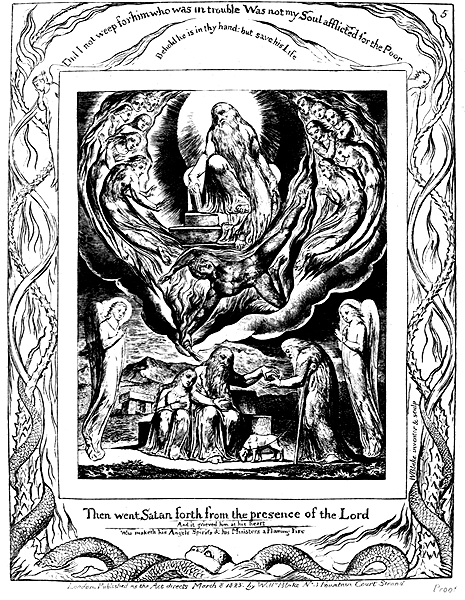
Job Picture 5

Above the picture we read:
"Did I not weep for him who was in trouble"
"Was not my God afflicted for the poor"
"Behold he is in thy hands but save his life"


His faith threatened by what the messenger had told him, Job attempts to demonstrate what a good Jew he is , pouring money into the hands of a less wealthy brother.

Meanwhile the middle layer of the picture shows Satan about to pour fire upon Job and 'get serious'-- the misfortunes to his children was one thing, bodily harm to himself is something else again.

In this picture Job (at the bottom) and God (at the top) bear a close resemblance. (Blake said something here of real significance: our image of God may be closer to our self image than to any objective idea of God ["Mental Things are alone Real; what is Calld Corporeal Nobody Knows of its dwelling Place; it is in Fallacy & its Existence an Imposture. Where is the Existence Out of Mind or Thought? Where is it but in the Mind of a Fool?" From VLJ (Erdman 565)]

(You might remember the same tired looking old man in the sky in Blake's masterwork called the Sea of Time and Space.)

The middle section of the picture shows a fiery Satan headed downward, about to rain fire upon the Earth. Edinger (p.27) points out that the two old men "have fallen into a neurasthenic state while Satan is in command of intense energies" (can you recall a moment when you might have been in a similar situation?). This indicates the fluctuating balance between psychic energy in the conscious and unconscious states-- like a pendulum swinging back and forth.

Under the influence of an explosion of the Unconscious we, like Blake's Job, may resort to illusory conventional activities. In just that manner we may ward off the Creative impulses coming to us from God, often thought to be from Old Harry, and we rest in the manacles of conventional mediocrity.

The captions under the picture read:
"Then went Satan forth from the presence of the Lord." (Job 2:7)
"And it grieved him at his heart" (Psalm 78:40?)

"Who maketh his Angels Spirits and his Mininsters a flaming fire" (Lamentations 2:3)

And below everything else can be seen a monstrous and evil-looking snake.