Showing posts with label Gates of Paradise. Show all posts

Wednesday, January 19, 2011

BUNYAN'S 'TRAVELLER'

A remarkable aspect of Norvig's book is the way she traces themes which appear in Blake's Bunyan illustrations through the work of his lifetime. This is prominent in the work she does in linking The Gates of Paradise with the Pilgrim illustrations. 'Gates' itself was evidence of the continuity of Blake's work stretching over decades.

The fact that Blake produced his images through engravings gave them an existence beyond the printed page; they also existed as copper plates. As Blake modified or developed his ideas, the printed images of the same plates could evolve with his thought. It has frequently been noted that the pages of his books were rearranged in various of the printings, or that additional pages were included. Also 'Minute Particulars' were added or emphasized or obscured according to the meaning he wished to convey at a particular time or to a particular audience. Norvig gives substance to the appearance of Blake's ideas as they resurfaced in unexpected places.

The Gates of Paradise initially printed with the prefix of For Children in 1793, was reissued in 1818 prefixed For the Sexes. Three additional plates were engraved with the Keys to the Gates and a final poem and image as an epilogue. This final plate Norvig sees as a link to the Bunyan illustrations which were produced in 1824. That is a period of 35 years over which Blake was communicating related ideas on the development of the psyche in the framework of the journey of a pilgrim (or 'traveller' as Blake called him).

Norvig states on Page 114 of
Dark Figures in the Desired Country: Blake's Illustrations to the Pilgrim's Progress:
"In this late revision of the emblem series, however, by alluding to Christian's identity scroll in The Pilgrim's Progress, the walking stick of the epilogue plate serves to emblemize the function of the eternal personality, which is shown to be basically at odds with those states of change we enter into and out of all the time, like sleep. The message is a terse development of the whole metaphysics of individuals versus states as Blake had refined in the years since his experiences at Felpham; and it is given expression in the poem accompanying the emblem in terms of the difference between "Man" and "Garment" - a difference that Satan (our own intrapsychic Accuser aspect) has not learned 'distinct to know.
"Once again, then we see Bunyan's image of the Christan mental Traveler linked by Blake with his own system of imaginal representation with which the concept of individuation via the route of differentiating self from "state," from his garment, permanent identity from temporary condition, the "Eternal Human" from "those States or Worlds in which the Spirit travels." (J 49).

Jerusalem , Plate 49, (E 198)
"Satan is the State of Death, & not a Human existence:
But Luvah is named Satan, because he has enterd that State.
A World where Man is by Nature the enemy of Man
Because the Evil is Created into a State. that Men
May be deliverd time after time evermore. Amen.
Learn therefore O Sisters to distinguish the Eternal Human
That walks about among the stones of fire in bliss & woe
Alternate! from those States or Worlds in which the Spirit
travels:
This is the only means to Forgiveness of Enemies[.]"


In this picture Christian has recovered his lost identity scroll which will allow him passage into heaven. Norvig sees Christian "retrieving his testament of selfhood from the zone of the state of grace (the arbor) so that it can serve him in the forward journey through all other states." (Page 177)


CHRISTIAN AT THE ARBOR
Plate 17

Sunday, December 26, 2010

BLAKE BIO

Michael Bedard has written a biography of William Blake which is directed to young adults. Although it is easy to read, it is thorough and reliable. He titled it William Blake: The Gates of Paradise and he organized it around the plates in Blake's poem of that title. He follows Blake's life by using an image from Gates of Paradise (which was originally addressed 'For Children') as a preface to each chapter of the book.

Chapter Six titled Lambeth: The Figure on the Stairs uses Plate 8 showing the infant emerging from the egg, captioned "At Length for Hatching Ripe He Breaks the Shell." The text deals with the economic and social situation which was disrupting the lives of the people through industrialization in Blake's day. Of the vision of the figure on the stairs Bedard says: "Perhaps the grim figure on the staircase hailed from the dark world that occupied Blake's mind so much at that time. For now he was busy putting together the poems that would depict the contrary state to the joyful vision of Songs of Innocence."

The cost of the book was kept down by not using color illustrations, but the pictures are numerous and well chosen. The book is indexed, contains source notes and a bibliography. Bedard's book is an ideal introduction to Blake for anyone not acquainted with the rigors of the life of one whose imagination belied his outward circumstances.

Tuesday, October 5, 2010

EARLY INTERPRETERS

Alexander Gilchrist wrote the first book on William Blake and his work, Life and Works of William Blake. After Gilchrist's book was published in 1863, interest in Blake began to develop. Algernon Charles Swinburne wrote in 1868, William Blake: A Critical Essay.

Swinburne, poet that he was, wrote his book length essay on William Blake in poetic language evoking emotions and calling on the intuition to assimilate the images presented. Here is his account of the beginning of Gates of Paradise
(Page 19-23):

"In the first plate of the 'Gates of Paradise,' the woman finds the child under a tree, sprung of the earth like a mandrake, which he who plucks up and hears groan must go mad or die; grown under the tree of physical life, which is rooted in death, and the leaf of it is poisonous, and it bears as fruit the wisdom of the serpent, moral reason or rational truth, which invents the names of virtue and vice, and divides moral life into good and evil. Out of earth is rent violently forth the child of dust and clay, naked, wide-eyed, shrieking ; the woman bends down to gather him as a flower, half blind with fierce surprise and eagerness, half smiling with foolish love and pitiful pleasure ; with one hand she holds other children, small and new-blown also as flowers, huddled in the lap of her garment; with the other she plucks him up by the hair, regardless of his deadly shriek and convulsed arms, heedless that this uprooting of the mandrake is the seal of her own death also.

"Then follow symbols of the four created elements from which the corporeal man is made; the water, blind and mutable as doting age, emblem of ignorant doubt and moral jealousy ; the heavy melancholy earth, grievous to life, oppressive of the spirit, type of all sorrows and tyrannies that are brought forth upon it, saddest of all the elements, tightest as a curb and painfullest as a load upon the soul: then the air wherein man is naked, the fire wherein man is blind; ashamed and afraid of his own nature and its nakedness, surrounded with similitudes of severance and strife:...

"In these first six plates is the kernel of the book ; round these the subsecpient symbols revolve, and toward these converge. The seventh we may assume to be an emblem of desire as it is upon earth, blind and wild, glad and sad, destroying the pleasures it catches hold of, losing those it lets go. One Love, a moth-like spirit, lies crushed at the feet of the boy who pursues another, flinging his cap towards it as though to trap a butterfly; startled with the laugh of triumphant capture even at his lips, as the wingless flying thing eludes him and soars beyond the enclosure of summer leaves and stems toward upper air and cloud."

Blake expresses some of above sentiments about fleeting joys in this poem from his notebook (E 470) except those who release joys in this poem experience a higher level of existence:

Eternity

"He who binds to himself a joy
Does the winged life destroy
But he who kisses the joy as it flies
Lives in eternity's sun rise"


Swinburne wrote 5 years after the Gilchrist biography was published, 41 years after Blake's death, and he wrote with the enthusiasm of a convert.

You can read Gilchrist's biography and Swinburne essays as Google books on your computer. Gilchrist's book is also available as a text document.

Here is Joseph Viscomi comments on the Gilchrist Life.

To learn more about Gilchrist and his book read on Wiki:
Alexander Gilchrist
Gilchrist's book
Volume II Blake's writings
Versions of Gilchrist's Book

Saturday, May 29, 2010

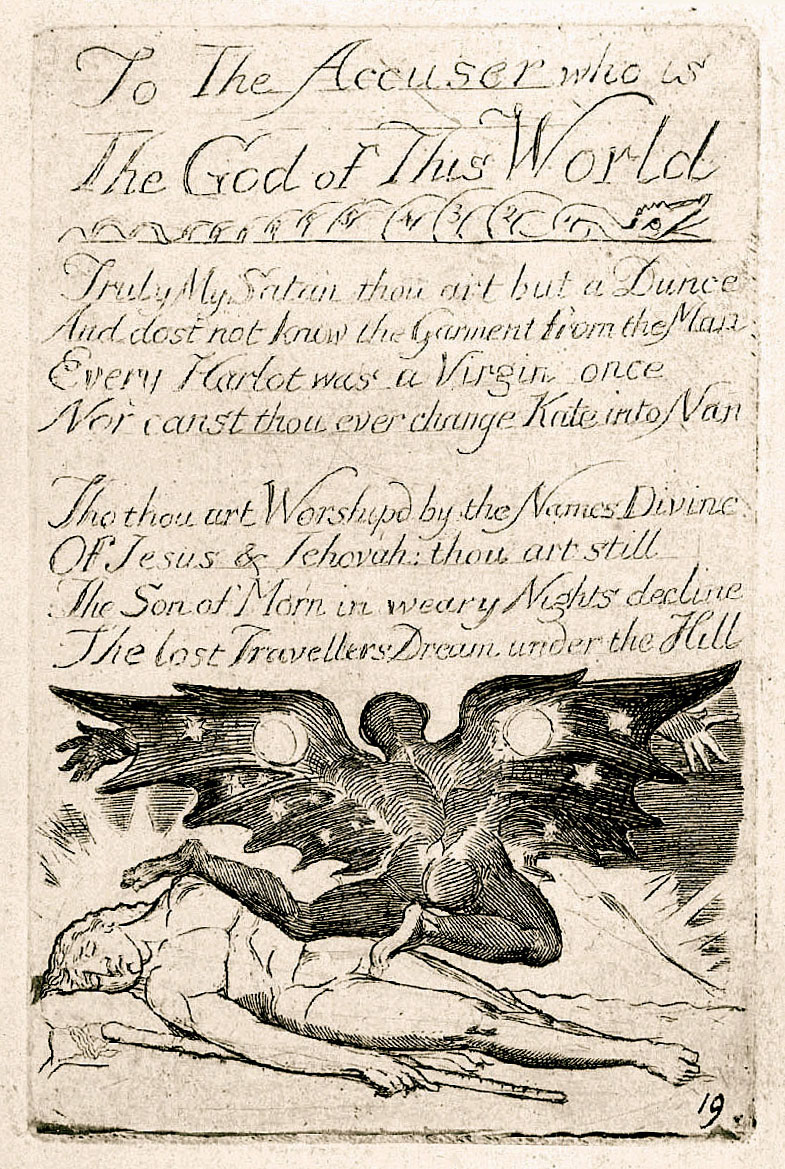
Gates of Paradise Epilogue

"To the Accuser who is
The God of this World."

There are two stanzas:

1. "Truly My Satan thou art but a Dunce
And dost not know the Garment from the Man
Every Harlot was a Virgin once
Nor canst thou ever change Kate into Nan."

Digby, p 52: "The individual, says Blake, is not the same as the state in which he is, in the course of experience, as he puts on or changes his clothes."
We wear many garments, some good, some not so good; in a lifetime of experience you can be sure there are many garments in your life. In a day you may pass through several states: one when you get up in the morning, another one after you're left home for the day, another when you get to your workplace at 8 or so, an entirely different state at 4 o'clock, etc. etc.

A book called Our Many Selves (that you can buy for $1.37) shows clearly how our states change as our environment changes. For example you were a very different man at twenty than you are at forty, perhaps sadder and wiser.

"What is the price of Experience? do men

buy it for a song?

Or wisdom for a dance in the street? No it

is bought with the price of all that a

man hath, his house his wife his children.

Wisdom is sold in the desolate market where none come
to buy
And in the witherd field where
the farmer plows for bread in vain"
(A portion of Enion's Lament in Night two of The Four Zoas - Erdman 325)

We have many selves, some of us of course more than others, or less than others.But Christ's aim, and Blake's, is that we might become One. That doesn't mean
identical like lemmings; no! something very different.


Stanza 2. "Tho' thou art Worship'd by the Names Divine
of Jesus and Jehovah thou art still
The Son of Morn in weary Night's decline
The lost Traveller's Dream under the Hill."

Paul wrote, " Satan himself is transformed into an angel of light." (II Corinthians 11:14). Within two centuries of the crucifixion of Jesus Christianity became a worldly establishment, under the control of worldly rulers, the primary agents of the God of this world. Blake lived with that insight from a very early age (like the child Jung, who showed the same insight with his dream of the monstrous turd falling on the cathedral.)

Blake knew like Paul that "the name of God is blasphemed among the Gentiles [pagans] because of you". (Romans 2) It's always one or the other who gets our worship: God or Satan.

We project our own image and call it God. But it isn't God (who is indescribable); it's our Spectre. What we think to be the primary good proves to be the bat-like figure Blake made for the last picture.


There you see the "
The lost Traveller's Dream under the Hill." As for the Son of Morn, that comes from Isaiah 13: "How art thou fallen from heaven, O Lucifer, son of the morning!"

In Symbol and Image in William Blake by George Wingfield Digby, he concludes his survey of The Gates of Paradise (page 53) with this pungent comment:

"The person who can attain an insight into this image of himself will know the source of his greatest illusion and bondage." -- and lo, the mind-forg'd manacles will fall away, and we will walk out of Plato's Cave and live at peace with God and Man.

Thursday, May 27, 2010

Gates of Paradise Picture 16

We're approaching the end of Gates of Paradise. After the end of a life there's a beginning. Here we have generation; birth and death are simultaneous. We see Mother Earth with the worm, symbol of mortality (and of many other things as well).

Here are the couplets for the (almost) last image:
"16. Thou'rt my Mother, from the womb;
Wife, Sister, Daughter, to the tomb;
Weaving to dreams the Sexual strife,
And weeping over the Web of Life."

To understand this picture we need some familiarity with Blake's use of sex in his myths. It goes back to the earliest literature of our culture, when the sky God was dominant and active while the Earth (Mother) God is passive, receptive, the yin to God's yang.

Digby, page 50: "The realm of the female goddess, the dark, conditioned, Yin side of life, is by itself a place of weeping, of strife, of illusion. It has to be redeemed by its opposite, the contrary state, the light, formative, Apollonian, or Yang side. The ignorant man [the sinner] wanders away into the realm of the Mother, and the farther he goes the more hopeless his lot becomes."

In the Bible such a man was Achan, described in Josahua 7. He had stolen plunder from a battle of Joshua's army for Canaan, the spoils of war, supposed to be belong to God; as a consequence Achan suffered a terrible fate. Blake created a terrible image for this state in Jerusalem plate 25 (Erdman 170-1)

The Valley of Achor became a symbol of failure, of sin, suffering, like a nest of robbers, expressed by the "terrible image" of Plate 25. But we learn from Hosea that there was redemption. Chapter Two portrays the reality of the valley of Achor, but shows a redemptive outlook (beginning with verse 13). Blake was very familiar with the Valley of Achor as it's described in Joshua and in Hosea. In it the ignorant man, the fallen woman suffers, but receives forgiveness and becomes a "door of hope".

This little picture, created by Blake in 1794, was elaborated in the next 20 years into thousands of lines of poetry about female love and eventual redemption.

Sunday, May 23, 2010

Gates of Paradise Picture 15

15 The Door of Death I open found
And the Worm Weaving in the Ground


Why must this gloomy picture succeed the last one?


As Blake wrote in Jerusalem, Plate 3:

"Reader! [lover] of books! [lover] of heaven,And of that God from whom [all books are given,]
Who in mysterious Sinais awful cave
To Man the wond'rous art of writing gave,
Again he speaks in thunder and in fire!
Thunder of Thought, & flames of fierce desire:
Even from the depths of Hell his voice I hear,
Within the unfathomd caverns of my Ear.
Therefore I print; nor vain my types shall be:
Heaven, Earth & Hell, henceforth shall live in
harmony"

In Eternity the contraries unite; Digby p. 49 suggests that these two pictures (14 and 15), so different in aspect, are the two contraries married in Eternity. In 1st Peter 3:18-19 we're told that "Christ also once suffered for sins, the just for the unjust, that he might bring us to God...by which also he went and preached unto the spirits in prison."

Jung spoke of the
Mysterium Coniunctionis ("mysterious conjunction"): the final alchemical synthesis (for Jung, of ego and unconscious, matter and spirit, male and female) that brings forth the Philosopher's Stone (the Self). Its highest aspect, as for alchemist Gerard Dorn, was the unus mundus, a unification of the Stone with body, soul, and spirit" (the marriage if you will).

Digby shows us how Blake expressed this union of opposites in his poem, Milton: John Milton is in Heaven, but he has left "unresolved problems exemplified in three quarrelsome wives and daughters" (page 49), (his Selfhood was not entirely annihilated).
"He took off the robe of the promise and the girdle of
the oath of God
,
and Milton said, I go to Eternal Death! The Nations still
Follow after the detestable Gods of Priam; in pomp
Of warlike selfhood, contradicting and blaspheming.
When will the Resurrection come; to deliver the sleeping body From corruptibility: O when Lord Jesus wilt thou come? Tarry no longer; for my soul lies at the gates of death.
I will arise and look forth for the morning of the grave.
I will go down to the sepulcher to see if morning breaks!
I will go down to self annihilation and eternal death,
Lest the Last Judgment come & find me unannihilate
And I be siez'd & giv'n into the hands of my own

Selfhood" (Milton, plate 15, Erdman p. 108)


Long, long ago Isaiah was written (or edited); looking at the book as a whole you may perceive something like these two pictures in Gates of Paradise. Isaiah is written with a rapid alternation between wrath (judgment) and grace (The Promise).
So we find Isaiah, Blake, "Milton", Jung, alchemy: all
agree in the Eternal union of the temporal opposites. Our
Poet tried to express this fundamental truth of life("joy and
woe are woven fin
e....the babe is more than swadling bands".
When you've met the immortal man, you're armed with light,
like the man in picture 14, to deal with the cross we all bear.
You've experienced the Marriage.

Friday, May 21, 2010

Gates of Paradise Picture 14


The couplets of this picture and the last one go so closely together that I've posted them here:

"13. But when once I did descry
The Immortal Man that cannot die,

14. Thro' evening shades I haste away
To close the labours of my day."


You have met Christ; you are saved; but there is still much to do. What is the chief labor of our day? to annihilate the Selhood? yes, that goes on ceaselessly; at least it has for me. The groves, the shadows, the "mind forg'd manacles" have to be cleared away one by one. Paul said "work out your own salvation with fear and trembling, for it is God which worketh in you both to will and to do of his good pleasure" (Philippians 2:12-13). All this is "the labors of my day".
(And what God is this that Paul speaks of? Why the God within of course, that of God in you. That was Blake's God.)

That's the work of Los, the Imagination, the 'Zoa' with whom Blake was most closely identified. Like Jeremiah he was called to build up and tear down. How many things did Edison have to try before he got the incandescent light? He learned to work continually and snatch a moment of sleep while one of his experiments was cooking. Such was Los; such was Blake.

Digby page 48: The Traveler "hastens to conclude the labors of his day; that is, the concerns that were so important for him...now appear to him as delusions to which he had been quite wrongly subservient. He has a new sense of direction and a new sense of his rightful task as a man."

If we look at Homer's myth, we see that it took many years for Odysseus to return from the escapades of the Trojan adventures. But finally having experienced about everything that could happen to a man, he escaped from the sea of time and space (with the help of the sea goddess, Eno), and was directed upward into the Eternal realm.

Wednesday, May 19, 2010

Gates of Paradise Picture 13


(It's actuallly 15.) The inscription is Fear and Hope are--Vision. Digby (p 47) speaks of the relativity of everything, especially mental values. "Without Contraries is no progression. Attraction and Repulsion, Reason and Energy, Love and Hate, are necessary to Human existence" (Marriage of Heaven and Hell, Plate 3. Erdman 34). But before he wrote that here is this verse (a complete mystification to the novice!) "Now is the dominion of Edom, & the return of Adam into Paradise; see Isaiah XXXIV & XXXV Chap"; (It would certainly help to read Isaiah 34 and 35).

You could call 34 "the day of the Lord's vengeance" and 35 "the new Jerusalem" (Blake called it "the return of Adam (us) into Paradise"). In the picture Blake has called them Hope and Fear.

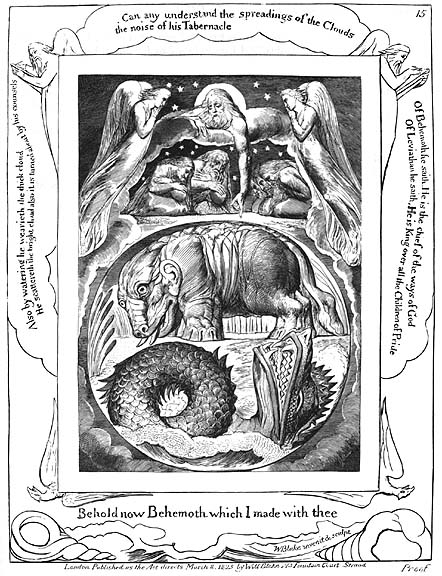
"Vision, or imagination gives insight into the positive and negative aspects of life... it sees the limits of things, and therefore it is the great unifier." Digby then refers us to Blake's Illustrations of the Book of Job (Plate 15) "Behold now Behemoth which I made with thee": Blake is quoting here Job 40:15, which goes on to say "he eateth grass as an ox."

This picture (15 of Gates of Paradise) kind of sums up all that has gone before. When we resort to (or achieve) Vision (which I identify as the intuitive faculty exemplified by Blake's Los), then Good and Evil, Love and Hate, Beautiful and Ghastly, White and Black, Heaven and Hell take on a New Light. The course of life, or the journey through life begin to hold greater meaning for us.

It also gives new insight into the meaning of what Blake was trying to say in The Marriage of Heaven and Hell, which ends with the magnificent aphorism "Everything that lives is holy";
in The Four Zoas (Night the Second) he amplified it like this
"for the source of life Descends to be a weeping babe" (Oh Wow!)

Monday, May 17, 2010

Gates of Paradise Picture 12

The couplet reads:
"And in the depts of my Dungeons
Closed the Fathers and the Sons."

Picture 12 inspires considerable thought: who are these people? we might suppose the old man is the inevitable Urizen or perhaps the God of Genesis 3. They seem to be in some enclosure like a prison cell. You might imagine that the two figures in the foreground could represent Adam and Eve, and perhaps the shape they were in right after the 'apple eating' incident.

Following that theme the remarkable thing is that God is in the same place as his two subjects. How could that be? It could never be that for a transcendent God, but Blake gave little or no thought to such a thing; In Marriage of Heaven and Hell, adapting the sobriquet of a devil he had this to say:
"The worship of God is: Honouring his gifts in other men, each according to his genius, and loving the greatest men best: those who envy or calumniate great men hate God; for there is no other God. "And in Jerusalem he wrote, "There is no other God than that God who is the intellectual fountain of Humanity". Many Quakers speak of "that of God" in you and me (called an immanent God), and that is pretty much Blake's God as well.

The theme and a very similar picture are found in Plate 16 of MHH where Blake states that "God only Acts & Is, in existing beings or Men."

These pictures describe the fate of those "caught in the toils of the world [who, poor men] fail to to develop or allow the expression of the divine spark within" (Digby 46).

Beneath the picture you might be able to read:
"Does thy God O Priest take such vengeance as this?"

Thy God O Priest! You might hark back to what Blake said about priests in MHH (Plate 11):
"Till a system was formed, which some took advantage of & enslav'd the vulgar by attempting to realize or abstract the mental deities from their objects: thus began Priesthood. Choosing forms of worship from poetic tales. And at length they pronounced that the Gods had orderd such things. Thus men forgot that All deities reside in the human breast"
,which happened to those trusting (in priests) souls seen in this picture.